

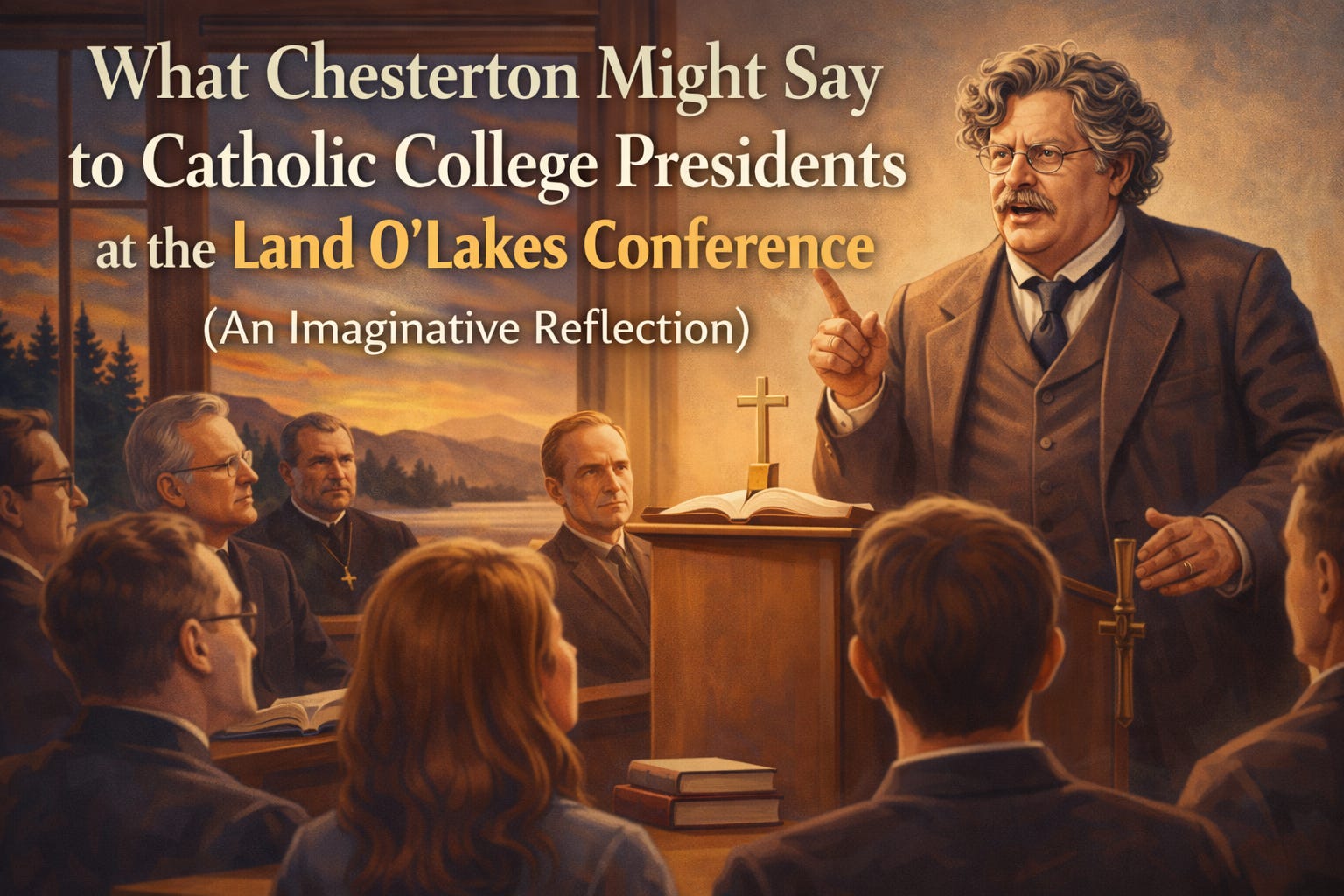
Editor’s Note:
The following essay is an imaginative reflection written in the voice and spirit of G.K. Chesterton. It is not a historical document, nor does it claim to represent words Chesterton ever wrote or spoke. It is offered as a literary meditation—using Chesterton’s characteristic paradox and moral clarity—to reflect on enduring questions surrounding Catholic higher education.
Gentlemen,
I should like to begin by congratulating you on your courage. It is no small thing to gather together by a lake in Wisconsin and declare yourselves free. Many men have done far less in far warmer places and have still written manifestos about it.
But courage, like freedom, is a thing whose usefulness depends very much on the direction in which it is used.
You have assembled, I am told, to speak of the Catholic university. This is already a hopeful sign, for the modern world has a habit of holding conferences about everything except the thing named in the title. One may attend a Congress on Marriage at which marriage is treated as a regrettable biological accident, or a Symposium on Peace at which peace is explained as an interval between wars. I am relieved to hear that you still wish to speak of Catholicism while calling your institutions Catholic.
And yet—if you will forgive a stranger who has come late to the meeting—I cannot help noticing that you speak of Catholicism in much the same tone that a man might speak of an heirloom: something handsome, inherited, and best kept safely behind glass.
You have announced, with admirable clarity, that the Catholic university must possess autonomy and academic freedom “in the face of authority of whatever kind, lay or clerical.” This sentence is so firm, so ringing, and so final that it deserves to be engraved on bronze—if only so that future generations may ask what precisely it was being freed from.
For authority, gentlemen, is a curious thing. It is rather like gravity: invisible, often annoying, but the very condition that allows anything to stand upright at all. One does not abolish gravity in order to improve architecture; one merely ends by building floating ruins.
The Church, you see, is not an obstacle placed in the path of truth. She is the road on which truth learned how to walk. It was the Church who taught Europe to argue precisely so that Europe might argue about her. To declare independence from her in the name of inquiry is a little like a child declaring independence from his mother in the name of learning how to speak.
You insist—again, with sincerity—that theology must remain present, even honored, within the Catholic university. This is reassuring, in the way it is reassuring to be told that the king will be allowed to remain in the palace—provided he does not interfere with government.
But theology, like philosophy, is a jealous guest. It cannot remain content forever as a decorative department, politely invited to interdisciplinary dinners and then ushered back to its corner. If it is true, it will insist on being central. If it is false, it will insist on being harmless. And the modern university has shown itself very skilled at converting dangerous truths into harmless electives.
You speak often of dialogue, and here I am entirely with you. Dialogue is a fine thing—so long as the participants believe that something can actually be said. But there is a modern sort of dialogue which resembles two men politely bowing to one another while carefully agreeing never to touch. That is not dialogue; it is mutual disarmament.
A Catholic university does not exist in order to ask whether Catholicism is allowed. It exists because Catholicism is true. If that fact is treated as an embarrassment, the embarrassment will not long remain confined to theology departments. It will spread, as embarrassments do, until the institution begins apologizing for its own existence.
You have rightly insisted that the university must serve as the “critical reflective intelligence” of the Church. This is an excellent phrase. But intelligence, like criticism, depends very much on love. A man who criticizes his mother because he hates her is called a cad. A man who criticizes her because he loves her is called a son.
The danger of your position, gentlemen, is not that you will criticize the Church too much. The danger is that you will eventually criticize her as something other than your mother—as one institution among many, one tradition among several, one voice in a faculty meeting that can always be outvoted.
And when that happens, the Catholic university will not become more universal. It will become more provincial. It will not join the modern world; it will merely imitate it—badly and belatedly.
For the modern secular university already exists, and it does not need your help. It has buildings, endowments, journals, grants, and reputations. What it does not have is a soul. And if the Catholic university forgets that it exists to supply precisely that deficiency, then it will discover too late that it has given away the only thing that made it worth defending.
Freedom is a magnificent thing. But freedom is not the absence of form; it is the right form rightly embraced. A bird is free not because it denies the air, but because it trusts it.
The Church is not the enemy of your freedom. She is the atmosphere in which your freedom first learned how to fly.
Yours,
A Friendly Englishman Who Believes in Paradox