

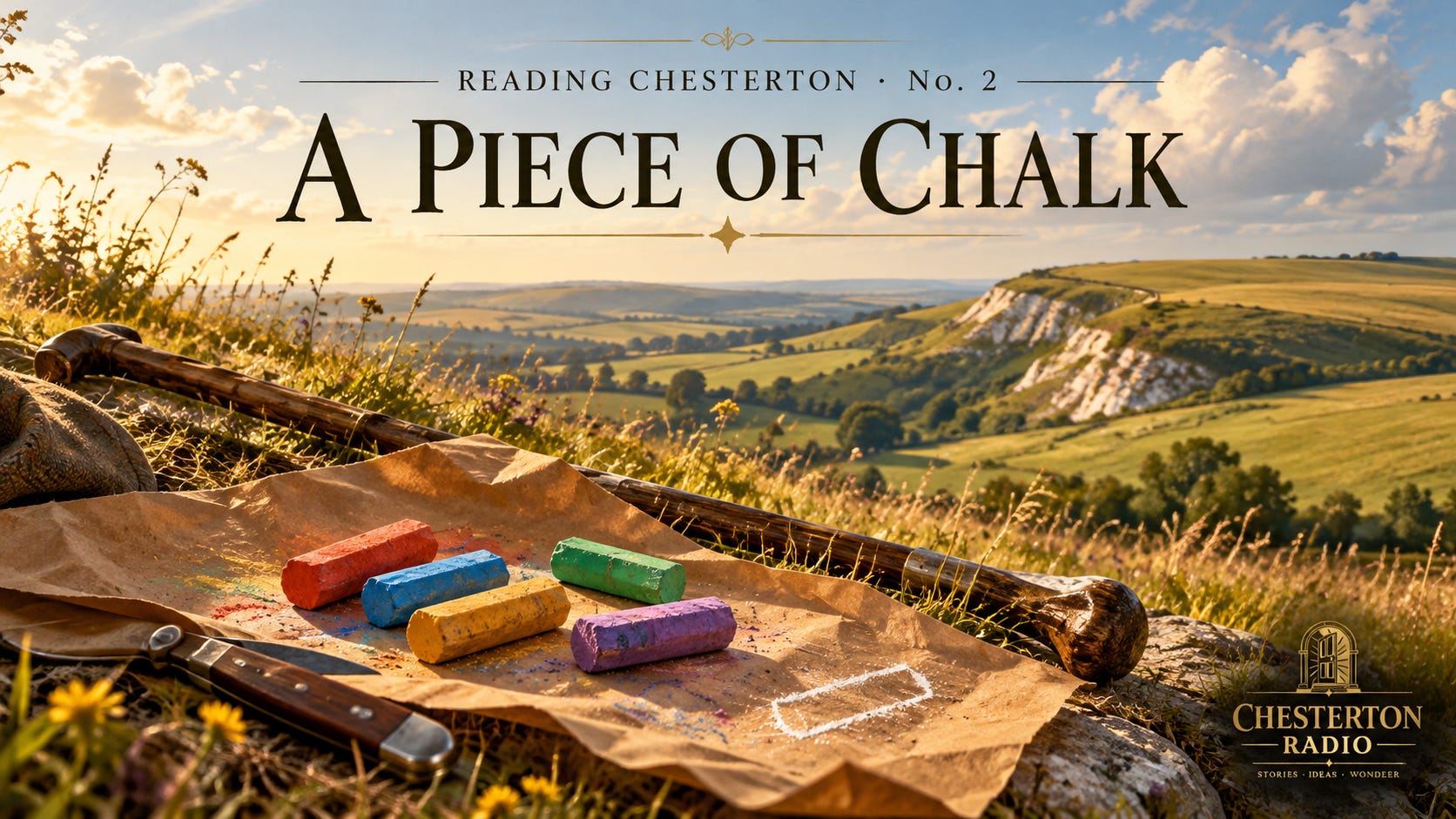
A summer walk, a sheet of brown paper, six colored chalks—and one missing color. Chesterton begins with almost nothing and ends by discovering an entire philosophy of goodness, imagination, and wonder in the English earth beneath him.
A Piece of Chalk
From Tremendous Trifles (1909)
G. K. Chesterton
Why We’re Reading It
Yesterday, in “The Ethics of Elfland,” Chesterton asked us to entertain the possibility that the world is much stranger than we have allowed ourselves to notice.
Today he goes for a walk.
That is one of the pleasures of reading Chesterton over time. He can make his case with philosophy, fairy tales, theology, paradox—and then make much the same case with a pocketknife, a sheet of brown paper, a cow, and six pieces of colored chalk.
“A Piece of Chalk” comes from Tremendous Trifles, Chesterton’s 1909 collection devoted largely to the proposition that the supposedly trivial things around us cease to be trivial the moment we actually look at them. The essay begins on a splendid summer morning in Sussex. Chesterton wants to draw. He has colored chalks. He needs brown paper. This modest expedition soon wanders through art, landscape, poetry, morality, Christianity, and the peculiar human habit of overlooking precisely what is nearest to us.
But we should not get ahead of him.
The pleasure of this essay is watching Chesterton discover his argument while apparently doing something else.
So put a few bright-colored chalks in your pocket, find a sheet of brown paper, and follow him out onto the downs.
And now, Chesterton.
A Piece of Chalk
I remember one splendid morning, all blue and silver, in the summer holidays when I reluctantly tore myself away from the task of doing nothing in particular, and put on a hat of some sort and picked up a walking-stick, and put six very bright-coloured chalks in my pocket. I then went into the kitchen (which, along with the rest of the house, belonged to a very square and sensible old woman in a Sussex village), and asked the owner and occupant of the kitchen if she had any brown paper.
She had a great deal; in fact, she had too much; and she mistook the purpose and the rationale of the existence of brown paper. She seemed to have an idea that if a person wanted brown paper he must be wanting to tie up parcels; which was the last thing I wanted to do; indeed, it is a thing which I have found to be beyond my mental capacity. Hence she dwelt very much on the varying qualities of toughness and endurance in the material.
I explained to her that I only wanted to draw pictures on it, and that I did not want them to endure in the least; and that from my point of view, therefore, it was a question, not of tough consistency, but of responsive surface, a thing comparatively irrelevant in a parcel. When she understood that I wanted to draw she offered to overwhelm me with note-paper, apparently supposing that I did my notes and correspondence on old brown paper wrappers from motives of economy.
I then tried to explain the rather delicate logical shade, that I not only liked brown paper, but liked the quality of brownness in paper, just as I liked the quality of brownness in October woods, or in beer, or in the peat-streams of the North. Brown paper represents the primal twilight of the first toil of creation, and with a bright-coloured chalk or two you can pick out points of fire in it, sparks of gold, and blood-red, and sea-green, like the first fierce stars that sprang out of divine darkness.
All this I said (in an off-hand way) to the old woman; and I put the brown paper in my pocket along with the chalks, and possibly other things. I suppose every one must have reflected how primeval and how poetical are the things that one carries in one’s pocket; the pocket-knife, for instance, the type of all human tools, the infant of the sword. Once I planned to write a book of poems entirely about the things in my pockets. But I found it would be too long; and the age of the great epics is past.
.....
With my stick and my knife, my chalks and my brown paper, I went out on to the great downs. I crawled across those colossal contours that express the best quality of England, because they are at the same time soft and strong. The smoothness of them has the same meaning as the smoothness of great cart-horses, or the smoothness of the beech-tree; it declares in the teeth of our timid and cruel theories that the mighty are merciful.
As my eye swept the landscape, the landscape was as kindly as any of its cottages, but for power it was like an earthquake. The villages in the immense valley were safe, one could see, for centuries; yet the lifting of the whole land was like the lifting of one enormous wave to wash them all away.
I crossed one swell of living turf after another, looking for a place to sit down and draw. Do not, for heaven’s sake, imagine I was going to sketch from Nature. I was going to draw devils and seraphim, and blind old gods that men worshipped before the dawn of right, and saints in robes of angry crimson, and seas of strange green, and all the sacred or monstrous symbols that look so well in bright colours on brown paper. They are much better worth drawing than Nature; also they are much easier to draw.
When a cow came slouching by in the field next to me, a mere artist might have drawn it; but I always get wrong in the hind legs of quadrupeds. So I drew the soul of the cow; which I saw there plainly walking before me in the sunlight; and the soul was all purple and silver, and had seven horns and the mystery that belongs to all the beasts. But though I could not with a crayon get the best out of the landscape, it does not follow that the landscape was not getting the best out of me.
And this, I think, is the mistake that people make about the old poets who lived before Wordsworth, and were supposed not to care very much about Nature because they did not describe it much.
They preferred writing about great men to writing about great hills; but they sat on the great hills to write it. They gave out much less about Nature, but they drank in, perhaps, much more. They painted the white robes of their holy virgins with the blinding snow, at which they had stared all day. They blazoned the shields of their paladins with the purple and gold of many heraldic sunsets. The greenness of a thousand green leaves clustered into the live green figure of Robin Hood.
The blueness of a score of forgotten skies became the blue robes of the Virgin. The inspiration went in like sunbeams and came out like Apollo.
.....
But as I sat scrawling these silly figures on the brown paper, it began to dawn on me, to my great disgust, that I had left one chalk, and that a most exquisite and essential chalk, behind. I searched all my pockets, but I could not find any white chalk. Now, those who are acquainted with all the philosophy (nay, religion) which is typified in the art of drawing on brown paper, know that white is positive and essential. I cannot avoid remarking here upon a moral significance.
One of the wise and awful truths which this brown-paper art reveals, is this, that white is a colour. It is not a mere absence of colour; it is a shining and affirmative thing, as fierce as red, as definite as black. When, so to speak, your pencil grows red-hot, it draws roses; when it grows white-hot, it draws stars.
And one of the two or three defiant verities of the best religious morality, of real Christianity, for example, is exactly this same thing; the chief assertion of religious morality is that white is a colour. Virtue is not the absence of vices or the avoidance of moral dangers; virtue is a vivid and separate thing, like pain or a particular smell.
Mercy does not mean not being cruel or sparing people revenge or punishment; it means a plain and positive thing like the sun, which one has either seen or not seen.
Chastity does not mean abstention from sexual wrong; it means something flaming, like Joan of Arc. In a word, God paints in many colours; but He never paints so gorgeously, I had almost said so gaudily, as when He paints in white. In a sense our age has realised this fact, and expressed it in our sullen costume.
For if it were really true that white was a blank and colourless thing, negative and non-committal, then white would be used instead of black and grey for the funeral dress of this pessimistic period. We should see city gentlemen in frock coats of spotless silver linen, with top hats as white as wonderful arum lilies. Which is not the case.
Meanwhile, I could not find my chalk.
.....
I sat on the hill in a sort of despair. There was no town nearer than Chichester at which it was even remotely probable that there would be such a thing as an artist’s colourman. And yet, without white, my absurd little pictures would be as pointless as the world would be if there were no good people in it. I stared stupidly round, racking my brain for expedients. Then I suddenly stood up and roared with laughter, again and again, so that the cows stared at me and called a committee.
Imagine a man in the Sahara regretting that he had no sand for his hour-glass. Imagine a gentleman in mid-ocean wishing that he had brought some salt water with him for his chemical experiments. I was sitting on an immense warehouse of white chalk. The landscape was made entirely out of white chalk. White chalk was piled more miles until it met the sky. I stooped and broke a piece off the rock I sat on; it did not mark so well as the shop chalks do; but it gave the effect.
And I stood there in a trance of pleasure, realising that this Southern England is not only a grand peninsula, and a tradition and a civilisation; it is something even more admirable. It is a piece of chalk.
The Color of Goodness
A Chesterton Radio Companion to “A Piece of Chalk”
There is something almost suspicious about an essay that begins with brown wrapping paper and ends with a theory of Christian virtue.
With Chesterton, however, this is not a detour. It is the road.
He rarely seems content to begin with an abstraction if there is a teapot, lamppost, pocketknife, railway platform, piece of cheese, or sheet of brown paper available. The ordinary object is not merely an illustration of the idea. Very often it is where the idea has been hiding.
That is what happens here.
Chesterton wants brown paper because he likes brownness. The practical old woman sees packaging material. Chesterton sees “the primal twilight of the first toil of creation.”
Both are looking at the same paper.
That difference may contain much of Chesterton.
The sensible explanation of brown paper is that it wraps parcels. Chesterton’s explanation is that against its darkness, gold and red and green suddenly become little acts of creation. The colors have something to push against. They appear not merely as marks but as eruptions of light.
And before we dismiss this as Chesterton making a mountain out of a molehill, it is worth remembering that making mountains out of molehills is more or less the declared purpose of Tremendous Trifles. His point is not that small things are secretly large in some sentimental sense. It is that our categories of “large” and “small” are often evidence of our failure to look.
A scrap of brown paper is small.
Creation is large.
But if the scrap of brown paper makes you see creation differently, which one are you looking at?
Drinking in the world
Then comes the cow.
Chesterton admits that he cannot draw the animal properly, particularly the troublesome hindquarters of quadrupeds, so he draws its soul instead.
This is a joke. It is also a little manifesto about art.
We tend to assume that close observation means accurate reproduction. Chesterton proposes something more complicated. The old poets, he says, did not necessarily describe nature as frequently as later writers, but perhaps they absorbed more of it. They “gave out” less because they “drank in” more.
It is a remarkably useful distinction in an age Chesterton never saw.
We possess more images of the world than any civilization in history. A telephone in a pocket can contain thousands of photographs. We photograph meals, sunsets, buildings, grandchildren, vacations, concerts and ourselves standing in front of all of them. We can watch live pictures from almost anywhere on earth.
Yet the question Chesterton raises is whether recording more necessarily means seeing more.
Perhaps sometimes it does. But sometimes the camera can become a way of finishing with a thing before we have really encountered it.
Chesterton has no photograph of the cow.
Instead the beast wanders into his imagination purple and silver, seven-horned and mysterious.
The result is biologically useless and artistically revealing.
He has allowed the world to enter him and come out changed.
That is what he means by the marvelous sentence about the old poets: “The inspiration went in like sunbeams and came out like Apollo.”
The world is not merely copied. It is received and transformed.
And then Chesterton discovers that he has forgotten the most important chalk.
White.
Here the essay changes.
Or perhaps we discover that it was never merely about drawing.
White is a color
Chesterton’s central claim is wonderfully simple: white is not nothing.
White is a color.
On brown paper this becomes obvious. White does not behave like blank space. It leaps from the page. It can be as forceful as red or black. It makes stars.
From this tiny artistic observation Chesterton moves immediately into morality.
Virtue, he says, works the same way.
This is the heart of the essay.
We often describe goodness negatively. A good man does not steal. He does not lie. He does not cheat his neighbor. He does not betray his wife. He does not hurt people.
There is truth in all of that, but Chesterton thinks it is radically incomplete.
A man could conceivably avoid a great many sins by doing almost nothing at all.
But virtue is not nothing.
Courage is not merely the absence of cowardice. It acts.
Generosity is not merely the absence of greed. It gives.
Mercy is not merely deciding not to inflict the maximum possible punishment. Mercy positively enters another person’s suffering.
Love is certainly not the absence of hatred.
Chesterton wants goodness restored to the category of things that exist.
White is a color.
That sounds like a small claim until the analogy lands.
Goodness is a color too.
This helps explain why Chesterton’s Christianity so often seems more colorful than the version people expect him to defend. Christianity is frequently imagined from the outside as a narrowing system: a collection of prohibitions marking off everything one must not do.
Chesterton insists upon almost the reverse.
Real virtue is not gray.
It is white-hot.
That explains his characteristically startling description of chastity as something “flaming, like Joan of Arc.” Whatever one makes of the particular example, the word flaming is the important one. He is deliberately rescuing virtue from the vocabulary of timidity.
Goodness is not what remains after all dangerous colors have been removed.
It has a color of its own.
And Chesterton cannot resist pushing the image further. God, he says, paints in many colors but perhaps never so gorgeously as when He paints in white.
It is an extravagant sentence.
It is supposed to be.
Chesterton is attacking the idea that holiness means becoming less alive.
Meanwhile, he cannot find the chalk
Then comes one of the finest transitions in the essay:
“Meanwhile, I could not find my chalk.”
After Christianity, morality, virtue, chastity, Joan of Arc and the colors of God, we are abruptly returned to a large man sitting on a hill who has misplaced an art supply.
This is essential Chesterton.
The philosophy does not cancel the joke, and the joke does not cancel the philosophy.
He actually needs the chalk.
And he has not got it.
So he begins considering the practical problem. Chichester is too far away. There is apparently no convenient artist’s shop on the Sussex Downs. His pictures require white. His grand theory of affirmative goodness is artistically useless without the one piece of chalk he left behind.
Then he looks around.
And laughs.
Not a tasteful literary chuckle.
He roars with laughter until the cows, in one of Chesterton’s finest throwaway lines, “called a committee.”
He has been searching for white chalk while sitting on millions of tons of it.
The joke is perfect because the philosophy has suddenly become geology.
Everything Chesterton has been saying about seeing the world is demonstrated in one ridiculous moment.
The thing he needs is not merely nearby.
It is beneath him.
He has overlooked it because it is too abundant.
The blindness of abundance
There is a peculiar human blindness toward things we possess in abundance.
Scarcity attracts attention. Abundance disappears.
We notice electricity when the lights go out.
We notice water when the tap stops running.
We notice health when something hurts.
We notice friendship when somebody moves away.
We notice home when we have been gone from it.
The familiar becomes part of the background, and background is precisely what Chesterton refuses to leave alone.
This is why his discovery on the hill is more than a clever ending.
The whole essay has been training us for it.
Brown paper is not merely wrapping.
A pocketknife is not merely a tool.
A cow is not merely an anatomical problem with difficult hind legs.
White is not merely blankness.
Virtue is not merely abstention.
And England is not merely the invisible place beneath an Englishman’s shoes.
The things nearest to us may be the things we see least.
Chesterton’s answer is not to go somewhere exotic.
It is to look again.
There is something particularly appealing about the fact that his moment of revelation produces laughter rather than solemnity.
A lesser essayist might have gazed across the downs and announced that he had achieved enlightenment.
Chesterton realizes that he has behaved like a man in the Sahara complaining about a shortage of sand.
Of course he laughs.
Wonder, for Chesterton, is very often comic because reality has caught us being foolish.
The universe has played a joke, and the joke is on the person who thought he understood the universe.
A piece of England
The last sentence performs one final reversal.
Chesterton has been walking across England in all its cultural grandeur: landscape, villages, history, saints, poets, civilization.
Then he breaks off a piece of it and draws with it.
England becomes chalk.
This does not diminish England. It makes England more astonishing.
A nation can be an abstraction on a map. A civilization can be an idea in a history book. A tradition can become a slogan.
But chalk is something you can hold.
Chesterton brings the grand thing down to earth without making it smaller.
Indeed, that may be one of his characteristic tricks. He does not elevate the ordinary by turning it into something else. He discovers that the ordinary thing was extraordinary before we arrived.
Yesterday, in “The Ethics of Elfland,” Chesterton argued that the proper response to existence is something like astonishment. The world need not have been this way. The fact that it is this way ought to surprise us.
Today he does not argue the point at length.
He goes outside.
That makes “A Piece of Chalk” a nearly perfect second reading for this series.
The philosophy of Elfland has come down from the clouds and landed on brown paper.
The world is strange.
Goodness is positive.
The ordinary is inexhaustible.
And the treasure we are searching for may be the ground we have been sitting on all afternoon.
Perhaps that is the invitation Chesterton leaves us.
Not necessarily to travel farther.
Not necessarily to acquire something new.
Not even necessarily to understand more.
First, look again.
Look at the things that have become invisible because they are always there: the familiar room, the old tool, the kitchen table, the person across from you, the church you have entered a hundred times, the street you drive every morning.
And perhaps look at goodness that way too.
Not as the blank space left when all the forbidden colors have been removed, but as something fierce and affirmative in its own right.
White is a color.
And somewhere, quite possibly beneath our feet, there may be more of it than we ever imagined.
Tomorrow in Reading Chesterton
“The Secret of a Train”
Chesterton boards a dark train carrying a mysterious passenger—and discovers that an ordinary railway journey can open suddenly onto ritual, death, and mystery.
There’s more behind this door.
Chesterton Radio is a world of stories, ideas, faith, mystery, laughter, and wonder — for people who still believe listening can be an adventure.
Listen Live — Chesterton Radio around the clock.
Classic Radio — Mysteries, dramas, comedies, and remarkable broadcasts from radio’s past.
Originals — New mysteries, radio dramas, fiction, readings, and programs from Chesterton Radio.
Daybreak — A daily journey through stories, history, culture, music, and unexpected connections.
Saturday Night Theatre — Great radio drama and our original Companion essays.
Morning Prayer — Scripture, prayer, and the ancient rhythm of the Church.
Rook — Our black-and-white comic from the peculiar world of Benedictine college life.
The Mercantile — Books, prints, apparel, and things from the Chesterton Radio world.
Subscribe and come through the Open Door.
Stories • Ideas • Wonder