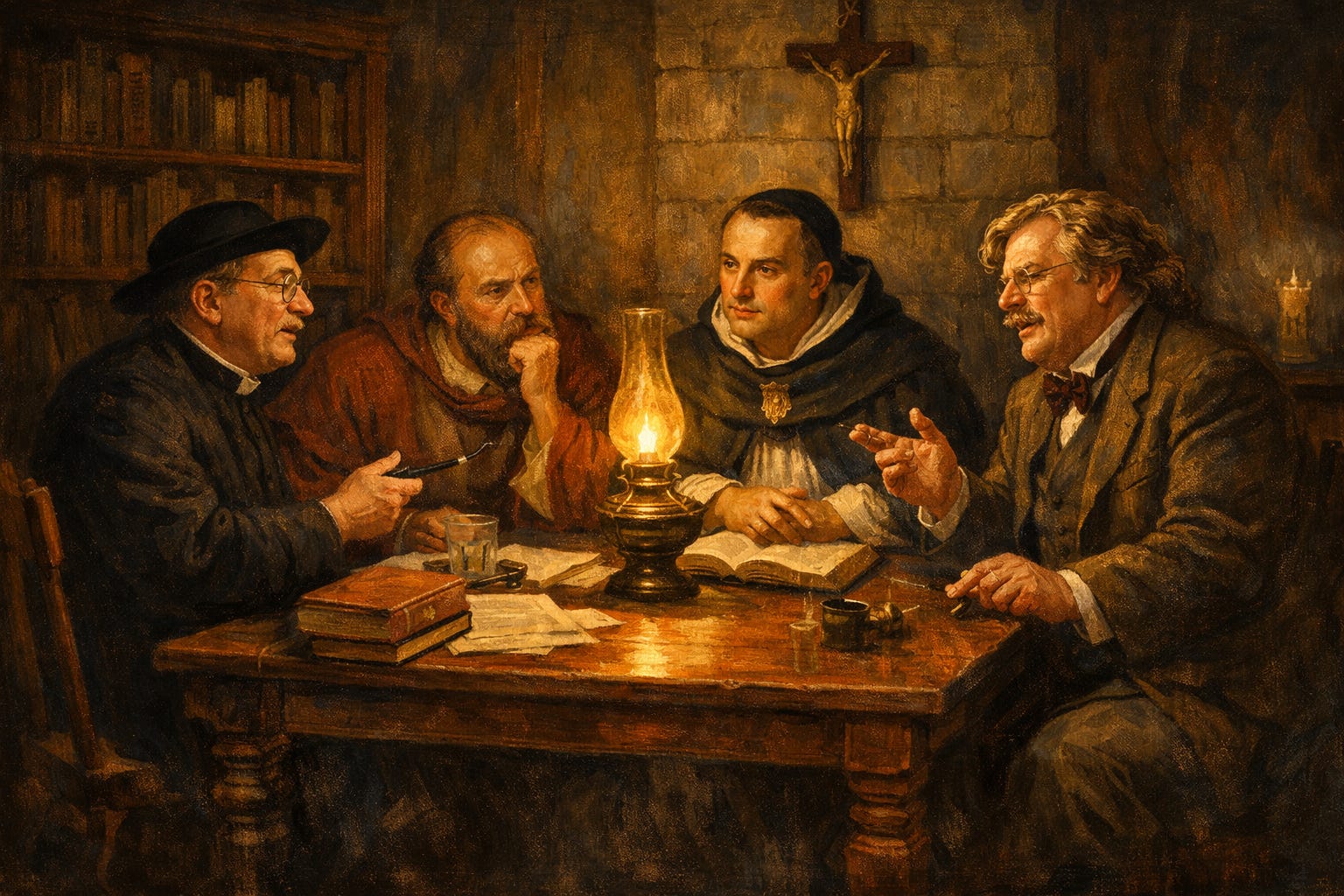
An imagined conversation drawn from real minds, real words, and eternal questions.
Prologue: The Small Man Who Asks Large Questions
Father Brown did not sit at the head of the table.
That would have been too obvious.
Instead, he sat slightly aside, like a man prepared to be ignored—and therefore prepared to hear everything. The room was neither heaven nor earth, but something like a borrowed library between worlds: oak shelves, lamplight, a crucifix worn smooth by centuries of argument.
Father Brown:
“Gentlemen, I shall not ask clever questions. Clever questions answer themselves. I shall ask only the sort of questions that people avoid because the answers follow them home.”
QUESTION I
What Is Truth—and How Do We Know It?
Father Brown:
“Is truth discovered, revealed, or remembered? And why does it seem to recognize us before we recognize it?”
St. Augustine
“You have made us for Yourself, O Lord, and our hearts are restless until they rest in You.”
— Confessions
Truth, Augustine begins, is not first a proposition but a destination.
He speaks as a man who chased truth through rhetoric, pleasure, ambition, and pride—only to discover that truth had been patiently waiting, like a father on the road. The human soul, he says, is shaped like an answer. We do not invent truth; we recognize it when it arrives.
Error, therefore, is not ignorance alone. It is misdirected love. A man may reason brilliantly and still be wrong, because he loves the wrong thing more than the right one.
“My weight is my love; wherever I am carried, it is my love that carries me.”
Augustine tells of his youth in Carthage, when he stole pears—not because he was hungry, but because the theft itself thrilled him.
“I loved the sin,” he admits, “not the fruit.”
Truth was absent not because it was hidden, but because his love was bent. Only when love was healed could truth be seen. Thus, truth is known when the heart is converted, not merely when the mind is informed.
St. Thomas Aquinas
“Truth is the adequation of the intellect and the thing.”
— Summa Theologiae
Aquinas speaks calmly, but with the quiet authority of a man who has mapped the terrain.
Truth, he explains, occurs when the intellect conforms to reality—not when reality conforms to preference. The mind is ordered toward being, just as the eye is ordered toward light. To deny truth is not freedom; it is blindness masquerading as independence.
Truth is not created by thought; it is received by it.
“The intellect is made for being, and truth is its proper object.”
Aquinas recalls a novice who once complained that theology was too difficult. Thomas responded by asking him to define “bread.”
When the novice struggled, Thomas smiled and said:
“Then do not blame theology for being difficult. Blame reality for being rich.”
Truth is demanding because reality is generous.
G.K. Chesterton
“The truth is a thing that can be loved and hated; adored and spat upon.”
— Orthodoxy
Truth, Chesterton declares, is not merely correct—it is personal.
Modern man pretends to want truth but only on the condition that it never contradict him. We no longer argue that truth is false; we argue that it is “only your truth,” which is a polite way of saying, “Please do not sit on my throne.”
Truth is not fragile. What is fragile is our pride.
“The human brain is a machine for coming to conclusions, not for avoiding them.”
Chesterton offers a picture:
A man complains that a map is wrong because the mountain blocks his road. The map, he insists, should be revised.
“The map is not wrong,” Chesterton says. “The mountain is simply unbribed.”
Truth is that mountain.
Father Brown (quietly):
“So truth is something we are made for, something we must conform to, and something that refuses to flatter us. No wonder it feels like judgment.”
QUESTION II
Is Reason Enough?
Father Brown:
“Can reason alone lead us to God—or does it require rescue?”
Aquinas
“Grace does not destroy nature, but perfects it.”
Reason, Aquinas insists, is trustworthy—because God created it. Through reason, man can know that God exists, that He is one, that He is good.
But reason is finite. It can climb far—but not infinitely.
Grace does not replace reason; it completes its journey.
“To one who has faith, no explanation is necessary. To one without faith, no explanation is possible.”
Aquinas compares reason to a ship. It can cross the sea—but not create the shore. Revelation is the landfall reason hopes for but cannot manufacture.
Augustine
“I believe in order that I may understand.”
Augustine warns that reason wounded by pride becomes clever in error.
Faith is not the enemy of reason—it is its medicine.
Without humility, reason becomes self-referential, arguing endlessly about mirrors while ignoring the sun.
He recalls philosophers who debated virtue brilliantly while living viciously.
“They spoke of light,” he says, “but never opened their eyes.”
Chesterton
“The madman is not the man who has lost his reason, but the man who has lost everything except his reason.”
Pure reason, Chesterton argues, becomes circular. It explains everything except why it should care.
Faith introduces meaning, limits, and joy—things reason alone cannot justify.
A man builds a perfect logical system and starves inside it because he forgot to include dinner.
Father Brown:
“So reason is a splendid servant—but a dangerous master.”
QUESTION III
Why Christianity—and Not Something Else?
Augustine
“Late have I loved You, Beauty so old and so new.”
Christianity, Augustine says, is true because it finds us while we are running from it.
It does not flatter our strength; it heals our wounds.
He describes hearing a child’s voice—Tolle lege—and opening Scripture not as a scholar, but as a man finally cornered by mercy.
Aquinas
Christianity is true because God has spoken.
Revelation is not a guess but a gift, confirmed by prophecy, coherence, and history.
If a king sends a messenger, it is not humility to ignore him—it is folly.
Chesterton
“Christianity has not been tried and found wanting; it has been found difficult and not tried.”
Christianity is true because it is the only story that fits the world without flattening it.
Every fairy tale, he notes, ends in the same shape: death defeated, humility rewarded, sacrifice crowned.
Christianity is the fairy tale that turned out to be fact.
FINAL QUESTION
What Is the Greatest Danger to the Soul?
Augustine: Disordered love
Aquinas: Pride against truth
Chesterton: Taking oneself too seriously—and God not seriously enough
Epilogue: Father Brown’s Last Word
Father Brown stood, brushing crumbs from his sleeve.
“It seems to me that hell is not a place of great sins, but of small certainties. And heaven is not a reward for cleverness, but a home for the grateful.”
The lamp went out.
The argument continued—somewhere.