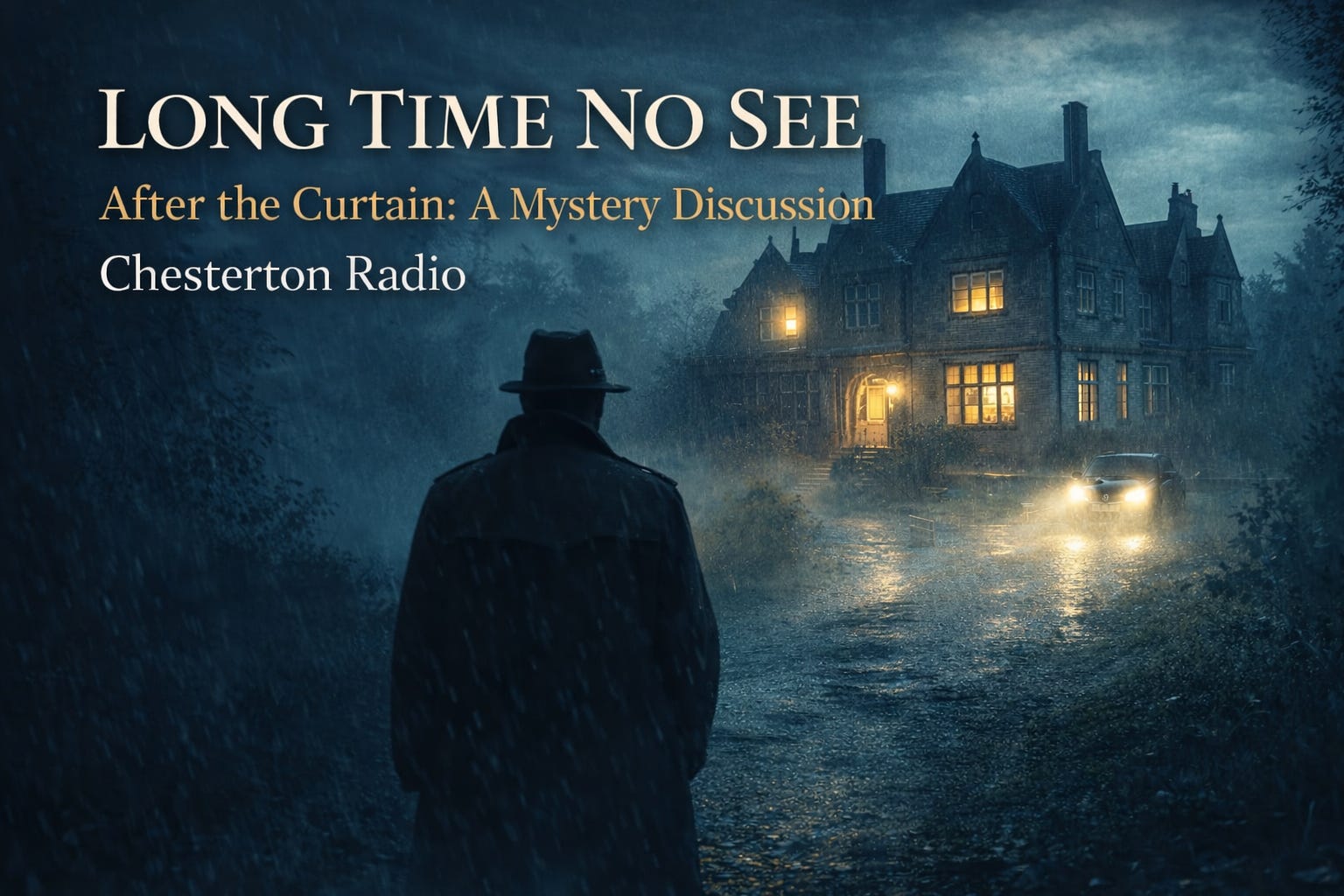
Some mysteries reward the listener twice.
First, when the crime is committed and the clues begin to gather.
And second, when the story is over and one realizes how cleverly the truth was hidden in plain sight.
Tonight, we return to one of the most popular dramas ever aired on Chesterton Radio: “Long Time No See.”
Long Time No See
Written by Joan Sadler and produced for the legendary BBC radio drama series Saturday Night Theatre, the play follows Inspector Burgess as he investigates the murder of crime novelist Alan Bell.
Bell is discovered dead in his isolated home while his wife, Harriet, is away in Paris. At first the investigation seems straightforward. Suspicion falls naturally on those closest to him — a gardener with an uneasy history, a former associate entangled in smuggling operations, and acquaintances whose alibis raise more questions than answers.
But as Inspector Burgess begins to untangle the threads, the case reveals a deeper history of resentment, secrecy, and long-buried crimes.
Gradually suspicion turns toward a man who seemed above suspicion — Colonel Ferguson, a respected family friend whose connection to the past may be far more dangerous than anyone realizes.
The mystery unfolds with the deliberate pace and careful construction that made BBC radio drama so enduringly enjoyable.
Listen to the Original Play
If you have not yet heard the drama, listen first.
The discussion below reveals the solution to the mystery.
After the Curtain: A Discussion of the Mystery
Once the final line of a detective story is spoken, the real conversation begins.
Good mysteries invite discussion. Were the clues fair? Did suspicion move naturally from one suspect to another? And was the final revelation inevitable — or surprising?
Below is a short conversation examining the plot and the motives behind the crime.
Note on the Discussion Audio
The discussion below features two AI-generated hosts analyzing the mystery in a conversational “radio panel” format. Their conversation explores the clues, the shifting suspicions, and the motives behind the crime after the story concludes.
⚠️ Spoiler Discussion
From this point forward, the identity of the killer is discussed.
Why Colonel Ferguson Killed Alan Bell
The brilliance of Long Time No See lies not merely in revealing the murderer, but in slowly uncovering the past that made the crime possible.
Colonel Ferguson appears throughout much of the story as a man above suspicion — disciplined, composed, and trusted by those around him. Yet the investigation gradually uncovers an older incident involving smuggling operations and a long-ago act of violence that had never fully disappeared.
Alan Bell, the victim, had begun revisiting this past.
As Burgess pieces together Bell’s recent activities, it becomes clear that the novelist possessed knowledge capable of destroying Ferguson’s carefully maintained reputation. What had once been buried history was becoming dangerously visible.
The murder, then, is not an impulsive act. It is a desperate attempt to silence the past.
Ironically, the crime ensures that the past will be examined more thoroughly than ever. By killing Bell, Ferguson sets the entire investigation in motion — drawing attention to the very secrets he hoped to conceal.
In the end, the crime becomes its own confession.
The Structure of a Classic Radio Mystery
Part of the pleasure of Long Time No See comes from the strengths of radio storytelling itself.
Without visual distractions, radio mysteries rely on dialogue, pacing, and the listener’s imagination. Suspicion shifts from one suspect to another through conversation and revelation rather than spectacle.
The listener becomes an investigator, weighing motives and questioning alibis along with the detective.
By the time the final pursuit begins, the structure of the mystery feels both surprising and inevitable — the hallmark of a well-constructed detective story.
A Chestertonian Observation
Detective stories endure because they quietly affirm something important about the world.
Crimes may be clever. Lies may be elaborate. The guilty may hide behind respectability and rank. But the universe itself seems arranged in such a way that truth eventually forces its way into the open.
As G. K. Chesterton often suggested, the detective story is ultimately a celebration of reason. It assumes that clues matter, that motives exist, and that patient observation can restore order where chaos briefly seemed to reign.
In that sense the detective story is not truly about crime.
It is about the quiet and inevitable victory of truth.
And that is why mysteries like Long Time No See remain satisfying long after the final line has been spoken.
Support Chesterton Radio
If you enjoy classic radio drama, thoughtful discussion, and the preservation of great storytelling from the golden age of broadcasting, consider supporting Chesterton Radio.
Your support helps keep these stories alive and allows us to continue sharing classic radio drama, discussions, and new original fiction inspired by these traditions.
👉