

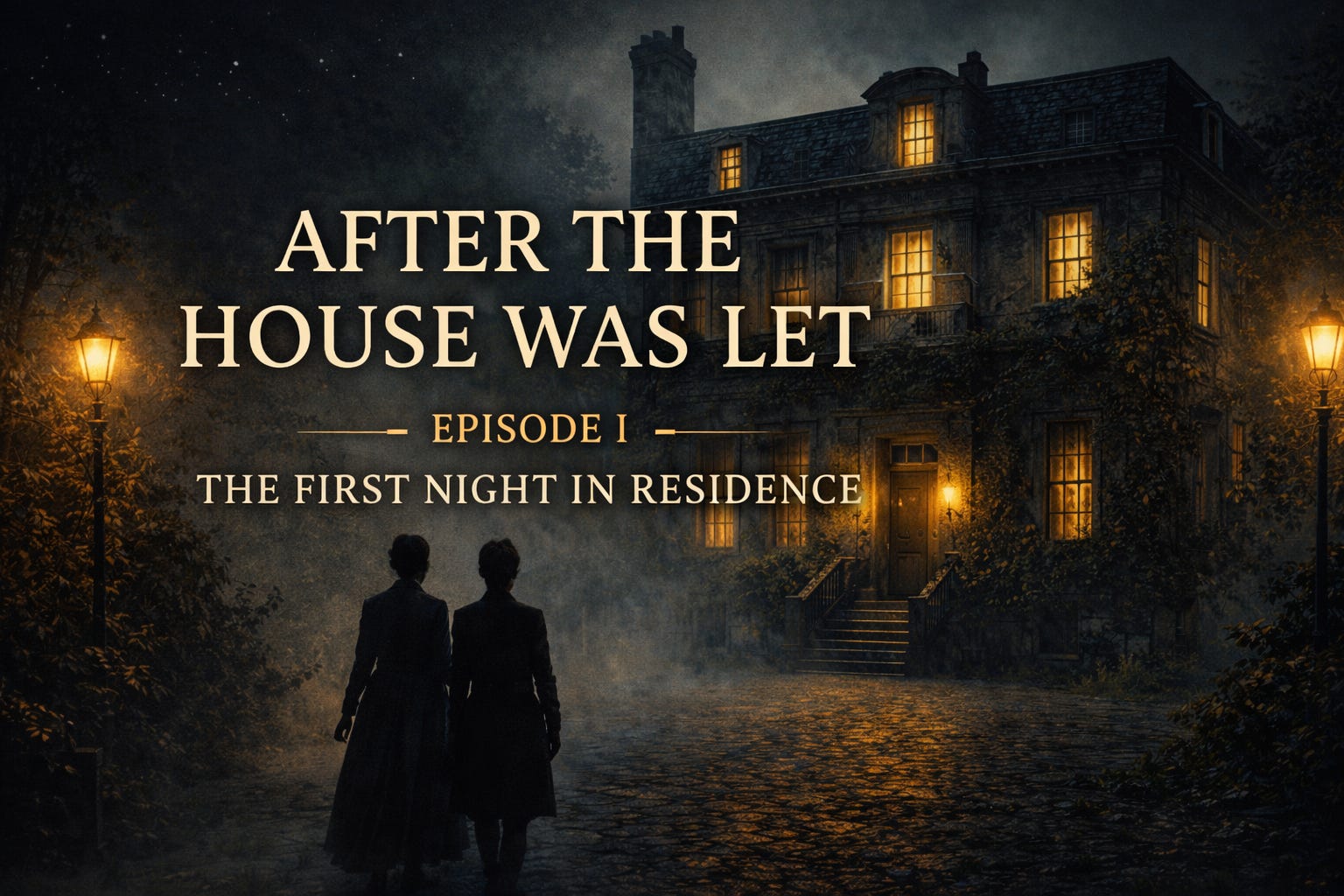
There are houses which stand empty because no one will enter them.
And there are houses which stand empty because something within them will not depart.
A Word Before We Reopen the Door
The original A House to Let was no ordinary tale. It was published in 1858 under the guiding imagination of Charles Dickens, with contributions from Wilkie Collins, Elizabeth Gaskell, and Adelaide Anne Procter — a rare instance of many pens constructing a single habitation.
We recently revisited the BBC production of that story here on Chesterton Radio. If you have not yet heard it, you may listen in your browser at any time — no special app required. Whether in Edge, Chrome, Brave, Safari, or any modern browser, these stories may be heard as well as read. Literature, like architecture, was once meant for resonance.
A listener wrote that he wished to follow the characters further.
And so, by popular vote, the key has turned once more.
What follows is not imitation, but continuation — a further lease upon a house that was never entirely vacant.
I. The Letting
The estate agent had described the property as “long unoccupied.”
The solicitor had called it “structurally sound.”
The neighbors had called it “unfortunate.”
Mr. Edward Ellingham, who possessed a temperament inclined toward practicality and railway timetables, found such descriptions reassuring rather than alarming. Houses, like reputations, were often injured more by gossip than by fact.
Mrs. Clara Ellingham was less certain.
She stood upon the threshold on that first evening, gloved hand resting lightly upon the brass knob, and felt something she could not readily categorize. It was not fear. Fear has a pulse. This sensation was quieter — like the awareness that one has entered a church between services.
The door closed behind them with a decisive finality.
The house was theirs.
It did not protest.
It did not welcome.
It observed.
II. The First Night
They retired early, fatigue overcoming curiosity. The drawing room fire had burned well; the hearthstone bore marks of former comfort. The wallpaper, though faded, retained dignity. Even the staircase banister, polished by unknown hands long ago, suggested an orderly domestic history.
And yet sometime past midnight, Clara awoke.
Not to sound — but to stillness.
There are degrees of silence. One may sleep through the silence of countryside fields or the silence of city hours past midnight. But this was a listening silence.
She lay very still.
From above — the faintest hesitation.
Not a footstep. Not a creak.
A pause.
She touched her husband’s arm.
“Edward.”
He stirred.
“Did you hear something?”
He listened with dutiful seriousness.
“Only timber settling,” he replied.
But timber does not hesitate.
And this had hesitated.
III. Morning Light
The next morning revealed nothing improper. Sunlight entered boldly, dissolving unease as it so often does. Servants reported no disturbance. The kitchen range performed its duties with moral clarity.
It was only in the course of practical inspection that the matter arose.
The attic stair had been omitted from the initial tour.
“Merely storage,” the agent had said dismissively.
Edward ascended first, holding a candle despite the daylight.
Dust lay thick but undisturbed.
The room beneath the eaves was small and plainly furnished: a writing table, a straight-backed chair, and against the far wall — a mahogany escritoire.
It was locked.
Not stuck.
Not swollen by damp.
Locked.
Clara joined him.
“This was not listed among the contents.”
“No,” Edward replied, irritation rising mildly. “But neither was it removed.”
Left — as if intentionally.
There is something accusatory about a locked object in a house you believe to be yours.
A locksmith was summoned.
The lock yielded after modest persuasion.
The desk opened.
Inside were letters.
IV. The Letters
They were tied neatly with faded ribbon.
Not abandoned carelessly.
Preserved.
The earliest bore a date from several years before the vacancy of the house.
Edward untied the ribbon with careful skepticism.
The handwriting was steady but strained.
“I find that silence is easier to inhabit than truth, though I fear it is less hospitable.”
Clara drew closer.
Another letter:
“The matter must not reach public knowledge. It would injure more than myself.”
Another:
“The house must remain unused until restitution is possible.”
Restitution.
That word alters atmosphere.
There are crimes that wound bodies.
And there are crimes that wound names.
The letters were addressed — but never posted.
Each bore the same recipient.
A respected name.
Associated with charitable works in the district.
Edward frowned.
“I know this name.”
“So do I,” Clara said quietly.
Reputation carries its own architecture.
V. The Shape of Avoidance
The final letter was undated.
The ink had thinned.
“Should the matter come to light, the good works would be discredited. Better the house stand empty than the conscience exposed.”
Clara folded the page slowly.
“This house was not empty,” she said. “It was avoided.”
Edward did not reply immediately.
He examined the room.
No signs of struggle.
No signs of haste.
Only deliberate withdrawal.
“Someone chose silence,” he said at last.
“Or penance,” Clara replied.
There is a difference.
VI. The Uneasy Evening
That evening, they dined by candlelight.
The house felt altered.
Not hostile.
Not threatening.
But inhabited by intention.
Clara found herself listening between sentences.
Edward, ordinarily decisive, seemed inclined toward contemplation.
“If we inform the authorities,” he began, “we risk scandal.”
“If we do not,” she replied, “we inherit silence.”
An empty room echoes.
A silenced conscience waits.
Before further conclusion could be reached, there came a knock at the front door.
Not tentative.
Not accidental.
Deliberate.
Edward rose.
The hallway felt longer than before.
He opened the door.
A gentleman stood upon the step.
Gray coat.
Measured posture.
Eyes that had already examined the windows.
“Good evening,” the visitor said. “I believe you have opened a desk that does not entirely belong to you.”
VII. The Threshold
The man did not force entry.
He did not plead.
He merely waited.
Clara stepped beside her husband.
“You know of the letters?” she asked.
“I know of their existence,” the gentleman replied. “And of their consequence.”
Edward stiffened.
“Then perhaps you might explain why this house was left unoccupied.”
The gentleman’s gaze drifted briefly upward — toward the attic.
“Because some debts,” he said evenly, “are not financial.”
A pause.
“And some houses,” he added, “are easier to leave than to justify.”
Clara felt the peculiar certainty that the house was no longer merely listening.
It was remembering.
To Be Continued
Episode II — The Letters That Were Never Posted
Who was the writer of the unsent letters?
What restitution was delayed?
And what debt now stands at the Ellinghams’ door?
Next Wednesday, the house will speak further.
A Reflection Before We Close
There is a difference between an empty room and a silenced conscience.
An empty room asks to be filled.
A silenced conscience asks to be avoided.
The former invites furniture.
The latter invites courage.
If you are reading this in your email, you may listen to the article aloud in your browser using built-in reading tools. Stories were once spoken before they were printed; they may still be spoken now.
The remainder of this six-part series will appear here each Wednesday.
If you would see the lamps remain lit in this and other houses of imagination, consider joining the Chesterton Radio Listener Club or supporting us on Patreon. Your support ensures that old stories are not merely preserved — but continued.
Until next Wednesday,
We shall leave the escritoire unlocked.
—
Chesterton Radio
Where Old Stories Live Again