

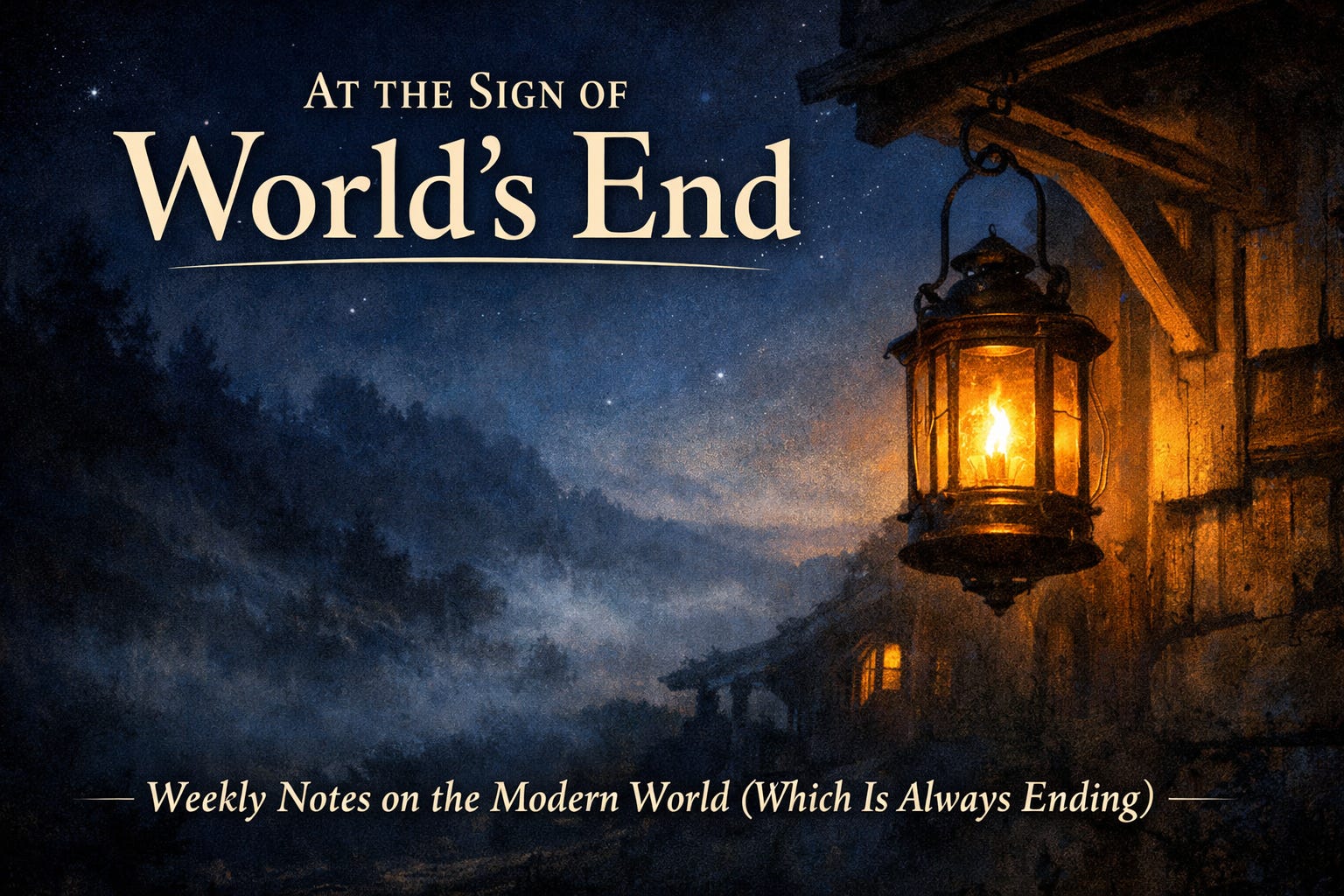
At the Sign of World’s End, we are told once again that everything has changed — which is how we know almost nothing has.
A gentleman arrived at the inn this week in a state of advanced alarm. He had just read that civilization was collapsing, language was dissolving, truth was a matter of preference, and the future belonged to people who had never met the past. He ordered a drink as one orders medicine and announced that we were living in “unprecedented times.”
This is always how one recognizes very precedented times.
Every age believes it has finally achieved a crisis worthy of history. The Romans thought the world was ending when people stopped wearing togas properly. Medieval monks were convinced the Antichrist would arrive by Tuesday. The Victorians suspected the railways might destroy the human soul by allowing it to travel at the shocking speed of thirty miles an hour. And now we have discovered that the true danger to civilization is that people disagree with us on the internet.
The scenery changes; the panic remains loyal.
What is new in our time is not confusion but confidence in confusion. Previous ages doubted, argued, and worried; ours doubts proudly. We have managed to turn uncertainty into a creed and contradiction into a lifestyle. A man once blushed when he contradicted himself. Now he calls it “nuance” and writes a book about it.
Yet the ordinary world remains wonderfully unimpressed.
Bread still requires wheat. Children still ask inconvenient questions. Love still refuses to be reduced to chemistry, and conscience continues to interrupt profitable plans. The modern philosopher may announce that everything is relative, but he still expects his pay to be absolute.
Reality, like a good innkeeper, nods politely at fashionable theories and then continues serving dinner.
The great mistake of apocalyptic ages is not that they see problems, but that they imagine problems are new. Pride, greed, cowardice, folly — these are antiques, not innovations. We have not invented human weakness; we have merely given it Wi-Fi.
And yet there is comfort in this. If the disease is old, so is the cure. Truth has survived worse centuries than ours, mostly because it does not panic when it is unfashionable. It waits. It endures. It outlives headlines the way mountains outlive weather.
From the window of the Sign of World’s End, one can see storms rolling across the horizon of public opinion. They are noisy, dramatic, and very sure of themselves. They are also passing.
The stars, meanwhile, do not issue statements.
So perhaps the world is ending — as it has done regularly for several thousand years. But it is ending in the presence of the same stubborn realities that have always interrupted our nonsense: love, laughter, bread, children, conscience, and the quiet, unreasonable conviction that truth is not a trend.
And that is why the lamp is still lit.
The world will likely end again next week — but until then, we shall keep the lamp trimmed and the door open.
📜 About This Series
At the Sign of World’s End is a weekly Chesterton-inspired essay series from Chesterton Radio, written in the spirit of G.K. Chesterton’s newspaper columns — cheerful, paradoxical, and stubbornly hopeful in an age that is always convinced it is about to collapse.
Pull up a chair. The world may be ending — as usual — but the conversation is just beginning.
🕯 New essays appear weekly at Chesterton Radio.
The world will likely end again next week — but until then, we shall keep the lamp trimmed and the door open.