

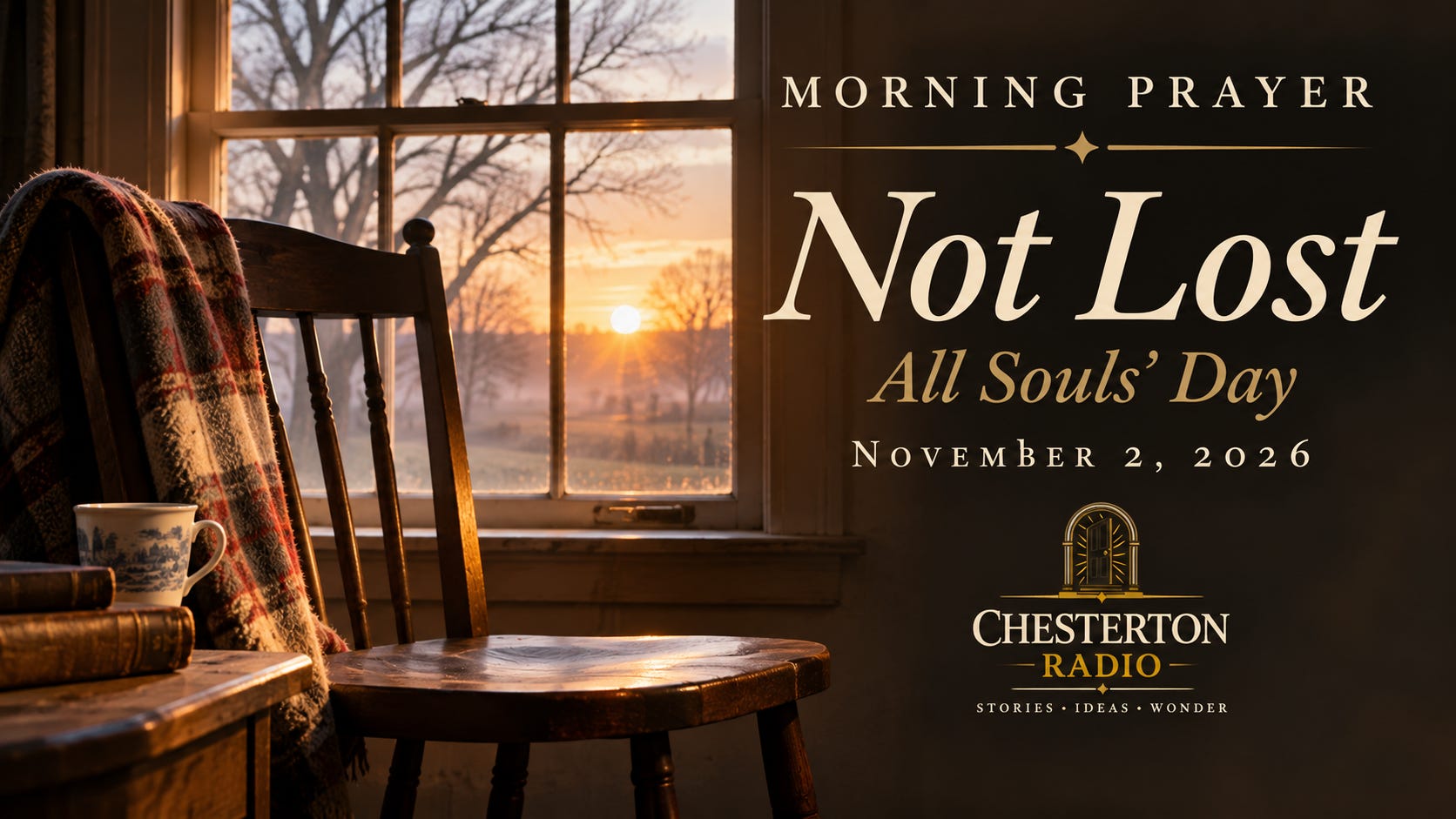
Morning Prayer: Not Lost
There are mornings when an empty chair seems more present than an occupied one.
A name comes to mind before we have quite decided to remember it. A photograph catches the eye. A familiar phrase returns in somebody else’s voice. We remember a father or mother, husband or wife, child, friend, teacher, neighbor—or someone whose absence has become so familiar that we sometimes forget it is an absence.
All Souls’ Day asks us to do something distinctly Christian with that absence.
Not merely remember the dead.
Pray for them.
And beneath all today’s prayers stands one astonishing promise of Christ: “I will not cast out.”
So this morning we bring before God those whom we love and see no longer, those whom the world remembers, those whom almost everyone has forgotten, and those whose names are known now to God alone.
OPENING VERSE
Lord, open my lips.
And my mouth shall declare thy praise.
INVITATORY
Antiphon: Come, let us adore the Lord, for in him all things live.
Psalm 94 (95)
Come let us praise the Lord with joy:
let us joyfully sing to God our saviour.
Let us come before his presence with thanksgiving;
and make a joyful noise to him with psalms.
For the Lord is a great God,
and a great king above all gods.
For in his hand are all the ends of the earth:
and the heights of the mountains are his.
For the sea is his, and he made it:
and his hands formed the dry land.
Come let us adore and fall down:
and weep before the Lord that made us.
For he is the Lord our God:
and we are the people of his pasture
and the sheep of his hand.
Today if you shall hear his voice,
harden not your hearts:
As in the provocation,
according to the day of temptation in the wilderness:
Where your fathers tempted me,
they proved me, and saw my works.
Forty years long was I offended with that generation,
and I said: These always err in heart.
And these men have not known my ways:
so I swore in my wrath that they shall not enter into my rest.
Glory be to the Father, and to the Son,
and to the Holy Ghost.
As it was in the beginning, is now, and ever shall be,
world without end. Amen.
Antiphon: Come, let us adore the Lord, for in him all things live.
PSALMODY
Psalm 50 (51)
Have mercy on me, O God
Antiphon: The bones that were humbled shall rejoice before the Lord.
Have mercy on me, O God, according to thy great mercy.
And according to the multitude of thy tender mercies
blot out my iniquity.
Wash me yet more from my iniquity,
and cleanse me from my sin.
For I know my iniquity,
and my sin is always before me.
To thee only have I sinned,
and have done evil before thee:
that thou mayst be justified in thy words,
and mayst overcome when thou art judged.
For behold I was conceived in iniquities;
and in sins did my mother conceive me.
For behold thou hast loved truth:
the uncertain and hidden things of thy wisdom
thou hast made manifest to me.
Thou shalt sprinkle me with hyssop,
and I shall be cleansed:
thou shalt wash me,
and I shall be made whiter than snow.
To my hearing thou shalt give joy and gladness:
and the bones that have been humbled shall rejoice.
Turn away thy face from my sins,
and blot out all my iniquities.
Create a clean heart in me, O God:
and renew a right spirit within my bowels.
Cast me not away from thy face;
and take not thy holy spirit from me.
Restore unto me the joy of thy salvation,
and strengthen me with a perfect spirit.
I will teach the unjust thy ways:
and the wicked shall be converted to thee.
Deliver me from blood, O God, thou God of my salvation:
and my tongue shall extol thy justice.
O Lord, thou wilt open my lips:
and my mouth shall declare thy praise.
For if thou hadst desired sacrifice,
I would indeed have given it:
with burnt offerings thou wilt not be delighted.
A sacrifice to God is an afflicted spirit:
a contrite and humbled heart, O God, thou wilt not despise.
Deal favourably, O Lord, in thy good will with Sion;
that the walls of Jerusalem may be built up.
Then shalt thou accept the sacrifice of justice,
oblations and whole burnt offerings:
then shall they lay calves upon thy altar.
Glory be to the Father, and to the Son,
and to the Holy Ghost.
As it was in the beginning, is now, and ever shall be,
world without end. Amen.
Antiphon: The bones that were humbled shall rejoice before the Lord.
Canticle of Ezechias
Isaiah 38:10–14, 17–20
Antiphon: From the gates of death, O Lord, deliver my soul.
I said: In the midst of my days
I shall go to the gates of hell:
I sought for the residue of my years.
I said: I shall not see the Lord God
in the land of the living.
I shall behold man no more,
nor the inhabitant of rest.
My generation is at an end,
and it is rolled away from me,
as a shepherd’s tent.
My life is cut off, as by a weaver:
whilst I was yet but beginning, he cut me off:
from morning even to night thou wilt make an end of me.
I hoped till morning,
as a lion so hath he broken all my bones:
from morning even to night thou wilt make an end of me.
I will cry like a young swallow,
I will meditate like a dove:
My eyes are weakened looking upward:
Lord, I suffer violence, answer thou for me.
Behold in peace is my bitterness most bitter:
but thou hast delivered my soul that it should not perish,
thou hast cast all my sins behind thy back.
For hell shall not confess to thee,
neither shall death praise thee:
Nor shall they that go down into the pit,
look for thy truth.
The living, the living, he shall give praise to thee,
as I do this day:
The father shall make the truth known
to the children.
O Lord, save me,
and we will sing our psalms all the days of our life
in the house of the Lord.
Glory be to the Father, and to the Son,
and to the Holy Ghost.
As it was in the beginning, is now, and ever shall be,
world without end. Amen.
Antiphon: From the gates of death, O Lord, deliver my soul.
Psalm 145 (146)
Praise the Lord, O my soul
Antiphon: I will praise my God all the days of my life.
Praise the Lord, O my soul,
in my life I will praise the Lord:
I will sing to my God as long as I shall be.
Put not your trust in princes:
In the children of men,
in whom there is no salvation.
His spirit shall go forth,
and he shall return into his earth:
in that day all their thoughts shall perish.
Blessed is he who hath the God of Jacob for his helper,
whose hope is in the Lord his God:
Who made heaven and earth,
the sea, and all things that are in them.
Who keepeth truth for ever:
who executeth judgment for them that suffer wrong:
who giveth food to the hungry.
The Lord looseth them that are fettered:
The Lord enlighteneth the blind.
The Lord lifteth up them that are cast down:
the Lord loveth the just.
The Lord keepeth the strangers,
he will support the fatherless and the widow:
and the ways of sinners he will destroy.
The Lord shall reign for ever:
thy God, O Sion, unto generation and generation.
Glory be to the Father, and to the Son,
and to the Holy Ghost.
As it was in the beginning, is now, and ever shall be,
world without end. Amen.
Antiphon: I will praise my God all the days of my life.
SHORT READING
1 Thessalonians 4:14
For if we believe that Jesus died and rose again, even so them who have slept through Jesus, will God bring with him.
SHORT RESPONSORY
I will praise thee, O Lord, for thou hast received me.
And hast not made my enemies to rejoice over me.
Thou hast turned my mourning into joy.
And hast surrounded me with gladness.
Glory be to the Father, and to the Son, and to the Holy Ghost.
I will praise thee, O Lord, for thou hast received me.
THE GOSPEL OF THE DAY
John 6:37–40
Jesus said:
All that the Father giveth to me shall come to me; and him that cometh to me, I will not cast out.
Because I came down from heaven, not to do my own will, but the will of him that sent me.
Now this is the will of the Father who sent me: that of all that he hath given me, I should lose nothing; but should raise it up again in the last day.
And this is the will of my Father that sent me: that every one who seeth the Son, and believeth in him, may have life everlasting, and I will raise him up in the last day.
BENEDICTUS
Canticle of Zachary — Luke 1:68–79
Antiphon: I am the resurrection and the life: he that believeth in me, although he be dead, shall live.
Blessed be the Lord God of Israel;
because he hath visited and wrought the redemption of his people:
And hath raised up an horn of salvation to us,
in the house of David his servant:
As he spoke by the mouth of his holy prophets,
who are from the beginning:
Salvation from our enemies,
and from the hand of all that hate us:
To perform mercy to our fathers,
and to remember his holy testament,
The oath, which he swore to Abraham our father,
that he would grant to us,
That being delivered from the hand of our enemies,
we may serve him without fear,
In holiness and justice before him,
all our days.
And thou, child, shalt be called the prophet of the Highest:
for thou shalt go before the face of the Lord
to prepare his ways:
To give knowledge of salvation to his people,
unto the remission of their sins:
Through the bowels of the mercy of our God,
in which the Orient from on high hath visited us:
To enlighten them that sit in darkness,
and in the shadow of death:
to direct our feet into the way of peace.
Glory be to the Father, and to the Son,
and to the Holy Ghost.
As it was in the beginning, is now, and ever shall be,
world without end. Amen.
Antiphon: I am the resurrection and the life: he that believeth in me, although he be dead, shall live.
INTERCESSIONS
Let us pray to God our Father, who raised Jesus Christ from the dead and has promised life to those who belong to him.
Lord, remember thy servants in mercy.
For the Church throughout the world, that she may proclaim the Resurrection with courage and accompany the grieving with tenderness,
Lord, remember thy servants in mercy.
For our families, and especially for those whose places at our tables are now empty, that memory may lead us not only to sorrow but to prayer,
Lord, remember thy servants in mercy.
For our parents and grandparents, teachers and priests, friends and benefactors, and all those whose goodness helped make us what we are,
Lord, remember thy servants in mercy.
For those who have died suddenly, violently, alone, or without the consolation of family and friends,
Lord, remember thy servants in mercy.
For those who died in war, disaster, poverty, persecution, or neglect, and for those whose names have disappeared from human memory,
Lord, remember thy servants in mercy.
For the souls in purgatory, especially those most in need of prayer, that every stain of sin may be cleansed and they may enter the joy of the heavenly Jerusalem,
Lord, remember thy servants in mercy.
For those who mourn today, especially where grief is fresh and heavy, that Christ who wept at the tomb of Lazarus may remain close to them,
Lord, remember thy servants in mercy.
For ourselves, that the certainty of death may teach us not fear but wisdom: to forgive quickly, love generously, repent sincerely, and live gratefully,
Lord, remember thy servants in mercy.
OUR FATHER
Our Father, who art in heaven,
hallowed be thy name.
Thy kingdom come.
Thy will be done on earth as it is in heaven.
Give us this day our daily bread.
And forgive us our trespasses,
as we forgive those who trespass against us.
And lead us not into temptation,
but deliver us from evil.
Amen.
CONCLUDING PRAYER
O God of the living and the dead,
whose Son entered the darkness of the grave
and rose victorious into everlasting life:
Hear our prayers for all thy faithful departed.
Forgive their sins, complete in them the work of thy mercy, and bring them into that kingdom where every tear is wiped away and death shall be no more.
Strengthen us who remain, that we may live in faith, die in hope, and at last be reunited with all who have gone before us marked with the sign of faith.
Through Jesus Christ our Lord.
Amen.
BLESSING
May the Lord bless us,
protect us from all evil,
and bring us to everlasting life.
Amen.
THE PARADOX OF THE DAY
The dead are beyond our reach—and yet Christian love reaches after them in prayer.
CHESTERTON FOR THE MORNING
“Tradition means giving votes to the most obscure of all classes, our ancestors. It is the democracy of the dead.”
— G. K. Chesterton, Orthodoxy
A CHESTERTONIAN MEDITATION
The Empty Chair Is Not Empty
There is something remarkably stubborn about an empty chair.
A person may be gone for ten years, and the chair can still belong to him.
Nobody issued a decree. Nobody attached a brass plaque to it. Yet everyone in the family knows. That was Dad’s chair. That was Grandmother’s place at the table. That was where he sat to read the newspaper. That was where she drank her coffee. That was where the dog knew crumbs were most likely to fall.
The practical modern mind might object that the chair belongs to whoever is sitting in it now.
The human heart knows better.
Things acquire history.
A coffee cup can become a relic of affection. A recipe written in fading ink can summon a person into a kitchen. A tool can retain something of the hand that used it. A phrase we swore we would never repeat suddenly emerges from our own mouth, and we discover with mild horror and considerable affection that we have become our father.
The dead are absent.
And they are astonishingly present.
All Souls’ Day begins with this strange human fact and then carries it much further than sentiment can go.
The Church does not merely tell stories about the dead.
She prays for them.
That is a startling thing.
Modern culture often gives us two unsatisfactory choices concerning death. We can pretend the dead have simply vanished into nothingness, or we can console ourselves with vague assurances that everyone who dies is immediately and automatically in perfect bliss.
Christianity is both more severe and more hopeful.
It takes death seriously because it takes life seriously. It takes sin seriously because it takes love seriously. And it takes prayer for the dead seriously because death does not destroy the communion created by Christ.
Love has duties even toward those we can no longer see.
This is why Chesterton’s famous phrase about the “democracy of the dead” is more than a clever political joke.
He was arguing for tradition: that our ancestors should not lose their voice merely because they have had the bad manners to die before us. The modern world, he suggested, can become an arrogant little oligarchy consisting entirely of people who happen to be alive at the moment.
All Souls’ Day pushes the idea deeper.
The dead do not merely belong in our councils.
They belong in our prayers.
The Church is larger than the visible congregation.
At Mass there may appear to be fifty people in the pews. But the Catholic imagination insists upon an enormous invisible company: angels and saints, generations of Christians, and the faithful departed for whom we pray.
Christianity has always been rather bad at respecting the supposedly impenetrable walls people erect around things.
God becomes man.
A virgin becomes a mother.
Bread becomes a means of divine communion.
Sinners become saints.
And a grave, which looks remarkably like an ending, becomes a place where Christians speak about resurrection.
That is why today’s Gospel contains one of Christ’s most tender promises:
“I should lose nothing.”
Nothing.
We know how easily things are lost.
Keys disappear. Letters are misplaced. Photographs fade. Houses are sold. Names vanish from buildings. Cemeteries weather away. Within a few generations, most of us will be unknown to nearly everyone walking the earth.
Human memory is terribly fragile.
God’s memory is not.
This may be one of the deepest consolations of All Souls’ Day.
The person whom nobody remembers is remembered by God.
The soldier buried beneath a weathered stone.
The infant whose life lasted only hours.
The immigrant whose descendants no longer know his name.
The elderly woman who died with no surviving family.
The prisoner.
The stranger.
The forgotten poor.
The man whose photograph was never taken.
The woman whose letters were thrown away decades ago.
They are not entries misplaced in the great filing cabinet of the universe.
“I should lose nothing.”
There is something almost domestic in the phrase.
Anyone who has ever hurried around the house searching for something precious understands it. We search because the thing matters.
And Christ describes the Father’s will in precisely the language of refusing loss.
Christian hope therefore does not require us to pretend death is pleasant.
It isn’t.
Christ himself wept at a grave.
Christianity does not tell the grieving mother that the empty chair is imaginary. It does not tell the widower that loneliness is merely an incorrect theological attitude. It does not ask us to smile at a coffin.
It asks something stranger.
It asks us to grieve with hope.
That qualification changes everything without abolishing anything.
We still miss them.
We still wish we could hear the voice once more.
We still occasionally think, for one impossible second, that we ought to telephone someone who has been dead for years.
But now memory can become prayer.
That is the great practical invitation of this day.
When the dead come unexpectedly to mind, pray.
When you pass the cemetery, pray.
When you find the old photograph, pray.
When you cook her recipe, use his tool, hear their song, or repeat the family story for the hundredth time, pray.
Memory need not terminate in nostalgia.
It can become charity.
Perhaps that is one reason Catholics have always seemed slightly crowded, even when alone.
We live among inheritances.
We speak words taught to us by people long dead. We profess a Creed hammered out by Christians whose bones have been dust for centuries. We read Scriptures copied and guarded by generations we never met. We worship in churches built by hands that can no longer lift anything.
We are surrounded by gifts from the dead.
And today we give something back.
Prayer.
It seems so little.
But Christianity has always delighted in things that seem too little: a mustard seed, five loaves, a cup of water, a widow’s coin, a child in a manger.
So give the little thing.
Say the name.
Offer the prayer.
Have the Mass said.
Visit the grave.
Remember the forgotten.
And when you notice that empty chair, do not imagine that Christianity asks you to call it full.
It asks you to believe something better.
The chair really is empty.
But the person is not lost.
CLOSING
For all who have gone before us marked with the sign of faith:
Eternal rest grant unto them, O Lord.
And let perpetual light shine upon them.
May they rest in peace.
Amen.
And may the souls of all the faithful departed, through the mercy of God, rest in peace.
Amen.
Chesterton Radio