

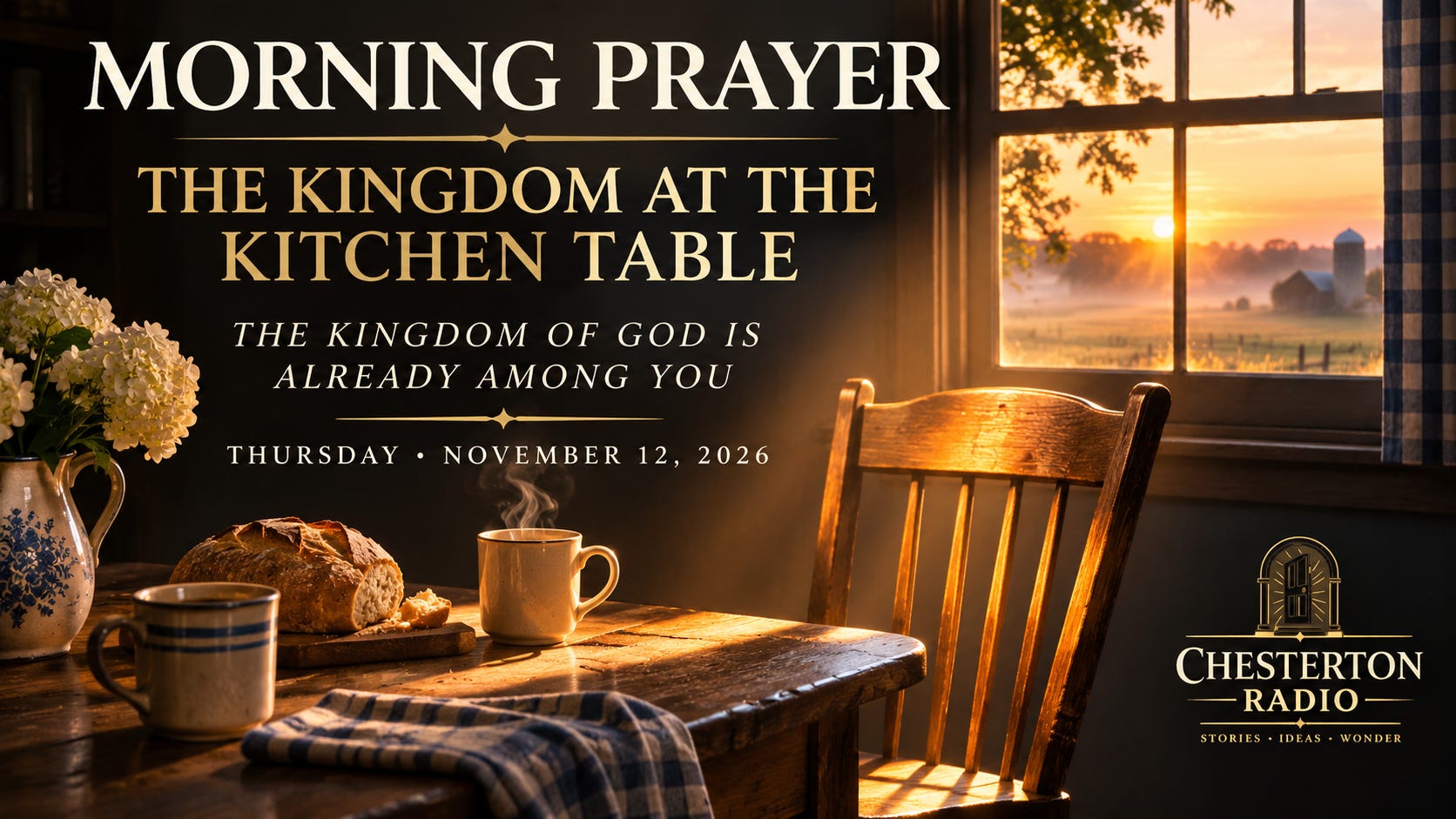
The Kingdom at the Kitchen Table
The Kingdom of God Is Already Among You
Opening
There is a curious habit of looking for the Kingdom of God everywhere except where we happen to be standing.
We imagine that God must be waiting beyond the horizon, behind some great historical event, or at the conclusion of a remarkable spiritual journey. Meanwhile, the kettle boils, the children wake, the workday approaches, and the ordinary world continues with its astonishing indifference to our expectations.
But this morning Christ tells us something that turns our expectations upside down: the Kingdom of God does not arrive as a spectacle to be pointed out. It is already among us.
On this memorial of Saint Josaphat, who gave his life in the cause of Christian unity, we pray for eyes capable of recognizing God’s presence and hearts courageous enough to make that presence visible through love.
Opening Verse
Lord, open my lips.
And my mouth shall declare thy praise.
Invitatory
Antiphon: Come, let us adore Christ, the King of martyrs.
Psalm 94 (95) — Venite, exsultemus
Come let us praise the Lord with joy: let us joyfully sing to God our saviour.
Let us come before his presence with thanksgiving; and make a joyful noise to him with psalms.
For the Lord is a great God, and a great King above all gods.
For in his hand are all the ends of the earth: and the heights of the mountains are his.
For the sea is his, and he made it: and his hands formed the dry land.
Come let us adore and fall down: and weep before the Lord that made us.
For he is the Lord our God: and we are the people of his pasture and the sheep of his hand.
Today if you shall hear his voice, harden not your hearts:
As in the provocation, according to the day of temptation in the wilderness: where your fathers tempted me, they proved me, and saw my works.
Forty years long was I offended with that generation, and I said: These always err in heart.
And these men have not known my ways: so I swore in my wrath that they shall not enter into my rest.
Glory be to the Father, and to the Son, and to the Holy Ghost.
As it was in the beginning, is now, and ever shall be, world without end. Amen.
Antiphon: Come, let us adore Christ, the King of martyrs.
Psalmody
First Psalm — Psalm 142 (143):1–11
A prayer for guidance and mercy
Antiphon 1: Cause me to hear thy mercy in the morning, O Lord.
Hear, O Lord, my prayer: give ear to my supplication in thy truth: hear me in thy justice.
And enter not into judgment with thy servant: for in thy sight no man living shall be justified.
For the enemy hath persecuted my soul: he hath brought down my life to the earth. He hath made me to dwell in darkness as those that have been dead of old:
And my spirit is in anguish within me: my heart within me is troubled.
I remembered the days of old, I meditated on all thy works: I meditated upon the works of thy hands.
I stretched forth my hands to thee: my soul is as earth without water unto thee.
Hear me speedily, O Lord: my spirit hath fainted away. Turn not away thy face from me, lest I be like unto them that go down into the pit.
Cause me to hear thy mercy in the morning; for in thee have I hoped. Make the way known to me, wherein I should walk: for I have lifted up my soul to thee.
Deliver me from my enemies, O Lord, to thee have I fled:
Teach me to do thy will, for thou art my God. Thy good spirit shall lead me into the right land:
For thy name’s sake, O Lord, thou wilt quicken me in thy justice. Thou wilt bring my soul out of trouble.
Glory be to the Father, and to the Son, and to the Holy Ghost.
As it was in the beginning, is now, and ever shall be, world without end. Amen.
Antiphon 1: Cause me to hear thy mercy in the morning, O Lord.
Old Testament Canticle — Isaiah 66:10–14a
The consolation of Jerusalem
Antiphon 2: Behold, I will bring upon her peace as it were a river.
Rejoice with Jerusalem, and be glad with her, all ye that love her: rejoice for joy with her, all you that mourn for her.
That you may suck and be filled with the breasts of her consolations: that you may milk out, and flow with delights, from the abundance of her glory.
For thus saith the Lord: Behold I will bring upon her as it were a river of peace, and as an overflowing torrent the glory of the Gentiles, which you shall suck: you shall be carried at the breasts, and upon the knees they shall caress you.
As one whom the mother caresseth, so will I comfort you, and you shall be comforted in Jerusalem.
You shall see and your heart shall rejoice, and your bones shall flourish like an herb.
Glory be to the Father, and to the Son, and to the Holy Ghost.
As it was in the beginning, is now, and ever shall be, world without end. Amen.
Antiphon 2: Behold, I will bring upon her peace as it were a river.
Second Psalm — Psalm 146 (147:1–11)
Praise of God’s goodness and providence
Antiphon 3: To our God be joyful and comely praise.
Praise ye the Lord, because psalm is good: to our God be joyful and comely praise.
The Lord buildeth up Jerusalem: he will gather together the dispersed of Israel.
Who healeth the broken of heart, and bindeth up their bruises.
Who telleth the number of the stars: and calleth them all by their names.
Great is our Lord, and great is his power: and of his wisdom there is no number.
The Lord lifteth up the meek, and bringeth the wicked down even to the ground.
Sing ye to the Lord with praise: sing to our God upon the harp.
Who covereth the heaven with clouds, and prepareth rain for the earth. Who maketh grass to grow on the mountains, and herbs for the service of men.
Who giveth to beasts their food: and to the young ravens that call upon him.
He shall not delight in the strength of the horse: nor take pleasure in the legs of a man.
The Lord taketh pleasure in them that fear him: and in them that hope in his mercy.
Glory be to the Father, and to the Son, and to the Holy Ghost.
As it was in the beginning, is now, and ever shall be, world without end. Amen.
Antiphon 3: To our God be joyful and comely praise.
Short Reading — 2 Corinthians 1:3–5
Blessed be the God and Father of our Lord Jesus Christ, the Father of mercies, and the God of all comfort.
Who comforteth us in all our tribulation; that we also may be able to comfort them who are in all distress, by the exhortation wherewith we also are exhorted by God.
For as the sufferings of Christ abound in us: so also by Christ doth our comfort abound.
Short Responsory
The Lord is our strength and our salvation.
The Lord is our strength and our salvation.
He comforteth those who trust in his mercy.
The Lord is our strength and our salvation.
Glory be to the Father, and to the Son, and to the Holy Ghost.
The Lord is our strength and our salvation.
Gospel of the Day — Luke 17:20–25
The coming of the Kingdom of God
And being asked by the Pharisees, when the kingdom of God should come? he answering them, and said: The kingdom of God cometh not with observation:
Neither shall they say: Behold here, or behold there. For lo, the kingdom of God is within you.
And he said to his disciples: The days will come when you shall desire to see one day of the Son of man; and you shall not see it.
And they will say to you: See here, and see there. Go ye not after, nor follow them:
For as the lightning that lighteneth from under heaven, shineth unto the parts that are under heaven, so shall the Son of man be in his day.
But first he must suffer many things, and be rejected by this generation.
The Gospel of the Lord.
Praise be to thee, O Christ.
Benedictus — Canticle of Zachary
Luke 1:68–79
Antiphon: He who loseth his life for Christ shall find the life that endureth forever.
Blessed be the Lord God of Israel; because he hath visited and wrought the redemption of his people:
And hath raised up an horn of salvation to us, in the house of David his servant:
As he spoke by the mouth of his holy prophets, who are from the beginning:
Salvation from our enemies, and from the hand of all that hate us:
To perform mercy to our fathers, and to remember his holy testament,
The oath, which he swore to Abraham our father, that he would grant to us,
That being delivered from the hand of our enemies, we may serve him without fear,
In holiness and justice before him, all our days.
And thou, child, shalt be called the prophet of the Highest: for thou shalt go before the face of the Lord to prepare his ways:
To give knowledge of salvation to his people, unto the remission of their sins:
Through the bowels of the mercy of our God, in which the Orient from on high hath visited us:
To enlighten them that sit in darkness, and in the shadow of death: to direct our feet into the way of peace.
Glory be to the Father, and to the Son, and to the Holy Ghost.
As it was in the beginning, is now, and ever shall be, world without end. Amen.
Antiphon: He who loseth his life for Christ shall find the life that endureth forever.
Intercessions
Let us turn to Christ, whose Kingdom is already among us, and ask that his grace may transform our hearts and our world.
Response: Lord, make thy Kingdom visible in our lives.
For the Holy Father, bishops, priests, and all who shepherd thy Church: grant them wisdom, courage, humility, and steadfast love.
Lord, make thy Kingdom visible in our lives.
For the unity of Christians, for which Saint Josaphat labored and suffered: heal ancient wounds, overcome bitterness, and lead all who bear the name of Christ toward the fullness of truth and charity.
Lord, make thy Kingdom visible in our lives.
For nations divided by hatred, violence, and suspicion: raise up peacemakers who seek justice without vengeance and reconciliation without surrendering truth.
Lord, make thy Kingdom visible in our lives.
For those beginning their daily work: bless the labor of their hands, the decisions entrusted to them, and the people who depend upon their faithfulness.
Lord, make thy Kingdom visible in our lives.
For our families, friends, neighbors, and those from whom we have become estranged: teach us to recognize the dignity of every person and to begin the difficult work of forgiveness.
Lord, make thy Kingdom visible in our lives.
For the sick, the lonely, the imprisoned, the anxious, and those who carry burdens unseen by others: comfort them with thy presence and send compassionate people to their aid.
Lord, make thy Kingdom visible in our lives.
For the faithful departed, especially those who died without comfort or companionship: receive them into the peace of thy eternal Kingdom.
Lord, make thy Kingdom visible in our lives.
For ourselves: deliver us from the temptation to search for thee everywhere except in the duties, relationships, and opportunities for love that thou hast placed before us today.
Lord, make thy Kingdom visible in our lives.
Our Father
Our Father, who art in heaven, hallowed be thy name; thy kingdom come; thy will be done on earth as it is in heaven.
Give us this day our daily bread; and forgive us our trespasses, as we forgive those who trespass against us; and lead us not into temptation, but deliver us from evil. Amen.
Concluding Prayer
Almighty and eternal God, whose Kingdom is established not by earthly spectacle but by the redeeming love of thy Son, open our eyes to thy presence among us.
Through the intercession of Saint Josaphat, bishop and martyr, strengthen the unity of thy Church, reconcile those divided by pride or bitterness, and give us courage to bear witness to the truth with charity.
May the duties of this day become occasions of grace, our words instruments of peace, and our homes places where thy love is known.
Through Jesus Christ our Lord. Amen.
Blessing
May the Lord bless us, protect us from all evil, and bring us to everlasting life.
Amen.
THE PARADOX OF THE DAY
The Kingdom of God is so great that it fills eternity, and so near that we can overlook it across the breakfast table.
CHESTERTON FOR THE MORNING
I want to love my neighbour not because he is I, but precisely because he is not I.
— G. K. Chesterton, Orthodoxy (1908), Chapter VIII, “The Romance of Orthodoxy.”
A CHESTERTONIAN MEDITATION
The Kingdom at the Kitchen Table
There is a peculiar sort of blindness that afflicts people who are looking for something very important.
A man searching for his spectacles may turn the entire house upside down while wearing them on his nose. A woman hunting for her keys may discover that she has been carrying them in her hand. And a civilization searching for the Kingdom of God may spend centuries examining the horizon while the King is standing in the room.
There is something almost comical about this, until we realize that the joke is on us.
The Pharisees ask Jesus when the Kingdom of God will come. It is a perfectly reasonable question. Kingdoms, after all, ordinarily arrive with considerable noise. There are banners, trumpets, proclamations, soldiers, ceremonies, and often an unfortunate amount of paperwork.
A kingdom that arrives without anybody noticing seems hardly worth calling a kingdom.
Yet Christ answers that the Kingdom does not come with observation. No one will be able to point triumphantly to a distant hill and announce that it has finally appeared.
And then comes the astonishing declaration: “For lo, the kingdom of God is within you.”
The Douay-Rheims gives us those familiar words, while the Greek expression also carries the sense of the Kingdom being among us, in our midst. Christ is not suggesting that every private feeling is divine or that God’s Kingdom is merely an inward state of mind. The King himself is standing before his questioners.
The answer to their question is looking them in the face.
This is perhaps the most extraordinary feature of Christianity: God repeatedly appears where respectable expectations insist he ought not to be.
The Creator of the universe arrives as a child. The Lord of glory works with wood and tools. The conqueror of death submits to death. The King establishes his throne upon a cross.
And the Kingdom, which we imagine must begin with some enormous transformation of the world, begins with the transformation of a human heart.
Not because the world is unimportant, but because the human heart is the place from which so much of the world’s goodness and wickedness proceeds.
Consider the ordinary kitchen table.
It is not a particularly impressive institution. It rarely possesses a constitution, a national anthem, or a ceremonial guard. Its government is frequently disputed by children, and its treasury consists chiefly of groceries.
Nevertheless, at that table some of the most consequential decisions in human history are made.
A father decides to apologize.
A mother chooses patience when patience is nearly exhausted.
A child learns that the last piece of bread belongs to someone else.
A husband listens instead of defending himself.
Someone makes room for an unexpected guest.
No trumpets sound. No newspaper reports the event. No historian writes down the date.
But something has happened that belongs to the Kingdom of God.
We must be careful here. Kindness does not manufacture the Kingdom, as though enough pleasant gestures could build heaven from the ground up. The Kingdom is God’s gift, brought near in Jesus Christ. Our charity is a response to his grace and a sign of his reign.
Yet that makes the ordinary act more wonderful, not less.
A cup of water offered in charity can participate in something eternal.
Chesterton understood that Christianity does not abolish the ordinary world. It restores our astonishment at it.
His defense of loving the neighbor precisely because the neighbor is another person is particularly important today.
We are often told that peace will come when everyone finally thinks alike. We imagine unity as a condition in which disagreement has been eliminated, personalities have been smoothed into conformity, and all the troublesome differences between human beings have disappeared.
But this is not the Christian understanding of love.
A husband does not love his wife because she is another version of himself. A mother does not love her child because the child has no independent will. A friend is not valuable because he has memorized our opinions and repeats them at suitable intervals.
Indeed, a world containing only people who agree with us would be a remarkably lonely place.
Love requires another person.
And genuine unity does not require the destruction of that otherness.
This brings us to Saint Josaphat, whose memorial the Church celebrates today.
Josaphat lived amid painful divisions among Christians of the Eastern and Western traditions. As a bishop, he labored for ecclesial unity and fidelity to the Catholic faith. His efforts unfolded in a world of deep religious and political conflict, and his life ended violently in martyrdom.
It would be sentimental to pretend that the conflicts surrounding his life were simple, or that unity can be achieved merely by asking everyone to be agreeable.
Truth matters. Conscience matters. History matters. Real wounds cannot be healed by pretending they never occurred.
But the Christian pursuit of unity must never forget the humanity of the person standing on the other side of the disagreement.
It is possible to defend a true proposition in a spirit so proud and bitter that the truth becomes almost invisible behind the defender.
It is also possible to mistake indifference for peace.
Neither is the Kingdom of God.
The unity for which Josaphat labored was not a vague friendliness detached from doctrine. It concerned communion in the faith. Yet his memorial also asks every Christian a searching question: can we desire the good of someone who opposes us?
Can we seek reconciliation without abandoning conviction?
Can we tell the truth without taking pleasure in another person’s humiliation?
These are not small questions. They are among the great adventures of the Christian life.
And they usually begin somewhere embarrassingly close to home.
It is comparatively easy to desire peace between nations we have never visited. It can be considerably harder to make peace with the person who has just interrupted our breakfast.
We may sincerely pray for Christian unity while refusing to speak to a relative.
We may denounce cruelty in public affairs while practicing a refined version of it in private conversation.
We may long for the Kingdom of God while defending every inch of the little kingdom of our own importance.
Christ’s words expose this contradiction.
The Kingdom is already among us, yet we may fail to recognize it because we are waiting for something more theatrical.
We want the lightning without the daily fidelity.
We want the triumph without the Cross.
And the Gospel refuses to separate them. Jesus speaks of the Son of Man’s glorious day, but immediately declares that first he must suffer and be rejected.
The Kingdom is present, but its fullness remains ahead. Christian hope does not deny suffering or pretend that the world has already been perfected. It knows that the risen Christ reigns even while his people continue to wait, labor, and suffer.
This morning, then, we need not manufacture a grand spiritual experience.
We can begin by asking God to show us what is already before us.
Perhaps there is someone who needs encouragement. Perhaps there is an apology that has been postponed. Perhaps there is work to be done honestly, a burden to be shared, a lonely person to be remembered, or a difficult truth to be spoken with tenderness.
These things may seem too ordinary to matter.
But the Gospel suggests that our idea of importance may be precisely what needs correcting.
The universe contains galaxies beyond counting, and yet the Son of God washed his disciples’ feet.
The God who numbers the stars also heals the brokenhearted.
The Lord whose Kingdom shall have no end may be asking us, before this day is over, to pull out one more chair.
And there, at an ordinary kitchen table, we may discover that heaven has been nearer than we imagined.
Closing
Lord Jesus Christ, teach us to recognize thy Kingdom where thou hast placed us, to seek unity without surrendering truth, and to love our neighbors not because they resemble us, but because they are thine.
Saint Josaphat, pray for us.
Chesterton Radio
If Morning Prayer has become part of your day, please consider becoming a paid subscriber. Your support helps keep Chesterton Radio’s daily prayers, stories, mysteries, and original programming available to everyone.
