

Opening
There is something reassuring about a light burning in a window before dawn. It tells us that someone is awake, that a house is inhabited, and perhaps that someone is waiting for us.
Yet a lamp does not remain lighted merely because we wish it to. It needs tending. It needs fuel. And some preparations cannot be postponed until the moment they are needed.
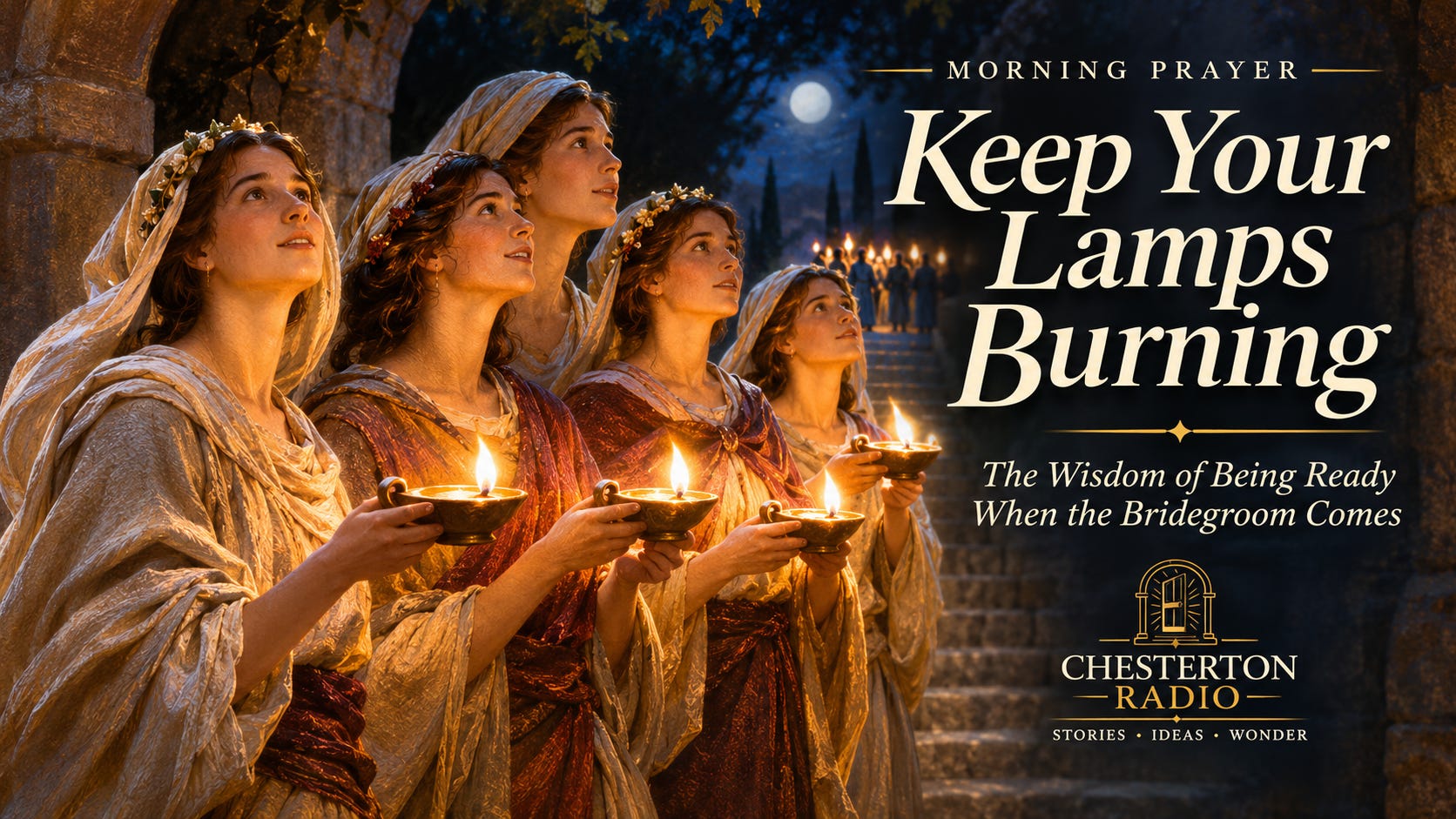
This Sunday, Our Lord tells us of ten young women awaiting a wedding procession. All carry lamps. All grow weary. All fall asleep. But only five have prepared for the unexpected delay.
As we begin this Sunday morning, let us ask for the wisdom to keep the flame of faith alive through the ordinary hours, so that when Christ comes, he may find us ready to welcome him.
Opening Verse
Lord, open my lips.
And my mouth shall declare thy praise.
Invitatory
Antiphon: We are the people of the Lord, the flock of his pasture; come, let us adore him. Alleluia.
Psalm 94 (95) — Venite, Exsultemus
1. Come let us praise the Lord with joy: let us joyfully sing to God our saviour.
2. Let us come before his presence with thanksgiving; and make a joyful noise to him with psalms.
3. For the Lord is a great God, and a great King above all gods.
4. For in his hand are all the ends of the earth: and the heights of the mountains are his.
5. For the sea is his, and he made it: and his hands formed the dry land.
6. Come let us adore and fall down: and weep before the Lord that made us.
7. For he is the Lord our God: and we are the people of his pasture and the sheep of his hand.
8. Today if you shall hear his voice, harden not your hearts:
9. As in the provocation, according to the day of temptation in the wilderness: where your fathers tempted me, they proved me, and saw my works.
10. Forty years long was I offended with that generation, and I said: These always err in heart.
11. And these men have not known my ways: so I swore in my wrath that they shall not enter into my rest.
Glory be to the Father, and to the Son, and to the Holy Ghost.
As it was in the beginning, is now, and ever shall be, world without end. Amen.
Antiphon: We are the people of the Lord, the flock of his pasture; come, let us adore him. Alleluia.
Psalmody
Psalm 117 (118) — Confitemini Domino
Antiphon 1: Glorious is the Lord on high. Alleluia.
1. Give praise to the Lord, for he is good: for his mercy endureth for ever.
2. Let Israel now say that he is good: that his mercy endureth for ever.
3. Let the house of Aaron now say, that his mercy endureth for ever.
4. Let them that fear the Lord now say, that his mercy endureth for ever.
5. In my trouble I called upon the Lord: and the Lord heard me, and enlarged me.
6. The Lord is my helper, I will not fear what man can do unto me.
7. The Lord is my helper: and I will look over my enemies.
8. It is good to confide in the Lord, rather than to have confidence in man.
9. It is good to trust in the Lord, rather than to trust in princes.
10. All nations compassed me about; and in the name of the Lord I have been revenged on them.
11. Surrounding me they compassed me about: and in the name of the Lord I have been revenged on them.
12. They surrounded me like bees, and they burned like fire among thorns: and in the name of the Lord I was revenged on them.
13. Being pushed I was overturned that I might fall: but the Lord supported me.
14. The Lord is my strength and my praise: and he is become my salvation.
15. The voice of rejoicing and of salvation is in the tabernacles of the just.
16. The right hand of the Lord hath wrought strength: the right hand of the Lord hath exalted me: the right hand of the Lord hath wrought strength.
17. I shall not die, but live: and shall declare the works of the Lord.
18. The Lord chastising hath chastised me: but he hath not delivered me over to death.
19. Open ye to me the gates of justice: I will go into them, and give praise to the Lord.
20. This is the gate of the Lord, the just shall enter into it.
21. I will give glory to thee because thou hast heard me: and art become my salvation.
22. The stone which the builders rejected; the same is become the head of the corner.
23. This is the Lord’s doing: and it is wonderful in our eyes.
24. This is the day which the Lord hath made: let us be glad and rejoice therein.
25. O Lord, save me: O Lord, give good success.
26. Blessed be he that cometh in the name of the Lord. We have blessed you out of the house of the Lord.
27. The Lord is God, and he hath shone upon us. Appoint a solemn day, with shady boughs, even to the horn of the altar.
28. Thou art my God, and I will praise thee: thou art my God, and I will exalt thee. I will praise thee, because thou hast heard me, and art become my salvation.
29. O praise ye the Lord, for he is good: for his mercy endureth for ever.
Glory be to the Father, and to the Son, and to the Holy Ghost.
As it was in the beginning, is now, and ever shall be, world without end. Amen.
Antiphon 1: Glorious is the Lord on high. Alleluia.
Old Testament Canticle — Daniel 3:52–57
Antiphon 2: To thee be glory and praise for ever, O Lord.
52. Blessed art thou, O Lord the God of our fathers: and worthy to be praised, and glorified, and exalted above all for ever: and blessed is the holy name of thy glory: and worthy to be praised, and exalted above all in all ages.
53. Blessed art thou in the holy temple of thy glory: and exceedingly to be praised, and exceeding glorious for ever.
54. Blessed art thou on the throne of thy kingdom, and exceedingly to be praised, and exalted above all for ever.
55. Blessed art thou, that beholdest the depths, and sittest upon the cherubims: and worthy to be praised and exalted above all for ever.
56. Blessed art thou in the firmament of heaven: and worthy of praise, and glorious for ever.
57. All ye works of the Lord, bless the Lord: praise and exalt him above all for ever.
Glory be to the Father, and to the Son, and to the Holy Ghost.
As it was in the beginning, is now, and ever shall be, world without end. Amen.
Antiphon 2: To thee be glory and praise for ever, O Lord.
Psalm 150 — Laudate Dominum in Sanctis
Antiphon 3: Let every spirit praise the Lord. Alleluia.
1. Praise ye the Lord in his holy places: praise ye him in the firmament of his power.
2. Praise ye him for his mighty acts: praise ye him according to the multitude of his greatness.
3. Praise him with sound of trumpet: praise him with psaltery and harp.
4. Praise him with timbrel and choir: praise him with strings and organs.
5. Praise him on high sounding cymbals: praise him on cymbals of joy: let every spirit praise the Lord. Alleluia.
Glory be to the Father, and to the Son, and to the Holy Ghost.
As it was in the beginning, is now, and ever shall be, world without end. Amen.
Antiphon 3: Let every spirit praise the Lord. Alleluia.
Short Reading
2 Timothy 2:8, 11–13
8. Be mindful that the Lord Jesus Christ is risen again from the dead, of the seed of David, according to my gospel.
11. A faithful saying: for if we be dead with him, we shall live also with him.
12. If we suffer, we shall also reign with him. If we deny him, he will also deny us.
13. If we believe not, he continueth faithful, he cannot deny himself.
Short Responsory
Lord, keep our hearts awake to thy coming.
Lord, keep our hearts awake to thy coming.
When the night is long, sustain our faith.
Lord, keep our hearts awake to thy coming.
Glory be to the Father, and to the Son, and to the Holy Ghost.
Lord, keep our hearts awake to thy coming.
Gospel of the Day
Matthew 25:1–13 — The Parable of the Ten Virgins
1. Then shall the kingdom of heaven be like to ten virgins, who taking their lamps went out to meet the bridegroom and the bride.
2. And five of them were foolish, and five wise.
3. But the five foolish, having taken their lamps, did not take oil with them:
4. But the wise took oil in their vessels with the lamps.
5. And the bridegroom tarrying, they all slumbered and slept.
6. And at midnight there was a cry made: Behold the bridegroom cometh, go ye forth to meet him.
7. Then all those virgins arose and trimmed their lamps.
8. And the foolish said to the wise: Give us of your oil, for our lamps are gone out.
9. The wise answered, saying: Lest perhaps there be not enough for us and for you, go ye rather to them that sell, and buy for yourselves.
10. Now whilst they went to buy, the bridegroom came: and they that were ready, went in with him to the marriage, and the door was shut.
11. But at last come also the other virgins, saying: Lord, Lord, open to us.
12. But he answering said: Amen I say to you, I know you not.
13. Watch ye therefore, because you know not the day nor the hour.
Benedictus — Canticle of Zachary
Luke 1:68–79
Antiphon: Blessed are they who keep watch for the Lord, for he shall welcome them into his kingdom.
68. Blessed be the Lord God of Israel; because he hath visited and wrought the redemption of his people:
69. And hath raised up an horn of salvation to us, in the house of David his servant:
70. As he spoke by the mouth of his holy prophets, who are from the beginning:
71. Salvation from our enemies, and from the hand of all that hate us:
72. To perform mercy to our fathers, and to remember his holy testament,
73. The oath, which he swore to Abraham our father, that he would grant to us,
74. That being delivered from the hand of our enemies, we may serve him without fear,
75. In holiness and justice before him, all our days.
76. And thou, child, shalt be called the prophet of the Highest: for thou shalt go before the face of the Lord to prepare his ways:
77. To give knowledge of salvation to his people, unto the remission of their sins:
78. Through the bowels of the mercy of our God, in which the Orient from on high hath visited us:
79. To enlighten them that sit in darkness, and in the shadow of death: to direct our feet into the way of peace.
Glory be to the Father, and to the Son, and to the Holy Ghost.
As it was in the beginning, is now, and ever shall be, world without end. Amen.
Antiphon: Blessed are they who keep watch for the Lord, for he shall welcome them into his kingdom.
Intercessions
Let us pray to Christ our Lord, who calls us to watchfulness and promises the joy of his eternal kingdom.
Response: Lord, keep our lamps burning.
For the Holy Father, our bishops, priests, and all who serve the Church: that they may guard faithfully the light entrusted to them and lead God’s people toward the heavenly banquet.
Lord, keep our lamps burning.
For our nation and the nations of the world: that those entrusted with authority may govern with wisdom, defend the vulnerable, and seek peace rather than power.
Lord, keep our lamps burning.
For all who labor, teach, study, raise families, and care for others: that ordinary duties may become daily offerings of love.
Lord, keep our lamps burning.
For our homes and families: that patience, forgiveness, hospitality, and prayer may keep the light of Christ alive within them.
Lord, keep our lamps burning.
For those who wait through illness, loneliness, grief, uncertainty, or long suffering: that they may know the nearness of Christ, especially when consolation seems delayed.
Lord, keep our lamps burning.
For the faithful departed, especially those remembered during this month of November: that they may enter the everlasting wedding feast of the Lamb.
Lord, keep our lamps burning.
For ourselves: that we may not mistake outward appearances for inward readiness, but cultivate the faith, hope, and charity that endure.
Lord, keep our lamps burning.
Our Father
Our Father, who art in heaven, hallowed be thy name.
Thy kingdom come. Thy will be done on earth as it is in heaven.
Give us this day our daily bread.
And forgive us our trespasses, as we forgive those who trespass against us.
And lead us not into temptation, but deliver us from evil.
Amen.
Concluding Prayer
Almighty and eternal God, who hast called us from darkness into thy marvelous light, grant us the wisdom to prepare our hearts for the coming of thy Son.
When our faith grows weary, renew it. When our charity grows cold, kindle it again. When the hours of waiting seem long, teach us to trust in thy promises.
May we spend this Sunday in gratitude, worship, and works of mercy, keeping our lamps ready until the hour when Christ our Bridegroom calls us into his eternal joy.
Through the same Jesus Christ, thy Son, our Lord.
Amen.
Blessing
May the Lord bless us, protect us from all evil, and bring us to everlasting life.
Amen.
The Paradox of the Day
The wise were ready for the unexpected because they had faithfully attended to the ordinary.
Chesterton for the Morning
“The test of all happiness is gratitude.”
— G. K. Chesterton, Orthodoxy, Chapter IV, “The Ethics of Elfland.”
A Chestertonian Meditation
The Lamps That Were Still Burning
There is a small domestic mystery about the oil lamp. It is a wonderfully simple invention, and yet it performs an astonishing service. It takes something nearly invisible—a little stored fuel—and turns it into something that can be seen across a darkened room.
The flame is what everybody notices. The oil is what makes the flame possible.
We are rather inclined to admire the flame and forget the oil. We praise the splendid public gesture, the heroic declaration, the magnificent achievement. We pay less attention to the quiet habits that make such things possible.
Yet the man who behaves bravely in a crisis may have been practicing courage for twenty years without anyone noticing. The woman whose kindness seems inexhaustible may have learned it through ten thousand small acts of patience. The person who remains faithful through suffering may have spent an ordinary lifetime learning how to pray.
The flame appears suddenly. The oil has been accumulating for years.
This is part of the strange wisdom in Our Lord’s parable of the ten virgins.
All ten have been invited to the wedding. All ten have lamps. All ten intend to greet the bridegroom. All ten even fall asleep.
Christ does not divide them into the energetic and the lazy, or the respectable and the disreputable. The difference is much more unsettling.
Five have brought enough oil. Five have not.
It is tempting to imagine that the foolish virgins were particularly wicked people. But the story does not say so. Their mistake seems almost embarrassingly ordinary. They were insufficiently prepared for something they genuinely expected to happen.
We know the feeling.
A man may sincerely intend to write a letter to an old friend and never write it. He may genuinely intend to forgive a grievance and carry it for twenty years. He may firmly believe that prayer matters and still arrange his life so that prayer is perpetually postponed.
Good intentions are real things, but they are not the same as completed acts.
A lamp is a real thing too. But without oil, it is mostly a handsome container.
There is a further peculiarity in the parable. The bridegroom is late.
This is not an incidental detail. The delay is what reveals the difference between the wise and the foolish.
It is easy to be faithful when everything happens promptly. A prayer is offered and immediately answered. A good deed is performed and gratefully acknowledged. A difficulty is endured and quickly resolved.
But what happens when the bridegroom does not arrive on schedule?
What happens when the illness continues, the reconciliation never comes, the work remains unfinished, or the world seems determined to reward everything except goodness?
The Christian life is not merely a matter of enthusiasm at the beginning. It is a matter of endurance through the middle.
And the middle can be very long indeed.
The Church has understood this from her earliest days. The first Christians lived in expectation of Christ’s return. They prayed, suffered, worked, buried their dead, and waited. Generations passed. Still they waited.
The waiting was not evidence that the promise had failed. It was the condition in which fidelity had to become real.
There is something rather beautiful about the fact that the wise virgins also fell asleep.
Our Lord is not describing five supernatural creatures who never experienced fatigue. They were human beings. They grew tired. They rested. But when the cry came at midnight, they possessed what they needed.
The lesson is not that Christians must remain in a perpetual state of nervous excitement. It is that they must cultivate a readiness deeper than excitement.
A good marriage is not sustained by the emotional intensity of the wedding day. It is sustained by faithfulness through ordinary Tuesdays.
A good friendship is not proved by one magnificent conversation. It is proved by years of presence.
And a living faith is not measured solely by moments of religious enthusiasm. It is sustained by the steady replenishment of the soul.
Prayer is oil. Repentance is oil. The sacraments nourish the flame. Works of mercy make visible the charity that burns within.
These are not mechanical guarantees of salvation, as though heaven could be purchased by accumulating sufficient spiritual supplies. They are ways in which grace is received, welcomed, and allowed to transform us.
The oil is not a commodity. It is the life of grace taking root in a human heart.
This helps explain the apparently harsh moment when the wise virgins refuse to share their oil.
At first glance, their refusal seems most uncharitable. Surely a Christian should share with someone in need?
Of course. But the parable is not an argument against generosity. It points toward something that cannot simply be transferred from one person to another at the final moment.
A mother can pray for her child, teach him, encourage him, and love him. She cannot do his loving for him.
A friend can lead another toward forgiveness. He cannot forgive in that person’s place.
The saints can intercede for us, and the Church can sustain us in countless ways. Yet each soul must finally answer the invitation of Christ.
No one can borrow a lifetime of love at midnight.
That is a sobering thought, but it is not a despairing one.
For the Gospel is addressed to us while there is still time.
The door has not yet closed. The Bridegroom has not yet arrived. The lamps can still be filled.
And perhaps the most encouraging part of the whole story is that the necessary preparation is so ordinary.
We are not commanded to perform a spectacular feat before breakfast. We are invited to begin again.
We can say our morning prayers. We can attend Mass. We can speak kindly to someone who has become difficult to love. We can apologize. We can visit someone who is lonely. We can offer our work honestly, without demanding that every good action be noticed.
A hundred small acts may seem insignificant beside the great events of history.
But a lamp does not require a thunderstorm to remain lighted. It requires oil.
Chesterton understood that gratitude is one of the fundamental ways in which we learn to see reality correctly. The grateful man recognizes that existence itself is a gift. He is astonished not merely by miracles but by the ordinary world in which miracles are possible.
That astonishment changes the character of waiting.
The Christian does not wait for Christ as a prisoner waits for the end of a sentence. He waits as a guest waits for the arrival of someone dearly loved.
There may be anxiety in the waiting. There may be sorrow. There may even be sleep.
But beneath it all is the conviction that the One who is coming is worth waiting for.
On this Sunday morning, the Church gives us the familiar gifts of another day: light at the window, perhaps coffee on the table, a road leading toward Mass, the faces of people we love, and a few hours in which to do something good.
None of these things is trivial.
Each is an opportunity to add a little oil.
And when the midnight cry finally comes, may it find us not frantically searching for a flame, but carrying one that has been quietly burning all along.
Closing
Lord Jesus Christ, Bridegroom of the Church, keep our hearts faithful through every hour of waiting. May the light thou hast kindled within us never be extinguished.
Chesterton Radio