
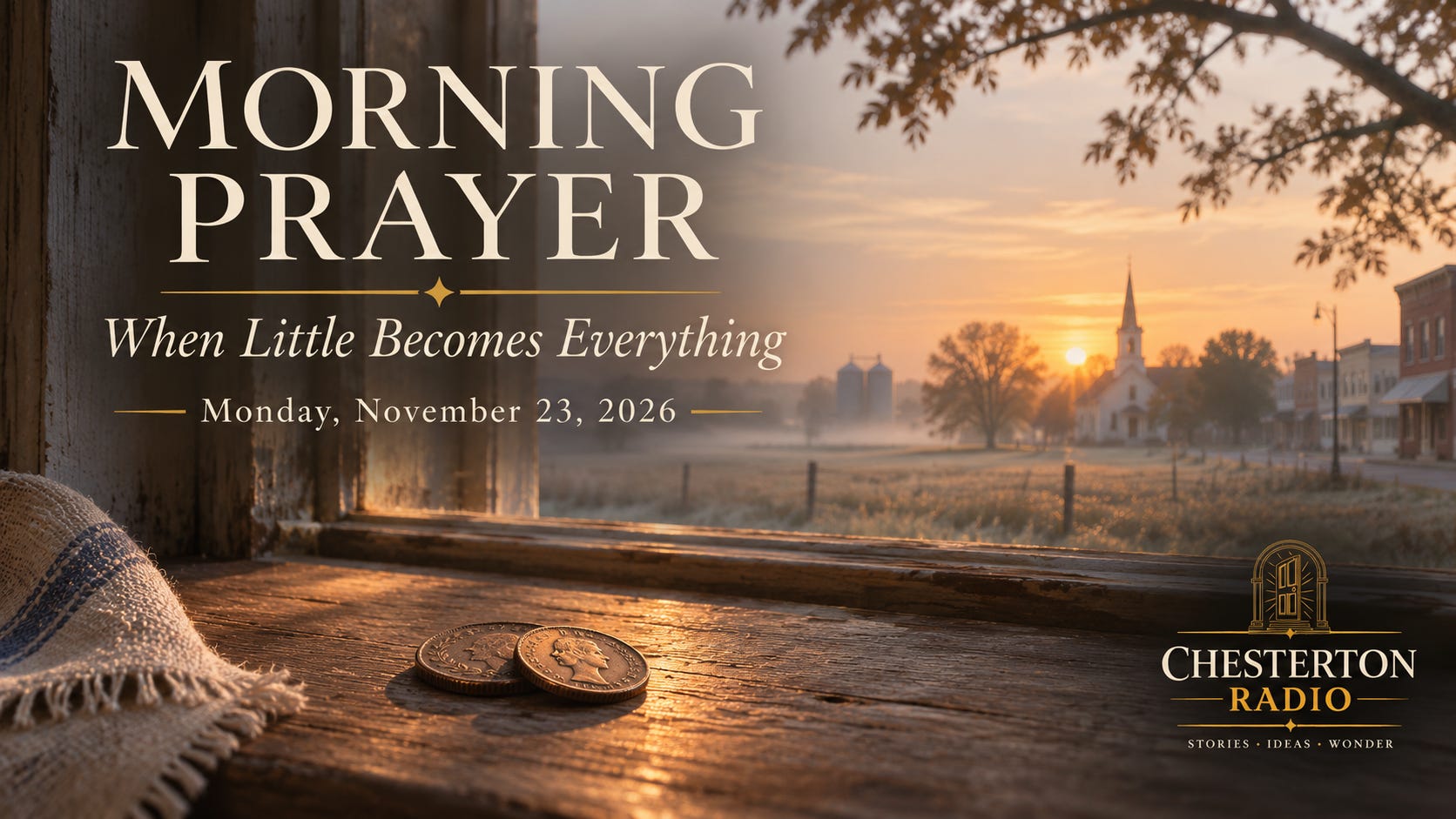
Morning Prayer: The Two Coins That Weighed More
Opening
A little money can make a surprising amount of noise. Two coins dropped into a dish announce themselves; two coins dropped into a treasury might disappear beneath the weight of everything already there. Yet the Lord, who created the sun and knows the depths of the sea, notices what almost everyone else misses.
In the final week of the Church’s liturgical year, with Advent just ahead, the Gospel asks an unsettling question: What does God count when he looks at what we give? The answer cannot be found merely in a ledger.
This morning the psalmist thirsts for the living God, the heavens proclaim their Maker, and a widow gives two small coins. We begin by asking for the grace to give God not an impressive appearance, but an undivided heart.
Opening Verse
Lord, open my lips.
And my mouth shall declare thy praise.
Invitatory
Antiphon: Come, let us adore the Lord, the maker of all things.
Psalm 94 (95) — A Call to Worship
1. Come let us praise the Lord with joy: let us joyfully sing to God our saviour.
2. Let us come before his presence with thanksgiving; and make a joyful noise to him with psalms.
3. For the Lord is a great God, and a great King above all gods.
4. For in his hand are all the ends of the earth: and the heights of the mountains are his.
5. For the sea is his, and he made it: and his hands formed the dry land.
6. Come let us adore and fall down: and weep before the Lord that made us.
7. For he is the Lord our God: and we are the people of his pasture and the sheep of his hand.
8. To day if you shall hear his voice, harden not your hearts:
9. As in the provocation, according to the day of temptation in the wilderness: where your fathers tempted me, they proved me, and saw my works.
10. Forty years long was I offended with that generation, and I said: These always err in heart.
11. And these men have not known my ways: so I swore in my wrath that they shall not enter into my rest.
Glory be to the Father, and to the Son, and to the Holy Ghost.
As it was in the beginning, is now, and ever shall be, world without end. Amen.
Antiphon: Come, let us adore the Lord, the maker of all things.
Psalmody
First Psalm — Psalm 41 (42): The Soul Thirsts for God
Antiphon 1: My soul thirsteth after the strong living God.
2. As the hart panteth after the fountains of water; so my soul panteth after thee, O God.
3. My soul hath thirsted after the strong living God; when shall I come and appear before the face of God?
4. My tears have been my bread day and night, whilst it is said to me daily: Where is thy God?
5. These things I remembered, and poured out my soul in me: for I shall go over into the place of the wonderful tabernacle, even to the house of God: With the voice of joy and praise; the noise of one feasting.
6. Why art thou sad, O my soul? and why dost thou trouble me? Hope in God, for I will still give praise to him: the salvation of my countenance,
7. And my God. My soul is troubled within myself: therefore will I remember thee from the land of Jordan and Hermoniim, from the little hill.
8. Deep calleth on deep, at the noise of thy flood-gates. All thy heights and thy billows have passed over me.
9. In the daytime the Lord hath commanded his mercy; and a canticle to him in the night. With me is prayer to the God of my life.
10. I will say to God: Thou art my support. Why hast thou forgotten me? and why go I mourning, whilst my enemy afflicteth me?
11. Whilst my bones are broken, my enemies who trouble me have reproached me; Whilst they say to me day by day: Where is thy God?
12. Why art thou cast down, O my soul? and why dost thou disquiet me? Hope thou in God, for I will still give praise to him: the salvation of my countenance, and my God.
Glory be to the Father, and to the Son, and to the Holy Ghost.
As it was in the beginning, is now, and ever shall be, world without end. Amen.
Antiphon 1: My soul thirsteth after the strong living God.
Old Testament Canticle — Ecclesiasticus (Sirach) 36: Prayer for God’s People
The complete Lauds selection, Sirach 36:1–5, 10–13 in the liturgical books, rendered using its corresponding Douay–Rheims verses 36:1–7, 13–16.
Antiphon 2: O Lord, shew us the light of thy mercies.
1. Have mercy upon us, O God of all, and behold us, and shew us the light of thy mercies:
2. And send thy fear upon the nations, that have not sought after thee: that they may know that there is no God beside thee, and that they may shew forth thy wonders.
3. Lift up thy hand over the strange nations, that they may see thy power.
4. For as thou hast been sanctified in us in their sight, so thou shalt be magnified among them in our presence,
5. That they may know thee, as we also have known thee, that there is no God beside thee, O Lord.
6. Renew thy signs, and work new miracles.
7. Glorify thy hand, and thy right arm.
13. Gather together all the tribes of Jacob: that they may know that there is no God besides thee, and may declare thy great works: and thou shalt inherit them as from the beginning.
14. Have mercy on thy people, upon whom thy name is invoked: and upon Israel, whom thou hast raised up to be thy firstborn.
15. Have mercy on Jerusalem, the city which thou hast sanctified, the city of thy rest.
16. Fill Sion with thy unspeakable words, and thy people with thy glory.
Glory be to the Father, and to the Son, and to the Holy Ghost.
As it was in the beginning, is now, and ever shall be, world without end. Amen.
Antiphon 2: O Lord, shew us the light of thy mercies.
Second Psalm — Psalm 18 (19):2–7: The Heavens Declare God’s Glory
Antiphon 3: The heavens shew forth the glory of God.
2. The heavens shew forth the glory of God, and the firmament declareth the work of his hands.
3. Day to day uttereth speech, and night to night sheweth knowledge.
4. There are no speeches nor languages, where their voices are not heard.
5. Their sound hath gone forth into all the earth: and their words unto the ends of the world.
6. He hath set his tabernacle in the sun: and he, as a bridegroom coming out of his bride chamber, Hath rejoiced as a giant to run the way:
7. His going out is from the end of heaven, And his circuit even to the end thereof: and there is no one that can hide himself from his heat.
Glory be to the Father, and to the Son, and to the Holy Ghost.
As it was in the beginning, is now, and ever shall be, world without end. Amen.
Antiphon 3: The heavens shew forth the glory of God.
Short Reading — Jeremias 15:16
Thy words were found, and I did eat them, and thy word was to me a joy and gladness of my heart: for thy name is called upon me, O Lord God of hosts.
Short Responsory
Original response for this edition.
Lord, make our hearts glad in thy word.
Lord, make our hearts glad in thy word.
Let our hands do what our lips profess.
Make our hearts glad in thy word.
Glory be to the Father, and to the Son, and to the Holy Ghost.
Lord, make our hearts glad in thy word.
Gospel of the Day — Saint Luke 21:1–4
The complete Mass Gospel, Douay–Rheims.
1. And looking on, he saw the rich men cast their gifts into the treasury.
2. And he saw also a certain poor widow casting in two brass mites.
3. And he said: Verily I say to you, that this poor widow hath cast in more than they all:
4. For all these have of their abundance cast into the offerings of God: but she of her want, hath cast in all the living that she had.
Benedictus — Canticle of Zachary (Saint Luke 1:68–79)
Antiphon: Blessed be the Lord God of Israel; for he hath visited and redeemed his people.
68. Blessed be the Lord God of Israel; because he hath visited and wrought the redemption of his people:
69. And hath raised up an horn of salvation to us, in the house of David his servant:
70. As he spoke by the mouth of his holy prophets, who are from the beginning:
71. Salvation from our enemies, and from the hand of all that hate us:
72. To perform mercy to our fathers, and to remember his holy testament,
73. The oath, which he swore to Abraham our father, that he would grant to us,
74. That being delivered from the hand of our enemies, we may serve him without fear,
75. In holiness and justice before him, all our days.
76. And thou, child, shalt be called the prophet of the Highest: for thou shalt go before the face of the Lord to prepare his ways:
77. To give knowledge of salvation to his people, unto the remission of their sins:
78. Through the bowels of the mercy of our God, in which the Orient from on high hath visited us:
79. To enlighten them that sit in darkness, and in the shadow of death: to direct our feet into the way of peace.
Glory be to the Father, and to the Son, and to the Holy Ghost.
As it was in the beginning, is now, and ever shall be, world without end. Amen.
Antiphon: Blessed be the Lord God of Israel; for he hath visited and redeemed his people.
Intercessions
Let us offer the day to Christ, who sees the smallest act of love and knows the needs hidden from the world. To each petition let us answer:
Lord, receive our hearts.
For the Holy Church, the Holy Father, our bishops, priests, deacons, religious, and all the faithful: that we may serve without seeking applause and safeguard those who are vulnerable, we pray.
Lord, receive our hearts.
For rulers and neighbors, for peace where there is conflict, and for those who must decide how limited resources are shared: that justice may attend mercy, we pray.
Lord, receive our hearts.
For those beginning their work today, for those looking for work, for caregivers and all whose labor goes unnoticed: that every honest duty may become an offering of love, we pray.
Lord, receive our hearts.
For our homes and families, for those preparing to travel or welcome guests, and for those who will spend this Thanksgiving week alone: that no one be forgotten at our tables or in our prayers, we pray.
Lord, receive our hearts.
For the poor, the widowed, the hungry, the indebted, the ill, and all who live with fear of tomorrow: that they may find real help, protection, companionship, and hope, we pray.
Lord, receive our hearts.
For the faithful departed and all who mourn them: that those who now walk in the shadow of death may rest in the mercy of the risen Christ, we pray.
Lord, receive our hearts.
For ourselves: that we may neither boast of what we give nor withhold the love that is ours to offer, we pray.
Lord, receive our hearts.
Our Father
Our Father, who art in heaven,
hallowed be thy name;
thy kingdom come;
thy will be done on earth as it is in heaven.
Give us this day our daily bread;
and forgive us our trespasses
as we forgive those who trespass against us;
and lead us not into temptation,
but deliver us from evil. Amen.
Concluding Prayer
O God, who knowest the worth of every secret sacrifice, cleanse our intentions and make us generous in love. Give bread to the hungry, courage to the anxious, and protection to those whose need may be exploited. Teach us to hear thy word with joy and to offer thee faithfully the work of our hands and the devotion of our hearts. Through Jesus Christ, thy Son, our Lord, who liveth and reigneth with thee in the unity of the Holy Ghost, God, world without end. Amen.
Blessing
May the Lord bless us, protect us from all evil, and bring us to everlasting life. Amen.
The Paradox of the Day
In the treasury of Heaven, two coins could weigh more than all the riches of the world.
Chesterton for the Morning
“The test of all happiness is gratitude; and I felt grateful, though I hardly knew to whom.”
— *G. K. Chesterton, Orthodoxy (1908), Chapter IV, “The Ethics of Elfland.”
A Chestertonian Meditation — The Ledger That Heaven Keeps
There is probably a drawer somewhere in your house containing a small republic of loose change. A penny keeps company with a paper clip; a nickel sleeps beside a button whose coat has long since disappeared; and a dime, possessing the irritating confidence of small things, rolls into the darkest corner. We scarcely count such money now. It has become the sort of treasure one gives to a child, or leaves for the next person to discover.
That is why the two coins in this morning’s Gospel are so astonishing. Nothing about their appearance suggests greatness. There is no trumpet, no procession, no donor’s name engraved on a wall. Our Lord watches rich men place their gifts in the treasury, and then he sees a widow deposit two brass mites. The whole transaction might have escaped a human observer. It does not escape him.
We tend to suppose that counting is the most objective of occupations. The bank balance does not flatter us. An accountant is not paid to praise our generosity. Two coins are two coins, and an impressive sum is an impressive sum. Yet Christ observes something no accountant can enter in the column marked Amount: what the gift costs the giver.
The rich have given from abundance. The widow, in the severe language of the Douay–Rheims, has given “all the living that she had.” Jesus does not pretend her coins have acquired a greater purchasing power. A hungry person cannot buy more bread because an offering is heroic. The material poverty remains. But the spiritual measurement has changed: the visible sum is small; the invisible trust is immense.
Here we meet one of those wonderfully unreasonable facts of Christianity which, upon examination, prove more reasonable than the ordinary rules of the world. In a shop, a thing is worth what someone will pay for it. In friendship, a thing may be worth what someone had to surrender to give it. A child’s uneven drawing may have no market value at all, but a mother would rescue it from a fire before a fashionable print. A worn letter can be more precious than an expensive book. A laborer who has little free time may give an hour whose true cost is greater than the grand donation of someone who scarcely notices the subtraction.
The Lord does not abolish arithmetic. He simply refuses to mistake arithmetic for the whole of reality.
There is a further difficulty, and the Gospel invites us to face it rather than evade it. Immediately before this scene, Saint Luke records Jesus’ warning against religious authorities who “devour the houses of widows” (Luke 20:47). We ought to hear that warning whenever anyone uses the widow’s two coins to pressure the poor into giving money they need for food or shelter. Christ praises the woman’s act of faith; he does not give prosperous people permission to profit from her vulnerability. A Church that admires her generosity must also be determined that no widow be neglected or exploited.
The widow is neither a decorative emblem of poverty nor a fundraising technique. She is a person whom Jesus sees. That, too, is part of the miracle: the most important figure in the treasury is the one the crowd has least reason to notice.
Our morning psalms prepare us for this reversal. “As the hart panteth after the fountains of water,” sings Psalm 41, “so my soul panteth after thee, O God.” The soul does not boast that it possesses God; it confesses thirst. The world teaches us to hide our emptiness. The psalm teaches us to turn it toward the living fountain. The widow’s gift and the psalmist’s longing are not identical experiences, but they share the same humility: neither mistakes need for disgrace.
The canticle from Ecclesiasticus asks the Lord to show the light of his mercies and gather his people together. And then Psalm 18 lifts our eyes from the treasury to the sky. The heavens have no purse at all, yet they spend the morning proclaiming the glory of their Maker. The sun pours out light without sending an invoice. A field receives it without proving that it deserves it. The smallest frosted blade of grass shines for a moment as if the whole universe had remembered its name.
Chesterton understood that before we can give rightly, we must learn to receive with wonder. In Orthodoxy, he finds the test of happiness in gratitude. Gratitude is an extraordinary habit because it begins by admitting that the best things are not entirely our achievements. We did not construct the morning. We did not invent the eyes with which we see it. Even the ability to work, earn, save, and give rests upon gifts we did not first manufacture.
This is not an argument for carelessness with money or a disdain for prudent provision. The widow’s real need matters. A household must budget. A parent must feed a child. The sick require medicine, not a sermon about the romance of sacrifice. Christian charity is never improved by pretending that necessities are luxuries. Still, prudence itself can become generous when it remembers what the money is for. We save not merely so that our fears may accumulate interest, but so that there may be bread, welcome, shelter, and freedom to help someone else.
Near the end of the Church’s year, and just before the American Thanksgiving holiday, this Gospel makes an especially useful examination of conscience. We may ask not simply, How much have I given? but What have I held back because I was afraid of being inconvenienced? Perhaps the gift is not financial at all. Perhaps it is an apology delivered without a defense, an afternoon given to a lonely relative, a patient answer to the same question asked for the fifth time, or the decision to see the quiet person everyone else overlooks.
None of these gestures excuses us from material generosity when we are able to give it. But the Lord who saw the widow also sees the offerings that never reach a collection plate. He sees the shift worked by someone already exhausted, the meal shared without a photograph, the hand held at a bedside, the prayer whispered for a person who cannot repay it.
Two coins fall into the treasury. They make a very small sound. Yet the King of the universe pauses to tell his disciples what they are worth. And somewhere this morning, in a drawer or a pocket or a human heart, something very small is waiting to be given with great love.
Closing
Lord Jesus, teach us to see what thou seest, to protect those whom the world overlooks, and to give thee our hearts without reserve. Amen.
Chesterton Radio