

Before the work of another Wednesday begins, the Church gives us something more fundamental than a list of things to accomplish.
She gives us time to pray.
Today we remember Saint Pius of Pietrelcina — Padre Pio — the Capuchin priest whose life became inseparable from prayer, the Eucharist, confession, suffering, and an extraordinary confidence in God.
That confidence fits remarkably well with today’s Gospel.
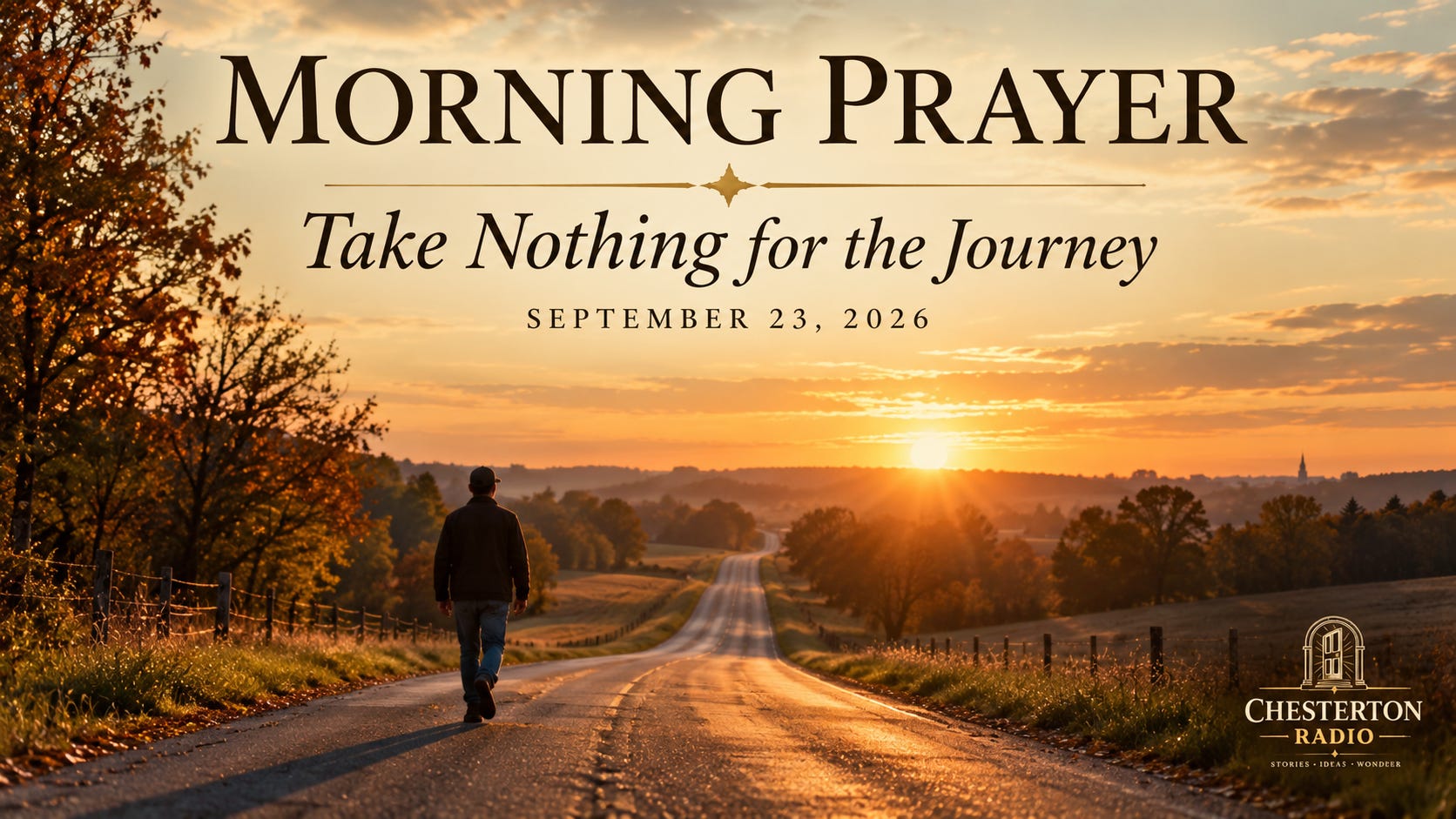
Christ sends the Twelve out to preach the Kingdom of God, but he sends them with almost nothing. No bread. No money. No second coat. They are given something apparently less practical and infinitely more important: Christ’s authority and the opportunity to trust his Providence.
Perhaps that is a good place to begin this morning.
Not by asking whether we possess everything we might need for the road ahead, but by remembering who has sent us upon it.
Opening Verse
Lord, open my lips.
And my mouth shall declare thy praise.
Invitatory
Antiphon
Come, let us adore Christ, the chief shepherd of his flock.
Psalm 94 (95)
Come let us praise the Lord with joy:
let us joyfully sing to God our saviour.
Let us come before his presence with thanksgiving;
and make a joyful noise to him with psalms.
Come, let us adore Christ, the chief shepherd of his flock.
For the Lord is a great God,
and a great King above all gods.
For in his hand are all the ends of the earth:
and the heights of the mountains are his.
For the sea is his, and he made it:
and his hands formed the dry land.
Come, let us adore Christ, the chief shepherd of his flock.
Come let us adore and fall down:
and weep before the Lord that made us.
For he is the Lord our God:
and we are the people of his pasture
and the sheep of his hand.
Today if you shall hear his voice,
harden not your hearts:
As in the provocation,
according to the day of temptation in the wilderness:
Where your fathers tempted me,
they proved me, and saw my works.
Come, let us adore Christ, the chief shepherd of his flock.
Forty years long was I offended with that generation,
and I said: These always err in heart.
And these men have not known my ways:
So I swore in my wrath
that they shall not enter into my rest.
Glory be to the Father, and to the Son,
and to the Holy Ghost.
As it was in the beginning, is now, and ever shall be,
world without end. Amen.
Come, let us adore Christ, the chief shepherd of his flock.
Psalmody
Psalm 35 (36)
Antiphon I
In thy light, O God, we shall see light.
The unjust hath said within himself, that he would sin:
there is no fear of God before his eyes.
For in his sight he hath done deceitfully,
that his iniquity may be found unto hatred.
The words of his mouth are iniquity and guile:
he would not understand that he might do well.
He hath devised iniquity on his bed,
he hath set himself on every way that is not good:
but evil he hath not hated.
O Lord, thy mercy is in heaven,
and thy truth reacheth even to the clouds.
Thy justice is as the mountains of God,
thy judgments are a great deep.
Men and beasts thou wilt preserve, O Lord:
O how hast thou multiplied thy mercy, O God!
But the children of men shall put their trust
under the covert of thy wings.
They shall be inebriated with the plenty of thy house;
and thou shalt make them drink of the torrent of thy pleasure.
For with thee is the fountain of life;
and in thy light we shall see light.
Extend thy mercy to them that know thee,
and thy justice to them that are right in heart.
Let not the foot of pride come to me,
and let not the hand of the sinner move me.
There the workers of iniquity are fallen,
they are cast out, and could not stand.
Glory be to the Father, and to the Son,
and to the Holy Ghost.
As it was in the beginning, is now, and ever shall be,
world without end. Amen.
In thy light, O God, we shall see light.
Canticle — Judith 16
Antiphon II
O Lord, thou art great and glorious in thy power, and no one can overcome thee.
Begin ye to the Lord with timbrels,
sing ye to the Lord with cymbals,
Tune unto him a new psalm,
extol and call upon his name.
The Lord putteth an end to wars,
the Lord is his name.
Let us sing a hymn to the Lord,
let us sing a new hymn to our God.
O Adonai, Lord, great art thou,
and glorious in thy power,
and no one can overcome thee.
Let all thy creatures serve thee:
because thou hast spoken, and they were made:
Thou didst send forth thy spirit, and they were created,
and there is no one that can resist thy voice.
The mountains shall be moved from the foundations with the waters:
the rocks shall melt as wax before thy face.
But they that fear thee,
shall be great with thee in all things.
Glory be to the Father, and to the Son,
and to the Holy Ghost.
As it was in the beginning, is now, and ever shall be,
world without end. Amen.
O Lord, thou art great and glorious in thy power, and no one can overcome thee.
Psalm 46 (47)
Antiphon III
Sing praises to our God, sing ye; sing praises to our King, sing ye.
O clap your hands, all ye nations:
shout unto God with the voice of joy.
For the Lord is high, terrible:
a great king over all the earth.
He hath subdued the people under us:
and the nations under our feet.
He hath chosen for us his inheritance,
the beauty of Jacob which he hath loved.
God is ascended with jubilee,
and the Lord with the sound of trumpet.
Sing praises to our God, sing ye:
sing praises to our king, sing ye.
For God is the king of all the earth:
sing ye wisely.
God shall reign over the nations:
God sitteth on his holy throne.
The princes of the people are gathered together,
with the God of Abraham:
For the strong gods of the earth
are exceedingly exalted.
Glory be to the Father, and to the Son,
and to the Holy Ghost.
As it was in the beginning, is now, and ever shall be,
world without end. Amen.
Sing praises to our God, sing ye; sing praises to our King, sing ye.
Short Reading
Hebrews 13:7–9
Remember your prelates who have spoken the word of God to you: whose faith follow, considering the end of their conversation,
Jesus Christ, yesterday, and today: and the same for ever.
Be not led away with various and strange doctrines. For it is best that the heart be established with grace, not with meats: which have not profited those that walk in them.
Short Responsory
Lord, keep watch over thy people.
Lord, keep watch over thy people.
By day and by night, let thy servants proclaim thy name.
Lord, keep watch over thy people.
Glory be to the Father, and to the Son, and to the Holy Ghost.
Lord, keep watch over thy people.
The Gospel of the Day
Luke 9:1–6
Then calling together the twelve apostles, he gave them power and authority over all devils, and to cure diseases.
And he sent them to preach the kingdom of God, and to heal the sick.
And he said to them:
Take nothing for your journey; neither staff, nor scrip, nor bread, nor money; neither have two coats.
And whatsoever house you shall enter into, abide there, and depart not from thence.
And whosoever will not receive you, when ye go out of that city, shake off even the dust of your feet, for a testimony against them.
And going out, they went about through the towns, preaching the gospel, and healing every where.
Benedictus
Antiphon
It is not you that speak, but the Spirit of your Father that speaketh in you.
Canticle of Zachary — Luke 1:68–79
Blessed be the Lord God of Israel;
because he hath visited and wrought the redemption of his people:
And hath raised up an horn of salvation to us,
in the house of David his servant:
As he spoke by the mouth of his holy prophets,
who are from the beginning:
Salvation from our enemies,
and from the hand of all that hate us:
To perform mercy to our fathers,
and to remember his holy testament,
The oath, which he swore to Abraham our father,
that he would grant to us,
That being delivered from the hand of our enemies,
we may serve him without fear,
In holiness and justice before him,
all our days.
And thou, child, shalt be called the prophet of the Highest:
for thou shalt go before the face of the Lord to prepare his ways:
To give knowledge of salvation to his people,
unto the remission of their sins:
Through the bowels of the mercy of our God,
in which the Orient from on high hath visited us:
To enlighten them that sit in darkness,
and in the shadow of death:
to direct our feet into the way of peace.
Glory be to the Father, and to the Son,
and to the Holy Ghost.
As it was in the beginning, is now, and ever shall be,
world without end. Amen.
It is not you that speak, but the Spirit of your Father that speaketh in you.
Intercessions
Christ is the Good Shepherd, who laid down his life for his sheep. Trusting in his care, let us pray:
Lord, nourish thy people.
Lord Jesus, thou didst send thy Apostles into the world to proclaim the Kingdom:
Give thy Church courage to speak the truth with charity and to carry the Gospel wherever men and women hunger for hope.
Lord, nourish thy people.
Thou didst send the Twelve without earthly guarantees:
Free us from the fear that tells us we can begin only when everything is certain, everything is provided, and every difficulty has been removed.
Lord, nourish thy people.
On this memorial of Saint Pius of Pietrelcina, we pray for Pope Leo, our bishops, priests, deacons, and all who have been entrusted with the care of souls:
Give them fidelity in prayer, courage in teaching, patience in service, and compassion toward those who seek reconciliation.
Lord, nourish thy people.
Remember especially those priests who spend long hours celebrating the sacraments, hearing confessions, visiting the sick, teaching the faith, comforting the grieving, and carrying burdens known only to thee:
Strengthen them when they are weary and renew their joy in their vocation.
Lord, nourish thy people.
For those who begin this morning uncertain of what comes next — those awaiting news, facing financial worries, making difficult decisions, searching for work, caring for family, or beginning an unfamiliar journey:
Give them today’s bread rather than tomorrow’s anxiety.
Lord, nourish thy people.
For all who labor today in offices and factories, classrooms and hospitals, farms and workshops, shops and kitchens, homes and construction sites:
May honest work become an offering of love, and may we recognize dignity even in the smallest task faithfully performed.
Lord, nourish thy people.
For our homes and families:
Keep us from becoming so accustomed to those we love that we cease to wonder at the gift of their presence.
Teach us patience with one another, readiness to forgive, and gratitude for ordinary days together.
Lord, nourish thy people.
For the sick, the lonely, the forgotten, the anxious, those carrying private grief, and all who have asked for our prayers:
Let them find shelter beneath thy wings and companions along the road.
Lord, nourish thy people.
For those who have died, especially those whom we love and still miss:
Bring them safely to that country where every faithful journey ends in homecoming.
Lord, nourish thy people.
And for ourselves:
Give us enough courage for today’s trouble, enough patience for today’s inconvenience, enough gratitude for today’s gifts, and enough faith to take the next step even when we cannot see the whole road.
Lord, nourish thy people.
Our Father
Our Father, who art in heaven,
hallowed be thy name.
Thy kingdom come.
Thy will be done on earth
as it is in heaven.
Give us this day our daily bread.
And forgive us our trespasses,
as we forgive those who trespass against us.
And lead us not into temptation,
but deliver us from evil.
Amen.
Concluding Prayer
Almighty and eternal God,
thou didst grant to Saint Pius of Pietrelcina a profound share in the Cross of thy Son and make his priestly ministry an instrument of mercy and reconciliation.
Through his intercession, keep us close to Christ in suffering and in joy. Teach us to seek thee faithfully in prayer, to receive thy mercy with humility, and to extend that mercy to those whom we meet.
When the road before us is uncertain, give us confidence in thy Providence; when the burden seems heavy, unite us more closely to the Passion of Christ; and when our earthly pilgrimage is ended, bring us to the joy of his Resurrection.
Through Jesus Christ our Lord.
Amen.
Blessing
May the Lord bless us,
and keep us from all evil,
and bring us unto everlasting life.
Amen.
The Paradox of the Day
The less the Apostles carried, the more room they left for Providence.
There is something almost comic about the instructions Jesus gives the Twelve today.
He sends them out to do an enormous thing.
Preach the Kingdom of God.
Heal the sick.
Confront evil.
Carry news that will eventually overturn an empire and change the history of the world.
And then he gives them what sounds like the world’s worst packing list.
Take nothing.
No staff.
No bag.
No bread.
No money.
Not even a second coat.
We would probably begin with a spreadsheet.
There would be a checklist, a risk assessment, a contingency plan, and a backup contingency plan. Someone would ask whether the Apostles had completed the appropriate travel authorization.
And Peter would almost certainly have forgotten his password.
But Christ strips the expedition down to something startlingly simple.
Go. Trust. Receive. Preach.
Perhaps the things we carry to make ourselves secure can sometimes become the very things that prevent us from discovering Providence.
Chesterton for the Morning
G. K. Chesterton wrote:
“An adventure is only an inconvenience rightly considered. An inconvenience is only an adventure wrongly considered.”
— G. K. Chesterton, All Things Considered, “On Running After One’s Hat”
Chesterton was writing about something wonderfully mundane: the inconveniences of ordinary life.
And that is precisely why the line matters.
Christianity does not ordinarily ask us to escape the ordinary world.
It asks us to see it.
A Chestertonian Meditation
Imagine one of the Twelve on the morning described by Saint Luke.
Perhaps he had packed the night before.
That would have been the sensible thing.
Some bread wrapped for the journey. A little money. An extra garment because evenings can become cold. A staff because roads are uneven. Perhaps some small object whose usefulness could be defended with complete seriousness.
Every traveller knows how this works.
The difficulty is rarely deciding what we obviously need. The difficulty is deciding what we might need.
And there is almost no limit to what we might need.
That is how a suitcase becomes heavy.
Then Jesus looks at the preparations and says:
Leave them.
There must have been a moment when somebody wondered whether he had heard correctly.
Because we generally imagine faith as receiving something.
Sometimes faith is putting something down.
The strange thing about luggage is that almost everything in it is reasonable. That is why we packed it. We do not generally fill suitcases with objects we know to be useless. We carry things because we can construct a perfectly plausible future in which we shall need them.
And if imagination is allowed to run far enough, we can imagine needing almost everything.
Another shirt.
Another tool.
Another dollar.
Another plan.
Another guarantee.
Another qualification.
Another meeting.
Another year before beginning.
Eventually we can become so perfectly prepared for the journey that we never leave.
Christ does something astonishing in today’s Gospel.
He sends the Apostles before they can make themselves invulnerable.
That is not irresponsibility.
It is discipleship.
There is an enormous difference between having a plan and believing that the plan is God.
The Apostles will need bread.
But someone will give them bread.
They will need shelter.
Someone will open a door.
They will need strength.
Strength will be given when strength is required.
They do not carry the entire journey with them.
They receive it one village at a time.
One house at a time.
One meal at a time.
One day at a time.
And suddenly a very familiar sentence from the Our Father becomes rather more alarming:
Give us this day our daily bread.
We have said those words so often that it is easy to overlook their outrageous modesty.
Christ does not teach us to pray for a warehouse.
He teaches us to pray for bread.
And not next month’s bread.
Today’s.
This theme appears almost uncannily in today’s first reading at Mass as well. The Book of Proverbs asks God for neither poverty nor riches, but simply for the food that is necessary.
There is a Christian sanity in that request that cuts directly across both greed and anxiety.
Greed says, I must possess more.
Anxiety says, I must possess enough to make the future incapable of frightening me.
The Gospel answers both with two words:
Trust God.
This does not mean refusing to save money, plan a project, pack a suitcase, buy groceries, maintain the house, prepare for retirement, or carry an umbrella when the forecast says rain.
Providence is not an excuse for stupidity.
Chesterton would have enjoyed the absurdity of that idea.
But prudence and Providence are not enemies. Prudence asks us to do faithfully what can reasonably be done today. Anxiety demands that we somehow guarantee tomorrow.
And tomorrow has never agreed to such an arrangement.
Chesterton understood this because he understood adventure.
In All Things Considered, he writes about floods, railway stations, jammed drawers, and the indignity of chasing one’s hat down the street. None of these things sounds particularly theological.
That is exactly the point.
Chesterton noticed that modern man had developed the peculiar ability to be surrounded by wonders and irritated by all of them.
A child at a railway station sees enormous machines roaring out toward unknown cities.
An adult sees a delayed train.
A child sees a storm and candles.
An adult sees a power outage.
A child chasing a hat sees a battle.
An adult sees an inconvenience.
The physical facts may be identical.
What changes is the imagination.
Chesterton’s claim is not that real suffering is imaginary. In the very essay from which today’s quotation comes, he carefully distinguishes genuine pain from mere inconvenience.
That distinction matters particularly today, because Padre Pio knew genuine suffering.
The Cross cannot be reduced to a positive attitude.
Illness is not pleasant because we decide to call it an adventure. Grief does not cease to hurt because we look at it from a jaunty angle. Loneliness, disappointment, betrayal, and death are not inconveniences that can be made charming by clever prose.
Christianity says something much stranger.
It says that even suffering cannot put us outside Providence.
The Cross itself proves it.
At Calvary everything appears to have gone wrong.
The Messiah is rejected.
The innocent man is condemned.
The disciples scatter.
The crowds mock.
The body is placed in a tomb.
If Christianity ended on Good Friday evening, despair would be entirely reasonable.
But Sunday exists.
That is the great Christian scandal against despair.
Not that Friday did not hurt.
Not that the Cross was secretly comfortable.
But that God was accomplishing something even when everyone looking at the scene would have sworn that everything had been lost.
Padre Pio built his life around precisely that mystery: Christ crucified is not evidence that God has abandoned the world.
Christ crucified is evidence of how completely God has entered it.
And so perhaps there is something we would like to put into our own bag this Wednesday morning.
Certainty about a decision.
An answer from someone.
Enough money to know everything will be all right.
A guarantee concerning our work.
A guarantee concerning our health.
A guarantee concerning our children.
A map showing exactly where the next year will lead.
Most of us would happily carry those things.
Christ rarely gives us that luggage.
Instead, he gives us himself.
And says:
Go.
There is tremendous freedom in realizing that we do not have to solve Thursday before breakfast on Wednesday.
We do not have to carry October through September.
We do not have to finish conversations that have not yet begun.
We do not need grace today for something that may happen six months from now.
Today’s grace is for today.
Tomorrow’s grace will arrive tomorrow.
Perhaps that is why the Apostles could travel so lightly.
They were not carrying the future. God was already there.
There is another beautiful detail in the Gospel.
The Apostles are forced to depend upon other people.
“Into whatsoever house you shall enter, abide there.”
They must accept hospitality.
That may be almost as difficult as travelling without money.
We like being the giver because the giver remains in control. Receiving is harder. Receiving means admitting that we are not self-sufficient.
Someone else must open the door.
Someone else must provide the meal.
Someone else must make room at the table.
And therefore Christ’s apparently impractical travel instructions create something else along the road:
community.
The Kingdom does not arrive as twelve perfectly equipped professionals descending upon helpless villages.
It arrives through relationships.
A door opens.
A stranger enters.
Bread is broken.
Stories are told.
The sick are brought forward.
Someone listens.
Someone believes.
Someone else does not.
The Apostles move onward.
Christianity begins spreading across the world from house to house.
Perhaps Providence very often works like that.
Not as a miraculous package dropped from heaven containing everything we shall ever require, but as the next open door.
The person who happens to know something we do not.
The friend who calls.
The stranger who helps.
The unexpected invitation.
The meal placed in front of us.
The delay that changes our plans.
Even the inconvenience that sends us down another road.
So as another ordinary Wednesday begins, perhaps we can leave one unnecessary thing behind.
Not the lunch.
You may need the lunch.
Leave the imaginary catastrophe.
Leave the conversation that has not happened.
Leave the argument you have been rehearsing with someone who is not in the room.
Leave the insistence that everything must be understood before anything can be trusted.
Leave tomorrow where God has put it:
tomorrow.
Take the work that is actually yours.
Take the people actually given to you.
Take today’s bread.
Take today’s grace.
And go.
Perhaps somewhere along the road a door will open.
Perhaps something inconvenient will become an adventure.
Perhaps something ordinary will suddenly reveal itself as a gift.
And perhaps at the end of the day we will discover the great paradox hidden inside Christ’s strange instructions to the Twelve:
We thought Providence meant having everything we might possibly need.
Instead, Providence meant discovering that God was already waiting for us at the next house.
Saint Pius of Pietrelcina, pray for us.
May we carry what is ours to carry today, put down what is not, and trust the road ahead to the God who is already there.
We do not need tomorrow’s grace this morning. Today’s will be enough.
Chesterton Radio