

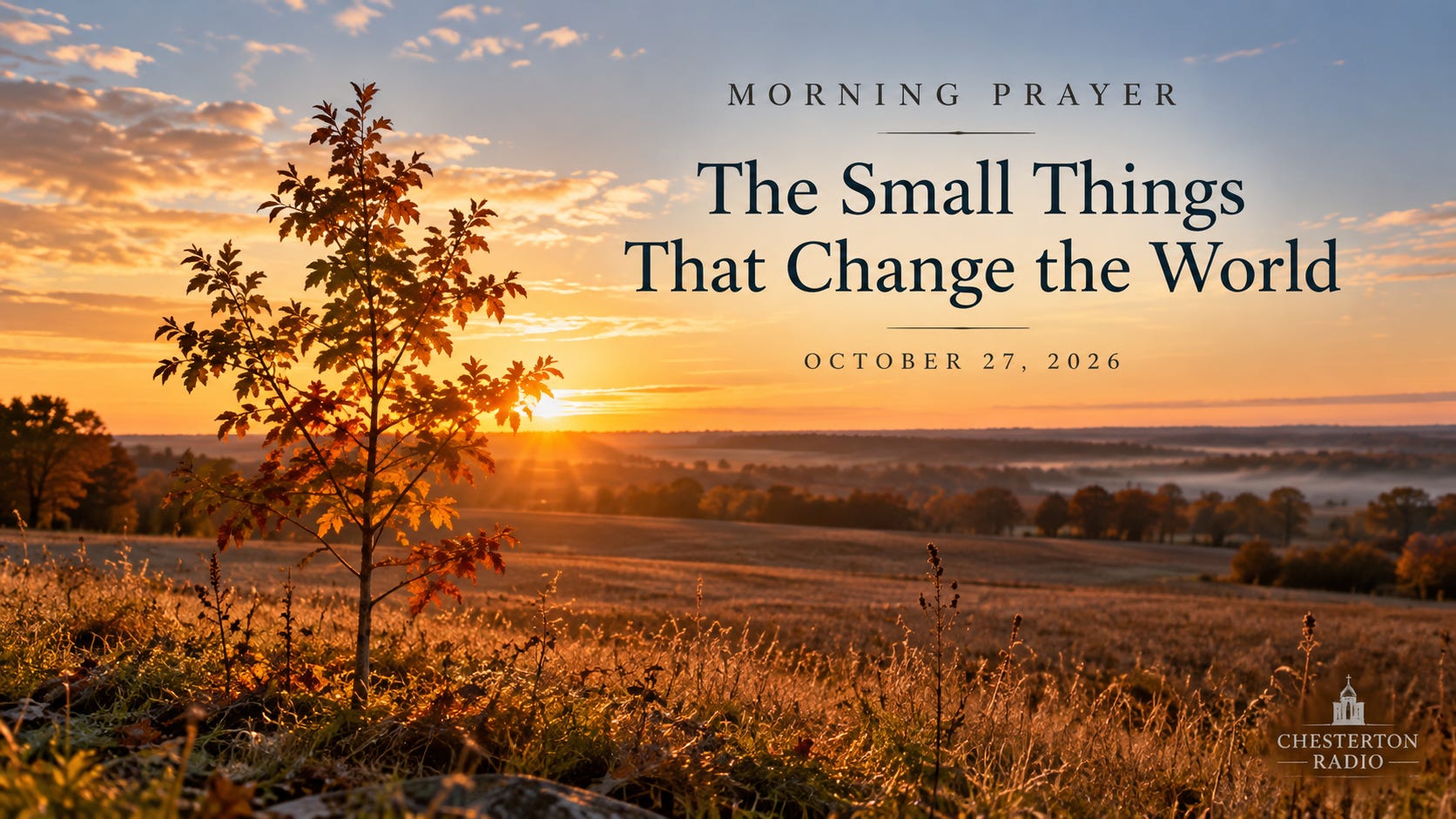
The Small Things That Change the World
Morning rarely announces itself with trumpets.
The first light comes almost apologetically through the window. Coffee begins with a spoonful of grounds. A fire begins with a match. A conversation begins with a word. Most of the things that eventually become important begin by looking remarkably unimportant.
Our Lord speaks this morning about two such things: a mustard seed and a little leaven.
Neither is impressive. Neither attracts a crowd.
Yet one becomes a place where birds can rest, and the other quietly changes an entire measure of dough.
Perhaps the Kingdom of God is nearer this morning than we think.
Opening Verse
Lord, open my lips.
And my mouth shall declare thy praise.
Invitatory
Antiphon: Come, let us adore the Lord, for he has made us and we are his people.
Psalm 94 (95)
Come let us praise the Lord with joy:
let us joyfully sing to God our saviour.
Let us come before his presence with thanksgiving;
and make a joyful noise to him with psalms.
For the Lord is a great God,
and a great King above all gods.
For in his hand are all the ends of the earth:
and the heights of the mountains are his.
For the sea is his, and he made it:
and his hands formed the dry land.
Come let us adore and fall down:
and weep before the Lord that made us.
For he is the Lord our God:
and we are the people of his pasture
and the sheep of his hand.
Today if you shall hear his voice,
harden not your hearts:
As in the provocation,
according to the day of temptation in the wilderness:
Where your fathers tempted me,
they proved me, and saw my works.
Forty years long was I offended with that generation,
and I said: These always err in heart.
And these men have not known my ways:
so I swore in my wrath that they shall not enter into my rest.
Glory be to the Father, and to the Son,
and to the Holy Ghost.
As it was in the beginning, is now, and ever shall be,
world without end. Amen.
Antiphon: Come, let us adore the Lord, for he has made us and we are his people.
Psalmody
Psalm 42 (43)
Antiphon: Send forth thy light and thy truth; they have conducted me.
Judge me, O God, and distinguish my cause from the nation that is not holy:
deliver me from the unjust and deceitful man.
For thou art God my strength:
why hast thou cast me off?
and why do I go sorrowful whilst the enemy afflicteth me?
Send forth thy light and thy truth:
they have conducted me,
and brought me unto thy holy hill, and into thy tabernacles.
And I will go in to the altar of God:
to God who giveth joy to my youth.
To thee, O God my God, I will give praise upon the harp:
why art thou sad, O my soul?
and why dost thou disquiet me?
Hope in God, for I will still give praise to him:
the salvation of my countenance, and my God.
Glory be to the Father, and to the Son,
and to the Holy Ghost.
As it was in the beginning, is now, and ever shall be,
world without end. Amen.
Antiphon: Send forth thy light and thy truth; they have conducted me.
Canticle — Isaiah 38:10–14, 17–20
Antiphon: Lord, thou hast delivered my soul that it should not perish.
I said: In the midst of my days
I shall go to the gates of hell:
I sought for the residue of my years.
I said: I shall not see the Lord God in the land of the living:
I shall behold man no more, nor the inhabitant of rest.
My generation is at an end,
and it is rolled away from me, as a shepherd’s tent.
My life is cut off, as by a weaver:
whilst I was yet but beginning, he cut me off:
From morning even to night
thou wilt make an end of me.
I hoped till morning,
as a lion so hath he broken all my bones:
From morning even to night
thou wilt make an end of me.
I will cry like a young swallow,
I will meditate like a dove:
My eyes are weakened
looking upward.
But thou hast delivered my soul
that it should not perish:
Thou hast cast all my sins
behind thy back.
For hell shall not confess to thee,
neither shall death praise thee:
Nor shall they that go down into the pit
look for thy truth.
The living, the living, he shall give praise to thee,
as I do this day:
The father shall make thy truth known
to the children.
O Lord, save me,
and we will sing our psalms all the days of our life
in the house of the Lord.
Glory be to the Father, and to the Son,
and to the Holy Ghost.
As it was in the beginning, is now, and ever shall be,
world without end. Amen.
Antiphon: Lord, thou hast delivered my soul that it should not perish.
Psalm 64 (65)
Antiphon: Blessed is he whom thou hast chosen and taken to thee.
A hymn, O God, becometh thee in Sion:
and a vow shall be paid to thee in Jerusalem.
O hear my prayer:
all flesh shall come to thee.
The words of the wicked have prevailed over us:
and thou wilt pardon our transgressions.
Blessed is he whom thou hast chosen and taken to thee:
he shall dwell in thy courts.
We shall be filled with the good things of thy house;
holy is thy temple,
Wonderful in justice.
Hear us, O God our saviour,
Who art the hope of all the ends of the earth,
and in the sea afar off.
Thou who preparest the mountains by thy strength,
being girded with power:
Who troublest the depth of the sea,
the noise of its waves.
The Gentiles shall be troubled,
and they that dwell in the uttermost borders shall be afraid at thy signs:
Thou shalt make the outgoings of the morning and of the evening
to be joyful.
Thou hast visited the earth, and hast plentifully watered it;
thou hast many ways enriched it.
The river of God is filled with water,
thou hast prepared their food: for so is its preparation.
Fill up plentifully the streams thereof,
multiply its fruits;
It shall spring up and rejoice
in its showers.
Thou shalt bless the crown of the year
of thy goodness:
And thy fields
shall be filled with plenty.
The beautiful places of the wilderness shall grow fat:
and the hills shall be girded about with joy.
The rams of the flock are clothed,
and the vales shall abound with corn:
They shall shout,
yea they shall sing a hymn.
Glory be to the Father, and to the Son,
and to the Holy Ghost.
As it was in the beginning, is now, and ever shall be,
world without end. Amen.
Antiphon: Blessed is he whom thou hast chosen and taken to thee.
Short Reading
1 Thessalonians 5:4–5
But you, brethren, are not in darkness, that that day should overtake you as a thief.
For all you are the children of light, and children of the day: we are not of the night, nor of darkness.
Short Responsory
Lord, hear my voice; in thy promise is my hope.
Lord, hear my voice; in thy promise is my hope.
From the morning I watch for thee.
In thy promise is my hope.
Glory be to the Father, and to the Son, and to the Holy Ghost.
Lord, hear my voice; in thy promise is my hope.
Gospel of the Day
Luke 13:18–21
And he said: To what is the kingdom of God like, and whereunto shall I resemble it?
It is like to a grain of mustard seed, which a man took and cast into his garden, and it grew and became a great tree, and the birds of the air lodged in the branches thereof.
And again he said: Whereunto shall I esteem the kingdom of God to be like?
It is like to leaven, which a woman took and hid in three measures of meal, till the whole was leavened.
Benedictus
Antiphon: The Kingdom of God is like a grain of mustard seed: small in the hand, yet great in the purpose of God.
Canticle of Zachary — Luke 1:68–79
Blessed be the Lord God of Israel;
because he hath visited and wrought the redemption of his people:
And hath raised up an horn of salvation to us,
in the house of David his servant:
As he spoke by the mouth of his holy prophets,
who are from the beginning:
Salvation from our enemies,
and from the hand of all that hate us:
To perform mercy to our fathers,
and to remember his holy testament,
The oath, which he swore to Abraham our father,
that he would grant to us,
That being delivered from the hand of our enemies,
we may serve him without fear,
In holiness and justice before him,
all our days.
And thou, child, shalt be called the prophet of the Highest:
for thou shalt go before the face of the Lord to prepare his ways:
To give knowledge of salvation to his people,
unto the remission of their sins:
Through the bowels of the mercy of our God,
in which the Orient from on high hath visited us:
To enlighten them that sit in darkness, and in the shadow of death:
to direct our feet into the way of peace.
Glory be to the Father, and to the Son,
and to the Holy Ghost.
As it was in the beginning, is now, and ever shall be,
world without end. Amen.
Antiphon: The Kingdom of God is like a grain of mustard seed: small in the hand, yet great in the purpose of God.
Intercessions
Christ teaches us that his Kingdom often begins where the world sees almost nothing. Trusting in the hidden work of his grace, we pray:
Lord, make thy Kingdom grow among us.
For the Church: that her faithfulness in small things may bear fruit far beyond what can presently be seen.
Lord, make thy Kingdom grow among us.
For bishops, priests, deacons, religious, missionaries, and all who quietly plant the Gospel in difficult ground.
Lord, make thy Kingdom grow among us.
For those entrusted with public authority: that wisdom, justice, and mercy may take root in decisions whose consequences will reach generations yet unborn.
Lord, make thy Kingdom grow among us.
For our work today: for workshops and offices, classrooms and kitchens, farms and factories, hospitals and homes; that ordinary duties may become acts of charity.
Lord, make thy Kingdom grow among us.
For marriages and families: that patience, forgiveness, fidelity, and sacrifice may work like leaven within the home.
Lord, make thy Kingdom grow among us.
For those who are discouraged because their efforts seem small or fruitless: give them perseverance and the grace to trust what they cannot yet see.
Lord, make thy Kingdom grow among us.
For the sick, the lonely, the frightened, the unemployed, the grieving, and all who begin this morning beneath a heavy burden.
Lord, make thy Kingdom grow among us.
For those who have died: receive them into the fullness of that Kingdom whose beginnings we see only dimly here.
Lord, make thy Kingdom grow among us.
For ourselves: teach us not to despise small beginnings, unnoticed duties, quiet prayers, or simple acts of love.
Lord, make thy Kingdom grow among us.
Our Father
Our Father, who art in heaven,
hallowed be thy name.
Thy kingdom come.
Thy will be done on earth as it is in heaven.
Give us this day our daily bread.
And forgive us our trespasses,
as we forgive those who trespass against us.
And lead us not into temptation,
but deliver us from evil.
Amen.
Concluding Prayer
O God, who delightest to bring great things from small beginnings, plant thy word deeply within us this day. Give us patience when we cannot see its growth, fidelity in the duties placed before us, and charity enough to become instruments of thy Kingdom in our homes, our work, and our communities. May the hidden leaven of thy grace transform us, until all that we are belongs to thee.
Through Christ our Lord.
Amen.
Blessing
May the Lord bless us, protect us from all evil, and bring us to everlasting life.
Amen.
The Paradox of the Day
The Kingdom becomes great precisely because it is willing to begin small.
Chesterton for the Morning
“Real development is not leaving things behind, as on a road, but drawing life from them, as from a root.”
— G. K. Chesterton, The Victorian Age in Literature (1913)
A Chestertonian Meditation
The Mustard Seed Does Not Look Important
There is something faintly ridiculous about a seed.
Hold one in your palm and there is almost nothing to admire.
It has no branches. No shade. No birds. No fruit. It cannot shelter anybody from the rain. It cannot hold a swing. It cannot become lumber or firewood or the subject of a landscape painting.
It looks remarkably like a bit of debris you ought to brush off the kitchen table.
And Christ says: look at it.
This is what the Kingdom of God is like.
We tend to imagine important things arriving importantly.
If God intends to change the world, surely there ought to be trumpets. There should be committees. There should be a large building with polished brass letters on the front. There ought at least to be a press release.
Instead there is a seed.
And then Christ makes matters worse by talking about yeast.
A seed can at least be seen. Leaven disappears.
The woman puts it into the flour, and presently there is no obvious distinction between the part that is leaven and the part that is dough. Something hidden begins working upon everything around it.
This is a very strange picture of power.
We usually think power means the ability to make oneself visible. Christ describes a power that is perfectly content to disappear.
That may explain why we so often misunderstand the important parts of our own lives.
A father gets up and goes to work.
A mother packs a lunch.
Someone makes a telephone call to an elderly relative.
A teacher explains the same lesson for the fourth time.
A mechanic tightens the bolt that nobody will ever see.
A nurse checks on a sleeping patient.
A husband apologizes.
A wife forgives him.
Someone says a decade of the Rosary in a parked car.
Someone puts five dollars into an envelope.
Someone turns off the television and listens to a child.
Someone decides not to say the cruel thing that has already formed perfectly in his mind.
Nothing happens.
At least nothing that would interest the evening news.
And yet Christianity makes the astonishing claim that these things may be among the most consequential events occurring in the world.
Chesterton wrote that “real development is not leaving things behind, as on a road, but drawing life from them, as from a root.”
A root is another rather unimpressive thing.
It does its best work underground.
Nobody praises the roots of the autumn tree. We praise the scarlet leaves. Nobody takes the family photograph beside a particularly handsome root.
But remove the root and the leaves become a very temporary achievement.
Modern life has a peculiar fondness for visible results.
We count followers, views, dollars, votes, customers, degrees, awards, square feet, miles, pounds, percentages and quarterly growth. Some of these measurements are useful. A man running a business who refuses to look at numbers is not spiritual; he is soon unemployed.
But numbers can tempt us into believing that only measurable things are real.
Christ’s mustard seed is a warning against that mistake.
For a long time the seed is doing things that cannot be photographed.
The shell softens.
The hidden machinery of life awakens.
A root moves downward before anything moves upward.
And if an impatient gardener dug it up every morning to check its progress, he would eventually succeed in proving that nothing was growing.
Much of the Christian life is like that.
We pray for a child and see no change.
We try to repair a marriage and discover that years of hurt are not undone by one good conversation.
We begin a useful work and wonder whether anyone notices.
We attempt to conquer an old sin and discover, rather annoyingly, that the old sin has no intention of surrendering merely because we have made a resolution.
We do something good and the world remains stubbornly untransformed.
The temptation is to conclude that the good thing was too small.
But perhaps smallness is not the defect.
Perhaps smallness is the method.
The Church herself began absurdly small.
There was a child in Bethlehem.
There was a carpenter’s household in Nazareth.
There were fishermen beside a lake.
There was a meal in an upper room.
There was a condemned man upon a cross.
There was a tomb.
There were frightened disciples behind a locked door.
None of these looked like the beginning of a civilization.
Yet here we are.
The mustard seed grew.
The leaven worked.
And this ought to change the way we look at Tuesday.
Tuesday is not generally considered one of the great days of the week.
Monday has the distinction of being hated. Friday is celebrated. Saturday has football and errands and weddings. Sunday belongs to the Lord.
Tuesday simply appears.
It is the mustard seed of weekdays.
Which makes it an excellent day for the Kingdom of God.
There are things you can do today that will never be recorded anywhere.
You can do your work honestly when dishonesty would be easier.
You can call someone who is lonely.
You can refuse to repeat gossip.
You can say grace.
You can encourage somebody who is failing.
You can make something properly even though nobody would notice the shortcut.
You can forgive.
You can pray.
You can begin again.
None of these things will feel like changing the world.
That is precisely the point.
The mustard seed does not feel like a tree.
The leaven does not look like a loaf.
The root does not resemble the branches it will someday support.
Faith means allowing God to work through beginnings whose endings we cannot see.
So do not despise the small thing placed in your hand this morning.
Plant it.
Mix it into the dough.
Say the prayer.
Do the work.
Make the call.
Keep the promise.
Forgive the injury.
Love the person standing in front of you.
And then leave enough room in the day for God to do what seeds have always done under his command:
become something astonishing.
May we have the humility today to plant what is small, the patience to leave it in God’s hands, and the faith to believe that heaven is already at work beneath the soil.
Chesterton Radio