

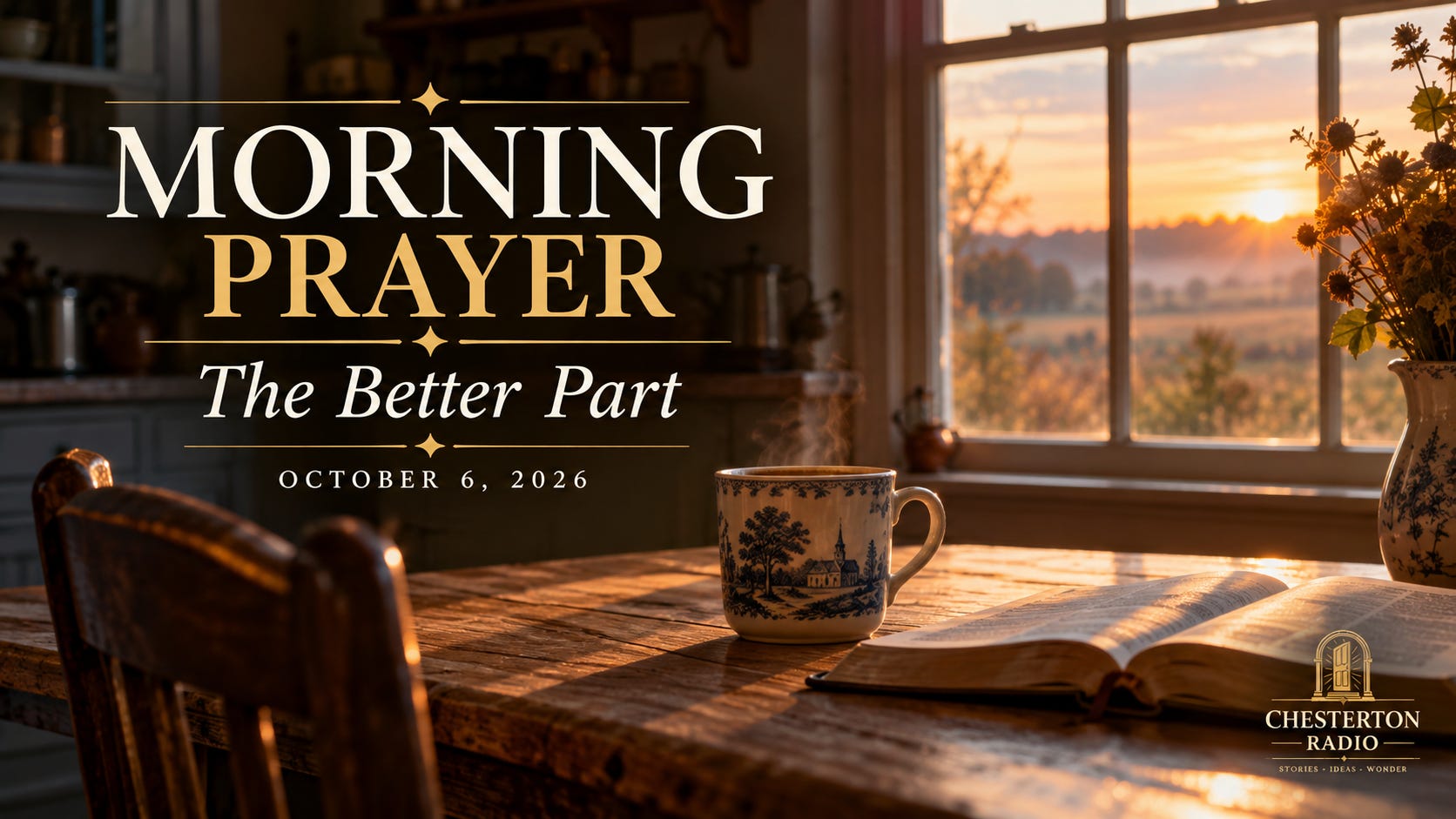
The Better Part
There are mornings when the day seems to begin before we do.
There is coffee to make, a message waiting for an answer, something that should have been finished yesterday, something else that must be started today. Before our feet have quite reached the floor, the mind has already opened half a dozen doors.
Martha would understand.
She was not doing anything wicked. She was serving. She was welcoming Christ into her home. And yet in the middle of all that good work she became anxious enough to complain to the Guest she was trying to serve.
Mary simply sat down and listened.
This morning, before we begin doing the many things that may genuinely need doing, the Church gives us a few minutes to do the one thing necessary.
To listen.
Opening Verse
Lord, open my lips.
And my mouth shall declare thy praise.
Invitatory
Antiphon: Come, let us adore the Lord, for he is our God.
Psalm 94 (95)
Come let us praise the Lord with joy:
let us joyfully sing to God our saviour.
Let us come before his presence with thanksgiving;
and make a joyful noise to him with psalms.
For the Lord is a great God,
and a great king above all gods.
For in his hand are all the ends of the earth:
and the heights of the mountains are his.
For the sea is his, and he made it:
and his hands formed the dry land.
Come let us adore and fall down:
and weep before the Lord that made us.
For he is the Lord our God:
and we are the people of his pasture
and the sheep of his hand.
Today if you shall hear his voice,
harden not your hearts:
As in the provocation, according to the day of temptation in the wilderness:
where your fathers tempted me,
they proved me, and saw my works.
Forty years long was I offended with that generation,
and I said: These always err in heart.
And these men have not known my ways:
so I swore in my wrath
that they shall not enter into my rest.
Glory be to the Father, and to the Son,
and to the Holy Ghost.
As it was in the beginning, is now, and ever shall be,
world without end. Amen.
Antiphon: Come, let us adore the Lord, for he is our God.
Psalmody
Antiphon I
Lord, thou hast blessed thy land; thou hast forgiven the sins of thy people.
Psalm 84 (85)
Lord, thou hast blessed thy land:
thou hast turned away the captivity of Jacob.
Thou hast forgiven the iniquity of thy people:
thou hast covered all their sins.
Thou hast mitigated all thy anger:
thou hast turned away from the wrath of thy indignation.
Convert us, O God our saviour:
and turn off thy anger from us.
Wilt thou be angry with us for ever:
or wilt thou extend thy wrath from generation to generation?
Thou wilt turn, O God, and bring us to life:
and thy people shall rejoice in thee.
Shew us, O Lord, thy mercy;
and grant us thy salvation.
I will hear what the Lord God will speak in me:
for he will speak peace unto his people:
And unto his saints:
and unto them that are converted to the heart.
Surely his salvation is near to them that fear him:
that glory may dwell in our land.
Mercy and truth have met each other:
justice and peace have kissed.
Truth is sprung out of the earth:
and justice hath looked down from heaven.
For the Lord will give goodness:
and our earth shall yield her fruit.
Justice shall walk before him:
and shall set his steps in the way.
Glory be to the Father, and to the Son,
and to the Holy Ghost.
As it was in the beginning, is now, and ever shall be,
world without end. Amen.
Antiphon: Lord, thou hast blessed thy land; thou hast forgiven the sins of thy people.
Antiphon II
My soul hath desired thee in the night; yea, and with my spirit within me in the morning early I will watch to thee.
Canticle — Isaiah 26:1–4, 7–9, 12
Sion the city of our strength, a saviour,
a wall and a bulwark shall be set therein.
Open ye the gates,
and let the just nation, that keepeth the truth, enter in.
The old error is passed away:
thou wilt keep peace: peace, because we have hoped in thee.
You have hoped in the Lord for evermore,
in the Lord God mighty for ever.
The way of the just is right,
the path of the just is right to walk in.
And in the way of thy judgments, O Lord,
we have patiently waited for thee:
Thy name, and thy remembrance
are the desire of the soul.
My soul hath desired thee in the night:
yea, and with my spirit within me in the morning early I will watch to thee.
When thou shalt do thy judgments on the earth,
the inhabitants of the world shall learn justice.
Lord, thou wilt give us peace:
for thou hast wrought all our works for us.
Glory be to the Father, and to the Son,
and to the Holy Ghost.
As it was in the beginning, is now, and ever shall be,
world without end. Amen.
Antiphon: My soul hath desired thee in the night; yea, and with my spirit within me in the morning early I will watch to thee.
Antiphon III
O God, let thy face shine upon us.
Psalm 66 (67)
May God have mercy on us, and bless us:
may he cause the light of his countenance to shine upon us,
and may he have mercy on us.
That we may know thy way upon earth:
thy salvation in all nations.
Let people confess to thee, O God:
let all people give praise to thee.
Let the nations be glad and rejoice:
for thou judgest the people with justice,
and directest the nations upon earth.
Let the people, O God, confess to thee:
let all the people give praise to thee:
The earth hath yielded her fruit.
May God, our God bless us,
May God bless us:
and all the ends of the earth fear him.
Glory be to the Father, and to the Son,
and to the Holy Ghost.
As it was in the beginning, is now, and ever shall be,
world without end. Amen.
Antiphon: O God, let thy face shine upon us.
Short Reading
1 John 4:14–15
And we have seen, and do testify, that the Father hath sent his Son to be the Saviour of the world.
Whosoever shall confess that Jesus is the Son of God, God abideth in him, and he in God.
Short Responsory
My God standeth by me; in him is all my trust.
He is my refuge and my strength.
In him is all my trust.
Glory be to the Father, and to the Son, and to the Holy Ghost.
My God standeth by me; in him is all my trust.
Gospel of the Day
Luke 10:38–42
Now it came to pass, as they went, that he entered into a certain town: and a certain woman named Martha, received him into her house.
And she had a sister called Mary, who sitting also at the Lord’s feet, heard his word.
But Martha was busy about much serving. Who stood and said: Lord, hast thou no care that my sister hath left me alone to serve? speak to her therefore, that she help me.
And the Lord answering, said to her: Martha, Martha, thou art careful, and art troubled about many things:
But one thing is necessary. Mary hath chosen the best part, which shall not be taken away from her.
Benedictus
Antiphon
God hath raised up to us a mighty salvation, according to the promise he made through his holy prophets.
Canticle of Zachary — Luke 1:68–79
Blessed be the Lord God of Israel;
because he hath visited and wrought the redemption of his people:
And hath raised up an horn of salvation to us,
in the house of David his servant:
As he spoke by the mouth of his holy prophets,
who are from the beginning:
Salvation from our enemies,
and from the hand of all that hate us:
To perform mercy to our fathers,
and to remember his holy testament,
The oath, which he swore to Abraham our father,
that he would grant to us,
That being delivered from the hand of our enemies,
we may serve him without fear,
In holiness and justice before him,
all our days.
And thou, child, shalt be called the prophet of the Highest:
for thou shalt go before the face of the Lord to prepare his ways:
To give knowledge of salvation to his people,
unto the remission of their sins:
Through the bowels of the mercy of our God,
in which the Orient from on high hath visited us:
To enlighten them that sit in darkness, and in the shadow of death:
to direct our feet into the way of peace.
Glory be to the Father, and to the Son,
and to the Holy Ghost.
As it was in the beginning, is now, and ever shall be,
world without end. Amen.
Antiphon: God hath raised up to us a mighty salvation, according to the promise he made through his holy prophets.
Intercessions
Christ our Lord comes among us not merely to receive our service, but to give us his presence. Let us turn to him with confidence:
Lord, teach us to hear thy voice.
For thy Church throughout the world: amid all her works of mercy, teaching, worship, and service, keep her first attentive to thee.
Lord, teach us to hear thy voice.
For bishops, priests, deacons, religious, missionaries, and all who labor in thy vineyard: preserve in them the quiet heart from which fruitful work is born.
Lord, teach us to hear thy voice.
For those beginning their day’s work: give wisdom to those who design and build, patience to those who teach and care for others, honesty to those who conduct business, and dignity to every honest labor.
Lord, teach us to hear thy voice.
For our homes and families: when duties multiply and tempers shorten, help us remember the persons for whom the work is being done.
Lord, teach us to hear thy voice.
For those burdened by anxiety, illness, loneliness, poverty, grief, or responsibilities that cannot simply be put aside: grant them rest in thee even when their burdens remain.
Lord, teach us to hear thy voice.
For those who have died: receive them into that peace in which every distraction ceases and every longing finds its end in thee.
Lord, teach us to hear thy voice.
For ourselves: save us both from neglecting the work thou hast given us and from allowing our work to make us forget thee.
Lord, teach us to hear thy voice.
Our Father
Our Father, who art in heaven,
hallowed be thy name.
Thy kingdom come.
Thy will be done on earth,
as it is in heaven.
Give us this day our daily bread.
And forgive us our trespasses,
as we forgive those who trespass against us.
And lead us not into temptation.
But deliver us from evil.
Amen.
Concluding Prayer
O God, who callest us to serve thee in the duties of each day, grant that our work may never make us forget thy presence.
Quiet what is anxious in us, order what is disordered, and teach us to recognize the one thing necessary: to remain with Christ, to hear his word, and then to rise and do faithfully whatever love requires.
Through Jesus Christ our Lord.
Amen.
Blessing
May the Lord bless us, protect us from all evil, and bring us to everlasting life.
Amen.
The Paradox of the Day
We do our work best when we remember that our work is not the most important thing in the room.
Chesterton for the Morning
“The world will never starve for want of wonders; but only for want of wonder.”
— G. K. Chesterton, Tremendous Trifles (1909), Chapter I, “Tremendous Trifles.”
A Chestertonian Meditation
The Better Part
There is something faintly comic about making coffee while thinking about six other things.
The coffee itself is simple enough. Water. Beans. Cup. Perhaps milk. Humanity managed this operation for centuries without project-management software.
Yet a modern person can stand in front of a coffee maker while mentally answering an email, remembering a bill, rehearsing a conversation, worrying about an appointment, planning dinner, and wondering why nobody else has emptied the dishwasher.
The cup has not become more complicated.
We have.
This is why Martha is such a wonderfully uncomfortable figure in the Gospel. She is uncomfortable because she is so respectable.
If she were lazy, the lesson would be easy.
If she refused to welcome Christ, the lesson would be obvious.
But Martha welcomes him.
She opens her house.
She works.
She serves.
And then she gets into trouble precisely while doing all these good things.
“Martha, Martha, thou art careful, and art troubled about many things.”
The danger in that sentence is not hidden in some spectacular sin. It is hidden in the phrase many things.
Most of us have many things.
The strange thing about responsibilities is that they rarely arrive carrying labels that say, “This will distract you from God.”
They arrive looking entirely reasonable.
There is work to finish.
There are children to drive somewhere.
There is a machine that does not work, a customer waiting for an answer, a lesson to prepare, a leaking faucet, an appointment to make, a form to complete, a kitchen to clean.
Somebody actually does have to cook supper.
Martha’s mistake cannot be that supper exists.
Christianity would be a rather impractical religion if holiness depended upon nobody making dinner.
The problem is subtler.
Martha has invited Christ into the house, and then become so absorbed in serving him that she is irritated by the sight of someone paying attention to him.
That is almost a definition of religious busyness.
We can become so occupied with the things of God that God himself becomes an interruption.
Mary does something scandalously simple.
She sits down.
She listens.
And Christ says that she has chosen the better part.
This does not mean that contemplation is holy and work is somehow second-rate. Christianity has never had much patience for a spirituality that leaves somebody else to wash all the dishes.
The distinction is not between working and sitting.
It is between attention and distraction.
A person can be attentive to God while sweeping a floor. Another can be distracted while kneeling in a chapel.
The question is not whether our hands are busy.
The question is what possesses the heart.
Chesterton understood that attention has something to do with wonder.
“The world will never starve for want of wonders,” he wrote, “but only for want of wonder.”
We tend to imagine that wonder requires something extraordinary.
A mountain.
A cathedral.
A miracle.
A sunrise dramatic enough to photograph.
Chesterton kept insisting that the greater problem was our inability to notice what was already in front of us.
The chair.
The street.
The stranger.
The cup of coffee.
The astonishing fact that another morning has appeared.
Mary sees what is in the room.
That may be the simplest description of her wisdom.
Christ is there.
Therefore she sits at his feet.
Martha also knows that Christ is there, of course. But gradually the serving becomes larger than the Guest.
We know this experience.
A father can become so worried about providing for his family that he has no time for the family.
A mother can become so determined to create the perfect holiday that everyone is afraid to enjoy it.
A volunteer can become so busy serving a parish that every additional person looks like another problem.
A professional can become so absorbed in completing the project that he forgets why the project was worth completing.
Even prayer can acquire this strange inversion.
We can worry whether we said enough prayers, prayed them correctly, maintained the schedule, finished the reading, kept the resolution—and completely miss the astonishing fact that God has invited us to speak with him.
Martha’s problem is not work.
It is proportion.
The small things have become enormous and the enormous thing has become small.
Christ is sitting in her house.
And she is worried about the kitchen.
There is a great mercy in the way Jesus corrects her.
“Martha, Martha.”
He says her name twice.
It does not sound like the voice of an irritated supervisor.
It sounds almost like someone trying to get the attention of a friend who has disappeared into her own thoughts.
Martha.
Come back.
You are here.
I am here.
That may be a useful prayer for the beginning of a Tuesday.
Come back.
The mind will run ahead.
It will invent conversations that have not happened and catastrophes that probably will not happen. It will replay yesterday and attempt to manage tomorrow.
Meanwhile, today will be sitting quietly in the room.
The Church’s Morning Prayer is one way of saying: come back.
Before the messages.
Before the meetings.
Before the errands.
Before the machinery starts and the roads fill and the day’s small emergencies begin announcing themselves as if each were the fall of Rome.
Come back.
“The one thing necessary” does not abolish the many things.
It puts them in their proper places.
Mary will eventually have to stand up.
Martha will eventually sit down.
Both will have work to do.
The Gospel simply tells us which comes first.
Listen before speaking.
Receive before giving.
See before hurrying.
Love before serving.
And perhaps this changes the service itself.
The dishes still need washing, but they are no longer an outrage committed against us by an ungrateful universe.
The email still needs answering, but it need not possess our soul.
The broken machine remains broken, but it is once again merely a broken machine.
The person standing beside it remains infinitely more important.
This is one of Christianity’s cheerful acts of rebellion against the world.
The world tells us that everything is urgent.
Christ tells us that one thing is necessary.
Those are not the same statement.
Much of what seems enormous at eight o’clock in the morning will be forgotten by Christmas.
Much of what seems ordinary—a conversation at breakfast, a child’s question, an old friend’s telephone call, ten quiet minutes of prayer—may turn out to have mattered enormously.
We cannot always know which is which.
That is why we need attention.
It is why we need wonder.
It is why, occasionally, we must have the courage to leave something unfinished long enough to notice who has entered the room.
There will always be many things.
There is only one better part.
And it begins by looking up.
Lord Jesus Christ, amid the many things of this day, keep our hearts attentive to thee.
Teach us when to work, when to stop, and above all how to recognize thy presence in both.
Chesterton Radio