

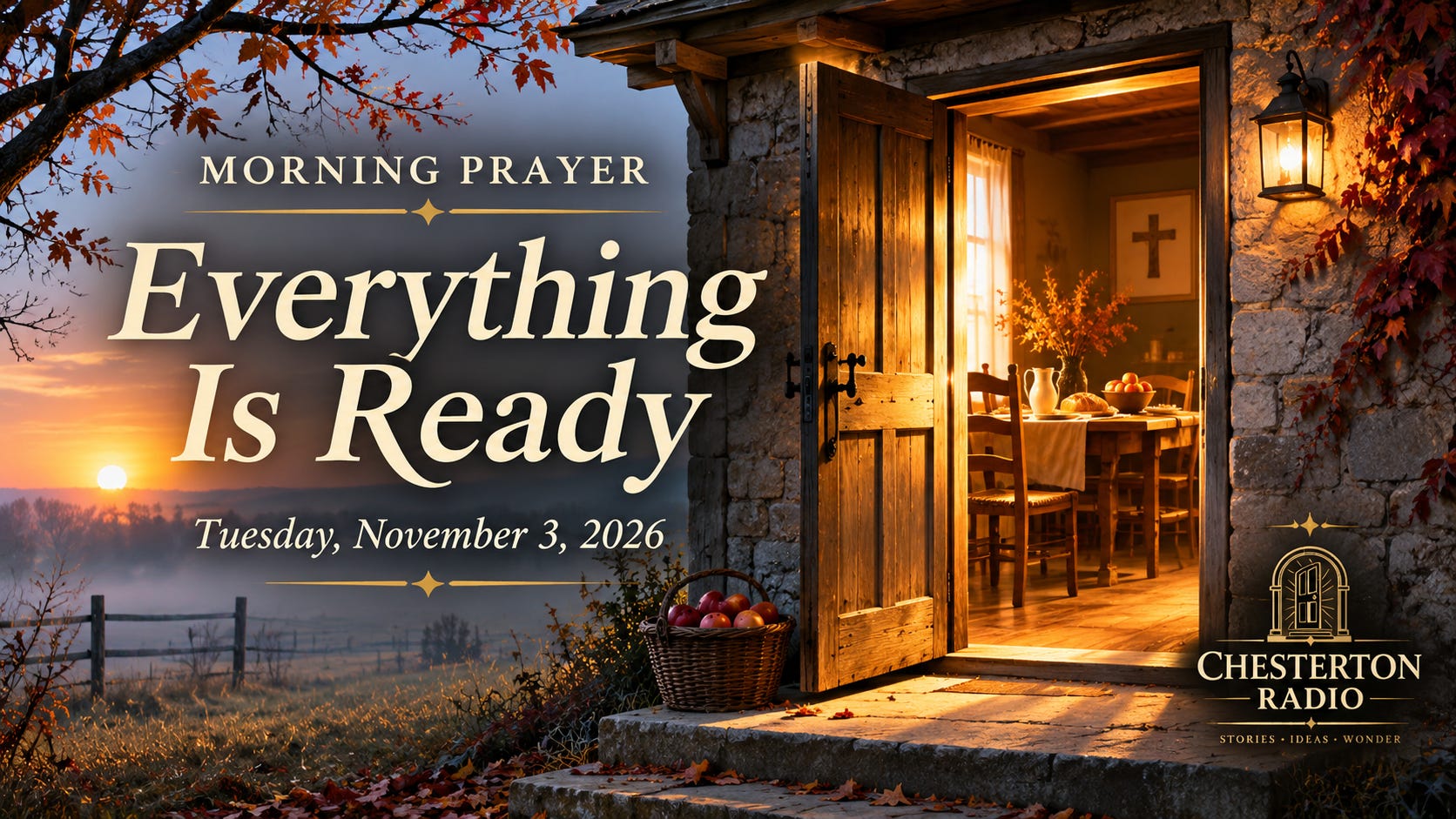
Morning Prayer: Everything Is Ready
There is a peculiar kind of tragedy in being invited to something wonderful and being too busy to go.
Not forbidden. Not excluded. Not forgotten.
Invited.
In this morning’s Gospel, the doors are open, the table is prepared, and the message has gone out: Come, for all things are now ready.
And then come the excuses.
A field. Some oxen. A household. Perfectly ordinary things—good things, even. Yet somehow they become more important than the feast.
Morning Prayer gives us an opportunity to hear the invitation again before the day’s fields, oxen, errands, appointments, worries, and screens begin making their own demands.
The table is ready.
The question is whether we will come.
OPENING VERSE
Lord, open my lips.
And my mouth shall declare thy praise.
INVITATORY
Antiphon: Come, let us adore the Lord, the great King who calls us to his feast.
Psalm 94 (95)
Come let us praise the Lord with joy: let us joyfully sing to God our saviour.
Let us come before his presence with thanksgiving; and make a joyful noise to him with psalms.
For the Lord is a great God, and a great King above all gods.
For in his hand are all the ends of the earth: and the heights of the mountains are his.
For the sea is his, and he made it: and his hands formed the dry land.
Come let us adore and fall down: and weep before the Lord that made us.
For he is the Lord our God: and we are the people of his pasture and the sheep of his hand.
Today if you shall hear his voice, harden not your hearts:
As in the provocation, according to the day of temptation in the wilderness: where your fathers tempted me, they proved me, and saw my works.
Forty years long was I offended with that generation, and I said: These always err in heart.
And these men have not known my ways: so I swore in my wrath that they shall not enter into my rest.
Glory be to the Father, and to the Son, and to the Holy Ghost.
As it was in the beginning, is now, and ever shall be, world without end. Amen.
Antiphon: Come, let us adore the Lord, the great King who calls us to his feast.
PSALMODY
Psalm 84 (85)
Antiphon: Thou hast blessed thy land, O Lord; thou hast forgiven the iniquity of thy people.
Lord, thou hast blessed thy land: thou hast turned away the captivity of Jacob.
Thou hast forgiven the iniquity of thy people: thou hast covered all their sins.
Thou hast mitigated all thy anger: thou hast turned away from the wrath of thy indignation.
Convert us, O God our saviour: and turn off thy anger from us.
Wilt thou be angry with us for ever: or wilt thou extend thy wrath from generation to generation?
Thou wilt turn, O God, and bring us to life: and thy people shall rejoice in thee.
Shew us, O Lord, thy mercy; and grant us thy salvation.
I will hear what the Lord God will speak in me: for he will speak peace unto his people:
And unto his saints: and unto them that are converted to the heart.
Surely his salvation is near to them that fear him: that glory may dwell in our land.
Mercy and truth have met each other: justice and peace have kissed.
Truth is sprung out of the earth: and justice hath looked down from heaven.
For the Lord will give goodness: and our earth shall yield her fruit.
Justice shall walk before him: and shall set his steps in the way.
Glory be to the Father, and to the Son, and to the Holy Ghost.
As it was in the beginning, is now, and ever shall be, world without end. Amen.
Antiphon: Thou hast blessed thy land, O Lord; thou hast forgiven the iniquity of thy people.
Canticle — Isaiah 26:1–4, 7–9, 12
Antiphon: My soul hath desired thee in the night; and in the morning early I will watch for thee.
In that day shall this canticle be sung in the land of Juda.
Sion the city of our strength: a saviour, a wall and a bulwark shall be set therein.
Open ye the gates, and let the just nation, that keepeth the truth, enter in.
The old error is passed away: thou wilt keep peace: peace, because we have hoped in thee.
You have hoped in the Lord for evermore, in the Lord God mighty for ever.
The way of the just is right, the path of the just is right to walk in.
And in the way of thy judgments, O Lord, we have patiently waited for thee: thy name, and thy remembrance are the desire of the soul.
My soul hath desired thee in the night: yea, and with my spirit within me in the morning early I will watch to thee.
When thou shalt do thy judgments on the earth, the inhabitants of the world shall learn justice.
Lord, thou wilt give us peace: for thou hast wrought all our works for us.
Glory be to the Father, and to the Son, and to the Holy Ghost.
As it was in the beginning, is now, and ever shall be, world without end. Amen.
Antiphon: My soul hath desired thee in the night; and in the morning early I will watch for thee.
Psalm 66 (67)
Antiphon: May God have mercy on us, and may the light of his countenance shine upon us.
May God have mercy on us, and bless us: may he cause the light of his countenance to shine upon us, and may he have mercy on us.
That we may know thy way upon earth: thy salvation in all nations.
Let people confess to thee, O God: let all people give praise to thee.
Let the nations be glad and rejoice: for thou judgest the people with justice, and directest the nations upon earth.
Let the people, O God, confess to thee: let all the people give praise to thee:
The earth hath yielded her fruit. May God, our God bless us,
May God bless us: and all the ends of the earth fear him.
Glory be to the Father, and to the Son, and to the Holy Ghost.
As it was in the beginning, is now, and ever shall be, world without end. Amen.
Antiphon: May God have mercy on us, and may the light of his countenance shine upon us.
SHORT READING
1 John 4:12–15
No man hath seen God at any time. If we love one another, God abideth in us, and his charity is perfected in us.
In this we know that we abide in him, and he in us: because he hath given us of his spirit.
And we have seen, and do testify, that the Father hath sent his Son to be the Saviour of the world.
Whosoever shall confess that Jesus is the Son of God, God abideth in him, and he in God.
SHORT RESPONSORY
My God stands beside me; in him will I trust.
He calls us from fear into freedom,
and in him will I trust.
Glory be to the Father, and to the Son, and to the Holy Ghost.
My God stands beside me; in him will I trust.
GOSPEL OF THE DAY
Luke 14:15–24
And when one of them that sat at table with him had heard these things, he said to him: Blessed is he that shall eat bread in the kingdom of God.
But he said to him: A certain man made a great supper, and invited many.
And he sent his servant at the hour of supper to say to them that were invited, that they should come, for now all things are ready.
And they began all at once to make excuse. The first said to him: I have bought a farm, and I must needs go out and see it: I pray thee, hold me excused.
And another said: I have bought five yoke of oxen, and I go to try them: I pray thee, hold me excused.
And another said: I have married a wife, and therefore I cannot come.
And the servant returning, told these things to his lord. Then the master of the house, being angry, said to his servant: Go out quickly into the streets and lanes of the city, and bring in hither the poor, and the feeble, and the blind, and the lame.
And the servant said: Lord, it is done as thou hast commanded, and yet there is room.
And the lord said to the servant: Go out into the highways and hedges, and compel them to come in, that my house may be filled.
But I say unto you, that none of those men that were invited shall taste of my supper.
BENEDICTUS
Antiphon: Blessed are they who hear the invitation of the Lord and come to his table.
The Canticle of Zachary — Luke 1:68–79
Blessed be the Lord God of Israel; because he hath visited and wrought the redemption of his people:
And hath raised up an horn of salvation to us, in the house of David his servant:
As he spoke by the mouth of his holy prophets, who are from the beginning:
Salvation from our enemies, and from the hand of all that hate us:
To perform mercy to our fathers, and to remember his holy testament,
The oath, which he swore to Abraham our father, that he would grant to us,
That being delivered from the hand of our enemies, we may serve him without fear,
In holiness and justice before him, all our days.
And thou, child, shalt be called the prophet of the Highest: for thou shalt go before the face of the Lord to prepare his ways:
To give knowledge of salvation to his people, unto the remission of their sins:
Through the bowels of the mercy of our God, in which the Orient from on high hath visited us:
To enlighten them that sit in darkness, and in the shadow of death: to direct our feet into the way of peace.
Glory be to the Father, and to the Son, and to the Holy Ghost.
As it was in the beginning, is now, and ever shall be, world without end. Amen.
Antiphon: Blessed are they who hear the invitation of the Lord and come to his table.
INTERCESSIONS
Christ calls us into the life of his Kingdom, not as strangers standing at the door but as guests for whom a place has been prepared. Trusting in his generosity, we pray:
Lord, teach us to answer when thou callest.
For the Church throughout the world: that she may go faithfully into the streets and lanes, the highways and hedges, carrying Christ’s invitation especially to those who believe themselves forgotten or unwanted.
Lord, teach us to answer when thou callest.
For the Holy Father, bishops, priests, deacons, religious, missionaries, and all who labor in the vineyard of the Lord: give them humility, courage, perseverance, and joy.
Lord, teach us to answer when thou callest.
For those who govern nations and communities: turn them from ambition and self-interest toward justice, peace, and the protection of the weak.
Lord, teach us to answer when thou callest.
For our work today—for offices, workshops, classrooms, farms, homes, roads, hospitals, and every place where duty awaits us: keep good work from becoming an excuse for forgetting the One for whom all work should finally be done.
Lord, teach us to answer when thou callest.
For our families and friends: make our homes places of welcome, patience, forgiveness, laughter, and gratitude.
Lord, teach us to answer when thou callest.
For the poor, the lonely, the sick, the disabled, the anxious, the forgotten, and all who find themselves at the margins: may they discover that at the table of Christ they are neither an afterthought nor an inconvenience.
Lord, teach us to answer when thou callest.
For those who have died, especially those for whom no one remembers to pray: bring them to the eternal banquet of thy Kingdom.
Lord, teach us to answer when thou callest.
And for ourselves: save us from the thousand respectable excuses by which we postpone holiness. Give us grace to recognize thy invitation today—and the courage simply to come.
Lord, teach us to answer when thou callest.
OUR FATHER
Our Father, who art in heaven,
hallowed be thy name.
Thy kingdom come.
Thy will be done on earth as it is in heaven.
Give us this day our daily bread.
And forgive us our trespasses,
as we forgive those who trespass against us.
And lead us not into temptation,
but deliver us from evil.
Amen.
CONCLUDING PRAYER
O God, whose generosity is greater than our deserving and whose house has room beyond our imagining, awaken us to thy invitation this morning.
Deliver us from those good things which become excuses when we place them before thee. Teach us to receive our work, possessions, homes, and relationships as gifts rather than barriers to thy grace.
Make us attentive to those whom the world overlooks, generous in welcoming the stranger, faithful in the duties before us, and ready when thou callest.
Through Christ our Lord.
Amen.
BLESSING
May the Lord bless us, and keep us from all evil, and bring us unto everlasting life.
Amen.
THE PARADOX OF THE DAY
The men who had everything were too busy for the feast; the people who had nothing were ready to receive everything.
CHESTERTON FOR THE MORNING
“There is no such thing on earth as an uninteresting subject; the only thing that can exist is an uninterested person.”
— G. K. Chesterton, Heretics, “On Mr. Rudyard Kipling and Making the World Small”
A CHESTERTONIAN MEDITATION
Everything Is Ready
There is probably no sentence more capable of causing panic in an ordinary household than:
“Dinner is ready.”
This is curious because dinner being ready is generally regarded as good news.
Nobody announces, “Dinner is ready!” as a threat. Yet it immediately discovers that one person is upstairs, another is answering an email, somebody has decided at precisely that moment to find a missing screwdriver, and someone else replies, “Coming!” in a tone that clearly means, “I shall begin considering the possibility within the next quarter of an hour.”
The food is ready.
The people are not.
That is almost the whole of today’s Gospel.
Christ tells us about a man who prepares a great supper. There is abundance, hospitality and expectation. Invitations have already gone out. Then comes the wonderful announcement:
“Come, for now all things are ready.”
And suddenly everybody is terribly busy.
One has bought a farm.
Another has bought five yoke of oxen.
Another has married.
None of these things is evil. That is what makes the parable uncomfortable.
If the first man had said, “I cannot come because I am committing a robbery,” we could dismiss him as a villain. If the second had said he was going off to worship an idol, the lesson would be pleasantly obvious.
But they have fields and animals and families.
They have, in other words, life.
And life has become their excuse for missing Life.
We often imagine that the great danger to the spiritual life is some spectacular wickedness. Sometimes it is. More often the danger is an entirely respectable collection of little urgencies.
There are emails.
There is a meeting.
The car needs fuel.
A bill needs paying.
Something is wrong with the sink.
There are groceries to buy, a customer to call, a report to finish, a child to collect, a lawn to mow, and a password to reset for an account we cannot remember creating.
None of these things is imaginary.
But neither is God.
The oddity is that we can become so absorbed in God’s gifts that we have no time for the Giver.
The field is real.
The oxen are real.
Marriage is real.
But so is the supper.
Chesterton had an extraordinary capacity for noticing this reversal. Modern man often thinks religion requires him to abandon the real world for an imaginary one. Chesterton repeatedly suggests almost the opposite: it is precisely because we have ceased seeing the world religiously that the world becomes dull, mechanical, and strangely unreal.
“There is no such thing on earth as an uninteresting subject,” he wrote in Heretics; “the only thing that can exist is an uninterested person.”
The same might almost be said of gifts.
There are very few ordinary gifts. There are mostly people who have grown ordinary toward them.
Consider the three excuses in the Gospel.
A field.
What is a field?
A patch of dirt, perhaps.
Or it is several million blades of grass rising inexplicably from a planet spinning through darkness beneath a star.
Oxen?
Livestock, certainly.
But also living creatures—breathing, moving, astonishing arrangements of bone and blood and muscle—which no engineer on earth can manufacture from raw materials.
And marriage?
We can make it sound almost administrative. But it is the fantastic proposition that one human being freely promises an entire earthly life to another.
The guests possess marvels.
Yet they use the marvels as excuses for missing the miracle.
That is the danger.
The Christian answer is not to despise the field.
It is to see the field properly.
It is not to curse the oxen.
It is to be grateful for them.
It is certainly not to dismiss marriage.
It is to understand that every true human love ultimately points beyond itself toward the Love that made loving possible.
God does not compete with his gifts.
He gives them.
And because he gives them, they should lead us toward him rather than away from him.
This is why Morning Prayer matters in a way quite disproportionate to the minutes it occupies.
At the beginning of the day, nearly everything is waiting to become an excuse.
The telephone has not yet rung, but it will.
The inbox may already contain its little red badges of urgency.
The day’s problems are gathering patiently outside the door.
There will be fields to inspect and oxen to examine.
And some of them genuinely need examining.
Christianity does not tell us to neglect them.
It tells us not to confuse them with the feast.
Prayer puts the world back in order.
For a few minutes we admit that the sun rose without our permission. Our hearts continued beating through the night without our management. The earth remained in its orbit while we slept.
We discover, rather humiliatingly and wonderfully, that Providence managed the universe during our absence.
Then we can go to work.
Perhaps this is one reason the master in Christ’s parable finally fills his house with people from the streets and lanes—the poor, the feeble, the blind, and the lame.
They possess one great advantage.
They know they need something.
The respectable guests believe themselves self-sufficient. They have property to manage, investments to inspect, households to arrange.
The poor man standing in the lane has no such illusion.
Tell him there is a feast and he understands the importance of the information.
There is a spiritual poverty that every Christian must recover.
Not misery.
Not contempt for the good things of creation.
Simply the ability to receive.
To say grace before breakfast is to admit that breakfast is not inevitable.
To kiss one’s spouse goodbye is to recognize, however briefly, that another human being is not one’s property.
To begin work with gratitude is to remember that skill, intelligence, strength, opportunity, and even another Tuesday morning are gifts.
And to pray is to stand at the door of the banquet and stop making excuses.
There is another lovely detail in Christ’s parable.
After the poor and the lame have entered, the servant reports:
“Yet there is room.”
What a sentence.
Yet there is room.
We tend to imagine scarcity.
Not enough time.
Not enough money.
Not enough attention.
Not enough places.
Not enough mercy.
But God’s Kingdom is described as a house that remains mysteriously larger than its guest list.
There is room.
Room for the sinner who thinks he has arrived too late.
Room for the person whose prayer life has collapsed.
Room for the distracted.
Room for the embarrassed.
Room for the person returning after twenty years.
Room for the man in the highway who never imagined the invitation was intended for him.
Room even for us, standing here on an ordinary Tuesday morning with an alarming number of things to do.
The tragedy of the first guests was not that the door was locked.
It was open.
The tragedy was not that there was no place for them.
Their places had been prepared.
Their tragedy was simply that they preferred their excuses.
So perhaps the first prayer today need not be complicated.
Before the appointments begin, before the machines start, before traffic gathers, before the day’s thousand perfectly legitimate concerns demand their share of us, we might hear once more the message carried by the servant down the road:
Come.
Everything is ready.
And for once, instead of explaining why we cannot, we might simply get up and go.
CLOSING
Lord, keep us from becoming so occupied with thy gifts that we miss thy invitation.
Let us work faithfully, love generously, receive gratefully, and recognize the feast hidden inside an ordinary Tuesday.
There is still room.
Chesterton Radio