

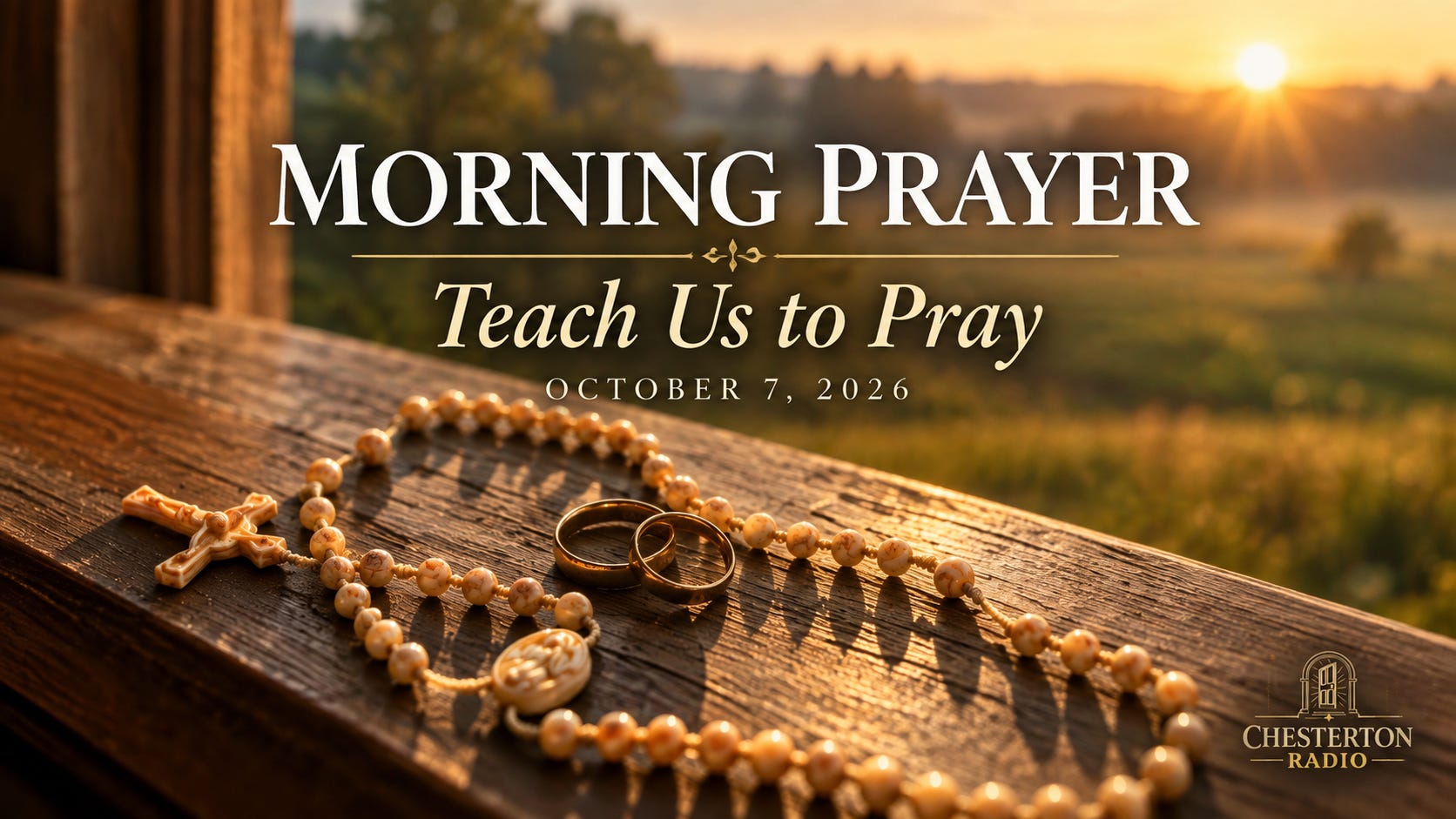
Teach Us to Pray
There are few requests in the Gospel more reassuring than the one the disciples make this morning.
They do not say, “Lord, we have mastered prayer.”
They say, “Lord, teach us to pray.”
These are men who have walked beside Christ, heard Him preach, watched Him heal, and seen Him disappear into solitude to speak with His Father. Yet when they look at their own prayer, they know that they are still beginners.
Perhaps that is why the Church gives us the Rosary.
A string of beads. A handful of prayers. The same words, again and again.
It is almost comically simple.
And perhaps that is precisely the point.
OPENING VERSE
Lord, open my lips.
And my mouth shall declare thy praise.
INVITATORY
Antiphon: Come, let us adore Christ the Lord, who gave us Mary for our Mother.
Psalm 94 (95)
Come let us praise the Lord with joy:
let us joyfully sing to God our saviour.
Let us come before his presence with thanksgiving;
and make a joyful noise to him with psalms.
For the Lord is a great God,
and a great King above all gods.
For in his hand are all the ends of the earth:
and the heights of the mountains are his.
For the sea is his, and he made it:
and his hands formed the dry land.
Come let us adore and fall down:
and weep before the Lord that made us.
For he is the Lord our God:
and we are the people of his pasture and the sheep of his hand.
Today if you shall hear his voice,
harden not your hearts:
As in the provocation, according to the day of temptation in the wilderness:
where your fathers tempted me, they proved me, and saw my works.
Forty years long was I offended with that generation,
and I said: These always err in heart.
And these men have not known my ways:
so I swore in my wrath that they shall not enter into my rest.
Glory be to the Father, and to the Son,
and to the Holy Ghost.
As it was in the beginning, is now, and ever shall be,
world without end. Amen.
Antiphon: Come, let us adore Christ the Lord, who gave us Mary for our Mother.
PSALMODY
Psalm 62 (63)
Antiphon: Blessed art thou, O Mary, for through thee the Saviour came into the world.
O God, my God, to thee do I watch at break of day.
For thee my soul hath thirsted;
for thee my flesh, O how many ways!
In a desert land, and where there is no way, and no water:
so in the sanctuary have I come before thee, to see thy power and thy glory.
For thy mercy is better than lives:
thee my lips shall praise.
Thus will I bless thee all my life long:
and in thy name I will lift up my hands.
Let my soul be filled as with marrow and fatness:
and my mouth shall praise thee with joyful lips.
If I have remembered thee upon my bed,
I will meditate on thee in the morning:
Because thou hast been my helper.
And I will rejoice under the covert of thy wings.
My soul hath stuck close to thee:
thy right hand hath received me.
But they have sought my soul in vain,
they shall go into the lower parts of the earth:
They shall be delivered into the hands of the sword,
they shall be the portions of foxes.
But the king shall rejoice in God,
all they shall be praised that swear by him:
because the mouth is stopped of them that speak wicked things.
Glory be to the Father, and to the Son,
and to the Holy Ghost.
As it was in the beginning, is now, and ever shall be,
world without end. Amen.
Antiphon: Blessed art thou, O Mary, for through thee the Saviour came into the world.
Canticle — Daniel 3:57–88, 56
Antiphon: With Mary let all creation bless the Lord.
All ye works of the Lord, bless the Lord:
praise and exalt him above all for ever.
O ye angels of the Lord, bless the Lord:
O ye heavens, bless the Lord.
O all ye waters that are above the heavens, bless the Lord:
O all ye powers of the Lord, bless the Lord.
O ye sun and moon, bless the Lord:
O ye stars of heaven, bless the Lord.
O every shower and dew, bless ye the Lord:
O all ye spirits of God, bless the Lord.
O ye fire and heat, bless the Lord:
O ye cold and heat, bless the Lord.
O ye dews and hoar frosts, bless the Lord:
O ye frost and cold, bless the Lord.
O ye ice and snow, bless the Lord:
O ye nights and days, bless the Lord.
O ye light and darkness, bless the Lord:
O ye lightnings and clouds, bless the Lord.
O let the earth bless the Lord:
let it praise and exalt him above all for ever.
O ye mountains and hills, bless the Lord:
O all ye things that spring up in the earth, bless the Lord.
O ye fountains, bless the Lord:
O ye seas and rivers, bless the Lord.
O ye whales, and all that move in the waters, bless the Lord:
O all ye fowls of the air, bless the Lord.
O all ye beasts and cattle, bless the Lord:
O ye sons of men, bless the Lord.
O let Israel bless the Lord:
let them praise and exalt him above all for ever.
O ye priests of the Lord, bless the Lord:
O ye servants of the Lord, bless the Lord.
O ye spirits and souls of the just, bless the Lord:
O ye holy and humble of heart, bless the Lord.
O Ananias, Azarias, and Misael, bless ye the Lord:
praise and exalt him above all for ever.
Let us bless the Father and the Son, with the Holy Ghost:
let us praise and exalt him above all for ever.
Blessed art thou, O Lord, in the firmament of heaven:
and worthy of praise, and glorious for ever.
Antiphon: With Mary let all creation bless the Lord.
Psalm 149
Antiphon: Rejoice, O Virgin Mary; thou didst treasure the word of God within thy heart.
Sing ye to the Lord a new canticle:
let his praise be in the church of the saints.
Let Israel rejoice in him that made him:
and let the children of Sion be joyful in their king.
Let them praise his name in choir:
let them sing to him with the timbrel and the psaltery.
For the Lord is well pleased with his people:
and he will exalt the meek unto salvation.
The saints shall rejoice in glory:
they shall be joyful in their beds.
The high praises of God shall be in their mouth:
and two-edged swords in their hands:
To execute vengeance upon the nations,
chastisements among the people:
To bind their kings with fetters,
and their nobles with manacles of iron.
To execute upon them the judgment that is written:
this glory is to all his saints.
Glory be to the Father, and to the Son,
and to the Holy Ghost.
As it was in the beginning, is now, and ever shall be,
world without end. Amen.
Antiphon: Rejoice, O Virgin Mary; thou didst treasure the word of God within thy heart.
SHORT READING
Isaiah 61:10
I will greatly rejoice in the Lord, and my soul shall be joyful in my God: for he hath clothed me with the garments of salvation, and with the robe of justice he hath covered me, as a bridegroom decked with a crown, and as a bride adorned with her jewels.
SHORT RESPONSORY
Blessed art thou, O Mary, because thou didst believe.
Blessed art thou, O Mary, because thou didst believe.
The Lord hath done great things to thee.
Because thou didst believe.
Glory be to the Father, and to the Son, and to the Holy Ghost.
Blessed art thou, O Mary, because thou didst believe.
GOSPEL OF THE DAY
Luke 11:1–4
And it came to pass, that as he was in a certain place praying, when he ceased, one of his disciples said to him: Lord, teach us to pray, as John also taught his disciples.
And he said to them: When you pray, say:
Father, hallowed be thy name. Thy kingdom come.
Give us this day our daily bread.
And forgive us our sins, for we also forgive every one that is indebted to us.
And lead us not into temptation.
BENEDICTUS
Antiphon: Holy Mary, Mother of God, pray for us that we may learn to pray as thy Son taught us.
Canticle of Zachary — Luke 1:68–79
Blessed be the Lord God of Israel;
because he hath visited and wrought the redemption of his people:
And hath raised up an horn of salvation to us,
in the house of David his servant:
As he spoke by the mouth of his holy prophets,
who are from the beginning:
Salvation from our enemies,
and from the hand of all that hate us:
To perform mercy to our fathers,
and to remember his holy testament,
The oath, which he swore to Abraham our father,
that he would grant to us,
That being delivered from the hand of our enemies,
we may serve him without fear,
In holiness and justice before him,
all our days.
And thou, child, shalt be called the prophet of the Highest:
for thou shalt go before the face of the Lord to prepare his ways:
To give knowledge of salvation to his people,
unto the remission of their sins:
Through the bowels of the mercy of our God,
in which the Orient from on high hath visited us:
To enlighten them that sit in darkness, and in the shadow of death:
to direct our feet into the way of peace.
Glory be to the Father, and to the Son,
and to the Holy Ghost.
As it was in the beginning, is now, and ever shall be,
world without end. Amen.
Antiphon: Holy Mary, Mother of God, pray for us that we may learn to pray as thy Son taught us.
INTERCESSIONS
With Mary, who treasured the word of God and pondered it in her heart, let us turn confidently to her Son.
Lord, teach us to pray.
For the Church throughout the world, that she may never grow weary of calling men and women to Christ:
Lord, teach us to pray.
For the Holy Father, our bishops, priests, deacons, religious, and all who teach the faith, that their words may grow from lives rooted in prayer:
Lord, teach us to pray.
For nations divided by hatred, war, suspicion, and fear, that hearts may be converted and peace sought with courage:
Lord, teach us to pray.
For those beginning their work this morning—for laborers, teachers, engineers, farmers, parents, students, craftsmen, caregivers, and all whose ordinary duties serve others:
Lord, teach us to pray.
For our homes and families, especially those carrying worries that cannot easily be spoken, that the Mother of Christ may lead them gently to her Son:
Lord, teach us to pray.
For the sick, the lonely, the grieving, and those who have awakened today already tired of the burdens they must carry:
Lord, teach us to pray.
For those who have died, especially those who once prayed beside us and whose voices we still remember:
Lord, teach us to pray.
For ourselves, that we may not abandon prayer because we are distracted, dry, hurried, or imperfect, but begin again:
Lord, teach us to pray.
OUR FATHER
Our Father, who art in heaven,
hallowed be thy name.
Thy kingdom come.
Thy will be done on earth as it is in heaven.
Give us this day our daily bread.
And forgive us our trespasses,
as we forgive those who trespass against us.
And lead us not into temptation,
but deliver us from evil.
Amen.
CONCLUDING PRAYER
O God, whose Son taught us to call thee Father, grant that, following the example and intercession of the Blessed Virgin Mary, we may ponder the mysteries of Christ with faithful hearts and return to prayer without weariness.
Teach us to ask with confidence, to listen in silence, to persevere when consolation is absent, and to carry what we have contemplated into the duties of this day.
Through Christ our Lord.
Amen.
BLESSING
May the Lord bless us, protect us from all evil, and bring us to everlasting life.
Amen.
THE PARADOX OF THE DAY
Prayer becomes new not by constantly finding new words, but by returning to the old words with a new heart.
CHESTERTON FOR THE MORNING
G. K. Chesterton once wrote:
“They always say, ‘Do it again’.”
— Orthodoxy, “The Ethics of Elfland”
Chesterton was writing about children—and about something adults often lose: the ability to delight in repetition.
A CHESTERTONIAN MEDITATION
There is something suspicious about a string of beads.
At least there is to the modern mind.
We are accustomed to devices whose purpose is to prevent repetition. The machine remembers the password. The computer completes the sentence. The telephone remembers the number. We invent shortcuts because doing the same thing twice feels vaguely like a failure.
And then the Church hands us fifty-three little beads and says: begin.
Say the words again.
And again.
And again.
It is almost offensively inefficient.
Which may be one reason it is so good for us.
Chesterton noticed that children possess a peculiar power which adults gradually lose. A child does not necessarily demand novelty. If something is wonderful, the child wants it repeated.
Again!
Read the story again.
Push the swing again.
Make the noise again.
Tell the joke again.
The exhausted adult assumes that repetition proves the child has not understood the entertainment. The child knows better. Repetition proves that the entertainment was worth having.
Chesterton carries the idea further in Orthodoxy. Perhaps, he suggests, the repetition we see in creation is not evidence that the universe is a machine. Perhaps God has not grown tired of sunrise.
Perhaps every dawn is another divine “Do it again.”
That is a rather good thought for the Rosary.
The objection to the Rosary is often that it repeats itself.
Of course it does.
So does the sunrise.
So does the heartbeat.
So does breathing.
So does the Mass.
So does forgiveness.
So does love.
No husband who tells his wife “I love you” on Tuesday is excused from saying it again on Wednesday because the matter was adequately covered.
Some truths are too important to be said only once.
The Rosary belongs to this strange family of important repetitions.
The words circle back, but we do not.
We have changed slightly by the time the next bead reaches our fingers.
A worry has intruded.
A face has appeared in the imagination.
A memory has returned.
A distraction has wandered through.
A grief has suddenly become sharper.
And then there is another Hail Mary waiting for us.
We begin again.
This morning’s Gospel is astonishingly appropriate for the feast.
The disciples find Jesus praying.
They have seen Him perform miracles. They have heard the parables. They have watched crowds gather around Him. Yet what finally produces their request is simply the sight of Jesus at prayer.
“Lord, teach us to pray.”
There is humility in that sentence.
The disciples do not ask for an advanced technique.
They admit ignorance.
Teach us.
And Christ gives them words.
Simple words.
Father.
Kingdom.
Bread.
Forgiveness.
Temptation.
Deliverance.
Christian prayer begins not in ingenuity but in reception. Before we invent words for God, God gives words to us.
Mary’s prayer has the same character.
At the Annunciation she does not present God with a strategic plan for the Incarnation.
She receives.
“Be it done to me according to thy word.”
The great Marian mystery begins with a woman allowing the Word of God to become more important than her own plans.
That is also what happens, in miniature, whenever we pray well.
We stop attempting to manage the universe for a few minutes.
We receive it.
This is why the Rosary is much more mysterious than its simplicity suggests.
The fingers move.
The lips speak.
But the mind is invited to look.
The Annunciation.
The Visitation.
Bethlehem.
Calvary.
The empty tomb.
Pentecost.
Again and again, the Rosary places the Christian beside Mary and says: look at Christ.
It does not ask us principally to admire Mary in isolation. Mary is forever pointing elsewhere.
Toward her Son.
At Cana she manages to compress Marian spirituality into one sentence:
Do whatever he tells you.
The beads therefore become a sort of handrail through the Gospel.
One can climb without a handrail. But on a dark morning, or when one is tired, or when the stairs are steep, it is useful to have something solid under the hand.
There are mornings when prayer feels luminous.
There are others when it feels like counting beads.
Count them anyway.
There are days when the words of the Our Father seem to open heaven.
There are others when the mind wanders before reaching “hallowed.”
Begin again.
This is one of the quiet mercies of Catholic prayer: it does not require us to be spiritually brilliant before breakfast.
The Church has already placed words in our hands.
The Psalms.
The Our Father.
The Hail Mary.
The Benedictus.
The Gloria.
Words worn smooth by millions of Christians who were distracted, frightened, joyful, sleepy, grieving, grateful, hurried, holy, and not particularly holy.
And still they prayed them.
Perhaps we sometimes imagine that the saints possessed some exotic form of concentration unavailable to ordinary people.
Mary suggests something simpler.
Faithfulness.
She kept things.
She pondered them.
She returned to them.
The Rosary is built upon that Marian habit.
Keep this mystery.
Turn it over.
Return to it tomorrow.
The bead passes beneath the thumb, and an old prayer begins again.
That does not mean nothing has happened.
A river can pass the same bridge every day without containing the same water.
We can say the same prayer every morning without bringing God quite the same person.
Yesterday’s prayer was offered by the person we were yesterday.
Today’s prayer comes with another day’s gratitude, another day’s mistakes, another day’s wounds, another day’s hopes.
And tomorrow—God willing—we shall come back again.
Perhaps that is why today’s request is one we never outgrow.
Lord, teach us to pray.
Not merely when we are children.
Not merely when we first believe.
Not merely when prayer feels easy.
Teach us today.
Teach us when we are old enough to think we ought to know how.
Teach us when we are distracted.
Teach us when we are frightened.
Teach us when the words feel dry.
Teach us when all we can manage is to pick up the beads and begin.
And perhaps heaven, which has watched the sun rise over the world yet again this morning, is not bored by any of it.
Perhaps God is not weary of our returning.
Perhaps Our Lady is not weary of hearing the old words.
Perhaps the great mistake is imagining that love must always say something new.
Sometimes love simply takes the next bead between its fingers and says:
Again.
May Our Lady of the Rosary pray for us today, and may her Son teach us to pray.
Chesterton Radio