

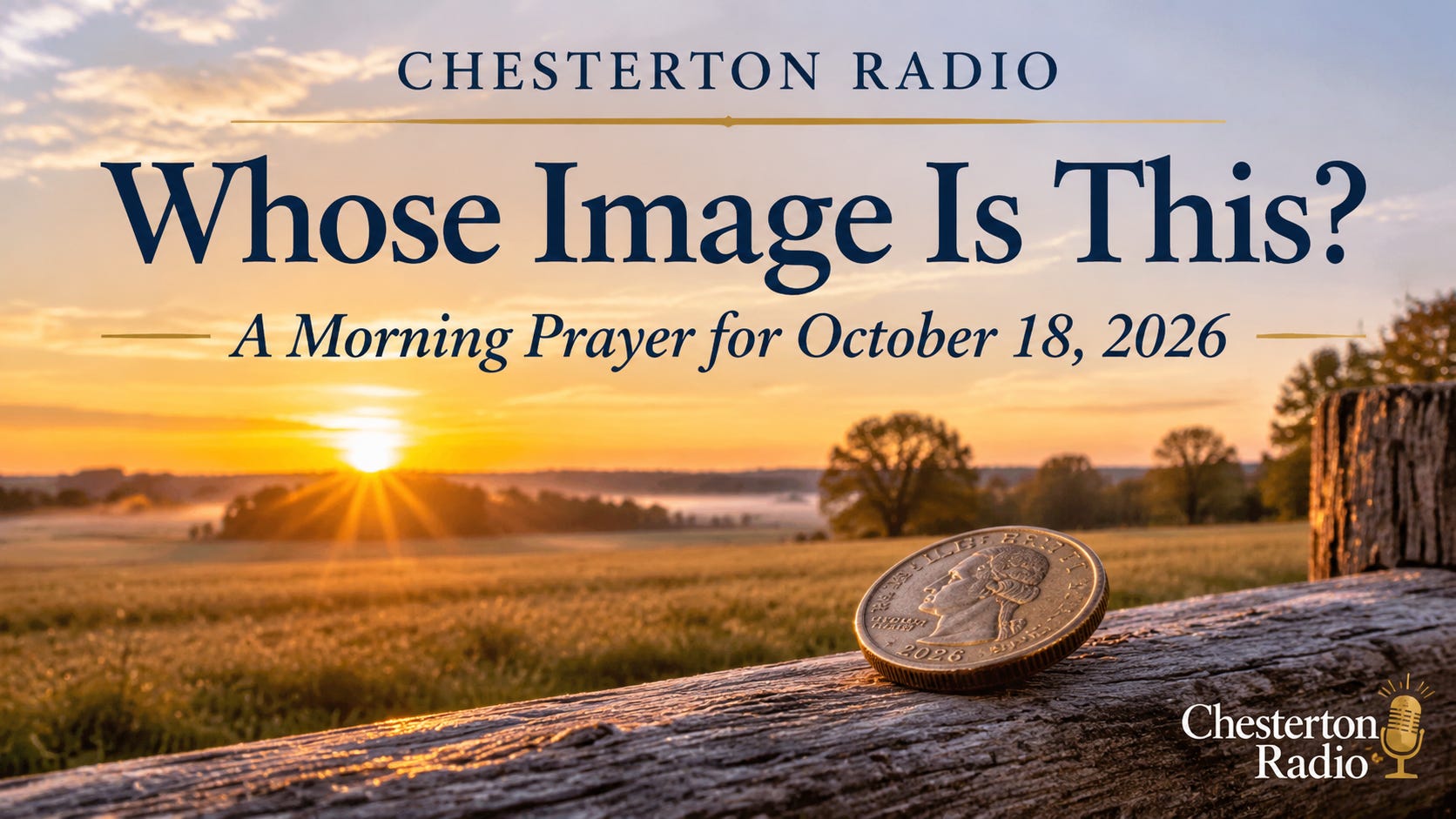
Whose Image Is This?
Most of us carry around objects we scarcely notice.
A coin is among the smallest. We drop it into a jar, leave it in the cup holder, or discover it beneath the sofa cushion. It bears an image and an inscription, but hardly anyone stops to look at either.
Today Jesus asks His enemies to look at a coin.
Then He asks a question that is much larger than money.
Whose image is this?
It is a question worth carrying with us into prayer this morning.
Opening Verse
V. Lord, open my lips.
R. And my mouth shall declare thy praise.
Invitatory
Antiphon: Come, let us adore the Lord, for He is our God.
Psalm 94 (95)
Come let us praise the Lord with joy:
let us joyfully sing to God our saviour.
Let us come before his presence with thanksgiving;
and make a joyful noise to him with psalms.
For the Lord is a great God,
and a great king above all gods.
For in his hand are all the ends of the earth:
and the heights of the mountains are his.
For the sea is his, and he made it:
and his hands formed the dry land.
Come let us adore and fall down:
and weep before the Lord that made us.
For he is the Lord our God:
and we are the people of his pasture and the sheep of his hand.
Today if you shall hear his voice,
harden not your hearts:
As in the provocation, according to the day of temptation in the wilderness:
where your fathers tempted me, they proved me, and saw my works.
Forty years long was I offended with that generation,
and I said: These always err in heart.
And these men have not known my ways:
so I swore in my wrath that they shall not enter into my rest.
Glory be to the Father, and to the Son, and to the Holy Ghost.
As it was in the beginning, is now, and ever shall be, world without end.
Amen.
Antiphon: Come, let us adore the Lord, for He is our God.
Psalmody
Psalm 62 (63)
Antiphon 1: At break of day, O God, I seek Thee; my soul thirsteth for Thee.
O God, my God, to thee do I watch at break of day.
For thee my soul hath thirsted;
for thee my flesh, O how many ways!
In a desert land, and where there is no way, and no water:
so in the sanctuary have I come before thee, to see thy power and thy glory.
For thy mercy is better than lives:
thee my lips shall praise.
Thus will I bless thee all my life long:
and in thy name I will lift up my hands.
Let my soul be filled with marrow and fatness:
and my mouth shall praise thee with joyful lips.
If I have remembered thee upon my bed,
I will meditate on thee in the morning:
Because thou hast been my helper.
And I will rejoice under the covert of thy wings:
my soul hath stuck close to thee: thy right hand hath received me.
But they have sought my soul in vain,
they shall go into the lower parts of the earth:
They shall be delivered into the hands of the sword,
they shall be the portions of foxes.
But the king shall rejoice in God,
all they shall be praised that swear by him:
Because the mouth is stopped of them that speak wicked things.
Glory be to the Father, and to the Son, and to the Holy Ghost.
As it was in the beginning, is now, and ever shall be, world without end.
Amen.
Antiphon 1: At break of day, O God, I seek Thee; my soul thirsteth for Thee.
Canticle — Daniel 3
Antiphon 2: All ye works of the Lord, bless the Lord; praise and exalt Him above all for ever.
All ye works of the Lord, bless the Lord:
praise and exalt him above all for ever.
O ye angels of the Lord, bless the Lord:
O ye heavens, bless the Lord.
O all ye waters that are above the heavens, bless the Lord:
O all ye powers of the Lord, bless the Lord.
O ye sun and moon, bless the Lord:
O ye stars of heaven, bless the Lord.
O every shower and dew, bless ye the Lord:
O all ye spirits of God, bless the Lord.
O ye fire and heat, bless the Lord:
O ye cold and heat, bless the Lord.
O ye dews and hoar frosts, bless the Lord:
O ye frost and cold, bless the Lord.
O ye ice and snow, bless the Lord:
O ye nights and days, bless the Lord.
O ye light and darkness, bless the Lord:
O ye lightnings and clouds, bless the Lord.
O let the earth bless the Lord:
let it praise and exalt him above all for ever.
O ye mountains and hills, bless the Lord:
O all ye things that spring up in the earth, bless the Lord.
O ye fountains, bless the Lord:
O ye seas and rivers, bless the Lord.
O ye whales, and all that move in the waters, bless the Lord:
O all ye fowls of the air, bless the Lord.
O all ye beasts and cattle, bless the Lord:
O ye sons of men, bless the Lord.
O let Israel bless the Lord:
let them praise and exalt him above all for ever.
O ye priests of the Lord, bless the Lord:
O ye servants of the Lord, bless the Lord.
O ye spirits and souls of the just, bless the Lord:
O ye holy and humble of heart, bless the Lord.
O Ananias, Azarias, and Misael, bless ye the Lord:
praise and exalt him above all for ever.
Let us bless the Father and the Son, with the Holy Ghost:
let us praise and exalt him above all for ever.
Blessed art thou, O Lord, in the firmament of heaven:
and worthy of praise, and glorious for ever.
Antiphon 2: All ye works of the Lord, bless the Lord; praise and exalt Him above all for ever.
Psalm 149
Antiphon 3: Let the children of Sion rejoice in their King. Alleluia.
Sing ye to the Lord a new canticle:
let his praise be in the church of the saints.
Let Israel rejoice in him that made him:
and let the children of Sion be joyful in their king.
Let them praise his name in choir:
let them sing to him with the timbrel and the psaltery.
For the Lord is well pleased with his people:
and he will exalt the meek unto salvation.
The saints shall rejoice in glory:
they shall be joyful in their beds.
The high praises of God shall be in their mouth:
and two-edged swords in their hands:
To execute vengeance upon the nations,
chastisements among the people:
To bind their kings with fetters,
and their nobles with manacles of iron.
To execute upon them the judgment that is written:
this glory is to all his saints.
Glory be to the Father, and to the Son, and to the Holy Ghost.
As it was in the beginning, is now, and ever shall be, world without end.
Amen.
Antiphon 3: Let the children of Sion rejoice in their King. Alleluia.
Short Reading
Apocalypse 7:10, 12
Salvation to our God, who sitteth upon the throne, and to the Lamb.
Blessing, and glory, and wisdom, and thanksgiving, honour, and power, and strength, to our God for ever and ever.
Amen.
Short Responsory
V. Thou art Christ, the Son of the living God. Have mercy on us.
R. Thou art Christ, the Son of the living God. Have mercy on us.
V. Thou art seated at the right hand of the Father.
R. Have mercy on us.
V. Glory be to the Father, and to the Son, and to the Holy Ghost.
R. Thou art Christ, the Son of the living God. Have mercy on us.
Gospel of the Day
Matthew 22:15–21
Then the Pharisees going, consulted among themselves how to insnare him in his speech.
And they sent to him their disciples with the Herodians, saying: Master, we know that thou art a true speaker, and teachest the way of God in truth, neither carest thou for any man: for thou dost not regard the person of men.
Tell us therefore what dost thou think, is it lawful to give tribute to Caesar, or not?
But Jesus knowing their wickedness, said: Why do you tempt me, ye hypocrites?
Shew me the coin of the tribute. And they offered him a penny.
And Jesus saith to them: Whose image and inscription is this?
They say to him: Caesar’s.
Then he saith to them:
Render therefore to Caesar the things that are Caesar’s; and to God, the things that are God’s.
Benedictus
Antiphon: From the rising of the sun unto its going down, let all the earth know that the Lord is God and there is no other.
Canticle of Zachary — Luke 1:68–79
Blessed be the Lord God of Israel;
because he hath visited and wrought the redemption of his people:
And hath raised up an horn of salvation to us,
in the house of David his servant:
As he spoke by the mouth of his holy prophets,
who are from the beginning:
Salvation from our enemies,
and from the hand of all that hate us:
To perform mercy to our fathers,
and to remember his holy testament,
The oath, which he swore to Abraham our father,
that he would grant to us,
That being delivered from the hand of our enemies,
we may serve him without fear,
In holiness and justice before him,
all our days.
And thou, child, shalt be called the prophet of the Highest:
for thou shalt go before the face of the Lord to prepare his ways:
To give knowledge of salvation to his people,
unto the remission of their sins:
Through the bowels of the mercy of our God,
in which the Orient from on high hath visited us:
To enlighten them that sit in darkness, and in the shadow of death:
to direct our feet into the way of peace.
Glory be to the Father, and to the Son, and to the Holy Ghost.
As it was in the beginning, is now, and ever shall be, world without end.
Amen.
Antiphon: From the rising of the sun unto its going down, let all the earth know that the Lord is God and there is no other.
Intercessions
Christ is the true image of the invisible God, and in Him we learn again to whom we belong. Let us turn to Him with confidence:
Lord, restore Thine image in us.
For the Church: that she may give fearless witness to the Kingdom of God while faithfully carrying out her duties in the kingdoms of this world,
Lord, restore Thine image in us.
For those entrusted with civil authority: that they may remember that authority is a stewardship and that every person placed beneath their care bears a dignity no government bestowed and no government can take away,
Lord, restore Thine image in us.
For those whose work sustains homes, farms, workshops, businesses, schools, hospitals, parishes, and communities: that honest labor may become an offering to God,
Lord, restore Thine image in us.
For our families: that we may see in those nearest to us not merely their faults, habits, usefulness, or needs, but persons made in the image of God,
Lord, restore Thine image in us.
For those burdened by debt, taxes, unemployment, financial anxiety, or uncertainty about the future: that they may receive wisdom, assistance, courage, and peace,
Lord, restore Thine image in us.
For those whose dignity has been forgotten—the unborn, the elderly, the lonely, the disabled, the imprisoned, the poor, the refugee, and everyone treated as a problem rather than a person,
Lord, restore Thine image in us.
For those who have died: that the God whose image they bore in this life may receive them into the fullness of His presence,
Lord, restore Thine image in us.
For ourselves: that amid all the claims made upon our time, money, loyalty, and attention, we may never forget the first and greatest claim upon us:
We belong to God.
Lord, restore Thine image in us.
Our Father
Our Father, who art in heaven,
hallowed be thy name.
Thy kingdom come.
Thy will be done on earth as it is in heaven.
Give us this day our daily bread.
And forgive us our trespasses,
as we forgive those who trespass against us.
And lead us not into temptation.
But deliver us from evil.
Amen.
Concluding Prayer
Almighty and eternal God,
Thou hast made us in Thine image and called us to Thyself.
Grant that amid the duties and demands of this earthly life we may give faithfully what justice requires, while never surrendering to the world that which belongs to Thee alone.
Purify Thy likeness in us, that our work, our possessions, our loyalties, and our lives may bear witness that Thou art Lord.
Through Christ our Lord.
Amen.
Blessing
May the Lord bless us,
protect us from all evil,
and bring us to everlasting life.
Amen.
The Paradox of the Day
The coin belongs to Caesar because it bears Caesar’s image; we belong to God because we bear God’s.
Chesterton for the Morning
“The world will never starve for want of wonders; but only for want of wonder.”
— G. K. Chesterton, Tremendous Trifles (1909), Chapter I, “Tremendous Trifles.”
A Chestertonian Meditation
Whose Image Is This?
There are few objects less romantic than the loose change in a man’s pocket.
Coins have a remarkable ability to become invisible precisely because they are everywhere. They gather in desk drawers, automobile consoles, kitchen jars, old coats, washing machines, and the mysterious corners beneath furniture where apparently a small but functioning economy has been established.
A child may still find a coin interesting.
An adult generally wants to know whether the parking meter takes cards.
And this is unfortunate, because a coin is actually a rather extraordinary little object.
Take one out and look at it.
There is a face on it.
There are words.
There is a date.
There is the name or symbol of a nation.
A government has taken a small piece of metal and solemnly announced that this object means something.
We hardly notice any of it.
Jesus did.
His enemies had approached Him with a trap.
The question sounded like a question about taxes, but it was really about allegiance.
If Jesus opposed the Roman tax, He could be denounced to Rome.
If He endorsed it without qualification, He could be made to look like a friend of the occupation.
It was the sort of question devised by clever men who had already decided that every possible answer would be wrong.
Christ asks for a coin.
That may be the funniest part of the encounter.
The men asking whether the tax should be paid are apparently carrying the money with which it is paid.
Jesus does not begin with a political theory.
He begins with the object in their hands.
“Whose image and inscription is this?”
Caesar’s.
Very well.
Give Caesar his coin.
But then comes the second half of the sentence.
“And to God, the things that are God’s.”
The trap disappears, and suddenly the men holding the coin are themselves caught by a much larger question.
If the coin bearing Caesar’s image belongs in some sense to Caesar, what bears the image of God?
They do.
So do we.
That is the tremendous thing hidden inside this little trifle.
The coin has Caesar stamped upon it.
Humanity has God stamped upon it.
The Book of Genesis says it before there are governments, taxes, currencies, parliaments, republics, empires, banks, or budgets:
God made man to His image.
This means that Christ’s answer is not principally an ingenious formula for separating Church and state. It certainly recognizes legitimate earthly obligations. Christians do not escape ordinary duties by becoming Christians.
Taxes must be paid.
Contracts honored.
Promises kept.
Work done.
Neighbors respected.
Laws obeyed when they are just.
Caesar has legitimate claims.
But Caesar’s great temptation has always been to forget where his claims end.
Caesar wants the coin.
Eventually Caesar tends to want the man as well.
Every age invents new Caesars.
They need not wear laurel wreaths.
A career can become Caesar.
Money can become Caesar.
Politics can become Caesar.
Popularity can become Caesar.
Technology can become Caesar.
Even a good cause can begin asking for something it has no right to possess.
Give me your money.
Give me your time.
Give me your attention.
Give me your anger.
Give me your Sundays.
Give me your peace.
Give me your identity.
Give me your soul.
And Christianity answers with an astonishingly cheerful refusal.
No.
The coin may be yours.
The man is God’s.
This is why Christianity has always had a peculiar relationship with worldly power. It can be remarkably obedient and remarkably rebellious at exactly the same time.
The Christian can pay the tax and refuse to worship the emperor.
He can serve his country and insist that his country is not God.
He can respect authority while remembering that authority itself stands beneath a higher Authority.
He can own property while knowing that even ownership is stewardship.
He can participate wholeheartedly in ordinary life without imagining that ordinary life is all there is.
This is not a gloomy restriction.
It is liberation.
For if we belong finally to God, then nobody else can completely own us.
Not an employer.
Not a government.
Not a political party.
Not a bank.
Not an audience.
Not an algorithm.
Not even our own mistakes.
The image remains.
It may be scratched.
It may be dirty.
It may be difficult to see.
But the image remains.
A battered coin is still recognizable as a coin.
And a battered human being remains a creature made in the image of God.
That is why Christianity has always made such inconvenient claims about human dignity.
The inconvenient person bears the image.
The unborn child bears the image.
The old man who cannot remember your name bears the image.
The prisoner bears the image.
The annoying neighbor bears the image.
The person on the other side of the political argument bears the image.
The stranger bears the image.
The person who has failed spectacularly bears the image.
And—occasionally most difficult of all—the face in the mirror bears the image.
Chesterton’s genius was to keep discovering enormous things concealed inside ordinary things.
A piece of chalk could lead to theology.
The contents of a pocket could become an adventure.
A railway journey could reveal a world.
“The world will never starve for want of wonders,” he wrote, “but only for want of wonder.”
Christ does something similar in today’s Gospel.
Someone hands Him pocket change.
And He reveals the nature of man.
Perhaps that is why the question is worth remembering today.
Whose image is this?
We can ask it when we look at the people around the breakfast table.
Whose image?
We can ask it when someone irritates us.
Whose image?
We can ask it when we encounter someone poor, confused, frightened, old, difficult, or inconvenient.
Whose image?
We can even ask it when we are discouraged by our own failures.
Whose image?
There are many inscriptions the world will attempt to stamp upon a human being.
Successful.
Failure.
Useful.
Useless.
Rich.
Poor.
Important.
Nobody.
Left.
Right.
Young.
Old.
Winner.
Loser.
But beneath every inscription imposed by the world is an older mark.
Made in the image of God.
A coin passes from hand to hand.
It is bought and sold, saved and spent, lost and found.
Eventually its surface wears smooth.
But we are not coins.
We cannot finally be priced.
Christ has taken the little piece of metal from His questioners and turned the whole universe right side up.
Give the small things their proper due.
Pay what you owe.
Keep your promises.
Do your work.
Fulfill your obligations.
Render to Caesar what is Caesar’s.
But when Caesar—or anything else—asks for the thing that bears God’s image, remember whose image it is.
The morning has begun.
There will be many claims upon us before evening.
Most of them will be perfectly legitimate.
But before answering them, it may be worth reaching into a pocket, finding a coin, and remembering the question Christ asked over something so small:
Whose image is this?
And then remembering the answer that matters even more.
Whose image are you?
May we recognize God’s image in every person we meet today—and remember His image in ourselves.
Chesterton Radio