

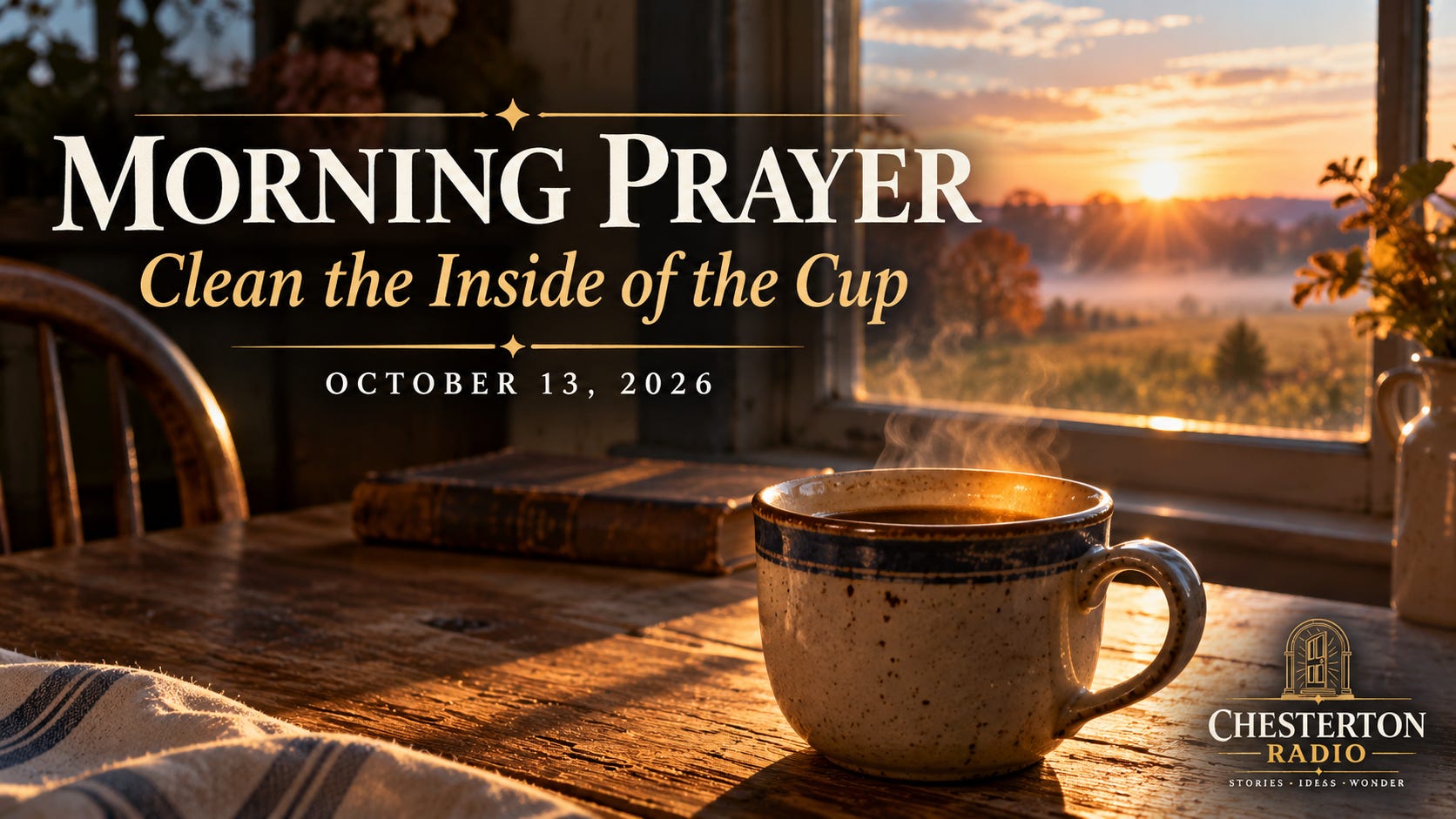
There is probably a cup somewhere near you this morning.
Perhaps it holds coffee. Perhaps tea. Perhaps it has already been washed and put upside down beside the sink, waiting for another ordinary day.
We are remarkably particular about cups. A stain on the rim bothers us. A fingerprint catches the eye. We rinse, scrub, polish, and put things back in their proper places.
This morning Christ looks at the cup too.
But He looks where we do not.
He asks us to begin the day not by making ourselves appear spotless, but by allowing God to cleanse what no one else can see.
So before the work begins, before the messages arrive, before we arrange the visible pieces of the day, let us ask God for the considerably more dangerous grace of an honest heart.
OPENING VERSE
Lord, open my lips.
And my mouth shall declare thy praise.
INVITATORY
Antiphon: Come, let us adore the Lord, the mighty God.
Psalm 94 (95)
Come let us praise the Lord with joy:
let us joyfully sing to God our saviour.
Let us come before his presence with thanksgiving;
and make a joyful noise to him with psalms.
For the Lord is a great God,
and a great king above all gods.
For in his hand are all the ends of the earth:
and the heights of the mountains are his.
For the sea is his, and he made it:
and his hands formed the dry land.
Come let us adore and fall down:
and weep before the Lord that made us.
For he is the Lord our God:
and we are the people of his pasture and the sheep of his hand.
Today if you shall hear his voice,
harden not your hearts:
As in the provocation, according to the day of temptation in the wilderness:
where your fathers tempted me, they proved me, and saw my works.
Forty years long was I offended with that generation,
and I said: These always err in heart.
And these men have not known my ways:
so I swore in my wrath that they shall not enter into my rest.
Glory be to the Father, and to the Son,
and to the Holy Ghost.
As it was in the beginning, is now, and ever shall be,
world without end. Amen.
Antiphon: Come, let us adore the Lord, the mighty God.
PSALMODY
Psalm 100 (101)
Antiphon: I will sing mercy and judgment unto thee, O Lord.
Mercy and judgment I will sing to thee, O Lord:
I will sing,
And I will understand in the unspotted way,
when thou shalt come to me.
I walked in the innocence of my heart,
in the midst of my house.
I did not set before my eyes any unjust thing:
I hated the workers of iniquities.
The perverse heart did not cleave to me:
and the malignant, that turned aside from me, I would not know.
The man that in private detracted his neighbour,
him did I persecute.
With him that had a proud eye, and an unsatiable heart,
I would not eat.
My eyes were upon the faithful of the earth,
to sit with me:
The man that walked in the perfect way,
he served me.
He that worketh pride shall not dwell in the midst of my house:
he that speaketh unjust things did not prosper before my eyes.
In the morning I put to death all the wicked of the land:
that I might cut off all the workers of iniquity from the city of the Lord.
Glory be to the Father, and to the Son,
and to the Holy Ghost.
As it was in the beginning, is now, and ever shall be,
world without end. Amen.
Antiphon: I will sing mercy and judgment unto thee, O Lord.
Canticle — Daniel 3:26–27, 29, 34–41
Antiphon: Take not away thy mercy from us, O Lord.
Blessed art thou, O Lord, the God of our fathers,
and thy name is worthy of praise, and glorious for ever:
For thou art just in all that thou hast done to us,
and all thy works are true, and thy ways right, and all thy judgments true.
For we have sinned, and committed iniquity,
departing from thee: and we have trespassed in all things.
Deliver us not up for ever, we beseech thee, for thy name’s sake,
and abolish not thy covenant.
And take not away thy mercy from us,
for the sake of Abraham thy beloved, and Isaac thy servant, and Israel thy holy one:
To whom thou hast spoken, promising that thou wouldst multiply their seed as the stars of heaven,
and as the sand that is on the sea shore.
For we, O Lord, are diminished more than any nation,
and are brought low in all the earth this day for our sins.
Neither is there at this time prince, or leader, or prophet, or holocaust, or sacrifice, or oblation, or incense,
or place of first fruits before thee,
That we may find thy mercy: nevertheless in a contrite heart and humble spirit
let us be accepted.
As in holocausts of rams, and bullocks, and as in thousands of fat lambs:
so let our sacrifice be made in thy sight this day, that it may please thee:
For there is no confusion to them that trust in thee.
And now we follow thee with all our heart,
and we fear thee, and seek thy face.
Glory be to the Father, and to the Son,
and to the Holy Ghost.
As it was in the beginning, is now, and ever shall be,
world without end. Amen.
Antiphon: Take not away thy mercy from us, O Lord.
Psalm 143 (144):1–10
Antiphon: To thee, O God, I will sing a new canticle.
Blessed be the Lord my God, who teacheth my hands to fight,
and my fingers to war.
My mercy, and my refuge:
my support, and my deliverer:
My protector, and I have hoped in him:
who subdueth my people under me.
Lord, what is man, that thou art made known to him?
or the son of man, that thou makest account of him?
Man is like to vanity:
his days pass away like a shadow.
Lord, bow down thy heavens and descend:
touch the mountains, and they shall smoke.
Send forth lightning, and thou shalt scatter them:
shoot out thy arrows, and thou shalt trouble them.
Put forth thy hand from on high, take me out, and deliver me from many waters:
from the hand of strange children:
Whose mouth hath spoken vanity:
and their right hand is the right hand of iniquity.
To thee, O God, I will sing a new canticle:
on the psaltery and an instrument of ten strings I will sing praises to thee.
Who givest salvation to kings:
who hast redeemed thy servant David from the malicious sword.
Glory be to the Father, and to the Son,
and to the Holy Ghost.
As it was in the beginning, is now, and ever shall be,
world without end. Amen.
Antiphon: To thee, O God, I will sing a new canticle.
SHORT READING
Isaiah 55:1
All you that thirst, come to the waters: and you that have no money, make haste, buy, and eat: come ye, buy wine and milk without money, and without any price.
SHORT RESPONSORY
Hear my voice, O Lord; in thy word have I hoped.
I have risen before the dawn and cried unto thee.
In thy word have I hoped.
Glory be to the Father, and to the Son, and to the Holy Ghost.
Hear my voice, O Lord; in thy word have I hoped.
GOSPEL OF THE DAY
Luke 11:37–41
And as he was speaking, a certain Pharisee prayed him that he would dine with him. And he going in, sat down to eat.
And the Pharisee began to say, thinking within himself, why he was not washed before dinner.
And the Lord said to him: Now you Pharisees make clean the outside of the cup and of the platter: but your inside is full of rapine and iniquity.
Ye fools, did not he that made that which is without, make also that which is within?
But yet that which remaineth, give alms; and behold, all things are clean unto you.
BENEDICTUS
Antiphon: He who made that which is without made also that which is within.
Canticle of Zachary — Luke 1:68–79
Blessed be the Lord God of Israel;
because he hath visited and wrought the redemption of his people:
And hath raised up an horn of salvation to us,
in the house of David his servant:
As he spoke by the mouth of his holy prophets,
who are from the beginning:
Salvation from our enemies,
and from the hand of all that hate us:
To perform mercy to our fathers,
and to remember his holy testament,
The oath, which he swore to Abraham our father,
that he would grant to us,
That being delivered from the hand of our enemies,
we may serve him without fear,
In holiness and justice before him,
all our days.
And thou, child, shalt be called the prophet of the Highest:
for thou shalt go before the face of the Lord to prepare his ways:
To give knowledge of salvation to his people,
unto the remission of their sins:
Through the bowels of the mercy of our God,
in which the Orient from on high hath visited us:
To enlighten them that sit in darkness, and in the shadow of death:
to direct our feet into the way of peace.
Glory be to the Father, and to the Son,
and to the Holy Ghost.
As it was in the beginning, is now, and ever shall be,
world without end. Amen.
Antiphon: He who made that which is without made also that which is within.
INTERCESSIONS
Christ calls us not merely to appear righteous, but to become new in heart. Trusting in His mercy, let us pray:
Lord, create a clean heart in us.
For the Church: that she may always proclaim Christ with courage, humility, and holiness, and that her visible works may spring from genuine love of God.
Lord, create a clean heart in us.
For bishops, priests, deacons, religious, and all who teach the faith: that their public ministry may be sustained by hidden prayer and integrity.
Lord, create a clean heart in us.
For our nation and communities: that concern for appearances may never replace justice, mercy, honesty, and care for the poor.
Lord, create a clean heart in us.
For our work today: keep us from doing merely what will be noticed. Teach us to do the unseen task well, to tell the truth when a lie would be easier, and to serve when there is no applause.
Lord, create a clean heart in us.
For our homes and families: cleanse us of old resentments, impatient words, concealed pride, and the little selfishnesses that accumulate unnoticed.
Lord, create a clean heart in us.
For those carrying suffering invisible to others: the lonely, anxious, grieving, exhausted, frightened, or forgotten. Give them companions who look beyond appearances.
Lord, create a clean heart in us.
For those who have died: cleanse them of every stain and bring them into the brightness of thy presence.
Lord, create a clean heart in us.
For ourselves: give us the courage to see what is within without despair, because the God who reveals our sins is also the God who desires to forgive them.
Lord, create a clean heart in us.
OUR FATHER
Our Father, who art in heaven,
hallowed be thy name.
Thy kingdom come.
Thy will be done on earth as it is in heaven.
Give us this day our daily bread.
And forgive us our trespasses,
as we forgive those who trespass against us.
And lead us not into temptation,
but deliver us from evil.
Amen.
CONCLUDING PRAYER
O God, who hast made both what is seen and what is hidden, cleanse our hearts by thy grace. Free us from the desire merely to appear good, and give us instead the freedom of those who belong wholly to Christ. May faith work in us through love, so that what we do before men may spring from what thou hast made true within us.
Through Christ our Lord.
Amen.
BLESSING
May the Lord bless us,
and keep us from all evil,
and bring us unto everlasting life.
Amen.
THE PARADOX OF THE DAY
The cleanest life is not the one with nothing to hide, but the one that has stopped hiding anything from God.
CHESTERTON FOR THE MORNING
“Sport, like soap, is an admirable thing, but, like soap, it is an agreeable thing.”
— G. K. Chesterton, What’s Wrong with the World, “The School for Hypocrites”
Chesterton’s joke about soap lands surprisingly close to today’s Gospel. His target was not cleanliness. Chesterton was quite capable of appreciating a bath. His target was the peculiar human trick of converting an external advantage into evidence of internal virtue.
Jesus goes considerably further.
He picks up the cup.
A CHESTERTONIAN MEDITATION
There is something wonderfully unforgiving about a coffee cup.
A table can look respectable while hiding crumbs beneath the placemat. A kitchen can be hurriedly straightened before company arrives. Papers can be pushed into a drawer. The door can be shut on the room we have decided not to deal with today.
But eventually somebody has to look inside the cup.
This is especially true in the morning.
Yesterday’s cup, abandoned beside a chair, has developed a little brown geography of its own. There is a ring around the inside marking the precise altitude at which yesterday’s enthusiasm for coffee expired. The outside may be perfectly presentable. The handle may shine. The manufacturer’s name may still be crisply printed underneath.
But nobody wants coffee poured into it.
The problem is not the cup.
The problem is what remains within.
And so we arrive at breakfast with the Pharisees.
It is easy to make them into cartoon villains. That is dangerous, because the instant the Pharisee becomes somebody obviously unlike us, he becomes spiritually useless to us.
The Pharisee in today’s Gospel is doing something quite ordinary. He invites Jesus to dinner.
That is hardly villainous.
Then he notices that Jesus has not performed the expected washing.
And suddenly the host is no longer looking at Christ.
He is looking at the rule.
More precisely, he is looking at Christ through the rule.
This is where the strange reversal occurs. The man has invited God to his table and becomes concerned that God has not washed properly.
There may be no better miniature of religion gone wrong.
We can invite God into the house and then spend the meal worrying about whether He is behaving according to our expectations.
Christ responds with a cup.
You clean the outside, He says.
But what about the inside?
It is a devastating image precisely because Jesus does not condemn cleanliness. A dirty cup does not become holy merely because hypocrisy is bad. The point is not that the outside should be filthy.
The point is that polishing the outside cannot clean the inside.
Chesterton understood this distinction instinctively. In What’s Wrong with the World, he mocked the modern tendency to confuse physical cleanliness with moral purity. Soap is good. Baths are good. Order is good. Civilization is good.
But none of them can absolve a man.
This is one of the great temptations of respectable life.
Respectability is largely visible.
Character is largely invisible.
The lawn can be mowed.
The bills can be paid.
The shoes can be polished.
The email can be courteous.
The parish committee can be attended.
The photograph can be smiling.
And the heart can still contain envy, resentment, greed, lust, vanity, cowardice, or an old grievance carefully preserved like a family heirloom.
Indeed, we sometimes polish the outside precisely because we do not want to open the cupboard where the other things are kept.
Christianity commits the astonishing discourtesy of opening it.
Not because Christianity despises us.
Because Christ intends to free us.
Saint Paul says today, “For freedom Christ has set us free.”
That is the other half of the Gospel.
We usually imagine freedom as the ability to keep people out of our private affairs.
Christ proposes something stranger: freedom begins when we no longer need a private room in the soul where God is forbidden to enter.
There is tremendous labor involved in maintaining appearances.
One must remember what one said.
One must protect one’s reputation.
One must explain away the failure.
One must ensure that the weakness remains unseen.
One must polish the cup repeatedly because somebody may notice the stain.
Grace offers an entirely different arrangement.
God already knows.
That may initially sound like bad news.
It is actually magnificent news.
The examination is over before we enter the room. The evidence has already been presented. The Judge knows considerably more about the defendant than the defendant does.
And still He came to dinner.
Still He calls.
Still He forgives.
Still He says: give me the inside.
This is why confession is one of the most astonishingly cheerful things in Christianity.
The world imagines confession as gloom: dark wood, whispered sins, uncomfortable admissions.
But the essential action of confession is the end of pretending.
The cup is turned over.
Here it is.
This is what is inside.
And Christ does not throw it away.
He washes it.
That is a very different religion from respectability.
Respectability says: Do not let anyone see the stain.
Christ says: Give me the cup.
Respectability says: Maintain the appearance.
Christ says: Become free.
Respectability asks: What will people think?
Christ asks: What is true?
And then comes the most surprising line in today’s Gospel.
“Give alms; and behold, all things are clean unto you.”
We might have expected Christ to prescribe a complicated interior purification. Instead He points outward toward generosity.
Why?
Because greed curls the soul inward.
Charity opens it.
The clenched hand and the closed heart are close relatives.
Give.
Give money where it is needed.
Give attention to the person who is usually overlooked.
Give patience when irritation would be more satisfying.
Give credit to somebody else.
Give the first word of reconciliation.
Give five minutes to the child telling the impossibly long story.
Give the lonely person a telephone call.
Give God the first part of the morning rather than whatever fragments remain after the world has finished eating it.
The curious thing about giving is that it begins cleaning rooms inside us we did not know were dirty.
The heart becomes larger by being spent.
This is one reason the Christian life cannot finally be reduced to self-improvement.
Self-improvement can become another form of polishing.
We can become very interested in becoming impressive versions of ourselves.
Christ is interested in something else.
He wants us to become gifts.
And perhaps that is why there is a cup on the breakfast table this morning.
A cup is made to be filled.
But it is also made to be emptied.
It receives precisely so that it can give.
The useful cup does not preserve yesterday’s coffee as a monument to itself. It is emptied, washed, and made ready to receive again.
So are we.
Every morning is God’s quiet invitation to be emptied of yesterday’s bitterness, yesterday’s vanity, yesterday’s fear, yesterday’s carefully rehearsed arguments.
The mercy of God is new.
The cup can be washed.
The coffee can be poured.
The day can begin.
And perhaps holiness is not chiefly the achievement of keeping the outside immaculate.
Perhaps it is having the humility, every morning, to hand God the cup.
Especially the inside.
CLOSING
Lord, cleanse what only thou canst see.
Empty us of what we have carried too long.
Fill us with thy grace.
And when we go out into the ordinary business of this Tuesday, let what others see on the outside be simply the overflow of what thou hast made new within.
Chesterton Radio