

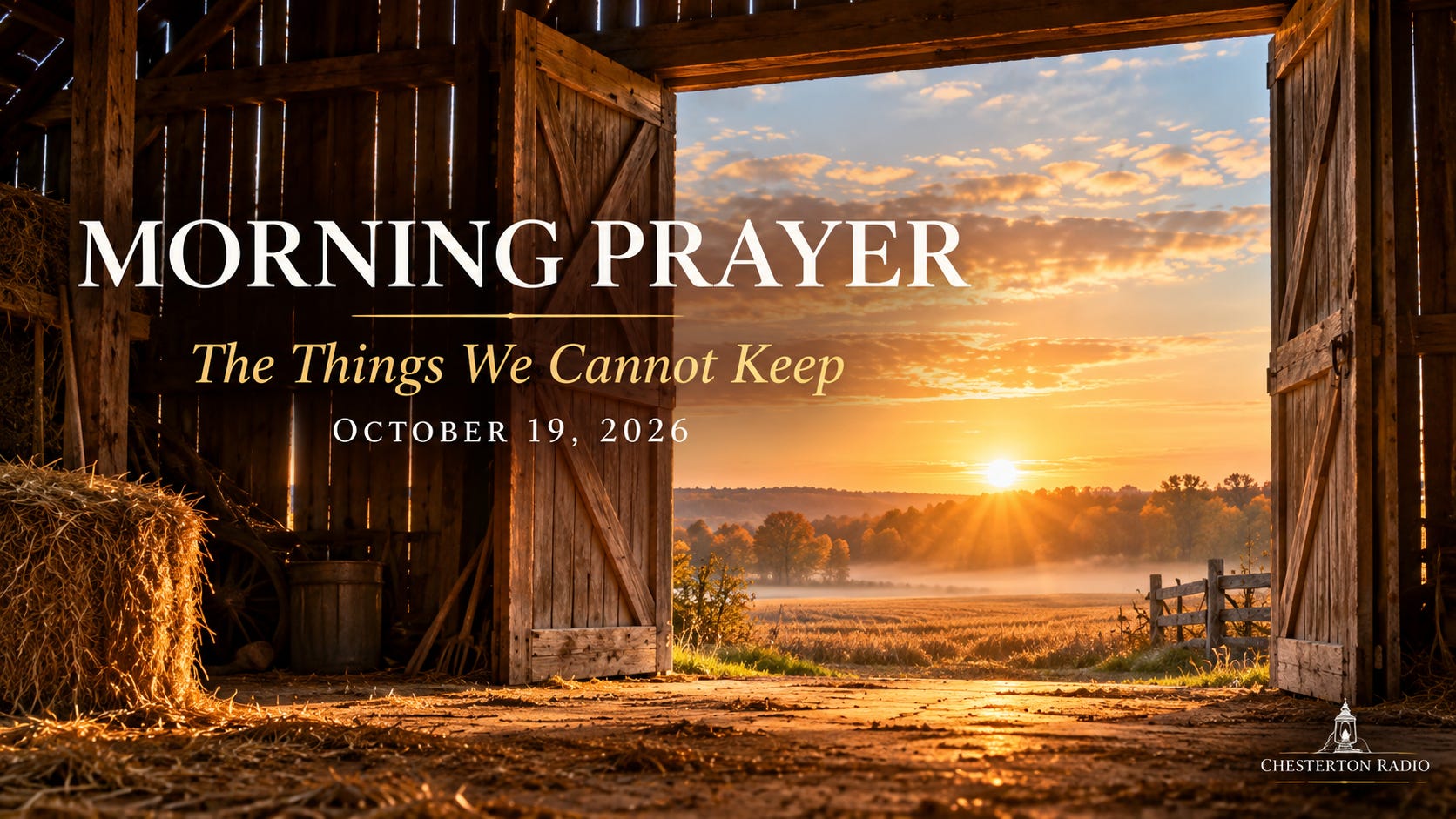
THE THINGS WE CANNOT KEEP
There is something reassuring about a full barn.
Or a full pantry. A full bank account. A full woodshed before winter. A full tank of gasoline before a long drive.
There is nothing wrong with preparing. Prudence is a virtue. The trouble begins when the things we have stored cease to be gifts and begin to look like guarantees.
Today Christ tells us about a man whose barns were full but whose soul was empty. And the Church gives us, on the same morning, men who surrendered nearly everything the world ordinarily calls security.
Saints John de Brébeuf, Isaac Jogues, and their companions went into a wilderness without any reasonable assurance that they would return from it.
Some did not.
The rich man built bigger barns because he wanted to possess his future.
The martyrs gave away their future because they knew to whom it already belonged.
Let us carry that difference into prayer.
OPENING VERSE
Lord, open my lips.
And my mouth shall declare thy praise.
INVITATORY
Antiphon: The Lord is the King of martyrs: come, let us adore him.
Psalm 94 (95)
Come let us praise the Lord with joy:
let us joyfully sing to God our saviour.
Let us come before his presence with thanksgiving;
and make a joyful noise to him with psalms.
For the Lord is a great God,
and a great King above all gods.
For in his hand are all the ends of the earth:
and the heights of the mountains are his.
For the sea is his, and he made it:
and his hands formed the dry land.
Come let us adore and fall down:
and weep before the Lord that made us.
For he is the Lord our God:
and we are the people of his pasture and the sheep of his hand.
Today if you shall hear his voice,
harden not your hearts:
As in the provocation, according to the day of temptation in the wilderness:
where your fathers tempted me, they proved me, and saw my works.
Forty years long was I offended with that generation,
and I said: These always err in heart.
And these men have not known my ways:
so I swore in my wrath that they shall not enter into my rest.
Glory be to the Father, and to the Son,
and to the Holy Ghost.
As it was in the beginning, is now, and ever shall be,
world without end. Amen.
Antiphon: The Lord is the King of martyrs: come, let us adore him.
PSALMODY
Psalm 5
Antiphon 1: In the morning I will stand before thee, O Lord, and I will see.
Give ear, O Lord, to my words,
understand my cry.
Hearken to the voice of my prayer,
O my King and my God.
For to thee will I pray:
O Lord, in the morning thou shalt hear my voice.
In the morning I will stand before thee, and will see:
because thou art not a God that willest iniquity.
Neither shall the wicked dwell near thee:
nor shall the unjust abide before thy eyes.
Thou hatest all the workers of iniquity:
thou wilt destroy all that speak a lie.
The bloody and the deceitful man
the Lord will abhor.
But as for me in the multitude of thy mercy,
I will come into thy house;
I will worship towards thy holy temple,
in thy fear.
Conduct me, O Lord, in thy justice:
because of my enemies, direct my way in thy sight.
For there is no truth in their mouth;
their heart is vain.
Their throat is an open sepulchre:
they dealt deceitfully with their tongues.
Judge them, O God.
Let them fall from their devices:
According to the multitude of their wickednesses cast them out:
for they have provoked thee, O Lord.
But let all them be glad that hope in thee:
they shall rejoice for ever, and thou shalt dwell in them.
And all they that love thy name
shall glory in thee:
For thou wilt bless the just.
O Lord, thou hast crowned us,
as with a shield of thy good will.
Glory be to the Father, and to the Son,
and to the Holy Ghost.
As it was in the beginning, is now, and ever shall be,
world without end. Amen.
Antiphon 1: In the morning I will stand before thee, O Lord, and I will see.
Canticle — 1 Paralipomenon 29:10–13
Antiphon 2: We praise the splendour of thy name, O Lord our God.
Blessed art thou, O Lord the God of Israel our father,
from eternity to eternity.
Thine, O Lord, is magnificence, and power,
and glory, and victory:
And to thee is praise:
for all that is in heaven and in earth is thine:
Thine is the kingdom, O Lord,
and thou art above all princes.
Thine are riches, and thine is glory:
thou hast dominion over all.
In thy hand is power and might:
in thy hand greatness, and the empire of all things.
Now therefore our God we give thanks to thee,
and we praise thy glorious name.
Glory be to the Father, and to the Son,
and to the Holy Ghost.
As it was in the beginning, is now, and ever shall be,
world without end. Amen.
Antiphon 2: We praise the splendour of thy name, O Lord our God.
Psalm 28 (29)
Antiphon 3: Adore ye the Lord in his holy court.
Bring to the Lord, O ye children of God:
bring to the Lord the offspring of rams.
Bring to the Lord glory and honour:
bring to the Lord glory to his name:
Adore ye the Lord
in his holy court.
The voice of the Lord is upon the waters;
the God of majesty hath thundered,
The Lord
upon many waters.
The voice of the Lord is in power;
the voice of the Lord in magnificence.
The voice of the Lord breaketh the cedars:
yea, the Lord shall break the cedars of Libanus.
And shall reduce them to pieces, as a calf of Libanus,
and as the beloved son of unicorns.
The voice of the Lord divideth the flame of fire:
The voice of the Lord shaketh the desert:
and the Lord shall shake the desert of Cades.
The voice of the Lord prepareth the stags:
and he will discover the thick woods:
And in his temple
all shall speak his glory.
The Lord maketh the flood to dwell:
and the Lord shall sit king for ever.
The Lord will give strength to his people:
the Lord will bless his people with peace.
Glory be to the Father, and to the Son,
and to the Holy Ghost.
As it was in the beginning, is now, and ever shall be,
world without end. Amen.
Antiphon 3: Adore ye the Lord in his holy court.
SHORT READING
2 Corinthians 1:3–5
Blessed be the God and Father of our Lord Jesus Christ, the Father of mercies, and the God of all comfort. Who comforteth us in all our tribulation; that we also may be able to comfort them who are in all distress, by the exhortation wherewith we also are exhorted by God. For as the sufferings of Christ abound in us: so also by Christ doth our comfort abound.
SHORT RESPONSORY
These were holy men; they shall live for ever.
These were holy men; they shall live for ever.
The Lord himself is their reward.
They shall live for ever.
Glory be to the Father, and to the Son, and to the Holy Ghost.
These were holy men; they shall live for ever.
GOSPEL OF THE DAY
Luke 12:13–21
And one of the multitude said to him: Master, speak to my brother that he divide the inheritance with me.
But he said to him: Man, who hath appointed me judge, or divider, over you?
And he said to them: Take heed and beware of all covetousness: for a man’s life doth not consist in the abundance of things which he possesseth.
And he spoke a similitude to them, saying: The land of a certain rich man brought forth plenty of fruits.
And he thought within himself, saying: What shall I do, because I have no room where to bestow my fruits?
And he said: This will I do: I will pull down my barns, and will build greater; and into them will I gather all things that are grown to me, and my goods.
And I will say to my soul: Soul, thou hast much goods laid up for many years; take thy rest; eat, drink, make good cheer.
But God said to him: Thou fool, this night do they require thy soul of thee: and whose shall those things be which thou hast provided?
So is he that layeth up treasure for himself, and is not rich towards God.
BENEDICTUS
Antiphon: Blessed are they that suffer persecution for justice’ sake: for theirs is the kingdom of heaven.
Canticle of Zachary — Luke 1:68–79
Blessed be the Lord God of Israel;
because he hath visited and wrought the redemption of his people:
And hath raised up an horn of salvation to us,
in the house of David his servant:
As he spoke by the mouth of his holy prophets,
who are from the beginning:
Salvation from our enemies,
and from the hand of all that hate us:
To perform mercy to our fathers,
and to remember his holy testament,
The oath, which he swore to Abraham our father,
that he would grant to us,
That being delivered from the hand of our enemies,
we may serve him without fear,
In holiness and justice before him,
all our days.
And thou, child, shalt be called the prophet of the Highest:
for thou shalt go before the face of the Lord to prepare his ways:
To give knowledge of salvation to his people,
unto the remission of their sins:
Through the bowels of the mercy of our God,
in which the Orient from on high hath visited us:
To enlighten them that sit in darkness, and in the shadow of death:
to direct our feet into the way of peace.
Glory be to the Father, and to the Son,
and to the Holy Ghost.
As it was in the beginning, is now, and ever shall be,
world without end. Amen.
Antiphon: Blessed are they that suffer persecution for justice’ sake: for theirs is the kingdom of heaven.
INTERCESSIONS
Through Christ, the faithful witness, who strengthened his martyrs to surrender even their lives, let us offer our prayers with confidence.
Lord, make us rich towards thee.
For the Church throughout the world: that she may proclaim Christ with the courage of the martyrs, neither softening the Gospel for comfort nor hardening it through pride.
Lord, make us rich towards thee.
For missionaries, priests, religious, catechists, parents, teachers, and all who carry the faith where it is difficult to speak of Christ: grant them perseverance, prudence, courage, and joy.
Lord, make us rich towards thee.
For those entrusted with wealth, property, businesses, farms, workshops, and the work of many hands: teach us to receive material goods gratefully without mistaking them for the purpose of life.
Lord, make us rich towards thee.
For our work today: keep us honest in small things, generous with our knowledge, patient with those who need us, and willing to place our talents at the service of others.
Lord, make us rich towards thee.
For our homes and families: preserve us from allowing possessions, schedules, ambitions, or anxieties to crowd out the people whom thou hast given us to love.
Lord, make us rich towards thee.
For those who suffer persecution, violence, loneliness, poverty, illness, or grief: give them consolation in Christ, and make us ready instruments of that consolation.
Lord, make us rich towards thee.
For the peoples among whom Saints John de Brébeuf, Isaac Jogues, and their companions laboured, and for all peoples wounded by the sins and conflicts of history: bring healing, reconciliation, justice, and peace.
Lord, make us rich towards thee.
For those who will die this day, especially those who do not expect death: grant them mercy and the grace to place themselves wholly into thy hands.
Lord, make us rich towards thee.
For our beloved dead: receive them into that kingdom where nothing is lost that has been given in love.
Lord, make us rich towards thee.
And for ourselves: free us from the foolish desire to possess tomorrow. Teach us to receive this day as a gift and to spend it generously.
Lord, make us rich towards thee.
OUR FATHER
Our Father, who art in heaven,
hallowed be thy name.
Thy kingdom come.
Thy will be done on earth,
as it is in heaven.
Give us this day our daily bread.
And forgive us our trespasses,
as we forgive those who trespass against us.
And lead us not into temptation.
But deliver us from evil.
Amen.
CONCLUDING PRAYER
O God, who didst strengthen Saints John de Brébeuf, Isaac Jogues, and their companions to bear witness to Christ even unto death, grant us, through their intercession, courage to spend ourselves for thy kingdom rather than store up our lives for ourselves.
Make us grateful for every good thing thou hast placed in our hands, generous in giving, steadfast in trial, and rich in those treasures which neither time nor death can take away.
Through Jesus Christ our Lord.
Amen.
BLESSING
May the Lord bless us,
and preserve us from all evil,
and bring us unto everlasting life.
Amen.
THE PARADOX OF THE DAY
We become richest when we finally understand that nothing we possess was ever really ours.
CHESTERTON FOR THE MORNING
“One of the chief uses of religion is that it makes us remember our coming from darkness, the simple fact that we are created.”
— G. K. Chesterton, The Boston Sunday Post, January 16, 1921
A CHESTERTONIAN MEDITATION
The Barn Door
There is something almost comical about a barn door.
A barn may be enormous. It may contain tractors, grain, tools, lumber, hay, old machinery, newer machinery, and several mysterious objects whose purpose has been forgotten by everyone except the man who refuses to throw them away.
But sooner or later everything in the barn must pass through a door.
The barn is large because we possess things.
The door is small because we do not.
This morning’s Gospel is about a man who has discovered the ancient human problem of insufficient storage.
His land has done astonishingly well. His harvest is larger than his barns. He faces a problem that most of us would be rather pleased to have.
“What shall I do?”
There is nothing particularly wicked in that question.
The farmer does not appear to have stolen his harvest. Christ does not say that he cheated his workers, falsified his accounts, moved boundary stones, or poisoned his neighbour’s wheat. His land simply produced abundantly.
Nor is there anything inherently wicked about building a larger barn.
If God gives a farmer an excellent crop, it would be a peculiar theology that required him to leave it in the rain.
The trouble is not really with the barn.
It is with the word my.
“My fruits.”
“My barns.”
“My goods.”
“My soul.”
And finally, “many years.”
The man has managed, in a few sentences, to acquire not merely grain and buildings but apparently ownership of time itself.
That is when heaven laughs.
Not cruelly. Not because grain is foolish or barns are wicked.
Heaven laughs because a man standing on a tiny patch of a planet spinning through an immeasurable universe has announced that he has personally secured the next several years.
God does not condemn him for having a harvest.
God calls him a fool because he has confused possession with permanence.
“This night do they require thy soul of thee.”
The most interesting thing about that sentence may be the verb require.
The soul is not destroyed. It is required.
It is called for.
It belongs somewhere.
And suddenly the Gospel becomes much larger than a warning against greed.
It becomes a question of ownership.
Chesterton said that religion makes us remember “the simple fact that we are created.”
That fact is so simple that we spend much of our lives forgetting it.
We speak of my house, my career, my money, my time, my plans, my body, my talents and my life.
Most of this is harmless shorthand. Civilization would become tiresome if every time somebody asked whose pickup truck was parked outside we answered, “Ultimately it belongs to Almighty God, but Providence has temporarily entrusted its stewardship to me.”
Yet the absurd answer contains the truth.
We are stewards surrounded by gifts.
Even the hands with which we grasp those gifts are gifts.
This is what makes today’s martyrs so unsettling.
John de Brébeuf, Isaac Jogues, and their companions were not men who despised life.
Christian martyrdom is not contempt for the world.
It is almost the opposite.
The martyr values life so highly that he refuses to lie about where it came from.
A martyr says, in effect, “My life is precious precisely because it is not mine.”
That is a very strange sentence.
It is also profoundly Christian.
The modern instinct says that something becomes valuable when we possess it. Christianity says that the greatest things become valuable when we discover that we cannot possess them at all.
A sunrise cannot be put in a safe.
A child’s laughter cannot be entered on a balance sheet.
A friendship cannot be warehoused.
A Mass cannot be stored for later.
Neither can a Monday morning.
We can receive these things. We can rejoice in them. We can sometimes protect them and cultivate them.
But we cannot own them in the way the rich man thought he owned his grain.
And this explains why gratitude is so closely connected with sanity.
The grateful man sees the same objects as the greedy man. He may even have exactly the same number of them.
But he sees them differently.
The greedy man looks at a field and says, “Mine.”
The grateful man looks at the same field and says, “Given.”
The difference is only one word.
It is also the difference between two worlds.
The first world must constantly build larger barns because everything must be secured against loss.
The second can open the barn door.
This does not mean recklessness. A father ought to provide for his family. A farmer ought to protect his crop. A business owner ought to pay his bills. A prudent person saves for old age.
Christianity has never taught that responsibility consists in refusing to plan.
It teaches something more difficult: plan without pretending to be Providence.
Build the barn.
But leave the door unlocked in your heart.
Save the money.
But remember whose image is printed more deeply upon the poor man than any image stamped upon the coin.
Make tomorrow’s schedule.
But write it in pencil.
And perhaps this is where the North American martyrs come closest to us.
Their circumstances were extraordinary. Most of ours are not.
We will probably not be asked today to cross a wilderness in a canoe to preach the Gospel. We are unlikely to be summoned to martyrdom before lunch.
But we will certainly be asked to surrender something.
A plan.
An hour.
A convenience.
An irritation.
A little money.
A little pride.
Perhaps the right to have the last word.
These are very small martyrdoms, and it would be foolish to confuse them with the terrible sufferings of those who actually gave their blood for Christ.
Yet they train the same muscle of the soul.
They teach us to open our hands.
And an open hand is one of the strangest things in Christianity.
A closed fist can hold a coin.
An open hand cannot.
But only an open hand can receive a gift.
That is the paradox behind the barns.
The rich fool has everything in his barns and nothing in his hands, because his hands are clenched around the idea that it all belongs to him.
The martyrs appear to have lost everything.
Yet they have become rich toward God.
The man in the Gospel wanted enough grain to guarantee many years.
The martyrs discovered something better than many years.
They discovered eternity.
Most of us stand somewhere between the two.
We have our little barns.
Our savings accounts and filing cabinets. Our garages and closets. Our calendars filled weeks ahead. Our projects and plans. The objects we mean to repair. The books we mean to read. The things we keep because we may need them someday.
There is nothing wrong with any of it.
Unless the barn becomes the place where we try to hide from mortality.
Then Christ walks up to the great door we have built and asks the most inconvenient question imaginable:
“And whose shall those things be?”
It is not a gloomy question.
It is liberating.
Because if everything must eventually pass from our hands, then perhaps our task was never to clutch it.
Perhaps our task was to use it.
To enjoy it.
To repair it.
To share it.
To make something beautiful with it.
To give thanks for it.
And, when the time comes, to let it go.
The martyrs understood the last part with terrifying clarity.
We can begin with the first.
The coffee in the cup.
The tools on the bench.
The people at the breakfast table.
The work waiting on the desk.
The October light outside the window.
None of it is ours forever.
Which is precisely why all of it can be received with wonder today.
The barn door is open.
And morning has come through it.
CLOSING
Lord, teach us today to hold thy gifts with gratitude and open hands.
Make us prudent without fear, diligent without possessiveness, and generous without counting the cost.
And when we are tempted to build a larger barn for our security, remind us that our true treasure cannot be stored there.
Saints John de Brébeuf, Isaac Jogues, and Companions, pray for us.
Chesterton Radio