

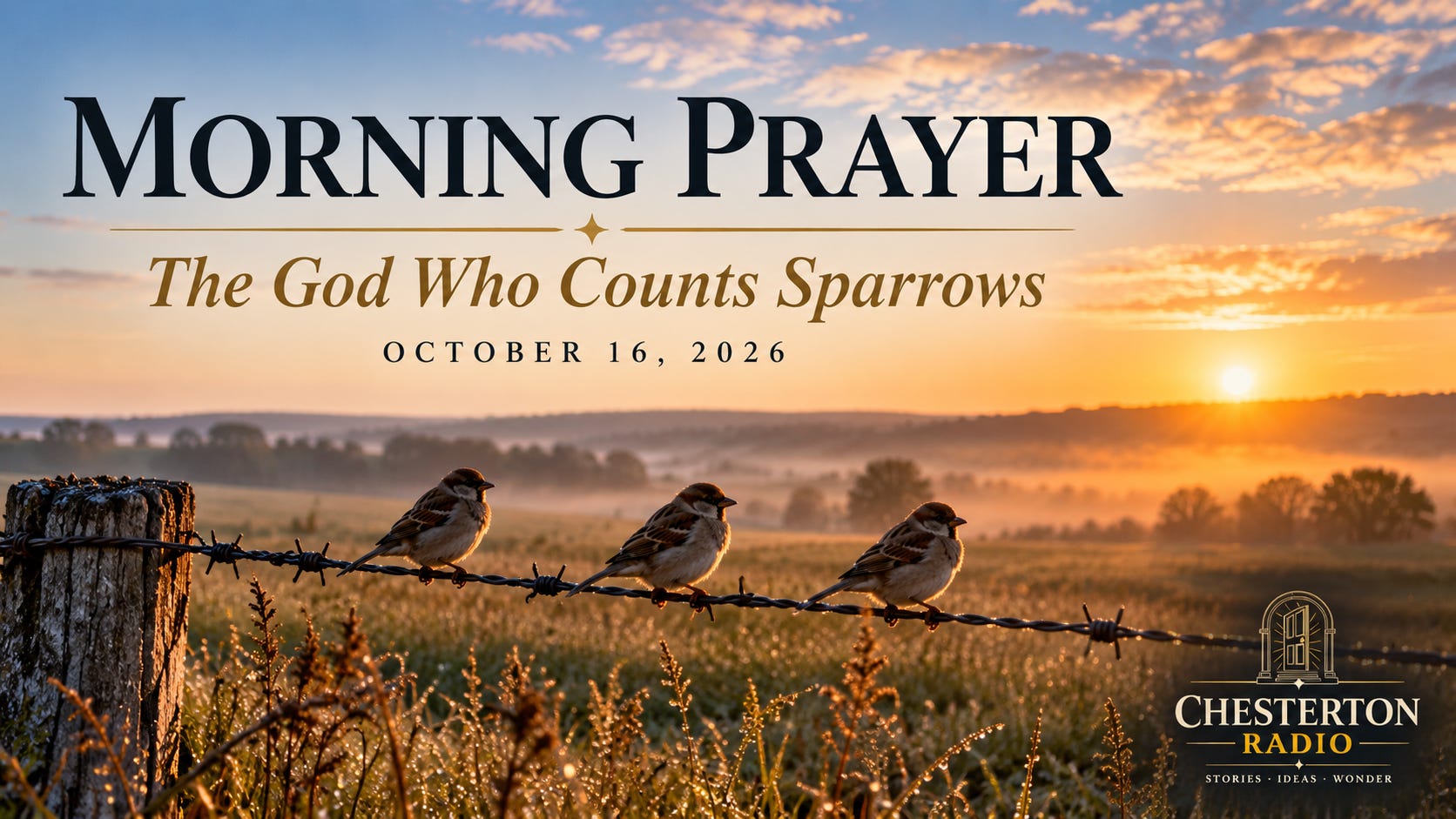
There are mornings when the world seems very large.
The news is large. Our troubles are large. The things we cannot control are very large indeed. And we ourselves can seem remarkably small.
Then Christ gives us a sparrow.
Not an eagle. Not a lion. A sparrow: the sort of little bird that hops beneath a hedge or sits unnoticed on a telephone wire.
Except it is not unnoticed.
This morning Christ tells us that not one of them is forgotten before God.
And then comes the astonishing conclusion:
Neither are you.
OPENING VERSE
Lord, open my lips.
— And my mouth shall declare thy praise.
INVITATORY
Antiphon: Come, let us adore the Lord, for he made us.
Psalm 94 (95)
Come let us praise the Lord with joy:
let us joyfully sing to God our saviour.
Let us come before his presence with thanksgiving;
and make a joyful noise to him with psalms.
For the Lord is a great God,
and a great King above all gods.
For in his hand are all the ends of the earth:
and the heights of the mountains are his.
For the sea is his, and he made it:
and his hands formed the dry land.
Come let us adore and fall down:
and weep before the Lord that made us.
For he is the Lord our God:
and we are the people of his pasture and the sheep of his hand.
Today if you shall hear his voice, harden not your hearts:
As in the provocation, according to the day of temptation in the wilderness:
Where your fathers tempted me,
they proved me, and saw my works.
Forty years long was I offended with that generation, and I said:
These always err in heart.
And these men have not known my ways:
so I swore in my wrath that they shall not enter into my rest.
Glory be to the Father, and to the Son, and to the Holy Ghost.
As it was in the beginning, is now, and ever shall be, world without end. Amen.
Antiphon: Come, let us adore the Lord, for he made us.
PSALMODY
Psalm 50 (51)
Antiphon 1: Create in me a clean heart, O God: and renew a right spirit within me.
Have mercy on me, O God, according to thy great mercy.
And according to the multitude of thy tender mercies blot out my iniquity.
Wash me yet more from my iniquity,
and cleanse me from my sin.
For I know my iniquity,
and my sin is always before me.
To thee only have I sinned, and have done evil before thee:
that thou mayst be justified in thy words, and mayst overcome when thou art judged.
For behold I was conceived in iniquities;
and in sins did my mother conceive me.
For behold thou hast loved truth:
the uncertain and hidden things of thy wisdom thou hast made manifest to me.
Thou shalt sprinkle me with hyssop, and I shall be cleansed:
thou shalt wash me, and I shall be made whiter than snow.
To my hearing thou shalt give joy and gladness:
and the bones that have been humbled shall rejoice.
Turn away thy face from my sins,
and blot out all my iniquities.
Create a clean heart in me, O God:
and renew a right spirit within my bowels.
Cast me not away from thy face;
and take not thy holy spirit from me.
Restore unto me the joy of thy salvation,
and strengthen me with a perfect spirit.
I will teach the unjust thy ways:
and the wicked shall be converted to thee.
Deliver me from blood, O God, thou God of my salvation:
and my tongue shall extol thy justice.
O Lord, thou wilt open my lips:
and my mouth shall declare thy praise.
For if thou hadst desired sacrifice, I would indeed have given it:
with burnt offerings thou wilt not be delighted.
A sacrifice to God is an afflicted spirit:
a contrite and humbled heart, O God, thou wilt not despise.
Deal favourably, O Lord, in thy good will with Sion;
that the walls of Jerusalem may be built up.
Then shalt thou accept the sacrifice of justice, oblations and whole burnt offerings:
then shall they lay calves upon thy altar.
Glory be to the Father, and to the Son, and to the Holy Ghost.
As it was in the beginning, is now, and ever shall be, world without end. Amen.
Antiphon 1: Create in me a clean heart, O God: and renew a right spirit within me.
Canticle — Tobias 13:8–11, 13–15
Antiphon 2: Rejoice, O Jerusalem: for through thee all nations shall be gathered unto the Lord.
Bless ye the Lord, all his elect:
keep days of joy, and give glory to him.
Jerusalem, city of God,
the Lord hath chastised thee for the works of thy hands.
Give glory to the Lord for thy good things,
and bless the God eternal,
That he may rebuild his tabernacle in thee,
and may call back all the captives to thee,
And thou mayst rejoice for ever and ever.
Thou shalt shine with a glorious light:
and all the ends of the earth shall worship thee.
Nations from afar shall come to thee:
and shall bring gifts, and shall adore the Lord in thee,
And shall esteem thy land as holy.
For they shall call upon the great name in thee.
Blessed are all they that love thee,
and that rejoice in thy peace.
My soul, bless thou the Lord,
because the Lord our God hath delivered Jerusalem his city from all her troubles.
Glory be to the Father, and to the Son, and to the Holy Ghost.
As it was in the beginning, is now, and ever shall be, world without end. Amen.
Antiphon 2: Rejoice, O Jerusalem: for through thee all nations shall be gathered unto the Lord.
Psalm 147
Antiphon 3: Praise the Lord, O Jerusalem: praise thy God, O Sion.
Praise the Lord, O Jerusalem:
praise thy God, O Sion.
Because he hath strengthened the bolts of thy gates:
he hath blessed thy children within thee.
Who hath placed peace in thy borders:
and filleth thee with the fat of corn.
Who sendeth forth his speech to the earth:
his word runneth swiftly.
Who giveth snow like wool:
scattereth mists like ashes.
He sendeth his crystal like morsels:
who shall stand before the face of his cold?
He shall send out his word, and shall melt them:
his wind shall blow, and the waters shall run.
Who declareth his word to Jacob:
his justices and his judgments to Israel.
He hath not done in like manner to every nation:
and his judgments he hath not made manifest to them.
Glory be to the Father, and to the Son, and to the Holy Ghost.
As it was in the beginning, is now, and ever shall be, world without end. Amen.
Antiphon 3: Praise the Lord, O Jerusalem: praise thy God, O Sion.
SHORT READING
Galatians 2:19–20
With Christ I am nailed to the cross.
And I live, now not I; but Christ liveth in me.
And that I live now in the flesh: I live in the faith of the Son of God, who loved me, and delivered himself for me.
SHORT RESPONSORY
The Lord, the Most High, hath done good things for me; in my need I shall cry unto him.
— The Lord, the Most High, hath done good things for me; in my need I shall cry unto him.
May he send his strength to rescue me.
— In my need I shall cry unto him.
Glory be to the Father, and to the Son, and to the Holy Ghost.
— The Lord, the Most High, hath done good things for me; in my need I shall cry unto him.
GOSPEL OF THE DAY
Luke 12:1–7
At that time, when great multitudes stood about him, so that they trod one upon another, he began to say to his disciples:
Beware ye of the leaven of the Pharisees, which is hypocrisy.
For there is nothing covered, that shall not be revealed: nor hidden, that shall not be known.
For whatsoever things you have spoken in darkness, shall be published in the light: and that which you have spoken in the ear in the chambers, shall be preached on the housetops.
And I say to you, my friends: Be not afraid of them who kill the body, and after that have no more that they can do.
But I will shew you whom you shall fear: fear ye him, who after he hath killed, hath power to cast into hell. Yea, I say to you, fear him.
Are not five sparrows sold for two farthings, and not one of them is forgotten before God?
Yea, the very hairs of your head are all numbered.
Fear not therefore: you are of more value than many sparrows.
BENEDICTUS
Canticle of Zachary — Luke 1:68–79
Antiphon: Through the bowels of the mercy of our God, the Orient from on high hath visited us.
Blessed be the Lord God of Israel;
because he hath visited and wrought the redemption of his people:
And hath raised up an horn of salvation to us,
in the house of David his servant:
As he spoke by the mouth of his holy prophets,
who are from the beginning:
Salvation from our enemies,
and from the hand of all that hate us:
To perform mercy to our fathers,
and to remember his holy testament,
The oath, which he swore to Abraham our father,
that he would grant to us,
That being delivered from the hand of our enemies,
we may serve him without fear,
In holiness and justice before him,
all our days.
And thou, child, shalt be called the prophet of the Highest:
for thou shalt go before the face of the Lord to prepare his ways:
To give knowledge of salvation to his people,
unto the remission of their sins:
Through the bowels of the mercy of our God,
in which the Orient from on high hath visited us:
To enlighten them that sit in darkness, and in the shadow of death:
to direct our feet into the way of peace.
Glory be to the Father, and to the Son, and to the Holy Ghost.
As it was in the beginning, is now, and ever shall be, world without end. Amen.
Antiphon: Through the bowels of the mercy of our God, the Orient from on high hath visited us.
INTERCESSIONS
God our Father forgets none of his creatures and has redeemed us through his Son. Trusting in his providence, let us pray:
Remember us, O Lord, in thy mercy.
For thy holy Church: strengthen the Holy Father, our bishops, priests and deacons, and all who serve thy people; grant them courage to proclaim the truth with charity.
Remember us, O Lord, in thy mercy.
For our country, our communities, and all the peoples of the world: give wisdom to those entrusted with authority, peace where there is conflict, and justice where the weak are forgotten.
Remember us, O Lord, in thy mercy.
For our daily work and vocation: bless the labor of our hands, give us honesty in small things, patience in difficulty, and gratitude for the opportunity to serve others.
Remember us, O Lord, in thy mercy.
For our homes and families: protect those we love, reconcile those who are divided, comfort those who are lonely, and teach us to recognize thy gifts in the ordinary life we share.
Remember us, O Lord, in thy mercy.
For the sick, the frightened, the poor, the grieving, and all who believe themselves forgotten: let them know that not one of thy children is hidden from thy sight.
Remember us, O Lord, in thy mercy.
For those who have died: receive them into thy mercy, forgive their sins, and bring them into the light and peace of thy presence.
Remember us, O Lord, in thy mercy.
For ourselves: cleanse us of hypocrisy and needless fear; give us clean hearts, truthful words, and the courage to entrust this day entirely to thee.
Remember us, O Lord, in thy mercy.
OUR FATHER
Our Father, who art in heaven,
hallowed be thy name.
Thy kingdom come.
Thy will be done on earth as it is in heaven.
Give us this day our daily bread.
And forgive us our trespasses,
as we forgive those who trespass against us.
And lead us not into temptation.
But deliver us from evil.
Amen.
CONCLUDING PRAYER
O Lord, who knowest all things and forgettest none whom thou hast made, cleanse our hearts from falsehood and free us from useless fear.
Grant that we may walk this day in truth, trusting in thy providence, faithful in our work, charitable toward our neighbor, and mindful of those whom the world passes by.
Through Christ our Lord.
Amen.
BLESSING
May the Lord bless us,
protect us from all evil,
and bring us to everlasting life.
Amen.
THE PARADOX OF THE DAY
The God whose greatness is beyond the stars reveals that greatness by refusing to forget a sparrow.
CHESTERTON FOR THE MORNING
“There was a time when you and I and all of us were all very close to God.”
— G. K. Chesterton, What’s Wrong with the World
A CHESTERTONIAN MEDITATION
The God Who Counts Sparrows
A sparrow is not a very impressive bird.
Nobody drives across Kansas to see one. There are no roadside signs announcing the presence of a particularly fine sparrow. A man who announced at breakfast that he intended to spend the day searching for sparrows might reasonably be asked whether he had enough work to do.
They are simply there.
They hop beneath hedges. They quarrel in gutters. They gather on telephone wires as though attending some small and badly organized convention.
Most of us scarcely see them.
And that is precisely why Christ chooses one.
Today’s Gospel deals with enormous subjects: truth and hypocrisy, judgment and death, courage and fear, heaven and hell.
Then, unexpectedly, into this immense theological landscape hops a tiny brown bird.
“Are not five sparrows sold for two farthings?”
One can almost imagine the disciples wondering what sparrows have to do with anything.
Quite a lot, apparently.
Christ tells them that not one of these almost valueless little creatures is forgotten before God.
This is more than a pleasant observation about God’s fondness for animals. It is a statement about the nature of reality.
Nothing is beneath God’s attention.
We tend to imagine Providence on a grand scale.
Wars. Elections. Popes. Presidents. Storms. Nations. Great conversions. Great catastrophes.
Surely God attends to such things.
But Christ gives us a rather more astonishing picture.
God notices sparrows.
And if God notices sparrows, our ordinary scale of importance may be badly wrong.
We worry because we are small.
Christ tells us that smallness is no obstacle whatsoever to being noticed by God.
Christianity itself is full of this divine preference for small things.
The God who created the stars became an infant.
He was born not in a palace but in a stable.
He grew up in an obscure town.
He worked with his hands.
He ate ordinary meals with ordinary people.
And when he wanted to explain the Kingdom of Heaven, he spoke about seeds, coins, sheep, lamps, bread, weeds, fishermen—and birds.
We keep looking upward for grandeur.
God keeps pointing downward.
Look at the seed.
Look at the child.
Look at the bread.
Look at the sparrow.
Chesterton understood this instinctively. He repeatedly returned to the possibility that the great catastrophe of modern life was not that the world had ceased to be wonderful, but that we had ceased to wonder at it.
He wrote of a time when we were “very close to God,” when the color of a pebble or the smell of a flower seemed like “fragments of a muddled message.”
Children still understand this.
A child does not require the Grand Canyon to experience wonder.
A puddle may do.
A beetle may do.
A cardboard box can become a castle.
A garden gate can become the frontier of a kingdom.
The tragedy of adulthood is not that these things cease to be remarkable.
It is that we become accustomed to them.
Christ’s sparrows restore the proper proportions.
Perhaps this Friday will contain nothing that anyone would call historic.
There may be emails to answer, dishes to wash, machinery to repair, groceries to buy, appointments to keep, floors to sweep, bills to pay, a telephone call to make, and some irritating little problem that refuses to solve itself.
None of it will appear in tomorrow’s newspaper.
That does not mean none of it matters.
The God who notices sparrows has permanently destroyed our excuse for despising small things.
The smallest act of patience may matter.
The telephone call made when we would rather postpone it may matter.
The kindness nobody witnesses may matter.
The prayer muttered in the car may matter.
The apology nobody demanded may matter.
The decision not to repeat a piece of gossip may matter.
The person sitting alone may matter.
The five quiet minutes given to somebody who needs them may matter enormously.
Christianity is not chiefly the discovery that man can do enormous things for God.
It is the discovery that God has done an enormous thing for man.
And once that has happened, even small things become charged with significance.
But there is another side to today’s Gospel.
Christ begins by warning his disciples against hypocrisy.
Hypocrisy is the attempt to maintain two realities: one outside and another inside. We carefully arrange the visible room while hoping nobody opens the cupboard.
But there are no cupboards with God.
“There is nothing covered, that shall not be revealed: nor hidden, that shall not be known.”
At first this sounds terrifying.
Then, strangely, it becomes liberating.
We need not maintain the performance.
We need not persuade God that we are braver than we are, holier than we are, happier than we are, or less frightened than we are.
He already knows.
Psalm 50 gives us the proper response:
“Create a clean heart in me, O God.”
Not a respectable-looking heart.
Not a heart with excellent public relations.
A clean heart.
Christianity does not ask us to persuade God that we are good.
It asks us to permit God to make us good.
And the One who undertakes this work is not an indifferent inspector.
He is the Father who knows us so intimately that Christ reaches for an almost comic image:
The very hairs of your head are numbered.
We cannot count them.
God can.
We forget ourselves.
God does not.
We lose sight of one another.
God does not.
We may sometimes imagine ourselves lost in the machinery of the world—one person among billions, one name, one number, one ordinary life among countless others.
Then a sparrow lands on the fence.
Perhaps that is enough.
For there he is: small, commonplace, thoroughly unimportant by nearly every measure human beings normally use.
And yet the Creator of Orion and the Pleiades has not forgotten him.
Christ asks us to make the obvious inference.
Neither has he forgotten you.
So when the morning becomes busy, when the telephone rings, when the machine refuses to cooperate, when the plans change, when somebody disappoints you, or when you simply feel very small in a very large world, remember the sparrow.
The bird itself may have forgotten where it was five minutes ago.
God has not forgotten the bird.
And God has not forgotten you.
Fear not therefore.
May we notice today what we usually overlook—and remember that God overlooks nothing.
Chesterton Radio