

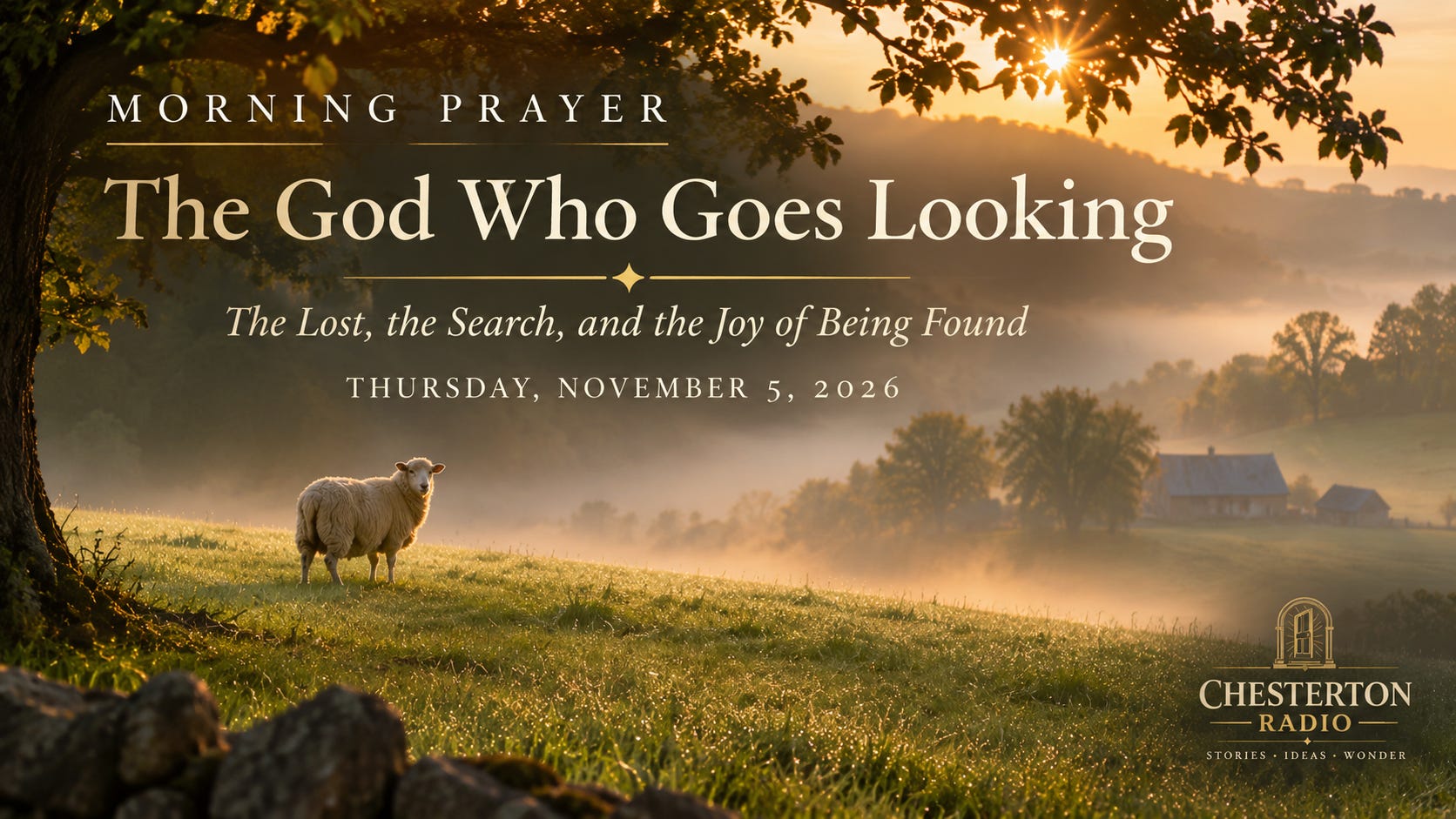
Opening
There is a particular sort of silence in a house when something has gone missing. Drawers are opened, pockets searched, cushions lifted. An ordinary object suddenly becomes the most important thing in the room.
The strange part is that the object has not changed. A lost key is still a key. A missing coin is worth precisely what it was worth before it disappeared. Yet we search for it with an urgency we never felt when it was safely in its place.
In today’s Gospel, Our Lord tells us of a shepherd who goes looking for one sheep and a woman who searches her house for one coin. Neither story ends with a lecture about carelessness. Both end with rejoicing.
This morning we come before the God who knows what is missing, who remembers those who have wandered, and who never mistakes a lost soul for a worthless one.
Opening Verse
Lord, open my lips.
And my mouth shall declare thy praise.
Invitatory
Antiphon: Come, let us adore the Lord, our shepherd, who calls his people by name.
Psalm 94 (95)
Come let us praise the Lord with joy: let us joyfully sing to God our saviour.
Let us come before his presence with thanksgiving; and make a joyful noise to him with psalms.
For the Lord is a great God, and a great King above all gods.
For in his hand are all the ends of the earth: and the heights of the mountains are his.
For the sea is his, and he made it: and his hands formed the dry land.
Come let us adore and fall down: and weep before the Lord that made us.
For he is the Lord our God: and we are the people of his pasture and the sheep of his hand.
To day if you shall hear his voice, harden not your hearts:
As in the provocation, according to the day of temptation in the wilderness: where your fathers tempted me, they proved me, and saw my works.
Forty years long was I offended with that generation, and I said: These always err in heart.
And these men have not known my ways: so I swore in my wrath that they shall not enter into my rest.
Glory be to the Father, and to the Son, and to the Holy Ghost.
As it was in the beginning, is now, and ever shall be, world without end. Amen.
Antiphon: Come, let us adore the Lord, our shepherd, who calls his people by name.
Psalmody
First Psalm — Psalm 79 (80)
The Lord, the shepherd of Israel
Antiphon: Stir up thy might, O Lord, and come to save us.
Unto the end, for them that shall be changed, a testimony for Asaph, a psalm.
Give ear, O thou that rulest Israel: thou that leadest Joseph like a sheep. Thou that sittest upon the cherubims, shine forth
Before Ephraim, Benjamin, and Manasses. Stir up thy might, and come to save us.
Convert us, O God: and shew us thy face, and we shall be saved.
O Lord God of hosts, how long wilt thou be angry against the prayer of thy servant?
How long wilt thou feed us with the bread of tears: and give us for our drink tears in measure?
Thou hast made us to be a contradiction to our neighbours: and our enemies have scoffed at us.
O God of hosts, convert us: and shew thy face, and we shall be saved.
Thou hast brought a vineyard out of Egypt: thou hast cast out the Gentiles and planted it.
Thou wast the guide of its journey in its sight: thou plantedst the roots thereof, and it filled the land.
The shadow of it covered the hills: and the branches thereof the cedars of God.
It stretched forth its branches unto the sea, and its boughs unto the river.
Why hast thou broken down the hedge thereof, so that all they who pass by the way do pluck it?
The boar out of the wood hath laid it waste: and a singular wild beast hath devoured it.
Turn again, O God of hosts, look down from heaven, and see, and visit this vineyard:
And perfect the same which thy right hand hath planted: and upon the son of man whom thou hast confirmed for thyself.
Things set on fire and dug down shall perish at the rebuke of thy countenance.
Let thy hand be upon the man of thy right hand: and upon the son of man whom thou hast confirmed for thyself.
And we depart not from thee, thou shalt quicken us: and we will call upon thy name.
O Lord God of hosts, convert us and shew thy face, and we shall be saved.
Glory be to the Father, and to the Son, and to the Holy Ghost.
As it was in the beginning, is now, and ever shall be, world without end. Amen.
Antiphon: Stir up thy might, O Lord, and come to save us.
Old Testament Canticle — Isaiah 12:1–6
The joy of salvation
Antiphon: With joy shall ye draw waters out of the Saviour’s fountains.
And thou shalt say in that day: I will give thanks to thee, O Lord, for thou wast angry with me: thy wrath is turned away, and thou hast comforted me.
Behold, God is my saviour, I will deal confidently, and will not fear: O because the Lord is my strength, and my praise, and he is become my salvation.
You shall draw waters with joy out of the saviour’s fountains:
And you shall say in that day: Praise ye the Lord, and call upon his name: make his works known among the people: remember that his name is high.
Sing ye to the Lord, for he hath done great things: shew this forth in all the earth.
Rejoice, and praise, O thou habitation of Sion: for great is he that is in the midst of thee, the Holy One of Israel.
Glory be to the Father, and to the Son, and to the Holy Ghost.
As it was in the beginning, is now, and ever shall be, world without end. Amen.
Antiphon: With joy shall ye draw waters out of the Saviour’s fountains.
Second Psalm — Psalm 80 (81)
Rejoice in God our helper
Antiphon: Rejoice to God our helper; sing aloud to the God of Jacob.
Unto the end, for the winepresses, a psalm for Asaph himself.
Rejoice to God our helper: sing aloud to the God of Jacob.
Take a psalm, and bring hither the timbrel: the pleasant psaltery with the harp.
Blow up the trumpet on the new moon, on the noted day of your solemnity.
For it is a commandment in Israel, and a judgment to the God of Jacob.
He ordained it for a testimony in Joseph, when he came out of the land of Egypt: he heard a tongue which he knew not.
He removed his back from the burdens: his hands had served in baskets.
Thou calledst upon me in affliction, and I delivered thee: I heard thee in the secret place of tempest: I proved thee at the waters of contradiction.
Hear, O my people, and I will testify to thee: O Israel, if thou wilt hearken to me,
There shall be no new god in thee: neither shalt thou adore a strange god.
For I am the Lord thy God, who brought thee out of the land of Egypt: open thy mouth wide, and I will fill it.
But my people heard not my voice: and Israel hearkened not to me.
So I let them go according to the desires of their heart: they shall walk in their own inventions.
If my people had heard me: if Israel had walked in my ways:
I should soon have humbled their enemies, and laid my hand on them that troubled them.
The enemies of the Lord have lied to him: and their time shall be for ever.
And he fed them with the fat of wheat, and filled them with honey out of the rock.
Glory be to the Father, and to the Son, and to the Holy Ghost.
As it was in the beginning, is now, and ever shall be, world without end. Amen.
Antiphon: Rejoice to God our helper; sing aloud to the God of Jacob.
Short Reading — Romans 14:17–19
For the kingdom of God is not meat and drink; but justice, and peace, and joy in the Holy Ghost.
For he that in this serveth Christ, pleaseth God, and is approved of men.
Therefore let us follow after the things that are of peace; and keep the things that are of edification one towards another.
Short Responsory
In the morning, O Lord, we seek thy face.
And in thy mercy we place our hope.
Thou dost hear the cry of those who call upon thee.
And in thy mercy we place our hope.
Glory be to the Father, and to the Son, and to the Holy Ghost.
In the morning, O Lord, we seek thy face, and in thy mercy we place our hope.
Gospel of the Day — Luke 15:1–10
The Lost Sheep and the Lost Coin
And the publicans and sinners drew near unto him to hear him.
And the Pharisees and the scribes murmured, saying: This man receiveth sinners, and eateth with them.
And he spoke to them this parable, saying:
What man of you that hath an hundred sheep: and if he shall lose one of them, doth he not leave the ninety-nine in the desert, and go after that which was lost until he find it?
And when he hath found it, lay it upon his shoulders, rejoicing:
And coming home, call together his friends and neighbours, saying to them: Rejoice with me, because I have found my sheep that was lost?
I say to you, that even so there shall be joy in heaven upon one sinner that doth penance, more than upon ninety-nine just who need not penance.
Or what woman having ten groats, if she lose one groat, doth not light a candle, and sweep the house, and seek diligently until she find it?
And when she hath found it, call together her friends and neighbours, saying: Rejoice with me, because I have found the groat which I had lost.
So I say to you, there shall be joy before the angels of God upon one sinner doing penance.
Benedictus — Canticle of Zachary
Luke 1:68–79
Antiphon: The Lord hath visited his people, to give knowledge of salvation and the remission of their sins.
Blessed be the Lord God of Israel; because he hath visited and wrought the redemption of his people:
And hath raised up an horn of salvation to us, in the house of David his servant:
As he spoke by the mouth of his holy prophets, who are from the beginning:
Salvation from our enemies, and from the hand of all that hate us:
To perform mercy to our fathers, and to remember his holy testament,
The oath, which he swore to Abraham our father, that he would grant to us
That being delivered from the hand of our enemies, we may serve him without fear,
In holiness and justice before him, all our days.
And thou, child, shalt be called the prophet of the Highest: for thou shalt go before the face of the Lord to prepare his ways:
To give knowledge of salvation to his people, unto the remission of their sins:
Through the bowels of the mercy of our God, in which the Orient from on high hath visited us:
To enlighten them that sit in darkness, and in the shadow of death: to direct our feet into the way of peace.
Glory be to the Father, and to the Son, and to the Holy Ghost.
As it was in the beginning, is now, and ever shall be, world without end. Amen.
Antiphon: The Lord hath visited his people, to give knowledge of salvation and the remission of their sins.
Intercessions
Let us pray to Christ, the Good Shepherd, who seeks the lost, strengthens the weak, and gathers His people in mercy.
Response: Lord, hear us and bring us nearer to thee.
For the Holy Father, our bishops and priests, and all who serve the Church: grant them patience in their ministry, courage in proclaiming the truth, and charity toward those who have wandered from the faith.
Lord, hear us and bring us nearer to thee.
For our country and for the nations of the world: turn the hearts of those who govern toward justice, peace, and the protection of the vulnerable.
Lord, hear us and bring us nearer to thee.
For those beginning their work this morning, for those seeking employment, and for those carrying difficult responsibilities: bless the labour of their hands and help them to serve others faithfully.
Lord, hear us and bring us nearer to thee.
For our families and homes: heal old misunderstandings, restore broken relationships, and help us to recognize the needs of those nearest to us.
Lord, hear us and bring us nearer to thee.
For the sick, the lonely, the discouraged, and all who believe themselves forgotten: let them know that their lives are precious in thy sight.
Lord, hear us and bring us nearer to thee.
For the faithful departed, especially those who have no one to remember them in prayer: receive them into thy mercy and grant them eternal rest.
Lord, hear us and bring us nearer to thee.
For ourselves: forgive our sins, turn us away from pride and resentment, and give us the grace to rejoice whenever another soul returns to thee.
Lord, hear us and bring us nearer to thee.
Our Father
Our Father, who art in heaven, hallowed be thy name. Thy kingdom come. Thy will be done on earth as it is in heaven.
Give us this day our daily bread. And forgive us our trespasses, as we forgive those who trespass against us.
And lead us not into temptation, but deliver us from evil.
Amen.
Concluding Prayer
O Lord God, whose mercy reaches even those who have wandered far from thee, look with kindness upon thy people this morning.
Restore what sin has wounded, strengthen what is weak, and awaken in us the desire to seek thy face.
Teach us to welcome the repentant, to comfort the sorrowful, and to serve our neighbours without counting the cost.
May the work of this day be pleasing to thee, and may we return at its close with grateful hearts.
Through Jesus Christ our Lord.
Amen.
Blessing
May the Lord bless us, protect us from all evil, and bring us to everlasting life.
Amen.
The Paradox of the Day
The God who lacks nothing searches for the one who has lost everything.
Chesterton for the Morning
“The way to love anything is to realise that it might be lost.”
— G. K. Chesterton, Tremendous Trifles, “The Advantages of Having One Leg” (1909).
A Chestertonian Meditation
The Arithmetic of Heaven
There is a curious moment in every household when a perfectly ordinary object becomes an object of extraordinary importance.
A key goes missing.
Yesterday it lay on the kitchen counter, unnoticed and unloved. Nobody admired its shape or thanked Providence for its existence. It was merely a key, one of those humble metal servants that perform their duties without applause.
But this morning the key has disappeared.
Suddenly the entire household is interested in it. Drawers are opened. Coats are searched. The furniture is moved. The kitchen becomes the scene of an investigation worthy of Sherlock Holmes, although Holmes would probably have found the key in considerably less time.
And when it is discovered beneath a newspaper, there is rejoicing.
The key has not become more valuable. It has simply become lost.
Or perhaps that is not quite true. Perhaps the loss has revealed a value that was present all along.
Our Lord tells two stories in today’s Gospel, and both begin with this peculiar human experience.
A shepherd loses one sheep from a flock of a hundred. A woman loses one coin from a collection of ten.
The shepherd goes searching through the wilderness. The woman lights a candle and sweeps her house.
Both are determined to recover what has been lost.
And both rejoice when they succeed.
There is something almost unreasonable about the shepherd’s behaviour.
He has a hundred sheep. One disappears. Ninety-nine remain.
By the standards of modern management, this is a ninety-nine percent retention rate. Many businesses would be delighted with such a figure. The shepherd could prepare an impressive report, congratulate himself on the success of the enterprise, and begin planning for next year.
But he does none of these things.
He goes looking for the sheep.
He does not calculate that one percent is an acceptable loss. He does not decide that the missing animal is no longer worth the trouble. He does not wait for the sheep to find its own way home.
He goes after it until he finds it.
The shepherd is not interested in percentages. He is interested in sheep.
And this, Christ tells us, is something like the arithmetic of heaven.
We are accustomed to measuring people by their accomplishments. We admire the successful, the talented, the wealthy, the influential, and the unusually productive. We make lists of achievements and attach numbers to almost everything.
Yet in the Gospel, heaven is moved by the recovery of a single sinner.
Not a famous sinner. Not an especially useful sinner. Not a sinner who promises to become an important person.
Simply one who repents.
The angels rejoice.
This is not because sin is a small matter. Quite the opposite. The joy of recovery would mean very little if being lost were of no consequence.
A man rescued from a shallow puddle may be grateful, but the man rescued from the sea understands something more profound about the value of being saved.
Christ takes sin seriously enough to call it lostness. He takes mercy seriously enough to promise that the lost can be found.
And there is another remarkable detail.
When the shepherd discovers the sheep, he places it upon his shoulders.
He does not stand at a distance and deliver a lecture on the dangers of wandering. He does not demand that the exhausted animal demonstrate its sincerity by walking the entire distance home.
He carries it.
This does not mean repentance is unnecessary. Christ explicitly speaks of the sinner doing penance. But it reminds us that salvation is not simply the story of a lost creature discovering its own strength.
It is the story of the Good Shepherd coming to find it.
The second parable makes the point in an even stranger way.
A coin cannot repent. It cannot cry for help. It cannot even know that it is missing.
Yet the woman searches for it because it remains hers.
Its value does not disappear merely because it has disappeared from sight.
This is worth remembering in a world that often treats people as though their worth depends upon their usefulness.
The elderly man who can no longer work is not less precious than he was in his prime. The sick woman who depends upon others has not lost her dignity. The child who struggles at school is not a failed version of a more successful child.
Nor is the person who has made a terrible mistake beyond the reach of God’s mercy.
A soul is not a tool that becomes worthless when it ceases to function properly.
It is a creature made for eternity.
Chesterton understood how easily we overlook the wonder of ordinary things. In his essay about an injured leg, he discovered that even a minor inconvenience could reveal the extraordinary value of something he had previously taken for granted.
We seldom appreciate the simple privilege of walking until walking becomes difficult.
We seldom appreciate the warmth of a home until we have been away from it.
And sometimes we do not understand how deeply we love someone until we fear losing that person.
But God’s love is not merely the human fear of loss magnified to an infinite degree. God does not suddenly discover our worth when we wander away. He has known it from the beginning.
The search reveals His mercy, not His ignorance.
There is a further lesson for us in the behaviour of the Pharisees.
They complain that Jesus receives sinners and eats with them.
It is a curious complaint. One might suppose that a physician should be praised for receiving the sick, or that a shepherd should be praised for finding a missing sheep.
Yet the Pharisees seem offended that mercy should be so generous.
Perhaps they fear that welcoming sinners somehow diminishes the value of righteousness.
Christ answers that heaven has room for rejoicing.
We must be careful not to turn holiness into a private possession, something made more valuable because fewer people share it. The purpose of the Church is not to become a comfortable gathering of people who have never wandered.
It is to lead souls to Christ.
And when someone returns, our proper response is not suspicion or resentment, but gratitude.
There will be people we encounter today who are carrying burdens we cannot see. Some will be discouraged. Some will be ashamed. Some will have spent years believing that God has forgotten them.
We may not be able to solve their troubles.
But we can refuse to treat them as lost causes.
We can speak kindly. We can listen. We can forgive. We can leave a door open.
These are small acts, but the Gospel has already warned us against despising small things.
One sheep. One coin. One sinner.
One soul returning home.
The world may scarcely notice.
But somewhere beyond the reach of our calculations, the angels are rejoicing.
And the Good Shepherd is walking home with His sheep upon His shoulders.
Closing
O Lord, let us hear thy voice today. When we wander, bring us home; when others are lost, teach us to seek them with charity; and when mercy triumphs, let us rejoice with heaven.
Amen.
Chesterton Radio — Faith, Wonder, and the Extraordinary in Ordinary Life.