

“Fairy tales do not tell children that dragons exist. Children already know that dragons exist. Fairy tales tell children that dragons can be killed.”
— G. K. Chesterton
There are many kinds of cold.
There is the cold that comes from the north wind, and the cold that comes from unpaid coal bills. There is the cold of estranged brothers and the colder chill of a drawing room where no one says what they mean. But in Colder Than of Late, the cold that matters most is not meteorological. It is moral.
And it bites.
❄️ A Play About Frost — and Fire
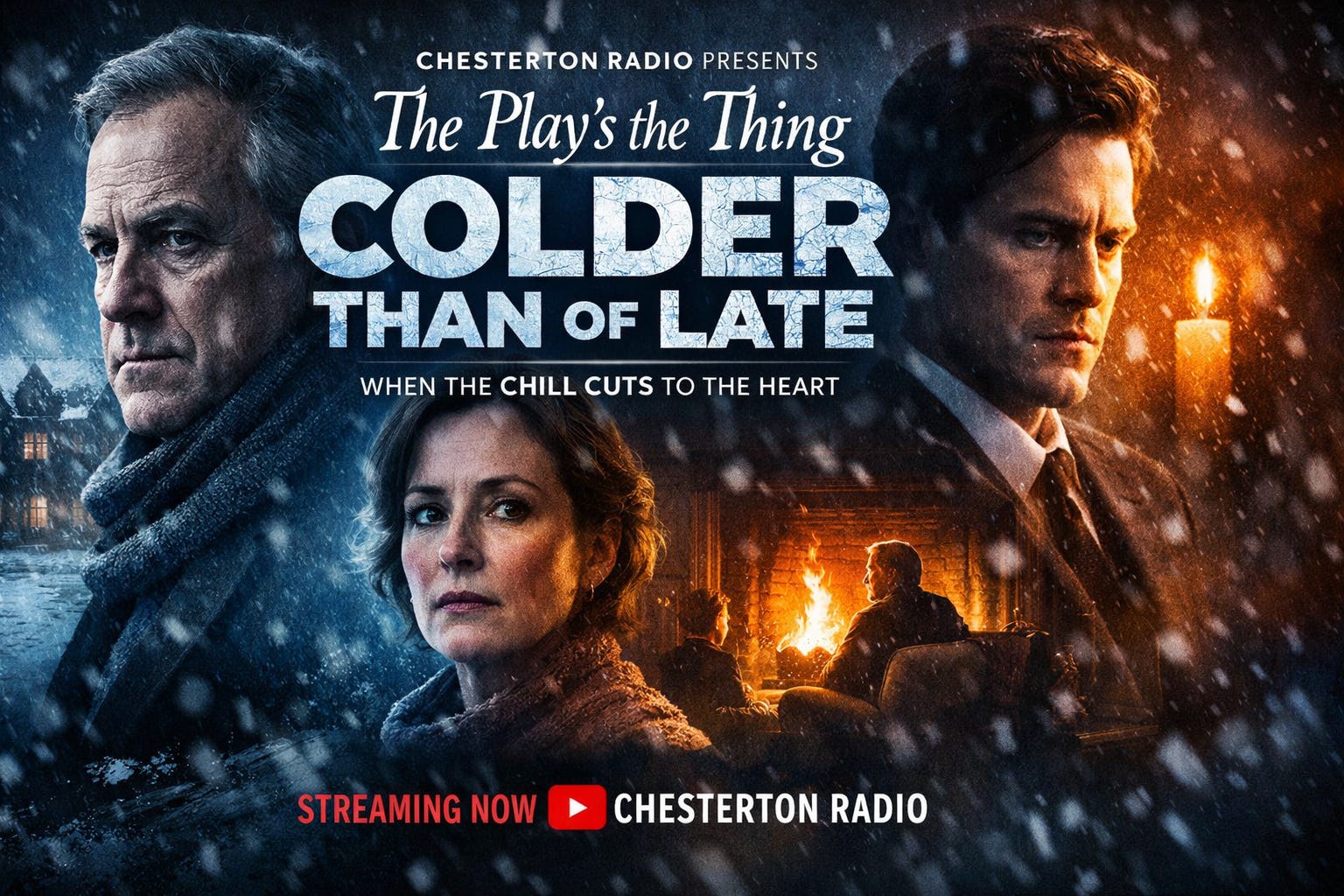
Colder Than of Late (now streaming on Chesterton Radio) is one of those dramas that begins quietly, like snow falling at dusk. A family, a house, a certain emotional distance that has settled over the hearth like ash.
The title itself suggests something worsening — a season that has turned sharper, harsher, more brittle than before. We sense that relationships have cooled. Words have become guarded. Affections, once generous, are rationed.
Without giving away its central turns (for this is a play best encountered fresh), the drama circles around misunderstandings, withheld truths, and the terrible efficiency of pride. The frost spreads not because someone hates, but because someone refuses to humble himself first.
It is, in other words, profoundly human.
🕯️ The Hearth and the Human Heart
What struck me most in listening to this production is how carefully it handles silence. In old radio drama, silence is never empty. It is charged. It is a loaded fireplace.
The pauses between characters say as much as the speeches.
This is the genius of radio theatre — the unseen allows the imagination to warm what the eye might overlook. In a visual medium, we are distracted by costumes and gestures. In radio, we hear the tremor in a voice. The catch in the breath. The brittle courtesy masking injury.
And so the “cold” of this play becomes almost tactile.
But here is the paradox: the colder the atmosphere grows, the more we long for warmth. The very severity of winter makes us remember summer. In that way, the play performs a subtle moral operation. It awakens desire for reconciliation.
🧊 The Chill of Pride
There is a peculiar English quality to the emotional restraint on display — that polite, well-spoken distance that can freeze a room faster than an open window.
But the problem is not Englishness. It is pride.
Pride is a thermostat that only moves in one direction.
It insists on being right rather than being reconciled. It prefers vindication to forgiveness. It would rather win the argument than save the relationship.
And so the house grows colder.
If the play has a villain, it is not any single character. It is that invisible frost of self-importance that creeps along the banisters and settles over family tables.
🔥 The Small Flame
Yet no good drama leaves us entirely in winter.
There is, in this story, a turning — subtle but real. A moment when someone risks warmth. A moment when silence breaks, not with accusation, but with vulnerability.
It is rarely grand. It is not operatic. It is human.
And that is what makes it powerful.
The smallest act of humility is often the first log on the fire.
🎙️ Why This Play Matters Now
We live in a time that prides itself on hot takes and heated debates. And yet, socially and spiritually, many households are colder than of late.
Conversations fracture over politics. Friendships cool over misunderstandings. Families retreat into separate rooms — sometimes literally, often digitally.
This play reminds us that warmth does not return by accident. It must be chosen.
It must be risked.
🎭 About The Play’s the Thing
In this series, we explore the great radio dramas and theatrical productions preserved in the Wireless Archive — not merely as entertainment, but as moral and imaginative encounters.
Each play is a window into the human soul. Each production a reminder that drama is not escapism but revelation.
As Chesterton once observed, the purpose of art is not to make things seem unreal — but to make them seem real again.
🎧 Listen Now
You can hear Colder Than of Late in full on Chesterton Radio here:
👉
And remember — you don’t need a special app to listen to our Substack stories or reflections. You can simply open any post in your browser (Edge, Chrome, Brave, Safari) and use the built-in “Read Aloud” or text-to-speech feature to enjoy the story as audio.
Sometimes the old wireless returns through the newest wires.
🤝 A Word About Support
Chesterton Radio is now entirely listener supported.
If these plays, reflections, and daily writings have warmed your home — if they have lit even a small fire in a cold season — would you consider supporting the work?
You can join the Chesterton Radio Listener Club on Substack or Patreon and help us preserve and expand this growing archive of drama, mystery, poetry, and paradox.
Your support keeps the hearth burning.
And in a world that is often colder than of late, that matters more than ever.
—
Until next time,
Keep the fire bright.
🎙️✨