

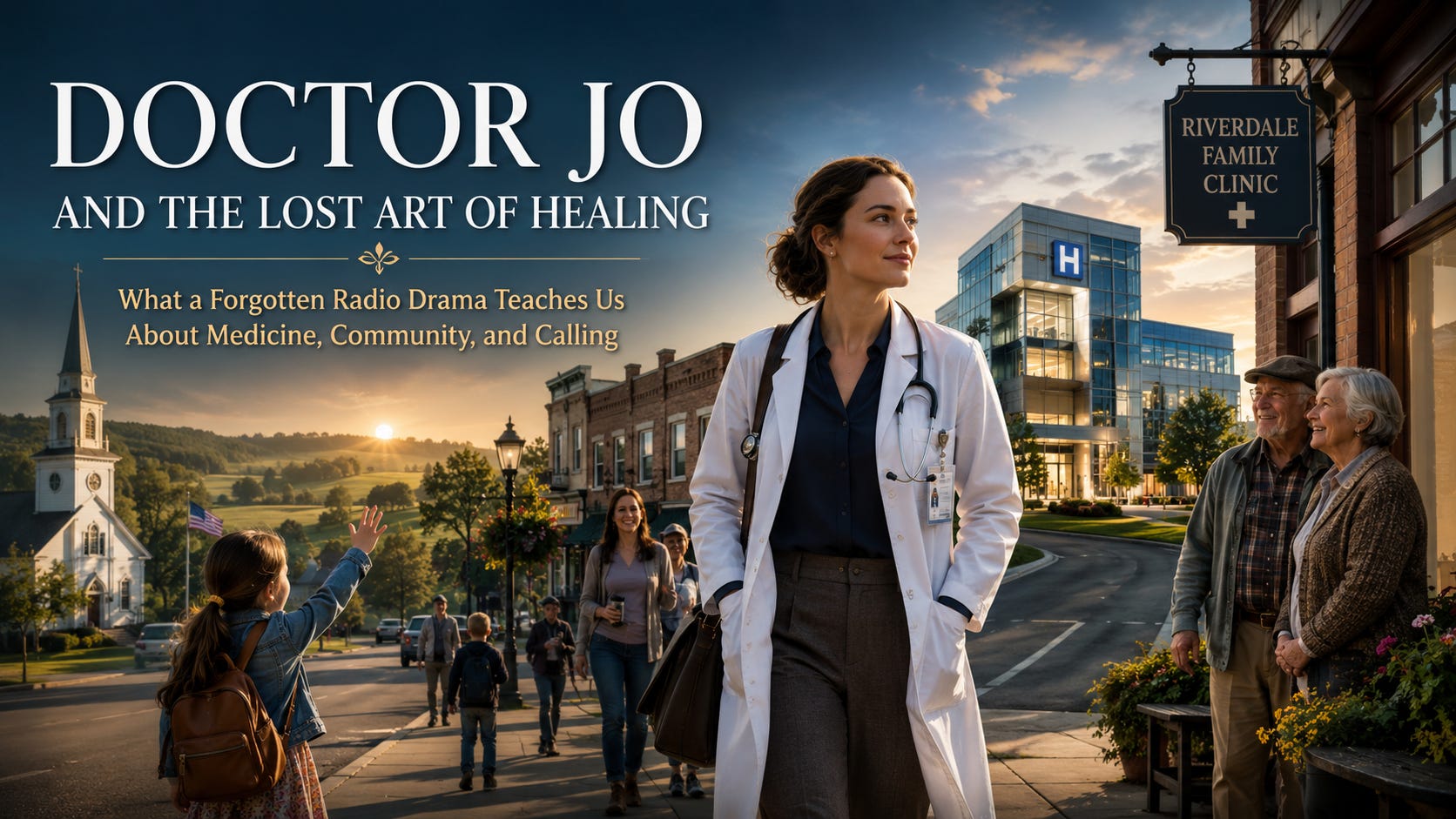
There are some stories that arrive at precisely the right moment.
Not because they are new.
Not because they are fashionable.
Not because they reflect the latest trend or controversy.
Rather, they arrive because they remind us of something we have forgotten.
That was my experience listening to Doctor Jo, a BBC Saturday Night Theatre production first broadcast in September of 1961. Written by Joan Morgan and presented during the golden age of British radio drama, the play emerged from a world that now feels both distant and strangely familiar.
At first glance, Doctor Jo appears to be a period drama centered on a woman physician navigating the expectations and assumptions of her time. That alone would make it interesting. The early 1960s were still an era in which women entering medicine faced barriers that many younger listeners today scarcely imagine.
Yet the play’s enduring power lies elsewhere.
Beneath its surface, Doctor Jo asks a question that remains surprisingly relevant in the twenty-first century.
What is a doctor?
The answer seems obvious.
A doctor diagnoses illness.
A doctor prescribes treatment.
A doctor performs procedures.
A doctor practices medicine.
Yet for most of human history, communities expected something more.
The doctor was not merely a technical expert.
The doctor was a trusted figure within the life of a town.
A counselor.
A confidant.
A witness to births and deaths.
A familiar face during moments of fear and uncertainty.
The physician belonged to the community.
And the community, in turn, trusted the physician.
Listening to Doctor Jo today, one cannot help but feel that the play is describing not only a person but an entire understanding of medicine that has gradually slipped away.
The timing of this realization is difficult to ignore.
Over the past several months, Chesterton Radio has explored Benedictine College’s proposed School of Osteopathic Medicine, rural healthcare shortages, physician formation, and the enduring idea of medicine as a vocation. Again and again, those conversations returned to the same question.
What kind of doctors does America need?
The answer suggested by Doctor Jo is both old-fashioned and surprisingly radical.
America needs healers.
Not merely practitioners.
Not merely providers.
Healers.
The distinction may be more important than we realize.
The Village Doctor
For much of human history, medicine was local.
The statement sounds almost quaint in an age of regional health systems, telemedicine platforms, electronic medical records, and specialists connected through networks spanning entire continents.
Yet for generations, the practice of medicine was inseparable from place.
Doctors belonged somewhere.
They served particular towns, particular neighborhoods, particular communities. Their patients were not anonymous entries in a database. They were neighbors.
The physician knew the baker.
The physician knew the schoolteacher.
The physician knew the local priest.
The physician knew which families had suffered hardship, which children struggled with illness, and which elderly residents needed extra attention during the winter months.
Medicine was personal because community life was personal.
This is the world that hovers quietly in the background of Doctor Jo.
The play emerges from an era when the local physician still occupied a distinctive position within society. The doctor was certainly respected for professional knowledge, but that knowledge alone did not explain the relationship.
Trust explained it.
The physician knew the community.
The community knew the physician.
Both sides understood that medicine involved more than technical competence.
It involved presence.
Today, the word “presence” sounds almost too simple.
Yet it may be one of the most important concepts in healthcare.
Patients rarely remember every detail of a diagnosis.
They often forget specific medical terminology.
Years later, however, many remember something else entirely.
They remember who sat beside them.
They remember who listened.
They remember who stayed.
The memory of presence frequently outlasts the memory of treatment.
This reality reveals something fundamental about healing.
Human beings do not experience illness merely as a biological event.
Illness affects relationships.
It affects families.
It affects hopes and fears.
It affects how individuals understand themselves and their future.
A patient confronting serious illness is not simply dealing with symptoms.
A patient is confronting uncertainty.
The physician enters that uncertainty.
This role requires scientific knowledge.
It also requires humanity.
Perhaps that is why the local doctor occupied such an important place within community life.
The physician stood at the intersection of science and human experience.
Part professional.
Part counselor.
Part neighbor.
Part witness.
People invited physicians into moments they shared with very few others.
Moments of birth.
Moments of loss.
Moments of fear.
Moments of hope.
The privilege was extraordinary.
The responsibility was equally extraordinary.
One of the most striking aspects of older medical stories is how frequently they emphasize relationships rather than procedures.
The doctor travels through a snowstorm to reach a patient.
The doctor knows several generations of the same family.
The doctor attends community events, church services, school functions, and civic gatherings.
The physician exists not outside the life of the town but within it.
Modern readers sometimes dismiss such portrayals as nostalgia.
Certainly, the past had its limitations.
Medical technology was less advanced.
Many treatments available today did not exist.
Patients often lacked access to specialized care that modern healthcare systems provide routinely.
No sensible person would wish to abandon those advances.
Yet acknowledging the benefits of modern medicine should not prevent us from asking whether something valuable was lost during the transition.
As healthcare systems grew larger and more complex, relationships often became more fragmented.
A patient might see one physician for primary care, another for cardiology, another for orthopedics, another for endocrinology, and several more specialists depending upon circumstances.
Each practitioner may provide excellent care.
Yet no single person necessarily possesses a complete picture of the patient’s life.
The system excels at treatment.
Patients sometimes struggle to find care.
The distinction is subtle.
It is also significant.
One of the reasons Doctor Jo feels so relevant today is that it reminds listeners of a time when medicine remained deeply embedded within community life.
The play is not arguing against scientific progress.
Rather, it quietly insists that science alone is insufficient.
Technical expertise matters.
Relationships matter too.
Indeed, some of the most important developments in healthcare may involve rediscovering how to balance both.
This challenge is particularly visible in rural America.
Across the United States, countless small communities struggle to recruit physicians. Hospitals face staffing shortages. Clinics operate with limited resources. Patients travel significant distances for routine appointments.
The issue is often discussed in terms of numbers.
How many doctors are needed?
How many residency positions should be funded?
How many medical schools should be established?
These are important questions.
Yet they do not fully capture what communities are seeking.
Most towns are not simply searching for a physician.
They are searching for their physician.
Someone who belongs.
Someone who stays.
Someone who understands the rhythms and realities of local life.
Someone who knows that healthcare involves more than procedures and prescriptions.
The distinction helps explain why discussions surrounding Benedictine College’s proposed School of Osteopathic Medicine have generated such interest throughout the Midwest.
People recognize that the issue extends beyond workforce development.
The issue concerns community life itself.
The physician remains one of the few professionals who regularly encounters individuals at their most vulnerable moments.
That responsibility cannot be reduced entirely to technical training.
It requires character.
It requires empathy.
It requires judgment.
Most of all, it requires a genuine concern for the people being served.
The best physicians have always understood this instinctively.
They recognize that medicine is not merely about diseases.
It is about persons.
The patient is never simply a diagnosis.
The patient is a human being with a story.
A family.
A future.
A life.
Listening to Doctor Jo, one senses that this understanding lies at the heart of the drama.
The play may center upon a physician, but it is ultimately concerned with something larger.
It is concerned with the relationship between healing and community.
That relationship has shaped medicine for centuries.
And despite all the extraordinary advances of modern healthcare, it remains as important today as it was when a young doctor first arrived in a village carrying little more than knowledge, determination, and a willingness to serve.
The technology has changed.
The calling has not.
And that realization leads naturally to the remarkable figure at the center of the story.
For Doctor Jo is not merely about a physician.
It is about a woman physician navigating a profession—and a society—that was only beginning to imagine what such a future might look like.
A Woman Ahead of Her Time
One of the reasons Doctor Jo remains compelling more than six decades after its original broadcast is that its central character embodies two stories at once.
The first is the story of a physician.
The second is the story of a woman entering a profession that was still, in many respects, learning how to make room for her.
Listeners today may struggle to appreciate how unusual that was.
Medicine had certainly never been exclusively male. Women had practiced medicine in various forms throughout history, and pioneering female physicians had been challenging barriers for generations. Yet during much of the twentieth century, medicine remained overwhelmingly dominated by men.
Medical schools enrolled relatively few women.
Hospital leadership was largely male.
Professional expectations were shaped by assumptions that had gone largely unchallenged for decades.
A woman entering medicine often faced questions that her male colleagues never encountered.
Was she serious about her career?
Would she eventually leave the profession?
Could patients trust her judgment?
Could she lead?
Could she handle responsibility?
The questions now seem unfair.
They were.
Yet they were real.
Women entering medicine frequently found themselves required not merely to perform their jobs but to justify their presence.
This reality gives Doctor Jo much of its dramatic energy.
The play is not simply about treating patients.
It is about earning trust.
It is about navigating expectations.
It is about proving competence in an environment where competence alone is not always enough.
The challenge extends far beyond medicine.
Indeed, it reflects one of the recurring themes of human history.
Every generation inherits assumptions.
Some assumptions are wise.
Others are not.
Progress often occurs because individuals possess the courage to challenge limitations that previous generations accepted as inevitable.
Such courage rarely announces itself dramatically.
More often, it appears in the form of perseverance.
A person shows up.
Does the work.
Accepts responsibility.
Earns respect.
Gradually, what once seemed unusual becomes normal.
The barrier disappears.
Future generations scarcely remember that it existed.
This process can be seen throughout modern medicine.
Today, women comprise a substantial portion of medical school enrollment and play leadership roles throughout healthcare. Female physicians serve as surgeons, researchers, educators, hospital administrators, and specialists in every field imaginable.
The change did not occur automatically.
It occurred because thousands of women demonstrated excellence despite skepticism.
They entered classrooms where few women had previously studied.
They entered hospitals where traditions remained deeply entrenched.
They entered professions that often underestimated them.
And they succeeded.
Listening to Doctor Jo, one senses that the character stands near the beginning of that transformation.
She belongs to a generation helping to redefine what the profession would become.
Yet what makes the drama particularly effective is that it never reduces her merely to a symbol.
She is not presented as an abstract social argument.
She is presented as a doctor.
The distinction matters.
Too often, discussions about professional barriers focus exclusively on the barrier itself.
The result can unintentionally obscure the person.
The audience remembers the obstacle and forgets the individual.
Doctor Jo avoids this trap.
The character’s significance emerges not because she is a woman practicing medicine but because she is a physician dedicated to serving patients.
The mission remains central.
The identity supports the mission rather than replacing it.
There is an important lesson here.
The most effective pioneers are often those who remain focused upon the work itself.
They do not seek recognition for breaking barriers.
They seek opportunities to serve.
Recognition arrives later.
Sometimes much later.
This pattern appears repeatedly throughout history.
The teacher focused on students.
The physician focused on patients.
The missionary focused on those being served.
The builder focused on the structure rising before them.
Only afterward do observers recognize the larger significance of what occurred.
The same principle applies to medicine itself.
The profession has always attracted individuals willing to accept substantial challenges in exchange for the opportunity to help others.
Long hours.
Demanding training.
Significant responsibility.
Continuous learning.
Few people choose such a path solely for prestige.
At its best, medicine appeals to something deeper.
It appeals to the desire to heal.
That desire transcends gender, class, geography, and generation.
The patient does not ultimately care whether the physician fits a cultural expectation.
The patient cares whether the physician is competent.
Compassionate.
Trustworthy.
Present.
The qualities that matter most in medicine have remained remarkably consistent across centuries.
Knowledge.
Judgment.
Character.
Service.
The physician who possesses these qualities earns trust.
The physician who lacks them struggles regardless of credentials.
This reality helps explain why Doctor Jo feels so relevant today.
The cultural landscape has changed dramatically since 1961.
The healthcare system has changed dramatically.
The profession itself has changed dramatically.
Yet the fundamental challenge facing physicians remains surprisingly similar.
How does one earn trust?
The answer is not found primarily in titles.
Nor is it found in technology.
Trust emerges through service.
Patients trust physicians who demonstrate competence.
They trust physicians who listen.
They trust physicians who care.
They trust physicians who consistently place the needs of others before personal convenience.
These virtues are timeless.
And they help explain why Doctor Jo ultimately feels less like a story about barriers and more like a story about vocation.
The character succeeds not because she wins an argument.
She succeeds because she embraces a calling.
A calling to heal.
A calling to serve.
A calling to enter difficult situations and make them better.
In that respect, she belongs to a long tradition of physicians who understood medicine as something more than employment.
She belongs to the tradition of those who viewed medicine as a vocation.
And that idea may be the most important lesson the play has to offer modern audiences.
For the future of healthcare will depend not only on scientific advances or institutional reforms.
It will depend upon whether future physicians continue viewing their profession as a calling worthy of devotion.
A profession can create careers.
A vocation creates healers.
And the difference between the two may shape the future of medicine more than any technology ever could.
Medicine as a Calling
The modern world speaks constantly about careers.
Students are encouraged to plan them.
Universities are organized around them.
Parents worry about them.
Entire industries exist to guide people toward them.
There is nothing wrong with this.
A career matters.
People need meaningful work.
They need opportunities to develop talents, support families, and contribute to society.
Yet there is a word that once occupied a much more prominent place in discussions about work.
Vocation.
Today the term is often associated exclusively with religious life.
People speak of vocations to the priesthood or religious orders.
Historically, however, the concept was much broader.
A vocation referred to a calling.
A way in which an individual could place personal gifts in the service of others.
Teaching could be a vocation.
Farming could be a vocation.
Parenthood could be a vocation.
Medicine could be a vocation.
The distinction may appear subtle.
In reality, it changes everything.
A career asks what a person does.
A vocation asks why a person does it.
A career focuses upon occupation.
A vocation focuses upon purpose.
A career may provide success.
A vocation provides meaning.
The best physicians often seem to understand this instinctively.
One encounters them in every generation.
They remain after hours to comfort worried families.
They return phone calls long after the workday has ended.
They accept responsibilities that cannot be measured on productivity reports.
They recognize that medicine involves obligations extending beyond technical competence.
Such physicians rarely describe themselves as heroes.
Most would probably reject the label entirely.
They simply view certain responsibilities as part of the calling.
The word feels old-fashioned.
Perhaps it should not.
Modern healthcare faces challenges that technology alone cannot solve.
Burnout continues affecting physicians at alarming rates.
Administrative burdens consume increasing amounts of time.
Healthcare systems struggle to balance financial realities with patient needs.
Many doctors report feeling caught between professional ideals and institutional pressures.
These concerns are not theoretical.
They affect real people.
They affect physicians.
They affect patients.
They affect communities.
And beneath many of these challenges lies a fundamental question.
What is medicine for?
The question sounds philosophical.
It is also practical.
If medicine exists primarily as a business, then efficiency becomes the highest good.
If medicine exists primarily as a technical discipline, then expertise becomes the highest good.
If medicine exists primarily as a profession, then career advancement becomes the highest good.
Each of these perspectives contains some truth.
None feels complete.
The physician who enters medicine solely for financial gain will eventually encounter disappointment.
The physician who enters medicine solely for prestige will eventually encounter disappointment.
The physician who enters medicine solely for intellectual stimulation will eventually encounter disappointment.
The profession demands too much.
The sacrifices are too great.
The responsibilities are too significant.
Something deeper is required.
Historically, that deeper motivation was often described as vocation.
A physician answered a call.
Not necessarily a dramatic call.
Not necessarily a mystical call.
Simply a recognition that one’s abilities could be used to serve others through healing.
This understanding transformed the profession.
Difficult responsibilities became meaningful responsibilities.
Sacrifices became investments.
Long hours became acts of service.
The work acquired a moral dimension that transcended employment.
Listening to Doctor Jo, one hears echoes of this older understanding.
The play emerged during a period when medicine still occupied a unique place within public life.
Doctors were respected not merely because they possessed knowledge but because they accepted responsibility.
Communities entrusted them with extraordinary privileges.
In return, physicians accepted extraordinary obligations.
The relationship was built upon trust.
Trust remains one of the most valuable forms of capital in healthcare.
Without trust, medicine becomes transactional.
Patients become consumers.
Physicians become providers.
The human relationship at the center of healing begins to weaken.
The best healthcare systems in the world still depend upon trust.
The best physicians still earn it.
The best patients still recognize it.
No technology can replace it.
This reality helps explain why conversations surrounding medical education have become so important.
Medical schools do more than teach anatomy and physiology.
They shape future physicians.
They communicate values.
They establish expectations.
They influence how students understand the profession itself.
This is one reason Benedictine College’s proposed School of Osteopathic Medicine has attracted attention throughout the Midwest.
Supporters recognize that the project is about more than increasing the number of doctors.
It is about forming doctors.
The distinction matters.
America certainly needs more physicians.
Rural communities desperately need them.
Small hospitals need them.
Underserved populations need them.
Yet numbers alone cannot solve every problem.
Communities need physicians who view medicine as service.
Physicians who understand the importance of relationships.
Physicians who see patients as people rather than cases.
Physicians who understand that healing involves both science and humanity.
In other words, communities need healers.
The word appears repeatedly throughout discussions of medicine because it captures something essential.
A healer does more than treat illness.
A healer restores.
A healer reassures.
A healer accompanies.
A healer recognizes the human being behind the diagnosis.
This understanding has deep roots within both the medical and Christian traditions.
The earliest hospitals emerged from communities that viewed care for the sick as a moral obligation.
Religious orders dedicated themselves to nursing.
Missionaries established clinics in remote regions.
Physicians often understood their work as a form of service.
The connection between healing and vocation became woven into the fabric of healthcare itself.
Modern medicine has achieved extraordinary things.
Diseases that once killed millions are now preventable.
Surgeries once considered impossible are performed routinely.
Diagnostic technologies reveal conditions with astonishing precision.
These achievements deserve celebration.
Yet the future of healthcare will depend upon preserving something that technology cannot provide.
Purpose.
The physician who understands medicine as a vocation brings something irreplaceable into the examination room.
A sense of mission.
A sense of responsibility.
A sense that healing matters because people matter.
This conviction animated the best physicians of the past.
It animates the best physicians of the present.
And it will be essential for the future.
Perhaps that is why Doctor Jo still feels relevant after more than sixty years.
Beneath the drama, beneath the historical setting, beneath the social changes and professional challenges, the play reminds us of a simple truth.
Medicine is not merely about treating disease.
It is about serving people.
And whenever a profession remembers that truth, it becomes more than a profession.
It becomes a calling.
It becomes a vocation.
It becomes one of the noblest forms of service a human being can undertake.
The question, then, is not whether the world still needs doctors.
The answer to that question is obvious.
The more important question is whether the world still produces people willing to answer the call.
And that question leads directly to the challenges facing healthcare in our own time.
The Disappearing Country Doctor
If Doctor Jo feels nostalgic to modern listeners, it is not because the play is sentimental.
It is because the world it depicts is becoming increasingly rare.
Not entirely gone.
Not yet.
But rarer than it once was.
The traditional country doctor occupied a unique position in society. He or she was not merely employed by a healthcare system. The doctor belonged to a community.
People knew where the physician lived.
They saw the doctor at church.
They encountered the doctor at school events, civic meetings, and local businesses.
The relationship extended beyond appointments.
The physician was woven into the daily life of the town.
When people spoke of “our doctor,” the possessive pronoun mattered.
The physician belonged to them.
And they belonged, in a sense, to the physician.
This relationship produced something difficult to quantify.
Trust.
Not the abstract trust measured by surveys and studies.
Personal trust.
The kind that develops through years of shared experience.
The kind that emerges when a doctor treats several generations of the same family.
The kind that allows difficult conversations to occur honestly.
The kind that transforms healthcare from a transaction into a relationship.
Many communities throughout rural America are discovering what happens when that relationship disappears.
The statistics tell part of the story.
Physician shortages affect large portions of the country.
Rural hospitals struggle to recruit staff.
Small communities compete aggressively for doctors.
Patients travel longer distances for care.
Entire counties face shortages of primary care physicians.
These realities have been discussed extensively by healthcare leaders, policymakers, and educators.
Yet the human consequences often receive less attention.
When a town loses its physician, it loses more than medical services.
It loses a source of stability.
It loses a trusted advisor.
It loses an institution embodied in a person.
The effects ripple outward.
Young families hesitate to move into communities lacking healthcare access.
Retirees relocate closer to medical facilities.
Businesses consider healthcare availability when evaluating locations.
Community confidence begins to weaken.
Healthcare is not simply one service among many.
It is part of the foundation upon which community life rests.
This reality explains why the physician shortage has become such a significant concern throughout the Midwest.
States like Kansas, Nebraska, Missouri, Oklahoma, and countless others face similar challenges.
Many physicians serving rural communities are approaching retirement age.
Replacing them has proven difficult.
The issue is not a lack of talented young doctors.
Medical schools continue producing exceptional graduates.
The issue is where those graduates ultimately choose to practice.
The reasons are understandable.
Modern medicine has become increasingly specialized.
Large healthcare systems offer resources, support networks, and professional opportunities difficult to replicate in smaller communities.
Educational debt influences decisions.
Family considerations influence decisions.
Career ambitions influence decisions.
No one should criticize young physicians for weighing these factors carefully.
The challenge is structural rather than personal.
Yet the result remains the same.
Many communities find themselves searching for doctors willing to choose service in places where the financial and professional incentives may not be as strong.
This is where the concept of vocation becomes particularly important.
A physician who views medicine solely as a career evaluates opportunities differently than a physician who views medicine as a calling.
The first asks practical questions.
The second asks practical questions as well, but also asks something more.
Where am I needed?
The distinction does not guarantee a particular answer.
Nor should it.
Not every physician is called to rural practice.
Not every doctor belongs in a small town.
Yet communities depend upon some physicians answering that call.
Historically, many did.
They returned to hometowns.
They settled in farming communities.
They established practices in places where the need was great and the rewards were largely intangible.
Their motivation often extended beyond economics.
They understood themselves as serving a community.
One hears echoes of this older understanding throughout Doctor Jo.
The physician exists not as an isolated professional but as a member of a larger human network.
The patients are not strangers.
They are neighbors.
The problems are not abstract.
They are personal.
The doctor knows the people being served.
This intimacy creates obligations.
It also creates meaning.
Modern healthcare systems have achieved extraordinary efficiencies.
They have also created a degree of distance.
The patient encounters specialists.
The specialist encounters data.
The system functions.
Yet many patients report feeling unseen.
Not neglected.
Simply unseen.
The distinction matters.
A healthcare system can provide excellent treatment while still leaving patients longing for something more.
They long for continuity.
They long for relationships.
They long for physicians who know their stories.
In other words, they long for some of the qualities embodied by the country doctor.
The answer is not to abandon modern medicine.
That would be foolish.
The answer is to recover the human dimensions of medicine that technological progress sometimes obscures.
The best healthcare systems of the future will likely be those that combine scientific excellence with relational care.
The best physicians will continue mastering technology while remembering that medicine remains fundamentally human.
This challenge extends beyond hospitals and clinics.
It reaches into medical schools.
It reaches into families.
It reaches into communities.
Ultimately, it reaches into the hearts of young people deciding what kind of lives they wish to lead.
Will medicine remain merely a profession?
Or will it continue to attract individuals who view healing as a vocation?
The answer will shape far more than healthcare.
It will shape communities.
It will shape towns.
It will shape the future of rural America.
And perhaps that is why a radio drama written more than sixty years ago still feels so relevant.
Doctor Jo reminds us of something that modern society occasionally forgets.
People do not merely need healthcare.
They need healers.
Communities do not merely need systems.
They need people willing to serve.
The technology may change.
The institutions may change.
The challenges may change.
But the need remains remarkably constant.
Every generation requires men and women willing to answer a call.
And every community hopes that, somewhere, someone still will.
What Doctor Jo Still Has to Teach Us
The greatest works of drama endure because they tell the truth.
Not necessarily every factual truth.
Not every historical truth.
Not every technical truth.
They endure because they reveal something true about human nature.
Something true about relationships.
Something true about the way people struggle, hope, fail, persevere, and serve.
This is why certain stories remain compelling long after the circumstances that produced them have disappeared.
The world of Doctor Jo has changed dramatically.
Medicine has changed.
Society has changed.
Technology has changed.
The role of women in professional life has changed.
Healthcare systems have changed.
Almost everything visible on the surface has changed.
And yet the play continues to resonate.
The reason is simple.
The central questions remain.
What does it mean to serve?
What does it mean to heal?
What does it mean to answer a calling?
What does it mean to devote one’s life to the well-being of others?
These questions are not relics of the past.
They are among the most important questions facing modern society.
Indeed, they may be more important than ever.
The twenty-first century is filled with remarkable achievements.
Artificial intelligence continues advancing at astonishing speed.
Medical technology grows more sophisticated every year.
Communication occurs instantaneously across continents.
Information flows constantly.
Capabilities that would have seemed miraculous a generation ago have become routine.
Yet none of these developments eliminate the need for human beings.
They merely change the context in which human beings operate.
The patient still experiences fear.
The family still experiences uncertainty.
The physician still faces difficult decisions.
The community still needs people willing to serve.
Technology can assist these realities.
It cannot replace them.
This is one reason discussions surrounding physician formation have become increasingly significant.
America certainly needs more doctors.
Few would dispute that.
Rural communities need them.
Underserved populations need them.
Hospitals need them.
Patients need them.
But numbers alone are not enough.
The deeper question concerns formation.
What kind of physicians will those doctors become?
Will they view medicine primarily as a technical profession?
Will they view it primarily as a business?
Will they view it primarily as a pathway toward status and achievement?
Or will they view it as something more?
The distinction matters because physicians do more than practice medicine.
They shape the culture of medicine.
Every doctor influences patients.
Many influence colleagues.
Some influence entire communities.
Over time, those influences accumulate.
The future of healthcare will be shaped not merely by innovation but by the values of the people applying it.
This is why institutions matter.
It is why medical schools matter.
It is why families matter.
It is why mentors matter.
And it is why the conversations surrounding Benedictine College’s proposed School of Osteopathic Medicine have attracted such attention.
The question is not simply whether another medical school should exist.
The question is what sort of physicians it hopes to form.
The answer, at least as many supporters envision it, echoes themes that appear throughout Doctor Jo.
Physicians rooted in service.
Physicians committed to community.
Physicians who understand that healing involves both science and humanity.
Physicians who recognize that patients are people before they are diagnoses.
Such ideals may sound obvious.
Yet obvious truths are often the easiest to forget.
Healthcare systems can become consumed by efficiency.
Educational institutions can become consumed by performance metrics.
Organizations can become consumed by administration.
Individuals can become consumed by career advancement.
None of these concerns are inherently wrong.
Yet all become dangerous when they obscure the central purpose of the work itself.
A physician exists to heal.
A teacher exists to educate.
A missionary exists to serve.
The mission must remain larger than the system.
This principle lies at the heart of Doctor Jo.
The drama ultimately succeeds because it is not really about medicine.
It is about service.
Medicine happens to be the form that service takes.
The same principle applies far beyond healthcare.
A teacher’s vocation is not ultimately about lesson plans.
A parent’s vocation is not ultimately about schedules.
A priest’s vocation is not ultimately about administration.
A physician’s vocation is not ultimately about paperwork.
Each exists for a human purpose.
Each exists to serve people.
Whenever institutions remember this truth, they flourish.
Whenever they forget it, something essential begins to disappear.
This may be the deepest lesson the play offers modern audiences.
Not a lesson about healthcare policy.
Not a lesson about professional advancement.
Not even primarily a lesson about medicine.
A lesson about human dignity.
The patient matters.
The physician matters.
The relationship matters.
Service matters.
Community matters.
These truths remain stubbornly relevant because they are rooted in realities that do not change.
Human beings still need healing.
Human beings still need hope.
Human beings still need one another.
And despite all the advances of modern society, the world continues searching for people willing to answer that need.
People willing to enter difficult situations and bring comfort.
People willing to shoulder responsibility.
People willing to devote themselves to the care of others.
People willing to become healers.
That is why Doctor Jo remains worth hearing.
Not because it transports us back to a vanished age.
But because it reminds us what every age requires.
The future will need physicians.
The future will need medical schools.
The future will need hospitals and technology and innovation.
But above all, the future will need men and women who understand that healing is ultimately an act of service.
The title character of Doctor Jo understood that.
The best physicians of every generation have understood it.
And if America hopes to heal its communities, strengthen its healthcare system, and serve those most in need, future generations of physicians will need to understand it as well.
For in the end, medicine is not merely about curing disease.
It is about caring for people.
And that truth is every bit as important today as it was when a young doctor first arrived in a village carrying little more than knowledge, courage, and a willingness to serve.
Postscript: Keeping the Signal Alive
At Chesterton Radio, we spend a great deal of time listening to voices from the past.
Old radio dramas.
Forgotten broadcasts.
Classic literature.
Historic speeches.
The writings of G.K. Chesterton and the many thinkers, artists, and storytellers who helped shape the civilization we inherited.
To some observers, this might appear to be an exercise in nostalgia.
It is not.
The purpose of revisiting old stories is not to escape the present.
It is to better understand it.
The best stories endure because they illuminate truths that remain relevant long after the circumstances that produced them have changed.
That is certainly true of Doctor Jo.
On the surface, it is a BBC radio drama from another era.
Beneath the surface, it is a story about vocation.
It is a story about service.
It is a story about what happens when professional excellence is joined to genuine concern for others.
In that respect, it belongs to a recurring theme that has emerged throughout many recent Chesterton Radio essays and podcasts.
The Builder and the Benedictine.
The School on the Hill.
Healing the Heartland.
The Keeper Leaves the Goal.
The Culture Project Generation.
And now, Doctor Jo and the Lost Art of Healing.
At first glance, these subjects appear unrelated.
A businessman.
A college.
A proposed medical school.
A missionary.
A radio drama.
Yet they are connected by a common thread.
Each asks the same question.
What does it mean to dedicate one’s life to something larger than oneself?
The answer takes many forms.
Sometimes it appears in a classroom.
Sometimes it appears in a hospital.
Sometimes it appears in a parish.
Sometimes it appears in a family.
Sometimes it appears in a quiet village where a doctor chooses to stay.
Again and again, the stories that endure are stories about service.
The modern world often celebrates visibility.
Chesterton celebrated faithfulness.
The modern world celebrates disruption.
Chesterton celebrated stewardship.
The modern world rewards attention.
Chesterton admired responsibility.
That is why his work remains so relevant.
And it is why old radio dramas continue to matter.
The best of them remind us that human beings are not merely consumers, voters, workers, or users of technology.
They are neighbors.
Citizens.
Parents.
Teachers.
Physicians.
Missionaries.
Builders.
People called to serve one another.
At Chesterton Radio, those are the stories we seek to tell.
Through our Deep Dive podcasts, feature essays, Daybreak broadcasts, Opening Night discussions, The Music Room, The School on the Hill series, From the Wireless Archive, and our growing collection of original programming, we explore the people, ideas, and institutions helping to preserve what is best in our civilization.
We live in a culture fascinated by what is new.
Chesterton Radio is interested in what endures.
The permanent things.
The enduring truths.
The quiet acts of service that rarely make headlines but shape the future nonetheless.
If you have enjoyed this essay, we invite you to become part of the Chesterton Radio community.
A free subscription ensures you never miss future essays, podcasts, and special features. A paid subscription helps support the research, writing, hosting, production, and development that make this work possible. It allows us to continue exploring great books, old-time radio, Catholic education, history, music, culture, and the remarkable people working to renew them.
You can also support the mission by sharing articles, recommending Chesterton Radio to friends, commenting on posts, and helping introduce others to the growing Chesterton Radio family.
Every subscriber matters.
Every share matters.
Every recommendation matters.
Together, they help keep the signal alive.
Because civilizations are not preserved by systems alone.
They are preserved by people.
People willing to teach.
People willing to build.
People willing to heal.
People willing to serve.
People willing to answer a call.
And every so often, if we are fortunate, a forgotten radio drama reminds us exactly why those people matter.
Thank you for listening.
We’ll meet you again soon—somewhere between a village doctor and a country parish, a Saturday Night Theatre broadcast and a modern medical school, searching for the enduring truths hidden within old stories.
Until then, keep your lamp lit, keep your sense of wonder, and remember that the greatest healing often begins not with a treatment, but with a person willing to care.
— Chesterton Radio
“The most incredible thing about miracles is that they happen.”
— G.K. Chesterton