

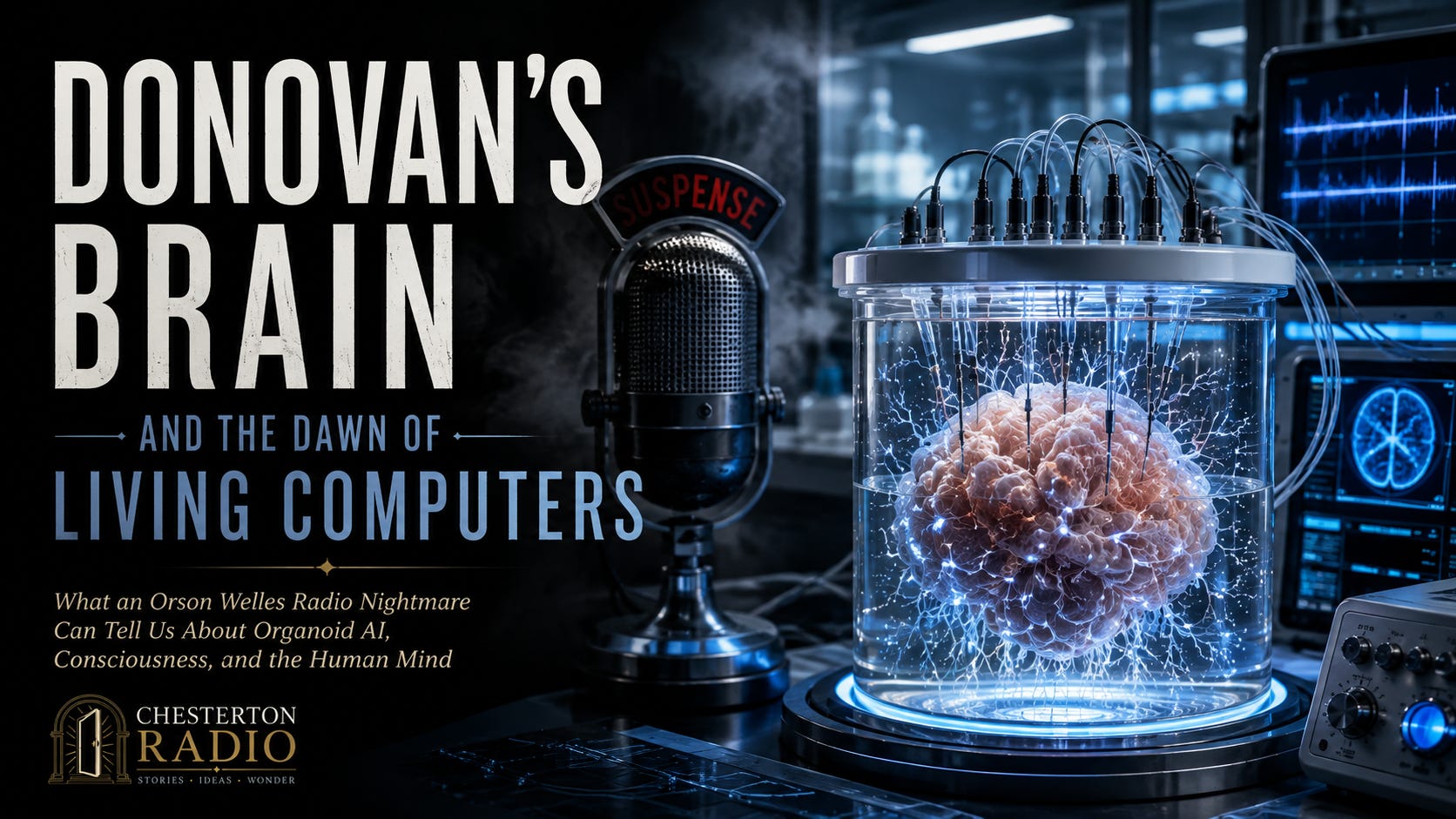
In 1944, Suspense presented one of old-time radio’s strangest and most unsettling experiments.
What if a human brain could remain alive after the body had died?
Starring Orson Welles as Dr. Patrick Cory, Donovan’s Brain begins as a tale of scientific curiosity and gradually becomes something much darker. More than eighty years later, its central idea no longer seems quite as safely confined to science fiction.
Researchers today are growing tiny structures of human neural tissue known as brain organoids, connecting them to electronic systems, and studying their ability to respond, adapt, learn, and process information. Some researchers have even proposed a new field called “organoid intelligence”—exploring whether living neural networks might someday perform forms of computation.
No, scientists have not created Donovan’s brain.
But they may have brought us close enough to the old story to make its questions worth asking again.
In this episode of The Common Room, we return to the extraordinary 1944 Suspense production of Curt Siodmak’s Donovan’s Brain and place it beside the emerging science of living computers.
What is the difference between intelligence and consciousness?
If living neural tissue can learn, is it simply biological hardware?
Could a biological computer ever become something toward which we have moral obligations?
If a human brain could somehow survive without its body, would the intelligence inside still be the person who once inhabited it?
And beneath all of these questions lies an older and deeper one:
Is a human being merely a brain?
Pull up a chair in The Common Room at The Little Station on Commercial Street in Atchison, Kansas, as an 82-year-old radio nightmare meets one of the strangest frontiers of modern science.
⚠️ SPOILER NOTE: This conversation discusses important events in Donovan’s Brain. If you haven’t heard the original Suspense production, consider listening first:
Keep the Little Station on the Air
Chesterton Radio is an independent listener-supported project devoted to keeping great stories, old radio, literature, ideas, and conversations alive—and finding new ways to bring them to another generation.
If you enjoy broadcasts like this one, please consider becoming a paid subscriber or supporting the station. Every subscription and contribution helps keep The Open Door open and The Little Station on the air.
Support Chesterton Radio:
https://chestertonradio.substack.com/subscribe
https://www.patreon.com/chestertonradio
https://www.buymeacoffee.com/chestertonradio
🌎 The Chesterton Radio World
🚪 The Open Door — 24/7 Chesterton Radio
https://live.chestertonradio.com
📻 Chesterton Radio on Substack
▶️ Chesterton Radio on YouTube
https://www.youtube.com/@ChestertonRadio
🎙️ Chesterton Radio Podcasts
Listen on Substack, Apple Podcasts, Spotify, and your favorite podcast app.
🛍️ The Chesterton Radio Shop
https://shop.chestertonradio.com
From old-time radio and classic literature to new stories, strange ideas, and conversations worth having, there is always another door to open.
Chesterton Radio
Stories • Ideas • Wonder
The Open Door is always on.


