

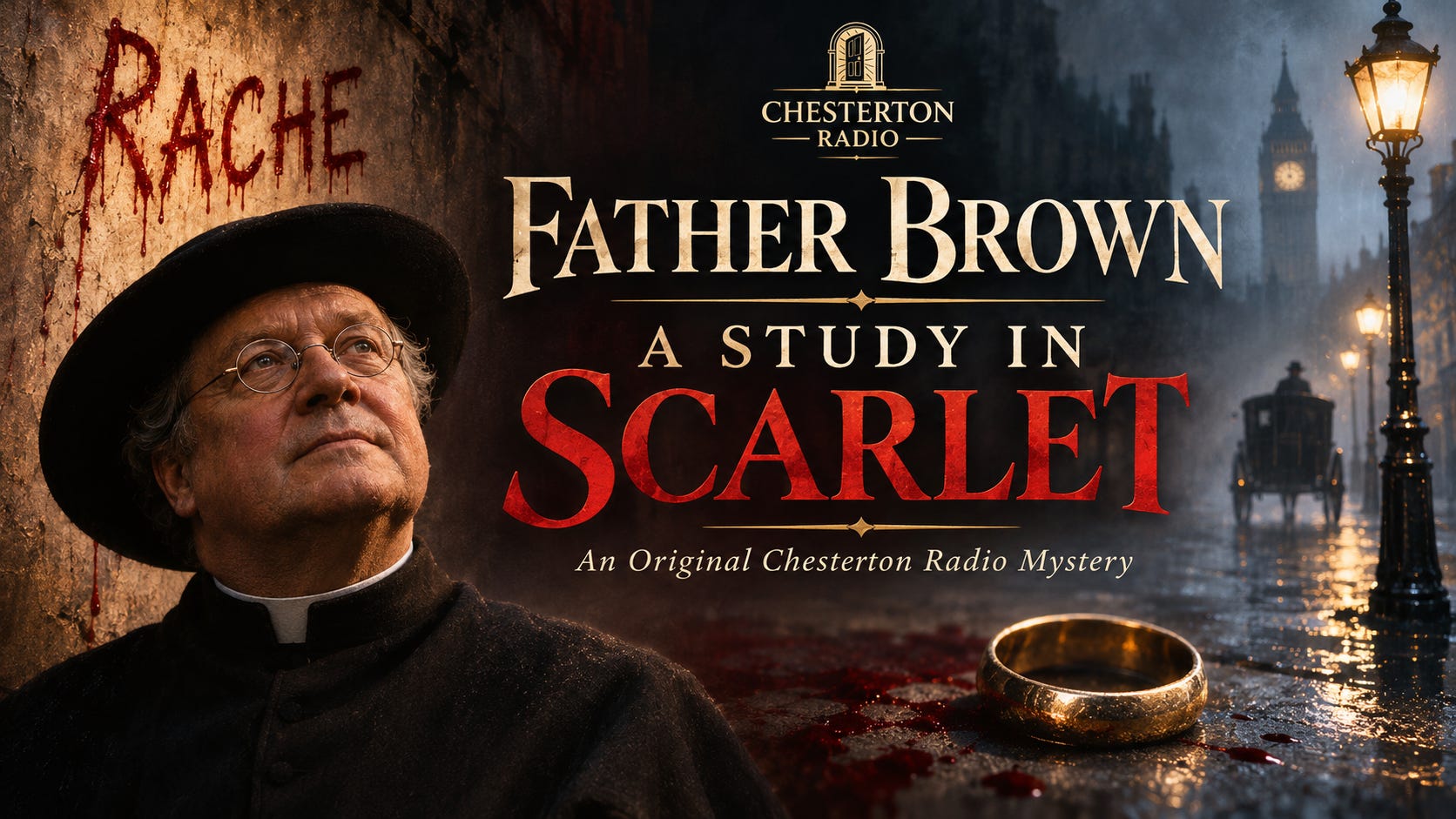
Introduction
In 1887, Arthur Conan Doyle introduced the world to a detective who would become one of the most famous characters in English literature.
His name was Sherlock Holmes.
The story was A Study in Scarlet, a remarkable mystery that began with a dead American in an empty London house, a strange message written in blood, and a trail of vengeance stretching across an ocean and back through a quarter-century of history.
It was the beginning of the Sherlock Holmes legend.
But suppose, for a moment, that Sherlock Holmes had never entered that house.
Suppose the investigation had instead brought Scotland Yard into the company of a small, unassuming Catholic priest, dressed in a shabby black coat and carrying an equally shabby umbrella.
A priest who possessed none of Holmes’s theatrical brilliance, who rarely seemed to notice the things that impressed other people, and who understood that the darkest mysteries of human conduct are not always solved by examining footprints, tobacco ash, or the chemical properties of poison.
Suppose that priest was Father Brown.
G. K. Chesterton’s beloved detective approaches crime from a different direction. He knows that evil is not always committed by monsters. Sometimes it is committed by ordinary men who have persuaded themselves that their suffering gives them permission to do terrible things.
And sometimes the most important clue is not the one that reveals how a man was murdered, but the one that explains why another man believed the murder was justified.
Our story begins in London in October 1908.
In an empty house off Brixton Road, the body of a wealthy American is discovered upon the floor.
There is no fatal wound.
There is blood, but apparently none of it belongs to the dead man.
Upon the wall, someone has written a single word:
RACHE.
Revenge.
And near the body lies a woman’s wedding ring.
For Inspector Tobias Gregson of Scotland Yard, it is the beginning of a difficult murder investigation.
For Father Brown, it is the beginning of a much older story.
A story that reaches back twenty-five years, across the Atlantic, to the mountains of the American West.
There, a young woman named Lucy Ferrier dreamed of a future with the man she loved.
But that future was taken from her.
And the man who loved her never forgot.
What followed was a pursuit measured not in days or months, but in decades. A pursuit in which love gradually became grief, grief became hatred, and hatred began to call itself justice.
Now, in the fog and gaslight of Edwardian London, the past has finally caught up with the present.
Two very different men are searching for the truth.
One is a Scotland Yard inspector determined to discover who committed the murders.
The other is a priest who understands that discovering the murderer may be the easiest part.
For beyond the clues, the bloodstains, and the extraordinary mystery lies a question that cannot be answered by deduction alone:
When does justice become revenge?
And can a man avenge the destruction of someone he loves without destroying something of himself?
Inspired by Arthur Conan Doyle’s A Study in Scarlet and reimagined through the moral imagination of G. K. Chesterton’s Father Brown, this is an original Chesterton Radio mystery about love, loss, guilt, and the dangerous temptation to take judgment into our own hands.
We invite you to enter the mystery.
Chesterton Radio presents:
FATHER BROWN: A STUDY IN SCARLET
Chapter One: The Empty House.
Chapter One
The Empty House
Inspector Tobias Gregson had never liked empty houses. An occupied house, however disorderly, possessed a certain honesty. Its inhabitants left behind the evidence of their lives: muddy boots, unwashed plates, newspapers folded at breakfast, and the small domestic arrangements by which ordinary people attempted to impose order upon existence.
An empty house offered no such assistance. It contained only what someone had chosen to leave there.
The house off Brixton Road was particularly disagreeable.
It stood behind a neglected strip of garden, its windows dark and its brickwork stained by years of London weather. A board advertising the property had fallen sideways against the iron railings. The front door stood open, and a constable waited beneath the porch with the expression of a man who would have preferred almost any other assignment.
It was shortly after six on the morning of Tuesday, 13 October 1908.
Gregson stepped down from the police carriage, buttoned his coat against the damp, and examined the building.
“Who found him?”
“Constable Rance, sir. During his rounds. Saw a light where there oughtn’t to have been one.”
“Where is Rance?”
“Inside, sir.”
“Anyone disturbed the body?”
“Not since the doctor came.”
Gregson looked sharply at him.
“That wasn’t quite what I asked.”
The constable considered this.
“No, sir.”
Gregson sighed and entered the house.
The passage smelled of damp plaster, stale dust, and something faintly medicinal. Bare boards creaked beneath his boots. There was no furniture, no carpet, and no indication that anyone had occupied the premises for some time.
The body lay in the front room.
He was a large man, perhaps fifty-five, expensively dressed in a dark travelling suit. His coat had fallen open, revealing a handsome waistcoat and a gold watch chain. His hat lay several feet away.
His face was the remarkable thing.
The mouth was drawn back, the eyes wide, and the features contorted into an expression of such extraordinary terror that Gregson found himself looking away before he had finished examining them.
Dr. Arthur Bell, the divisional surgeon, stood beside the fireplace.
“Well?” Gregson asked.
“Dead.”
“I had ventured that far myself.”
“Then you have made an excellent beginning.”
Bell was an elderly Scotsman whose professional manners improved considerably in the presence of the dead.
Gregson crouched beside the body.
“Violence?”
“Possibly.”
“Where?”
“That is the difficulty.”
Bell indicated the man’s chest and throat.
“No gunshot. No knife wound. No injury sufficient to account for death. There is a little bruising about the wrists, but nothing remarkable.”
“Heart failure?”
“Perhaps. Poison is another possibility. I should prefer an examination before committing myself.”
Gregson looked toward the floor.
There were several dark stains upon the boards.
“Blood?”
“Certainly.”
“His?”
“I can find no wound from which it could have come.”
Gregson straightened.
“Then we have a dead man without a wound, and blood without an owner.”
“An admirably economical description,” said Bell.
“Do you know his name?”
“Papers in the pocket. Enoch J. Drebber, Cleveland, Ohio. Some correspondence. Railway tickets. American money.”
Gregson made a note.
Then he noticed the writing.
It appeared on the wall opposite the fireplace, above a strip of damaged plaster. The letters were uneven, dark, and large enough to be read from the doorway.
RACHE.
Gregson approached it.
“Good Lord.”
“Quite,” said Bell.
“Written in blood?”
“Apparently.”
Gregson examined the letters without touching them.
“German, isn’t it?”
“Revenge, I believe.”
“Then somebody has been considerate enough to explain his motive.”
“Or inconsiderate enough to give you a false one.”
Gregson turned.
The remark had not come from the doctor.
A small man stood in the doorway, holding a shabby umbrella and wearing a black clerical coat that appeared to have been made for someone considerably larger. His round face bore an expression of mild concern, though whether for the dead man or the inconvenience of the living was not immediately apparent.
Gregson rose.
“Who are you?”
“Brown,” said the stranger. “Father Brown.”
“And what are you doing here?”
“I was hoping to speak to a policeman.”
“You have succeeded.”
“Yes. Though I fear I have interrupted you at rather an awkward moment.”
Gregson looked past him.
“Constable!”
The uniformed man appeared.
“Who admitted this gentleman?”
“I did, sir. He came asking about a cabman. Said it might concern the house.”
Gregson looked back at the priest.
“What cabman?”
“A man called William Harker. He sometimes attends my church, though I cannot claim he attends it with great regularity. He came to see me yesterday evening because another driver had frightened him.”
“Frightened him how?”
“He had been speaking of two Americans. Apparently he had followed them for some time. Harker thought he might be planning to rob them.”
“And you came to the police?”
“I advised Harker to do so. He was reluctant. He had already mentioned the matter to a constable, who told him to report it properly if he had something definite to say. When I learned this morning that a gentleman had been found dead here, I wondered whether Harker’s concern might have been justified.”
Gregson studied him.
“How did you learn about the murder?”
“The constable outside the church was discussing it with the milkman. Neither was particularly discreet.”
“Do you know the other driver’s name?”
“No.”
“His appearance?”
“An American, according to Harker. Middle-aged. Rather ill-looking. I thought the nationality might be significant.”
Gregson glanced at the dead man.
It was significant enough to be worth recording.
“Where can I find Harker?”
“At the cab yard near the railway arches. He begins early. I can give you the address.”
“Do so.”
Father Brown searched his pockets, produced a folded piece of paper, discovered that it was a grocery bill, and eventually found a pencil.
Gregson waited with diminishing patience.
“Thank you,” he said when the address was finally written down. “We shall look into it.”
The priest nodded but did not leave.
Instead, he looked toward the body.
“Poor fellow,” he said.
Gregson frowned.
“You knew him?”
“No.”
“Then why poor fellow?”
Father Brown considered the question.
“Well, he seems to have been very frightened.”
“Most men would be frightened if somebody murdered them.”
“Yes,” said Father Brown. “But not necessarily frightened in quite that way.”
He moved a little nearer.
Gregson was about to object when the priest stopped beside the doorway and looked at the dead man’s face.
“It is a dreadful thing,” Father Brown said quietly, “to discover that the person you have wronged has not forgotten you.”
Gregson stared at him.
“Who says he wronged anybody?”
“Nobody. I was thinking aloud. It is a bad habit of mine.”
“Then I suggest you refrain from it while we conduct a murder investigation.”
“Certainly.”
Father Brown lowered his eyes.
For several moments he appeared to be studying a loose thread on his sleeve.
Gregson returned to the wall.
“RACHE,” he said. “Revenge. Whoever wrote it wanted us to know why this man died.”
“Did he?”
Gregson turned impatiently.
“You have another explanation?”
“Only that people sometimes write things because they wish other people to read them.”
“That is generally the purpose of writing.”
“Quite. But it is not always the purpose of telling the truth.”
Bell gave a small cough that might have concealed amusement.
Gregson ignored him.
“Are you suggesting the murderer wrote this to mislead us?”
“I should not like to suggest anything so definite. But it seems a curious way of expressing a private grievance.”
“How so?”
“Well, if I were angry enough with a man to kill him, I might wish him to know why. But I cannot imagine why I should wish to explain it to the next policeman who entered the room.”
Gregson looked again at the wall.
The thought was irritating because it was reasonable.
He turned to the constable.
“Who has been through the dead man’s pockets?”
“Dr. Bell and myself, sir. The articles are on the mantelpiece.”
There were coins, a watch, a pencil, several papers, and a small notebook.
Beside them lay a plain gold ring.
Father Brown noticed it immediately.
“Ah,” he said.
Gregson followed his gaze.
“A woman’s wedding ring. Found near the body.”
“How curious.”
“Why?”
“Because it is such an ordinary thing.”
Gregson stared at him.
“A woman’s wedding ring at the scene of a murder is hardly ordinary.”
“No, of course not. I meant that a wedding ring is ordinarily a very unremarkable object. Millions of people possess them. Yet someone has contrived to make this particular one remarkable.”
“It may belong to a woman connected with the victim.”
“Indeed it may.”
The priest spoke with such ready agreement that Gregson suspected he had not agreed at all.
“Perhaps his wife,” Gregson continued.
“Perhaps.”
“Or a mistress.”
“Possibly.”
“Or a woman who came here with him.”
“That would be another possibility.”
Gregson lost patience.
“Have you any useful observation to make, Father?”
The priest picked up his umbrella.
“Only that I should be careful about deciding whose ring it was.”
Gregson was about to answer when Dr. Bell interrupted.
“Inspector, there’s something else.”
The surgeon had turned the dead man’s right hand toward the window.
“Look at the fingers.”
Gregson leaned forward.
There were marks upon the skin near the wrist, and the knuckles were faintly reddened.
“He struggled?”
“It would appear so.”
“With the murderer?”
“Presumably.”
Father Brown looked at the hand, then at the ring upon the mantelpiece.
“May I ask where the ring was found?”
“Near his shoulder,” Gregson replied. “On the floor.”
“Not in his pocket?”
“No.”
“Nor on his finger?”
“Obviously not.”
“Yes,” said Father Brown. “That is rather interesting.”
Gregson folded his arms.
“Why?”
The priest hesitated.
“I am not certain yet.”
“Then perhaps we might postpone the discussion until you are.”
“An excellent suggestion.”
Father Brown moved toward the door.
At the threshold he stopped and looked back into the room.
The dead man lay beneath the grey morning light. Above him, the bloody letters stood out upon the wall, theatrical and ugly. On the mantelpiece rested the small gold circle.
“Inspector,” said Father Brown.
Gregson looked up.
“What now?”
“I wonder whether the ring was lost.”
“Of course it was lost. Somebody dropped it.”
“Yes. But that is not quite the same thing.”
Gregson waited.
Father Brown spoke slowly, as though arranging the thought for himself.
“A man may drop something because he no longer wants it. Or because he has forgotten it. Or because, at a particular moment, something else matters more.”
“And?”
“And afterward he may want it back very badly indeed.”
Gregson glanced at the ring.
“Then we shall be ready for him.”
“That would be wise.”
The priest stepped into the passage.
Gregson called after him.
“Father Brown.”
“Yes?”
“You have not told me what you think happened here.”
“No,” said the priest. “I am afraid I don’t know.”
“Then what do you know?”
Father Brown looked back at the dead American.
“Only that whoever killed this man seems to have wanted the police to look at the writing.”
He paused.
“And I think we ought to look rather carefully at the ring.”
Then he went out into the wet London morning, leaving Inspector Gregson with a dead American, five letters written in blood, and the disagreeable suspicion that the smallest man in the room had noticed something the others had missed.
For several minutes Gregson stood motionless.
Then he turned to the constable.
“That ring,” he said. “Make certain it is properly recorded and secured.”
“Yes, sir.”
“And find me William Harker.”
The constable hurried away.
Gregson returned to the mantelpiece and examined the little circle of gold.
It was old, worn thin at the edges, and entirely without ornament.
He had been thinking of it as something a woman had lost.
For the first time, he considered the possibility that it was something a man had kept.
And somewhere in London, he thought, there might be a man who had just discovered that he had lost it.
End of Chapter One.
FATHER BROWN: A STUDY IN SCARLET
An Original Chesterton Radio Mystery
Chapter Two
The Word on the Wall
Inspector Gregson was still examining the photograph when Lestrade entered his office.
It was nearly eleven o’clock on the morning of 13 October, and the rain that had accompanied the discovery of Enoch Drebber’s body had settled into a fine, persistent drizzle. Beyond the windows of Scotland Yard, London continued its ordinary business with an indifference that Gregson had always found vaguely offensive after a murder.
The photograph showed the wall of the empty house in Brixton.
Five dark letters stood out against the discoloured plaster.
RACHE.
Lestrade placed his hat upon a chair and leaned over the desk.
“German,” he said.
“So everyone keeps telling me.”
“Means revenge.”
“That also.”
“Then perhaps the fellow has been good enough to tell us what this is about.”
Gregson laid down the photograph.
“I have been wondering why he should.”
Lestrade glanced at him.
“Why he should want revenge?”
“Why he should write it on the wall.”
“To make a statement, I suppose.”
“To whom?”
“To the dead man.”
“The dead man was in no condition to read it.”
Lestrade smiled thinly.
“You’re becoming philosophical, Gregson. It’s a dangerous occupation for a policeman.”
Gregson disliked the observation because he recognized its source. The little priest had been gone from the Brixton house for several hours, yet his questions remained behind like the smell of damp plaster.
“There are other possibilities,” Lestrade continued. “Rache might be a name. Rachel, perhaps. Interrupted before he finished.”
“By whom?”
“Someone approaching the house.”
“Then why leave the body and all its valuables?”
“Perhaps he had no time.”
“Enough time to write five letters in blood?”
Lestrade looked again at the photograph.
“You’re determined to make this difficult.”
“I should prefer to make it correct.”
Gregson drew a sheet of paper toward him.
“The word may be German. It may be a name. It may be a deliberate falsehood. Until we have something to connect it with the dead man, it proves very little.”
“Then we begin with the dead man.”
“Precisely.”
The door opened, and Dr. Arthur Bell entered carrying a leather case and an expression of professional dissatisfaction.
“I have examined your American,” he announced.
“And?”
“He remains dead.”
Lestrade laughed.
Gregson did not.
“Have you established a cause?”
“Not conclusively. There is no penetrating wound, no fracture of the skull, no evidence of strangulation sufficient to account for death. The stomach contents and organs have been retained for further examination.”
“Poison?”
“A serious possibility.”
“What kind?”
“That, Inspector, is why I have retained the organs.”
Bell removed his spectacles and polished them.
“The expression upon the face, the apparent suddenness of death, and the absence of a sufficient injury are consistent with certain poisons. They are not proof of poisoning. I should be obliged if neither of you announced a chemical discovery to the newspapers before I have made one.”
Gregson nodded.
“And the blood?”
“The stains from the floor and the writing are human blood, so far as I can presently determine. But I have found no corresponding wound upon Drebber.”
“Could it have come from his mouth?”
“There is no indication of that.”
“His nose?”
“No.”
“Then somebody else was bleeding.”
“That is a reasonable inference. It is not yet an identification.”
Gregson opened his notebook.
“Did you notice the marks on the wrists?”
“Yes. The man may have been restrained or seized. There are slight abrasions about the hands as well.”
“So there was a struggle.”
“Possibly a brief one.”
Bell closed his case.
“One further observation. The man appears to have suffered considerable distress immediately before death. I cannot tell you whether the distress was caused by fear, by the agent that killed him, or by both.”
Gregson remembered the dead man’s face.
He had seen men die violently before. There was something especially dreadful about Drebber’s expression, as though the man had recognized his fate before it reached him.
“Thank you, Doctor.”
Bell departed.
Lestrade took up his hat.
“I shall have another look at the American’s papers. If he had enemies, there may be something in his correspondence.”
“And I shall speak to the people who live near the house.”
“Still thinking about the priest?”
Gregson looked up sharply.
“What priest?”
“The little fellow who wandered into your murder scene. I heard about him.”
“He brought a possible witness.”
“Of course he did.”
Lestrade’s smile was insufferable.
“Try not to let him solve the case before luncheon.”
Gregson watched him leave.
Then he returned to the photograph.
The writing was ugly, hurried, and irregular. Yet it was large enough to command attention from anyone entering the room.
He turned the photograph face down.
He had had enough of looking where the murderer wanted him to look.
By half past twelve, Gregson had returned to Brixton.
The vacant house looked less sinister in daylight, though no more inviting. A small crowd had gathered outside the railings, consisting principally of boys, idlers, and a woman who insisted that she had known the property to be haunted for fifteen years.
Gregson interviewed the neighbours.
Most had heard nothing. One remembered a carriage. Another remembered two carriages. A third was certain that a gentleman in a tall hat had entered the house shortly before midnight, though she had been in bed at the time and could not explain how she had seen him.
At a narrow house farther along the road, an elderly widow named Mrs. Pritchard provided something more useful.
“I heard wheels,” she said.
“What time?”
“Late. After the public house had shut, I should think.”
“One carriage?”
“One that stopped. Others passed.”
“How do you know it stopped?”
“Because the horse was stamping. I could hear it against the stones.”
“Did you look outside?”
“I was going to. But my window sticks in wet weather, and I wasn’t going to stand there wrestling with it for the sake of a horse.”
“Did you hear voices?”
“Two men, I believe.”
“What did they say?”
“Couldn’t tell you. One spoke loudly, and the other answered. Then a door shut.”
“The front door of the house?”
“I couldn’t swear to it.”
“How long did the carriage remain?”
“Not very long. I heard the wheels again.”
Gregson made a careful note.
“Did the men sound English?”
Mrs. Pritchard considered.
“One sounded peculiar.”
“Peculiar in what way?”
“Like an American gentleman who once rented the rooms upstairs. He was always telling us that things were better in Ohio.”
Gregson felt his interest sharpen.
“Both Americans?”
“I only heard one plainly enough to say.”
“Could you recognize the voice?”
“No, Inspector. I’m not going to pretend I could.”
Gregson thanked her. He appreciated a witness who knew the limits of her own knowledge.
Outside, a constable approached.
“We’ve found Rance, sir.”
“Good. Bring him here.”
Constable Rance was a heavy young man whose nervousness made him appear perpetually guilty of something.
Gregson took him through the discovery again.
“The light was in the front room?”
“Yes, sir.”
“And when you entered?”
“Nobody there but the dead gentleman.”
“Did you search the premises?”
“Yes, sir. The rooms upstairs and the back yard.”
“Did you see anyone leaving the neighbourhood?”
“A few people. One fellow near the corner, rather unsteady on his feet.”
“Drunk?”
“That’s what I thought.”
“Describe him.”
“Middle-aged. Rough coat. Scarf about his neck. He was leaning against the railings for a moment.”
“Did you speak to him?”
“Told him to move along.”
“Did he answer?”
“Something about being poorly, sir. I didn’t catch the rest.”
“An accent?”
Rance hesitated.
“I couldn’t say.”
Gregson looked at him for a long moment.
“Constable, a man has been murdered in an empty house, and you saw a stranger lingering nearby. Why was that not in your first report?”
“I thought he was drunk, sir.”
“That is not an answer.”
“No, sir.”
Gregson recorded the description. It was too general to identify anyone, but the man’s apparent illness interested him.
He remembered Father Brown’s account of an American cabdriver who looked unwell.
It might mean something.
It might mean nothing.
A detective who could not distinguish the two was soon in trouble.
Father Brown was in the church vestry when Gregson found him that afternoon.
The priest was attempting to mend the clasp of an old prayer book with a piece of string. The operation had evidently proved more difficult than anticipated.
“Inspector,” he said, looking up. “Have you found your murderer?”
“No.”
“Ah. Then I suppose you have come about the cabman.”
“Among other things. I have sent a man to interview Harker. I wanted to ask you about something you said this morning.”
“That was rash of me. I said several things, and I fear most of them were unnecessary.”
“You suggested the writing on the wall was intended for the police.”
“I suggested it might be.”
“Why?”
Father Brown put down the prayer book.
“Because it was so conspicuous.”
“That is hardly evidence.”
“No. But it is worth considering. There are things a murderer does because he is angry, and things he does because he is frightened. Then there are things he does because he wants us to think he is a particular sort of murderer.”
“A political fanatic, perhaps?”
“Perhaps. Or a German. Or somebody who has read a German dictionary.”
Gregson smiled despite himself.
“Lestrade thinks it might be the beginning of a woman’s name.”
“That is possible too.”
“You seem determined to leave every possibility open.”
“Not every possibility. Only the ones we have not disproved.”
Gregson sat down.
“The medical examination suggests poison.”
“Does it?”
“There is no sufficient injury. The blood seems to belong to somebody else.”
Father Brown became attentive.
“Was there a great deal of blood?”
“Enough to write the word, and some upon the floor.”
“But not enough to suggest that a man had been seriously wounded?”
“No.”
“That is interesting.”
“Why?”
“A man may bleed a little without having been attacked. A cut finger, for example. Or a nosebleed.”
Gregson made a note.
“Do you think the murderer was injured?”
“I don’t know. I should want to know whether the blood appeared to have fallen naturally or been deliberately placed.”
“We shall examine that.”
“Good.”
Gregson took the wedding ring from a small paper packet and placed it on the table.
“Now this.”
Father Brown regarded it.
“I have been thinking about it,” he admitted.
“So have I.”
“I thought this morning that it might belong to a woman whom the dead man had wronged.”
“And now?”
“I am less certain.”
“Why?”
“Because I began with the wrong question.”
“What was that?”
“Who was the woman?”
“And the right question?”
“Who cared enough about the ring to bring it into that house?”
Gregson leaned forward.
“Someone might have brought a woman there.”
“Certainly. But you have found no evidence of a woman being present, have you?”
“Not yet.”
“Then we mustn’t invent one merely to explain her ring.”
Gregson looked at the small gold band.
“You said this morning that the murderer might want it back.”
“Yes.”
“Why would a murderer carry a woman’s wedding ring?”
Father Brown turned the ring gently between his fingers.
“Perhaps it belonged to his wife.”
“Or his sweetheart.”
“Or his mother. Or someone who died long ago. We cannot know yet.”
“You are not being very helpful.”
“No,” said Father Brown. “But I am trying not to be helpful in the wrong direction.”
Gregson laughed.
It was the first time the priest had made him laugh.
Father Brown returned the ring.
“May I ask something?”
“Certainly.”
“Was the dead man’s money taken?”
“No.”
“His watch?”
“No.”
“Then whoever killed him was not chiefly interested in robbery.”
“Agreed.”
“And the writing was intended to be found.”
“Probably.”
“And the ring was left behind, though it may have mattered greatly to somebody.”
“Possibly.”
Father Brown folded his hands.
“Then perhaps the most useful thing we can do is give that somebody a reason to come and ask for it.”
Gregson looked at him.
“You mean advertise it?”
“Why not? People are wonderfully inventive when they have lost something they love.”
“Or something that might hang them.”
“Yes,” said Father Brown. “That too.”
Gregson rose and began pacing the little vestry.
They could publish a brief notice claiming that a wedding ring had been found near Brixton Road. The description need not mention the murder. Anyone claiming it would be asked to identify the object.
If the ring belonged to an innocent woman, she might provide information.
If it belonged to the murderer, he might make a mistake.
It was a simple plan, and Gregson was annoyed that he had not thought of it sooner.
“I shall have the notice placed in tomorrow’s papers.”
“Then I hope you will take care.”
“Of what?”
“Of the person who comes.”
“Naturally.”
“I mean that he may not come as himself.”
Gregson paused.
“Why not?”
“Because a man who has taken the trouble to write a false message upon a wall may be quite capable of sending a false messenger to collect a ring.”
The inspector considered this.
“Then we shall arrange for someone to watch the claimant.”
“That sounds sensible.”
Gregson put on his hat.
At the door he turned.
“Father Brown, you still haven’t told me what you think the ring means.”
The priest looked down at the broken prayer book.
“I am afraid I have been rather foolish about it.”
“How?”
“I assumed it must have something to do with the dead man’s affections. But I am beginning to wonder whether it has more to do with the murderer’s.”
Gregson waited.
Father Brown continued, almost apologetically.
“There is a curious difference between a man who kills for something he wants and a man who kills because of something he has lost. The first may be satisfied when he obtains it. The second is often much harder to satisfy.”
“Because he cannot get it back?”
“Exactly.”
For a moment neither spoke.
Then Father Brown added, “And if the thing he has lost is a person, the difficulty becomes very great indeed.”
Gregson looked at the ring once more.
It was a small, commonplace object. A few shillings’ worth of gold, worn smooth by years of use.
Yet someone had carried it into a deserted house where an American gentleman had died in terror.
The inspector returned the ring to its packet.
“Tomorrow morning,” he said. “We shall see who wants it.”
Father Brown nodded.
“Yes. And perhaps we shall discover why.”
Outside, the rain had stopped. The late afternoon sun struggled through the clouds above London, illuminating the wet pavement and the passing traffic.
Gregson stepped into the street and hailed a cab.
As the driver climbed down to open the door, the inspector found himself studying the man’s face.
It was a perfectly ordinary English face, reddened by weather and work.
Gregson gave his destination and climbed inside.
The cab moved off.
He had spent the morning searching for a murderer among bloody letters, poisoned bodies, and mysterious symbols.
Now he found himself wondering how many men drove through London every day carrying histories that nobody had thought to ask about.
At Scotland Yard, he dictated the notice himself.
It was deliberately brief.
A plain gold wedding ring had been found in the neighbourhood of Brixton Road. The owner might recover it upon furnishing a satisfactory description and applying at an address supplied for the purpose.
Gregson read the words twice.
Then he signed the instruction for publication.
He had no way of knowing whether anyone would answer.
But somewhere in London, if Father Brown was right, there was a man who had lost something more important to him than money, safety, or freedom.
And tomorrow, Gregson intended to offer him the chance to come looking for it.
End of Chapter Two.
Chapter Three
A Ring Without a Bride
The woman who came to claim the wedding ring was wearing a veil thick enough to conceal her face and boots sufficiently muddy to suggest that she had walked a considerable distance.
Inspector Tobias Gregson noticed the boots first.
It was half past ten on Wednesday morning, 14 October 1908, and he had been waiting nearly two hours in the little ground-floor office he had borrowed for the purpose. The notice had appeared in the morning newspapers, directing anyone claiming the ring to apply at an address near Westminster.
The office belonged to a retired solicitor who owed Gregson a favour. Its furnishings consisted of a desk, three chairs, a bookcase, and a portrait of Queen Victoria whose expression suggested that she disapproved of the entire proceeding.
The woman stood in the doorway, clutching a small black handbag.
“I have come about the ring,” she said.
Her voice was low and rather hoarse.
Gregson rose.
“Please come in.”
She entered reluctantly.
“You are the gentleman who found it?”
“I am acting for the person who did.”
“Then perhaps you will give it to me.”
“Certainly, madam, if you can establish that it belongs to you.”
She remained standing.
Gregson indicated a chair.
“Won’t you sit down?”
“I would rather not.”
“As you please.”
He opened his notebook.
“Your name?”
“Mrs. Ellen Turner.”
“Address?”
“Camberwell.”
“Where in Camberwell?”
The woman hesitated.
“Near the church.”
“There are several churches in Camberwell, Mrs. Turner.”
“I don’t see what that has to do with my ring.”
“Nothing, if it is yours. But we must take reasonable precautions.”
She shifted her weight.
Gregson observed that her hands were gloved, although the room was warm.
“Describe the ring, please.”
“A plain gold wedding ring.”
“Any inscription?”
“No.”
“How old?”
“I couldn’t say. I’ve had it many years.”
“Where did you lose it?”
“In a cab.”
Gregson’s pencil stopped.
“A cab?”
“Yes.”
“Where?”
“Somewhere near Brixton Road.”
“When?”
“Monday evening.”
“Which cab?”
“I don’t know.”
“Was it a hansom or a four-wheeler?”
“A four-wheeler, I think.”
“You think?”
“I wasn’t paying particular attention.”
Gregson looked at her.
“You have given a very uncertain account of losing an object you are apparently anxious to recover.”
“I am an elderly woman, Inspector. My memory isn’t what it was.”
Gregson had not told her he was an inspector.
He closed the notebook.
“Who told you I was a policeman?”
The woman became very still.
“I beg your pardon?”
“You called me Inspector.”
“I suppose I must have read it somewhere.”
“The advertisement gave no name or occupation.”
She looked toward the door.
“I don’t care for being questioned like a criminal.”
“Then perhaps you will explain why you have come here.”
“Because the ring is mine.”
Gregson rose.
“One moment, madam.”
But the woman had already turned.
She moved with surprising speed, passing through the doorway and into the passage before Gregson could reach her.
“Stop!”
He followed.
By the time he reached the street, she was hurrying toward the corner.
A constable stationed opposite the office stepped forward.
“That woman,” Gregson called. “Follow her. Don’t lose sight of her.”
The constable hurried after the veiled figure.
Gregson himself started in pursuit, but a delivery cart emerged from a side street, forcing him to stop.
By the time it passed, the woman had disappeared around the corner.
He stood for a moment in the cold morning air, furious with himself.
Then he returned to the office.
The ring remained safely in its packet.
The woman had not even seen it.
Father Brown arrived twenty minutes later.
He found Gregson pacing beside the desk.
“Good morning, Inspector.”
“That remains to be seen.”
“Ah. Has something happened?”
“Someone came for the ring.”
“Did they?”
“A woman. Or somebody dressed as one.”
Father Brown removed his hat.
“That is interesting.”
“She gave a false name, an incomplete address, and an account of losing the ring that wouldn’t have satisfied a child.”
“Did she see the ring?”
“No.”
“Then she cannot have learned anything about it beyond what was in the advertisement.”
“Precisely.”
“Did she get away?”
“For the moment.”
Father Brown sat down.
Gregson described the interview, including the woman’s apparent age, clothing, voice, and abrupt departure.
When he finished, the priest looked thoughtful.
“She called you Inspector?”
“Yes.”
“That was careless.”
“Very.”
“Unless she expected to find a policeman.”
Gregson stopped pacing.
“What do you mean?”
“Well, if someone sent her to collect the ring, they may have warned her that the police were involved.”
“Or she recognized me.”
“That too.”
Gregson resumed his pacing.
“I ought to have detained her.”
“On what grounds?”
“Giving a false name.”
“Are you certain it was false?”
“No.”
“Then perhaps you did the right thing by allowing her to leave.”
Gregson stared.
“I didn’t allow her to leave. She escaped.”
“Yes, of course. But now you may discover where she went.”
“If the constable has managed to follow her.”
“Quite.”
Gregson sat down heavily.
“You are remarkably cheerful about other people’s failures.”
“I assure you, Inspector, I have had so many of my own that I find them difficult to distinguish.”
The door opened.
A young constable entered, flushed and breathless.
“Beg pardon, sir.”
“Well?”
“I followed the woman as far as the railway bridge.”
“And?”
“She turned into a narrow passage beside a public house. There was a cab waiting at the far end.”
“A cab?”
“Yes, sir. A four-wheeler.”
“Did she enter it?”
“Not immediately. She stopped beside the driver and spoke to him.”
“What did he look like?”
“Middle-aged. Dark coat. Hat pulled low. Couldn’t see his face properly.”
“Did you hear what they said?”
“No, sir. I was too far away.”
“Then what happened?”
“The woman climbed inside, and the cab drove off.”
“Number?”
“I couldn’t make it out, sir. The rear lamp was muddy.”
Gregson closed his eyes.
“Did you at least see which direction it took?”
“Yes, sir. Toward the Embankment.”
“Anything distinctive about the horse?”
“A dark bay, sir. White mark on the near foreleg.”
Gregson opened his eyes.
“That may be useful. What about the woman?”
“She lifted her veil before she got into the cab.”
“And?”
The constable hesitated.
“Well, sir, I don’t think she was an elderly woman.”
“Why not?”
“She moved like a younger person. And when she lifted the veil, I saw the lower part of her face. It looked rather rough.”
“Rough?”
“Like a man’s, sir.”
Gregson leaned forward.
“Are you telling me the woman was a man?”
“I wouldn’t swear to it. But that’s what I thought.”
Father Brown, who had been listening quietly, looked up.
“Did the driver assist the passenger into the cab?”
“No, Father. He stayed on his box.”
“Did he turn around when they spoke?”
“Only a little.”
“Then you cannot say whether they knew one another.”
“No, Father.”
“Thank you.”
Gregson dismissed the constable with instructions to make a written report.
When the door closed, he turned to Father Brown.
“Well?”
“Well,” said the priest, “we have learned that somebody wanted the ring badly enough to take considerable trouble over it.”
“And sent a disguised messenger.”
“Apparently.”
“Which means the ring belongs to the murderer.”
“It makes that possibility rather stronger.”
Gregson frowned.
“You never commit yourself to anything.”
“Oh, I commit myself to a great many things. Unfortunately, I am often wrong.”
He looked toward the window.
“May I ask whether the woman seemed frightened?”
“She was nervous.”
“Of being arrested?”
“Possibly.”
“Or of failing?”
Gregson considered.
“She was certainly anxious to obtain the ring.”
“Then perhaps she had been promised something for it.”
“Money?”
“Perhaps. Or perhaps someone had made her afraid of returning without it.”
Gregson looked at him sharply.
“You think she was an accomplice?”
“I think she was doing an errand. That is not necessarily the same thing.”
The interview with William Harker took place that afternoon.
Harker was a broad-shouldered cabman with a red face, enormous hands, and the uncomfortable manner of a man who had never expected to be invited into Scotland Yard.
Gregson placed him in a chair and opened his notebook.
“You spoke to Father Brown on Monday evening?”
“Yes, sir.”
“About another driver?”
“That’s right.”
“Tell me exactly what happened.”
Harker rubbed his hands together.
“I’d been waiting for a fare near the station. There was this American fellow standing beside another cab. He’d been asking questions about two gentlemen.”
“What sort of questions?”
“Where they were staying. Whether they’d been seen at the station. Whether they travelled together.”
“Did he give their names?”
“No, sir. But he said they were Americans.”
“What did he look like?”
“Not a young man. Thin in the face. Weather-beaten. Had a way of looking at you as though he wasn’t quite listening.”
“Anything else?”
“He was poorly, I think.”
“How do you know?”
“He stopped speaking once and put his hand against his chest. Went white as paper. I thought he was going to fall.”
Gregson remembered the constable’s description of the man near the Brixton house.
“Did he recover?”
“After a minute. Said it was nothing.”
“Did he speak with an American accent?”
“Yes, sir.”
“Do you know his name?”
“No.”
“His cab number?”
“I didn’t notice.”
“Where did he work?”
“Couldn’t say. I’ve seen him about the yards, but he wasn’t one of the regular fellows I knew.”
Gregson made another note.
“Why did you think he intended to rob these Americans?”
Harker looked embarrassed.
“Well, sir, it was the way he spoke about them.”
“What did he say?”
“He said one of them had lived too long.”
Gregson’s pencil stopped.
“Those exact words?”
“As near as I remember.”
“And the other?”
“He said the other would have his turn.”
The room was silent.
Father Brown sat beside the window, his umbrella across his knees.
“Did he seem angry?” the priest asked.
“Not exactly, Father.”
“How, then?”
Harker struggled for an answer.
“Like a man waiting for something. Something he’d been waiting for a very long time.”
Father Brown lowered his eyes.
Gregson leaned forward.
“Did he threaten either gentleman?”
“Not directly.”
“Did he say why he wanted them?”
“No, sir.”
“Did he mention a woman?”
Harker shook his head.
“Not that I remember.”
Gregson looked at Father Brown.
The priest was studying the worn handle of his umbrella.
“Father?”
“Yes?”
“Have you any questions?”
“Only one.”
He turned to Harker.
“When the man spoke of those two Americans, did he sound pleased at the thought of finding them?”
Harker considered.
“No, Father.”
“Angry?”
“Not particularly.”
“Then what?”
The cabman looked uncomfortable.
“Almost relieved.”
Father Brown nodded.
“Thank you. That is helpful.”
By evening, Gregson had ordered inquiries at several cab yards and requested the relevant licensing information.
The search would take time.
London possessed an extraordinary number of drivers, vehicles, and stables, and an American accent was not sufficient to identify a murderer.
Nevertheless, the evidence was beginning to form a pattern.
A dead American.
A second American who had apparently been watching him.
A cab heard near the murder house.
A mysterious claimant who had departed in another cab.
And a wedding ring that somebody wanted badly enough to risk approaching the police.
Gregson spread his notes across the desk.
Father Brown stood beside the fireplace.
“You were right about the ring,” Gregson said.
“I was wrong about it first.”
“That is hardly important.”
“It may be. I thought it belonged to a woman connected with the dead man. But now I think it may have belonged to a woman connected with the man who killed him.”
“Why?”
“Because the murderer seems to have carried it into the room, and then tried to recover it.”
“Perhaps it was simply evidence he wanted removed.”
“Yes. But why carry it there in the first place?”
Gregson considered.
“To show it to Drebber.”
“That would make sense.”
“To remind him of someone.”
“Yes.”
“Someone he had wronged.”
“Possibly.”
Father Brown moved toward the desk and looked at the little gold band.
“It is strange,” he said, “how a thing can remain unchanged while everything it means is altered.”
Gregson waited.
“A wedding ring is intended to be a sign of fidelity. Yet it may become a reminder of betrayal. It is meant to join two people together. Yet it may survive when one of them has gone.”
“Do you think the woman is dead?”
“I don’t know.”
“Then why speak as though she were?”
Father Brown looked faintly embarrassed.
“Because I have known men who kept such things for many years. They could no longer speak to the person who had worn them, so they spoke to the object instead.”
Gregson glanced at the ring.
“And sometimes they killed for it?”
“Sometimes they killed for what they believed it represented.”
The inspector folded his notes.
“Then we are looking for a man with a grievance against Drebber.”
“That seems likely.”
“An American cabdriver.”
“Perhaps.”
“A man who has been following two Americans.”
“Yes.”
“And who sent someone to recover a ring.”
“Possibly.”
Gregson smiled.
“That is nearly a complete description.”
“It is a beginning.”
“And what do you think he will do next?”
Father Brown did not answer immediately.
He looked at the window, where the last light of the day was fading behind the rooftops.
“That depends,” he said, “on whether the other American is still alive.”
Gregson stared at him.
“Stangerson?”
“Is that his name?”
“Joseph Stangerson. Drebber’s secretary. Lestrade has been trying to find him.”
Father Brown turned.
“Then I hope he finds him soon.”
There was something in his voice that made Gregson uneasy.
“Why?”
“Because if the man we are seeking has spent years waiting for two people, I doubt he will be satisfied with one.”
Gregson reached for the telephone.
He had scarcely lifted the receiver when the office door opened.
Lestrade stood on the threshold.
His face was pale, and his usual briskness had deserted him.
“Gregson,” he said.
The inspector put down the receiver.
“What is it?”
“I’ve found Stangerson.”
“Where?”
“At his hotel.”
“Well?”
Lestrade removed his hat.
“He’s dead.”
For a moment nobody spoke.
Then Gregson asked the question he already dreaded.
“How?”
Lestrade looked from the inspector to the small priest standing beside the fireplace.
“Someone has stabbed him through the heart.”
Father Brown closed his eyes.
Gregson rose slowly from his chair.
On the desk between them lay the little gold wedding ring.
The first murder had been a mystery.
The second was beginning to look like a promise fulfilled.
End of Chapter Three.
Chapter Four
The Second Judgment
Joseph Stangerson had died with his hand upon the door.
Inspector Tobias Gregson noticed this before he noticed the blood, although there was considerably more blood than there had been in the empty house at Brixton.
The dead man lay on his back beside the narrow bed, his right arm extended toward the entrance. A small table had been overturned. A chair stood at an awkward angle against the washstand, and the bedclothes had been dragged halfway to the floor.
The room was on the second floor of a modest hotel near Euston Station. Its windows overlooked a courtyard where a porter was attempting to persuade a horse to move backward.
It was shortly after eight on the morning of Thursday, 15 October 1908.
Lestrade stood beside the fireplace.
“The chambermaid found him at seven,” he said. “She knocked, received no answer, and asked the manager to open the door.”
“Was it locked?”
“No. Merely closed.”
“Anyone seen leaving?”
“We’re questioning the staff.”
Gregson crouched beside the body.
Stangerson was a thin man of about fifty, carefully dressed in a shirt and trousers, with his braces hanging loose at his sides. His face was severe even in death. A dark stain spread across the front of his shirt.
“One wound?” Gregson asked.
“Apparently.”
“Knife?”
“Almost certainly. The surgeon will give us a proper opinion.”
Gregson examined the outstretched hand.
There were small cuts upon two fingers.
“He fought.”
“Yes,” said Lestrade. “And rather effectively, judging by the room.”
Father Brown stood near the doorway, his umbrella held carefully against his coat.
He had said nothing since their arrival.
Gregson looked toward him.
“Well, Father?”
The priest regarded the dead man.
“I wonder whether he knew who had come to see him.”
Lestrade answered.
“The murderer, presumably.”
“Yes. But did he recognize him before the struggle began?”
Gregson rose.
“What difference would that make?”
“A considerable one. A man who recognizes an enemy may fight before the enemy has done anything. A man who receives a stranger may wait until he discovers what the stranger wants.”
Lestrade looked at the overturned table.
“Either way, he fought.”
“Indeed. But I should like to know what frightened him.”
Gregson remembered the expression upon Drebber’s face.
Two Americans. Two deaths. Two different forms of terror.
“Let us begin with the room,” he said.
The hotel manager was a small, anxious gentleman named Mr. Phelps, who seemed chiefly concerned that the establishment’s reputation would not survive a second visit from the police.
“I assure you, Inspector, we maintain a perfectly respectable house.”
“That is encouraging,” Gregson replied. “Now tell me about your guest.”
“Mr. Stangerson arrived on Monday afternoon with another American gentleman.”
“Drebber?”
“Yes, sir.”
“Were they travelling together?”
“Certainly. Though I gathered they were not on the best of terms.”
“Why?”
“They had words in the dining room on Monday evening.”
“About what?”
“I couldn’t say. Mr. Drebber had been drinking. Mr. Stangerson asked him to lower his voice.”
“Did you hear anything else?”
Phelps hesitated.
“Something about a man following them.”
Gregson leaned forward.
“Which of them said that?”
“Mr. Stangerson. He said they ought to leave London immediately.”
“And Drebber?”
“He laughed. Said the fellow was a ghost and that ghosts couldn’t hurt anyone.”
Father Brown looked up.
“Those exact words?”
“Very nearly, Father.”
“Did Mr. Stangerson laugh?”
“No. He seemed extremely disturbed.”
Gregson made a note.
“What happened afterward?”
“Mr. Drebber went out. Mr. Stangerson remained here.”
“Did Drebber return?”
“No, sir.”
“Did Stangerson report him missing?”
“He asked whether we had seen him. On Tuesday morning he went out to make inquiries. When he returned, he seemed quite shaken.”
“Did he know Drebber was dead?”
“I believe he had heard something about a murder. He asked me whether the police had called.”
“Did you notify them?”
“I told him I thought he ought to speak to an officer. He said he would do so after attending to certain business.”
Gregson exchanged a glance with Lestrade.
A man who knew his travelling companion had been murdered, and who suspected he might be next, had nevertheless remained at the hotel.
“Did he receive visitors?”
“Not that I know of.”
“Any letters?”
“One was delivered yesterday afternoon.”
“From whom?”
“I don’t know.”
“Have you kept the envelope?”
“It was taken up to his room.”
Lestrade nodded.
“We have his papers.”
Gregson continued.
“Did anyone see a stranger entering the hotel this morning?”
Phelps called for the night porter.
The man, whose name was Briggs, was elderly and had the permanently injured expression of someone accustomed to being blamed for other people’s misfortunes.
“I saw a cabdriver,” he said.
Gregson became attentive.
“When?”
“Early. Before six.”
“Did he enter the hotel?”
“Yes, sir. Came in through the side entrance while I was carrying coal.”
“Describe him.”
“American, I should say. Rough-looking fellow. Dark coat. Hat pulled down.”
“Did you speak to him?”
“He asked for Mr. Stangerson.”
“What did you tell him?”
“That the gentleman was upstairs.”
“Did you send him up?”
“He said Mr. Stangerson was expecting him.”
“And you believed him?”
Briggs looked offended.
“How was I to know otherwise?”
Gregson controlled his temper.
“Did you see him leave?”
“No, sir.”
“Did you notice anything unusual about him?”
The porter thought for a moment.
“He looked ill.”
“Ill?”
“Had his hand against his chest as he came through the passage. Stopped to catch his breath.”
Gregson wrote rapidly.
“Anything else?”
“He asked for water.”
“Did you give him some?”
“Yes, sir. In the passage.”
“What happened to the glass?”
“I took it back to the kitchen.”
Gregson instructed Lestrade to have it found, if it had not already been washed.
Father Brown spoke quietly.
“Was the man carrying anything?”
“A small parcel, Father. Wrapped in brown paper.”
“Large?”
“No bigger than a book.”
“Did he seem angry?”
“No. Very quiet.”
“Thank you.”
The porter was dismissed.
Gregson looked at Lestrade.
“An American cabdriver. Ill. Seeking Stangerson.”
“And a man fitting that description has been seen near the first murder,” Lestrade replied.
“Now we need his name.”
Dr. Bell arrived shortly afterward and examined the body.
“The wound is consistent with a narrow-bladed knife,” he said. “It appears to have penetrated the chest deeply enough to cause rapid death.”
“Would Stangerson have remained conscious?”
“Possibly for a short time. I cannot be more precise.”
“Could he have reached the door?”
“Perhaps. His position is consistent with an attempt to do so.”
Bell examined the cuts upon the dead man’s fingers.
“These may be defensive injuries. He appears to have grasped or tried to turn aside a blade.”
Gregson looked around the room.
The chair had been knocked over. The table lay on its side. A water jug had shattered beside the washstand.
Whatever had happened, Stangerson had not submitted quietly.
Lestrade approached the writing desk.
“There’s something else.”
He held up a small cardboard box.
Inside were two compartments, each lined with pale paper. One contained a single small white pill. The other was empty.
Gregson examined it.
“Medicine?”
“Possibly.”
“Was it found in his pocket?”
“No. Beneath the overturned table.”
Father Brown came nearer.
“May I see?”
Lestrade held the box where he could examine it without touching it.
The priest studied the two compartments.
“Curious.”
“Why?” Gregson asked.
“Because it seems arranged for a choice.”
“A choice of medicine?”
“Perhaps.”
Gregson looked at the empty compartment.
“One pill has been taken.”
“Or removed,” said Father Brown.
Lestrade closed the box.
“I’ll have Bell examine it.”
The surgeon looked displeased.
“I can examine its appearance, certainly. I cannot tell you what a substance contains merely by looking at it.”
“Could it be poison?”
“Many things could be poison, Inspector. I should prefer not to make a discovery before conducting an examination.”
Gregson almost smiled.
Bell took charge of the box for proper testing.
Father Brown remained beside the table.
“There is something rather dreadful about that little object,” he said.
Gregson turned.
“More dreadful than a knife?”
“In a way.”
“How?”
“A knife is honest about what it is. A man who draws one generally knows that he is about to do violence.”
“And a pill?”
“A pill may be offered as a remedy. Or as a choice. Or as something that appears to place the responsibility elsewhere.”
Gregson frowned.
“Responsibility for what?”
Father Brown looked toward Stangerson’s body.
“For what happens afterward.”
The papers in Stangerson’s travelling case provided the first definite connection between the two murdered Americans.
There were railway receipts, hotel bills, correspondence from Cleveland, and several letters relating to property transactions.
Most were ordinary business documents.
One was not.
It was an old letter, folded into quarters and kept inside a leather pocketbook. The paper had yellowed, and the ink had faded at the creases.
Gregson opened it carefully.
The letter was dated 1883.
Its heading read:
Salt Lake City, Utah Territory.
He looked up.
“Utah.”
Lestrade came to his side.
“What of it?”
“Stangerson and Drebber were together there twenty-five years ago.”
“How do you know?”
Gregson pointed to the letter.
It concerned a disputed property arrangement involving a man named John Ferrier. The writer referred to discussions with Enoch Drebber and Joseph Stangerson, and to a disagreement over Ferrier’s daughter.
The wording was guarded, almost legal.
Yet beneath its formal language lay unmistakable pressure.
Gregson read a passage aloud.
“’Mr. Ferrier must understand that the matter cannot remain unsettled indefinitely. His daughter’s refusal has already occasioned unnecessary difficulty, and Mr. Drebber expects the arrangements previously discussed to be honoured.’”
Lestrade whistled softly.
“Marriage?”
“It would appear so.”
Father Brown held out his hand.
“May I?”
Gregson passed him the letter.
The priest read it slowly.
“Who wrote this?” he asked.
“The signature is difficult to make out.”
“Then we should not guess.”
He returned the paper.
Gregson examined the date again.
“Twenty-five years.”
Lestrade looked toward the dead man.
“A long time to keep a letter about a marriage.”
“Especially one that apparently caused trouble,” Gregson replied.
Father Brown stood very still.
“Was there a name for the daughter?”
Gregson searched the page.
“No. Only ‘Miss Ferrier.’”
“Then we must discover it.”
“Why?”
“Because the letter speaks about her as though she were a parcel that had failed to arrive.”
Gregson looked at him.
“That was not uncommon language in business correspondence.”
“She was not a business arrangement.”
The words were spoken so quietly that Gregson almost missed them.
Lestrade examined another document.
“Here is a second reference to Ferrier. A receipt for land transferred after his death.”
“His death?”
“Apparently. Same year.”
Gregson took the paper.
The receipt was signed by an agent and referred to property formerly held by John Ferrier.
There was nothing in the document to establish how Ferrier had died.
Nevertheless, the sequence troubled him.
A dispute over a daughter.
A demand that an arrangement be honoured.
Then the father’s death.
And twenty-five years later, two men connected with that dispute had been murdered in London.
“Find everything you can about Ferrier,” Gregson said. “And about the daughter.”
Lestrade nodded.
“I’ll send inquiries through the proper channels.”
“Also check Drebber’s correspondence. There may be another reference.”
Father Brown was looking at the old letter.
“Inspector,” he said, “I think we may be approaching the beginning of this affair.”
“The beginning?”
“Yes. We have been investigating two deaths in London. But perhaps the story began with another death, a very long way from here.”
By late afternoon, Gregson had returned to Scotland Yard.
The evidence lay before him in separate packets.
The wedding ring.
The photograph of the writing at Brixton.
The statements of Harker, Rance, and the hotel porter.
The old Utah letter.
The pillbox was with Dr. Bell, awaiting examination.
Gregson arranged the papers in chronological order.
For the first time, he could see something resembling a deliberate sequence.
Drebber had been taken to an empty house and had died without a visible wound.
Stangerson had been approached in his hotel room and had died fighting.
Both men had feared someone.
Both had been connected with a dispute in Utah twenty-five years earlier.
And an American cabdriver had apparently been following them.
Lestrade entered carrying a fresh report.
“The porter has confirmed his description,” he said. “The man was about fifty, weather-beaten, with an American accent. He was carrying a parcel when he entered, but Briggs cannot remember whether he had it when he went upstairs.”
“Any other witnesses?”
“A chambermaid heard raised voices shortly before six. She thought one man said, ‘You know what you must do.’ Then something fell.”
“Did she hear a struggle?”
“Furniture moving. A cry. She was frightened and went downstairs.”
“Why didn’t she report it?”
“She thought the gentlemen were quarrelling.”
Gregson shook his head.
“London is full of people who hear murders and assume they are domestic disagreements.”
Lestrade placed the report on the desk.
“There’s more. Stangerson had made inquiries yesterday about passage to Liverpool. He apparently intended to leave England.”
“Alone?”
“The clerk could not say.”
Gregson leaned back.
“He knew someone was coming.”
“Yes.”
“And he was too late.”
Father Brown, seated near the fire, looked up.
“Perhaps he was too late twenty-five years ago.”
Gregson frowned.
“What do you mean?”
“I mean that we must be careful not to mistake fear for innocence.”
Lestrade crossed his arms.
“You think Stangerson deserved what happened?”
“No.”
“Then what are you suggesting?”
“Only that a man may be guilty of a very grave wrong and still have the right not to be murdered.”
Gregson looked at the priest.
“You seem determined to defend both sides.”
“I am trying to distinguish them.”
“How?”
“By remembering that there may be two crimes where we have been looking for one.”
Lestrade gave a short laugh.
“Two crimes? We already have two murders.”
“Yes. But perhaps there was another crime before either of them.”
Gregson considered the Utah letter.
“The affair with Ferrier’s daughter.”
“Possibly.”
“And our murderer has appointed himself to punish it.”
Father Brown nodded.
“That is what troubles me.”
“Why?”
“Because he seems to have arranged his punishment as though it were a judgment.”
Gregson looked toward the empty compartment of the pillbox, as he remembered it.
“A choice.”
“Yes.”
“One man may have been offered something he could swallow. The other refused.”
“We do not know that yet.”
“No. But it would explain the different deaths.”
Father Brown rose.
“It might. And if it is true, we must ask why the murderer needed the appearance of a choice at all.”
“To make his victims suffer?”
“Perhaps. Or to persuade himself that he was not entirely responsible for what he intended to do.”
Gregson was silent.
The priest continued.
“A man who kills in anger may afterward admit that he was angry. But a man who kills in the name of justice may find it much harder to admit that he has killed at all.”
Lestrade looked impatient.
“That is philosophy again.”
“No,” said Father Brown. “It is a possible motive for the ceremony.”
Gregson turned back to his notes.
The idea was disturbing because it gave a shape to the two murders.
Not robbery.
Not a quarrel.
Not a political conspiracy.
Something older, colder, and more deliberate.
A private sentence carried out by a man who believed himself entitled to pronounce it.
The final discovery came shortly before six.
A clerk entered with a bundle of papers recovered from Drebber’s correspondence.
“These were overlooked in the first sorting, sir. They were inside a sealed envelope among his travelling documents.”
Gregson opened the packet.
It contained several old letters from America, a faded photograph of a young woman, and a small memorandum written in Drebber’s own hand.
The photograph showed a young woman standing beside an older man in front of a wooden house. The image was worn, but the woman’s face remained clear.
She was perhaps twenty.
Her expression was serious, almost defiant.
On the reverse, in faded ink, someone had written:
John Ferrier and Lucy. Utah, 1883.
Gregson handed the photograph to Father Brown.
The priest studied it.
“Lucy,” he said.
“Apparently.”
“She looks very young.”
“Twenty, perhaps.”
“And quite determined.”
Gregson glanced at the picture.
“Determined to do what?”
“I don’t know. But she does not look like someone who would easily agree to being disposed of.”
Lestrade had opened the memorandum.
“Listen to this.”
He read aloud.
“’Ferrier matter concluded. Stangerson insists there may still be difficulty from the young man. Drebber considers the danger exaggerated.’”
Gregson looked up.
“What young man?”
“There’s a name beneath it.”
Lestrade held the paper nearer the lamp.
The handwriting was hurried and partly obscured by a stain.
He read it slowly.
“Jefferson Hope.”
For a moment the room was silent.
Gregson took the memorandum.
The name was written clearly enough.
Jefferson Hope.
He looked from the old photograph to the letter from Utah, then toward the statements describing an American cabdriver who had spent years searching for two men.
“Who was he?” Gregson asked.
Lestrade shook his head.
“There’s nothing more here.”
Father Brown placed the photograph carefully upon the desk.
“Then I think,” he said, “we had better find out.”
Gregson looked again at the young woman in the photograph.
Lucy Ferrier.
Twenty-five years ago, she had stood beside her father in the American West, looking toward a future that neither of them could have imagined.
Now two men connected with her name lay dead in London.
And somewhere between those two moments stood a third man, whose name had survived in the papers of the dead.
Jefferson Hope.
Gregson wrote it at the top of a clean sheet of paper.
For the first time since entering the empty house at Brixton, he had something more substantial than a description.
He had a name.
End of Chapter Four.
Chapter Five
The Girl in the Mountains
The photograph had been taken in sunlight.
Inspector Tobias Gregson noticed this because the young woman in it was squinting slightly, although she had made no attempt to turn her face away from the camera. Her father stood beside her, broad-shouldered and solemn, with one hand resting upon the back of a wooden chair.
The picture had been made twenty-five years earlier, in a country Gregson had never visited, of two people he had never met.
Yet he had begun to suspect that everything which had happened in London during the past four days could be traced to the moment when those two people stood together in the sun.
It was Thursday evening, 15 October 1908.
Father Brown sat opposite him, examining a letter which had arrived among the papers recovered from Joseph Stangerson’s hotel room.
The letter was addressed to an American solicitor. It had evidently been written by John Ferrier, though there was no indication that it had ever been posted.
Gregson watched the priest read.
“Well?”
Father Brown did not answer immediately.
At last he placed the letter upon the desk.
“I think,” he said, “that we have been looking at this affair from the wrong end.”
“How so?”
“We began with two dead men and asked who hated them. Perhaps we ought to begin with a young woman and ask what happened to her.”
Gregson picked up the letter.
The handwriting was strong and regular at the beginning, but became increasingly hurried toward the end.
He read the first sentence aloud.
“’I have told Mr. Drebber that my daughter’s answer is no, and that I shall not compel her to give another.’”
Father Brown nodded.
“That seems clear enough.”
“Unfortunately,” said Gregson, “it does not appear to have settled the matter.”
The first useful account of John Ferrier came from a statement enclosed with the letter.
It had been written years afterward by an American named Samuel Whitcomb, formerly a merchant in Salt Lake City, who had known the Ferrier family during the summer of 1883.
Whitcomb’s account was incomplete. He admitted that much of what occurred in the final days had been concealed from him, and that some details had reached him through other witnesses.
But he remembered Lucy Ferrier.
He remembered her particularly well.
“Miss Ferrier,” he wrote, “was not a girl easily frightened, nor one who mistook obedience for goodness. She was respectful to her father and generous to her neighbours, but she had a decided mind of her own.”
Gregson read the passage twice.
“That sounds like a character reference.”
“Perhaps,” said Father Brown. “It is pleasant to find one written for a person rather than against her.”
Whitcomb described the Ferriers’ house on the outskirts of the settlement.
It was a substantial wooden building surrounded by cultivated land, with the mountains rising beyond the valley. John Ferrier had prospered through hard work, and Lucy, whom he had adopted as a child, had grown up in a household that was comfortable without being grand.
The two were deeply attached.
Ferrier was not a man of elaborate speech. He preferred a horse that worked, a tool that lasted, and a promise that could be trusted.
Lucy had inherited none of his silence.
She spoke readily, laughed easily, and possessed what Whitcomb called “a most inconvenient habit of asking a second question when the first answer was unsatisfactory.”
Gregson glanced toward Father Brown.
“That sounds rather like somebody I know.”
The priest looked surprised.
“Does it?”
“Never mind.”
In the spring of 1883, Lucy had become acquainted with Jefferson Hope.
He was a young man then, twenty-seven years old, employed at intervals as a guide, hunter, and prospector. He knew the mountain trails better than the streets of any town and had little money beyond what he earned by his own exertions.
Whitcomb described him as weather-beaten, energetic, and possessed of a confidence that sometimes approached recklessness.
He was not a member of the Ferriers’ religious community.
That difference mattered to some of the men who later interfered with the proposed marriage.
It did not matter to Lucy.
Gregson turned to a second letter, written in Lucy’s own hand to a married friend who had moved east.
The paper was thin, and several lines had become nearly illegible.
One passage remained perfectly clear.
Father says Jefferson is a man who can be trusted to come back when he promises. I told him that was a very good beginning, but I should also like a husband who knows when to go away.
Gregson smiled.
Father Brown smiled too.
“She had a sense of humour.”
“Apparently.”
“That is encouraging.”
“Why?”
“Because it means she was not merely a beautiful young woman in somebody else’s tragedy.”
Gregson looked again at the photograph.
The face was handsome enough, but the expression was not particularly romantic.
She looked as though she had been interrupted in the middle of something important.
He continued reading.
Lucy wrote that Hope had asked her to marry him when his next expedition was finished. She had agreed, subject to her father’s blessing, which had been freely given.
She described a future of ordinary things: a house, a garden, horses, perhaps children.
There was nothing remarkable in the plans.
That, Gregson thought, was what made them painful.
The people in the photograph had not been preparing for a tragedy. They had been preparing for a life.
The difficulties began when Enoch Drebber expressed an interest in marrying Lucy.
Drebber was already a man of influence among a small circle of local associates. He had property interests, money, and friends who were accustomed to having their wishes treated as instructions.
Joseph Stangerson was one of those friends.
Whitcomb’s statement was careful to distinguish these men and their associates from the wider community in which the Ferriers lived. Many of the family’s neighbours were decent people who knew nothing of the intimidation that followed. Others suspected trouble but were afraid to become involved.
The threats came from particular men.
They were not the acts of an entire people.
Drebber first approached Ferrier with what he called a proposal.
Ferrier refused it.
Drebber returned with Stangerson.
This time the proposal was accompanied by references to obligations, property arrangements, and the consequences of defying certain influential persons.
Ferrier again refused.
The final meeting was described in a note made by Ferrier himself.
Mr. Stangerson informed me that I had misunderstood my position. I replied that I understood it perfectly. My daughter is not part of my property, and I cannot transfer her to another man.
Father Brown looked up.
“There,” he said.
“What?”
“That is the heart of it.”
Gregson considered the words.
“Ferrier’s refusal?”
“No. His reason.”
The priest tapped the paper gently.
“He understood something which the others did not. They thought the question was whether he would give his daughter away. He knew the question was whether she had given herself.”
Gregson read on.
Lucy had been present at a subsequent meeting.
According to Whitcomb, she had been told that her marriage to Drebber would settle the dispute and preserve her father’s position.
Her answer was brief.
“I have promised to marry Jefferson Hope,” she said. “I will not marry Mr. Drebber.”
Stangerson warned her that the matter was no longer entirely in her hands.
Lucy replied, “Then you have mistaken whose marriage it is.”
Gregson put down the paper.
“She seems to have been quite formidable.”
“Yes,” said Father Brown. “And I imagine that made them angrier.”
“Why?”
“Because men who are accustomed to being obeyed often regard refusal as an injury.”
The final warning gave Ferrier little time.
A written demand required him to resolve the marriage question within a stated period. The letter carried no official authority that Gregson could establish, but the threats behind it were sufficiently plain.
Ferrier made preparations to leave.
He sent word to Jefferson Hope, who was working in the mountains, and arranged for provisions and horses.
The plan was to escape by night, taking a less travelled route through the foothills and then making for a settlement beyond the immediate influence of Drebber’s associates.
Hope returned to guide them.
Whitcomb’s account of the departure came partly from a hired hand who had helped prepare the horses.
Lucy insisted upon taking very little.
She packed clothing, some letters, a small Bible that had belonged to her mother, and a few personal possessions.
Her father urged her to take more.
“We shall need a home when we arrive,” he told her.
“We shall have one,” she replied.
“And what shall we put in it?”
“Whatever we can afford.”
“That may not be much.”
“Then we shall have less to dust.”
Ferrier laughed, according to the witness.
It was the last occasion upon which anyone remembered hearing him laugh.
They departed after dark.
Hope led the horses along a rough track toward the mountains, keeping away from the principal roads.
For several hours the escape appeared successful.
The air was cold, and the moonlight lay across the upper slopes. Below them, the lights of the settlement diminished until they resembled a scattering of sparks.
Lucy rode beside her father.
Hope went ahead.
At a narrow passage between two ridges, he left them briefly to examine the route and find a safe way forward.
When he returned, the horses were gone.
So was Lucy.
John Ferrier lay dead beside the trail.
Gregson stopped reading.
There was no detailed account of Ferrier’s death in Whitcomb’s statement.
Only the testimony of a later witness, who had helped recover the body, and the circumstances in which Hope had found him.
Ferrier had suffered a fatal gunshot wound.
There were signs of a struggle.
His belongings had been disturbed.
The witness could not establish who had fired the shot.
Gregson looked toward Father Brown.
“Stangerson?”
“Possibly.”
“The memorandum suggests he was involved.”
“Yes. But we must distinguish what we suspect from what we can prove.”
Gregson nodded.
It was an observation he might ordinarily have made himself.
The papers showed that Stangerson had helped enforce the demands against Ferrier. They did not establish precisely what part he had taken in the killing.
Hope, however, had evidently believed him responsible.
A later letter referred to Stangerson as “the man who brought the others upon us.”
Gregson copied the phrase.
He could imagine what it had meant to Hope to return to that lonely mountain passage.
The dead father.
The missing daughter.
The horses taken.
The sudden destruction of everything toward which he had been working.
He could imagine the horror.
What he could not imagine was carrying it for twenty-five years.
Lucy was taken back to the settlement.
Within days she was compelled to marry Enoch Drebber.
The surviving accounts differed in their details, but none suggested that she had freely consented.
One witness described her standing through the ceremony without speaking except when directly addressed.
Another said that she had refused food afterward.
A third remembered that she had asked repeatedly whether anyone had seen Jefferson Hope.
The records did not establish every circumstance of her confinement.
They established enough.
She had been deprived of the future she had chosen, separated from the man she intended to marry, and placed under the authority of a husband she had explicitly refused.
Within a few weeks she was dead.
The surviving medical account attributed her death to fever and exhaustion. Whether the illness had been worsened by the circumstances of her marriage could not be established from the papers alone.
Gregson closed the statement.
“Twenty-one,” he said.
Father Brown looked at him.
“Her age?”
“Approximately.”
The priest nodded.
For a long moment neither spoke.
Then Gregson said, “Drebber lived another twenty-five years.”
“Yes.”
“Stangerson too.”
“Yes.”
“And she died within weeks.”
Father Brown looked at the photograph.
“It is a dreadful thing,” he said, “when the people who destroy a life are permitted to continue their own as though nothing has happened.”
Gregson was surprised by the bitterness in his voice.
“Do you think they deserved punishment?”
“Certainly.”
“Then you can understand Hope.”
“I can understand him very well.”
The priest paused.
“That is precisely why I am afraid of him.”
Jefferson Hope returned too late to save Lucy.
The statement of a former servant described his arrival after her death.
He was admitted to the house only after demanding to see her.
The servant remembered his appearance: filthy from travel, exhausted, and so altered that she scarcely recognized him.
He asked where Lucy had been buried.
When told, he stood without speaking.
Then he asked for something that had belonged to her.
The servant gave him a small packet containing several personal effects.
Among them was a plain gold ring.
The ring had been intended for Lucy’s marriage to Hope. According to her friend, Lucy had kept it after their engagement, although the wedding had never taken place.
Hope took it from the packet.
He did not ask for anything else.
Gregson looked toward the evidence cabinet.
The ring recovered at Brixton was old and worn, but its appearance was consistent with the description.
It was not yet proof of identity.
Nevertheless, for the first time, its presence in the murder house had an intelligible meaning.
The ring had been carried from Utah to London.
From a young woman’s hopes to an old man’s revenge.
Father Brown regarded the photograph.
“That is a terrible journey for such a small thing,” he said.
Gregson did not answer.
The final papers traced Hope’s pursuit through the years that followed.
There were references to him in mining settlements, railway towns, and cities where Drebber and Stangerson had lived or conducted business.
Some accounts described a man who asked persistent questions about the two Americans.
Others mentioned a stranger who had appeared unexpectedly and then disappeared.
The evidence was fragmentary.
Hope had worked when he needed money, travelled when he could afford it, and followed leads that frequently came to nothing.
His health had deteriorated.
One witness described attacks of severe pain in his chest. Another remembered him stopping suddenly in the street, pale and breathless, before insisting that nothing was wrong.
He had never married.
There was no record of a settled home.
No indication that he had abandoned his pursuit.
Gregson placed the papers in a neat pile.
“Twenty-five years,” he said.
Father Brown nodded.
“A very long sentence.”
“For Drebber and Stangerson?”
“For all three of them.”
Gregson looked at him.
“Hope was not a prisoner.”
“Was he not?”
“He was free to go where he pleased.”
“Yes. Except that he seems never to have gone anywhere except where his enemies might be found.”
Gregson considered the distinction.
“You pity him.”
“Very much.”
“Even if he murdered them?”
“Especially then.”
Gregson frowned.
“I don’t follow you.”
Father Brown folded his hands.
“A man who suffers an injustice may become bitter. That is understandable. But bitterness is a poor companion for a journey of twenty-five years. It speaks continually, and after a while the traveller begins to mistake its voice for his own.”
“That does not excuse murder.”
“No,” said Father Brown. “Nothing we have learned excuses murder.”
He looked again at Lucy’s photograph.
“But it may explain why a man who once loved a living woman has spent the greater part of his life thinking about two living men.”
The last document was a short note from an American investigator, dated only a few months earlier.
It stated that Drebber and Stangerson had left the United States and were believed to be travelling in Europe.
The writer had also received an inquiry from a man matching Jefferson Hope’s description.
Hope had asked particularly about their destination.
Gregson read the note aloud.
“’The inquirer appeared to be in poor health, but was determined to follow the gentlemen abroad. He stated that he had business with them which could not be settled by correspondence.’”
Lestrade, who had been listening from the doorway, stepped forward.
“That sounds like our man.”
“It sounds like him,” Gregson agreed.
“Then we know who killed Drebber and Stangerson.”
“We know who had a powerful motive. We have not yet proved he was in either room.”
Lestrade looked annoyed.
“You have a name, a history, a grievance, and a description of an American cabdriver.”
“And no witness who has identified Jefferson Hope as that driver.”
“Not yet.”
“Precisely.”
Father Brown rose from his chair.
“Inspector, may I ask something?”
“Certainly.”
“Did the American investigator say where Hope intended to go?”
Gregson examined the note.
“Only that he was following Drebber and Stangerson to Europe.”
“Then perhaps we ought to discover where he landed.”
“We shall.”
“And where he found employment.”
“Yes.”
“And whether he has been ill recently.”
Gregson looked up.
“Why the last?”
“Because a man may conceal his name, change his occupation, and travel a great distance. But he cannot always conceal the condition of his own body.”
Lestrade nodded slowly.
“The cabman Harker described was ill.”
“So did the porter at Stangerson’s hotel,” Gregson replied.
“And Constable Rance saw a sick man near the Brixton house.”
The three men looked at one another.
For the first time, the scattered descriptions seemed to belong to a single person.
Gregson reached for his notebook.
“Tomorrow morning,” he said, “we begin with the cab yards.”
It was nearly nine o’clock when the last message arrived.
A constable entered carrying a telegram that had been forwarded from an American shipping agent in Liverpool.
Gregson opened it.
The message was brief.
It confirmed that a passenger named Jefferson Hope had arrived in England earlier that year.
A forwarding address had been supplied for correspondence.
The address was in London.
Gregson read it twice.
Then he looked at the papers upon his desk.
John Ferrier had died in the mountains.
Lucy Ferrier had died after a marriage she had refused.
Enoch Drebber and Joseph Stangerson had died in London.
And the man who had pursued them for twenty-five years was not merely a name in an old American memorandum.
He had crossed the Atlantic.
He had come to England.
He had come to London.
Gregson folded the telegram.
Father Brown stood beside the window, looking out at the lamps shining through the mist.
“Well?” the priest asked.
Gregson answered quietly.
“Jefferson Hope is alive.”
“And?”
The inspector looked toward the street, where the sound of carriage wheels rose from the darkness.
“He is in London.”
End of Chapter Five.
Chapter Six
The Avenger
Inspector Tobias Gregson laid six cab licences upon his desk and crossed out the first name.
It was eight o’clock on the morning of Friday, 16 October 1908, and Scotland Yard had begun the day with an unusual number of policemen asking questions about horses.
The first driver was seventy-three years old and had not worked for three months. The second was a young Irishman whose employer swore he had never been farther west than Bristol. The third was in hospital with a broken leg.
Gregson drew a line through his name.
“Three down,” he said.
Lestrade, standing beside the window, looked at the remaining papers.
“How many more?”
“Forty-seven.”
“Good Lord.”
“Those are merely the drivers whose descriptions might fit. There are considerably more who have not yet been described at all.”
Lestrade picked up his hat.
“Then I shall begin with the yards south of the river.”
“Take Sergeant Wilkins. Have him examine the hiring books, not merely question the proprietors. A man may be known by one name at his lodging and another at his employment.”
“And the American?”
“Particularly the American.”
Lestrade paused.
“Do you really think Jefferson Hope is driving a cab?”
“I think we have good reason to find out.”
“Twenty-five years chasing two men across the world, and he ends by driving a cab in London.”
Gregson looked at him.
“What better occupation could he have chosen?”
Lestrade considered the question.
Then he put on his hat.
“None that I can think of.”
The address supplied by the shipping agent proved to be a lodging house near the river.
Its landlady was a narrow woman named Mrs. Agnes Pike, who regarded policemen as a necessary evil and foreign lodgers as an unnecessary one.
She examined the photograph of Jefferson Hope which Gregson had obtained from the American papers.
“That’s him,” she said.
“You’re certain?”
“Quite certain.”
“When did he stay here?”
“First came in April. Stayed a fortnight, then went away. Came back in September.”
“Is he here now?”
“No.”
“When did he leave?”
“Monday morning.”
Gregson’s pencil stopped.
Monday, 12 October.
The day of Drebber’s last journey.
“Did he give a reason?”
“Said he’d found work elsewhere.”
“What sort of work?”
“Driving.”
“A cab?”
“That’s what he told me.”
“Did he mention the yard?”
“No. But he had a letter sent here from a man named Pritchard. Something to do with horses.”
Gregson copied the name.
“Was Mr. Hope ill?”
Mrs. Pike folded her arms.
“He was always ill.”
“In what way?”
“Had pains in his chest. Sometimes he’d sit on the stairs until he could get his breath. Once I thought he was dying.”
“Did he see a doctor?”
“Not while he was here. Said doctors were no use to him.”
“Anything else?”
“He had bleeding from the nose now and again. Ruined a perfectly good handkerchief of mine.”
Gregson looked up sharply.
“How often?”
“Twice that I saw. Perhaps more.”
He made a careful note.
The blood at Brixton had never been satisfactorily accounted for.
Now there was a man with a motive for murder, a connection to both victims, a plausible occupation, and a medical history consistent with the stains.
It was not proof.
But it was becoming difficult to regard the accumulation as accidental.
“Did he receive visitors?”
“Not that I noticed.”
“Did he keep any unusual possessions?”
Mrs. Pike hesitated.
“He had a little box he was very particular about.”
“What kind of box?”
“Small. Dark. Kept it in his coat.”
“Did you see what was inside?”
“No. And I don’t go poking into my lodgers’ things, Inspector.”
Gregson thanked her.
Outside, the morning traffic rattled past.
He looked at the name in his notebook.
Pritchard.
At last, something that could be followed.
By eleven o’clock, the inquiry had reached a cab proprietor named Alfred Pritchard, whose yard stood behind a row of warehouses south of the Thames.
Pritchard was a stout, practical man with a permanently suspicious expression.
He produced his hiring book reluctantly.
“Hope?” he said. “Yes. American fellow. Took a four-wheeler from me.”
“Under his own name?”
“Jefferson Hope. I’ve got it written here.”
He turned the book toward Gregson.
The entry gave the driver’s name, a lodging address, the cab assigned to him, and the dates upon which he had worked.
Gregson examined the page.
“How did he come to you?”
“Answered a notice. Said he’d driven horses all his life. Knew his way about well enough after a few days.”
“Did you check his references?”
“Checked what I needed to check. His papers were in order.”
“Was he working on Monday night?”
Pritchard ran his finger down the page.
“Yes.”
“And Tuesday?”
“Yes.”
“Wednesday?”
“Yes.”
“Thursday?”
“He brought the cab back late.”
“At what hour?”
“Near midnight.”
“Where is he now?”
“Out working, I suppose.”
Gregson looked up.
“With your cab?”
“Certainly.”
“Which one?”
“Number thirty-seven.”
The inspector wrote it down.
“Describe the horse.”
“Dark bay. White on the near foreleg.”
Gregson’s pencil stopped.
He remembered the constable who had followed the veiled claimant from the office near Westminster.
A dark bay.
A white mark on the near foreleg.
The same description.
He looked at Pritchard.
“Are you certain?”
“I’ve owned the animal six years, Inspector. I’d be a poor sort of proprietor if I didn’t know his legs.”
Gregson closed the book.
For the first time that morning, he allowed himself a small smile.
Father Brown was waiting at Scotland Yard when Gregson returned.
The priest had brought a parcel of sandwiches, which he was attempting to divide between himself and a young constable who had evidently missed his breakfast.
“Inspector,” he said. “You look pleased.”
“I have found our American.”
“Have you?”
“Jefferson Hope. Arrived in England earlier this year. Lodged near the river. Hired a four-wheeled cab from Alfred Pritchard. The horse matches the description given by the constable who followed the ring claimant.”
“That is very good.”
“He was working on the night Drebber disappeared.”
“Yes.”
“And he suffers from chest pains and recurrent bleeding from the nose.”
Father Brown put down his sandwich.
“Ah.”
Gregson noticed the change in his expression.
“You think that important?”
“I think it may explain something which has troubled us since Tuesday.”
“The blood?”
“Yes.”
“Dr. Bell has already suggested it could have come from the murderer.”
“Then perhaps we are beginning to discover whose blood it was.”
Gregson sat down.
“I have also confirmed that Hope was in London before Drebber and Stangerson were killed.”
“And you have the records to establish it?”
“Shipping information, lodging testimony, and the cab proprietor’s book.”
“Excellent.”
Gregson looked at him.
“You sound almost disappointed.”
“Not at all. I am delighted when things can be proved.”
“Then what is troubling you?”
Father Brown considered.
“The ring.”
“We know where it came from.”
“Yes.”
“And we know why Hope might have carried it.”
“Yes.”
“Then what more is there?”
The priest looked toward the window.
“I have been wondering why he sent someone to recover it.”
“Because it was valuable to him.”
“Certainly. But the attempt was dangerous. He must have suspected the police were involved.”
“Perhaps he was willing to take the risk.”
“Yes,” said Father Brown. “I think he was.”
He was silent for a moment.
“That suggests a man who has not yet finished what he came to do.”
Gregson frowned.
“Both his enemies are dead.”
“Then perhaps he has finished it now.”
“Or perhaps he intends to disappear.”
“Perhaps.”
Father Brown folded the paper around the remaining sandwich.
“But there is another possibility.”
“What?”
“That he has nowhere he particularly wishes to go.”
At half past one, Lestrade returned with the statement of a railway porter who had seen Drebber on Monday evening.
The American had been drinking and had quarrelled with Stangerson earlier in the night.
He had dismissed his companion and entered a four-wheeled cab.
The porter remembered the driver because the man had climbed down to assist Drebber and then appeared suddenly unwell.
“He held the side of the cab,” the porter reported, “and stood quite still for a moment, as though something had taken hold of him.”
The porter could not swear to the driver’s face.
But when shown the photograph obtained from America, he said the resemblance was strong.
Gregson refused to treat the identification as conclusive.
He arranged for the witness to be questioned separately and recorded the limits of his recollection.
Then he examined the timings.
Drebber had entered the cab late on Monday evening.
The journey to Brixton was possible within the period established by Mrs. Pritchard’s account of the carriage near the vacant house.
The horse and vehicle matched those described by the constable following the ring claimant.
Hope had access to both.
And the cab proprietor’s records placed him in possession of the vehicle.
Gregson spread the papers across his desk.
He no longer had a collection of coincidences.
He had a route.
A vehicle.
A driver.
And two dead passengers who had been pursued by that driver for twenty-five years.
The final confirmation came from the hotel where Joseph Stangerson had died.
The porter had described a weather-beaten man who had asked whether the American gentleman was staying there.
He had noticed the stranger’s accent and his apparent difficulty breathing.
Gregson brought him to the Yard and showed him several photographs, including the one obtained from America.
The porter studied them carefully.
Then he placed a finger upon Jefferson Hope’s face.
“That’s the gentleman.”
“Are you certain?”
“I believe so, sir.”
“Did you see him enter Mr. Stangerson’s room?”
“No, sir.”
“Did you see him leave?”
“No.”
“Then you can identify only the man who made the inquiry.”
“That’s right, sir.”
Gregson nodded.
It was enough.
Not enough for a conviction by itself, but enough to support the other evidence.
He issued instructions for Hope’s arrest.
The difficulty was finding him.
Cab number thirty-seven had not returned to Pritchard’s yard.
The proprietor said Hope sometimes worked late, particularly when railway traffic was heavy.
Gregson stationed men at the yard and at the lodging address Hope had supplied.
He also sent officers to watch several principal cab stands.
By late afternoon, there was still no sign of him.
Lestrade grew impatient.
“He may have heard we’re after him.”
“Possibly.”
“Then he’ll leave London.”
“Perhaps.”
“We ought to send notices to the railway stations.”
“I have already done so.”
Lestrade looked annoyed.
Gregson continued examining the reports.
Father Brown sat quietly in the corner.
At last the priest spoke.
“Inspector, does Mr. Hope know that you know his name?”
“Not unless someone has told him.”
“And does he know that you have discovered his history?”
“Again, not unless someone has told him.”
“Then why should he run?”
“Because he has committed two murders.”
“Yes. But he has had several days to run already.”
Gregson looked up.
“What are you suggesting?”
“Only that we should be careful not to imagine that he thinks as we do.”
“Meaning?”
“We want to arrest him because he has killed two men. He may believe he has finally accomplished the one purpose for which he has lived.”
“And therefore?”
“Therefore he may be less concerned with escape than we suppose.”
Lestrade shook his head.
“Every murderer wants to escape.”
“Many do,” said Father Brown.
“And this one?”
“I don’t know. But a man who has spent twenty-five years pursuing something may find it difficult to know what to do when he catches it.”
Gregson considered the observation.
Then he looked again at the cab proprietor’s statement.
Hope had worked long hours.
He had returned regularly to the same yard.
He had no known family in England.
His health was poor.
And he had continued driving after both murders.
Perhaps the priest was right.
Perhaps Hope was not hiding.
Perhaps he was simply carrying on.
At six o’clock, a message arrived from a constable near Waterloo.
Cab number thirty-seven had been seen taking a fare toward the Strand.
Gregson moved immediately.
He sent one officer to the next likely stand and another to watch the road leading back toward Pritchard’s yard.
Then he went with Lestrade and two constables to the yard itself.
Father Brown accompanied them.
Gregson had not invited him, but neither had he objected.
The evening was cold.
A thin mist had settled above the roofs, and the gas lamps shone with blurred yellow halos.
Pritchard stood beside the stable door, visibly alarmed by the number of policemen occupying his premises.
“Will there be trouble?” he asked.
“I hope not,” Gregson replied.
“He’s a quiet fellow.”
“Quiet men sometimes cause trouble.”
“So do noisy ones.”
Gregson could not dispute the observation.
They waited.
At twenty minutes past seven, the sound of wheels approached from the street.
A four-wheeler turned beneath the archway.
The horse was dark bay, with a white mark on its near foreleg.
Gregson stepped forward.
The driver drew up.
He was a thin, weather-beaten man with a dark scarf around his neck. His face was deeply lined, and his eyes possessed an alertness that seemed strangely at odds with his exhausted appearance.
For a moment he looked at the policemen without surprise.
Then he glanced toward the stable.
“Something wrong?” he asked.
His accent was unmistakably American.
Gregson approached.
“Jefferson Hope?”
“That’s my name.”
“I am Inspector Gregson of Scotland Yard.”
Hope looked at him steadily.
“I guessed you might be.”
“I wish to speak with you concerning the deaths of Enoch Drebber and Joseph Stangerson.”
The American did not move.
A horse stamped in the stable behind him.
Then Hope gave a faint, humourless smile.
“So you’ve found out about them.”
“Will you come down, please?”
Hope looked at the inspector, then at Lestrade, then at the constables standing near the archway.
His gaze rested briefly upon Father Brown.
“Who’s the little gentleman?”
“A priest,” Gregson answered.
Hope considered this.
“Well,” he said, “I suppose there’s room for everybody.”
He began climbing down from the driver’s box.
Halfway to the ground, he stopped.
His face changed.
One hand went suddenly to his chest, and he gripped the side of the cab with the other.
Gregson stepped forward.
“Are you ill?”
Hope shook his head.
For several seconds he stood motionless, breathing with difficulty.
Then the colour returned slowly to his face.
“Just an old complaint.”
“Do you require a doctor?”
“Not yet.”
He descended the remaining step.
Gregson took him by the arm.
“Jefferson Hope, I am arresting you on suspicion of the murders of Enoch Drebber and Joseph Stangerson.”
Hope looked at the inspector’s hand.
Then he looked up.
“Both of them?”
“Both.”
For the first time, something like satisfaction appeared in the American’s expression.
“Good,” he said quietly.
Lestrade moved behind him.
“Your hands, please.”
Hope offered no resistance.
As the constable secured him, Gregson noticed that the man’s fingers were trembling.
Whether from illness, exhaustion, or excitement, he could not tell.
Father Brown stood a little apart.
Hope looked toward him again.
“Are you here to tell me I’ve done wrong, Father?”
The priest answered gently.
“I should rather hear what you have done first.”
Hope gave a short laugh.
“You’ll have plenty to hear.”
The search of Hope’s clothing produced a watch, a small sum of money, a folded railway timetable, and a worn leather purse.
There was no wedding ring.
Gregson had not expected to find it.
From an inside pocket, however, the constable removed a small metal container.
It was no larger than a matchbox.
The lid fitted tightly.
Gregson opened it.
Inside lay two small compartments, each containing a pale, rounded pill.
He looked at them.
Then he looked at Hope.
“What are these?”
The American’s expression changed.
For the first time since his arrest, he seemed genuinely disturbed.
“Be careful with those.”
“Why?”
“Because they aren’t sweets, Inspector.”
Lestrade leaned forward.
“Medicine?”
Hope looked from one policeman to the other.
“Something like that.”
Gregson closed the box.
He remembered the similar container recovered from Stangerson’s room.
The dead man in Brixton had borne no fatal wound.
Dr. Bell had suspected poison.
And now the suspected murderer carried two unexplained pills.
Gregson placed the container carefully in an evidence envelope.
“Where did you obtain these?”
Hope said nothing.
“Are they poisonous?”
Still no answer.
Father Brown had been watching quietly.
Now he spoke.
“Mr. Hope, did you intend to give those pills to somebody?”
The American turned toward him.
For a moment the two men regarded one another.
Then Hope smiled.
It was a weary smile, without triumph or pleasure.
“That’s a curious question for a priest.”
“Perhaps.”
Hope looked at the sealed envelope.
“Ask me tomorrow,” he said.
Gregson frowned.
“Why tomorrow?”
The American’s eyes returned to Father Brown.
“Because, Inspector, you haven’t heard the whole story yet.”
He paused.
“And when you do, you’ll understand why there had to be two.”
End of Chapter Six.
Chapter Seven
The Choice of Two Pills
Jefferson Hope placed both hands upon the table and asked for a glass of water.
It was nine o’clock on the morning of Saturday, 17 October 1908.
Inspector Tobias Gregson sat opposite him in a small interview room at Scotland Yard. Lestrade occupied a chair beside the door, while a clerk waited with pen and paper to record the prisoner’s statement.
Father Brown stood near the window.
Hope had slept badly. His face was grey beneath its weathered complexion, and his breathing had the shallow, deliberate quality of a man attempting not to disturb some injury within his chest.
Gregson had offered to postpone the interview until a doctor could examine him.
Hope had refused.
“I’ve waited twenty-five years to tell this story,” he said. “I don’t intend to wait another day.”
Gregson opened his notebook.
“You understand that anything you say may be used as evidence against you?”
“I understand.”
“And that you are under no obligation to make a statement?”
“Perfectly.”
“Then perhaps you will begin by explaining the pills.”
Hope drank the water.
“Two pills,” he said. “One harmless. One deadly. That’s the whole of it.”
“Not quite the whole,” said Gregson.
“No. I suppose not.”
The inspector placed the sealed container recovered from Hope’s coat upon the table. Beside it lay the similar box found in Joseph Stangerson’s room.
Dr. Bell had examined the surviving contents. He had advised that one preparation appeared to contain a dangerous substance, while the other might be comparatively harmless. He had not yet completed the chemical examinations and would not certify their composition merely from appearance.
“Are these the same kind of pills you gave Enoch Drebber?” Gregson asked.
“Yes.”
“Did you prepare them yourself?”
“I obtained the poison years ago. Prepared the doses myself.”
“Why two?”
Hope looked surprised.
“Because one man had to die, and one man had to live.”
“And who decided which?”
“God.”
Father Brown turned from the window.
“Did He?”
Hope regarded him steadily.
“That’s what I believed.”
Gregson opened the file containing the statements from the railway porter, the cab proprietor, and the witnesses near Brixton Road.
“On Monday evening, 12 October, Drebber entered your cab after separating from Stangerson.”
“That’s right.”
“You had been following them?”
“For days.”
“Why did he choose your cab?”
“He was drunk. He wanted a driver, and I was there.”
“Did he recognize you?”
“Not at first.”
Hope rubbed his hands together.
“He’d grown fat and prosperous. I’d grown old. Twenty-five years can do a great deal to a man’s face.”
“Where did he ask to be taken?”
“Back toward his lodging. He changed his mind twice on the way. I let him talk.”
“And instead you drove him to Brixton?”
“Yes.”
“Why that particular house?”
“I had seen it standing empty. A quiet place. Nobody likely to interrupt.”
“How did you persuade him to enter?”
Hope looked down at his hands.
“I stopped the cab and told him we had arrived. He climbed down. By then he was unsteady enough that I could lead him almost anywhere.”
“Did you threaten him?”
“Once we were inside.”
“With what?”
“A knife.”
Lestrade leaned forward.
“The same knife used upon Stangerson?”
“Yes.”
Gregson made a note.
“Continue.”
Hope looked toward the door, as though the empty house were somewhere beyond it.
“I shut the door behind us. There was hardly any light. I had a candle. He complained about the place and asked what sort of trick I was playing.”
“Then?”
“I held the candle up to my face.”
Hope paused.
“He knew me then.”
Gregson had spent four days imagining the scene in the vacant house.
He had pictured an argument, a struggle, perhaps a sudden attack.
Now he listened as the murderer described something colder.
“Drebber went white,” Hope continued. “He backed against the wall. I told him my name. I asked whether he remembered John Ferrier.”
“Did he?”
“He said Ferrier had been dead a long time.”
“And Lucy?”
Hope’s fingers tightened upon the edge of the table.
“He told me not to speak of her.”
The room was silent.
“I asked him whether he remembered the girl he had forced into marriage. Whether he remembered how her father died. Whether he remembered the man she had intended to marry.”
“What did he say?”
“He said it was ancient history.”
Hope laughed once.
“Ancient history. That’s what he called it.”
Gregson looked at the documents concerning the Ferrier family.
The letters and testimony established a history of intimidation, a failed escape, a murdered father, and a marriage Lucy had resisted. They explained why Jefferson Hope had pursued these men.
They did not explain why Hope believed himself entitled to kill them.
“What happened next?” Gregson asked.
“I took out the pills.”
“You had them ready?”
“Yes.”
“Before you collected Drebber?”
“Yes.”
Gregson underlined the answer.
“Go on.”
“I put the two pills where he could see them. Told him one contained poison and the other was harmless. Told him to choose.”
“Did he believe you?”
“He believed me well enough.”
“Did you explain that you would take the other?”
“Yes.”
“And did you?”
“I did.”
Gregson looked at him.
“You were willing to die?”
“I had been willing to die for a long time.”
“That is not quite an answer.”
“It’s the only one I have.”
Hope leaned back, exhausted by the effort of speaking.
“Drebber thought I was mad. Perhaps I was. But he knew I meant what I said. He chose a pill. I swallowed the other.”
“And Drebber?”
“He took his.”
“What followed?”
“For a moment, nothing. Then he began to shake. He tried to stand. He caught at my coat and went down.”
Hope closed his eyes.
“When he was dead, I knew the other pill had been harmless.”
Gregson stared at him.
“You did not know beforehand?”
“No.”
“Then you might have died instead.”
“Yes.”
“And Drebber would have lived?”
“That was the bargain.”
Father Brown moved toward the table.
“May I ask you something, Mr. Hope?”
Hope opened his eyes.
“Go ahead.”
“You said God decided which man should die.”
“Yes.”
“But you decided that a man must die.”
Hope’s expression hardened.
“I gave him a chance.”
“You gave him a choice between two pills after taking him to an empty house at knifepoint.”
“He had taken everything from me.”
“That may be true.”
“It is true.”
“I believe you have suffered a terrible wrong.”
“Then you understand.”
“I understand why you hated him.”
Father Brown sat down.
“But I am not certain I understand why you thought hatred could appoint you a judge.”
Hope looked away.
Gregson watched the priest with growing interest.
He had expected a sermon. Instead, Father Brown spoke almost apologetically.
“If a man throws a coin to decide whether he shall murder his neighbour, the coin does not become responsible for the murder.”
Hope’s jaw tightened.
“This was different.”
“Was it?”
“I risked my own life.”
“Yes. But risking your own life does not give you ownership of another man’s.”
Hope struck the table with his open hand.
“You weren’t there!”
“No,” said Father Brown quietly. “I wasn’t.”
“You didn’t see what they did to her.”
“No.”
“You didn’t see her father lying dead. You didn’t see what was left of Lucy when they had finished with her.”
The priest lowered his eyes.
“No. And I shall not pretend that I did.”
For a moment Hope seemed ready to rise from his chair.
Then the anger went out of him.
He sat back and pressed a hand against his chest.
Gregson waited until his breathing steadied.
“Mr. Hope,” he said, “we must return to Brixton.”
The inspector opened the photograph of the writing upon the wall.
“RACHE.”
Hope glanced at it.
“That was mine.”
“Why did you write it?”
“To confuse you.”
“Why German?”
“I knew enough of the word to think it might send you after foreigners or political societies. I had seen it used before.”
“You wished us to believe Drebber had been killed by some conspiracy?”
“Something of the sort.”
“Why not simply leave the house?”
Hope shrugged.
“I had been waiting twenty-five years. When it was done, I wasn’t thinking as clearly as I might.”
“And the blood?”
“Mine.”
“How?”
“My nose began bleeding. It happens sometimes when I’m excited or unwell.”
“Did Drebber strike you?”
“He caught at me, but he didn’t wound me. The blood came from my nose.”
Gregson remembered Mrs. Pike’s statement and the description of the unsteady stranger Constable Rance had encountered near the house.
“Did you remain there after Drebber died?”
“For a while.”
“What were you doing?”
“Looking at him.”
Hope said it without pleasure.
“I’d imagined that moment more times than I could count. When it came, he was simply a dead man on a dirty floor.”
“And the ring?”
Hope’s expression changed.
Gregson took the small paper packet from the file and opened it.
The worn gold band lay upon the table.
For several seconds Hope said nothing.
Then he reached toward it.
Gregson moved the packet out of his reach.
“You recognize it?”
“Of course.”
“Whose was it?”
“Lucy’s.”
“How did you obtain it?”
“I took it after she died. It was the ring they had made her wear.”
His voice had grown very quiet.
“I carried it because it was the only thing of hers I had left.”
“Why did you take it into the house?”
“I wanted Drebber to see it. I wanted him to remember her.”
“And you dropped it?”
“I must have lost it when he caught at me. I didn’t know until I was back in the cab.”
“Did you return to look for it?”
“Yes. But there were people about the house by then.”
“So you answered our advertisement.”
Hope looked up sharply.
“Your advertisement?”
Gregson nodded.
“The woman who came to claim the ring.”
Hope gave a faint smile.
“I sent someone.”
“Who?”
“A fellow who owed me a favour. He had no notion what the ring meant.”
“He dressed as an elderly woman?”
“That was his idea. Not a particularly good one, it seems.”
“Why did he call me Inspector?”
“I told him the police might be watching.”
Gregson wrote down the answer.
“Did you drive the cab in which he escaped?”
“Yes.”
“Then you were outside while he attempted to recover the ring?”
“That’s right.”
Gregson glanced toward Father Brown.
The priest was looking at the gold band.
“Twenty-five years,” he said.
Hope nodded.
“Twenty-five years.”
“And you nearly lost it in the very act of avenging her.”
Hope did not answer.
Lestrade opened the second murder file.
“Now Stangerson.”
Hope’s face became guarded.
“What about him?”
“You killed him on Thursday morning.”
“Yes.”
“At his lodging?”
“Yes.”
“How did you gain access?”
“I asked after him at the hotel. I learned where his room was. Later I went up when the passage was quiet.”
“Did he recognize you?”
“At once.”
“What happened?”
“He tried to shut the door. I forced my way in.”
“Did you offer him the pills?”
“I intended to.”
“But you stabbed him.”
“He fought.”
“With what?”
“He seized my arm and tried to take the knife. We struggled. He was stronger than I expected.”
Hope looked at his hands.
“I had meant to give him the same choice as Drebber. But he would not listen. He went for my throat.”
“And you killed him.”
“Yes.”
“Where was the pillbox?”
“I had taken it out before he attacked me. It fell during the struggle. I couldn’t find it afterward.”
Lestrade nodded.
That agreed with the disturbed furniture and the position in which the box had been recovered.
“Did you intend to murder Stangerson before you entered the hotel?”
“I intended to settle accounts with him.”
“By the same method?”
“Yes.”
“But you were prepared to use the knife?”
Hope hesitated.
“I carried it.”
Gregson wrote the answer carefully.
“You knew Stangerson had helped arrange Ferrier’s death?”
“I knew what he had done.”
“And you believed that entitled you to kill him?”
Hope looked at him.
“I believed he deserved to die.”
“That was not my question.”
“No,” said Hope. “I suppose it wasn’t.”
Father Brown rose and approached the window.
Outside, a carriage passed through the street, its wheels rattling over the stones.
For a little while nobody spoke.
Then the priest turned.
“Mr. Hope, when you offered Drebber the pills, did you hope he would choose the poisoned one?”
Hope stared at him.
“Of course.”
“Then you were not indifferent to the result.”
“No.”
“You wanted him dead.”
“Yes.”
“And when Stangerson would not submit to your choice, you killed him without it.”
Hope’s face darkened.
“He attacked me.”
“Yes. I do not doubt that he resisted. But you had gone to his room armed, intending to force him into a deadly game.”
The American looked down.
Father Brown continued.
“I think you wished the pills to make your vengeance something other than vengeance. Something solemn. Something that would let you believe you had not truly chosen.”
Hope said nothing.
“But you chose the house. You chose the knife. You chose the poison. You chose the men.”
The priest paused.
“God was not obliged to approve because you allowed chance to decide which of two pills a frightened man swallowed.”
Hope’s hands trembled.
“You make it sound very simple.”
“No,” said Father Brown. “I think it is terribly difficult.”
“Then why do you condemn me?”
“Because the difficulty does not make the killing right.”
Hope looked toward the ring upon the table.
“I wanted justice.”
“I know.”
“Nobody else would give it to me.”
“Perhaps nobody did.”
“Then what was I supposed to do?”
Father Brown did not answer immediately.
Gregson expected him to speak of forgiveness.
Instead, the priest said, “I wish someone had helped you before hatred became the only thing you had left.”
Hope looked up.
For an instant, something in his expression altered.
Then he turned away.
Gregson closed the notebook.
The account was substantially complete.
The route to Brixton, the two pills, the blood, the inscription, the ring, and the second murder had all been explained.
More importantly, much of the statement could be tested against evidence obtained before Hope’s arrest.
Gregson had the cab records, the witnesses, the medical findings, the American correspondence, and the physical exhibits.
He had not needed a confession to discover the murderer.
But the confession had shown him something the evidence alone could not.
The crime had not been an outburst of anger.
It had been an arrangement patiently prepared over many years.
He looked at Hope.
“Is there anything you wish to add to your statement?”
The American sat motionless.
Then he said, “Yes.”
Gregson reopened the notebook.
“What is it?”
“There’s something you ought to understand about Lucy.”
Father Brown returned to his chair.
Hope looked at the priest.
“You’ve heard what happened to her. But you haven’t heard what she was like.”
“Then perhaps,” said Father Brown, “you should tell us.”
Hope drew a breath.
It caught painfully in his chest.
He tried again.
His face tightened.
One hand went beneath his coat.
Gregson rose.
“Mr. Hope?”
The American attempted to speak, but no words came.
His chair scraped backward.
He gripped the edge of the table with both hands, his face suddenly drained of colour.
Father Brown stepped toward him.
“Inspector, fetch the doctor.”
Gregson moved to the door.
Behind him came a sharp, strangled gasp.
Hope had half risen from his chair.
Now he stood bent forward, clutching his chest, his eyes wide with an agony that seemed to have seized him from within.
“Doctor!” Gregson shouted into the passage. “At once!”
When he turned back, Jefferson Hope was sinking toward the floor.
Father Brown caught him beneath the shoulders.
The American’s lips moved.
For a moment Gregson thought he was trying to speak the name of one of the men he had killed.
But it was not Drebber.
It was not Stangerson.
It was Lucy.
End of Chapter Seven.
Chapter Eight
The Last Confession
“Don’t move him.”
Father Brown spoke sharply enough that Inspector Gregson stopped in the act of lifting Jefferson Hope from the floor.
The American lay half against the priest’s knees, his face contorted by pain. His right hand gripped the front of his coat, while his left moved blindly across the boards as though searching for something he had dropped.
“Help is coming,” Gregson said.
Hope shook his head.
“Can’t—”
“Don’t try to speak.”
But Hope caught the inspector’s sleeve.
“Lucy.”
“I know.”
“No. You don’t.”
Father Brown bent closer.
“Then tell us, if you can.”
Hope struggled for breath.
“She wasn’t—”
A fresh spasm seized him. His fingers tightened upon Gregson’s sleeve and then released it.
Lestrade returned with Dr. Bell, who had been examining another prisoner elsewhere in the building.
The surgeon knelt immediately.
“How long has he been like this?”
“Less than two minutes,” Gregson answered.
Bell felt the man’s pulse, examined his face, and listened briefly at his chest.
“Has he complained of pain before?”
“Several times,” said Gregson. “He has been unwell since his arrest.”
Hope gave a faint, impatient movement.
“Been unwell for years.”
“Then you ought to have told somebody,” Bell said.
“I did. Nobody listened.”
“Well, I am listening now. Be still.”
Bell looked up at Gregson.
“I want him moved to a bed, but not until we have arranged to do it carefully. Send for assistance. And fetch my bag.”
Lestrade hurried out.
Gregson remained beside the prisoner.
For the first time since Hope’s arrest, the inspector found himself afraid that the man might die before the case was properly concluded.
He had spent the better part of a week pursuing a murderer.
Now he wanted that murderer to live.
They carried Hope into a small room adjoining the infirmary.
By the time he had been settled upon the bed, the violence of the attack had diminished. His breathing remained difficult, but he could speak again.
Dr. Bell stood beside him, gravely dissatisfied.
“Your heart and the great vessels near it are in a very dangerous condition,” he said. “I suspect an aneurysm. I cannot tell you how much time you have.”
Hope looked at him.
“Neither can I.”
“Have you been told this before?”
“An American doctor warned me. Said something might give way inside me without much notice.”
“And you continued driving a cab?”
“I had work to finish.”
Bell studied him.
“That is one description of it.”
He drew Gregson aside.
“I would not conduct a prolonged examination or interview. He must be kept quiet. Another attack may be fatal.”
Gregson glanced toward the bed.
“He has made a statement concerning two murders.”
“Then you are fortunate to have obtained it.”
“Can he finish?”
Bell looked at the patient.
“Only if he wishes, and only briefly. I shall remain nearby.”
When the surgeon had gone to the adjoining room, Gregson approached the bed.
“Mr. Hope, your statement has been recorded. You need say nothing further.”
Hope opened his eyes.
“I wasn’t finished.”
“You can rest.”
“I’ve rested enough.”
Father Brown stood at the foot of the bed, holding his shabby hat.
Hope looked toward him.
“You asked me something.”
“I asked several things,” said the priest. “I’m afraid I have that habit.”
“About Lucy.”
Father Brown nodded.
“I wondered whether you could remember her without remembering the men who wronged her.”
Hope stared at the ceiling.
For a long time he did not answer.
Then he said, “I used to.”
“She laughed at my hat.”
Gregson looked up from his notebook.
Hope’s voice was weaker now, but something of its harshness had disappeared.
“The first time I met her properly, I had this great ridiculous hat. I’d bought it from a trader who swore it would last ten years. She said it looked as though I’d stolen it from a scarecrow.”
Father Brown smiled.
“Was she right?”
“Completely.”
Hope closed his eyes.
“She had a way of saying things. Not cruelly. She could make a fool of you and somehow leave you pleased about it.”
Gregson wrote a few words, then stopped.
This was not evidence in the ordinary sense.
Yet he found himself unwilling to interrupt.
“She was clever,” Hope continued. “Cleverer than I was. She could read a book and remember half of it. Her father had taught her figures and accounts, and she kept his household better than he ever could.”
“Did she like the mountains?” Father Brown asked.
“She loved them. But not the way I did.”
“How was that?”
“I liked being alone out there. She liked finding things.”
“What sort of things?”
“Flowers. Birds’ nests. Places where the water came down after the snow melted. She could remember every little stream in a valley.”
Hope’s expression softened.
“Once she made me ride three miles out of my way because she wanted to show me a patch of blue flowers. I told her there were flowers nearer home.”
“What did she say?”
“That those weren’t the flowers she wanted me to see.”
He gave a small laugh, which ended in a painful breath.
“She was right about that too.”
Father Brown drew up a chair.
“Did you intend to marry?”
“Of course.”
“What would you have done afterward?”
Hope looked surprised.
“Afterward?”
“Where would you have lived?”
“We talked about it. I had some money put by. Not much, but enough to make a beginning. I thought we might settle farther west.”
“Did she agree?”
“Not altogether.”
Hope looked toward the window.
“She wanted a proper house. A garden. Somewhere her father could visit. She said she’d had enough of moving about and never knowing whether she’d see the same people the following year.”
“And you?”
“I wanted to keep travelling.”
“What did you decide?”
“We hadn’t decided.”
Hope was silent for a moment.
“That’s something I forgot.”
“What?”
“That we used to disagree.”
He looked at Father Brown.
“After she died, I remembered her as though she’d agreed with everything I ever said.”
The priest said nothing.
“She didn’t,” Hope continued. “She had a mind of her own. A strong one.”
Gregson thought of the letters they had recovered from America.
Lucy Ferrier’s handwriting had been firm and unusually clear. In one letter she had refused the marriage proposed for her in language that left no doubt of her wishes.
She had not been a passive figure in the tragedy.
She had fought it.
And lost.
Hope shifted upon the bed.
“I remember the last ordinary day.”
Father Brown leaned forward.
“What happened?”
“Nothing important.”
Hope smiled faintly.
“That’s why I remember it.”
He stared past them.
“John Ferrier was repairing a gate. I was helping him, though he said I was making the work twice as difficult. Lucy came out with a basket and told us to stop arguing.”
“Did you?”
“No. We argued about whether we were arguing.”
Father Brown chuckled softly.
“That sounds familiar.”
“She sat on the fence and watched us. Then she asked whether I meant to spend the rest of my life repairing other men’s gates.”
“What did you say?”
“I said I’d repair hers whenever she wanted.”
“And she?”
“She said she intended to have a gate that didn’t need repairing.”
Hope looked down at his hands.
“I thought we’d have years to settle that argument.”
The room was very still.
Outside, somewhere in the yard, a horse stamped against the stones.
Hope listened to it.
“After she died, I couldn’t remember what her voice sounded like when she was happy. I could remember the last time I saw her. I could remember her face when she was frightened. But the other things began to go.”
He swallowed.
“I was afraid I’d lose them altogether.”
“So you kept the ring,” said Father Brown.
“Yes.”
“And followed Drebber.”
“Yes.”
“Did the pursuit help you remember her?”
Hope considered.
“At first, I thought it did.”
“And afterward?”
“Afterward I thought about Drebber more than I thought about Lucy.”
He turned his head toward the priest.
“Is that what you wanted me to say?”
“No,” Father Brown answered. “I wanted to hear about the girl who laughed at your hat.”
Hope closed his eyes.
For a moment Gregson thought he had fallen asleep.
Then the American whispered, “She would have hated what I became.”
Father Brown did not contradict him.
Gregson waited until Hope opened his eyes again.
“There is one matter I must put to you,” he said.
Hope looked weary.
“Go on.”
“You have admitted killing Enoch Drebber and Joseph Stangerson.”
“Yes.”
“You have explained the means by which you killed them.”
“Yes.”
“And you have stated that you planned their deaths.”
“I planned to make them answer for what they did.”
“By killing them.”
“Yes.”
Gregson paused.
“Do you understand that the wrongs committed against Lucy Ferrier and her father do not remove your responsibility for those killings?”
Hope looked at him with something approaching amusement.
“Inspector, I never expected an English jury to thank me.”
“That is not what I asked.”
“I know.”
Hope turned his face toward the window.
“I killed them. You have my word for it, if that’s what you need.”
“I have considerably more than your word.”
“Then you’ve done your job.”
Gregson closed the notebook.
It was an answer he could accept professionally.
Whether it was an answer Jefferson Hope could accept within himself was another matter.
The inspector had seen criminals who denied everything, criminals who confessed for attention, and criminals who appeared almost grateful to be caught.
Hope belonged to none of these familiar categories.
He had admitted his actions without hesitation.
Yet he continued to speak of them as though they had been imposed upon him by events long past.
Father Brown seemed to recognize the distinction.
“Mr. Hope,” he said, “do you regret killing them?”
Hope’s eyes opened.
“Would you regret it?”
“I hope I should.”
“You weren’t there.”
“No.”
“You didn’t love her.”
“No.”
“You didn’t spend twenty-five years looking for the men who destroyed her life.”
“No.”
Hope studied him.
“Then you can’t know.”
“That is true,” said Father Brown. “But I can ask.”
Hope looked away.
“I regret that it came to this.”
The priest waited.
“I regret the years. I regret what I lost. I regret that she never had the life she wanted.”
“And the men?”
Hope’s expression hardened.
“I don’t know.”
It was not a satisfactory answer.
But it was the first answer Gregson had heard from him that seemed wholly uncertain.
Dr. Bell returned and examined the patient.
“Enough,” he said.
Hope made a faint protest.
“No more questions. Not from the police, not from the clergy, and certainly not from me unless I must ask them.”
Father Brown rose.
“An admirable arrangement, Doctor.”
Bell gave him a severe look.
“I should have thought a priest would know the value of silence.”
“We are occasionally instructed in it,” Father Brown replied. “Though I have never been particularly good at the practice.”
Gregson put away his papers.
“Will you be able to move him to hospital?”
“Not safely at present. We shall keep him here under observation and send for further medical assistance.”
The inspector nodded.
He had already arranged for the statement to be copied and witnessed.
There would be reports to prepare, evidence to reconcile, and communications to send to the authorities in America.
There would also be two dead men whose murders required proper accounting.
He could not forget that.
Drebber and Stangerson had committed grave wrongs, but they had not ceased to be men under the protection of the law.
Nor could he forget Lucy Ferrier.
Her death had been reduced, for twenty-five years, to a grievance carried in another person’s heart.
Now the surviving letters and testimony gave her something more substantial: a name, a history, and words of her own.
Gregson intended that those records should remain with the case.
He turned to leave.
Hope called after him.
“Inspector.”
Gregson stopped.
“Yes?”
“The ring.”
Gregson hesitated.
“It is evidence.”
“I know.”
“Then I cannot give it to you.”
Hope nodded.
“I wasn’t asking you to.”
“What, then?”
“Don’t let it be lost.”
Gregson looked at him.
“I shall see that it is kept safely.”
“Thank you.”
The inspector went out.
It was nearly noon when the second attack came.
Gregson was in his office examining the signed statement when a constable appeared at the door.
“Dr. Bell asks for you, sir.”
The man’s expression told him enough.
Gregson followed him through the passage.
By the time he reached the infirmary room, Hope was struggling for breath.
Dr. Bell stood beside the bed, one hand at the patient’s wrist.
Father Brown was seated nearby.
The American’s face had become terribly pale.
“What has happened?” Gregson asked.
Bell did not look up.
“I fear the aneurysm has ruptured.”
“Can anything be done?”
The surgeon shook his head.
Hope opened his eyes.
For a moment he seemed not to recognize anyone.
Then he saw Father Brown.
“Father.”
“Yes, Mr. Hope.”
“Do you think—”
The words failed him.
Father Brown leaned closer.
“What is it?”
Hope struggled to speak.
“Do you think she knew?”
“Knew what?”
“That I loved her.”
The priest looked at him for a long moment.
“I think,” he said gently, “that she knew you loved her before any of these terrible things happened.”
Hope’s eyes filled.
“She did.”
“Yes.”
The American stared at the ceiling.
“I wish I’d stayed.”
Father Brown did not ask what he meant.
Perhaps Hope wished he had remained with Lucy rather than leaving on the journey from which he returned too late.
Perhaps he wished he had stayed beside her grave instead of pursuing her enemies across two continents.
Perhaps he meant something else altogether.
There was no time to discover which.
Hope’s breathing became more laboured.
His hand moved weakly across the blanket.
Father Brown took it.
For several seconds the two men remained motionless.
Then Hope whispered, “I’m tired.”
“I know.”
“Very tired.”
The priest bowed his head.
Gregson stood at the foot of the bed.
He had expected some final declaration, some explanation that would make sense of twenty-five years of hatred.
None came.
Hope’s fingers tightened once around Father Brown’s hand.
Then they relaxed.
Dr. Bell bent over him.
He listened at the chest, waited, and listened again.
At last he straightened.
“He’s gone.”
Gregson looked at the clock.
It was a few minutes after twelve.
Jefferson Hope had survived his victims by less than a week.
He had not lived to stand trial.
He had not asked for the forgiveness of the law.
And he had not supplied the neat conclusion that the inspector, despite himself, had begun to desire.
Dr. Bell covered the dead man’s face.
“I shall have to make my report,” he said.
Gregson nodded.
“Of course.”
The surgeon left to arrange the necessary formalities.
Father Brown remained beside the bed.
Gregson watched him for a moment.
“Did he make a confession to you?”
The priest looked up.
“He made his statement in your presence, Inspector.”
“I meant a religious confession.”
“No.”
Gregson hesitated.
“Then you cannot tell me that he was forgiven.”
“No,” said Father Brown. “I cannot tell you that.”
“Do you think he was?”
The priest looked toward the covered figure.
“I do not know what passed between that man and God in his last moments.”
Gregson waited.
“I know he was responsible for two murders,” Father Brown continued. “I know he suffered a dreadful wrong. And I know those are two different truths.”
“Can both be remembered?”
“They must be.”
Gregson looked at the bed.
“He seemed almost decent at the end.”
“He may have been decent in many ways.”
“And yet he killed two men.”
“Yes.”
The priest picked up his hat.
“We make a great mistake when we suppose that a man must be entirely wicked before he can do a wicked thing.”
Gregson considered this.
“And another mistake,” Father Brown added, “when we suppose that because a man has suffered, everything he does afterward must be justified.”
The inspector gave a tired smile.
“You have a way of making matters more complicated.”
“I am afraid they usually are.”
Later that afternoon, Gregson returned to the evidence room.
The exhibits from the Brixton murder had been arranged for final examination before being placed in secure storage.
There were the dead man’s watch and papers, the photographs of the writing upon the wall, the reports concerning the blood, and the containers of pills.
And there was the ring.
Gregson asked the clerk to bring it to him.
He opened the packet.
The little gold band rested upon the paper, exactly as it had on the mantelpiece of the empty house.
He remembered how confidently he had first imagined it belonged to some woman connected with Drebber.
He remembered Father Brown’s question.
Whose ring was it?
Now he knew.
Yet the answer seemed less simple than it had before.
It had been placed upon Lucy Ferrier’s finger in a marriage she had not wanted.
Jefferson Hope had taken it after her death and carried it for twenty-five years.
He had shown it to the man he believed responsible for destroying her happiness.
He had dropped it in the course of a murder.
And he had nearly risked his liberty to recover it.
For Hope, the ring had become a relic of suffering.
For the police, it had become evidence.
But once, before any of these things, it had been only a little circle of gold.
Gregson wondered what Lucy would have made of its history.
He could not know.
That, he thought, was perhaps the saddest part.
Everyone had spoken of what Lucy Ferrier meant to them.
Her father had wanted to protect her.
Drebber had wanted to possess her.
Hope had wanted to avenge her.
Yet she had wanted something for herself.
A house.
A garden.
A gate that did not need repairing.
He closed the packet.
Father Brown was waiting in the passage when Gregson emerged.
“Going home, Father?”
“Eventually. I have promised to visit an elderly lady who is convinced her neighbour has stolen her cat.”
“Has he?”
“I rather doubt it. The cat has a habit of visiting several houses, and I fear it is better fed in some than in others.”
Gregson smiled.
“An easier case than this one.”
“I should not be too certain. People are remarkably unreasonable about cats.”
They walked together toward the entrance.
Outside, the October afternoon was already growing dim.
The streets were crowded with the ordinary movement of London: clerks returning from their offices, tradesmen driving carts, women carrying parcels, children running between the lampposts.
A cab passed slowly along the road.
Gregson watched the driver.
For a moment he remembered Jefferson Hope seated upon his box, carrying two pills and a woman’s wedding ring through the streets of a city that knew nothing of his history.
“Father Brown,” he said.
“Yes?”
“Do you suppose Hope ever found what he was looking for?”
The priest considered.
“He found the men.”
“Yes.”
“But I don’t think they were what he had been looking for when he began.”
Gregson looked at him.
“What was?”
“A life with Lucy Ferrier.”
The inspector said nothing.
“And that,” Father Brown continued, “was something he could not recover by killing anybody.”
They reached the steps.
Gregson held out his hand.
“You have been of considerable assistance.”
“Have I?”
“Yes. Though I confess there were moments when I doubted it.”
“I am sure there were. I doubted it myself.”
Gregson shook his head.
“You are a very peculiar man.”
“That is frequently observed.”
The priest opened his umbrella.
There was no rain, but he appeared to regard the instrument as a necessary precaution against the general uncertainty of English weather.
“Good afternoon, Inspector.”
“Good afternoon, Father.”
Gregson watched him disappear into the crowd.
Then he returned to his office.
There was still a report to finish.
On his desk lay the evidence packet containing Lucy Ferrier’s ring.
Gregson took it up once more before placing it with the other exhibits.
He thought of the empty house in Brixton, the dead American upon the floor, and the five ugly letters written upon the wall.
Revenge.
It had been the first word the murderer offered them.
But it had not been the first word of the story.
Before revenge there had been a young woman laughing at a ridiculous hat.
Before the murders there had been a father repairing a gate.
Before the long pursuit there had been two people planning a future and disagreeing cheerfully about where they should live.
Gregson had spent his professional life searching for the truth in the things people left behind.
A footprint.
A letter.
A stain upon the floor.
A careless word.
Now he understood that an object might tell the truth about a crime and still conceal almost everything about the life that had given it meaning.
He looked at the ring.
It was worn thin, plain, and without ornament.
There was nothing remarkable about it.
And once, long ago, it had belonged to a girl who wanted a garden.
Gregson folded the paper carefully around the little circle of gold.
Then he sealed the packet, entered it in the register, and put it away.
THE END
Closing Epilogue
And so ends Father Brown: A Study in Scarlet.
In the end, the mystery was solved.
The murderer was identified. The evidence was explained. The strange writing upon the wall, the blood, the poison, and the little gold ring all found their places in the story.
But the mystery of the human heart proved rather more difficult.
Jefferson Hope had spent twenty-five years pursuing the men he believed responsible for destroying the woman he loved.
He called it justice.
He believed that by offering his enemies a choice between two pills, he had placed their fate in the hands of Providence.
But Father Brown understood something Hope could no longer see.
A man cannot make murder righteous simply by allowing chance to decide who dies.
And suffering a terrible wrong does not give us permission to commit another.
Yet Father Brown also understood that Jefferson Hope had not begun his journey as a murderer.
He had begun it as a young man in love.
Long before the empty house in Brixton, before the bloody message upon the wall, before the years of pursuit and hatred, there had been a young woman named Lucy Ferrier.
A young woman who laughed at a ridiculous hat, loved the mountains, and dreamed of a house with a garden.
She had wanted a life.
And that, perhaps, is the greatest tragedy of the story.
For twenty-five years, Jefferson Hope remembered the injustice done to Lucy.
But somewhere along the way, his enemies had become more important to him than the happiness he had once hoped to share with her.
His revenge could punish the men who had wronged her.
It could not restore a single day of the life they had taken.
Arthur Conan Doyle’s A Study in Scarlet introduced the world to Sherlock Holmes, the great master of observation and deduction.
In our reimagining, Father Brown offers a different kind of insight.
The question is not merely who committed the crime, or how.
It is what happens to a human soul when the desire for justice becomes inseparable from the desire to destroy.
And whether mercy and justice, so often mistaken for opposites, may both be necessary if we are to see another human being clearly.
We need not excuse Jefferson Hope’s murders to pity him.
Nor need we excuse the wrongs committed against Lucy Ferrier simply because her avenger became a murderer himself.
Both truths remain.
And perhaps that is why the little gold ring matters more than the bloody word upon the wall.
Revenge was the end of Jefferson Hope’s story.
But it was not the beginning.
The beginning was love.
And love was what the ring had once been meant to signify.
You’ve been listening to Father Brown: A Study in Scarlet, an original Chesterton Radio mystery inspired by Arthur Conan Doyle’s classic novel and reimagined with G. K. Chesterton’s beloved priest-detective.
If you’ve enjoyed this production, we invite you to explore more classic mysteries, radio dramas, literature, history, and the enduring wit and wisdom of G. K. Chesterton here at Chesterton Radio.
Chesterton Radio is made possible by the generosity of our listeners, patrons, and subscribers.
If these stories bring something worthwhile into your day, please consider helping us keep them on the air.
You can become a supporting subscriber, make a contribution, or learn more about supporting the station at:
Every contribution helps us preserve great stories, produce new programs, and keep the door open for listeners around the world.
And remember, Chesterton Radio is always on the air through The Open Door, our twenty-four-hour stream of classic radio, literature, mystery, and more.
Listen anytime at:
Thank you for spending this time with us.
Until we meet again, keep your curiosity alive, your sense of wonder close at hand, and remember that even the darkest mystery may contain a little light.
From all of us at Chesterton Radio, good night.
And may God bless you.