

✒️ Introductory Note
There are two kinds of detectives in fiction. One kind peers at footprints, cigar ash, and the corners of envelopes. The other kind peers at the human soul — and finds that it leaves deeper tracks than mud.
Father Brown belongs, of course, to the second category.
The small priest with the round face and the umbrella does not solve crimes because he is cleverer than criminals. He solves them because he knows what it is like to be one. He understands that evil rarely announces itself with horns and fireworks. More often it arrives with good manners, tidy ledgers, and a watch that runs just a little fast.
The Father Brown Files continues in the spirit of the beloved mysteries created by G. K. Chesterton — not as an imitation of his genius, which would be impossible, but as an affectionate homage to his favorite theme: that the greatest mysteries are not locked rooms, but locked hearts… and that both may sometimes be opened by a quiet man who believes in sin, forgiveness, and the occasional miracle.
So step with us into a modern hotel that is just old enough to have secrets, and listen for a clock that dares to tell the truth.
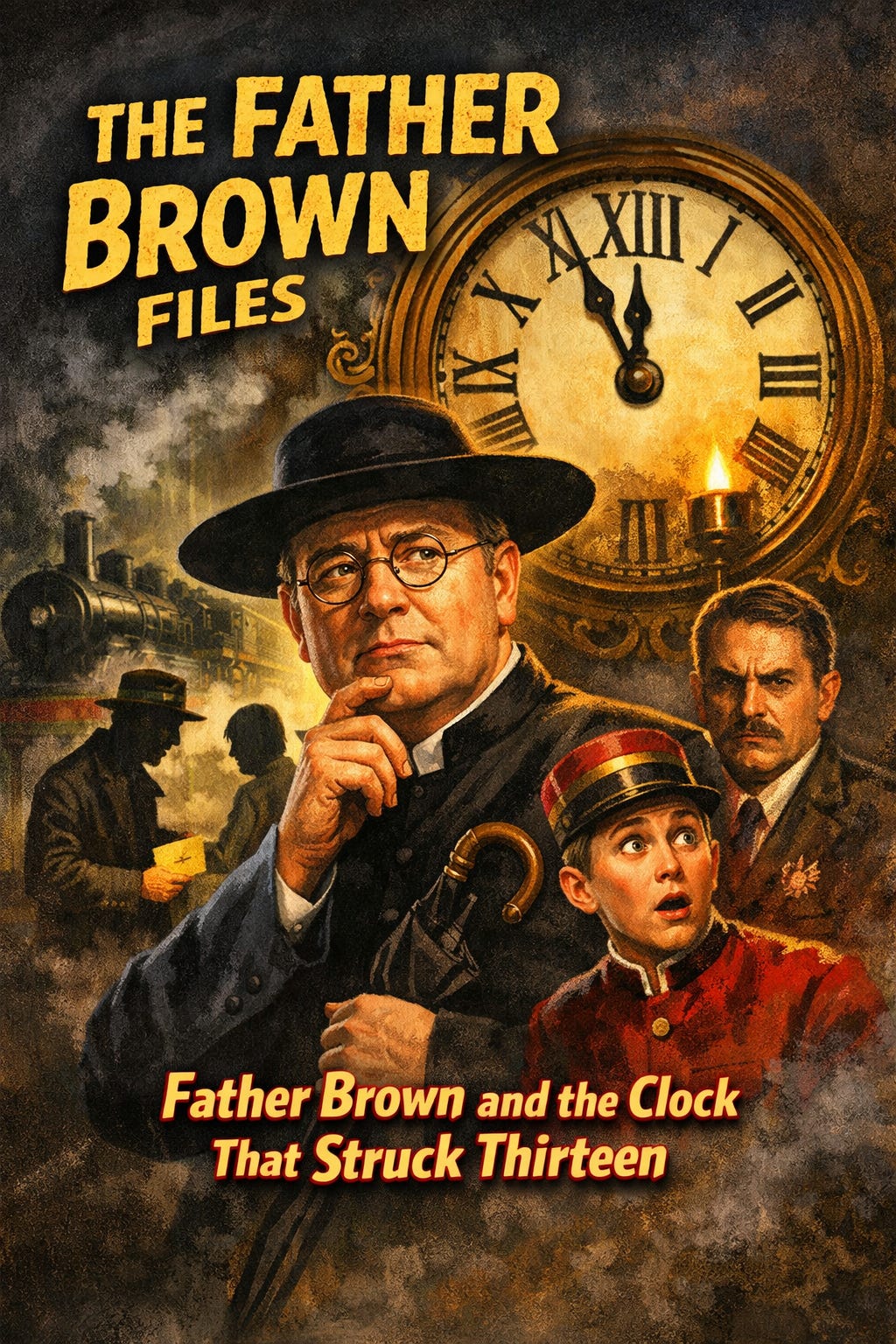
Father Brown and the Clock That Struck Thirteen
Father Brown disliked modern hotels. They seemed to him like large, polite machines designed to process human beings without ever truly meeting them. The Grand Imperial at Harborough was a shining example. It had electric lights too bright for comfort, carpets too thick for honesty, and a staff so efficient that one could vanish in it like a letter misfiled.
Father Brown had only come because Mrs. McArdle, a widow from his parish, had begged him to escort her to the town. She was visiting her nephew, a clerk in the railway office, and had declared that “one shouldn’t travel alone at my age unless one is a bishop or a bandit.”
So the priest found himself seated in a tall leather chair near the lobby clock — an enormous brass contraption mounted on the wall, with Roman numerals and a pendulum like a slow, golden sigh. It ticked with the solemnity of a judge.
“It’s a famous clock, Father,” said Mrs. McArdle, who had just finished a determined struggle with her teacup. “They say it’s never wrong.”
“That is a very alarming reputation for a clock,” said Father Brown mildly. “It suggests no one has ever dared contradict it.”
Just then, a small commotion rippled through the lobby. A gentleman with a dark moustache and a face shaped by permanent dissatisfaction was arguing with the hotel manager, a smooth man with silver hair and an expression of permanent apology.
“I tell you, sir, my room was locked,” snapped the moustached man. “Locked from the inside. My papers are gone.”
“Mr. Crayle,” said the manager soothingly, “we will of course investigate. But perhaps you mislaid—”
“I do not mislay state contracts!” roared Mr. Crayle. “I am here on government business.”
Father Brown glanced up, interested. Government business had a way of producing sins that required unusually tidy waistcoats.
The manager turned and saw the priest watching.
“Ah—Father,” he said, relieved. “Perhaps you might help calm our guest. He seems to think—well—he thinks something impossible has happened.”
Father Brown rose with a gentle creak.
“Impossible things are my speciality,” he said. “They usually turn out to be merely improbable — which is much more dangerous.”
The Locked Room
Mr. Crayle’s room was on the third floor, overlooking the railway yard. The bed was neatly made. The window was closed. A writing desk stood by the wall, its drawers open like empty mouths.
“My briefcase was here,” said Crayle, pointing. “Locked. The key was in my pocket. Inside were confidential bidding figures for a steel contract. Gone.”
“Was anything else taken?” asked Father Brown.
“No. Just the papers.”
The manager hovered.
“No sign of forced entry,” he said. “And the chambermaid swears she never entered after morning service.”
Father Brown wandered to the window and peered out.
“A fine view of the railway,” he murmured. “One could almost escape by train without leaving the building.”
Crayle stared at him.
“I beg your pardon?”
“Nothing,” said Father Brown cheerfully. “Just admiring the efficiency of modern life.”
He walked to the door.
“Who has keys to this room?”
“Only the guest and the front desk,” said the manager.
“And the chambermaid?” asked Father Brown.
“She has a passkey, but she insists—”
Father Brown nodded.
“Everyone insists,” he said. “That is why God invented questions.”
The Witnesses
They interviewed the staff in a small sitting room.
The chambermaid, a pale girl named Elsie, twisted her apron.
“I never went in after ten, sir. I was polishing the banister outside when I heard the clock strike twelve.”
“The big clock downstairs?” asked Father Brown.
“Yes, sir. Loud as a church bell.”
The bellboy, a freckled youth with eager eyes, nodded vigorously.
“I heard it too, Father. Twelve clear chimes.”
Mr. Crayle frowned.
“I left the hotel at eleven-thirty and returned at twelve-fifteen. My papers were gone when I came back.”
“So the theft happened,” said Father Brown, “between half past eleven and a quarter past twelve.”
“Exactly,” said Crayle.
Father Brown tilted his head.
“That is a very exact sort of robbery.”
The Clock
Back in the lobby, Father Brown stood beneath the great clock. He listened to its tick.
“Do you trust this clock?” he asked the manager.
“Entirely,” said the manager. “It has not lost a minute in twenty years.”
“Ah,” said Father Brown. “That is worse than being wrong. It means it is proud.”
Just then, the clock struck one.
It struck once. Then twice. Then three times.
Then, unexpectedly, it struck a fourth.
A murmur went through the lobby.
“That’s odd,” said the bellboy.
The clock continued. Five. Six. Seven.
At twelve, it paused.
Then it struck again.
Thirteen.
Silence fell.
The manager stared upward in horror.
“It’s never done that before.”
Father Brown looked pleased.
“It is a very honest clock,” he said. “It confesses its sins eventually.”
The Revelation
They gathered again in Mr. Crayle’s room. The manager, the bellboy, Elsie the maid, and Crayle himself.
Father Brown stood by the desk.
“The crime was not impossible,” he began. “It was merely mechanical.”
Crayle bristled.
“Are you accusing someone of using machinery to steal my papers?”
“In a sense,” said Father Brown. “But not machinery of steel. Machinery of time.”
He turned to the manager.
“Your famous clock does not keep perfect time. It runs fast.”
“Impossible!”
“It struck thirteen just now,” said Father Brown. “Because it had already crept past one. It is always a little ahead.”
He faced Crayle.
“You left at eleven-thirty by your watch. But by the hotel clock, it was already nearly noon.”
Crayle’s face hardened.
“That proves nothing.”
“Oh yes it does,” said Father Brown gently. “You arranged to meet your competitor at the railway yard at noon — real noon — to sell him the bidding figures. But you told everyone you returned at twelve-fifteen, by your watch. In truth, by the hotel clock, it was nearly one.”
The room went very still.
“You stole your own papers,” Father Brown went on, “and staged the locked-room mystery to hide the sale. You knew the clock ran fast. You relied on it.”
Crayle laughed harshly.
“Ridiculous.”
“Then why,” said Father Brown quietly, “did you complain so loudly about a locked door instead of the loss itself? A man robbed by others fears thieves. A man robbing himself fears witnesses.”
Crayle lunged for the door, but the bellboy had already blocked it with surprising bravery.
The Moral of the Clock
Later, as Mrs. McArdle prepared to retire, she shook her head.
“All that over a clock being wrong,” she said.
“Oh, the clock was right,” said Father Brown. “It told the truth eventually.”
“But why did he do it?” she asked. “He seemed a respectable man.”
Father Brown looked up at the pendulum swinging below.
“Because he believed time was money,” he said. “So he tried to steal time itself — by lying about it. But time belongs to God, and He has a way of striking thirteen when we least expect it.”
Mrs. McArdle blinked.
“I’ll stick to knitting,” she said.
Father Brown smiled and watched the pendulum swing, like a slow, golden sigh measuring not hours, but consciences.
📻 About Chesterton Radio
Chesterton Radio is a listener-supported storytelling channel devoted to classic radio drama, timeless literature, and the wit and wisdom of G.K. Chesterton and friends. We bring the golden age of imagination back to life — one mystery, one adventure, one reflection at a time.
You can also listen anytime to The Open Door, our gentle 24/7 live stream of stories, music, and companionable sound, at Listen.ChestertonRadio.com.
If you enjoy these stories, consider supporting our work and helping us keep great storytelling on the air.
Series Note
The Father Brown Files is an original series of mysteries written in the spirit of the Father Brown stories by G. K. Chesterton. These stories are new works created by Chesterton Radio and are not part of Chesterton’s original canon.
The character Father Brown was created by G. K. Chesterton. Any additional recurring characters, plots, and situations in this series are original to Chesterton Radio.
© 2026 Chesterton Radio. This is an original story written in the spirit of G.K. Chesterton’s Father Brown mysteries. Father Brown was created by G.K. Chesterton.