

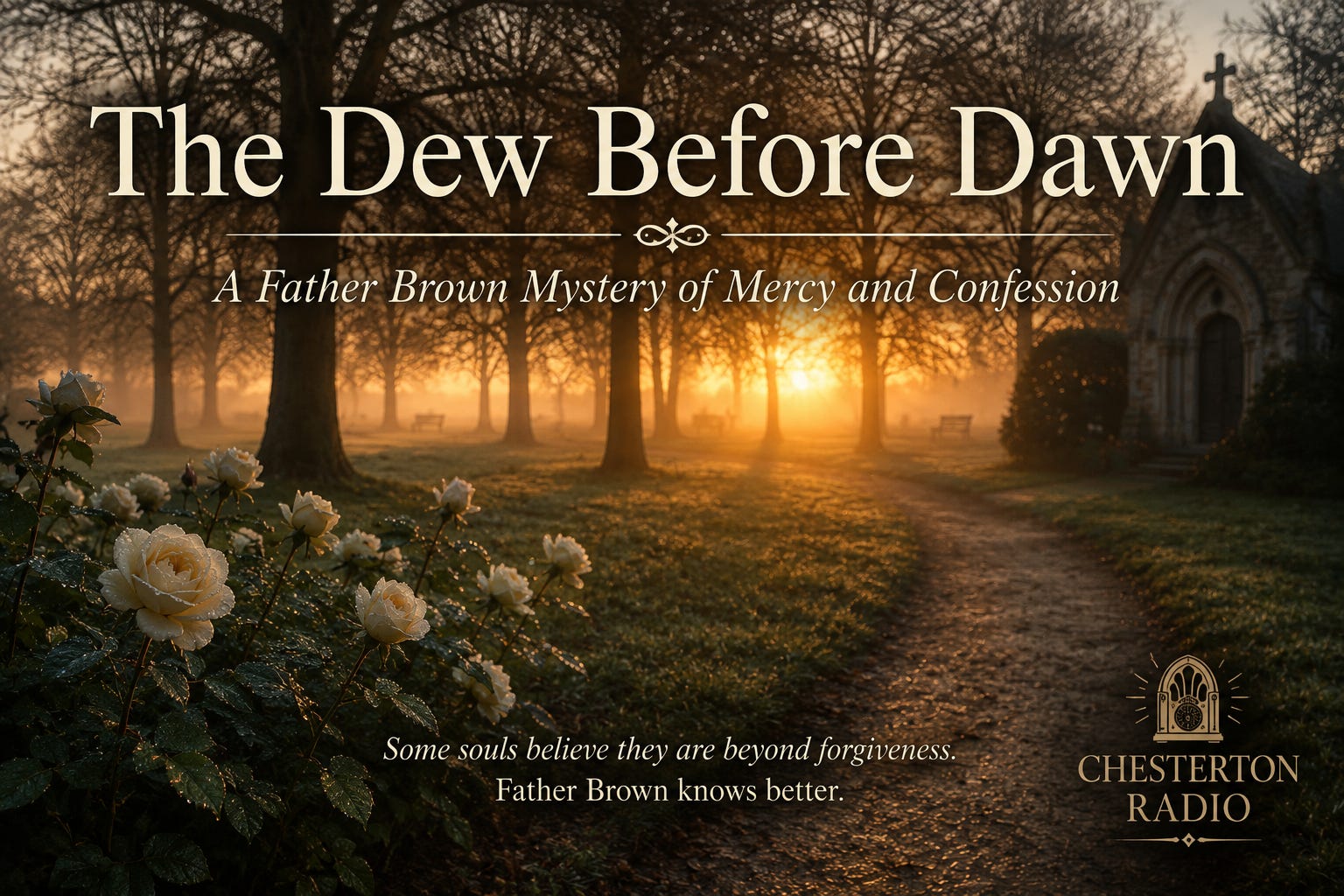
Part One – The Garden Before Sunrise
The village of St. Anselm always belonged to the birds before it belonged to men.
Long before the baker opened his shutters or the blacksmith struck his first blow upon the anvil, the air was already alive with robins, blackbirds, and the gentle cooing of wood pigeons hidden among the ancient elms. A light mist drifted across the fields beyond the churchyard, softening every hedge and stone wall until the whole countryside seemed less like England than a memory of Eden.
Father Brown enjoyed this hour more than any other.
He had already finished Morning Prayer in the little stone church, where the candles still flickered before the sanctuary lamp. The familiar psalms lingered pleasantly in his mind.
“Create in me a clean heart, O God.”
It was one of those verses that could never become ordinary. Like sunlight through stained glass, it appeared different every time one looked upon it.
The little priest walked slowly along the lane, his umbrella tucked beneath one arm despite the clear sky. He carried no particular destination in mind. He often said that one could not properly discover God’s surprises by hurrying toward them.
The village itself seemed washed clean.
Every blade of grass carried a bead of dew. Spider webs stretched between rose bushes like silver lace. The ancient yew beside the church shimmered as though adorned with tiny stars.
Father Brown smiled.
“There is something wonderfully extravagant about dew,” he murmured. “No one asks for it. No one earns it. Yet every morning the whole world receives it.”
His reflection was interrupted by hurried footsteps.
The church sexton, Mr. Alfred Briggs, was running toward him in obvious distress. Running was something Mr. Briggs regarded as nearly sinful unless a building happened to be on fire.
“Father!” he gasped. “Thank heaven I’ve found you.”
Father Brown removed his spectacles and polished them quietly.
“I hope nothing has happened to the church.”
“No... no, Father... it’s Ashcombe Hall.”
The priest’s expression became attentive.
“What has happened there?”
“It’s Mr. Edmund Ashcombe.”
“The gardener?”
“The owner, Father. Sir Edmund himself.”
Briggs lowered his voice.
“They’ve found him dead.”
Ashcombe Hall stood upon a gentle rise overlooking the village, surrounded by formal gardens famous throughout the county. Tourists occasionally visited simply to admire the rose terraces and the remarkable cedar tree planted, according to family legend, during the reign of Queen Anne.
Sir Edmund loved the gardens far more than the great house.
Though wealthy enough to employ half a dozen gardeners, he insisted upon tending his favorite beds himself every morning before breakfast. Villagers often saw him carrying pruning shears while still wearing an old tweed jacket that had become almost as celebrated as the roses.
“He always said flowers told the truth,” Mrs. McCarthy remarked as she hurried beside Father Brown toward the estate.
“And did they?” Father Brown asked.
“They never argued with him.”
When they reached the gardens, Inspector Mallory was already there, directing two constables with brisk efficiency.
The inspector greeted Father Brown with the resigned expression of a man who suspected mysteries became more complicated whenever priests arrived.
“I suppose you’ve heard.”
“I have.”
“It appears to be natural causes.”
Father Brown nodded.
“So everyone keeps telling me.”
Mallory looked mildly annoyed.
“Because it is.”
He led the priest through the rose garden.
Morning sunlight had only just begun to reach the eastern beds. Hundreds of blossoms still glittered beneath the dew.
Beneath the great cedar tree lay Sir Edmund Ashcombe.
He rested upon the grass almost peacefully, one hand across his chest and the other lying open beside him. His gardening basket had fallen only a few feet away. Pruning shears remained neatly folded inside.
“It appears he collapsed while working,” Mallory explained. “Dr. Henderson believes his heart simply failed.”
Father Brown remained silent.
The inspector continued.
“No signs of struggle.”
“No missing property.”
“No wounds.”
“No footprints besides his own.”
“The ground is too wet for anyone to have approached unnoticed.”
He sounded quietly satisfied.
“A sad business, certainly, but hardly mysterious.”
Father Brown knelt beside the body.
For nearly a minute he said nothing.
Then he gently lifted Sir Edmund’s open hand.
His brow furrowed.
He examined the fingertips.
Turned the palm over.
Then looked toward the flower beds.
“What is it?” Mallory asked.
Father Brown did not answer immediately.
Instead he glanced at the roses.
Then at the overturned basket.
Then once more at the dead man’s hands.
Finally he stood.
“Inspector...”
“Yes?”
“Would you indulge a rather foolish question?”
Mallory sighed.
“I’ve learned they are rarely foolish.”
Father Brown looked down at the motionless gardener.
“Why,” he asked softly, “are Sir Edmund’s hands perfectly clean?”
The inspector blinked.
Father Brown continued almost to himself.
“He has been gardening before sunrise.”
“The roses have been pruned.”
“The basket has fresh cuttings.”
“The earth is still damp.”
“And yet...”
He gently closed the dead man’s hand.
“...there is not the smallest trace of soil beneath his fingernails.”
The morning breeze stirred the cedar branches overhead.
Somewhere in the garden, a robin began to sing.
For the first time that morning, Inspector Mallory no longer believed he was looking at the scene of a natural death.
Father Brown and the Dew Before Dawn
Part Two – The House of Hidden Hearts
Ashcombe Hall was a curious mixture of grandeur and neglect.
Its stone façade still possessed the dignity of another century, yet the ivy had begun to claim one wing, and several windows remained shuttered despite the brightness of the morning. The gardens flourished because Sir Edmund had loved them. The house endured only because generations before him had built it well.
Inspector Mallory removed his hat as he entered.
“The family is assembled in the drawing room,” he said. “I have asked everyone to remain until we’ve spoken with them.”
Father Brown nodded, though his attention seemed elsewhere.
He paused beside the entrance table.
There lay Sir Edmund’s walking stick.
His broad-brimmed gardening hat.
A pair of heavy leather gloves.
Father Brown picked up one glove.
It was dry.
He smiled faintly to himself.
“Curious.”
“What is?”
“Most gardeners wear gloves to protect their roses.”
Mallory shrugged.
“He often worked without them.”
“So I have heard.”
The priest replaced the glove exactly where he had found it.
“I wonder why today was different.”
The drawing room was filled with the peculiar silence that follows sudden tragedy.
No one spoke above a whisper.
No one appeared entirely comfortable sitting down.
Sir Edmund’s only son, Jonathan Ashcombe, stood near the fireplace, staring into ashes that had long since grown cold. He was a handsome man in his early forties, impeccably dressed despite the early hour.
Nearby sat Mrs. Eleanor Graves, the housekeeper, whose service to the Ashcombe family stretched back nearly thirty years.
At the window stood Mr. Charles Fenwick, a prosperous developer whose company had spent months attempting to purchase a portion of the estate.
Finally there was Miss Clara Evans, Sir Edmund’s young secretary, her eyes red from weeping.
Mallory cleared his throat.
“I’m afraid I must ask each of you a number of questions.”
Jonathan answered first.
“My father rose every morning at half past five.”
“Always alone?”
“Always.”
“You saw him today?”
“No.”
“When did you last speak with him?”
“Last evening.”
“About?”
Jonathan hesitated.
“We argued.”
The room became noticeably quieter.
“Over what?” Mallory asked.
“The estate.”
He spoke without embarrassment.
“The house is expensive to maintain. Mr. Fenwick has made a generous offer for the western gardens.”
Father Brown looked up.
“The rose gardens?”
Jonathan nodded.
“They occupy nearly twelve acres.”
“And your father refused?”
“He said some things were not for sale.”
Mr. Fenwick folded his arms.
“He was sentimental.”
Father Brown smiled pleasantly.
“There are worse faults.”
Mrs. Graves proved more difficult.
She answered every question precisely.
Almost too precisely.
“Sir Edmund was kind.”
“He attended church.”
“He paid his workers fairly.”
“He loved his roses.”
Everything she said was true.
Yet Father Brown had the odd impression that every truthful sentence was carefully arranged to avoid another truth entirely.
As she rose to leave, something slipped from the pocket of her apron.
A folded page.
Father Brown stooped to retrieve it.
It was a single sheet from a small prayer book.
Only half remained.
The top portion had been torn away.
Visible upon the page were the words:
“Have mercy upon me...”
The remainder of the prayer had vanished with the missing half.
Mrs. Graves quickly accepted it.
“Thank you, Father.”
“You dropped this.”
“Yes.”
Her hands trembled slightly.
“It belonged to my husband.”
“I’m sorry.”
“So am I.”
She tucked the page away almost hurriedly before leaving the room.
Mallory frowned.
“Does that strike you as strange?”
“No.”
“It doesn’t?”
Father Brown smiled gently.
“Only sad.”
Mr. Fenwick possessed the confidence of a man accustomed to buying whatever interested him.
“I offered Sir Edmund twice the market value.”
“And he still refused?” Father Brown asked.
“He said beauty cannot be valued by surveyors.”
The priest chuckled.
“That sounds very much like him.”
Fenwick leaned forward.
“Father, surely you understand progress?”
“I hope so.”
“The village needs housing.”
“It probably does.”
“The gardens accomplish nothing.”
Father Brown looked toward the open window.
Outside, bees moved lazily among the lavender.
A butterfly settled upon a white rose.
“I wonder,” he said quietly, “whether they would agree.”
Fenwick frowned.
“I’m speaking seriously.”
“So am I.”
Miss Clara Evans remained until last.
She seemed scarcely older than twenty-five.
“I found him.”
Father Brown’s voice became softer.
“Would you tell us what happened?”
“I brought him the morning correspondence.”
She clasped her hands tightly together.
“He liked to read letters while walking through the gardens.”
“What time?”
“A little after six.”
“And then?”
“I saw the basket first.”
Her voice faltered.
“Then...”
She closed her eyes.
“I knew.”
Father Brown allowed several moments to pass.
“You cared for Sir Edmund.”
She nodded.
“He was the first employer who treated me as though my opinions mattered.”
Tears filled her eyes once more.
“I shall miss him terribly.”
Father Brown reached into his pocket and quietly handed her a clean handkerchief.
“There is another question,” he said.
She looked at him uncertainly.
“Did Sir Edmund pray?”
She seemed surprised.
“Every morning.”
“Before gardening?”
“No.”
“After.”
“He always said tending the roses prepared him to speak honestly with God.”
The priest’s eyes brightened almost imperceptibly.
“And where did he pray?”
“In the little garden chapel.”
Father Brown turned immediately toward Inspector Mallory.
“The chapel.”
Mallory blinked.
“You think something happened there?”
“I don’t know.”
“But I believe we have been looking at the wrong beginning.”
The garden chapel stood only a short walk beyond the cedar tree.
It was scarcely larger than a toolshed, built generations earlier as a place of quiet devotion. A simple wooden cross hung above the door.
Everything inside appeared untouched.
A worn kneeler.
A small table.
A Bible.
A leather-bound prayer book.
Father Brown picked it up.
Most of its pages were intact.
Except one.
One page had been carefully torn out.
He compared the rough edge with the memory of the fragment Mrs. Graves had dropped.
It matched perfectly.
Mallory stared.
“What prayer was missing?”
Father Brown slowly turned the book until he reached the torn section.
The following page began in the middle of a familiar sentence.
“...create in me a clean heart, O God, and renew a right spirit within me.”
The beginning of the prayer—the part asking for mercy—was gone.
Father Brown closed the book gently.
“It is a dangerous thing,” he said almost to himself, “when someone wishes to keep renewal while tearing away mercy.”
Outside, the chapel bell gave a single quiet note in the morning breeze.
Father Brown looked once more toward the rose garden.
The mystery, he realized, had not begun beneath the cedar tree.
It had begun here—
In a place built for confession.
And someone had tried very carefully to remove the first words of forgiveness.
Father Brown and the Dew Before Dawn
Part Three – The Weight of Mercy
Inspector Mallory disliked loose ends.
By noon he had dispatched constables throughout the village, collected statements from the servants, and requested Dr. Henderson’s formal report. Everything proceeded with the reassuring order expected of a proper investigation.
Everything, that is, except Father Brown.
The little priest seemed to be investigating something entirely different.
Instead of examining footprints or questioning servants, he wandered slowly through the village, greeting people as though it were any ordinary Friday. He stopped to admire a baker’s window, complimented a child on a carefully carved toy boat, and paused long enough to watch an elderly woman scatter crumbs for sparrows.
To anyone observing him, he appeared delightfully distracted.
Only Inspector Mallory had learned that Father Brown usually looked most distracted when he was paying the closest attention.
His first stop was the cottage of Mrs. Agnes Porter.
She had arranged flowers in the church every Saturday for nearly forty years.
“Father!” she exclaimed. “I heard about Sir Edmund.”
“So has everyone.”
She shook her head sadly.
“He never passed the church without bringing flowers.”
“I didn’t know that.”
“Oh, yes.”
She smiled at the memory.
“Always the imperfect blooms.”
“The imperfect ones?”
“He said the finest roses belonged in the gardens.”
“And the bruised ones?”
“They belonged before the altar.”
Father Brown laughed softly.
“That sounds exactly like him.”
Mrs. Porter became thoughtful.
“He once told me that God had a peculiar fondness for damaged things.”
The priest remained silent.
It was not a remark one easily forgot.
From there he walked to the village blacksmith.
Thomas Wilkes had known Sir Edmund since childhood.
“Fine gentleman,” Wilkes said, laying aside his hammer.
“Honest?”
“As the day is long.”
“Proud?”
The blacksmith smiled.
“Sometimes.”
“But only about the roses.”
“And people?”
Wilkes leaned against the forge.
“He forgave too easily.”
Father Brown looked up.
“Too easily?”
“Some thought so.”
The blacksmith lowered his voice.
“There were folk who took advantage.”
“Did Sir Edmund mind?”
“He always said that being cheated was cheaper than becoming bitter.”
Father Brown nodded slowly.
“A costly lesson.”
“The cheapest one there is.”
That afternoon Father Brown returned to Ashcombe Hall.
The great cedar cast a broad shadow across the lawn where Sir Edmund had been found.
The body had been removed.
Only the flattened grass remained.
Father Brown stood quietly beneath the branches.
Then, instead of looking down, he looked up.
High among the limbs, a rook was industriously building its nest.
The priest smiled.
“Very sensible.”
Inspector Mallory approached.
“I’ve been looking everywhere for you.”
“I was watching architecture.”
“The bird?”
“It seems happier than most architects.”
Mallory chose not to answer.
“The doctor has finished.”
“And?”
“He is puzzled.”
Father Brown looked interested.
“There was no heart attack.”
“No?”
“No stroke either.”
The inspector folded his arms.
“There are traces of a rare cardiac poison.”
Father Brown nodded.
“I thought there might be.”
“You did?”
“I only knew Sir Edmund had not died naturally.”
Mallory frowned.
“Why didn’t you say so?”
“Because I didn’t yet know how he had died.”
“There is a difference.”
They walked together toward the greenhouse.
Mallory spoke first.
“The poison acts slowly.”
“So the doctor says.”
“It could have been taken an hour before death.”
“Perhaps longer.”
The inspector stopped.
“Which means the murderer could have been almost anywhere.”
Father Brown looked thoughtfully at the glasshouse.
“Not almost anywhere.”
“No?”
“No.”
“He had breakfast with no one.”
“He walked alone.”
“He entered the gardens alone.”
“The poison narrows the time.”
“It does not widen it.”
Mallory rubbed his forehead.
“I sometimes feel you solve mysteries by making them more complicated.”
Father Brown smiled.
“I try to make them more truthful.”
Inside the greenhouse grew hundreds of young rose plants.
Each was carefully labeled in Sir Edmund’s neat handwriting.
Father Brown examined them with unexpected interest.
One label caught his eye.
Misericordia
He turned to the head gardener, Mr. Collins.
“I don’t recognize the name.”
“It isn’t an official variety.”
“No?”
“Sir Edmund was developing it himself.”
“What sort of rose was it to be?”
Collins smiled sadly.
“Pure white.”
The gardener touched one unopened bud.
“He intended to name it Mercy.”
Father Brown remained silent.
“He said every great garden deserved one flower that reminded people forgiveness is more beautiful than perfection.”
The priest gently touched the unopened bloom.
“And was it finished?”
“Not yet.”
“It still has no registered name.”
Father Brown looked at the unopened petals.
“Perhaps that is fitting.”
Late in the afternoon he visited the little garden chapel once more.
The torn prayer book still rested where he had left it.
This time he noticed something else.
The kneeler.
Its cushion showed fresh impressions.
Not one pair.
Two.
Someone besides Sir Edmund had prayed there that morning.
He knelt carefully.
The impressions faced one another.
Not side by side.
As though two people had spoken.
Or confessed.
Father Brown closed his eyes.
He could almost hear the silence that had filled the tiny room only hours before.
Not an empty silence.
The sort that exists after someone has finally told the truth.
When he emerged, he found Mrs. Graves standing outside.
She seemed neither surprised nor alarmed to see him.
“I thought you might come.”
“I hoped you might.”
She clasped her hands tightly.
“You know about the torn page.”
“I do.”
“It wasn’t Sir Edmund.”
“I never believed it was.”
Her shoulders relaxed slightly.
“He would never remove the words about mercy.”
“No.”
“He needed them too much.”
Mrs. Graves looked toward the gardens.
“He carried guilt all his life.”
“For what?”
She hesitated.
“For surviving.”
Father Brown said nothing.
“My husband died during the war.”
She swallowed hard.
“Sir Edmund believed it should have been him.”
The priest looked at her gently.
“That is a very common sin.”
She seemed startled.
“A sin?”
“Yes.”
“We imagine ourselves wiser than Providence.”
Tears formed in her eyes.
“He spent thirty years trying to deserve being alive.”
“And never discovered he already did.”
Mrs. Graves covered her face.
“I should have told him.”
“Told him what?”
“That God had forgiven him long before he forgave himself.”
The words seemed to empty years of sorrow from her heart.
Father Brown waited patiently.
After a long silence she whispered another sentence.
“I wasn’t the last person to see him alive.”
The priest’s eyes lifted quietly.
“No?”
She shook her head.
“There was someone in the chapel.”
“Who?”
Mrs. Graves looked toward Ashcombe Hall.
“I promised.”
“You promised a man.”
“Yes.”
“But not God.”
She closed her eyes.
“No.”
Father Brown spoke almost in a whisper.
“The truth does not become betrayal simply because it is painful.”
Mrs. Graves drew a long, trembling breath.
Then she looked directly at him.
“The last person to speak with Sir Edmund...”
She paused.
“...was his son.”
At that very moment, from somewhere inside the Hall, came the sharp crash of breaking glass.
Inspector Mallory’s voice echoed through the open windows.
“Father Brown!”
The little priest turned immediately toward the house.
Whatever had just happened, the murderer had realized something.
And frightened people often made the first real mistake of their lives.
Father Brown and the Dew Before Dawn
Part Four – The Prayer That Was Torn Away
The sound of breaking glass echoed through Ashcombe Hall like a pistol shot.
Inspector Mallory reached the library first.
A tall window stood open.
Its lower pane had shattered inward, scattering fragments across the Persian carpet. One of the servants, pale with fright, pointed toward the gardens.
“I only stepped away for a moment,” he stammered. “When I returned...”
“What was taken?” Mallory demanded.
The servant looked around the room.
“I... I don’t know.”
Father Brown entered more slowly.
He ignored the broken window.
He ignored the muddy footprints on the sill.
Instead, he walked directly to Sir Edmund’s writing desk.
Several drawers had been opened hurriedly.
Letters lay scattered across the polished oak surface.
An ink bottle had been overturned.
Yet one object remained precisely where it belonged.
A small silver crucifix.
Father Brown smiled almost sadly.
“The thief was in a hurry.”
Mallory looked up.
“Or wanted us to think so.”
“Quite.”
The inspector knelt beside the broken glass.
“There are footprints outside.”
“So there are.”
“They lead toward the old orchard.”
Father Brown nodded.
“And yet I do not believe our visitor escaped through the window.”
Mallory stared.
“The glass is inside the room.”
“Exactly.”
The priest picked up one tiny fragment.
“If someone broke in, much of the glass should be outside.”
Instead, nearly every piece lay at their feet.
“It appears,” Father Brown said quietly, “that someone inside wished us to believe someone had come from outside.”
The library overlooked the formal gardens.
From its windows Sir Edmund could watch the roses through every season.
Father Brown wandered slowly along the shelves.
Books on botany.
Church history.
Poetry.
A well-thumbed volume of Pascal.
Another by Chesterton.
Then, between two gardening manuals, he noticed something curious.
A slim leather notebook.
Its cover bore no title.
Inside were not accounts or gardening notes, but names.
Dozens of names.
Beside each was a short sentence.
“Loan forgiven.”
“Debt cancelled.”
“Rent postponed.”
“Widow assisted anonymously.”
“School fees paid.”
No amounts.
No signatures.
Only quiet acts of mercy.
Father Brown turned another page.
Near the end was written:
“Mercy is safest when forgotten by everyone except God.”
The priest closed the notebook without another word.
Jonathan Ashcombe was waiting in the conservatory.
“You wanted to see me?”
Father Brown smiled.
“I merely hoped we might walk.”
They strolled slowly beneath climbing roses.
Neither spoke for several moments.
Finally Jonathan broke the silence.
“You think I killed my father.”
“I think you loved him.”
Jonathan gave a bitter laugh.
“Those are not the same thing.”
“No.”
“They often become confused.”
The younger man stopped beside a marble fountain.
“My father never understood me.”
“Perhaps.”
“He loved flowers more than business.”
“That is true.”
“He would rather save a rose garden than secure the family’s future.”
Father Brown looked at the water rippling quietly in the basin.
“And what would you rather save?”
Jonathan did not answer.
After a long pause he asked,
“Do you believe people can change?”
Father Brown looked genuinely surprised.
“Of course.”
“Completely?”
“No.”
Jonathan frowned.
“No?”
“We become more truly ourselves.”
The priest smiled.
“Grace does not replace a man.”
“It teaches him who he was meant to be.”
Later that afternoon, Father Brown returned alone to the little chapel.
The torn prayer book still rested upon the table.
He opened another copy from the church for comparison.
The missing page contained more than the beginning of Psalm Fifty-One.
It also included the prayer appointed for that morning.
“Lord, you do not despise the broken and contrite heart.”
He looked thoughtfully at the empty space.
Whoever removed the page had not merely hidden words.
They had hidden an idea.
The idea that repentance is answered with mercy.
He folded the two books together.
Then something slipped from between their covers.
A pressed white rose petal.
Almost translucent with age.
On its back, in Sir Edmund’s unmistakable handwriting, were four words.
“After confession, plant mercy.”
Father Brown read the sentence again.
Then again.
At first it sounded like gardening advice.
Then it sounded like theology.
Finally, it sounded like a confession.
As evening approached, Father Brown found Mrs. McCarthy arranging flowers in the church.
She immediately noticed his expression.
“You’ve discovered something.”
“I’ve discovered someone.”
“The murderer?”
“No.”
“The victim.”
She looked puzzled.
“I thought we knew him.”
“I don’t believe anyone did.”
He sat quietly in the front pew.
“Everyone admired Sir Edmund.”
“Some envied him.”
“A few disliked him.”
“But almost no one understood him.”
Mrs. McCarthy waited.
“He had spent years quietly repairing lives.”
“Without anyone knowing.”
She smiled.
“That sounds like a Christian.”
“It sounds,” Father Brown replied gently, “like a man who had learned that gratitude is best expressed in secret.”
The old housekeeper nodded thoughtfully.
“And what has that to do with murder?”
Father Brown looked toward the crucifix above the altar.
“Everything.”
“The murderer did not hate Sir Edmund because he was cruel.”
“He hated him because mercy is unbearable to someone who refuses it.”
That night Inspector Mallory arrived at the presbytery carrying an envelope.
“The laboratory report.”
Father Brown accepted it.
“The poison was mixed into tea.”
“Tea?”
“The residue was found in the cup recovered from the garden chapel.”
Father Brown looked up immediately.
“The chapel.”
“Yes.”
“The doctor estimates Sir Edmund drank it no more than thirty minutes before he died.”
Mallory sat heavily in the chair.
“So whoever met him there shared tea.”
“And conversation.”
“And perhaps confession.”
The inspector sighed.
“I still cannot understand why anyone would poison a man in the middle of a prayer.”
Father Brown was silent for so long that Mallory wondered if he had heard.
Finally the little priest spoke.
“Inspector...”
“Yes?”
“People rarely choose to murder during prayer.”
“They choose to murder because prayer has brought them to the edge of truth.”
He folded the report and placed it carefully beside his breviary.
“I believe I know what happened in that chapel.”
Mallory leaned forward.
“You know who did it?”
Father Brown shook his head.
“Not yet.”
“I know something far more important.”
“What?”
The priest’s face was filled not with triumph, but with sadness.
“I know what Sir Edmund said with his last living words.”
Outside, the church bell began to ring for Evening Prayer.
Father Brown rose slowly.
“The tragedy is not that a man died after speaking of forgiveness.”
He reached for his hat.
“The tragedy is that someone heard those words...”
“...and believed they could never apply to them.”
Father Brown and the Dew Before Dawn
Part Five – The White Rose
The following morning dawned much as the last had.
Again the fields shimmered beneath a veil of silver dew.
Again the birds greeted the sunrise before the church bells.
Again Father Brown completed Morning Prayer while the village still slept.
But today one sentence lingered in his thoughts longer than the others.
“The steadfast love of the Lord is new every morning.”
He closed the breviary slowly.
“There is the difficulty,” he murmured.
“God insists upon beginning again.”
Inspector Mallory was waiting outside the church.
“I’ve hardly slept.”
“Neither have I.”
“You’ve solved it, haven’t you?”
Father Brown adjusted his battered hat.
“I believe I have understood it.”
“The same thing.”
“Oh, no.”
“The first is much harder.”
They walked together toward Ashcombe Hall.
The morning mist still lay among the rose beds.
Mallory broke the silence.
“I’ve questioned everyone again.”
“And?”
“No contradictions.”
“No confessions.”
“No new evidence.”
Father Brown smiled.
“On the contrary.”
“We have been surrounded by evidence from the beginning.”
The inspector sighed.
“I was afraid you might say that.”
The little chapel stood open.
Someone had placed fresh flowers upon the tiny altar.
Not red roses.
White ones.
Father Brown recognized them immediately.
“Misericordia.”
The unfinished rose.
The rose Sir Edmund had hoped to name Mercy.
Only one blossom had opened during the night.
Its petals were almost impossibly white.
Father Brown gazed at it for a long while.
“Beautiful, isn’t it?”
Mallory looked puzzled.
“It’s only a flower.”
“No.”
“It is a sermon.”
The priest knelt once more at the worn prayer bench.
The impressions left by two people had almost disappeared.
Yet in his imagination they became perfectly clear.
He could almost hear the conversation.
Sir Edmund speaking quietly.
Another voice burdened with fear.
A confession.
Not made to a priest.
Made to a friend.
Then tea.
Then forgiveness.
Then betrayal.
Father Brown stood.
“It happened almost exactly here.”
Mallory looked around the tiny chapel.
“You can see it?”
“I can understand it.”
“There is a difference.”
They returned to the Hall.
Jonathan Ashcombe stood alone in the rose garden.
He looked older than he had the previous day.
“You wished to speak with me, Father?”
“I wished to ask you one question.”
Jonathan nodded.
“Did your father ever disappoint you?”
The younger man laughed sadly.
“Frequently.”
“How?”
“He forgave people.”
Father Brown waited.
“He forgave men who cheated him.”
“He forgave relatives who insulted him.”
“He forgave servants who stole.”
“He even forgave me.”
His voice nearly broke.
“I hated that.”
“Why?”
“Because it meant he always believed I could become better.”
Silence settled between them.
Jonathan finally whispered,
“I was tired of being believed in.”
Father Brown regarded him with immense kindness.
“My dear boy...”
“...that is the saddest thing I have heard in many years.”
Late that afternoon Mrs. Graves appeared at the presbytery.
She carried a small wooden box.
“I found this while cleaning Sir Edmund’s desk.”
Inside lay dozens of envelopes.
Each bore only a name.
None had been mailed.
Father Brown opened one.
Inside was a single handwritten sentence.
“If ever you believe yourself beyond forgiveness, please come and speak with me before doing anything foolish.”
He opened another.
Different handwriting.
Different recipient.
The same promise.
Mrs. Graves wiped away a tear.
“He wrote them over many years.”
“He never sent them.”
“No.”
“He preferred speaking face to face.”
Father Brown nodded.
“He understood that mercy is difficult to seal inside an envelope.”
Then something caught his eye.
At the bottom of the box lay one final envelope.
It had never been addressed.
Inside was only a pressed white rose petal.
And one sentence.
“The first thing forgiveness restores is hope.”
Father Brown closed his eyes.
“There it is.”
Mrs. Graves looked puzzled.
“What?”
“The motive.”
That evening Inspector Mallory returned once more.
“I’ve been thinking.”
“A dangerous habit.”
“I know.”
The inspector smiled despite himself.
“What if the murderer never intended to kill Sir Edmund?”
Father Brown looked up sharply.
“Go on.”
“The poison was measured carefully.”
“Perhaps too carefully.”
“It could have been intended merely to make him ill.”
The priest considered this.
“An interesting thought.”
“But not quite.”
“No?”
“The murderer expected death.”
Mallory frowned.
“How can you be certain?”
Father Brown walked to the window.
Outside, the first evening stars had begun to appear.
“Because of the hands.”
“The hands again?”
“Yes.”
“The murderer cleaned them.”
“So?”
“A man who merely hopes his victim will become ill does not stop to erase evidence.”
“He panics.”
“He runs.”
“But someone stayed.”
“Someone carefully washed every trace of soil from Sir Edmund’s fingers.”
He turned back toward the inspector.
“Why?”
Mallory answered slowly.
“To remove evidence.”
“No.”
“To create it.”
The inspector stared.
“I don’t understand.”
“They wished us to believe Sir Edmund had never touched the earth that morning.”
“But why?”
Father Brown smiled gently.
“Because they knew exactly where he had been.”
The inspector remained silent.
“The clean hands were not an accident.”
“They were...”
Father Brown finished quietly,
“...the last sentence in a carefully written lie.”
The following morning the entire village gathered for Morning Prayer.
Word had spread that Father Brown wished to speak afterward.
The church filled earlier than usual.
Jonathan Ashcombe entered quietly.
Mrs. Graves took her accustomed pew.
Mr. Fenwick stood near the back.
Miss Clara Evans knelt with her head bowed.
Inspector Mallory remained beside the door.
No one spoke.
Outside, the white roses stirred gently in the morning breeze.
Father Brown looked once toward the unfinished garden beyond the churchyard.
Then he opened his breviary.
Today’s first words were the same ancient invitation they had prayed countless times before.
“O Lord, open our lips.”
He smiled almost imperceptibly.
“Yes,” he whispered.
“That is precisely what must happen.”
He closed the book.
Turned toward the waiting congregation.
And prepared to tell them how a murder had begun...
...with a conversation about forgiveness.
Father Brown and the Dew Before Dawn
Part Six – A Clean Heart
The church remained unusually still after Morning Prayer.
No one hurried toward the door.
No one whispered.
Even the children seemed to sense that something extraordinary was about to happen.
Outside, sunlight poured through the open doorway, illuminating the white roses that decorated the sanctuary. Mrs. Porter had gathered the first blossoms of Misericordia before dawn.
Father Brown stood quietly beside the lectern.
He looked less like a detective than a parish priest preparing a homily.
Inspector Mallory waited near the rear of the church.
Jonathan Ashcombe sat with bowed head.
Mrs. Graves clutched her worn prayer book.
Mr. Charles Fenwick stood stiffly in the last pew.
Miss Clara Evans stared silently at the crucifix.
Father Brown removed his spectacles.
“I think,” he began gently, “we have all been asking the wrong question.”
The congregation waited.
“We have asked who killed Sir Edmund.”
He smiled faintly.
“The better question is why someone thought Sir Edmund had to die.”
He walked slowly down the center aisle.
“Sir Edmund rose before sunrise every morning.”
“He tended his roses.”
“Then he entered the little garden chapel.”
“He never reversed that order.”
Several villagers nodded.
Everyone knew his habits.
“On Thursday morning,” Father Brown continued, “someone met him there.”
“They came burdened by a terrible secret.”
“They believed they had committed a sin beyond forgiveness.”
“They came expecting judgment.”
He paused.
“They received mercy.”
The silence deepened.
“Sir Edmund spoke as he always spoke.”
“He reminded them that God does not despise a broken and contrite heart.”
“He reminded them that confession is not the end of hope.”
“He even poured them a cup of tea.”
Father Brown’s voice became almost wistful.
“It was the sort of kindness that often changes a life.”
He looked slowly around the church.
“Unless...”
“...one has already decided that no forgiveness is possible.”
Inspector Mallory stepped forward.
“The poison was in the tea.”
Father Brown nodded.
“Yes.”
“But Sir Edmund did not prepare it.”
“The visitor did.”
Several gasps echoed through the church.
“The poison had been brought to the chapel.”
“It was never intended for anyone else.”
Jonathan Ashcombe looked up suddenly.
“You mean...”
“The visitor expected to drink it.”
Father Brown inclined his head.
“They came intending to end their own life.”
A murmur swept through the congregation.
“But Sir Edmund insisted on exchanging cups.”
The priest smiled sadly.
“He had an old habit.”
“If he was serving tea, he always handed the better cup to his guest.”
The realization spread slowly across every face.
“The poison,” whispered Mrs. McCarthy.
“...was meant for someone else.”
“Yes.”
Father Brown’s voice scarcely rose above a whisper.
“Sir Edmund died because he was being generous.”
He turned toward the congregation.
“Now we understand the clean hands.”
Everyone listened intently.
“When Sir Edmund collapsed beneath the cedar tree, the visitor realized what had happened.”
“They were horrified.”
“They tried desperately to save him.”
“They failed.”
Father Brown folded his hands.
“Then panic overcame love.”
“They remembered the poison.”
“They remembered the conversation.”
“They feared no one would believe the truth.”
“So they washed Sir Edmund’s hands.”
Inspector Mallory frowned.
“Why?”
“They wished everyone to think he had died before beginning his gardening.”
“Why?”
“So no one would ever suspect the tea in the chapel.”
Father Brown smiled gently.
“It was an act born not of calculation...”
“...but of terror.”
He looked down briefly.
“It was also the greatest mistake.”
He lifted Sir Edmund’s gardening gloves.
“They overlooked one thing.”
“They cleaned the hands.”
“They forgot the gloves.”
A puzzled silence followed.
Father Brown held them higher.
“These gloves were perfectly dry.”
“If Sir Edmund had intended to wear them while gardening, he never reached the garden.”
“If he had not intended to wear them...”
“...why were they laid out?”
Inspector Mallory’s eyes widened.
“They were arranged after his death.”
“Exactly.”
“The visitor returned to the house.”
“They attempted to reconstruct an ordinary morning.”
“They placed the gloves.”
“They later staged the broken library window.”
“They tore the page from the prayer book.”
“Not because they hated prayer...”
“...but because they could not bear to read the words about mercy.”
Father Brown slowly turned toward the last pew.
His eyes rested not upon Jonathan...
...nor upon Fenwick...
...but upon Mrs. Eleanor Graves.
The elderly housekeeper closed her eyes.
“I know,” she whispered.
No one moved.
No one spoke.
She rose slowly.
Her hands trembled.
“I never wished him harm.”
“I know.”
“He found me in the chapel.”
Her voice broke.
“I had finally decided...”
“...that everyone would be happier without me.”
Tears streamed down her face.
“My husband died because I begged him not to volunteer.”
“He went anyway.”
“I believed I had killed him.”
“For thirty years.”
Father Brown nodded quietly.
“Sir Edmund carried the same burden.”
“He told me.”
“He said God had forgiven us both long ago.”
She wept openly now.
“I had already poured the poison.”
“I meant to drink it.”
“He insisted we exchange cups.”
“I couldn’t tell him.”
“He smiled...”
“...and thanked me for the tea.”
The church was utterly silent.
“I watched him walk toward the roses.”
“I thought everything would be all right.”
“Then he fell.”
Mrs. Graves covered her face.
“I tried to save him.”
“I tried.”
“I couldn’t.”
She sank to her knees.
“I washed his hands.”
“I thought if no one knew about the chapel...”
“...they would never know what I had done.”
Inspector Mallory stepped forward quietly.
His voice had lost every trace of official severity.
“Mrs. Graves...”
She looked up.
“I must ask you to come with me.”
She nodded.
“I understand.”
Before anyone could move, Father Brown spoke once more.
“There is one thing left.”
Mrs. Graves looked at him through tears.
“You believed that your life had been defined by one terrible mistake.”
She nodded.
“So did Sir Edmund.”
“He spent thirty years proving that mercy grows best in broken soil.”
Father Brown walked to the sanctuary.
He picked up the single white rose.
Returning, he placed it gently in her trembling hands.
“This flower has only just opened.”
“It has no perfect history.”
“It simply opened this morning.”
He smiled.
“That is how grace works.”
Mrs. Graves began to sob—not with despair, but with the release of a burden carried for decades.
After she and Inspector Mallory had left, no one spoke for several minutes.
Finally Jonathan Ashcombe approached Father Brown.
“My father died saving another person.”
“He did.”
“I spent years thinking he loved everyone except me.”
Father Brown smiled.
“No.”
“He loved everyone the same way.”
“Which meant he never stopped believing they could become saints.”
Jonathan looked toward the white roses.
“I think...”
“...I should finish his garden.”
The priest nodded.
“I believe he would like that.”
Late that afternoon Father Brown walked once more beneath the great cedar.
The grass had already begun to spring upright again.
The dew had vanished.
The roses glowed in the warm sunlight.
He paused beside the newly opened white blossom.
“It is strange,” he said softly to himself, “that we spend so much of life trying to keep our hands clean.”
He looked thoughtfully at the dark earth around its roots.
“And yet it is the heart that God washes.”
A robin landed on the garden wall.
The church bells began to ring across the village.
Father Brown smiled beneath his battered hat.
The mystery had begun with spotless hands.
It had ended with a clean heart.
And that, he reflected as he walked home through the shining afternoon, was the greater miracle.
The End
Postscript
Thank you for reading Father Brown and the Dew Before Dawn.
If this story reminded you that every mystery ultimately points toward a deeper truth—and that mercy is often the greatest surprise of all—we invite you to continue the journey with us.
At Chesterton Radio, you’ll discover original Father Brown mysteries, classic radio drama, literary deep dives, daily Morning Prayer, thoughtful conversations, and stories inspired by the enduring wisdom of G. K. Chesterton.
📻 Listen live, anytime: Our 24/7 live stream is always on at live.chestertonradio.com, where stories, ideas, and wonder are never far away.
🎙️ Subscribe to the podcast: Chesterton Radio is available on major podcast platforms, including Apple Podcasts and Spotify, so you can listen wherever you are.
✉️ Join our community: Subscribe on Substack for new stories, essays, podcasts, and exclusive content delivered directly to your inbox.
❤️ Support Chesterton Radio: If these stories have encouraged or inspired you, please consider supporting our work through one of our listener-supported communities:
Buy Me a Coffee
Substack Paid Subscription
Patreon
SubscribeStar
Your encouragement and support help keep the little station on Commercial Street in Atchison, Kansas broadcasting around the clock—sharing timeless stories, classic drama, original fiction, and the hope that truth, goodness, and beauty are always worth seeking.
Until next time, may your path be guided by wisdom, your heart strengthened by mercy, and may you never forget that every dawn is another invitation to begin again.
The Open Door is always on.
Morning Prayer Deep Dive: Finding God in the Ordinary

Today’s Morning Prayer is more than a daily devotion—it is an invitation to slow down, listen closely, and discover how Scripture, history, literature, and the Christian imagination illuminate one another.
CHESTERTON RADIO MORNING PRAYER

“The world will never starve for want of wonders; but only for want of wonder.”