

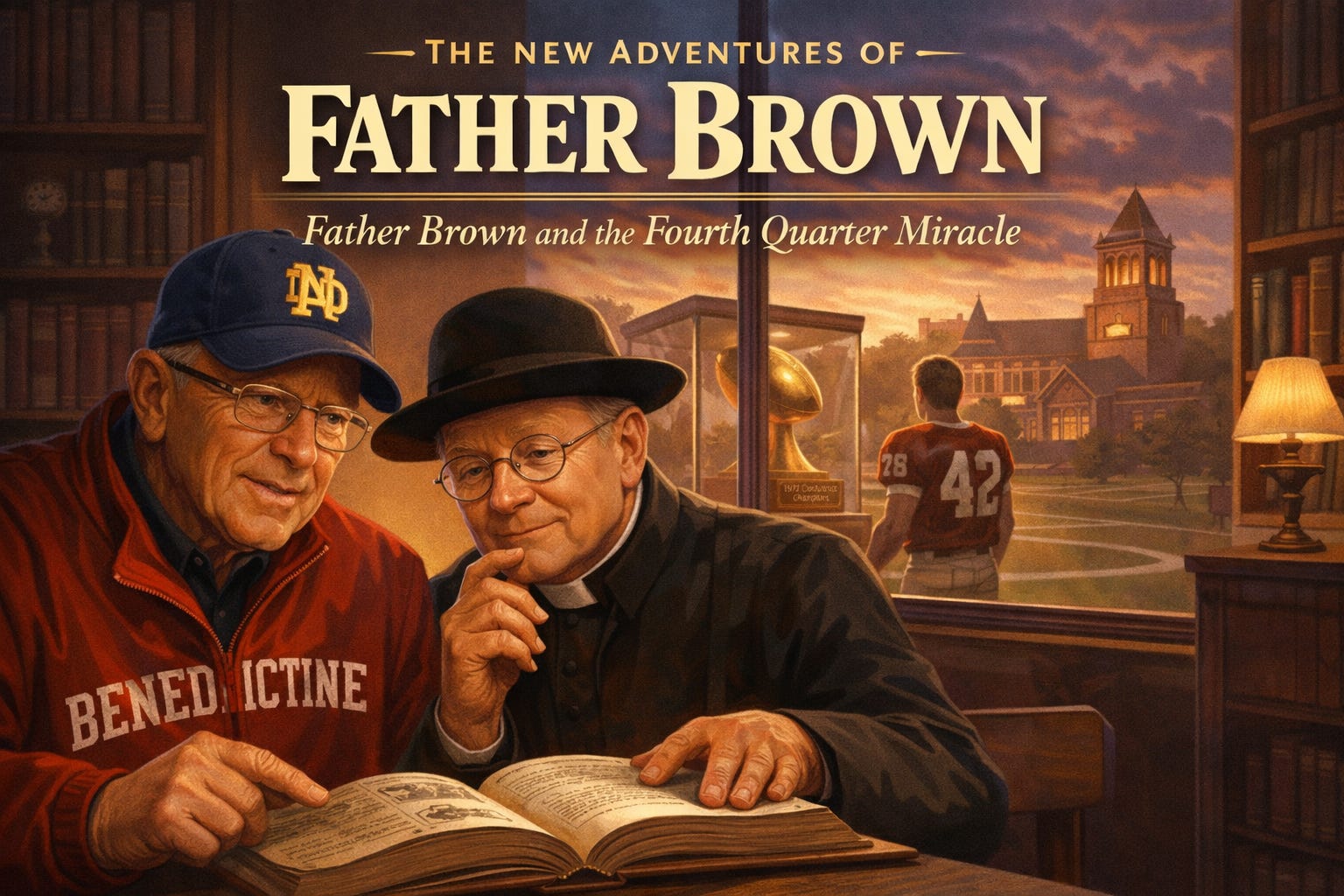
The trouble with miracles, Father Brown often said, is not that they happen too rarely, but that we expect them to look impressive.
That was why he found himself standing on the windswept edge of a football practice field in Atchison, Kansas, watching a group of young men in Benedictine College practice jerseys run wind sprints with the solemn intensity of medieval monks.
Father Brown’s black coat flapped like a distracted crow in the prairie breeze. Beside him stood Coach Lou Holtz, compact, energetic, and peering across the field with the keen look of a man who could spot a missed assignment from three states away.
“See that young fella, number 42?” the Coach said, pointing. “Got heart. Maybe not the fastest, maybe not the biggest, but he shows up. Every. Single. Day. That’s what wins games.”
Father Brown nodded gravely. “Yes. It is also what wins heaven.”
Coach Holtz gave him a sideways glance. “Father, I’m talking about football.”
“I rarely am,” Father Brown said cheerfully.
They had met that morning at a campus leadership breakfast, where Father Brown had been invited to say a few words about virtue, and Coach Holtz had been invited to say many words about discipline. The two had discovered an immediate affection for each other, founded on their shared belief that the soul and the scoreboard were both improved by perseverance.
What neither of them expected was to be drawn into a mystery before lunchtime.
The Missing Trophy
The call came from the college president just after practice ended.
“The Heritage Trophy is gone,” he said in a strained voice. “The one from the 1970 championship season. It’s the centerpiece of the alumni weekend display. The case was locked. No sign of forced entry.”
Coach Holtz stopped pacing. “That trophy means something to those men. Blood, sweat, busted knuckles — you don’t just replace that at a sporting goods store.”
Father Brown adjusted his hat. “Where was it kept?”
“In the athletic hall of honor. We discovered it missing this morning.”
“And who has access?” Father Brown asked.
“Facilities staff, athletic department, a few administrators… and the alumni volunteers setting up the display.”
Coach Holtz squared his shoulders. “Let’s go take a look.”
The Hall of Honor
The hall smelled faintly of floor polish and nostalgia. Photographs lined the walls: black-and-white teams with crew cuts and leather helmets, color shots from later decades, smiling athletes frozen forever in mid-victory.
At the center stood a glass case. Empty.
Only a small brass plaque remained:
1970 Conference Champions
“Courage is not the absence of fear, but the decision that something else is more important.”
Coach Holtz read it softly. “I like that line.”
Father Brown looked at the plaque longer than the empty space above it.
“Who discovered it first?” he asked.
“A student worker,” the president said. “Came in early to set up chairs.”
“No broken glass,” Father Brown observed. “No damaged lock.”
“It was opened with a key,” Coach Holtz muttered.
Father Brown nodded. “Yes. Which means the thief did not wish to smash anything — not glass, not memories, not reputation.”
“That’s… oddly considerate for a thief,” the president said.
“Or very frightened,” Father Brown replied.
The Suspects
They learned quickly that four people had been in the building late the previous evening:
A facilities supervisor, recently reprimanded for budget overruns.
An assistant athletic director, under pressure after a poor season.
An elderly alumnus, part of the championship team, who had lingered alone in the hall.
A star current player, number 42 — the same young man Coach Holtz had praised — who had stayed late to “get in extra reps.”
Coach Holtz frowned. “Kid’s got character.”
Father Brown smiled gently. “So did Judas, in certain moods.”
The Coach blinked. “You don’t pull punches, do you?”
“Only in boxing,” Father Brown said.
The Alumnus
They found the elderly alumnus sitting on a bench outside the chapel, staring at the river.
“I just wanted to see it again,” he said when asked about the trophy. “Last time I held it, I had two good knees and a full head of hair. Now I’ve got neither.”
“Did you take it?” Father Brown asked mildly.
The old man shook his head. “No, Father. I thought about touching it. Didn’t even do that. Some things feel like holy relics.”
Father Brown nodded. “Yes. And relics are often guarded not by locks, but by love.”
The Facilities Supervisor
The supervisor was brisk and defensive.
“You think I’d risk my job over a hunk of metal?” he said. “I’ve got three kids in school.”
“People sometimes steal not for money,” Father Brown said, “but for anger.”
The man’s shoulders slumped. “I was mad, sure. But I’m not stupid.”
Father Brown believed him.
The Assistant Athletic Director
She met them in her office, eyes tired.
“We needed a big alumni turnout,” she admitted. “Morale’s low. Donations are down. But stealing our own trophy? That would be madness.”
“Indeed,” Father Brown said. “It would be like a general burning his own flag.”
Number 42
They found the player alone in the weight room, lifting in slow, controlled motions.
Coach Holtz leaned on the rack. “Son, where were you last night after practice?”
“Here, Coach. Then the hall. I like looking at the old teams.”
“Why?” Father Brown asked.
The young man hesitated. “Because they were great. And I… I don’t know if we ever will be.”
“Did you open the trophy case?” Father Brown asked quietly.
The barbell clanged as it hit the rack.
“I just… wanted to hold it,” the player said. “Just for a second. To know it was real.”
Coach Holtz’s jaw tightened. “You took it?”
“No! I put it back! I swear!”
Father Brown watched his face. There was shame there. But not the particular fear of a thief.
“You opened the case,” Father Brown said, “but you did not take the trophy.”
The young man looked up, startled. “How do you know?”
“Because if you had taken it, you would have hidden it somewhere close — a locker, a dorm room. Instead, you look like a man who is afraid he has already done something wrong… and might be blamed for something worse.”
The player swallowed hard. “I shouldn’t have touched it.”
Coach Holtz put a hand on his shoulder. “Son, touching history isn’t a crime. Running from responsibility is.”
Father Brown’s Realization
Back in the hall, Father Brown stood again before the empty case.
He looked not at the space where the trophy had been — but at the plaque beneath it.
“Courage is not the absence of fear, but the decision that something else is more important.”
He turned to the president.
“Who chose that quote?”
The president blinked. “I… did. We added it last year.”
“And who objected?”
The man hesitated. “Well… one of the old team captains said it wasn’t the original motto. Said we were rewriting history.”
“Ah,” Father Brown said softly.
The Real Thief
They found him in a guest dorm, packing a suitcase: another alumnus from the 1970 team, broad-shouldered even in old age.
“I was going to bring it back,” he said gruffly when confronted. “Just… needed to keep it safe.”
“Safe from what?” Coach Holtz demanded.
“From being turned into a slogan!” the man snapped. “We weren’t saints. We were a bunch of scared kids trying not to lose. Now they stick fancy quotes on it like we were philosophers.”
Father Brown stepped forward.
“You did not steal the trophy,” he said gently. “You stole your own youth back — because you were afraid it had been misunderstood.”
The old man’s hands trembled. “We weren’t heroes. We were just… together.”
“And that,” Father Brown said, “is precisely what makes it heroic.”
The man sank onto the bed. “I was afraid they’d turned it into a lie.”
“Memories grow,” Father Brown said. “They do not have to stay small in order to stay true.”
The Return
That evening, the trophy was back in its case.
At the alumni banquet, Coach Holtz stood at the podium.
“Championships aren’t won by talent alone,” he said. “They’re won by showing up, by playing for the man next to you, and by doing the right thing when nobody’s watching.”
Father Brown, seated at a corner table, smiled faintly.
A student leaned over to him. “Father, was it a miracle that the trophy came back?”
Father Brown shook his head.
“No,” he said. “It was something rarer.”
“What’s that?”
“A man deciding that the truth was more important than his pride.”
He watched number 42 laughing with an old alumnus, the years between them briefly erased.
“Yes,” Father Brown murmured. “Fourth quarter miracles usually look exactly like that.”
End of story.
📻 About Chesterton Radio
Chesterton Radio is a listener-supported home for timeless stories, sacred beauty, and the quiet light of Christian imagination. Inspired by the wit and wonder of G. K. Chesterton, our mission is simple: to keep great truths clothed in great stories, and to make a little room each day for reflection, joy, and faith.
We share classic radio drama, literature, music, and daily meditations that remind us the world is charged with meaning — and that grace often arrives in ordinary disguises.
🎧 Join our 24/7 live stream, The Open Door, anytime at
The lamp is always lit, and there’s always a chair by the fire.