

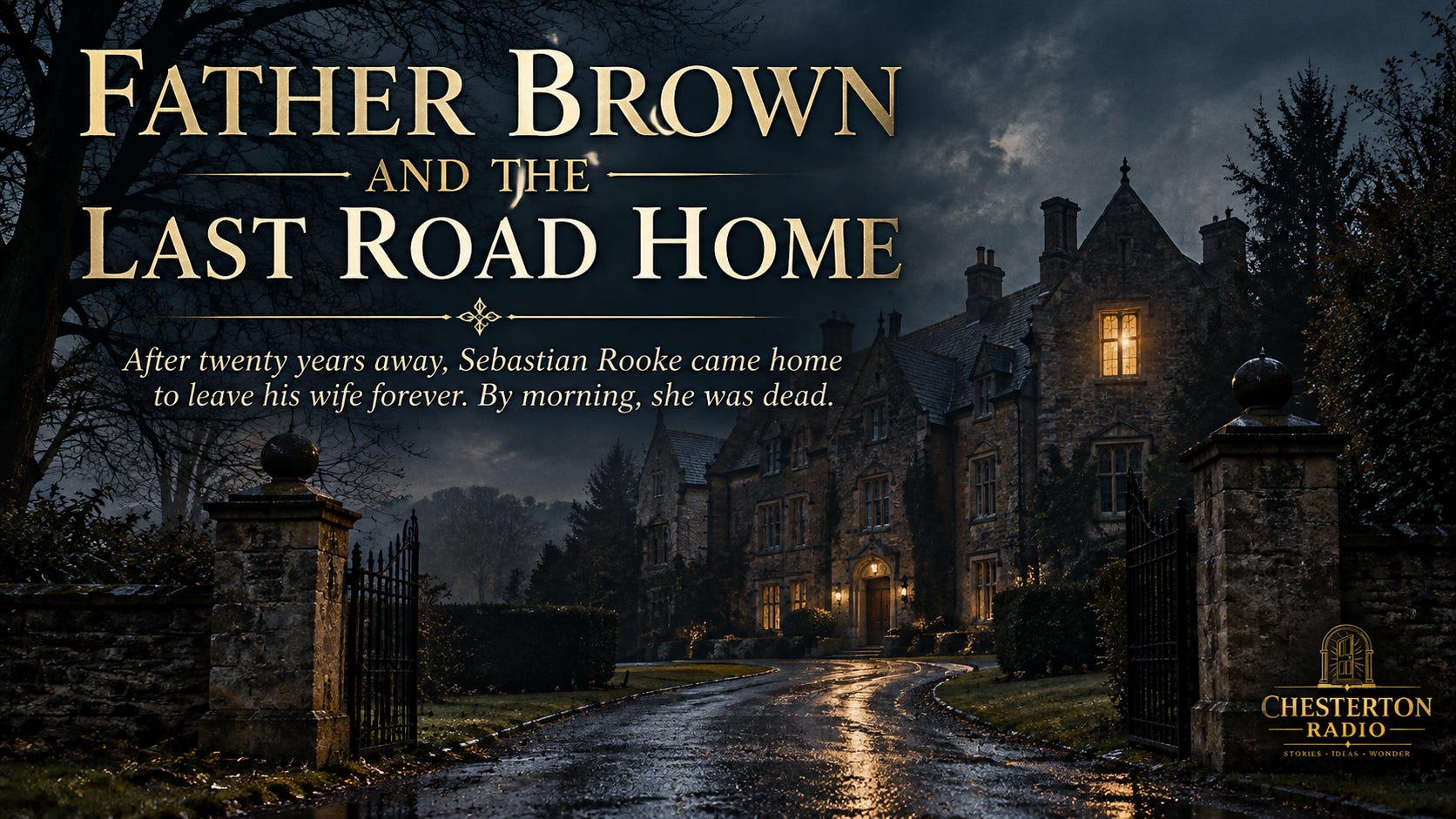
There are some roads we travel because we want to discover what lies at the end of them.
And there are others we travel because we are afraid to discover what we left behind.
For twenty years, Sebastian Rooke has chosen the road.
Paris. Monte Carlo. New York. Ships, motorcars, aeroplanes, fortunes won and lost, friendships, scandals, accidents, women—and always another place waiting beyond the next horizon.
He calls it freedom.
But on a storm-darkened night in England, Sebastian turns his Bentley through the gates of Blackthorn Hall and sees something he has not seen in twenty years.
A light burning in his wife’s window.
He has come home for one purpose: to ask Eleanor Rooke to sign the papers that will finally end their marriage.
He intends to be gone by morning.
But Father Brown has noticed something peculiar about men who spend their lives running away.
Eventually, they may discover that the place they feared most was the only place they were ever free to return to.
Tonight from Chesterton Radio:
Father Brown and the Last Road Home.
A mystery of murder, marriage, forgiveness—and the terrible difficulty of accepting a love we have done nothing to deserve.
FATHER BROWN AND THE LAST ROAD HOME
Part One — The Light in the Window
The motorcar came up the hill like an argument with the weather.
Rain struck the windscreen in silver sheets and was swept away only to return at once. The headlamps found twenty yards of road, lost them, found a stone wall, lost that too, and finally discovered two black trees bending over the lane like old men attempting to prevent an improvident marriage.
Sebastian Rooke laughed.
He had always liked machines best when they were being asked to do something unreasonable.
The Bentley answered the hill with a deeper growl. Sebastian changed down, put his shoulder slightly forward, and drove into the storm.
There were men who slowed for darkness.
There were men who slowed for rain.
Sebastian had once driven a motorcar from Lyon toward Grenoble with half a windscreen, no lamps and a French count shouting prayers from the passenger seat. He had crossed the Atlantic in weather that caused a steward to discover religion. He had flown above the Channel in a machine whose engine had been designed by an optimist and maintained by a drunk.
A Gloucestershire storm did not impress him.
At least, that was what Sebastian told himself.
Then the road curved.
The gates appeared.
He stopped laughing.
They were smaller than he remembered.
That was the first indignity.
The two stone pillars had once seemed enormous. As a boy he had climbed one of them and been unable to get down. His father had stood below threatening consequences while his mother shouted contradictory instructions from an upstairs window.
Now the pillars looked merely old.
The iron gates stood open.
Beyond them the road climbed between bare beeches toward Blackthorn Hall.
Sebastian did not move.
Rain hammered the roof.
His right hand remained on the gear lever. His left rested on the steering wheel. Beside him, propped against the passenger seat, was a blackthorn walking stick with a silver collar and an iron ferrule worn slightly flat along one edge. He had carried it since an aeroplane had attempted to kill him in France and had failed by three inches and one kneecap.
In the inside pocket of his coat was a packet of papers.
They had crossed the Atlantic with him.
They had crossed France.
They had survived a railway compartment, two hotels, three solicitors and a particularly tiresome customs officer at Southampton.
All that remained was a signature.
Sebastian looked through the gates.
“Come along,” he said.
It was not entirely clear whether he was speaking to the motorcar.
He put it into gear.
The Bentley passed between the pillars.
For the first time in twenty years, Sebastian Rooke went home.
Blackthorn Hall did not appear all at once.
It emerged.
First came the old wall beside the kitchen garden. Then the chapel roof, black and sharp against a sudden whiteness of lightning. Then the west tower.
Finally the house itself rose out of the rain.
It was not a castle, although several Rookes had behaved as if it were. It was a long, irregular house of grey stone, altered by generations who possessed money but lacked agreement. One wing was Elizabethan, another Georgian, and a Victorian ancestor had contributed a conservatory so ugly that subsequent generations had hidden it behind yew trees.
Sebastian had spent years remembering Blackthorn as enormous.
It wasn’t.
It was worse than enormous.
It was familiar.
The Bentley slowed.
Most of the windows were dark.
One was not.
High in the east side of the house, behind rain streaming down the glass, a single window burned with a warm yellow light.
Sebastian knew the room.
He knew the window.
For twenty years he had seen the lights of Paris, Naples, New York, Vienna, Monte Carlo, Boston and half the ports of the Mediterranean.
He knew the lights of casinos at four in the morning and railway stations at dawn.
He knew the lights of hospitals.
He knew the peculiar light of hotel corridors after everybody sensible had gone to bed.
Yet there was something distinctly unfair about this one.
Eleanor’s window.
Sebastian stopped the car in the middle of the drive.
The engine idled.
The rain fell.
The window remained illuminated.
“Well,” Sebastian said softly.
He had no idea what he meant by it.
Then he drove on.
The front door opened before he reached it.
An elderly man stood beneath the portico holding an umbrella of such impressive dimensions that Sebastian suspected it might once have belonged to a bishop.
“Good Lord,” Sebastian said.
The elderly man stared at him.
Sebastian stared back.
“Pritchard?”
The old man’s face changed.
For a second he was no longer the dignified butler of Blackthorn Hall.
He was the man who had once caught a fourteen-year-old boy attempting to lower his father’s best shotgun from an upstairs window with a bedsheet.
“Master Sebastian.”
Silence followed.
Pritchard’s face reddened.
“Mr. Rooke, sir.”
Sebastian smiled.
“I liked the first one better.”
Pritchard looked as though he had committed an offense against the Constitution.
“Your luggage, sir?”
“One case.”
Pritchard looked past him toward the Bentley.
“One?”
“I travel lightly.”
“You did not used to, sir.”
Sebastian laughed.
“Pritchard, you’ve improved.”
“I have had twenty years, sir.”
That one landed.
Pritchard seemed to regret it.
Sebastian did not.
He handed him the case.
“And Mrs. Rooke?”
Pritchard hesitated for less than a second.
“In the drawing room, sir.”
Of course she was.
Sebastian stepped into the hall.
Warmth struck him first.
Then smell.
Wood smoke. Beeswax. Wet wool. Old books.
He had forgotten that houses possessed smells.
Hotels had smells, certainly, but they were temporary smells: soap, tobacco, polish, other people’s dinners.
Blackthorn smelled like itself.
A fire burned in the great hall grate. The long-case clock beside the stairs ticked with the same pompous certainty it had possessed when Sebastian was twelve.
He looked up.
The staircase seemed absurdly narrow.
The ceiling was lower.
Even the suit of armour at the landing had diminished.
Only the memories had refused to shrink.
A voice came from the library doorway.
“You might have telegraphed.”
Sebastian turned.
His brother stood beneath the lamp.
Edmund Rooke had always been two years younger and ten years older.
At forty-eight he had finally grown into the arrangement.
He was tall, lean and dressed in a dark suit that looked as though it had never done anything it regretted. There was grey at his temples. His face had sharpened since Sebastian last saw it, but the eyes were the same cool grey.
Sebastian spread his arms.
“Edmund.”
“Sebastian.”
“You look prosperous.”
“You look expensive.”
Sebastian grinned.
“There he is.”
Edmund did not quite smile.
Then, unexpectedly, he crossed the hall and embraced his brother.
It lasted perhaps two seconds.
That was longer than Sebastian had expected.
Edmund stepped away.
“You’re wet.”
“I’ve crossed England.”
“That usually happens when it rains.”
“Does it still rain here?”
“Almost continuously since you left.”
“I wondered whether you’d blame me eventually.”
“I’ve had practice.”
There was affection in it.
There was also something harder.
Sebastian looked around.
“You’ve kept the place standing.”
“Someone had to.”
The words were ordinary.
Sebastian heard the twenty years inside them.
He removed his gloves.
“Eleanor?”
“In the drawing room.”
“So Pritchard tells me.”
“She knows you’re here.”
That surprised him.
“How?”
“She heard the motorcar.”
Sebastian glanced toward the staircase.
“She remembers the Bentley?”
“She remembers you.”
There was no obvious reproach in Edmund’s voice.
That made it worse.
Sebastian reached for the blackthorn stick Pritchard had brought in and rested his right hand on its silver head.
Edmund noticed the slight stiffness in his leg.
“What happened?”
“France.”
“What happened in France?”
“France happened.”
Edmund waited.
Sebastian sighed.
“An aeroplane.”
“You crashed?”
“Eventually.”
“You were flying it?”
“Until shortly before the crash.”
Edmund stared at him.
Then, despite himself, he laughed.
For one instant they were boys again.
Sebastian felt something inside him loosen.
Then a small, damp priest walked into the hall carrying a book.
He was so thoroughly unimpressive that Sebastian assumed he must be important.
His hat had surrendered to the rain. His umbrella was dripping onto the stone floor. His spectacles had fogged, and he was carrying a thick volume under one arm while trying unsuccessfully to close the umbrella with the other.
Edmund went to him.
“Father Brown, you shouldn’t have walked back in this.”
“I didn’t intend to,” said Father Brown. “I intended the rain to stop.”
He considered the umbrella.
“It had other plans.”
Sebastian laughed.
Father Brown looked up at him.
“Ah.”
Edmund made the introduction.
“My brother Sebastian. Father Brown is staying with Father Michael in the village.”
Father Brown held out a small hand.
Sebastian shook it.
“Father.”
“Mr. Rooke.”
“You don’t seem surprised to see me.”
“I didn’t know you weren’t here.”
Sebastian looked at Edmund.
Edmund’s mouth twitched.
Father Brown held up the book.
“Mrs. Rooke lent me this. I came to return it before supper and then discovered that Providence had arranged the weather badly.”
“What is it?”
Sebastian glanced at the cover.
“Augustine,” said Father Brown.
“Good heavens.”
“He gets better after the first few centuries.”
Sebastian laughed again.
He liked the priest.
That annoyed him slightly.
“You’ll stay to dinner, Father,” Edmund said.
“Oh, I couldn’t.”
A tremendous clap of thunder shook the windows.
Father Brown looked toward them.
“On the other hand, cowardice is not always a sin.”
Edmund took his wet coat.
Sebastian watched Father Brown examine the hall with the vague curiosity of a man who had misplaced something unimportant.
His gaze paused on Sebastian’s walking stick.
“That’s had adventures.”
Sebastian looked pleased.
“It has.”
Father Brown pointed toward the ferrule.
“You hold it on the wrong side.”
Sebastian blinked.
“Do I?”
“For the injury.”
Sebastian looked down at the stick in his right hand.
“Habit.”
“Habits are often stronger than injuries.”
Father Brown wandered toward the fire.
Sebastian watched him.
“Is he always like that?”
Edmund said, “Unfortunately.”
From the drawing room came a woman’s voice.
“Sebastian?”
Nothing in the world could have prepared him for the fact that Eleanor’s voice had not changed.
She stood beside the fireplace.
That was how he first saw her after twenty years.
Not waiting at a window.
Not weeping beside a photograph.
Not dressed in the colours of mourning for a man who was inconveniently alive.
She stood beside the fireplace with one hand resting on the mantel and a book open facedown beside her.
Her hair, once almost black, had threads of silver at the temples. She was thinner than he remembered. There were lines around her eyes.
Sebastian’s first absurd thought was that she had aged.
His second was that he had too.
His third was worse.
He knew her face.
Not merely recognized it.
Knew it.
He knew the slight lift of her left eyebrow when she found something ridiculous.
He knew how one corner of her mouth moved before the other when she was trying not to smile.
He knew the little line between her brows that appeared when she was angry but determined to remain civilized.
Twenty years had altered the face without making it strange.
Eleanor closed the book.
“Hello, Sebastian.”
Every speech he had rehearsed disappeared.
“Hello, Eleanor.”
Edmund moved toward the drinks table.
Father Brown became intensely interested in Augustine.
Eleanor looked Sebastian up and down.
“You’re limping.”
“Aeroplane.”
“Of course.”
Sebastian almost smiled.
“You look well.”
“So do you.”
“That’s charitable.”
“No. Charitable would have been younger.”
There it was.
He laughed.
And then, unexpectedly, she did too.
Not much.
But enough.
Sebastian’s heart performed an action he regarded as medically unnecessary.
Eleanor turned to Edmund.
“Has Pritchard found Sebastian a room?”
“The blue room.”
Something unreadable passed across Eleanor’s face.
“The blue room will do.”
Sebastian looked between them.
“I wasn’t intending to stay long.”
“No,” Eleanor said.
She crossed to the drinks table.
“You never were.”
Dinner was delayed by the storm.
It was the sort of practical inconvenience Blackthorn Hall had endured for three centuries, and Edmund responded by issuing two quiet instructions which apparently caused food to appear.
Sebastian watched him.
“You really do run the place.”
“Someone has to know where the roof leaks.”
“It didn’t leak when I left.”
“It did. You simply weren’t the person who received the bills.”
Eleanor hid a smile behind her glass.
Father Brown examined a walnut.
Sebastian pointed at Edmund.
“This is what he used to do when we were boys. I would propose an expedition, and Edmund would ask how we were getting home.”
“Somebody had to.”
“We always got home.”
“Yes.”
Edmund took a drink.
“You did.”
The room became slightly quieter.
Father Brown cracked the walnut.
It made a surprisingly loud noise.
“Getting home is an underrated part of travel,” he said.
Sebastian turned.
“You don’t approve of travel, Father?”
“Oh, certainly. The difficulty with going anywhere is that you take yourself along.”
Eleanor looked at the priest.
Edmund looked into his glass.
Sebastian smiled.
“I have occasionally tried to avoid that.”
“Yes,” Father Brown said.
He ate the walnut.
Sebastian waited.
Nothing else came.
He decided that the priest was either very wise or very irritating.
Possibly both.
The papers remained in Sebastian’s coat until after the soup.
He had intended to produce them immediately.
That had been the plan.
Arrive.
Be pleasant.
Explain the situation.
Obtain Eleanor’s signature.
Leave in the morning.
It was astonishing how easy a plan looked when drawn up in a hotel room.
Instead they talked about the village.
Eleanor knew everything.
Mrs. Bell’s son had returned from India. The old mill had been converted to electricity. The school had acquired a second classroom. A bridge Sebastian remembered jumping from as a boy had been condemned as unsafe.
“About time,” Edmund said.
“It was perfectly safe.”
“You broke your arm.”
“I landed badly.”
“You landed on a cow.”
“That was the cow’s fault.”
Eleanor laughed.
Sebastian stopped.
It was not the polite laugh she had given him earlier.
It was the old one.
Bright.
Sudden.
Completely unguarded.
For perhaps two seconds he was twenty-three years old and standing beside a river with a girl who had taken off her shoes because he had dared her to wade across.
Then Eleanor noticed him looking.
The laugh disappeared.
Sebastian reached for his wine.
“So,” she said.
“Yes.”
“You didn’t come from America to discuss Mrs. Bell’s son.”
“No.”
“Then perhaps we should save you the trouble of inventing another reason.”
Edmund looked toward Sebastian.
Father Brown continued eating soup.
Sebastian put down his spoon.
“I came because there is a matter we ought to settle.”
Eleanor’s face did not change.
“What matter?”
Sebastian almost admired her for making him say it.
“Our marriage.”
Father Brown’s spoon paused for no more than a second.
Edmund said nothing.
Sebastian reached inside his coat and removed the packet.
He placed it beside his plate.
“The solicitors have prepared everything.”
Eleanor looked at the papers.
Then at him.
“How efficient.”
“It needn’t be unpleasant.”
“I’m relieved.”
Sebastian heard the edge now.
“I didn’t mean—”
“I know what you meant.”
She picked up the packet.
“Have you read these?”
“Most of them.”
“Most?”
“There are a great many pages.”
“Marriage had only one.”
Father Brown looked down very quickly.
Sebastian suspected he was hiding a smile.
Eleanor opened the packet.
“You require my signature.”
“Yes.”
“And then?”
Sebastian had rehearsed this part.
“I return to New York.”
“Immediately?”
“After London.”
“Of course.”
She turned another page.
“And after New York?”
Sebastian hesitated.
“There is someone.”
Edmund’s glass touched the table harder than necessary.
Eleanor continued reading.
“Is there?”
“Her name is Katherine.”
Eleanor looked up.
“Does Katherine know you’re married?”
“Yes.”
“Then she is better informed than several of your previous friends.”
“Eleanor.”
“What?”
“That isn’t fair.”
For the first time her composure slipped.
“Fair?”
The single word crossed the table more effectively than a thrown plate.
Then she controlled herself.
She closed the packet.
“How old is she?”
“That is irrelevant.”
“So under thirty.”
Father Brown became fascinated by the salt cellar.
Sebastian leaned back.
“Thirty-four.”
“Practically ancient.”
“She is not the reason for this.”
“No?”
“No.”
“Then why mention her?”
“Because I am attempting to be honest.”
Eleanor looked at him for a long moment.
“That must be exhausting.”
Edmund stood.
“Perhaps this would be better discussed privately.”
“No,” Eleanor said.
Then more gently:
“No. Sit down, Edmund.”
He did.
Eleanor placed the papers beside her plate.
“When do you need them?”
“Tomorrow would be convenient.”
She nodded.
Sebastian waited.
She resumed her soup.
“That is all?”
“For the moment.”
“Good. The soup is getting cold.”
Sebastian stared at her.
He had crossed an ocean prepared for tears, accusations, fury, perhaps even melodrama.
Eleanor asked Pritchard for pepper.
It was infuriating.
The storm worsened after dinner.
Wind moved around the old house in long low notes. Rain rattled the drawing-room windows. Somewhere in the distance a branch cracked.
Edmund stood at the fire.
“The chapel roof will need checking tomorrow.”
Sebastian looked toward the dark window.
“The chapel is still used?”
“Every week.”
“Father Michael says Mass there twice a month,” Eleanor said. “And Father Brown occasionally when he is visiting.”
Father Brown nodded.
“It’s a very good chapel.”
“What makes a chapel good?” Sebastian asked.
“A roof is helpful.”
Edmund smiled.
“Barely. The old sacristy side has been troublesome for years.”
“The little outside door?” Eleanor asked.
“Yes. The ivy has nearly swallowed it.”
Sebastian remembered a narrow stone passage, two boys hiding there from a tutor, and a bat that had caused Edmund to scream with an enthusiasm he later denied.
“You were terrified of that passage.”
“I was eight.”
“You screamed.”
“It was a bat.”
“It was a very small bat.”
“It was larger when I was eight.”
Father Brown looked pleased.
“Most monsters are.”
Edmund gave him a suspicious glance.
Sebastian laughed.
He realized he had been laughing a great deal since coming home.
That seemed improper.
He poured another whisky.
Father Brown sat near the fire with his hands folded over his waistcoat.
Sebastian had encountered priests all over the world.
There had been an enormous Irish priest in Boston who drank whisky like medicine and argued about baseball. A French Jesuit in Marseille had beaten him at chess while apparently asleep. In Naples a young curate had helped him out of a difficulty involving a motorcar, a municipal fountain and a policeman whose sense of humour had suffered grievously in the war.
Father Brown seemed less remarkable than any of them.
Sebastian therefore found himself talking to him.
“Have you travelled much, Father?”
“A little.”
“France?”
“Yes.”
“Italy?”
“Yes.”
“America?”
“No.”
“You should.”
“I have enough trouble understanding the English.”
Sebastian grinned.
“America is magnificent. Everything is happening there.”
“What?”
“Everything.”
Father Brown considered this.
“That sounds tiring.”
“It is alive.”
“So is a wasp.”
Eleanor laughed.
Sebastian pointed toward Father Brown.
“You see, Eleanor? This is what England does. It takes a continent and compares it to an insect.”
“It might be a compliment,” she said.
“It isn’t.”
Father Brown said, “Wasps are very industrious.”
“Hopeless.”
Sebastian rose, leaning automatically on the blackthorn stick with his right hand.
He paced toward the fire.
“I spent four years in America. New York alone could swallow this county and never notice.”
“Perhaps that’s why the county doesn’t go there,” Eleanor said.
“Do you know what the trouble with this place is?”
Edmund sighed.
“We’re about to be told.”
“It thinks permanence is a virtue.”
“And you don’t?”
“I think movement is a virtue.”
“Movement toward what?” Eleanor asked.
“Does it matter?”
“Yes.”
“Why?”
“Because otherwise a man running toward something and a man running away look remarkably similar.”
The words struck harder than she seemed to intend.
Or perhaps exactly as hard.
Sebastian looked at her.
Edmund looked at the fire.
Father Brown looked at Sebastian’s shoes.
Outside, thunder rolled across the valley.
Sebastian smiled.
“You always did have a gift for making an adventure sound like a character defect.”
“And you always had a gift for making a character defect sound like an adventure.”
That one was almost affectionate.
Almost.
Sebastian lifted his glass to her.
“Touché.”
It was Father Brown who asked about Monte Carlo.
The priest did it innocently.
At least Sebastian thought it was innocent.
He had mentioned a motor race in France and Father Brown said:
“Was that the time you went to Monte Carlo?”
Edmund looked at him.
“How could you possibly know that?”
Father Brown blinked.
“Mr. Rooke mentioned it ten minutes ago.”
“Oh.”
Sebastian laughed.
“My dear Father, Monte Carlo deserves more than a mention.”
And that was enough.
The stories began.
Sebastian told them about the winter he arrived in Monaco with eighty pounds and left with a motorcar he technically did not own.
He told them about racing outside Reims when a tyre burst at a speed Edmund refused to believe.
“It was ninety.”
“The car couldn’t do ninety.”
“It could downhill.”
“You said you were climbing.”
“Then it was a very determined car.”
He told them about Vienna, where a hotel manager had confiscated his passport over an unpaid account until Sebastian somehow ended up having dinner with the man’s daughter and left with both the passport and an invitation to return.
Eleanor shook her head.
“You were impossible.”
“I was charming.”
“You were impossible charmingly.”
“Which is a form of charm.”
“It is a form of impossible.”
Even Edmund laughed.
Sebastian went on.
There had been America.
Factories in Detroit.
A disastrous investment in a company manufacturing automatic cigar cutters.
A winter in Boston.
A summer in California.
An aeroplane bought with money he did not have.
“Why?” Edmund asked.
“Because I didn’t have an aeroplane.”
“That isn’t an answer.”
“It answered the problem.”
“You didn’t have a problem.”
“I didn’t have an aeroplane. That was the problem.”
Eleanor laughed again.
Sebastian heard it.
And lost the next sentence.
Only for a second.
He looked at her.
Eleanor’s eyes were bright with amusement.
Then something changed between them, almost imperceptibly, and she looked away.
Sebastian finished his whisky.
He was pouring another when Eleanor said, “Enough.”
“Of America?”
“Of whisky.”
Sebastian looked at the bottle.
“I’ve hardly begun.”
“You began before dinner.”
“I’ve developed stamina.”
“I noticed.”
He set down the bottle.
“There. Obedient.”
“That would be a novelty.”
“You see, Father? Twenty years and I return to find myself persecuted.”
Father Brown smiled.
“Persecution is generally less comfortable.”
“You haven’t been married to Eleanor.”
“No.”
Eleanor said, “Neither have you, for most practical purposes.”
Silence.
This time Sebastian did not laugh.
Edmund moved slightly.
“Eleanor—”
“No.”
She looked at Sebastian.
“He came here to discuss the marriage. We may as well discuss it.”
Sebastian’s face hardened.
“I have discussed it.”
“You produced papers.”
“They say most of what needs saying.”
“Solicitors often do. That’s why people pay them.”
“What would you like me to say?”
“I don’t know.”
“Then we have something in common.”
Eleanor stood.
She crossed toward the side table and lifted the papers.
“You could have posted these.”
“I wanted to speak to you.”
“There are telephones.”
“Not for this.”
“There are solicitors.”
“I used them.”
“There are trains carrying solicitors.”
Sebastian’s irritation rose.
“What exactly are you asking?”
Eleanor turned.
“Why are you here?”
“I’ve told you.”
“No. You’ve told me what you’ve brought.”
She held up the papers.
“I asked why you came.”
“To obtain your signature.”
“You could have obtained that without crossing an ocean.”
“I happened to be in England.”
“You landed at Southampton yesterday and drove here today.”
Sebastian stared at her.
“How do you know when I landed?”
“Edmund reads newspapers.”
Edmund said, “Your arrival was mentioned.”
“Was it?”
“You apparently told a reporter you were returning to settle an old debt.”
Sebastian smiled thinly.
“Reporters improve everything.”
Eleanor put the papers down.
“So I will ask again. Why did you come yourself?”
The fire snapped.
Rain beat against the windows.
Sebastian looked at the woman he had once known better than anyone alive.
“I thought I owed you that much.”
Eleanor’s expression changed.
Not softened.
Changed.
“You owe me?”
“It was a figure of speech.”
“I see.”
“Don’t do that.”
“Do what?”
“Take every word apart as though I’m under examination.”
“You’re not under examination.”
“It feels remarkably like one.”
“No, Sebastian.”
She looked at him steadily.
“You’ve simply become accustomed to audiences.”
That silenced him.
Father Brown’s eyes lifted.
Edmund turned toward the window.
Sebastian reached for his glass, remembered it was empty, and put it down again.
“You think that’s what my life has been?”
“I don’t know what your life has been.”
“I’ve just spent an hour telling you.”
“No.”
She said it quietly.
“You’ve spent an hour telling us stories.”
Sebastian stood so quickly that the walking stick fell against the chair.
He caught it before it reached the floor.
His face was flushed.
“What would satisfy you, Eleanor?”
“I haven’t asked to be satisfied.”
“What do you want from me?”
“I haven’t asked for anything.”
“Precisely!”
The word was louder than he intended.
From somewhere in the hall came the faint movement of a servant who had heard it.
Sebastian lowered his voice.
“You haven’t asked for anything in twenty years.”
Eleanor’s eyes flashed.
“You would have preferred invoices?”
“At least invoices can be paid.”
The instant he said it, something passed across Father Brown’s face.
Sebastian did not see it.
Edmund did.
Eleanor was very still.
Then she said:
“You always did prefer debts to gifts.”
Sebastian laughed without humour.
“What is that supposed to mean?”
“Nothing.”
“No. Go on.”
“I said nothing.”
“You never say nothing.”
“That is one thing you apparently remember.”
He took a step toward her.
His stick struck the carpet with its familiar uneven click.
“You want me to apologize.”
“No.”
“You want me to tell you I’ve wasted my life.”
“No.”
“You want me to say I should have stayed here and become Edmund.”
Edmund turned.
“I’d rather not be used as a medical condition.”
Father Brown coughed into his hand.
Even Eleanor almost smiled.
Sebastian did not.
“I have lived,” he said.
“I didn’t say you hadn’t.”
“I’ve done things.”
“Yes.”
“I’ve seen more of the world than anyone in this room.”
“Almost certainly.”
“I’ve flown above clouds. I’ve crossed oceans in storms worse than this. I’ve raced cars that sensible men wouldn’t sit in while they were parked. I’ve made fortunes.”
Edmund said, “And lost them.”
“And lost them magnificently.”
“There is no magnificent way to lose money.”
“You would know.”
Edmund’s face tightened.
Sebastian saw it.
For a moment the brothers stared at each other.
Then Sebastian looked away.
“I’m sorry.”
Edmund seemed more surprised than offended.
Sebastian turned back to Eleanor.
“You make it sound empty.”
“I haven’t said that.”
“You don’t have to.”
“I haven’t said it because I don’t know if it was empty.”
Sebastian opened his mouth.
Eleanor continued.
“You are the only person who can know that.”
That was somehow worse.
Sebastian reached for the wine bottle.
Eleanor reached for it at the same moment.
Their hands met.
Neither moved.
Then Sebastian smiled.
“There. Proof we’re still capable of agreement.”
Eleanor pulled the bottle toward herself.
“Proof that you’re predictable.”
He took it back.
She held on.
“Sebastian.”
“Eleanor.”
“Give me the bottle.”
“I crossed the Atlantic for this bottle.”
“You crossed the Atlantic for my signature.”
“Apparently I was misinformed.”
She tugged.
He tugged back.
It was absurd.
For one second, ridiculously, they were young.
Then the base of the bottle struck the rim of Eleanor’s glass.
The glass tipped.
Eleanor caught it too late.
It shattered against the table.
She drew in a breath.
Sebastian saw the blood.
Everything else disappeared.
“Your hand.”
“It’s nothing.”
“Give it to me.”
“Sebastian—”
“Give me your hand.”
She did.
Without thought, Sebastian pulled a white handkerchief from his pocket and wrapped it around her palm.
His fingers knew what to do.
More strangely, they knew her hand.
Eleanor stopped speaking.
Sebastian bent over the cut.
“It isn’t deep.”
“I told you.”
“You always say that.”
“So do you.”
He looked up.
They were very close.
Twenty years vanished.
Not metaphorically.
For one impossible second Sebastian could smell summer grass beside the river and hear Eleanor laughing because he had dropped both shoes into the water.
Then the room returned.
The fire.
Edmund.
Father Brown.
Rain.
Sebastian released her.
A small dark stain marked the front of his white evening shirt where her hand had brushed it.
Neither of them noticed.
Pritchard came in with a cloth and began clearing the broken glass.
Father Brown bent to retrieve a fragment that had fallen near his shoe.
“Funny things, glasses,” he said.
Everyone looked at him.
“They break most easily when two people are trying to hold the same thing.”
He placed the fragment on Pritchard’s tray.
Sebastian stared at him.
Father Brown blinked.
“I suppose that’s why they make handles on cups.”
Eleanor laughed despite herself.
The tension broke.
Not entirely.
But enough.
Later, Sebastian stood at the drawing-room window.
The storm had begun to move east, though rain still streamed across the glass.
Far below, the road disappeared into darkness.
He could just see the gates when lightning illuminated them.
Beyond those gates lay London.
Southampton.
Ships.
New York.
Katherine.
Paris, if he wished.
Rome.
Cairo.
Anywhere.
The thought had always comforted him.
Tonight it did not.
Behind him, Edmund and Father Brown were discussing the chapel roof.
“The western gutter is sound,” Edmund said. “It’s the sacristy wall that worries me.”
“The little door still opens?”
“When it feels like it. The ivy has pulled the frame.”
“We ought to cut it back.”
“In spring.”
Sebastian listened without listening.
Eleanor sat near the fire, her bandaged hand resting in her lap.
The divorce papers lay unopened on the table beside her.
He turned.
She was looking at him.
“What?”
“Nothing.”
“You’ve been doing that all evening.”
“Doing what?”
“Looking as though I’m a problem you haven’t solved.”
Eleanor smiled faintly.
“You always think you’re a problem.”
“I usually am.”
“Sometimes you’re merely a man.”
“That sounds disappointing.”
“It might be a relief.”
He crossed the room.
The blackthorn stick clicked against the floor.
Father Brown watched the ferrule for a moment and then looked away.
Sebastian stopped at the fire.
“You asked whether my life was empty.”
“No. You accused me of asking.”
“Very well. I’ll answer the question you didn’t ask.”
“That sounds like you.”
Edmund sat down.
Perhaps he recognized the tone.
Sebastian Rooke was about to perform.
And Sebastian performed magnificently.
He told Eleanor what the world looked like from above the clouds.
He told her about flying east before sunrise when the horizon became a thin red line and then, without warning, the entire world turned gold.
He told her about driving through France at midnight with vineyards black on either side and the road shining beneath the lamps.
He told her about New York from the deck of a ship.
Not the postcards.
Not the buildings.
The first sight of it before dawn, when the city seemed less like something men had built than something they had dared the earth to contain.
He told her about standing outside a casino with ten thousand francs in his pocket and discovering three hours later that he possessed twelve.
He told her about losing everything and beginning again.
About California.
About Boston snow.
About a woman in Vienna who could play Chopin from memory after drinking half a bottle of champagne.
About a mechanic in France who rebuilt an engine through the night because Sebastian had promised to race it in the morning.
About the moment an aeroplane engine stopped over a field and the extraordinary silence that followed.
He told her about danger.
Speed.
Money.
Women.
Ships.
Music heard through hotel walls.
Breakfast at midnight.
Dinner at dawn.
He had slept in palaces and railway stations.
He had been rich.
He had been broke.
He had been applauded.
He had been arrested.
He had crossed oceans with no idea what waited on the other side.
He had awakened in cities where nobody knew his name and regarded that anonymity as the purest kind of freedom.
As he spoke, the years seemed to fall from him.
This was Sebastian Rooke as the world knew him.
Perhaps as Sebastian Rooke knew himself.
The man who had refused the ordinary bargain.
The man who had not remained where he had been put.
The man who had discovered that the world was enormous and had therefore attempted to consume as much of it as possible.
Even Edmund listened.
Even Father Brown smiled at some of the stories.
And Eleanor—
Eleanor watched him.
Sebastian’s voice softened.
“I have stood on the deck of a ship in the middle of the Atlantic when there wasn’t another light anywhere in the world.”
He looked toward the dark window.
“You cannot understand what that feels like unless you’ve seen it. The sky goes all the way down to the sea. There is nothing behind you and nothing ahead of you. Not really. For a little while you belong nowhere.”
He smiled.
“And nobody owns you.”
Something flickered across Eleanor’s face.
Sebastian turned back toward the fire.
“I’ve had more lives than most men get one of. When one went wrong, I began another. When a place became dull, I left it. When a business failed, I found another. When I lost money, I made more. When I crashed an aeroplane, I bought another aeroplane.”
Edmund said, “Eventually.”
Sebastian laughed.
“Yes. Eventually.”
He looked at Eleanor.
“You think I should regret it.”
“I haven’t said that.”
“No. But you look at me as if I’ve spent twenty years running in circles.”
Eleanor shook her head.
“I don’t know what you’ve been doing.”
“I’ve been living.”
“Yes.”
“Freely.”
Eleanor said nothing.
Sebastian felt suddenly compelled to convince her.
Perhaps because she was the only person in the room who had not asked to be convinced.
“I have never belonged to a place,” he said. “Do you understand? That’s the point. Most men spend their lives building walls around themselves and then call the walls security. A house. A position. A routine. Obligations multiplying until they can’t move without asking permission from everything they’ve accumulated.”
His voice rose.
“I could leave.”
Thunder murmured far away.
“I could always leave.”
Edmund looked down.
Father Brown’s expression was unreadable.
Sebastian continued.
“If Paris bored me, there was Rome. If Rome bored me, there was New York. If New York became impossible, there was California. There was always another road. Another ship. Another room. Another morning.”
He smiled almost triumphantly.
“I have never awakened anywhere in the world and believed I had to remain there.”
The fire settled.
The storm had become quieter.
For the first time all evening, Blackthorn Hall itself seemed silent.
Eleanor looked at him.
Not angrily.
Not accusingly.
There was something far more dangerous in her expression.
Tenderness, perhaps.
Or sorrow.
Sebastian could not tell.
She studied the man standing before her: older, scarred, charming, infuriating, magnificent in his way, carrying twenty years of roads inside him like medals.
When she spoke, her voice was very quiet.
“Are you happy, Sebastian?”
FATHER BROWN AND THE LAST ROAD HOME
Part Two — The Longest Night
Sebastian did not answer.
It was such an unusual thing for him to do that Edmund looked up.
The fire shifted behind Sebastian. Somewhere inside it a log collapsed, sending a brief tower of sparks up the chimney.
Eleanor waited.
Sebastian smiled.
It was a good smile. He had used it in drawing rooms, courtrooms, hotel lobbies, railway compartments and once, with considerable success, upon a French customs official who had discovered three bottles of brandy where no bottles of brandy were legally expected to be.
“I have seen things most men only read about.”
“I know.”
“I have crossed oceans.”
“Yes.”
“I have flown aeroplanes.”
“I remember.”
“I have made money.”
Edmund stirred.
Sebastian pointed at him.
“And lost it. Yes, Edmund. We have established the point.”
“I wasn’t going to say anything.”
“You were thinking it loudly.”
Eleanor did not smile.
Sebastian looked at her.
“I have known extraordinary people.”
“Yes.”
“I have had extraordinary experiences.”
“I believe you.”
He stopped.
Eleanor’s voice remained gentle.
“I didn’t ask where you’ve been.”
The sentence was not loud enough to reach the hall.
It did not need to be.
Sebastian stared at her.
Father Brown bent forward and adjusted a coal which did not appear to require adjustment.
Sebastian gave a short laugh.
“What sort of question is that?”
“A simple one.”
“Those are generally the worst kind.”
“Are you happy?”
He turned toward the window.
Rain still travelled down the glass, but the violence had gone out of it. Beyond the window there was only darkness and, somewhere beyond the darkness, the road.
“I don’t know what you want me to say.”
“The truth would be interesting.”
“You assume I haven’t told it.”
“I assume nothing.”
“You have been sitting there judging every word.”
“No.”
“Yes.”
“I’ve been listening.”
“That is often the same thing with you.”
Eleanor’s expression changed.
Sebastian saw it and immediately wished the words back.
She looked at the bandage around her hand.
“When you left,” she said, “I spent three years wondering what I had done wrong.”
He said nothing.
“I thought perhaps I had been dull. Or possessive. Or insufficiently adventurous. I thought perhaps there had been some moment when I might have said the correct thing and didn’t.”
“Eleanor—”
“No. You wanted truth.”
Her voice was still controlled.
That made it worse.
“I wondered whether I had loved you too much. Then I wondered whether I had loved you badly. Then I wondered whether you had ever loved me at all.”
Sebastian lowered his eyes.
“After five years I became angry.”
“I don’t blame you.”
“I am not asking whether you blame me.”
He looked up.
“After ten years I stopped being angry every day. That was a great improvement.”
A faint smile touched her mouth.
“Anger is terribly tiring.”
Father Brown nodded as though this were a practical observation about gardening.
Eleanor continued.
“There were mornings when I wished you were dead.”
Sebastian stared at her.
Edmund turned sharply.
“Eleanor.”
She did not look at him.
“I did.”
Sebastian’s face had lost its smile.
“Why?”
“Because dead men don’t come home.”
Nobody spoke.
She looked directly at Sebastian.
“Do you understand?”
He did not.
Then he did.
A little.
“The worst thing wasn’t that you had gone. It was that you might return. Every carriage on the drive. Every telegram. Every telephone call from London. Every newspaper that mentioned your name.”
Her eyes shone, but she did not cry.
“I would think, perhaps this is it.”
Sebastian looked away.
“And then it wasn’t.”
The clock in the hall struck the quarter-hour.
Four small chimes.
“I did that to you.”
“Yes.”
He swallowed.
“Yes,” she said again. “You did.”
There was no accusation in the second one.
Only fact.
Sebastian crossed slowly toward the fire.
He had performed before hostile crowds.
He had faced creditors, policemen, surgeons and women carrying objects which could reasonably be classified as weapons.
None of them had frightened him as much as Eleanor speaking quietly.
“I was young.”
“So was I.”
“I was a fool.”
“Yes.”
“I didn’t know what I wanted.”
“That is true.”
His head came up.
“You needn’t agree with everything.”
“I thought agreement was one of the things marriage required.”
Father Brown coughed.
Sebastian glanced at him.
The priest appeared to be examining his sleeve.
A reluctant smile touched Sebastian’s face.
Then disappeared.
“I didn’t leave because you were dull.”
“I know that now.”
“You were never dull.”
“Thank you.”
“You were infuriating.”
“That I knew immediately.”
“And impossible.”
“Sebastian, you married me.”
“Exactly.”
For the first time Eleanor smiled.
It saved him.
Not much.
Enough.
Sebastian leaned against the mantel.
“You want to know whether I’m happy.”
“Yes.”
“I don’t know.”
Eleanor said nothing.
He laughed softly.
“Good Lord.”
“What?”
“I don’t know.”
He seemed almost delighted by the discovery.
“I have answers for everything.”
“Yes.”
“I’ve made a career of it.”
“I know.”
“And I don’t know.”
Father Brown said, “That is sometimes where answers begin.”
Sebastian turned.
“I thought priests were supposed to provide answers.”
“Oh, no,” said Father Brown. “Mostly we hear the wrong ones.”
Edmund smiled despite himself.
Sebastian looked back at Eleanor.
“I have been happy.”
“I hope so.”
That surprised him.
“You do?”
“Of course.”
“After everything?”
“I didn’t spend twenty years hoping you were miserable.”
“Why not?”
Eleanor looked puzzled.
“Because that would have made both of us miserable.”
Sebastian stared at her.
There it was again.
That infuriating refusal to arrange herself according to his expectations.
He wanted accusation because he understood accusation.
He wanted punishment because punishment had a price.
Eleanor kept giving him things for which there appeared to be no bill.
He turned abruptly.
“I still say permanence is overrated.”
Edmund sighed.
“Oh, God.”
“No, listen.”
“I have been listening for forty-eight years.”
“Then another five minutes won’t kill you.”
“That remains unproven.”
Sebastian ignored him.
“There are men in this county who have never been twenty miles from the house where they were born. They inherit a business, marry the girl expected of them, sit in the same pew every Sunday and die in the same bed they were born in.”
Father Brown said, “That would require a very durable bed.”
Eleanor laughed.
Sebastian pointed at him.
“Father.”
“Sorry.”
Sebastian continued.
“People call such men dependable. Perhaps they’re simply frightened.”
Eleanor considered it.
“Yes.”
He stopped.
“Yes?”
“Yes.”
“You agree?”
“Sometimes.”
Sebastian seemed almost offended.
“You are ruining a perfectly good argument.”
“I never said staying was courage.”
He looked at her.
“Then what are you saying?”
“That leaving isn’t always courage either.”
The room became still.
Eleanor’s bandaged hand rested on the arm of the chair.
“Did you choose all those roads, Sebastian?”
“Of course.”
“All of them?”
“Yes.”
“Every ship?”
“Yes.”
“Every hotel?”
He hesitated.
“Yes.”
“Every woman?”
“Eleanor.”
“You brought Katherine into this room, not I.”
“I didn’t bring her anywhere.”
“No. That may be the difficulty.”
He stared.
Eleanor stood.
She crossed to the table and touched the divorce papers with one finger.
“Katherine knows the man who raced cars in France.”
“She knows rather more than that.”
“I hope so.”
“She knows me.”
Eleanor looked at him.
Sebastian’s confidence faltered.
“Katherine knows you now,” she said.
“Yes.”
“I knew you before you became interesting.”
Edmund turned away quickly.
Sebastian stared at her.
“That is an outrageous thing to say.”
“Is it?”
“I was extremely interesting at twenty-three.”
“You once spent an entire afternoon attempting to teach a dog to smoke a pipe.”
“It nearly learned.”
“It ate the tobacco.”
“It was an experimental stage.”
“You cried when the dog died.”
Sebastian stopped.
Eleanor’s smile faded.
“So did I.”
Something moved between them.
Not memory exactly.
Something deeper than memory.
The recognition that another human being had been present when the world was young.
Sebastian looked toward the fire.
“Katherine likes the stories.”
“I imagine they’re very good.”
“They are.”
“I know.”
“She doesn’t sit there correcting them.”
“No.”
“She doesn’t remember what actually happened.”
“No.”
Sebastian’s eyes returned to Eleanor.
“And you do.”
“Yes.”
He suddenly looked tired.
“That is damned inconvenient.”
“I have always thought so.”
Edmund moved toward the drinks table.
“I think perhaps we’ve had enough for one evening.”
Sebastian turned.
“You’ve been waiting to say that.”
“I’ve been waiting for twenty years to say several things.”
“Then why not begin?”
Eleanor said, “Sebastian.”
“No. He’s earned it.”
Edmund’s hand stopped above the decanter.
“What have I earned?”
“The right to tell me what a bastard I’ve been.”
Father Brown looked mildly distressed.
Sebastian glanced at him.
“Sorry, Father.”
“I’ve heard the word.”
“Where?”
“Confession.”
Sebastian nodded.
“Of course.”
Edmund poured water instead.
“You don’t need me to tell you anything.”
“Don’t I?”
“No.”
“You’ve kept the house standing.”
“Yes.”
“Paid the bills.”
“Yes.”
“Looked after the tenants.”
“Yes.”
“Looked after Eleanor.”
Edmund’s eyes moved toward her.
Only for a moment.
“Yes.”
Sebastian spread his hands.
“And I arrived this evening in a Bentley and asked for dinner.”
“You always arrive in time for the interesting part.”
The sentence fell between them.
Sebastian’s smile vanished.
Edmund regretted it almost immediately.
But not enough to withdraw it.
“The funerals weren’t very interesting,” Edmund said. “Father’s wasn’t. Mother’s wasn’t. Nor were the years when the north roof had to be replaced and there was no money to do it. Nor explaining to tradesmen why accounts carrying the Rooke name might require patience.”
Sebastian said nothing.
“Nor sitting with Eleanor when newspapers reported you’d been killed somewhere in France.”
Eleanor looked sharply at Edmund.
“Enough.”
“No.”
Edmund’s voice remained quiet.
That made it more dangerous.
“He wants truth.”
Sebastian’s face had gone pale.
Edmund continued.
“You had adventures. We had consequences.”
“Edmund.”
This time it was Sebastian.
Softly.
Edmund stopped.
For a moment the brothers looked at one another.
Sebastian said, “I’m sorry.”
Edmund’s anger faltered.
Sebastian did not embellish it.
Did not explain.
Did not tell a story.
“I’m sorry.”
Edmund looked away.
“That’s not why I said it.”
“I know.”
Something almost like affection returned to Edmund’s face.
Then disappeared.
Father Brown watched both brothers.
His eyes were sad.
It was Eleanor who broke the silence.
“Do you remember the river?”
Sebastian looked at her.
“What?”
“The river.”
“Of course.”
“You told it incorrectly.”
“I did not.”
“You said you dared me to cross.”
“I did.”
“You did not.”
“I distinctly remember—”
“I dared you.”
Sebastian frowned.
Eleanor smiled.
“You said the water was too high.”
“Nonsense.”
“You said we’d ruin our shoes.”
“I have never worried about shoes.”
“You were wearing your father’s.”
Edmund began laughing.
Sebastian looked betrayed.
“You remember?”
“I remember Father asking why his shoes smelled of river mud.”
Sebastian pointed at Eleanor.
“You told him?”
“I saved your life.”
“You informed on me.”
“I told him you’d fallen in.”
“I did not fall in.”
“You fell in twice.”
“The second time was deliberate.”
“Why?”
“To retrieve my shoe.”
“You wouldn’t have lost the shoe if you hadn’t fallen in the first time.”
Father Brown was smiling now.
Sebastian looked from one face to another.
“This house has become hostile.”
Eleanor laughed.
The old laugh.
Bright and sudden.
Sebastian stopped defending himself.
He simply listened.
For a moment Blackthorn Hall was not filled with twenty years.
It was filled with summer.
A river.
Two young people barefoot on a bank.
A pair of ruined shoes.
A future neither of them yet knew could be broken.
Eleanor wiped at one eye.
From laughter.
Only laughter.
Sebastian smiled.
“You kissed me that day.”
Eleanor’s eyebrow rose.
“You kissed me.”
“You didn’t object.”
“I was recovering from nearly drowning.”
“You were standing in three feet of water.”
“I was very delicate.”
“You bit my lip.”
“You deserved it.”
“I bled.”
“You were always theatrical.”
Sebastian laughed.
Then, slowly, the laughter left him.
“You were happy then.”
Eleanor looked at him.
“Yes.”
“So was I.”
“Yes.”
The simplicity of it frightened him.
He walked toward the window.
The rain had nearly stopped.
Drops moved slowly down the glass.
The road beyond the gates was invisible now, but Sebastian knew exactly where it lay.
He always knew where roads were.
“You asked why I came.”
Eleanor waited.
Sebastian’s reflection hovered in the black glass.
“I don’t know.”
“You said you wanted the papers signed.”
“I know what I said.”
“Then perhaps you do know.”
“No.”
He turned.
“If that were all I wanted, I could have sent them.”
“Yes.”
“I could have sent a solicitor.”
“Yes.”
“I could have stayed in New York.”
“Yes.”
“Katherine asked me why I had to come myself.”
Eleanor’s expression changed slightly.
“What did you tell her?”
“That there were some things a man ought to do face-to-face.”
“Very noble.”
“It sounded better in New York.”
“Most things do.”
Sebastian smiled.
Then he looked at the papers.
“You’re not going to sign them.”
It was not a question.
Eleanor said, “No.”
Edmund looked at her.
Sebastian turned slowly.
“What?”
“I am not going to sign them.”
Anger came quickly because it was easier than everything else.
“You have no right.”
“I believe the papers themselves suggest otherwise.”
“Don’t be clever.”
“I am not trying to be.”
“I crossed the Atlantic.”
“Yes. You mention it frequently.”
“I have a life in America.”
“I know.”
“There are arrangements.”
“I imagine so.”
“Katherine—”
“Will survive one night without a telegram.”
Sebastian took a step toward her.
“Why?”
Eleanor did not answer.
“Why won’t you sign?”
“Because you don’t want me to.”
He laughed.
Too loudly.
“Don’t be absurd.”
“Then why are you angry?”
“Because you’re refusing.”
“No. You expected me to refuse.”
“I expected nothing of the sort.”
“You came yourself.”
“I have explained that.”
“Badly.”
Sebastian’s voice rose.
“If you won’t end this marriage, Eleanor, then by God I will.”
The words travelled into the hall.
Somewhere beyond the drawing-room door something moved.
A servant.
Perhaps Pritchard.
Edmund stepped forward.
“Sebastian.”
Sebastian turned on him.
“Stay out of it.”
“I have spent twenty years in it.”
“That does not make it yours.”
Edmund’s face changed.
Eleanor moved between them.
“Enough.”
Sebastian’s chest rose and fell.
His eyes were fixed on Edmund.
Then he looked at Eleanor.
The anger drained almost as quickly as it had arrived.
He seemed suddenly ashamed.
Father Brown said quietly, “Roads are funny things.”
Nobody had remembered he was there.
Sebastian turned.
“What?”
Father Brown looked toward the window.
“A road can take a man away from a house.”
“Yes.”
“And the same road can bring him back.”
Sebastian waited.
Father Brown shrugged.
“It doesn’t seem to care which.”
“That is your contribution?”
“I hadn’t intended to contribute.”
Sebastian stared at him.
Then, despite everything, laughed.
The danger passed.
Not entirely.
Enough.
It was after midnight when Edmund finally left the drawing room.
He had estate accounts to review, which Sebastian considered a grotesque activity at any hour and particularly after midnight.
Father Brown went in search of the book he had supposedly come to return and had subsequently misplaced twice.
That left Sebastian and Eleanor alone.
Neither mentioned it.
Eleanor stood.
“You should see your room.”
“The blue room?”
“No.”
Sebastian looked at her.
She walked toward the door.
“Come.”
He followed.
The staircase creaked in precisely the same places.
Sebastian knew that before he stepped on them.
The knowledge disturbed him.
At the landing Eleanor turned left.
Not toward the blue room.
Toward the east corridor.
Sebastian stopped.
“No.”
Eleanor continued.
He followed more slowly.
She opened a door.
The lamp inside was already lit.
Sebastian stood on the threshold.
His room.
Not as it had been.
That would have been impossible.
The wallpaper had changed. The curtains were newer. The bed was larger than the narrow one he remembered.
But the shelves—
His books were still there.
Not all of them.
Enough.
Stevenson.
Dumas.
A battered volume of Jules Verne.
On the mantel stood a small wooden aeroplane.
Sebastian stared at it.
“Oh, God.”
Eleanor looked at the object.
“You made that.”
“I was fourteen.”
“You insisted it would fly.”
“It did.”
“It fell from the roof.”
“That is a kind of flight.”
“It struck Edmund.”
“He was badly positioned.”
A photograph stood beside it.
Two boys.
One girl.
A river behind them.
Sebastian picked it up.
Eleanor said nothing.
The bed had been turned down.
Fresh sheets.
A glass of water stood beside it.
A lamp worked on the bedside table.
Sebastian looked around.
“Why?”
“Why what?”
“Why is this here?”
“It is a bedroom.”
He looked at her.
“Occasionally people sleep in them.”
“Eleanor.”
“What did you expect us to do with it?”
“I don’t know.”
“Neither did I.”
He touched the spine of one of the books.
“There are fresh sheets.”
“I assure you, Sebastian, we have discovered laundry in your absence.”
He almost smiled.
“Has it always been like this?”
Eleanor looked around the room.
“More or less.”
“For twenty years?”
“Not continuously. That would be very expensive linen.”
He looked at her.
She met his eyes.
Neither spoke.
Sebastian turned toward the window.
From here, high on the east side of Blackthorn Hall, he could see where the road would be in daylight.
This was the illuminated window.
The one he had seen from the drive.
He understood that now.
He touched the glass.
Cold.
“Sometimes,” he said, “I thought about this house.”
Eleanor stood behind him.
“I imagined you had forgotten it.”
“I tried.”
She said nothing.
“Not the important things.”
“What things?”
“The clock.”
Eleanor smiled.
“That dreadful clock?”
“I heard it when I came in.”
“It loses four minutes every week.”
“It always did.”
“Yes.”
“The smell of the hall.”
“Dust?”
“Wood smoke.”
“Mostly dust.”
“The staircase.”
He turned.
“The river.”
Eleanor’s smile faded.
“And the window.”
She looked toward it.
Sebastian’s voice became quieter.
“There were nights in hotels when I would wake and not know what city I was in.”
Eleanor did not move.
“I would lie there trying to remember. Paris. Vienna. Boston. Once it was Cleveland, which seemed unnecessarily cruel.”
She laughed softly.
Sebastian did not.
“And sometimes, before I remembered where I was, I would think I was here.”
Eleanor looked at him.
“I could hear the clock.”
His voice had changed.
No performance now.
No continents.
No aeroplanes.
Just a man in a bedroom.
“I would think I could go home.”
“Why didn’t you?”
He looked at the photograph in his hand.
“I don’t know.”
“Yes, you do.”
Sebastian shook his head.
“One year away requires an apology.”
Eleanor waited.
“Five requires an explanation.”
He placed the photograph back on the mantel.
“Twenty requires a miracle.”
Eleanor said, “You have always preferred miracles to apologies.”
He laughed once.
“That sounds like me.”
“Yes.”
He sat on the edge of the bed.
For the first time that evening he looked his age.
“What was I afraid of?”
Eleanor did not answer for him.
Sebastian stared at the floor.
“I wasn’t afraid of staying.”
Silence.
“I was afraid of what staying meant.”
Eleanor’s bandaged hand tightened slightly.
Sebastian looked up at her.
“You knew when I was frightened.”
“Yes.”
“I hated that.”
“I know.”
“You knew when I was lying.”
“Usually.”
“When I was showing off.”
“Always.”
“When I needed help.”
Eleanor said nothing.
Sebastian looked away.
“I could crash an aeroplane.”
“That seems established.”
“I could lose money.”
“Also established.”
“I could wake in a police station in Naples and talk my way out by breakfast.”
Eleanor’s eyes flickered.
Sebastian noticed.
“What?”
“Nothing.”
“A lawyer appeared.”
“What?”
“In Naples.”
He smiled faintly.
“I’d forgotten. Extraordinary fellow. English. Arrived at precisely the right moment. Never discovered who sent him. I assumed one of the chaps at the hotel.”
Eleanor looked toward the window.
Sebastian continued, almost to himself.
“There was a hospital in Paris too. They swore the bill had been settled. I thought perhaps I’d paid it drunk.”
Father Brown’s voice came from the corridor.
“That seems a dangerous financial system.”
Sebastian turned.
The priest stood in the doorway holding Augustine.
“Found it,” he said.
Eleanor looked at him.
Father Brown looked at Eleanor.
Something passed between them so quickly Sebastian missed it.
Sebastian smiled.
“I have always been lucky, Father.”
Father Brown considered this.
“Perhaps.”
They returned downstairs.
Edmund was standing beside the fire.
The divorce papers were still on the table.
He looked at Sebastian and Eleanor entering together.
His gaze moved from one to the other.
“Everything satisfactory?”
Sebastian looked at the papers.
Then at Eleanor.
“No.”
Edmund’s expression tightened.
Sebastian crossed the room.
He picked up the packet.
For several seconds he simply held it.
Then he dropped it onto the table.
“I don’t want them.”
Edmund stared.
Eleanor said nothing.
Sebastian looked at her.
“I don’t want the papers.”
“You said that.”
“I mean it.”
“You frequently mean things at one o’clock in the morning.”
“I’ll mean it tomorrow.”
Eleanor’s eyes changed.
Sebastian saw it.
He took a breath.
“I’ll stay.”
She did not move.
“I’ll stay here.”
“For how long?”
He almost laughed.
“For good.”
“No.”
Sebastian blinked.
“No?”
“No.”
“I have just made the most responsible declaration of my adult life.”
“That is precisely why I distrust it.”
“Eleanor.”
“You’ve been home six hours.”
“Seven.”
“Then naturally everything is settled.”
“I am trying to tell you—”
“I know what you’re trying to tell me.”
“Then why are you arguing?”
“Because you are trying to promise twenty years before you’ve managed one morning.”
Sebastian stopped.
Eleanor stepped closer.
“Don’t promise me forever.”
He stared at her.
“I thought women liked that sort of thing.”
“I did at twenty-two.”
“What happened?”
“I married you.”
Edmund looked away.
Father Brown lowered his head.
Sebastian smiled.
Eleanor did too.
Then her expression softened.
“Stay tomorrow.”
Sebastian’s smile disappeared.
“What?”
“Tomorrow.”
She spoke as if suggesting breakfast.
“Wake up here.”
He said nothing.
“Have breakfast.”
“That’s your grand plan?”
“Yes.”
“And then?”
“If tomorrow is tolerable, stay the next day.”
Sebastian stared.
“And after that?”
“We shall see.”
“That is remarkably unromantic.”
“I have had twenty years of romance from newspaper columns. I think I should like breakfast.”
He looked at her.
There were a hundred things he could have said.
Sebastian Rooke had crossed oceans and continents carrying speeches with him.
He had persuaded investors to lend him money they could not afford to lose.
He had persuaded women to forgive things they ought not to have forgiven.
He had persuaded policemen, customs officials, creditors, mechanics, hotel managers and once an extremely suspicious magistrate.
Now, when the most important answer of his life was required, he had almost nothing.
“All right,” he said.
Eleanor nodded.
“Tomorrow.”
“Tomorrow.”
That was all.
It was enough.
Edmund moved.
Only slightly.
Sebastian looked toward him.
His brother’s face was controlled.
Too controlled, perhaps.
But Sebastian had spent the evening injuring him.
He mistook the expression for weariness.
“I suppose you’ll have to find me something useful to do.”
Edmund stared.
“You?”
“Yes.”
“At Blackthorn?”
“Don’t sound so alarmed.”
“I was attempting to imagine it.”
“I can work.”
“You bought an aeroplane because you didn’t have one.”
“That required considerable initiative.”
Eleanor laughed.
Edmund looked at her.
Then at Sebastian.
His eyes dropped to the unsigned papers on the table.
“I see.”
Nothing more.
Sebastian crossed to the drinks table, considered the whisky and deliberately poured water.
Eleanor noticed.
She said nothing.
That pleased him more than praise would have.
Father Brown put Augustine under his arm.
“I think I shall go to bed.”
Sebastian said, “It seems I’m staying after all, Father.”
Father Brown nodded.
“That’s fortunate.”
“Why?”
“The road is dreadful.”
Sebastian laughed.
“You make everything sound accidental.”
“A great many important things are.”
Father Brown headed for the door.
Sebastian stopped him.
“Father.”
The priest turned.
“Do you think people can begin again?”
Father Brown considered the question.
“No.”
Sebastian looked startled.
Eleanor did too.
Father Brown smiled.
“Fortunately, tomorrow is usually new enough.”
Then he left.
Sebastian stared after him.
“I still can’t decide whether I like that man.”
Eleanor said, “He’ll survive.”
Sebastian picked up his blackthorn walking stick.
He looked toward the stairs.
Then at Eleanor.
For a moment neither moved.
He set the stick against the side of the fireplace.
The silver collar caught the light.
“I won’t need that upstairs.”
“No?”
“The leg is better than I pretend.”
“I suspected.”
“Of course you did.”
He walked toward her.
They stood very close.
Sebastian looked at the bandage around her hand.
“Does it hurt?”
“A little.”
“I’m sorry.”
“For the glass?”
He looked at her.
“No.”
Eleanor’s eyes filled.
Only slightly.
Sebastian lifted his hand.
Stopped.
For once he did not assume permission.
Eleanor closed the remaining distance.
Her uninjured hand touched his cheek.
Sebastian shut his eyes.
There was no kiss.
It was somehow more intimate without one.
He lowered his forehead until it rested against hers.
Neither spoke.
Twenty years remained between them.
They did not vanish.
That would have been too easy.
They remained: betrayals, loneliness, anger, foolishness, distance, other women, unanswered letters, funerals missed, nights wasted.
All of it remained.
But for the first time the twenty years were behind them instead of between them.
Eleanor whispered, “Tomorrow.”
Sebastian opened his eyes.
“Tomorrow.”
Then he went upstairs.
Eleanor remained beside the fire after he had gone.
She listened to his footsteps.
One.
Two.
The pause on the third stair.
She smiled.
He had remembered the creak.
Or his body had.
The footsteps continued.
Then disappeared.
Blackthorn Hall became quiet.
Edmund stood near the drawing-room doorway.
Eleanor turned.
“I thought you’d gone.”
“I was checking the windows.”
“The storm is nearly over.”
“Yes.”
He looked toward the staircase.
“He is staying?”
“For tomorrow.”
Edmund’s face did not change.
“Tomorrow.”
“Yes.”
“And after that?”
“We shall see.”
His eyes moved toward the divorce papers.
“You believe him?”
Eleanor looked at the stairs.
“I believe tonight.”
“That isn’t what I asked.”
“No.”
Edmund waited.
Eleanor looked back at him.
“Good night, Edmund.”
Something tightened in his jaw.
Then vanished.
“Good night.”
He left.
Eleanor stood alone.
The fire was almost out.
She sat at the small writing desk near the window.
For several minutes she did nothing.
Then she opened the drawer.
Paper.
Envelope.
Pen.
She began to write.
Stopped.
Crossed something out.
Began again.
Once she laughed quietly at herself.
The letter was not long.
When she finished, she read it.
Then folded it.
Placed it in the envelope.
On the front she wrote one word.
Sebastian.
She held the envelope for a moment.
Then placed it beneath the little brass clock on the desk.
Outside, the rain had become a whisper.
Eleanor looked toward the dark garden.
Somewhere beyond the trees stood the chapel.
She extinguished the lamp.
The chapel at Blackthorn Hall had never been impressive.
That was one reason Eleanor loved it.
Rookes who had spent fortunes enlarging drawing rooms and rebuilding façades had left the chapel almost alone.
A dozen pews.
Stone floor.
Dark oak.
A small altar.
The red sanctuary lamp.
Tonight the rain tapped softly against the old glass.
Eleanor entered through the house passage and closed the door behind her.
The air smelled of wax and cold stone.
She moved into a pew.
For a while she simply sat.
She did not pray eloquently.
She was too tired for eloquence.
Perhaps most people were.
She thought of Sebastian upstairs in his old room.
Tomorrow he would wake there.
The idea seemed almost absurd.
She smiled.
Then bowed her head.
Behind her, somewhere near the sacristy, wood moved against stone.
Eleanor lifted her head.
A draught touched the back of her neck.
She turned.
Someone stood in the darkness near the side passage.
Her expression changed.
Not fear.
Recognition.
“What are you doing here?”
A voice answered.
Low.
Controlled.
The sanctuary lamp flickered.
Sebastian could not sleep.
He had spent twenty years sleeping anywhere.
Ships.
Trains.
Hotels.
A bench in a railway station outside Milan.
Once, memorably, beneath a billiard table in Boston.
His own bed defeated him.
He lay on his back staring at the ceiling.
The room was silent except for the rain.
Tomorrow.
The word had become ridiculous.
He had lived almost entirely in next weeks, next cities, next ventures, next women, next roads.
Tomorrow had always been something to get through on the way to somewhere else.
Now tomorrow had a room.
A breakfast table.
Eleanor.
He smiled into the darkness.
Then immediately became frightened.
That, too, seemed familiar.
He sat up.
The lamp beside the bed still burned.
On the mantel the wooden aeroplane threw a ridiculous shadow against the wall.
Sebastian looked at it.
“You never flew.”
The aeroplane declined to argue.
He lay back.
Tomorrow.
He would telephone London.
Then New York.
Katherine.
His stomach tightened.
There would be pain.
Consequences.
Explanations.
For once he did not imagine escaping them.
That realization was so unfamiliar that he almost laughed.
The storm had stopped.
Blackthorn Hall was completely still.
Sebastian closed his eyes.
Somewhere below, a bell rang.
Once.
He opened them.
Silence.
Then footsteps.
Running.
Sebastian sat up.
A door slammed.
A voice called from below.
He was already moving.
He reached the corridor in shirtsleeves.
His evening shirt was still on him, crumpled now, the small dark mark near the front unnoticed.
Another door opened.
Father Brown appeared wearing an old dressing gown over his clothes.
Sebastian stared.
“Do you sleep dressed?”
“Not successfully.”
“What happened?”
“I don’t know.”
Edmund emerged from the opposite corridor.
He was fully dressed.
“What’s wrong?”
Pritchard appeared at the foot of the stairs.
For the first time Sebastian had ever seen him, the old butler looked frightened.
“Mrs. Rooke, sir.”
Sebastian’s hand tightened on the banister.
“What about her?”
“We can’t find her.”
Sebastian almost laughed.
The sentence was too ordinary.
“What do you mean, you can’t find her?”
“Her room is empty.”
“She’s somewhere in the house.”
“Yes, sir.”
“Then find her.”
Pritchard hesitated.
Sebastian saw something in his face.
“What?”
“One of the maids saw her cross the lower passage.”
“When?”
“Perhaps half an hour ago.”
“Where does it go?”
Nobody answered.
Then Father Brown said:
“The chapel.”
Sebastian was first down the stairs.
He did not have his stick.
He did not notice.
The old injury caught as he reached the bottom and nearly sent him against the wall.
Edmund seized his arm.
“Slow down.”
Sebastian pulled free.
They crossed the lower hall.
Pritchard carried a lamp.
Father Brown followed.
The house passage toward the chapel was colder than the rest of Blackthorn Hall.
Sebastian remembered running through it as a boy.
He remembered hiding from tutors.
He remembered Edmund screaming at the bat.
He remembered Eleanor at twenty-two, carrying flowers for Easter.
Memory became intolerable.
The chapel door was closed.
Sebastian reached it first.
He tried the handle.
Locked.
“Eleanor!”
He struck the door.
“Eleanor!”
No answer.
Edmund pushed past him.
“There is another key.”
“Where?”
“Vestry cupboard.”
“Get it.”
Edmund hesitated.
Only a fraction.
Then turned.
Father Brown stood beside the chapel door.
He looked down.
There were wet marks on the stone floor.
Sebastian did not see him looking.
He was pounding on the door.
“Eleanor!”
Pritchard said, “Sir—”
“Eleanor!”
Father Brown placed a hand on Sebastian’s arm.
“Wait.”
Sebastian turned on him.
“For what?”
Father Brown said nothing.
Edmund returned with the key.
His hand was steady.
He put it into the lock.
Turned.
The door opened.
The sanctuary lamp was still burning.
That was the first thing Sebastian saw.
Not Eleanor.
The red light.
Small.
Steady.
Ordinary.
Then Pritchard raised the lamp.
Eleanor lay beside the first pew.
Her face was turned slightly toward the altar.
One hand rested against the stone.
The other—the injured one—still carried Sebastian’s white handkerchief around the palm.
Sebastian did not move.
Nobody did.
Father Brown crossed the chapel first.
He knelt beside her.
His fingers touched her wrist.
Then her throat.
Sebastian watched.
He did not understand what the priest was doing.
It seemed unnecessary.
Eleanor was going to wake.
Of course she was.
Tomorrow had already been arranged.
Father Brown lowered his head.
Sebastian said, “No.”
Very softly.
Father Brown looked at him.
“No.”
Sebastian crossed the chapel.
Edmund caught his arm.
Sebastian threw him off.
“Don’t.”
He reached Eleanor.
Kneeling was difficult because of the leg.
He did it anyway.
“Eleanor.”
He touched her shoulder.
Cold had already begun entering the fabric.
Sebastian pulled his hand back.
“No.”
He looked at Father Brown.
The priest said nothing.
“You’re mistaken.”
Father Brown’s eyes were full of something Sebastian could not bear.
“You’re mistaken.”
He turned toward Eleanor again.
“Eleanor.”
The word broke.
Behind him Pritchard made a sound and turned away.
Edmund stood motionless near the chapel door.
Sebastian touched Eleanor’s hair.
Twenty years.
Twenty years of roads.
Ships.
Hotels.
Women.
Cities.
Money.
Music.
Speed.
Twenty years in which there had always been somewhere else to go.
And now there was nowhere.
Something lay on the stone beyond Eleanor’s hand.
Black wood.
A silver collar.
Sebastian stared at it.
His walking stick.
For several seconds he could not understand how it had come there.
Father Brown followed his gaze.
Then Father Brown looked at Sebastian’s shirt.
At the dark stain.
At Sebastian’s face.
Outside the chapel, the last rainwater fell from the roof in slow, separate drops.
The storm was over.
Sebastian had finally decided to stay.
Morning had not yet come.
FATHER BROWN AND THE LAST ROAD HOME
Part Three — The Man Who Confessed
Morning came anyway.
It entered the chapel reluctantly, as though even daylight had heard what happened there and was uncertain whether it ought to intrude.
A grey line appeared first in the narrow eastern window.
Then the shapes inside the chapel separated themselves from the darkness.
The altar.
The pews.
The stone floor.
The small red sanctuary lamp.
Eleanor.
Sebastian remained beside her.
Nobody had persuaded him to move.
Pritchard had tried once.
Edmund had tried twice.
Father Brown had not tried at all.
Sebastian knelt awkwardly on the stone, one leg stretched slightly because the old injury would not permit anything else. Eleanor lay before him exactly as she had when they opened the door.
Her face seemed peaceful.
Sebastian hated that.
Peace was an obscenity.
She ought to have looked angry.
She ought to have been irritated with him.
She ought to have raised one eyebrow and told him he was making a spectacle of himself.
Instead she was still.
Her injured hand rested beside her, Sebastian’s white handkerchief still tied around the palm.
He stared at it.
Tomorrow.
The word had become monstrous.
He had spent twenty years avoiding tomorrow.
Then he had finally promised one.
And it had arrived without her.
Father Brown stood several yards away near the first pew.
The priest was looking at the floor.
Not praying.
Looking.
Sebastian noticed.
“What are you doing?”
Father Brown glanced up.
“Looking at the floor.”
“I can see that.”
“Then I haven’t been entirely unsuccessful.”
Sebastian almost became angry.
Almost.
But anger required a world in which things mattered.
He looked back at Eleanor.
Beyond her hand lay the blackthorn walking stick.
Silver collar.
Black wood.
Worn iron ferrule.
Sebastian stared at it again.
“I left that upstairs.”
Father Brown said nothing.
Sebastian frowned.
“No.”
Memory returned.
The drawing room.
The dying fire.
Eleanor standing close to him.
He had put the stick beside the fireplace.
“I left it downstairs.”
“Yes,” Father Brown said.
Sebastian looked at him.
“You remember?”
“Yes.”
“How did it get here?”
“I don’t know.”
Edmund stood near the chapel door.
His face looked twenty years older than it had at dinner.
“We ought not touch anything else.”
Sebastian laughed.
It was a terrible sound.
“Very efficient of you.”
Edmund flinched.
Sebastian saw it.
For one moment something like shame crossed his face.
“I’m sorry.”
Edmund looked at him.
Sebastian turned away.
“I seem to be saying that rather often.”
“No,” Edmund said quietly. “Not often.”
The words might have been cruel.
They were not.
That made them worse.
Pritchard appeared in the doorway.
“Sir.”
Nobody answered.
“Constable Webb has telephoned from the village. Superintendent Harcourt is coming from Cheltenham.”
Edmund nodded.
“Thank you.”
Pritchard remained.
His eyes moved toward Eleanor.
The old man’s mouth trembled.
He turned away before anyone could see it.
Everyone saw it.
Father Brown looked again at the floor.
There were wet marks near the chapel entrance.
Several blurred impressions crossed the stone.
Mud.
Water.
And beside two of them, a small crescent where something narrow and hard had touched the floor.
The ferrule of a walking stick.
Father Brown looked at Sebastian’s stick.
Then at Sebastian’s right hand.
Then at the marks.
He said nothing.
Superintendent Arthur Harcourt arrived shortly after seven.
He was not what Sebastian expected.
Sebastian had known policemen in several countries and had generally encountered them under circumstances that prevented friendship. Italian policemen shouted. French policemen became philosophical. American policemen asked direct questions with alarming enthusiasm.
Harcourt did none of these things.
He was a broad, middle-aged man with a carefully trimmed moustache, a dark overcoat and the tired courtesy of somebody who had learned that bad news did not improve when delivered loudly.
He spoke first to Edmund.
Then Pritchard.
Then the maid who had seen Eleanor crossing the lower passage.
Then Father Brown.
Only after that did he approach Sebastian.
“Mr. Rooke.”
Sebastian remained in the drawing room.
Someone had made coffee.
Nobody had drunk it.
The fire had been rebuilt.
The divorce papers were still on the table.
Harcourt looked at them.
“You arrived yesterday evening?”
“Yes.”
“After an absence of approximately twenty years?”
“Approximately.”
“From America?”
“Most recently.”
Harcourt glanced at him.
“Most recently?”
“I’ve been difficult to locate.”
“So I gather.”
There was no judgment in it.
Harcourt opened a notebook.
“You came to see your wife.”
“Yes.”
“Regarding these?”
He indicated the papers.
“Yes.”
“Divorce proceedings.”
“Yes.”
“Mrs. Rooke had not signed them.”
“No.”
“You argued.”
“Yes.”
“Quite severely?”
Sebastian looked toward the window.
“At times.”
“Several members of the household heard you.”
“I imagine half Gloucestershire heard me.”
Harcourt did not smile.
“Mr. Pritchard recalls hearing you say something rather particular.”
Sebastian knew before he heard it.
Harcourt read from his notes.
“’If you won’t end this marriage, Eleanor, then by God I will.’”
The words sounded different in daylight.
They sounded like evidence.
Sebastian stared at the fire.
“Did you say that?”
“Yes.”
“What did you mean?”
“I was angry.”
“That wasn’t my question.”
Sebastian looked at him.
Harcourt’s expression remained calm.
“What did you mean?”
“I don’t know.”
Harcourt waited.
Sebastian laughed bitterly.
“I spent twenty years saying things I didn’t mean and last night saying things I did. You’ll have to forgive me if I no longer know which category that belonged to.”
Harcourt made a note.
Father Brown sat in a chair near the window.
He appeared to be examining his shoes.
Harcourt continued.
“You had been drinking.”
“Yes.”
“How much?”
“Enough.”
“Enough for what?”
“Superintendent, if I knew what quantity of whisky was required for every bad decision I’ve made, I might have had a more economical life.”
Harcourt closed the notebook slightly.
“Mr. Rooke, I appreciate that your wife has died only a few hours ago.”
Sebastian’s face changed.
Harcourt continued gently.
“But I need facts.”
“Facts.”
“Yes.”
Sebastian looked toward Father Brown.
The priest’s shoes were apparently still interesting.
“Very well.”
He stood.
“Fact. I abandoned Eleanor twenty years ago.”
Harcourt said nothing.
“Fact. I had affairs.”
Edmund looked up.
“Sebastian—”
“No. The superintendent wants facts.”
Harcourt said, “Only those concerning last night.”
“They all concern last night.”
Sebastian began walking.
His limp was more pronounced without the stick.
“I came here intending to ask the woman I married to release me so I could marry somebody else.”
“Sebastian,” Edmund said.
Sebastian ignored him.
“I arrived with solicitors’ papers in my pocket. I informed Eleanor that twenty years of humiliation were insufficient and asked her to put her name beneath them.”
Harcourt watched him.
“We argued.”
“Yes.”
“I shouted.”
“Yes.”
“I threatened her.”
“Apparently.”
Sebastian stopped.
“And now she’s dead.”
Silence.
Harcourt said, “Those are circumstances. They are not yet a conclusion.”
Sebastian looked almost amused.
“You’re very fair.”
“I try to be.”
“Don’t.”
Harcourt frowned.
Sebastian walked to the drinks table.
His hand reached automatically toward the whisky.
Stopped.
He looked at the bottle.
Then moved his hand away.
“I went upstairs sometime after midnight.”
“Alone?”
“Yes.”
“Mrs. Rooke?”
“Stayed here.”
“Did you see her again before the chapel?”
Sebastian hesitated.
“No.”
“You are certain?”
He looked at Harcourt.
The superintendent caught it.
“What?”
“I said no.”
“You hesitated.”
“I was drinking.”
“Do you remember going upstairs?”
“Yes.”
“Entering your room?”
“Yes.”
“Going to bed?”
“I didn’t undress.”
“Did you sleep?”
“I don’t know.”
“You don’t know?”
“I lay down.”
“For how long?”
“I don’t know.”
“What happened next?”
“The bell.”
“What bell?”
“The chapel bell. Or a bell somewhere below. Once.”
“And before that?”
“Nothing.”
“You are certain?”
Sebastian’s irritation rose.
“I have just told you I don’t know whether I slept.”
Harcourt nodded.
“So there is a period you cannot account for.”
Sebastian stopped.
The room became very quiet.
Edmund looked toward Harcourt.
Father Brown finally stopped examining his shoes.
Sebastian said, “How long?”
“We don’t yet know.”
“How long between my going upstairs and the bell?”
“Perhaps forty minutes. Perhaps an hour.”
Sebastian stared at him.
Harcourt continued carefully.
“Mrs. Rooke was seen entering the lower passage during that interval.”
Sebastian looked toward the chapel corridor.
“Alone?”
“The maid saw only Mrs. Rooke.”
“Only Eleanor.”
“Yes.”
Sebastian’s face had gone pale.
Harcourt opened the notebook again.
“There is something else.”
Sebastian looked at him.
“The blood on your shirt.”
His hand moved instinctively toward the small brown stain.
For the first time he seemed to see it.
He touched it.
Looked at his fingers.
Of course nothing came away.
The blood had dried hours ago.
“Eleanor.”
Harcourt said nothing.
Sebastian whispered it again.
“Eleanor.”
Then he looked toward the chapel.
The walking stick.
The blood.
The threat.
The missing hour.
Something inside his face seemed to collapse.
Edmund stood.
“Sebastian.”
Sebastian backed away from him.
“No.”
“Sit down.”
“No.”
“You’re exhausted.”
Sebastian looked at Harcourt.
“What killed her?”
Harcourt hesitated.
“We cannot yet say with certainty.”
“What killed her?”
“A blow to the head appears likely.”
Sebastian closed his eyes.
His walking stick had an iron ferrule.
“No,” Edmund said.
Sebastian opened his eyes.
His brother had understood too.
“No,” Edmund repeated. “You didn’t.”
Sebastian looked at him.
“Didn’t I?”
“You were upstairs.”
“Was I?”
“I saw you go.”
“You saw me go upstairs. You didn’t see me remain there.”
“Sebastian—”
“I don’t remember.”
Harcourt said, “Mr. Rooke—”
“I don’t remember.”
His voice rose.
“An hour. You said an hour.”
“Approximately.”
Sebastian stared at the blood on his shirt.
Then at the divorce papers.
Then toward the passage leading to the chapel.
His voice became very quiet.
“I killed her.”
Edmund crossed the room.
“No.”
Sebastian did not look at him.
“I killed her.”
Harcourt stood.
“Mr. Rooke, I have not accused you of anything.”
“Then you’re wasting time.”
“You are in considerable distress.”
Sebastian laughed.
“That’s a delicate description.”
“I would advise you not to make statements—”
“I killed Eleanor.”
“How?”
The question stopped him.
Sebastian looked at Harcourt.
“What?”
“How did you kill her?”
Sebastian’s mouth opened.
Nothing came.
Harcourt waited.
Sebastian looked toward the chapel.
“With the stick.”
“You remember striking her?”
Silence.
“No.”
“Do you remember taking the stick from the drawing room?”
“No.”
“Do you remember going downstairs?”
“No.”
“Entering the chapel?”
“No.”
“Speaking to Mrs. Rooke?”
Sebastian’s face twisted.
“No.”
“Do you remember anything whatsoever about the act you say you committed?”
“No.”
Harcourt lowered his voice.
“Then why are you confessing?”
Sebastian struck the table with his hand.
“What difference does it make?”
Everyone jumped except Father Brown.
Sebastian’s voice broke loose.
“I left her! I betrayed her! I came home after twenty years with divorce papers and another woman’s name in my mouth. I stood in this room and threatened her. Then she forgave me.”
His chest rose and fell.
“She forgave me.”
Nobody moved.
Sebastian looked toward the chapel.
“And now she is dead.”
Harcourt said gently, “That does not answer my question.”
“It answers every question.”
“No,” said Father Brown.
Sebastian turned.
The priest had risen.
Father Brown looked very small beside the tall windows.
“You have told us why you think you deserve to have killed her, Mr. Rooke.”
Sebastian stared at him.
Father Brown continued.
“You haven’t told us how you did.”
The blood was the first thing to become innocent.
Pritchard made it innocent almost accidentally.
Harcourt was questioning him about the previous evening when Father Brown asked:
“What happened to the broken glass?”
Pritchard blinked.
“Glass, Father?”
“Mrs. Rooke’s wineglass.”
Sebastian looked up.
Pritchard remembered.
“Oh. Yes.”
Harcourt turned.
“What broken glass?”
“At dinner, sir. Or shortly after.”
“The drawing room,” Father Brown said.
Pritchard nodded.
“Mrs. Rooke cut her hand.”
Harcourt looked at Sebastian’s shirt.
Sebastian did too.
Memory returned in an instant.
Eleanor reaching for the bottle.
His hand over hers.
The ridiculous struggle.
The glass breaking.
Blood.
Give me your hand.
His white handkerchief around her palm.
Her fingers against his shirt.
He sat down.
“Oh God.”
Father Brown said, “No laboratory required, Superintendent. Only a butler.”
Pritchard looked uncertain whether this was complimentary.
Harcourt asked, “You saw the injury?”
“Yes, sir.”
“And Mr. Rooke attended to it?”
“Immediately.”
“Did Mrs. Rooke touch his shirt?”
“I couldn’t say.”
Father Brown could.
“She did.”
Harcourt looked at him.
“You noticed?”
“I noticed the stain.”
“At the time?”
“Yes.”
“And said nothing?”
“I didn’t know it would become interesting.”
Harcourt studied him for a moment.
Father Brown added:
“Blood proves that two people touched. It is rather less talented at telling us why.”
Sebastian stared at the stain.
A few minutes earlier it had been proof that he killed Eleanor.
Now it was proof that he had held her hand.
He found this somehow worse.
The walking stick was less cooperative.
Harcourt brought it into the hall shortly after eight.
Sebastian looked at it as though it belonged to somebody else.
Father Brown took it.
He turned it upside down.
The ferrule was iron, worn distinctly along one side.
“You’ve had this some years?”
“Since France.”
“You use it every day?”
“Most days.”
“In your right hand.”
Sebastian looked irritated.
“We discussed this yesterday.”
“Yes.”
“Apparently my incorrect method of limping has become important.”
“Most incorrect things do, eventually.”
Harcourt crouched beside one of the muddy impressions photographed and marked near the chapel passage.
Father Brown looked at Sebastian.
“Would you walk to the door?”
“What?”
“Walk to the door.”
Sebastian stared.
Father Brown handed him the stick.
He took it automatically in his right hand.
“Go on.”
“This is absurd.”
“Probably.”
Sebastian walked.
Click.
Step.
Click.
Step.
His left leg carried the injury, but the stick remained in his right hand, an old habit that had become part of the rhythm of his body.
Click.
Step.
Click.
Harcourt watched.
Father Brown watched the stick.
“Again.”
Sebastian turned.
“Father—”
“Please.”
He walked back.
The worn side of the ferrule struck the floor at the same slight angle each time.
Father Brown took the stick from him.
Then pointed toward the muddy marks.
Harcourt saw it first.
“Wrong side.”
Sebastian frowned.
Harcourt knelt.
“The stick marks.”
Father Brown nodded.
“Whoever made these was carrying it on the left.”
Harcourt examined the impressions.
“And pressing down rather heavily.”
“Mr. Rooke doesn’t.”
Sebastian looked offended.
“I limp very convincingly.”
“You limp theatrically.”
“There’s a difference?”
“Usually an audience.”
For one impossible second Sebastian almost smiled.
Then he remembered why they were discussing the stick.
The expression vanished.
Harcourt stood.
“You’re certain you left it in the drawing room?”
Sebastian looked toward the fireplace.
“Yes.”
Pritchard said, “I saw it there, sir.”
“When?”
“After Mr. Sebastian went upstairs.”
Everyone looked at him.
Pritchard realized the importance.
“I came in to bank the fire.”
“How long afterward?” Harcourt asked.
“Perhaps ten minutes.”
“And the stick was there?”
“Yes, sir.”
Harcourt looked toward the chapel corridor.
Someone had moved it.
Nobody said the sentence.
It did not need saying.
The chapel door surrendered next.
The main door had indeed been locked.
The key had been found inside the chapel.
For nearly an hour this appeared impressive.
Then Father Brown went outside.
Harcourt followed.
So did Sebastian, although Edmund told him he ought to rest.
“I’ve rested for twenty years,” Sebastian said. “It hasn’t improved anything.”
The morning was colourless.
The storm had washed the sky clean and left the gardens in disorder. Branches lay across the lawn. Water stood in the gravel. The air smelled of wet earth and stone.
They walked around the chapel.
Sebastian limped behind them.
Father Brown stopped beside the sacristy wall.
Ivy covered almost everything.
There was no obvious door.
Harcourt pushed aside several wet strands.
“There.”
A narrow wooden door sat inside a stone frame.
Sebastian remembered it.
“The bat.”
Harcourt looked at him.
“What?”
“Nothing.”
Father Brown touched the ivy.
Several stems were broken.
Not cut.
Broken.
Their pale interiors were fresh.
He crouched.
Mud lay just inside the threshold.
A narrow line of clean stone showed where the lower corner of the door had recently scraped across the floor.
Father Brown pushed.
Nothing happened.
He pushed harder.
Wood groaned against stone.
The door opened six inches.
Cold air entered the sacristy.
Sebastian stared.
Father Brown looked through the gap.
“Apparently it still opens when it feels like it.”
Sebastian remembered Edmund saying precisely that.
Harcourt examined the broken ivy.
“This was opened last night.”
“Yes.”
“Someone entered or left through here.”
“Yes.”
“Someone who knew the door existed.”
Father Brown looked toward Blackthorn Hall.
“Probably.”
Harcourt studied him.
“You have somebody in mind.”
Father Brown shook his head.
“I have several people in mind.”
“Who?”
“Everyone who knew the house.”
“That’s not several. That’s half the household.”
“Then I have half the household in mind.”
Harcourt sighed.
Sebastian leaned against the wall.
The physical case against him was collapsing piece by piece.
He looked no happier.
Harcourt noticed.
“So far, Mr. Rooke, we have established that the blood on your shirt probably came from an earlier injury, the stick was removed from the drawing room after you went upstairs, and the chapel was accessible by another entrance.”
Sebastian said nothing.
“You understand what that means?”
“Yes.”
“What?”
Sebastian looked at him.
“You’re ruining it.”
Harcourt frowned.
“Ruining what?”
“My punishment.”
Father Brown looked at him.
Sebastian laughed without humour.
“There. I’ve shocked the priest.”
“No,” Father Brown said.
“Nothing shocks you?”
“A great many things. Mostly respectable ones.”
Sebastian turned away.
“I should be guilty.”
“Why?”
“Because there ought to be some order in the universe.”
Father Brown waited.
Sebastian gestured toward the house.
“I leave a woman for twenty years and she lives. I come home. She forgives me. I decide to stay. She dies.”
His voice sharpened.
“What would you call that?”
“A tragedy.”
“Justice.”
“No.”
“You don’t know what I’ve done.”
“No.”
“I do.”
“That is often less useful.”
Sebastian turned on him.
“Stop trying to save me.”
Father Brown’s face changed very slightly.
“I’m not.”
“Then what are you doing?”
“Trying to prevent you from telling lies.”
Sebastian stared.
“I confessed to murder.”
“Yes.”
“And you call that a lie?”
“If you didn’t murder her.”
“You don’t know that.”
“No.”
“Then why are you so determined to believe me innocent?”
Father Brown looked at the wet ivy.
“I’m not particularly interested in your innocence.”
That silenced everyone.
Father Brown continued:
“Innocence is very nice, but truth is more useful.”
Sebastian’s mouth tightened.
“You want me forgiven.”
“No.”
“I don’t want forgiveness.”
“I know.”
Something in the priest’s voice made Sebastian look at him.
Father Brown said quietly:
“It is possible to be proud even of being damned.”
Sebastian’s face went white.
Father Brown walked back toward the house.
It was the ship ticket that began it.
But they did not find the ship ticket first.
They found Paris.
Harcourt had asked to examine Eleanor’s desk and private papers.
Edmund objected.
Not angrily.
Simply at once.
“My sister-in-law’s personal correspondence has nothing to do with this.”
Harcourt said, “I hope you’re right.”
Edmund’s jaw tightened.
Sebastian stood near the window.
He had said almost nothing since returning from the chapel.
Father Brown noticed the envelope beneath the little brass clock.
Sebastian.
He saw the name.
He did not touch it.
Instead he looked away.
There would be time for letters.
Or there would not.
The dead possessed very few private things, and Father Brown thought the living were sometimes too quick to steal even those.
Harcourt opened the desk drawers.
Household accounts.
Village committee papers.
Letters.
Receipts.
Bank correspondence.
Nothing extraordinary.
Then Sebastian, standing behind him, said:
“Wait.”
Harcourt stopped.
Sebastian reached past him and took a folded receipt.
At the top was the name of a Paris physician.
Dr. Étienne Morel.
Sebastian read it twice.
“What’s wrong?” Harcourt asked.
Sebastian did not answer.
“Mr. Rooke?”
“I know him.”
“A friend?”
“No.”
Sebastian’s eyes remained on the paper.
“He treated me.”
“When?”
“1921.”
Edmund, across the room, became very still.
Sebastian continued.
“I was in Paris. After the accident.”
“The aeroplane?” Father Brown asked.
“No. Motorcar.”
He almost smiled.
“Different catastrophe.”
Nobody laughed.
Sebastian read the receipt.
“Three hundred pounds.”
Harcourt said, “The account was paid from Blackthorn.”
Sebastian looked at Edmund.
“Why?”
Edmund’s expression was unreadable.
“I don’t know.”
Sebastian looked back at the paper.
“Morel told me an English friend had settled it.”
“Perhaps one did.”
“I didn’t have English friends in Paris.”
He turned the paper over as though the reverse might explain the front.
It did not.
Harcourt continued searching.
Five minutes later he found Naples.
A solicitor’s letter.
Sebastian took it from him.
His face changed again.
“Bellini.”
“Another physician?”
“Lawyer.”
He laughed softly.
“Oh, this is absurd.”
“What happened?” Harcourt asked.
Sebastian leaned against the desk.
“I was arrested.”
Edmund closed his eyes briefly.
Father Brown noticed.
“For what?” Harcourt asked.
“It was complicated.”
“Most arrests are simple.”
“You haven’t been arrested in Naples.”
“No.”
“Then I have the advantage.”
“What were you charged with?”
Sebastian considered.
“Technically, several things.”
“Mr. Rooke.”
“A motorcar was involved.”
“Of course,” Edmund said.
Sebastian glanced at him.
“There you are. Family history.”
He looked back at the letter.
“I spent one night in a cell. The next morning Bellini appeared. Excellent fellow. Terrible tie. Knew exactly which magistrate to speak to.”
“Who hired him?”
“I thought the British consul.”
Harcourt held out his hand.
Sebastian gave him the letter.
The superintendent read the final paragraph.
“He was retained by a firm in London.”
“What firm?”
Harcourt read the name.
Sebastian did not recognize it.
Edmund did.
Father Brown saw that too.
The next paper concerned Monte Carlo.
Not a debt exactly.
A debt purchased.
Sebastian sat down.
“No.”
Harcourt continued reading.
Sebastian took the document from him.
“That can’t be right.”
“What?”
“I owed this man money.”
“Apparently.”
“No. You don’t understand. I owed him a great deal of money.”
“That usually improves a debt’s claim to existence.”
Father Brown coughed.
Harcourt almost smiled.
Sebastian did not.
“The debt disappeared.”
“How?”
“I won enough to pay part of it. Then I was told the remainder had been settled.”
“By whom?”
“A business associate.”
“Name?”
Sebastian looked at the document.
“I don’t know.”
Harcourt pointed.
“The debt was acquired by a London bank acting for a private client.”
Sebastian looked toward Edmund again.
Edmund was staring at the fire.
“Edmund.”
His brother did not move.
“Did you know about this?”
Edmund looked up.
“Some of it.”
The room changed.
Sebastian stood.
“Some of it?”
“Yes.”
“How much?”
Edmund said nothing.
Sebastian crossed the room.
“How much?”
“Sebastian—”
“How much did you know?”
Edmund looked toward Harcourt.
“These matters have nothing to do with Eleanor’s death.”
Father Brown said, “They might.”
Edmund’s eyes moved toward him.
For the first time there was something cold in them.
“Why?”
Father Brown shrugged.
“I don’t know yet.”
Sebastian slapped the paper onto the table.
“Who paid Morel?”
Edmund looked at him.
“Who hired Bellini?”
Silence.
“Who bought the debt?”
Edmund’s face seemed to settle into something almost weary.
“Eleanor.”
Sebastian stopped.
Nobody spoke.
The clock on the mantel ticked.
Once.
Twice.
Sebastian laughed.
It was a small laugh.
“No.”
Edmund said nothing.
“No.”
He picked up the Paris receipt.
“Eleanor didn’t know I was in Paris.”
“She knew.”
“How?”
“You wrote.”
“I didn’t.”
“Not to her.”
Sebastian frowned.
“To Mother?”
“Once. To Pritchard twice. To me occasionally when you needed money. To people who wrote to us when you were incapable of writing anyone.”
Sebastian stared at him.
“She kept track?”
Edmund’s mouth tightened.
“As much as anyone could keep track of you.”
Sebastian sat down.
The papers lay before him.
Paris.
Naples.
Monte Carlo.
His life had become a file.
There were more.
An American hotel.
Boston.
Sebastian recognized the name immediately.
“The Tremont.”
Harcourt looked up.
“You stayed there?”
“Three months.”
“Apparently the final six weeks were paid from England.”
Sebastian shook his head.
“No. Charles paid that.”
“Charles?”
“Charles Whitney. We were in business together.”
Edmund said, “Whitney wrote Eleanor.”
Sebastian turned.
“What?”
“He couldn’t afford it.”
“He told me—”
“He lied.”
Sebastian stared at him.
“Why?”
Edmund’s answer was almost impatient.
“Perhaps because Eleanor asked him to.”
A hospital in Vienna.
Sebastian remembered the ceiling.
White plaster.
A crack above the bed.
He remembered waking after three days with no idea how he had arrived.
He remembered the nurse telling him the account had been taken care of.
“Insurance,” he whispered.
Harcourt looked at the document.
“No.”
Sebastian closed his eyes.
Another paper.
New York.
A bank transfer after a business venture failed.
Sebastian had told that story at dinner.
He had told it magnificently.
He had been down to his last few dollars.
Then money arrived.
A forgotten investment, he had said.
Or a debt repaid.
He could no longer remember which explanation he had invented.
The money had come from Blackthorn.
The adventures remained.
That was almost the cruelest part.
He really had flown the aeroplanes.
He really had crossed oceans.
He really had slept beneath the billiard table.
He really had gambled and raced and failed and begun again.
But beneath the great legend of Sebastian Rooke—free man, unattached man, man who belonged nowhere—there had apparently been an invisible wire running all the way back to Gloucestershire.
Whenever he fell far enough, someone at the other end pulled.
Not enough to bring him home.
Enough to keep him alive.
He looked at Edmund.
“Why?”
Edmund’s expression hardened.
“You’ll have to be more specific.”
“Why would she do this?”
Edmund said nothing.
“Why?”
“Because she was Eleanor.”
“That isn’t an answer.”
“It was the only answer she ever gave.”
Sebastian stared.
Edmund looked away.
Then, almost under his breath:
“God knows why she kept doing it.”
Father Brown raised his eyes.
Edmund saw him.
Something passed between them.
Small.
Almost nothing.
Then Harcourt opened another folder.
Inside was a railway receipt.
A hotel account.
And an envelope from the Cunard Line.
Sebastian stopped breathing.
He recognized the date.
“No.”
Harcourt looked at him.
Sebastian took the envelope.
His hands were trembling now.
Not theatrically.
That was what frightened Father Brown.
Sebastian Rooke had spent most of his life making gestures large enough to conceal what he felt.
Now he made none.
He opened the envelope.
Inside was a copy of a booking.
One berth.
Liverpool.
Passenger:
Sebastian Rooke.
The date was eleven years earlier.
Sebastian sat down.
Edmund looked at the floor.
Father Brown watched Sebastian.
“Where were you?” Harcourt asked.
Sebastian did not answer.
“Mr. Rooke?”
“New York.”
His voice sounded distant.
“What happened?”
Sebastian looked at the ticket.
“Nothing.”
Nobody believed him.
He laughed faintly.
“That’s the strange thing. Nothing happened.”
He ran one thumb over the edge of the paper.
“I’d lost the company.”
No one interrupted.
“Whitney had gone west. I owed money to everyone. I had been ill. Influenza, perhaps. Pneumonia. I don’t know. There was a woman.”
He stopped.
“There’s always a woman in my stories, isn’t there?”
Father Brown said nothing.
“She left.”
He looked at the ticket.
“I had a room on West Forty-Fourth Street. Awful place. The radiator screamed all night. I remember lying there thinking that I had finally reached the end.”
Edmund’s face changed.
Sebastian did not see it.
“There was no next city. No next scheme. No next road.”
He smiled without humour.
“For perhaps the first time in my life, I had nowhere to go.”
He lifted the ticket.
“This arrived.”
Harcourt said, “You received it?”
“A message. At the hotel desk. Passage to England had been arranged. Paid.”
“Did you know by whom?”
“No.”
“What did you think?”
Sebastian stared into the past.
“I thought it was Charles.”
Edmund said quietly, “It wasn’t.”
Sebastian looked at him.
“She bought it?”
Edmund nodded.
The room disappeared for Sebastian.
He saw a hotel lobby.
Rain on New York streets.
A clerk sliding an envelope across a desk.
A ship waiting at the pier.
England.
Blackthorn.
Eleanor.
He had stood holding the ticket for nearly an hour.
Then he had gone to a bar.
The next morning he had sold the passage to another man for half its value.
Three days later he had taken a train west.
Another road.
Always another road.
Sebastian lowered the paper.
“She bought me a way home.”
Nobody answered.
“I sold it.”
His voice was almost inaudible.
“I sold the damned ticket.”
Father Brown looked down.
Sebastian suddenly stood and crossed to the window.
Outside, beyond the wet lawn, the gates were visible.
And beyond the gates:
the road.
He had always known where roads were.
His hand touched the glass.
“She wasted twenty years waiting for me.”
Father Brown said:
“That is what you cannot forgive her for.”
Sebastian turned.
For the first time that morning, there was anger in him again.
“Forgive her?”
Father Brown remained seated.
“It is sometimes easier to forgive the person who has injured us than the person to whom we owe everything.”
Sebastian stared at him.
The anger went out.
He looked back through the window.
Edmund stood near the desk.
His hands were clasped behind him.
Sebastian said:
“She shouldn’t have.”
Nobody asked what he meant.
“Paris. Naples. Vienna. New York.”
His voice grew quieter with every city.
“She shouldn’t have done any of it.”
Edmund said:
“I told her that.”
Father Brown looked up.
Sebastian turned.
“You told her?”
“More than once.”
“Why?”
Edmund’s control slipped.
Only slightly.
“Because you kept hurting her.”
The words came out harder than anything he had said all morning.
Sebastian absorbed them.
Edmund continued:
“You vanished. You wrote when you needed something. You sent promises you didn’t keep. You let newspapers tell us whether you were alive.”
“Edmund,” Harcourt said.
But Edmund had stopped himself already.
He drew a breath.
His voice returned to normal.
“I thought helping you merely allowed you to continue.”
Sebastian looked down.
“You were probably right.”
“No.”
Edmund’s answer came too quickly.
Everyone looked at him.
He corrected himself.
“That isn’t the point.”
“What was Eleanor’s point?” Father Brown asked.
Edmund looked at him.
“What?”
“When you told her she should stop.”
Edmund’s face became guarded.
“What did she say?”
For a moment it seemed he would refuse.
Then he gave a small, bitter smile.
“She said helping Sebastian did not mean approving of Sebastian.”
Father Brown waited.
Edmund continued reluctantly.
“She said she could be angry with him and still not wish him dead in Paris.”
Sebastian closed his eyes.
There she was.
Not a saint at a window.
Eleanor.
Annoyed.
Practical.
Sending money while furious.
Saving him without pretending he deserved it.
It was unbearable.
The papers took another hour.
Some requests Eleanor had refused.
That surprised Sebastian almost as much as the others.
A telegram from Cairo asking for money had been answered with a single sentence:
No. Come home if you need help.
He had not come.
A request from France had received nothing.
A later letter in Eleanor’s hand explained why.
Sebastian had money enough for racing and was therefore not destitute enough for rescue.
He laughed when he read it.
A real laugh.
One breath only.
“That’s Eleanor.”
Edmund looked at him.
“Yes.”
Another letter showed she had instructed a solicitor never to pay Sebastian’s gambling debts directly.
“She didn’t trust me.”
“She understood you,” Edmund said.
Sebastian nodded.
“Yes.”
That was worse.
Father Brown wandered through the papers without seeming to read them.
He was reading Edmund instead.
Edmund knew which drawer contained the bank correspondence.
He knew the London solicitor.
He remembered the Paris physician.
He had arranged the transfer to Vienna.
He had personally telephoned about the ship passage to England.
He had helped Eleanor save Sebastian again and again.
Not grudgingly.
Not at first.
That was the important thing.
There were letters in Edmund’s hand from ten years earlier full of concern for his brother.
Instructions to bankers.
Requests for information.
A telegram to an American acquaintance:
IF SEBASTIAN ILL PLEASE WIRE IMMEDIATELY STOP FUNDS AVAILABLE STOP
Father Brown read it twice.
Edmund saw him.
“I didn’t hate my brother, Father.”
Father Brown folded the telegram.
“I didn’t say you did.”
“You were thinking it.”
“No.”
Edmund looked almost irritated.
“What were you thinking?”
Father Brown considered.
“That hatred is sometimes simpler.”
Edmund stared at him.
Father Brown put the telegram down.
By noon the house had become bright.
The storm clouds were gone.
Sunlight entered the windows.
It was indecent.
Blackthorn Hall had no right to look beautiful.
Sebastian wandered upstairs alone.
Nobody stopped him.
He entered his old room.
The bed had been slept in now.
Barely.
The lamp remained on.
The wooden aeroplane sat on the mantel.
He picked it up.
One wing was slightly crooked.
He remembered making it.
He had been twelve.
His father had told him the proportions were wrong.
Sebastian had insisted it would fly.
It had not.
He laughed softly.
Then saw the fresh sheets.
The polished furniture.
The small stack of books.
His old photograph beside the bed.
Not a shrine.
That would have been easier.
Shrines belonged to dead men.
The room had simply remained a room.
Available.
Ready.
He opened the wardrobe.
Two old jackets hung inside.
Neither would fit him now.
On the upper shelf sat a pair of boots.
Ridiculous boots.
He remembered them instantly.
“Eleanor.”
His voice broke.
He sat on the bed.
For twenty years he had imagined that Blackthorn Hall represented everything he had escaped.
Walls.
Duty.
Expectation.
Possession.
A place where everyone knew who he was.
He had never imagined that one room inside it had remained empty because somebody refused to fill it.
There had always been somewhere to return.
He simply had not returned.
Father Brown appeared in the doorway.
Sebastian did not look up.
“Do priests knock?”
“Usually.”
“You didn’t.”
“No.”
“Why?”
“The door was open.”
Sebastian looked at the room.
“Of course it was.”
Father Brown waited.
Sebastian held the wooden aeroplane.
“Do you know what is intolerable?”
“Several things.”
“That she wasn’t waiting.”
Father Brown tilted his head.
Sebastian looked at him.
“Not the way I imagined it. She wasn’t sitting at the window every night like some damned heroine in a bad novel.”
“No.”
“She lived.”
“Yes.”
“She had friends.”
“Yes.”
“Committees.”
“Apparently.”
“She read Augustine.”
“Nobody’s perfect.”
Sebastian looked at him.
Then, unexpectedly, laughed.
It lasted longer this time.
When it ended, he wiped his eyes.
“She lived without me.”
“Yes.”
“And still left the room.”
Father Brown looked around.
“Yes.”
Sebastian put the aeroplane back on the mantel.
“I don’t understand.”
“No.”
“I don’t deserve to understand.”
Father Brown sighed.
“There you go again.”
Sebastian turned.
“What?”
“Deserving.”
The word hung there.
Father Brown did not explain it.
He walked to the window.
From here the road could be seen beyond the gates.
Sebastian joined him.
“I could leave,” he said.
“Yes.”
“I could be in London tonight.”
“Probably.”
“Southampton tomorrow.”
“Possibly.”
“New York in a week.”
“If the ship is punctual.”
Sebastian stared at the road.
“I don’t want to.”
Father Brown nodded.
That was all.
Downstairs, Superintendent Harcourt had begun assembling a different case.
Not a complete one.
But a different one.
Someone had removed Sebastian’s walking stick from the drawing room after he went upstairs.
Someone had carried it incorrectly.
Someone had entered the chapel through the old sacristy door.
Someone had known enough about the house to know that door existed.
Someone had apparently attempted to construct evidence pointing toward Sebastian.
That meant the obvious case had not merely been mistaken.
It had been arranged.
Harcourt disliked arranged evidence.
“It means forethought,” he said.
Father Brown shook his head.
“Not necessarily.”
They stood in the library.
Harcourt frowned.
“Moving the stick and creating the tracks?”
“That may have happened afterward.”
“After the killing?”
“Yes.”
“Then panic?”
“Perhaps.”
“You’re very fond of perhaps.”
“It’s a useful word.”
Harcourt closed his notebook.
“Whoever did this knew Rooke’s stick was downstairs.”
“Yes.”
“Knew the side door.”
“Yes.”
“Probably knew about the argument.”
“Yes.”
“Knew Sebastian had been drinking.”
“Yes.”
“Knew his history with his wife.”
“Yes.”
Harcourt stared at him.
“You’ve just described everyone in this house.”
“No.”
Father Brown looked toward the door.
“Not everyone knew the same things.”
Harcourt waited.
Father Brown did not continue.
The superintendent sighed.
“I begin to understand why policemen find priests irritating.”
“Confession usually happens the other way round.”
Harcourt almost smiled.
Then Edmund entered.
He carried a ledger.
“Superintendent. You asked for the household accounts.”
“Thank you.”
Edmund put the book on the desk.
Perfectly aligned.
Father Brown watched his hands.
Steady.
Still steady.
Harcourt said, “Mr. Rooke, I may need to speak with everyone again.”
“Of course.”
“You were awake after your brother went upstairs?”
“Yes.”
“How long?”
“I don’t know exactly.”
“You spoke with Mrs. Rooke?”
A pause.
“Briefly.”
Father Brown looked at him.
Harcourt asked, “About what?”
“Sebastian.”
“Specifically?”
“Whether he intended to stay.”
“And?”
“She said he did.”
“How did you feel about that?”
Edmund’s expression did not change.
“It was Eleanor’s decision.”
“That isn’t what I asked.”
For the second time that day, the sentence appeared.
Edmund looked at Harcourt.
“I had doubts.”
“About your brother?”
“Anyone with sense had doubts about Sebastian.”
From somewhere in the hall came Sebastian’s voice:
“I heard that.”
He entered.
He had changed clothes.
He had not shaved.
Without the evening suit and without the theatrical ease, he looked older.
Human.
Edmund turned.
“I assumed you would.”
Sebastian leaned against the door.
“You usually wait until I’m present before insulting me.”
“I was distracted.”
“Understandable.”
The brothers looked at one another.
There was grief between them.
And something else.
Father Brown watched.
Sebastian walked to the desk.
He touched the ledger Edmund had brought.
“You did all of it with her.”
Edmund’s eyes narrowed.
“What?”
“The money.”
“Some.”
“The lawyers.”
“Some.”
“The ticket.”
Edmund looked away.
“Yes.”
Sebastian nodded.
“Thank you.”
Edmund stared at him.
It was perhaps the one thing he had not expected.
Sebastian repeated:
“Thank you.”
Edmund’s face changed.
Anger appeared.
Not much.
But enough.
“You don’t get to thank me.”
Silence.
Sebastian looked startled.
Edmund seemed startled too.
He recovered.
“I mean—”
“No,” Sebastian said.
His voice was quiet.
“Go on.”
Edmund looked at him.
Twenty years stood suddenly between the brothers.
Not behind them.
Between them.
“You don’t get to make gratitude another performance.”
Sebastian flinched.
Edmund continued.
“We weren’t characters in one of your stories. Eleanor wasn’t. Your mother wasn’t. Your father wasn’t. I wasn’t.”
“I know.”
“No. You are beginning to know.”
Sebastian said nothing.
Edmund’s voice remained controlled.
“Every time you fell, somebody here dealt with the consequences. Every time you disappeared, Eleanor waited for the telegram. Every time you needed money, she found it. Every time you needed a lawyer, a doctor, a friend—”
He stopped.
Sebastian looked at him.
“After everything I did to her.”
Edmund’s eyes flashed.
“Yes.”
Not anger now.
Bewilderment.
That was what Father Brown heard.
Not hatred.
A question.
A question that had apparently been asked for years.
Sebastian said:
“Why?”
Edmund laughed once.
There was no humour in it.
“Exactly.”
Father Brown looked at him.
Edmund saw it.
The room became very still.
Father Brown’s face had changed.
Only slightly.
But Harcourt noticed.
“What is it?” the superintendent asked.
Father Brown did not answer.
He was looking at Edmund.
Not at his hands.
Not at his shoes.
Not at the ledger.
At Edmund.
And suddenly the whole shape of the thing was different.
The murderer had not needed to hate Eleanor.
That had been the mistake.
Hatred was simple.
Money was simple.
Scandal was simple.
Even jealousy was simple.
But there was something more dangerous than jealousy.
There was justice without mercy.
Father Brown thought of Sebastian.
Sebastian left.
Edmund remained.
Sebastian squandered.
Edmund saved.
Sebastian betrayed.
Edmund protected.
Sebastian crossed oceans.
Edmund repaired roofs.
Sebastian sent requests.
Edmund sent money.
Sebastian accumulated adventures.
Edmund accumulated duties.
And at the end of twenty years Sebastian came home.
One night.
One miserable, magnificent night.
And Eleanor forgave him.
Father Brown looked at Edmund Rooke and understood the question behind his face.
Not:
Why does she love him?
Something worse.
Why should he receive what I earned?
Father Brown lowered his eyes.
There it was.
Not hatred.
Arithmetic.
Late in the afternoon Father Brown found Edmund alone in the drawing room.
The sunlight had moved west.
The room looked nothing like it had during the storm.
The divorce papers were gone.
Harcourt had taken them.
The broken glass was gone.
Pritchard had taken it.
The whisky bottle remained.
Nobody had touched it.
Edmund sat at Eleanor’s writing desk.
The small brass clock stood before him.
Beneath it lay the envelope.
Sebastian.
Edmund was looking at it.
Father Brown entered.
Edmund immediately stood.
“I wasn’t opening it.”
“I know.”
“She wrote it last night.”
“Yes.”
“For Sebastian.”
“Yes.”
Edmund looked at the name.
“Everything was for Sebastian.”
Father Brown said nothing.
Edmund turned.
“That sounded ugly.”
“A little.”
“I didn’t mean it that way.”
“No.”
Edmund looked tired now.
Not merely sleepless.
Tired in some older place.
Father Brown sat beside the fire.
Edmund remained standing.
After a moment he said:
“You think I resented him.”
“Did you?”
“Of course.”
The honesty surprised Father Brown less than it would have surprised Harcourt.
Edmund continued:
“How could I not?”
He looked toward the window.
“He was always leaving.”
“Yes.”
“And everyone loved him for returning.”
Father Brown folded his hands.
Edmund smiled faintly.
“When we were boys, Sebastian could disappear for an entire afternoon, come home covered in mud, and Mother would embrace him because she’d been frightened.”
“What happened when you stayed home?”
“I was told I was a good boy.”
“Ah.”
Edmund looked at him sharply.
“Don’t.”
“Don’t what?”
“Make it profound.”
Father Brown blinked.
“I was only going to say good boys are often underappreciated.”
Despite himself, Edmund laughed.
It was brief.
Then he sat.
For a while neither spoke.
The little clock ticked.
Father Brown looked at Eleanor’s desk.
“Did you help arrange the payments?”
“You know I did.”
“All of them?”
“No.”
“Which?”
“Paris. Naples. Vienna. The American transfers.”
“The ship?”
“Yes.”
“Why?”
Edmund looked almost offended.
“Because she asked me.”
Father Brown nodded.
“Even when the money was for Sebastian?”
Edmund’s answer came immediately.
“Especially then.”
Father Brown watched him.
Edmund looked down.
“She worried.”
“Yes.”
“Constantly.”
“Yes.”
“I told her he wasn’t worth it.”
Father Brown said nothing.
Edmund’s jaw tightened.
“I don’t mean his life wasn’t worth saving.”
“No.”
“I mean—”
He stopped.
Father Brown waited.
Edmund tried again.
“I told her there had to be an end somewhere.”
“To what?”
“Forgiveness.”
Father Brown’s eyes lifted.
Edmund looked toward the envelope.
“Otherwise what does anything mean?”
The question was very quiet.
Father Brown said:
“What do you mean?”
Edmund stood.
“Nothing.”
But it was not nothing.
Father Brown knew that now.
The room.
The money.
The twenty years.
The sacristy door.
The walking stick.
The strange left-handed marks.
Eleanor going to the chapel.
Edmund awake after Sebastian went upstairs.
And one question repeated beneath everything Edmund had said since morning:
After everything Sebastian did to her, why?
Father Brown rose.
He walked toward the desk.
He did not touch Eleanor’s letter.
Instead he looked at the little brass clock.
“She spoke to you after Sebastian went upstairs.”
Edmund’s back stiffened.
“Briefly.”
“She told you he was staying.”
“Yes.”
“For tomorrow.”
“Yes.”
“And then she wrote this.”
Edmund said nothing.
Father Brown looked toward the windows.
The chapel roof was visible beyond the trees.
“Mrs. Rooke went to the chapel afterward.”
Edmund’s face remained expressionless.
Father Brown continued.
“The old sacristy door was opened during the night.”
Still nothing.
“You knew it could be opened.”
“I manage the estate.”
“Yes.”
Edmund turned toward him.
“What are you suggesting?”
Father Brown’s voice remained mild.
“Nothing.”
“Then why are you asking?”
Father Brown looked at him.
Edmund Rooke had spent twenty years doing what was required.
Repairing roofs.
Paying debts.
Protecting the family name.
Helping Eleanor.
Helping even Sebastian.
He had remained when another man ran.
He had sacrificed while another man indulged himself.
He had been decent.
Reliable.
Faithful.
Good.
And somewhere, imperceptibly, goodness had become a claim.
Duty had become a debt.
Sacrifice had become a bill waiting to be paid.
Father Brown understood.
He understood because he had seen the same arithmetic in churches.
In families.
In respectable men.
Sometimes in himself.
The prodigal came home.
And somebody who had never left stood outside the feast asking why.
Father Brown stepped closer.
Edmund did not move.
The priest’s voice was almost gentle.
“What did she say to you in the chapel, Mr. Rooke?”
Edmund went completely still.
FATHER BROWN AND THE LAST ROAD HOME
Part Four — The Last Road Home
Edmund went completely still.
It was not the stillness of surprise.
Sebastian saw that at once.
Surprise moved through a man. It widened the eyes, tightened the mouth, sent some small involuntary signal through the hands.
This was different.
Edmund seemed to withdraw into himself, as though somewhere behind his face a door had quietly closed.
Father Brown waited.
Outside the drawing-room windows, water fell from the bare branches in slow drops. The storm had gone east. What remained of it was only a grey morning and the occasional mutter of thunder very far away.
Sebastian looked from the priest to his brother.
“What did he say?”
Father Brown did not turn.
“I asked Mr. Rooke what Mrs. Rooke said to him in the chapel.”
Sebastian stared.
“Edmund wasn’t in the chapel.”
“No,” Edmund said.
The answer came quickly.
Too quickly.
Father Brown nodded.
“That would certainly make my question rather foolish.”
Edmund’s eyes hardened.
“I went to bed.”
“Yes.”
“You know I went to bed.”
“I know you went upstairs.”
“There is a difference?”
“There generally is.”
Sebastian took a step toward them.
“Father.”
Father Brown looked at him.
Sebastian’s voice had changed.
There was none of the old theatricality in it now.
“What are you saying?”
“I think,” said Father Brown, “that your brother knows how your walking stick reached the chapel.”
Edmund laughed once.
It was not convincing.
“This is absurd.”
“Probably.”
“You have spent the morning proving Sebastian innocent. You now require someone else to be guilty.”
“No.”
Father Brown shook his head.
“I required Sebastian not to be guilty. That was quite different.”
Edmund turned toward the window.
His hands were behind his back.
Sebastian knew that posture.
Edmund had stood like that before headmasters.
Before their father.
Before creditors.
Before every unpleasant thing in life that could be made manageable by standing straight and speaking carefully.
“You have no evidence,” Edmund said.
Father Brown looked almost embarrassed.
“I have rather too much.”
Superintendent Harcourt was summoned from the library.
He entered carrying a notebook and wearing the expression of a man who had been told that the simple murder he had nearly solved had become complicated again.
“What is it?”
Father Brown pointed toward Sebastian’s walking stick.
It lay across the writing desk where Harcourt had left it.
“That,” he said.
Harcourt frowned.
“We’ve been over the stick.”
“Yes.”
“The marks are wrong. You established that.”
“No. The marks are quite right.”
Harcourt stared at him.
Father Brown picked up the stick.
“They are merely right for the wrong man.”
He carried it across the carpet and handed it to Sebastian.
Sebastian took it automatically in his right hand.
Father Brown pointed.
“You’ve done that every time.”
Sebastian looked down.
“My right hand?”
“Yes.”
“My right leg is the bad one.”
“Yes.”
“So everyone keeps telling me I’m doing it incorrectly.”
“You are.”
Sebastian almost smiled.
Father Brown continued.
“But you’ve been doing it incorrectly for years. Habits are very inconvenient things when somebody is trying to imitate us.”
Harcourt’s expression changed.
Father Brown placed the stick back on the desk.
“The marks outside the chapel were made by somebody carrying it conventionally. On the side opposite Mr. Sebastian Rooke’s habit.”
Edmund said, “That proves nothing.”
“No. But Pritchard saw the stick beside the drawing-room fireplace after Sebastian had gone upstairs.”
Sebastian turned.
“What?”
Pritchard stood near the door.
He looked miserable.
“Yes, sir.”
“You’re certain?”
“I moved it, sir. Only a few inches. I was putting the screen before the fire.”
“And I was upstairs?”
“Yes, sir.”
Harcourt looked toward Edmund.
Edmund did not move.
Father Brown said, “So Sebastian went upstairs without the stick. Later the stick appeared beside Eleanor’s body.”
“Someone moved it,” Harcourt said.
“Yes.”
Edmund’s voice remained controlled.
“There were half a dozen people in the house.”
“Five,” said Father Brown.
“That distinction hardly matters.”
“It mattered to Mrs. Rooke.”
Edmund looked at him.
Father Brown’s eyes were sad.
“She knew which one followed her.”
Silence.
Sebastian felt something cold move through him.
“No.”
Nobody answered.
He looked at Edmund.
“No.”
Edmund met his eyes.
Sebastian crossed the room.
“Tell him.”
“Sebastian—”
“Tell him you weren’t there.”
Edmund’s face tightened.
“Don’t make a scene.”
For perhaps the first time in his life, Sebastian did not.
He simply stood before his brother.
“Tell him.”
Edmund looked away.
That was enough.
Sebastian stepped back.
It was a very small movement.
It seemed to carry twenty years with it.
Father Brown went to the fireplace.
“The chapel was never locked.”
Harcourt frowned.
“The main door was.”
“Yes. Houses have an unfortunate habit of possessing more than one door.”
“The sacristy.”
Edmund said nothing.
Father Brown nodded.
“The little outside door everyone had forgotten because ivy covered most of it.”
Harcourt looked at him.
“You opened it?”
“With difficulty.”
“When?”
“This morning.”
“You might have mentioned that.”
“I am mentioning it now.”
Harcourt sighed.
Father Brown continued.
“The ivy had been broken recently. Not by the storm. The broken stems were underneath the fallen rainwater, not over it.”
Harcourt’s eyes moved again to Edmund.
“You knew that door worked?”
Edmund’s reply came after a pause.
“I manage the estate.”
“Yes,” said Father Brown. “You told us last night that the sacristy side had been troublesome for years.”
Sebastian remembered it.
The fire.
The whisky.
The storm.
The conversation that had seemed meaningless.
The chapel roof will need checking tomorrow.
The old sacristy side has been troublesome for years.
The little outside door?
Yes. The ivy has nearly swallowed it.
It had all been there.
The entire murder had been waiting politely in the drawing room before anyone had been murdered.
Sebastian sat down.
Father Brown looked toward him and then away.
“The blood on Sebastian’s shirt,” Harcourt said.
“Eleanor’s.”
“Yes.”
“But from her hand.”
“Yes.”
“The glass.”
Father Brown nodded.
“Blood proves that two people were close together. It doesn’t tell us why.”
“And the threat?”
Sebastian closed his eyes.
If you won’t end this marriage, Eleanor, then by God I will.
His own voice returned to him from the night before.
Ugly.
Angry.
Useful.
Edmund said quietly, “Everyone heard it.”
Father Brown turned.
“Yes.”
Something in the priest’s tone made Edmund look at him.
“You heard it too,” Father Brown said.
Edmund’s mouth tightened.
Father Brown continued.
“You heard Sebastian threaten her. You saw him drinking. You knew about the divorce papers. You knew he had gone upstairs. And after Eleanor died, you knew exactly what sort of murder everyone would believe Sebastian Rooke capable of committing.”
Sebastian looked up.
Father Brown’s voice became softer.
“You didn’t have to invent a murderer, Mr. Rooke.”
Edmund’s eyes flickered toward Sebastian.
“You merely borrowed the one everybody had already made.”
Harcourt closed his notebook.
“I think we’d better hear what happened in the chapel.”
“Nothing happened.”
Edmund’s voice was still firm.
But the firmness had become effort.
Father Brown said, “Something did.”
“You cannot know that.”
“No.”
“Then stop pretending you do.”
“I don’t know what happened.”
Father Brown folded his hands.
“I know why you went there.”
That struck harder.
Edmund turned.
“You know nothing about me.”
“Probably very little.”
“You arrive for dinner. You spend one night under this roof. And now you presume to understand twenty years.”
“No.”
Father Brown looked around the room.
“I think twenty years are rather difficult to understand. That’s why people usually reduce them to arithmetic.”
Edmund’s face changed.
Sebastian saw it.
So did Harcourt.
Father Brown went on.
“Twenty years of bills.”
Edmund said nothing.
“Twenty years of roofs.”
Nothing.
“Creditors.”
Edmund’s jaw tightened.
“Funerals.”
Sebastian lowered his eyes.
“Letters from foreign hospitals. Newspapers reporting that your brother might be dead. Eleanor waiting for telegrams. Money disappearing from an estate that didn’t have enough money. Problems arriving from Paris, Naples, Vienna, New York.”
“Stop.”
It was the first time Edmund’s voice broke.
Father Brown stopped.
Edmund stared into the fire.
“You don’t know.”
“No.”
“I stayed.”
“Yes.”
“Someone had to.”
“Yes.”
“Father died.”
“I know.”
“Sebastian wasn’t here.”
Sebastian said nothing.
“Mother died.”
Edmund’s voice was rising now.
“Sebastian wasn’t here.”
Sebastian’s face had gone white.
“The north roof nearly collapsed. The bank wanted the west fields. There were tenants who had to be paid. Men who had worked for this family for forty years. Eleanor sat at that desk night after night trying to make figures agree that could not possibly agree.”
He pointed toward Sebastian.
“And where was he?”
Sebastian answered.
“Monte Carlo, I think.”
Edmund stared at him.
Sebastian did not look away.
“That year,” he said. “I was in Monte Carlo.”
Edmund laughed.
There was something terrible in it.
“Of course you were.”
“I lost twelve thousand francs.”
“Of course you did.”
“I am not arguing with you.”
“Why not? You always did.”
“Because you’re right.”
That stopped him.
Sebastian stood.
“You’re right, Edmund.”
His voice was quiet.
“I wasn’t here.”
Edmund’s face twisted.
“You don’t get to make it noble now.”
“I know.”
“You don’t get to stand there and confess beautifully.”
“I know.”
“You always did that. You’d break something and then make everyone admire the apology.”
Sebastian flinched.
“I know.”
Edmund looked almost furious at the absence of resistance.
“I stayed.”
“Yes.”
“I protected this house.”
“Yes.”
“I protected her.”
Sebastian swallowed.
“Yes.”
“I even protected you.”
“Yes.”
Edmund stared at him.
Then his voice dropped.
“So did she.”
Sebastian looked down.
The ticket from New York seemed suddenly to be in his hand again.
Passage to England.
Paid.
A road home.
Sold for half its value.
Father Brown said quietly:
“And yesterday he came back.”
Edmund’s eyes went to him.
“Yes.”
“He came back to leave again.”
“Yes.”
“He asked Eleanor for a divorce.”
“Yes.”
“And then he changed his mind.”
Edmund did not answer.
Father Brown waited.
Something in Edmund’s face collapsed.
Only slightly.
But enough.
“He always changed his mind,” Edmund said.
The chapel came back in fragments.
Not because Father Brown described it.
Because Edmund did.
At first unwillingly.
Then because once twenty years had begun speaking, they would not stop.
“She went there after he went upstairs.”
“How did you know?” Harcourt asked.
“I saw her.”
“From where?”
“The landing.”
“And you followed?”
Edmund hesitated.
“Yes.”
“Through the main door?”
“No.”
Father Brown said nothing.
Edmund looked at him.
“The sacristy.”
The word was barely audible.
Sebastian sat motionless.
Edmund stared at the fire.
“She was kneeling.”
His voice changed.
For the first time, he was no longer speaking to the room.
He was speaking to a place that existed only for him.
“The sanctuary lamp was burning.”
Sebastian saw it.
Small.
Red.
Steady.
Eleanor on the stone.
But Edmund had seen her alive.
“She heard me.”
Eleanor turned from the altar.
“Edmund?”
“You shouldn’t be here.”
She looked faintly amused.
“It’s our chapel.”
“Not tonight.”
That removed the amusement.
“What is it?”
Edmund closed the sacristy door behind him.
“Is he staying?”
Eleanor was silent.
“Eleanor.”
“Yes.”
One word.
Twenty years answered by one word.
Edmund stared at her.
“For how long?”
“I don’t know.”
“He doesn’t know?”
“No.”
“He made another promise.”
“No.”
“Then what has he done?”
“He decided not to go tomorrow.”
Edmund laughed.
It echoed strangely in the little chapel.
“That is all?”
“For Sebastian, it is not a small thing.”
“He arrived tonight to divorce you.”
“I know.”
“He told you about another woman.”
“I was present.”
“He threatened you.”
“I was present for that too.”
“He has humiliated you for twenty years.”
Eleanor’s face hardened.
“I know what Sebastian has done.”
“Do you?”
“Yes.”
“No, Eleanor. I don’t think you do.”
She stood.
That angered him more than tears would have.
There were no tears.
No helpless widow abandoned by a romantic villain.
Only Eleanor.
Tired.
Wounded.
Certain.
Edmund stepped toward her.
“I watched you open letters from hospitals.”
“Yes.”
“I watched you send money.”
“Yes.”
“I told you to stop.”
“I remember.”
“He would disappear for months.”
“Yes.”
“He took other women to hotels while you paid his doctors.”
Eleanor’s face tightened.
“Yes.”
“He sold the ticket.”
That one hurt.
She looked away.
Edmund saw it and pressed harder.
“You bought him passage home and he sold it.”
“Yes.”
“And tonight he walks through that door and says he might stay until breakfast, and suddenly twenty years don’t matter?”
“I did not say they don’t matter.”
“What do they matter, then?”
“They happened.”
“That is not an answer.”
“It is the only answer there is.”
Edmund stepped closer.
“He abandoned you.”
“Yes.”
“He betrayed you.”
“Yes.”
“He squandered everything he touched.”
“Often.”
“He left you to carry what he should have carried.”
“Yes.”
“He let you believe he was dead.”
“Yes.”
“He came home to ask you to release him so that he could go to another woman.”
“Yes.”
Edmund’s voice cracked.
“And you forgive him.”
Eleanor looked at him.
“Yes.”
The word seemed to strike him physically.
“Why?”
Eleanor shook her head.
“I don’t know that forgiveness always has a why.”
“Everything has a why.”
“No.”
“Yes.”
“No, Edmund.”
He stared at her.
For twenty years Edmund Rooke had believed in reasons.
Reasons kept roofs standing.
Reasons balanced accounts.
Reasons prevented estates from collapsing and creditors from taking fields.
Reasons were solid things.
Eleanor was asking him to stand in a universe where the most important thing in it had no invoice.
“What more could he possibly do to you?”
Eleanor was silent.
“What more, Eleanor?”
“Nothing.”
Edmund stopped.
For one blessed second, he understood the word incorrectly.
Relief crossed his face.
Then Eleanor said:
“That’s why there is nothing left to forgive.”
Edmund stared at her.
She turned toward the altar.
“No.”
Eleanor stopped.
“You don’t get to do that.”
She turned back.
“Do what?”
“Make it meaningless.”
“What?”
“Everything.”
His voice was shaking now.
“Everything I did.”
Eleanor’s expression changed.
And for the first time she understood.
“Edmund.”
“I stayed.”
“Yes.”
“I protected you.”
“I know.”
“I protected Blackthorn.”
“Yes.”
“I cleaned up after him.”
“I know.”
“I was here.”
“Yes.”
“Does none of that matter?”
“Of course it matters.”
“Then why doesn’t it matter enough?”
Eleanor looked at him.
There was sorrow in her face now.
Not fear.
That might have saved her.
Fear might have stopped him.
Instead there was pity.
“Oh, Edmund.”
He caught her arm.
“Don’t.”
“Let me go.”
“You don’t understand.”
“I think I do.”
“No.”
“Edmund.”
“You owe—”
He stopped.
The word had escaped.
Eleanor stared at him.
So did he.
You owe.
Twenty years had finally spoken plainly.
Eleanor gently tried to pull her arm away.
“No,” she said.
Edmund tightened his grip.
“No?”
“I owe you gratitude.”
He said nothing.
“Affection.”
Nothing.
“My trust.”
Nothing.
“But not that.”
She pulled free.
He reached for her again.
She turned.
His hand struck her shoulder harder than he intended.
Eleanor stumbled.
There was one step behind her.
Then stone.
The sound was very small.
That was what Edmund remembered most.
Not a scream.
Not thunder.
Not the great operatic noise Sebastian would have invented for such a moment.
Only the back of Eleanor’s head striking the corner of the low stone prie-dieu beside the first pew.
She fell.
Edmund stood looking at her.
“Eleanor?”
She did not move.
“Eleanor.”
He knelt.
There was blood beneath her hair.
His hands began to shake.
For twenty years Edmund Rooke had known what to do next.
A bill arrived.
Pay it.
A roof leaked.
Repair it.
A creditor called.
Negotiate.
A brother vanished.
Find him.
A woman fell dead at his feet.
There was no next thing.
And then, horribly, there was.
Sebastian.
The threat.
The whisky.
The divorce papers.
The blood already on Sebastian’s shirt.
The walking stick beside the fire.
A story the whole house already believed.
Edmund rose.
And began putting the world back into order.
Nobody spoke when he finished.
The fire shifted in the grate.
A piece of coal collapsed inward.
Harcourt’s pencil had stopped moving.
Sebastian was staring at his brother.
Edmund looked twenty years older.
Father Brown said:
“You went back for the stick.”
“Yes.”
“You placed it beside her.”
“Yes.”
“And made the marks outside.”
“Yes.”
“With the stick in your left hand.”
Edmund almost smiled.
“I never noticed which hand he used.”
“No,” said Father Brown. “People often notice a man’s sins more carefully than his habits.”
Sebastian looked away.
Harcourt said, “And then you came back through the house?”
“The sacristy door. Around the east wall. Through the kitchen entrance.”
“And when the chapel was opened?”
“I was with everyone else.”
Harcourt closed the notebook.
Edmund straightened.
The old discipline returned.
Not completely.
Enough.
“You’ll want me to come with you.”
“Yes.”
Harcourt moved toward him.
But Edmund looked at Father Brown.
“There is one thing you’re wrong about.”
Father Brown waited.
“I did love her.”
“I know.”
“You speak as though it were merely pride.”
“No.”
“I would have done anything for her.”
Father Brown looked at him sadly.
“Except let her be free.”
Edmund flinched.
Sebastian stood.
“Father.”
He was looking at his brother.
“Don’t.”
Father Brown became silent.
Edmund and Sebastian faced one another.
The golden son and the good son.
The one who left.
The one who stayed.
Sebastian spoke first.
“I am sorry.”
Edmund gave a tired laugh.
“For what?”
Sebastian considered.
“Almost everything.”
Something passed across Edmund’s face.
It might once have become a smile.
It did not.
“You always were comprehensive.”
Sebastian’s mouth moved.
For one second they were boys again.
Then Edmund looked away.
“He didn’t deserve her.”
The room went still.
Father Brown answered immediately.
“Of course he didn’t.”
Sebastian looked at him.
So did Harcourt.
Even Edmund seemed startled.
Father Brown adjusted one sleeve.
“Mrs. Rooke wasn’t paying wages.”
Nobody spoke.
Father Brown looked at Edmund.
“You did good things. Many of them. They were good because they were good things.”
Edmund’s face hardened.
“That sounds convenient.”
“It is terribly inconvenient.”
Father Brown glanced at Sebastian.
“So is forgiveness.”
He turned back.
“You both made the same mistake. You thought love kept accounts. You merely disagreed about which side of the ledger Sebastian Rooke belonged on.”
Edmund said nothing.
“You thought twenty years of goodness put Eleanor in your debt.”
Father Brown looked toward Sebastian.
“And he thought twenty years of wickedness put him beyond her love.”
Sebastian lowered his head.
“Both are arithmetic.”
Father Brown’s voice became very quiet.
“Eleanor wasn’t doing arithmetic.”
Edmund stared at the floor.
Father Brown went to the window.
Outside, weak sunlight had begun touching the wet lawn.
“A wage is much easier,” he said. “You can earn it.”
He rubbed a spot from the glass with one finger.
“A debt is easier too. You can pay it.”
He turned.
“A gift is rather frightening.”
“Why?” Harcourt asked.
Father Brown seemed surprised by the question.
“Because there is nothing to do with it except receive it.”
Sebastian closed his eyes.
Edmund looked at him.
For the first time there was no anger in his face.
Only exhaustion.
Harcourt touched Edmund’s arm.
Edmund nodded.
At the door he stopped.
“May I see her?”
Harcourt hesitated.
“Yes.”
Edmund looked toward Sebastian.
Sebastian could think of a thousand things to say.
For once he said none of them.
Edmund left.
The house became quiet afterward.
Not peaceful.
Quiet.
There was a difference.
Men came and went.
A motorcar arrived from the village.
Harcourt spoke to Pritchard.
Doors opened.
Doors closed.
Somewhere a telephone rang twice and stopped.
Sebastian wandered through all of it like a guest who had remained after the end of a party.
Eventually he found himself in the drawing room.
The fire had nearly gone out.
Two glasses still stood on the table from the night before.
One had been Eleanor’s.
He looked at it for a long time.
Then at the chair where she had sat.
Are you happy, Sebastian?
He sat down.
He had crossed oceans because sitting still frightened him.
Now he could not imagine moving.
Pritchard appeared in the doorway.
“Sir?”
Sebastian looked up.
The old man was holding an envelope.
“What is it?”
“I found this beneath the clock, sir.”
Sebastian stared.
Pritchard came into the room.
“The little brass clock on the writing desk.”
He held out the envelope.
Only one word was written upon it.
Sebastian.
He knew the handwriting.
His hand would not take it.
Pritchard waited.
Finally Sebastian reached out.
“When?”
“I believe Mrs. Rooke wrote it last night, sir.”
Sebastian looked at him.
“How do you know?”
“I saw her at the desk after you went upstairs.”
Pritchard’s voice faltered.
“She asked whether there would be eggs for breakfast.”
Sebastian looked down at the envelope.
Pritchard swallowed.
“There would have been, sir.”
He left.
Sebastian remained alone.
For several minutes he did not open it.
He had opened letters in casinos.
On trains.
In hospitals.
In hotel rooms.
Letters from solicitors.
Creditors.
Women.
Business partners.
Men threatening to shoot him.
Men asking him to invest.
Women threatening to shoot him.
Women asking him to invest.
Occasionally the categories had overlapped.
He had never been afraid of an envelope.
He was afraid of this one.
At last he broke the seal.
There was a single sheet.
No great declaration.
No accusation.
No absolution.
Only Eleanor.
Sebastian,
You looked rather frightened when you said you would stay, so I think we had better make the arrangement smaller.
Do not promise me twenty years. You have never been particularly good with large promises.
Stay tomorrow.
Have breakfast with me.
If we survive breakfast, stay for luncheon.
If luncheon proves tolerable, we may consider dinner.
After that we shall see.
Pritchard says your old clothes are still in the wardrobe, although I warn you that neither of us is twenty-three and the trousers may be less forgiving than I am.
We need not repair twenty years in one morning.
We can begin with one.
Eleanor
Sebastian read it once.
Then again.
At the third reading he stopped at:
Have breakfast with me.
He lowered the paper.
The room blurred.
He laughed.
It was one sound.
Broken almost immediately by another.
He pressed the heel of his hand against his eyes.
“No.”
There was nobody there to answer.
“Eleanor.”
The house remained quiet.
He looked back at the letter.
If we survive breakfast.
Sebastian bent forward.
For twenty years he had imagined grief as something dramatic.
A cliff.
A battlefield.
A motorcar overturned beside a road.
An aeroplane falling out of cloud.
He had been wrong.
Grief was an empty chair.
A cold cup.
Eggs that would not be eaten.
Breakfast with someone who was dead.
Father Brown found him an hour later in the upstairs room.
Sebastian had packed.
One case.
Exactly as he had arrived.
The ridiculous wooden aeroplane remained on the shelf.
Fresh sheets covered the bed.
The lamp worked.
The room had been ready.
Sebastian closed the case.
Father Brown stood in the doorway.
“You’re leaving.”
“Yes.”
“Ah.”
Sebastian looked irritated.
“Is that all?”
“I hadn’t prepared anything.”
“You usually seem to have something.”
“Mostly people mistake shortness for wisdom.”
Sebastian picked up the case.
“I can’t stay here.”
“No.”
Sebastian stopped.
“You agree?”
“I agree that you can’t stay here.”
“Good.”
Father Brown examined the wooden aeroplane.
“But I don’t think that’s what you’re doing.”
Sebastian stared at him.
“What am I doing?”
“Leaving.”
“That’s generally how one avoids staying.”
“Yes.”
Father Brown picked up the aeroplane.
One wheel was missing.
“You were leaving yesterday because you were afraid of living here.”
He put it down.
“Today you’re leaving because you’re afraid of grieving here.”
Sebastian’s jaw tightened.
“Does the distinction matter?”
“Not to the road.”
Sebastian looked toward the window.
Beyond the lawn he could see the gates.
He always knew where roads were.
“Perhaps the road is what I’m good at.”
“Yes.”
Father Brown said it so readily that Sebastian turned.
The priest shrugged.
“People are often very good at their worst habits.”
Sebastian almost laughed.
Almost.
Then the anger came.
“What would you have me do?”
“I don’t know.”
“Stay in this room?”
“If you like.”
“Walk through that house?”
“Yes.”
“Sit at that table?”
“Yes.”
“Eat breakfast?”
“That is customary in the morning.”
Sebastian put the case down hard.
“She should be there.”
“Yes.”
“I was supposed to have breakfast with her.”
“Yes.”
“I finally came back.”
Father Brown said nothing.
“I came back.”
“Yes.”
“And she is dead.”
“Yes.”
Sebastian turned away.
“I should have died in France.”
“No.”
“Or Naples.”
“No.”
“Vienna would have been convenient.”
“No.”
“Why not?”
Father Brown looked genuinely puzzled.
“Because Eleanor spent a remarkable amount of money preventing it.”
Sebastian stared at him.
For several seconds neither spoke.
Then, against his will, Sebastian laughed.
It hurt.
Father Brown nodded toward the case.
“It seems rather rude to waste all that effort.”
Sebastian sat on the bed.
The laughter disappeared.
“I don’t know how to live with this.”
“No.”
“I don’t know how to repay her.”
“No.”
Sebastian looked up sharply.
Father Brown sat beside him.
The mattress sank slightly beneath the small priest.
“That is the part you dislike.”
“What?”
“You can’t repay her.”
Sebastian looked at the floor.
Father Brown continued.
“You could repay a loan.”
“Yes.”
“You could settle a gambling debt.”
“I have occasionally done so.”
“You could even serve a sentence.”
Sebastian’s face changed.
Father Brown saw it.
“Yes,” he said. “You would rather like that.”
Sebastian said nothing.
“Punishment is tidy.”
The priest folded his hands.
“Forgiveness is untidy.”
“You think I want to be punished.”
“I think you have wanted it since you found her.”
“I deserve it.”
“Perhaps.”
Sebastian looked at him.
Father Brown shrugged.
“Deserving things has caused quite enough trouble in this house.”
Sebastian lowered his head.
“She forgave me.”
“Yes.”
“I didn’t ask her to.”
“No.”
“I can’t make it right.”
“No.”
“I can’t give her those years back.”
“No.”
“I can’t even give her tomorrow.”
Father Brown was silent.
Sebastian’s voice broke.
“So what am I supposed to give her?”
Father Brown looked at the letter in Sebastian’s hand.
“Perhaps the thing she kept trying to save.”
Sebastian followed his eyes.
“My life?”
“Yes.”
“What for?”
Father Brown stood.
“I imagine that’s for you to discover.”
He walked toward the door.
Sebastian said, “Father.”
Father Brown stopped.
“She wasted twenty years on me.”
The priest turned.
“No.”
Sebastian waited.
Father Brown looked around the room.
At the fresh sheets.
The lamp.
The books.
The wooden aeroplane.
“She spent them.”
Then he left.
Sebastian carried the case downstairs.
Pritchard saw him.
The old man’s face became expressionless.
“The Bentley, sir?”
“Yes.”
“Very good.”
Pritchard took the case.
Sebastian watched him walk toward the front door.
“Pritchard.”
The butler stopped.
“Sir?”
“Did she really have this room aired?”
Pritchard looked up the staircase.
“Yes, sir.”
“How often?”
“Now and then.”
“Why?”
Pritchard seemed surprised.
“In case you came home.”
Sebastian looked away.
“Of course.”
Pritchard hesitated.
“Shall I put the case in the motorcar?”
“Yes.”
“Very good, sir.”
He walked outside.
Sebastian remained in the hall.
The long-case clock ticked.
Wood smoke lingered in the air.
Old books.
Beeswax.
The smell of Blackthorn.
The house smelled like itself.
He put his hand on the door.
Then stepped outside.
Morning had become beautiful.
Sebastian resented it.
After a night like that, the world ought to have shown some decency.
Clouds had broken above the hills.
Pale September sunlight lay across the wet grass. Every branch held water. Drops flashed briefly when the light touched them and vanished when the wind moved.
The storm had washed the road clean.
The Bentley stood in the drive.
Pritchard had placed the case behind the seat.
Sebastian climbed in.
His hands rested on the wheel.
He did not start the engine.
After a while he got out again.
Pritchard had already gone inside.
Sebastian took his walking stick and began toward the gates.
He walked slowly.
Not because of the leg.
Because there was no reason to hurry.
The gravel gave way beneath the iron ferrule.
Right hand.
Always the right hand.
At the gates he stopped.
Beyond them lay the road.
He knew what came next.
London.
Southampton.
A ship.
France perhaps.
Paris.
New York.
Boston.
Chicago.
California.
Buenos Aires if he became ambitious.
There were trains.
Ships.
Motorcars.
Aeroplanes.
Hotels where nobody knew his name.
Bars where everybody would.
Women who had never heard of Eleanor Rooke.
Men who would buy him whisky for the privilege of hearing how Sebastian Rooke had once returned to England and discovered—
He stopped the story before it formed.
That was new.
He looked down the road.
For twenty years every road had promised the same miracle.
Somewhere else.
A city where he could begin again.
A hotel where yesterday had no forwarding address.
A railway platform from which a man could depart before anybody discovered he needed them.
He had called that freedom.
The road said nothing.
It merely went somewhere.
Footsteps sounded behind him.
Father Brown approached carrying the same umbrella with which he had arrived.
It was closed now.
Sebastian looked at it.
“Your weather improved.”
“I had very little to do with it.”
Father Brown stopped beside him.
For a while they both looked down the road.
Sebastian said, “Harcourt has gone?”
“With your brother.”
Sebastian nodded.
“Did Edmund see her?”
“Yes.”
“What did he say?”
“Nothing.”
Sebastian looked toward the village.
“That may have been the first sensible thing either of us has done.”
Father Brown did not answer.
Sebastian tapped the ferrule of his stick against the stone.
“I don’t know what happens now.”
“No.”
“I thought you people were supposed to know.”
“Mostly we know what happened a very long time ago.”
Sebastian almost smiled.
Then he looked back at Blackthorn Hall.
From here the house seemed larger.
Not enormous.
Familiar.
The chapel roof rose beyond the east wing.
Above it was the window.
Eleanor’s window.
The same window he had seen through the storm.
It was dark.
Sebastian stared at it.
The night before, a light had burned there.
He had seen it from the drive and felt something he had refused to name.
Paris had possessed ten thousand lights.
New York a million.
Monte Carlo glittered as though electricity had been invented specifically to prevent repentance.
But through twenty years of cities, one light had mattered.
Now it was gone.
“There is nobody waiting now.”
Father Brown followed his gaze.
First to the dark window.
Then to the chapel.
Then, for some reason, to the front door.
“I shouldn’t be too certain of that.”
Sebastian looked at him.
Father Brown did not explain.
Of course he didn’t.
The small priest opened his umbrella, remembered that it was not raining, closed it again, and started down the road toward the village.
Sebastian watched him.
“Father.”
Father Brown turned.
Sebastian had meant to say something important.
Something about Eleanor.
Forgiveness.
God.
Twenty years.
He could not find the words.
“Thank you.”
Father Brown nodded.
Then he walked away.
Sebastian remained beside the gate.
The road stretched before him.
London.
Southampton.
Ships.
Paris.
New York.
Everywhere.
The world was still there.
That surprised him.
Nothing had closed.
No gate had been locked.
No road had vanished.
He could leave.
He was completely free.
Sebastian looked back at Blackthorn Hall.
The wet stone shone faintly in the morning light.
The chapel.
The dark window.
Somewhere inside was the drawing room where Eleanor had asked whether he was happy.
The dining table where she had laughed.
The broken wineglass.
The little brass clock.
A breakfast that would never happen.
Upstairs waited a room with fresh sheets.
Books.
A lamp that worked.
An absurd wooden aeroplane with one wheel missing.
A room that had never been a shrine.
Only a room kept ready.
Sebastian looked once more at the road.
For twenty years he had always known where roads were.
He had always known how to leave.
This time he turned around.
He went home.
For twenty years, Sebastian Rooke believed freedom was something waiting farther down the road.
Another city.
Another ship.
Another adventure.
Another chance to become someone who had never made the mistakes he had made before.
Eleanor understood something different.
She did not ask him to repair twenty years in a single night.
She asked him to stay for breakfast.
Perhaps that is why Father Brown understood what neither Rooke brother could.
Edmund believed love was something a good man could earn.
Sebastian believed it was something a bad man could no longer deserve.
Eleanor simply gave it.
And in the end, Sebastian discovered the strange freedom of receiving a gift he could never repay.
The road remained open.
The world remained waiting.
He could still leave.
For the first time in his life, he was free enough not to.
You have been listening to Father Brown and the Last Road Home, an original story from Chesterton Radio.
Thank you for spending this evening with us.
And wherever the road has taken you—
may there always be a light in the window,
and a way home.