

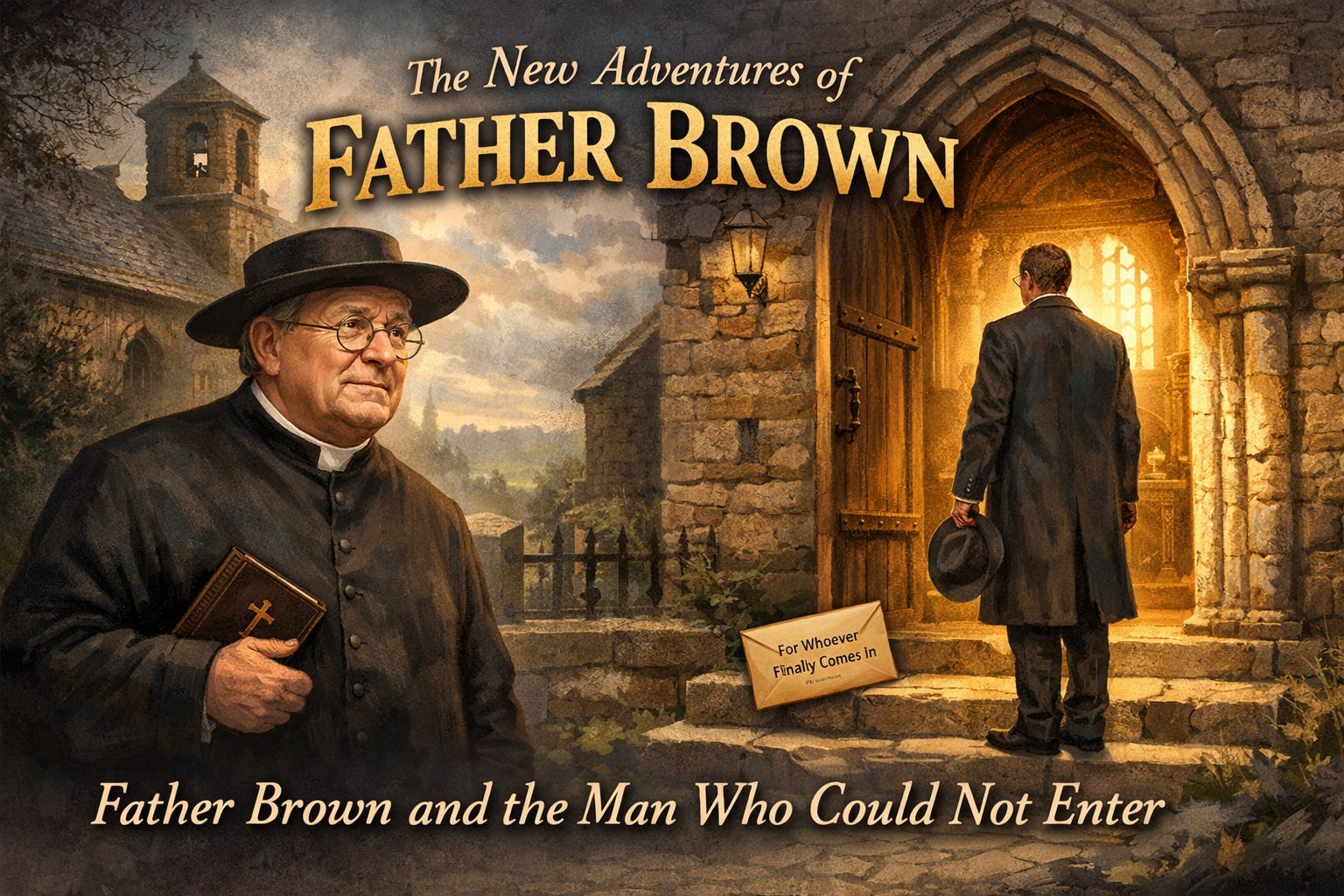
The church doors of St. Mildred’s were open.
This was, in itself, unremarkable. What was remarkable was the man standing outside them as if they were locked.
Father Brown noticed him because he was not looking at the church, but at the ground — as though the stones of the path were offering an argument he was losing.
He was a well-dressed man in a city overcoat, gloves still on despite the mild morning, hat in hand. He looked, Father Brown thought, like a man about to give a speech — except there was no one to hear it.
“You may go in,” said Father Brown gently, coming up beside him.
The man startled. “I beg your pardon?”
“The church,” said Father Brown, nodding toward the open door. “It’s not a museum. You’re allowed.”
The man forced a thin smile. “I was just leaving.”
“You have not yet arrived,” said Father Brown.
That, for some reason, seemed to irritate him.
“My name is Adrian Morley,” the man said stiffly. “I was merely… observing the architecture.”
“From the back of your conscience,” said Father Brown cheerfully. “I’m Father Brown.”
Morley hesitated, then said with sudden sharpness, “You’re the priest here?”
“One of them. The church is God’s; the confusion is usually mine.”
Morley looked again at the doorway — at the warm interior light, the scent of wax and old wood drifting out like a welcome. His jaw tightened.
“I don’t go in,” he said.
Father Brown tilted his head. “Because you do not believe?”
“Because,” Morley said, “I know.”
The Accusation
They walked together along the low stone wall beside the churchyard.
“I was once on the parish council here,” Morley said abruptly. “Years ago. Before your time. I funded repairs. Organized drives. Everyone said I was a pillar of the church.”
“Those are usually hollow,” Father Brown said pleasantly.
Morley ignored him. “There was a man. Thomas Weaver. He worked for a small local charity. He accused me of financial misconduct. Claimed I’d steered contracts to my own firm.”
“And had you?”
Morley’s lips thinned. “It was… complicated.”
Father Brown nodded. “It always is, when one has explained it to oneself long enough.”
Morley stopped walking. “He ruined me. Public allegations. Investigations. I was cleared — legally. But my reputation never recovered. He lost his job. Moved away. Died, I hear, not long after.”
“And now,” said Father Brown, “you cannot enter a church.”
“I will not,” Morley snapped. “I have done nothing that cannot be justified.”
“That is a very different thing,” said Father Brown quietly.
The Envelope
They returned toward the church door. A small brown envelope lay on the stone step, addressed simply:
For Whoever Finally Comes In
Morley froze.
Father Brown bent with difficulty and picked it up. “Ah. Providence has dreadful handwriting but excellent timing.”
“It’s not for me,” Morley said quickly.
“Most letters worth reading aren’t,” said Father Brown, opening it.
Inside was a folded sheet, worn at the creases.
Father Brown read silently, then handed it to Morley.
The handwriting was shaky.
If you are reading this, it means you have done what I could not — you have come back. I am Thomas Weaver. I wrote this when I knew I was dying.
I accused Adrian Morley because I believed I was right. Later I discovered I had misunderstood part of the evidence. I was too proud to admit doubt. I let anger do the rest. I harmed a man’s name — perhaps unjustly.
If Adrian ever returns, tell him I am sorry. Not because he was innocent, and not because he was guilty, but because I judged him without mercy.
God will sort the accounts. I could not.
Tell him the church door is still open.
Morley’s hands trembled.
“This is a trick,” he whispered.
“Yes,” said Father Brown. “One of God’s better ones.”
The Real Barrier
“I didn’t know,” Morley said hoarsely. “I thought he hated me.”
“He probably did,” said Father Brown. “For a while. Most people do their worst sins while thinking they are being very brave.”
Morley looked at the doorway again. “But he says he might have been wrong. That means—”
“That you might have been right?” Father Brown shook his head. “No. It means he was a sinner. Like you. Like me. The difference is he discovered it before he died.”
Morley’s voice rose. “But I was cleared!”
“In court,” said Father Brown. “Not in your soul.”
Morley sagged against the church wall. “I did benefit from those contracts. I told myself it was only fair. That everyone did it. That the charity would survive.”
“And did it?”
Morley closed his eyes. “Barely.”
Father Brown nodded. “You see, Mr. Morley, the door you cannot enter is not made of oak. It is made of excuses.”
Clean Hands
A shaft of morning light fell across the threshold.
Morley stared at his gloved hands.
“I’ve donated to hospitals,” he said weakly. “Scholarships. Relief funds.”
“Very good,” said Father Brown. “God loves generosity. But He has a particular fondness for honesty.”
Morley slowly pulled off one glove, then the other, as if uncovering evidence.
“What do I do?” he asked.
Father Brown smiled gently. “You ascend.”
“I’m not sure I can.”
“No one ever is,” said Father Brown. “That’s why the stairs are called grace.”
Morley looked at the letter again, then at the open door.
“Will God forgive me?” he asked.
Father Brown considered. “Yes.”
Morley blinked. “Just like that?”
“Oh no,” said Father Brown. “Not just like that. First you must admit you are the sort of man who needs forgiving. That is the hard part.”
Morley took a step toward the entrance — then stopped.
“I feel like a fraud.”
“Excellent,” said Father Brown. “That is the beginning of truth.”
The Mystery Solved
Later, Father Brown would say that the mystery had not been about money, or contracts, or accusations.
It had been about a man who believed the church door was locked because his pride was.
When Morley finally crossed the threshold, he did not look triumphant. He looked like a man entering a hospital after pretending for years he was perfectly healthy.
Father Brown remained outside a moment, looking up at the old stone tower.
“Who shall ascend the hill of the Lord?” he murmured.
Then he waddled in after the sinner, which was, after all, his professional duty.
And the church door remained open.