

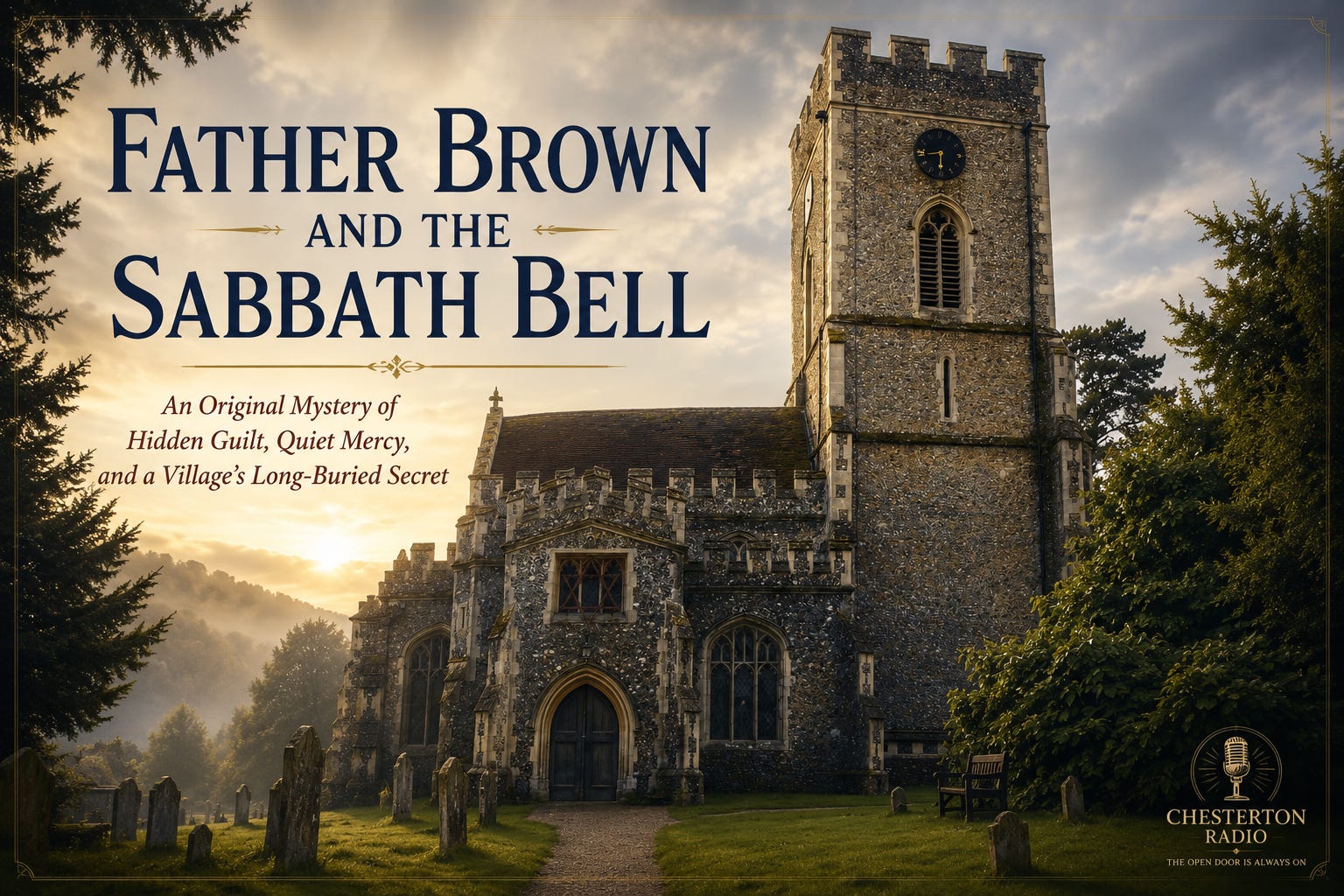
Introduction
There are villages that appear untouched by time.
Little Bracken is one of them.
Its cottages gather around the ancient church of St. Michael, where generations have marked the passing of life beneath the sound of a single bell. Harvests have come and gone, children have grown old, and families have carried both their joys and their sorrows beneath its quiet tower.
When the village’s most respected benefactor, Sir Julian Ashcombe, is found dead beneath that bell on an otherwise peaceful Sunday afternoon, the tragedy seems at first to be simple. Yet every answer uncovers another question. Old friendships conceal forgotten obligations. Acts of generosity hide deeper wounds. Long-buried memories refuse to remain buried.
Inspector Arthur Vale approaches the mystery with patience, careful observation, and an unwavering commitment to the evidence. Beside him is Father Brown, whose quiet understanding of human nature often sees beyond appearances, reminding those around him that truth is rarely hidden by cleverness alone, but by the complicated ways ordinary people seek to protect those they love.
As the investigation unfolds, events from more than twenty years earlier begin to cast long shadows across the present. A child’s death, a family shattered by grief, anonymous letters, secret acts of mercy, and a village bound together by silence gradually reveal themselves to be parts of the same unfinished story.
Father Brown and the Sabbath Bell is an original mystery inspired by the enduring tradition of the classic English detective novel. It is a story not only of crime and investigation, but of conscience, forgiveness, and the price of carrying another person’s burden. In Little Bracken, the greatest mysteries are found not in hidden passages or ingenious devices, but within the hearts of ordinary people whose best intentions have become entangled with fear, loyalty, and regret.
The bell of St. Michael’s has remained silent for many years.
Its final echo is only now beginning to be heard.
Father Brown and the Sabbath Bell
Part One
Sunday arrived upon the valley with such quiet certainty that it seemed less like another day than the fulfillment of a promise. The mist had risen from the little river before dawn and now lingered only in the hollows beyond the wheat fields, where it drifted in pale ribbons between ancient hedgerows. Above it all, St. Michael’s tower stood upon its low rise of earth, neither commanding the countryside nor surrendering to it, but belonging to it in the peculiar fashion of old churches that have watched generation after generation pass beneath their shadow.
The village of Little Bracken had no ambition to become remarkable. Travelers occasionally stopped for luncheon at the King’s Stag Inn and remarked that it was “quite untouched.” The villagers always smiled politely at such compliments, knowing that nothing inhabited by ordinary people was ever untouched. Time had laid its hand upon every stone. Storms had bent the oldest elms. Joy had filled the cottages as often as grief. The place remained beautiful only because no one had attempted to make beauty its chief business.
The bell began to ring.
Its sound did not seem to travel through the morning so much as awaken memories already resting within it. Doors opened. A shepherd closed his gate. Children, scrubbed into reluctant respectability, followed patient mothers toward the churchyard. The innkeeper removed his apron, locked the front door with unnecessary ceremony, and informed his empty common room that ale would have to wait until salvation had been suitably acknowledged.
Miss Eleanor Briggs, who kept the village shop, stood outside arranging baskets of apples. She believed fruit ought to be displayed with optimism even when England had not produced an optimistic harvest. Across the lane, old Matthew Dobson, the sexton, inspected the church gate for the third time that morning, although no sensible person imagined the gate capable of changing its mind overnight.
“You’re expecting royalty,” Miss Briggs observed.
“No,” Dobson replied. “Only parishioners.”
“I’ve always found them rather less predictable.”
Dobson grunted. It was impossible to determine whether he agreed.
Along the footpath that crossed the western meadow walked Thomas Hale with his wife Anne and their two children. Thomas worked the land belonging to Ashcombe Manor. His boots were carefully repaired, his jacket was not, and his youngest daughter carried a crust of bread in one hand while attempting to gather daisies with the other.
“You’ll lose one or the other,” Anne said.
“I know.”
“Which?”
“The daisies.”
Her mother smiled.
There are moments when poverty possesses a dignity wealth can scarcely understand. They are seldom grand moments. More often they consist of a child refusing to complain because she has already learned that complaint cannot bake another loaf.
The bells continued.
Not far behind the Hale family came Sir Julian Ashcombe.
He was a man whom strangers admired almost immediately.
Tall, silver-haired, impeccably dressed without ostentation, he possessed the composed bearing that newspapers often describe as distinction when they cannot think of anything more precise. Ashcombe Manor overlooked the village from the eastern hill. During the previous twenty years Sir Julian had restored the church roof, endowed scholarships for village children, rebuilt the infirmary after a fire, and quietly paid more mortgages than anyone knew.
His generosity was genuine.
No one denied it.
His devotion to duty was equally genuine.
That, too, no one denied.
Yet there existed around him a curious reserve, as though gratitude itself hesitated before approaching too closely.
He greeted each villager by name.
“Good morning, Mrs. Briggs.”
“Good morning, Sir Julian.”
“Young Edward, have you remembered your catechism?”
“I think so, sir.”
“Thinking is an uncertain substitute for remembering.”
The boy blushed.
Sir Julian smiled kindly enough, but the kindness carried the firmness of polished oak.
When he reached Thomas Hale, he paused.
“I understand one of my western hedges has been disturbed.”
Thomas nodded.
“The storm brought half of it down.”
“So I was told.”
“I stayed late yesterday repairing it.”
“I know.”
There followed one of those brief silences during which two perfectly honest men somehow fail to understand one another.
“I also heard,” Sir Julian continued, “that several gleaners entered the south field before permission had been granted.”
Thomas answered carefully.
“They gathered only what had already fallen.”
“Rules are often made precisely for occasions that appear harmless.”
“They were hungry.”
Sir Julian regarded him steadily.
“Hunger does not repeal order.”
“No, sir.”
“It is fortunate that we have charity.”
“It is.”
The conversation ended courteously.
Neither man raised his voice.
Neither spoke untruthfully.
Yet Mrs. Hale found herself drawing her children a little closer as they walked on.
Inside the churchyard, Canon Richard Ellwood stood welcoming parishioners. He was a broad-shouldered clergyman whose sermons were occasionally longer than intended and whose parishioners forgave him because they suspected he always believed there was one more hopeful thing worth saying.
He looked up as another visitor entered through the lychgate.
The newcomer was short, slightly round, dressed in an old black coat that had surrendered any ambition toward elegance years earlier. His umbrella appeared determined to survive another decade despite evidence to the contrary.
“Father Brown!”
The little priest removed his hat.
“Good morning.”
“You’ve come earlier than expected.”
“The train surprised everyone by arriving where it was meant to.”
Canon Ellwood laughed.
“That alone deserves thanksgiving.”
“I included it.”
Father Brown looked about the churchyard with mild interest. He noticed the children chasing one another between ancient gravestones, an elderly widow straightening flowers no one else would have seen were crooked, and a robin perched upon the shoulder of a weathered stone saint.
He also noticed Thomas Hale watching Sir Julian.
Not angrily.
Not fearfully.
Only with the expression of a man trying to reconcile gratitude with disappointment.
The observation passed across Father Brown’s face as lightly as a cloud crossing sunlight.
No one else appeared to see it.
The congregation gathered.
Within St. Michael’s the air retained that cool fragrance peculiar to churches built before memory itself seemed modern. Candles flickered beneath worn carvings. Sunlight entered through stained glass that had outlived kings and fashions alike, casting patches of crimson and sapphire upon the stone floor.
The Gospel spoke of the disciples plucking ears of corn upon the Sabbath.
Some listened with habitual reverence.
Some with wandering attention.
Some with private concerns.
Father Brown listened as though hearing familiar music played upon a different instrument.
When the service ended, people emerged into the brightness of late morning.
The churchyard quickly became a small republic of conversations.
The schoolmistress, Miss Lydia Marsh, discussed examinations with Canon Ellwood.
Dr. Edwin Fletcher complained cheerfully that nobody became ill on weekdays anymore.
The landlord of the King’s Stag invited anyone willing to forgive his cooking.
Old Dobson examined the bell ropes once more.
Sir Julian stood near the porch speaking with two churchwardens.
“You’ve done remarkable work on the restoration,” one said.
“It was necessary.”
“You’ve preserved the church.”
Sir Julian glanced toward the tower.
“We preserve what has been entrusted to us.”
Father Brown, standing only a few yards away, bent to retrieve a small wooden spinning top that one of the children had dropped.
The little boy thanked him.
“You nearly lost your world,” Father Brown said, handing it back.
“It’s only a toy.”
“So it is.”
The priest smiled.
“But children usually know which things are only toys better than grown men do.”
The boy nodded solemnly without understanding.
Children often recognize truth long before they understand it.
The churchyard gradually emptied.
Families drifted home.
The inn reopened.
The village settled into the peaceful rhythm of a Sunday afternoon.
Sir Julian remained behind.
“I should like a moment alone,” he told Canon Ellwood.
“Certainly.”
“I wish to inspect the bell chamber afterward. Dobson mentioned a fault in one of the beams.”
“I’ll send him.”
“No need.”
The Canon inclined his head.
Sir Julian crossed the churchyard and entered the tower.
Father Brown watched him disappear.
Then he turned unexpectedly toward Miss Briggs’s shop.
“You’ve forgotten something?” the Canon asked.
“No.”
“What are you looking for?”
“I’m not entirely sure.”
The little priest studied the dusty roadway.
A sparrow hopped twice before him and flew away.
Father Brown smiled faintly.
“It is curious,” he said.
“What is?”
“People often look upward in churches.”
“Naturally.”
“And yet,” Father Brown replied, “it is usually the things nearest our feet that trip us.”
Before the Canon could answer, hurried footsteps came across the green.
Young Edward Ash, the blacksmith’s apprentice, arrived breathless.
“Mr. Dobson’s nowhere to be found.”
“He was here moments ago.”
“The noon Angelus...”
Everyone stopped.
The bell had not rung.
The omission seemed strangely larger than silence itself.
Old habits are like the foundations of a house; one notices them chiefly when they fail.
Canon Ellwood frowned.
“Come.”
He, Father Brown, Dr. Fletcher, and several villagers crossed the churchyard together.
The tower door stood ajar.
Inside, the spiral staircase climbed into cool darkness.
“Dobson?” the Canon called.
No answer.
They began to ascend.
Their footsteps echoed upon the worn stone.
Halfway upward, Dr. Fletcher stopped.
“Do you smell that?”
No one answered.
There was nothing extraordinary in the scent itself—only old timber, bell rope, dust, and something faintly metallic that did not belong.
They climbed higher.
The bell chamber lay flooded with pale afternoon light streaming through the wooden louvres.
The great bell hung motionless above them.
One rope swayed almost imperceptibly.
Upon the ancient floorboards, beneath the silent bell he had so faithfully maintained for years, lay Sir Julian Ashcombe.
He was perfectly still.
One hand rested upon the fallen bell rope as though reaching for it even now.
His face bore neither terror nor anger.
Only astonishment.
For a long moment no one spoke.
Outside, swallows wheeled through the brilliant summer sky.
The wheat moved in slow golden waves beyond the churchyard wall.
The village waited for the Angelus that never came.
And in the silence beneath the bell, it seemed that something more than a man’s life had been broken.
Father Brown and the Sabbath Bell
Part Two
And in the silence beneath the bell, it seemed that something more than a man’s life had been broken.
Canon Richard Ellwood was the first to move.
He took one step toward the body and then stopped, as if some invisible boundary had been drawn across the floorboards. There was nothing theatrical in the movement. It was simply the hesitation of a man who had spent his life entering rooms where suffering waited for him, yet had never learned to enter without reverence.
Dr. Edwin Fletcher passed him.
The doctor had been cheerful on the staircase, almost professionally so, but the expression left his face as he knelt beside Sir Julian Ashcombe. He placed two fingers against the dead man’s throat, though the gesture seemed no more than a formality. Then he bent close to the mouth and examined the eyes.
“No one touch anything,” he said.
