

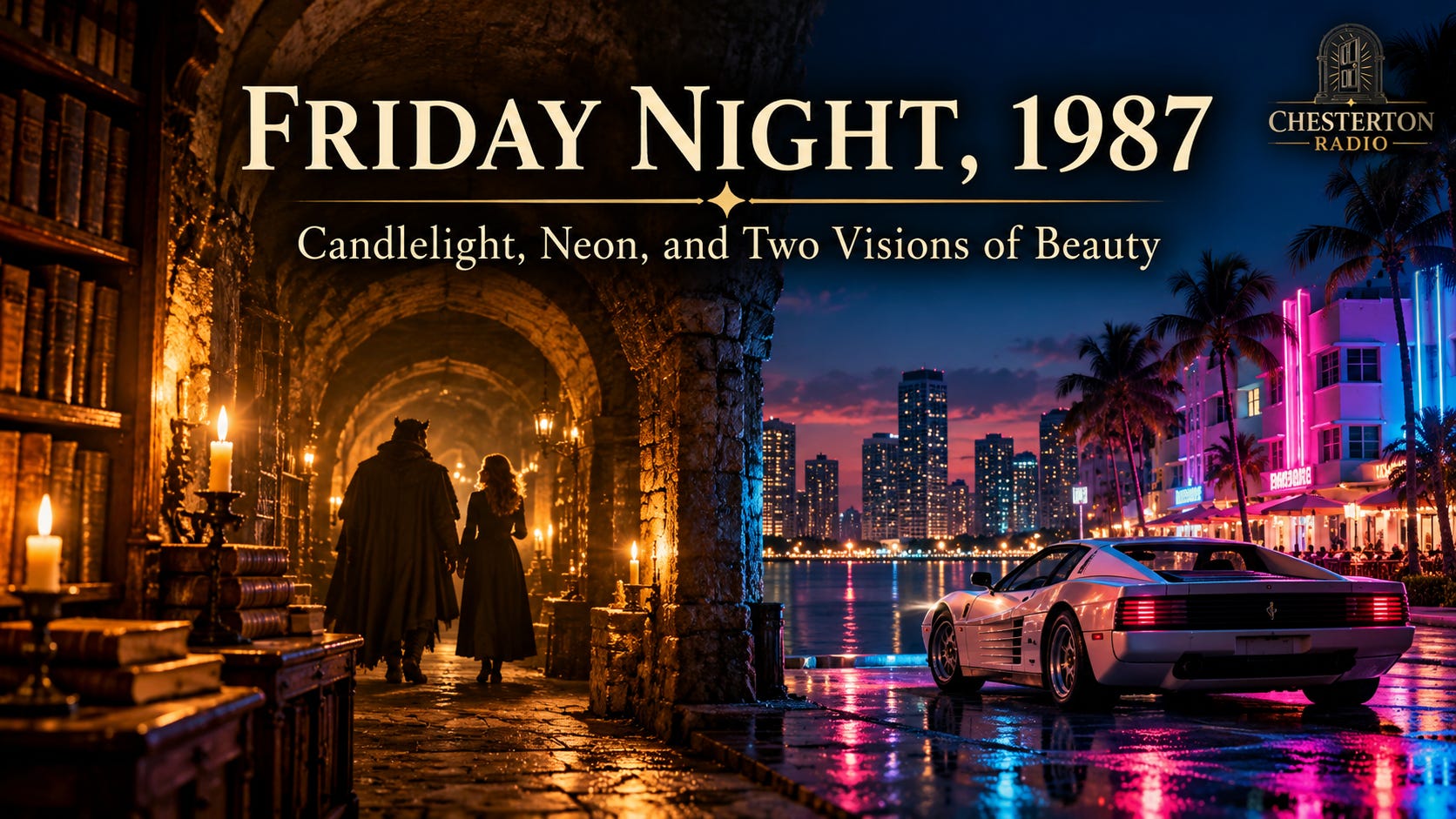
I remember looking forward to Friday nights.
Not simply because Friday meant the end of the working week. There was something waiting on television.
In my memory, it is Miami Vice and then Beauty and the Beast. Or perhaps Beauty and the Beast and then Miami Vice. Nearly forty years later, the order has become less certain than the feeling.
And perhaps that is appropriate.
Because the television schedule tells us something rather wonderful.
During the 1987–88 season, CBS scheduled Beauty and the Beast at 8:00 on Friday evenings. NBC scheduled Miami Vice at 9:00. So a viewer who loved both programs could spend an hour beneath the streets of New York with Vincent and Catherine, and then, with the push of a button—or perhaps the mechanical clunk of a channel selector—emerge into the neon night of Miami with Crockett and Tubbs.
The arrangement really happened. CBS announced Beauty and the Beast for Fridays at eight, starring Linda Hamilton and Ron Perlman, while Miami Vice occupied NBC’s Friday 9:00 slot from June 1986 until March 1988.
What an extraordinary two hours of television that was.
One hour gave us stone walls, candlelight, books, poetry, cloaks, tunnels and an impossible love.
The next gave us glass, chrome, Ferraris, speedboats, synthesizers, nightclubs and an impossible war.
One city seemed to belong to the Middle Ages.
The other seemed to belong to the future.
And both existed in contemporary America.
Looking back, the most interesting question may not be why these two utterly different programs could coexist on Friday night.
It may be why the same person could love them both.
Because beneath all the obvious differences, Beauty and the Beast and Miami Vice were asking surprisingly similar questions.
What remains when appearances are stripped away?
What is worth protecting?
Where does a person belong?
And what if the world everyone calls real is not quite as real as it looks?
At Eight O’Clock, Go Below
Beauty and the Beast premiered on CBS in September 1987.
Its premise sounded like something that ought not to have survived a network programming meeting.
Catherine Chandler, played by Linda Hamilton, is a successful young woman living in Manhattan. After a brutal attack, she is rescued by Vincent, played by Ron Perlman, a powerful, leonine man who lives in a hidden civilization beneath New York.
The series had been created by Ron Koslow, with Paul Junger Witt and Tony Thomas among its executive producers. Later in that first season, a young television writer and producer named George R. R. Martin would become part of the creative team. Contemporary credits confirm Martin as both producer and writer during the first season.
But those facts don’t explain the program.
You have to remember how it looked.
The world above was recognizably late-1980s Manhattan: offices, apartments, courtrooms, streets, telephones, elevators, ambition, danger.
Then Catherine descended.
And suddenly there were candles.
Stone.
Old furniture.
Books.
Firelight.
People sitting together.
Children being taught.
Messages carried through tunnels.
A community governed less by institutions than by relationships and obligations.
And Vincent.
Ron Perlman’s performance is one of the reasons the entire improbable enterprise works. Vincent could easily have become a costume, a gimmick or a superhero. Instead Perlman made him thoughtful, educated, gentle, dangerous when necessary and painfully conscious of the boundary separating him from Catherine.
That boundary matters.
Vincent cannot simply move into Catherine’s apartment and become another handsome television boyfriend after the makeup comes off.
There is no makeup to come off.
His difference is real.
The romance therefore lives within limits.
That is almost shocking by contemporary standards. Much modern storytelling assumes that a barrier exists principally so that the characters can smash through it. Beauty and the Beast understood something older: sometimes the barrier is what gives the longing its shape.
Vincent and Catherine’s relationship could therefore be intensely romantic without constantly becoming physical.
A rooftop.
A balcony.
A book.
A conversation.
A hand extended.
A promise.
Things that would seem impossibly small in another program became enormous.
The show was not embarrassed by earnestness.
That may be one of the things that makes it seem stranger now than the Beast himself.
At Nine O’Clock, Go South
Then it was time to change channels.
The candles disappeared.
The synthesizer arrived.
Miami Vice had premiered on NBC in 1984, created by Anthony Yerkovich with Michael Mann as executive producer. By the 1987–88 season, Crockett and Tubbs were already cultural icons. Contemporary program records list Don Johnson as Detective James “Sonny” Crockett, Philip Michael Thomas as Ricardo Tubbs, Edward James Olmos as Lieutenant Martin Castillo, and Jan Hammer as composer.
If Beauty and the Beast invited you below the modern city, Miami Vice put you directly onto its gleaming surface.
The cars.
The boats.
The hotels.
The clothes.
The ocean.
The palms.
The architecture.
The women.
The money.
The night.
And, above all, the color.
Miami Vice did not merely depict Miami. It created a Miami of the imagination.
Pastel walls against impossible blue skies. White linen at night. Chrome reflecting neon. Black water illuminated by pink and turquoise. A sports car moving down an empty road while music transformed a police procedural into something closer to a music video, an opera or a dream.
Don Johnson’s Crockett seemed to possess all the accessories that American popular culture associated with having made it.
The clothes were right.
The car was certainly right.
He lived on a boat.
He had an alligator.
Even Crockett’s rolled-up sleeves became part of the mythology. Johnson later recalled that the look had a practical origin: Miami was hot, so he pushed up his jacket sleeves and dispensed with belt and socks.
Yet there is something peculiar about remembering Miami Vice primarily as a celebration of glamour.
Because the show was often terribly sad.
Crockett lives inside the fantasy and knows what it costs.
People die.
Informants disappear.
Friends betray one another.
Cases end without restoring the moral order.
Love affairs do not necessarily rescue anyone.
Undercover identities eat into real identities.
The beautiful car keeps moving through the beautiful night, but Crockett increasingly looks like a man who knows that the road doesn’t lead where the advertisements promised.
The pastel colors may be bright.
The moral universe is often noir.
That is why Miami Vice lasted in the imagination after so many imitations of its fashion disappeared.
The clothes were not the story.
The contradiction was.
Candlelight and Neon
Put the two shows beside one another and something curious happens.
Beauty and the Beast looks like fantasy.
Miami Vice looks like reality.
But look again.
Vincent’s underground civilization is impossible, certainly. There probably isn’t a vast candlelit kingdom beneath Manhattan inhabited by poets, craftsmen, children and a leonine philosopher.
Yet what does Vincent’s supposedly fantastic world value?
Family.
Friendship.
Books.
Education.
Loyalty.
Memory.
Duty.
Hospitality.
Protection of the weak.
Sacrifice.
Love.
Now look at the fantastic surface of Miami Vice.
Endless money.
Endless pleasure.
Endless mobility.
Beautiful people.
Beautiful machines.
Beautiful houses.
Beautiful clothes.
No roots.
No limits.
No permanence.
Which world was really the fantasy?
That question is too easy if we turn it into a sermon. Miami Vice itself knew that the glitter was insufficient. Indeed, that knowledge is one reason the program was so good.
But imagine watching these worlds consecutively.
At eight o’clock, beauty is something hidden beneath the surface.
At nine o’clock, beauty is the surface.
One show takes us downward.
The other races horizontally.
Vincent descends into the earth.
Crockett accelerates toward the horizon.
Neither can entirely escape his world.
The Sound of Two Cities
And then there was the music.
It is difficult now to communicate how revolutionary the use of music in Miami Vice seemed.
Popular songs had appeared on television before, of course. But Miami Vice treated recorded music as something more than background decoration. Michael Mann recalled wanting music that did not sound like generic television drama, while Jan Hammer was given unusual creative freedom in constructing the electronic score.
Hammer’s theme became a phenomenon in its own right. It reached No. 1 on the American pop chart, and the Miami Vice soundtrack album was itself enormously successful. Blue Note’s biography of Hammer notes that the theme earned him two Grammys.
The series used artists including Phil Collins, Glenn Frey and Kate Bush alongside Hammer’s original compositions. Contemporary critics recognized that the music wasn’t merely accompanying the images; it was integral to the program’s identity.
There were sequences in Miami Vice where the story seemed temporarily to stop being television drama and become something else.
Music.
Images.
Movement.
Emotion.
A car traveling through the night could become a character moment.
A song could tell us what Crockett would never say.
Then consider the musical world from which the viewer had just emerged.
Beauty and the Beast used an orchestral vocabulary. Lee Holdridge composed its theme, with Don Davis credited for music on episodes including “Nor Iron Bars a Cage” and “Promises of Someday.”
Its sound belonged to romance, mystery and fairy tale.
And beyond music there was the sound of language.
Vincent reads.
That shouldn’t be a radical characteristic for a television hero, but it almost feels like one now.
Literature in Beauty and the Beast isn’t set dressing designed to tell us that Vincent is clever. Books belong to the civilization below. Stories, poetry and inherited language connect people who have deliberately placed themselves outside much of modern life.
Vincent’s physical appearance suggests the primitive.
His interior life reveals civilization.
That reversal is essential.
The Beast knows poetry.
The sophisticated world above often behaves like a jungle.
And so, on one Friday evening, your ears could travel as far as your eyes.
Strings, poetry and whispered conversation beneath Manhattan.
Then synthesizers, rock songs, engines and gunshots beside the Atlantic.
You did not need an algorithm to recommend the second world after the first.
You changed the channel.
When Television Had an Appointment
That channel change is worth remembering because television itself worked differently.
We talk about “watching television” today, but the phrase describes a fundamentally different activity.
Today we choose.
In 1987, television also chose us.
A program existed at a time.
Friday at eight.
Friday at nine.
If you weren’t there, you might miss it.
Yes, there were VCRs. Some households became quite sophisticated at programming them, assuming nobody accidentally changed the channel or caused the machine’s little digital clock to flash 12:00 for six months.
But television remained primarily an appointment.
The schedule mattered.
The anticipation mattered.
The opening theme mattered because it announced that the thing you had been waiting for all week had finally arrived.
And everyone else watching was watching at essentially the same moment.
The 1987–88 Friday schedule now looks like an archaeological cross-section of American popular culture.
At eight, ABC offered Full House and another sitcom; CBS offered Beauty and the Beast; NBC had Rags to Riches. At nine, ABC offered the cyberpunk satire Max Headroom, CBS had the oil-and-wealth juggernaut Dallas, and NBC had Miami Vice. At ten came 20/20, Falcon Crest and NBC’s Private Eye during the fall lineup.
Just consider that nine o’clock choice.
Max Headroom.
Dallas.
Miami Vice.
Three versions of the future, money and modernity sitting next to one another on the dial.
And before them, on CBS, was a Beast reading books by candlelight.
You couldn’t invent a better cultural exhibit.
The Two Outsiders
There is another reason Beauty and the Beast and Miami Vice fit together better than they first appear.
Both are stories about divided people.
Vincent belongs to one world but loves someone in another.
Catherine increasingly belongs to both.
Crockett is a police officer who must continually inhabit the identity of a criminal.
Tubbs is a New York cop who comes to Miami pursuing his brother’s killer and becomes part of this strange tropical moral landscape.
Everyone is crossing boundaries.
Above and below.
Police and criminal.
Civilization and wilderness.
Appearance and reality.
Public identity and hidden self.
Vincent’s divided identity is visible on his face.
Crockett’s is concealed behind sunglasses.
That may be the most striking comparison of all.
Neither man can simply be what the world sees.
And both are lonely.
Vincent has a community, but there is one world he cannot fully enter.
Crockett can go almost anywhere, but seems increasingly uncertain where home is.
One man is physically confined and spiritually rooted.
The other possesses extraordinary mobility and is spiritually adrift.
There is something almost Chestertonian in the reversal.
What Chesterton Might Recognize
There is no need to recruit G. K. Chesterton as a television critic for NBC and CBS.
He died decades before either program existed.
But he would have recognized the paradox.
Chesterton repeatedly returned to the idea that wonder does not require escaping ordinary reality. The difficulty is learning to see reality again.
Modern people, in his telling, can become so accustomed to existence that we stop noticing how astonishing it is.
Beauty and the Beast makes the ordinary strange by placing it underground.
A family dinner becomes precious.
A book becomes a treasure.
A safe home becomes miraculous.
A promise becomes binding.
Candlelight becomes beautiful because darkness exists around it.
Limits make things matter.
That is a very Chestertonian idea.
And Miami Vice, curiously, approaches the same truth from the opposite direction.
It gives its characters almost everything modernity can offer and then asks why they are still unhappy.
More speed does not solve the problem.
More money doesn’t.
A better car doesn’t.
A more beautiful view doesn’t.
Freedom without belonging can become another kind of prison.
Neither show states these ideas as propositions. Thank goodness.
They dramatize them.
And sometimes television understands an idea better when it doesn’t know it is discussing philosophy.
What America Was Watching
The pairing also tells us something about America in 1987.
The decade is remembered through its surfaces: Wall Street, conspicuous consumption, designer labels, personal computers, shopping malls, aerobics, sports cars, MTV.
Those things were real.
But so was the hunger for their opposite.
The same culture that made Miami Vice a phenomenon made Beauty and the Beast a network series.
That is remarkable.
CBS didn’t hide the show on some experimental cable channel. It placed it at eight o’clock Friday as the lead-in to Dallas and Falcon Crest. A contemporary Los Angeles Times report noted that CBS expected the romantic fantasy to attract a substantial female audience and deliberately positioned it before those established Friday dramas.
Millions of Americans who were being told that the future was sleek, fast and electronic were also willing to visit a place where people communicated through pipes, read poetry and lived by candlelight.
Perhaps those desires were not contradictory.
Perhaps they were complementary.
We wanted the Testarossa.
And we wanted the tunnel.
We wanted the future.
And we were already beginning to wonder what it might cost.
What We Lost Wasn’t Necessarily Better Television
It is tempting at this point to say that television was better then.
That is too easy.
Some of it was wonderful.
Some of it was terrible.
The same is true now.
Today’s best television can achieve things that the old network system could scarcely attempt. Long-form storytelling is more sophisticated. Production values can be cinematic. Entire international libraries are instantly available.
I can watch practically anything I want tonight.
That is an extraordinary privilege.
But something did disappear.
Not quality.
Rhythm.
Friday night meant something because Friday night had a schedule.
The limitation created anticipation.
You couldn’t have the program whenever you wanted it.
Therefore you wanted it more when it arrived.
And there was a communal dimension that streaming has difficulty reproducing.
You watched an episode on Friday because that was when the episode existed.
Someone at work had watched it.
Someone at school had watched it.
Your neighbor had watched it.
On Saturday morning, people could talk about the same thing because they had experienced it at nearly the same time.
Today we sometimes begin conversations with a negotiation:
“Have you seen it?”
“What season are you on?”
“Don’t tell me anything.”
“I’m only on episode four.”
The enormous abundance of entertainment has paradoxically made shared entertainment harder.
We gained the library.
We lost some of the appointment.
And an appointment has one great advantage over a library.
You can look forward to it.
Friday Night Again
Perhaps that is why the memory survives.
I don’t remember every episode.
I don’t even remember the order correctly.
In memory, Miami Vice may come first and Beauty and the Beast second.
The old schedules insist otherwise.
But memory has preserved something more interesting than a television grid.
It preserved the anticipation.
Friday was coming.
And when it arrived, there were places to go.
At eight o’clock there was a city beneath New York where a creature who looked like a beast read books, loved a woman he could not entirely possess, and belonged to a community that believed some things were worth protecting.
At nine there was another city, blazing with artificial light, where two detectives drove through paradise hunting men who had discovered how easily desire could be turned into a business.
The first city was impossible.
The second one actually existed.
And somehow the impossible city sometimes seemed more real.
That may be what I didn’t understand in 1987.
I simply knew I wanted to watch.
Nearly forty years later, putting the two programs beside one another reveals something I couldn’t have articulated then.
They weren’t opposites after all.
Both were suspicious of appearances.
Both were fascinated by people with divided identities.
Both understood loneliness.
Both believed beauty mattered.
Both placed violence beside beauty and asked whether beauty could survive.
Both gave us heroes trying to preserve some fragment of goodness in worlds that continually threatened it.
They simply illuminated those questions differently.
One used candles.
The other used neon.
And perhaps that is why the memory of those Friday evenings has lasted.
One moment, candlelight beneath Manhattan.
The next, neon reflected in Miami water.
Two cities.
Two visions of beauty.
Two visions of the modern world.
And for a brief period in the late 1980s, both were waiting for us on Friday night.
P.S. — The Chesterton Radio World
This is the sort of journey we love taking at Chesterton Radio: following an old television program, a forgotten radio play, a piece of music or a Chesterton essay until we discover that what looked like nostalgia was really a doorway.
Around here you’ll find classic radio drama and literature, Reading Chesterton, the morning explorations of Daybreak, music, cultural deep dives, and the Open Door, our 24-hour stream where there is always something playing somewhere in the Chesterton Radio world.
The programs may be old.
The questions usually aren’t.