

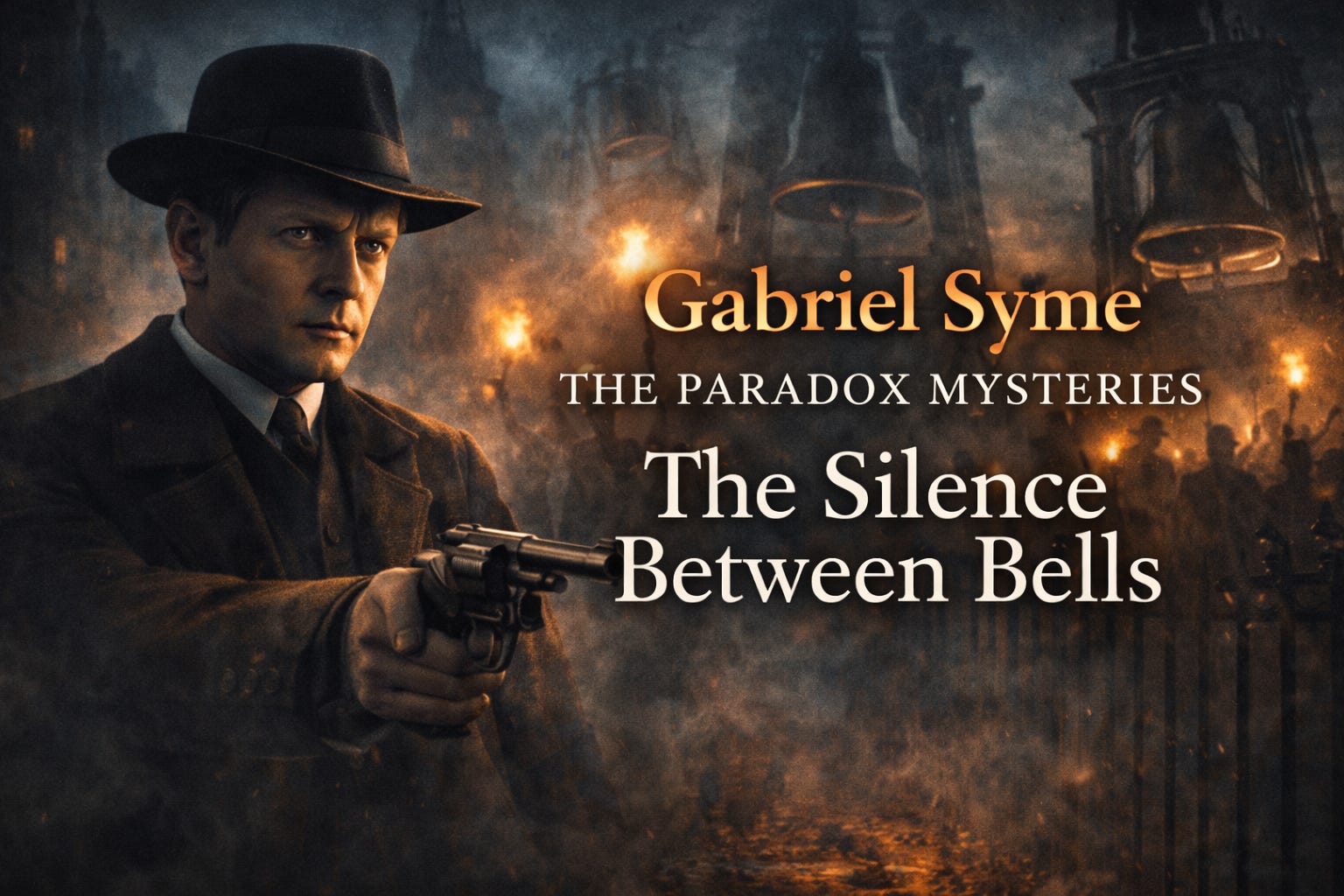
Series Introduction
There are detectives who solve crimes.
There are philosophers who solve arguments.
Gabriel Syme solves something more dangerous:
he solves ideas before they explode.
Once known—by certain discreet authorities—as “Thursday,” Syme learned that the gravest conspiracies are not those that blow up buildings, but those that quietly undermine meaning itself. For bombs destroy walls; ideas dissolve foundations.
In these chronicles, Syme confronts those who would abolish order in the name of freedom, dissolve structure in the name of progress, or silence bells in the name of peace.
For the world is not threatened merely by violence.
It is threatened by clever despair.
And Syme has made a profession of opposing it.
Episode I
The Silence Between Bells
London was not quiet.
It merely pretended to be.
The rain fell in thin, determined lines; hansom wheels hissed across wet cobblestones; somewhere a piano labored through optimism. Yet Gabriel Syme felt that beneath the city’s respectable noises lay something withheld—like a sentence interrupted before its verb.
He stood beneath the tower of St. Mildred’s, watching the clock.
It was not wrong.
It was late.
And yet it did not strike.
Midnight passed as if embarrassed.
Syme adjusted his hat.
“A bell that refuses to speak,” he murmured, “is either broken or bribed.”
He suspected bribery.
I. The Letter Without a Signature
Earlier that evening, a letter had arrived at his lodgings.
It bore no name. Only a seal—an unadorned circle, perfectly blank.
Inside were four words:
THE PAUSE IS POWER.
Syme had smiled faintly.
Most revolutionaries favored exclamation marks.
This one preferred ellipses.
He followed the second line of the message to an address in Bloomsbury: a former music conservatory, now shuttered. The building’s façade bore carved angels who appeared to have lost confidence in their wings.
Inside, gas lamps burned low. And gathered in the hall were seven men seated at a long table.
No masks.
No banners.
Only stillness.
One rose as Syme entered.
“We are the Custodians of Interruption,” the man said calmly.
Syme removed his gloves.
“I had hoped for something less dramatic,” he replied.
II. The Philosophy of the Pause
The speaker introduced himself as Mr. Ravel.
“You are Gabriel Syme,” Ravel continued. “You believe in order.”
“I believe in music,” Syme said. “Order is merely its grammar.”
Ravel smiled thinly.
“Music is overrated. Silence is superior.”
“Silence is beautiful,” Syme conceded. “But only because it frames sound.”
Ravel gestured to the darkened piano behind him.
“Civilization,” he said, “is intoxicated with continuity. Clocks strike. Bells ring. Trains depart. Sermons conclude. Everything insists on progression.”
“Yes,” said Syme.
“We propose interruption.”
Syme nodded politely.
“Most criminals do.”
Ravel ignored this.
“Tomorrow,” he said, “every major bell tower in London will fail to ring. Noon will pass unannounced. Vespers will not sound. Midnight will arrive unnoticed.”
“And you believe this will accomplish…?”
“A revelation,” Ravel replied. “Men will see that time is arbitrary. Structure is imagined. Authority is theatrical.”
Syme folded his hands.
“Or,” he said gently, “they will think the bells need repair.”
Ravel’s eyes sharpened.
“You underestimate absence.”
“I never underestimate absence,” Syme said softly. “It is the most persuasive liar in existence.”
III. The Mechanism
The conspiracy was ingenious.
A series of small devices—ingenious clock-stopping instruments—had been smuggled into tower mechanisms by sympathetic engineers. At a signal transmitted through a crude electrical network, each would halt its respective bell hammer.
The plan was not to destroy.
It was to delay.
“Delay,” Ravel explained, “creates doubt. Doubt creates detachment. Detachment dissolves allegiance.”
Syme regarded him thoughtfully.
“You believe men obey bells,” he said.
“They obey habit.”
“And habit is tyranny?”
“It is sedation.”
Syme’s voice softened.
“Habit,” he said, “is memory made friendly.”
Ravel’s lips tightened.
“At noon tomorrow,” he declared, “the city will pause.”
IV. Noon Without a Voice
Syme did not sleep.
Instead, he visited three churches before dawn and quietly warned their vergers. Not of conspiracy—no man believes a warning about silence—but of mechanical irregularity.
“Wind the secondary springs,” he advised. “Test the manual pull.”
The vergers nodded politely. They had seen stranger parishioners.
At precisely noon, London inhaled.
And waited.
One second passed.
Then two.
St. Mildred’s remained silent.
St. Bartholomew’s remained mute.
Across Bloomsbury, towers stood frozen.
Ravel stood in the conservatory hall, listening with predatory satisfaction.
“You see?” he whispered.
Syme listened too.
Then—faint, distant, imperfect—came a single bell.
Not from a grand cathedral.
From a modest parish on the city’s edge.
A hand-pulled bell.
Then another.
Then a third.
Not synchronized.
Not majestic.
But stubborn.
Within minutes, several churches—those warned to test manual pulls—began ringing.
The sound was uneven, almost comical.
But it was sound.
Ravel’s expression altered.
“That is insufficient,” he muttered.
Syme smiled.
“On the contrary,” he said. “It is exactly sufficient.”
V. The Paradox
The bells that rang were not automated.
They were human.
Men and boys had climbed towers and pulled ropes by hand.
The rhythm was flawed.
The tone irregular.
But the city heard it.
And something subtle occurred.
People checked pocket watches.
Shops adjusted shutters.
Workers resumed schedules.
The world did not dissolve.
It corrected.
Ravel stared at Syme.
“You interfered.”
“I cooperated,” Syme replied.
“With whom?”
“With gravity,” Syme said lightly. “With sunrise. With the fact that men do not require perfection to recognize pattern.”
Ravel shook his head.
“You have only delayed the inevitable.”
“Delay,” Syme said, “is your specialty.”
VI. The Arrest of Silence
The police arrived without spectacle.
The devices were seized.
The engineers questioned.
Ravel remained composed as he was led away.
“You cannot prevent interruption,” he said to Syme. “History itself is interruption.”
Syme considered this.
“Yes,” he agreed. “But interruption presumes something worth interrupting.”
Ravel frowned.
“What do you serve?” he demanded.
Syme looked toward the faint ringing still echoing through London.
“I serve the fact,” he said quietly, “that the universe is not embarrassed to continue.”
Epilogue — The Silence Between Bells
That evening, Syme walked once more beneath St. Mildred’s tower.
The clock struck properly.
The sound was ordinary.
Profoundly ordinary.
Syme reflected that true order is not theatrical. It does not shout. It does not even insist. It simply resumes.
There are men who would explode the city.
There are men who would freeze it.
Both misunderstand the same thing.
The world is not held together by force.
It is held together by promise.
And promise, like a bell, rings because someone wound it.
Syme turned toward the fog, which was already thinning.
For chaos may shout.
Silence may scheme.
But morning keeps its appointment.
Series Outro
Gabriel Syme: The Paradox Mysteries
Where conspiracy meets metaphysics.
Where chaos is interrogated.
Where order is not enforced — but revealed.
If you enjoyed this first installment, the next mystery will confront a darker idea still:
What happens when men attempt not to silence time…
but to rewrite memory?