

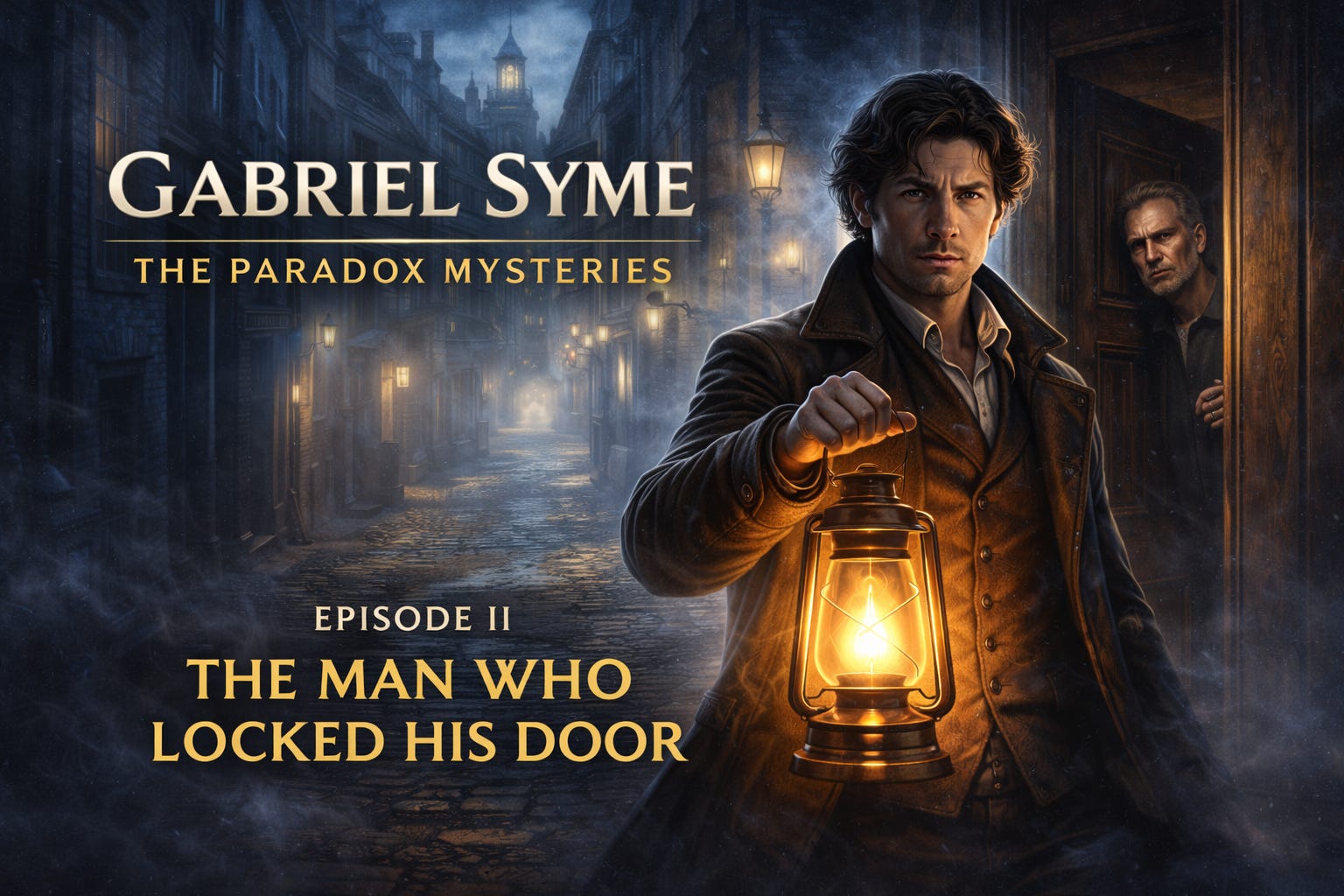
Intro
Each Thursday on Chesterton Radio, we follow Gabriel Syme — poet, philosopher, and reluctant detective — into the quiet wars of ideas.
Syme first appeared in G.K. Chesterton’s The Man Who Was Thursday, where he discovered that the most dangerous conspiracies are often philosophical ones. In these new chronicles, he continues that strange vocation: investigating the places where a good idea grows just a little too large for the world.
For crimes rarely begin with knives.
They begin with theories.
Tonight’s paradox concerns a man who did something extraordinary.
He locked his door.
And refused to open it for three years.
The Man Who Locked His Door
Gabriel Syme had always considered midnight a profoundly democratic institution.
It arrived whether invited or not. It silenced the powerful and the weak alike. It did not consult committees. It did not moderate itself for comfort.
It was simply dark.
And therefore honest.
It was with some concern, then, that he first heard of the man in Bartholomew Court who had abolished visitors entirely.
The news came to him over breakfast in a small café near Fleet Street.
The café possessed that melancholy dignity which attaches itself to establishments where the coffee is dreadful but the conversation excellent. Syme was halfway through a newspaper article about municipal drainage when Inspector Hargreaves entered with the determined air of a man who intended to ruin someone’s morning.
“Syme,” he said, dropping heavily into the chair opposite him, “I have a problem.”
Syme folded the newspaper carefully.
“My dear Inspector,” he said mildly, “you are the only man I know who considers that unusual.”
Hargreaves ignored the remark.
“There’s a man in Bartholomew Court who has not opened his door in three years.”
Syme stirred his coffee.
“That sounds less like a crime and more like a hobby.”
“He never leaves the house.”
“Still a hobby.”
“He receives food through the letter slot.”
Syme paused.
“Now that,” he said, “is architecture.”
The Door
Bartholomew Court was one of those narrow London passages that appear to have been designed by a man who disliked daylight.
The buildings leaned inward as though conspiring against the sky. Laundry lines stretched overhead like surrender flags. Somewhere a piano attempted a cheerful melody and failed heroically.
They stopped before a plain brown door.
It was utterly ordinary.
Except for one thing.
It had not opened in three years.
Syme examined the brass knocker.
“Polished.”
“Yes,” said Hargreaves.
“But never used.”
The Inspector shrugged.
“That’s the mystery.”
Syme shook his head.
“No, my friend. That is merely the symptom.”
He knocked.
No answer.
Hargreaves knocked louder.
Still nothing.
Syme smiled slightly.
“You are asking the wrong question.”
“What question should we ask?”
“Not ‘why won’t he open the door?’”
Syme tapped the wood thoughtfully.
“But ‘why does he keep answering it?’”
The Neighbors
London neighbors are rarely uninterested observers.
The grocer confirmed the arrangement.
“I leave the food outside every morning,” he said. “By afternoon it’s gone.”
“Have you seen him?” Syme asked.
“Once,” said the grocer. “Three years ago when he moved in. Tall chap. Pale. Looked like a man who had just lost an argument with the universe.”
“And since then?”
“Never.”
A laundress contributed another detail.
“There’s light in the upstairs window every night.”
“Do you ever see him moving?” Syme asked.
“No.”
“Never?”
“Not once.”
Syme frowned.
“That is impossible.”
“Well then,” said the laundress cheerfully, “it’s impossible every night.”
The Letter
The following morning Scotland Yard received a letter.
It was addressed simply:
To anyone who still believes in doors.
Hargreaves handed it to Syme.
Inside was a single sheet of paper.
Syme read it aloud.
The world is too full of intrusion.
Men enter each other’s lives uninvited.
They bring arguments, demands, expectations.
I have solved this problem.I have closed my door.
—A Free Man
Hargreaves stared.
“That’s madness.”
Syme shook his head slowly.
“No.”
He folded the paper.
“It is philosophy.”
The Inspector groaned.
“That’s worse.”
The Philosophy of Isolation
Syme returned alone that evening.
London was foggy in the way that makes the city resemble a half-finished sketch.
He stood before the door.
Then he laughed.
“My dear sir,” he said aloud, “you have made a magnificent mistake.”
The letter slot opened.
A voice came from inside.
“What mistake?”
Syme leaned toward the opening.
“You locked the door to keep the world out.”
“Yes.”
“But the world is not outside.”
A pause.
“What do you mean?”
Syme smiled.
“My dear fellow, the world is inside your head.”
The voice responded cautiously.
“That is precisely why I closed the door.”
Syme laughed.
“You cannot escape humanity by avoiding humans.”
“I have escaped conflict.”
“No,” said Syme gently.
“What then?”
“You have escaped forgiveness.”
There was silence.
Finally the voice asked:
“Who are you?”
“Gabriel Syme.”
Another pause.
“The poet detective?”
“Occasionally.”
The Paradox
The man behind the door spoke slowly.
“The world is full of demands. Friends require loyalty. Strangers require politeness. Society requires conformity. Privacy is impossible.”
Syme nodded.
“Yes.”
“So I removed society.”
“And with it,” said Syme, “every opportunity to be generous.”
The voice hesitated.
“That is not generosity. That is inconvenience.”
Syme leaned closer to the door.
“My dear sir, generosity is merely inconvenience performed cheerfully.”
The voice said nothing.
Syme continued.
“You wished to live freely. But freedom requires resistance.”
“What resistance?”
“Other people.”
The Door Opens
The door opened.
Not dramatically.
Not suddenly.
Just enough.
A pale man stood there with the expression of someone who had spent three years debating the furniture.
Syme removed his hat politely.
“Good evening.”
The man stepped onto the street.
It was the first time he had done so in three years.
He looked upward.
The London sky was not impressive.
But it was enormous.
The Solution
Later that night Hargreaves demanded an explanation.
“There was no crime.”
“No.”
“No body.”
“No.”
“No conspiracy.”
Syme finished his coffee.
“Only a paradox.”
“What paradox?”
“The man locked his door to escape the world.”
“Yes.”
“And then wrote a letter asking someone to knock.”
The Inspector blinked.
“You mean he wanted to be found?”
Syme smiled.
“My dear Hargreaves, the loneliest thing in the world is a man who succeeds.”
Closing Reflection
Every crime hides a contradiction.
Some men steal money.
Others steal peace.
But the strangest criminal of all is the man who tries to steal himself from the world.
For the world is not merely a place.
It is a conversation.
And the moment you stop answering—
Someone knocks.
Outro
Gabriel Syme: The Paradox Mysteries appears every Thursday here on Chesterton Radio.
These stories explore the strange place where detective fiction meets philosophy — where crimes begin not with bullets, but with ideas.
If you enjoy these stories, please consider supporting the work of Chesterton Radio.
We are listener supported, and your support helps keep these weekly stories, daily prayers, and classic radio explorations alive.
You can subscribe (free or paid) at:
ChestertonRadio.Substack.com
Until next Thursday —
Keep the lantern lit.