

There are some problems so large that they are difficult to see clearly.
We encounter them indirectly.
A rural hospital closes.
A family drives two hours to find a specialist.
An elderly patient waits months for an appointment.
A community struggles to recruit physicians despite offering incentives, facilities, and support.
A young doctor graduates carrying hundreds of thousands of dollars in debt and chooses a large metropolitan practice rather than a small town desperately in need of care.
Each event appears isolated.
Together, they reveal one of the most significant challenges facing American healthcare.
The shortage of physicians is no longer a future concern.
It is a present reality.
The consequences are particularly visible throughout rural America.
Small towns across the nation are finding it increasingly difficult to attract and retain doctors. Counties that once supported thriving medical practices now struggle to replace retiring physicians. Hospitals operate under growing financial pressure. Emergency rooms absorb responsibilities once handled by family doctors. Patients travel farther for routine care. Preventive medicine declines. Chronic illnesses become more difficult to manage.
The problem affects millions of Americans.
Yet the discussion often focuses almost entirely on numbers.
How many physicians are needed?
How many medical schools should be built?
How many residency positions should be funded?
How many graduates enter primary care?
These questions matter.
But they are not the only questions that matter.
For beneath the physician shortage lies a deeper question.
What sort of doctors does America need?
The answer is not as obvious as it first appears.
Certainly, America needs more physicians.
But America also needs physicians who view medicine as something more than a career.
It needs physicians who see patients as human beings rather than case files.
It needs physicians who understand service.
It needs physicians who possess technical excellence and moral formation.
It needs physicians capable of bringing competence, compassion, and wisdom into communities that increasingly feel forgotten.
In short, America needs doctors who understand medicine as a vocation.
That realization helps explain why the proposed Benedictine College School of Osteopathic Medicine has generated such interest among educators, healthcare professionals, and supporters of Catholic higher education.
At first glance, the proposal appears straightforward.
A growing college seeks to establish a medical school.
Such projects are ambitious but not unprecedented.
Yet viewed more carefully, the proposal represents something much larger.
It raises important questions about the future of healthcare, the purpose of higher education, and the role that faith-based institutions may play in addressing some of America’s most pressing challenges.
Most importantly, it invites us to reconsider what medicine itself is meant to be.
For medicine has always been about more than science.
And doctors have always been called to something more than employment.
The Doctor in the Small Town
For much of American history, the physician occupied a unique position within community life.
The local doctor was more than a healthcare provider.
He or she was often one of the central figures in the town itself.
Doctors delivered babies.
They cared for children.
They treated injuries.
They comforted families during illness.
They sat beside hospital beds.
They made house calls.
They attended church.
They knew generations of patients by name.
Their work extended beyond medicine into the fabric of community life.
The physician was not merely practicing in a town.
The physician belonged to the town.
This model was never perfect.
Healthcare has always faced challenges.
Medicine has always evolved.
Yet something important existed within that older relationship.
The physician understood the community.
The community trusted the physician.
Both benefited from the connection.
Today, that relationship is becoming increasingly difficult to sustain.
The reasons are numerous.
Medical education has become longer and more expensive.
Healthcare systems have grown larger and more complex.
Administrative burdens have increased dramatically.
Many young physicians graduate with substantial debt.
Professional opportunities often concentrate in urban and suburban regions where larger health systems offer attractive compensation and resources.
The result is understandable.
New physicians frequently choose locations that provide financial stability, professional support, and personal opportunities.
No one should criticize them for doing so.
Yet the cumulative effect has been profound.
Many rural communities now face persistent physician shortages.
According to numerous healthcare studies, large portions of rural America are designated as medically underserved areas. Entire counties struggle to recruit family physicians, pediatricians, psychiatrists, and specialists. Hospitals operate with limited staffing. Residents travel long distances for routine care.
The challenge is particularly acute throughout the Midwest.
In communities scattered across Kansas, Nebraska, Missouri, Oklahoma, and countless other states, access to healthcare increasingly depends upon geography.
The irony is difficult to ignore.
Some of the communities that feed the nation, power the nation, and sustain the nation’s agricultural economy often find themselves struggling to secure basic medical services.
The problem cannot be solved simply by producing more physicians.
Many policymakers have attempted exactly that.
The results have been mixed.
Because the issue is not solely numerical.
It is cultural.
The question is not merely where physicians are trained.
The question is how they are formed.
A physician who sees medicine primarily as a pathway to status or income may naturally gravitate toward opportunities that maximize those rewards.
A physician who sees medicine as a vocation may evaluate opportunities differently.
The distinction matters.
Indeed, it may be one of the most important distinctions in healthcare today.
Historically, many of the strongest rural healthcare systems emerged because physicians felt called to serve particular communities.
Some returned to hometowns.
Some responded to religious convictions.
Some chose service over prestige.
Some simply believed that meaningful work could be found wherever people needed care.
These motivations remain powerful.
Yet modern educational systems do not always encourage them.
Increasingly, students are taught to view careers through the lens of personal advancement.
Medicine becomes a profession.
A profession becomes an income stream.
An income stream becomes a lifestyle.
The logic is understandable.
Yet something essential can be lost.
The patient becomes secondary.
Service becomes optional.
Vocation disappears.
The language of vocation may sound old-fashioned.
In reality, it remains deeply relevant.
Young people continue searching for meaningful work.
They continue seeking opportunities to contribute.
They continue wanting lives that matter.
Despite countless claims to the contrary, idealism has not vanished.
One sees evidence of this repeatedly among students entering healthcare fields.
Many are motivated by a genuine desire to help others.
Many want careers that combine intellectual challenge with service.
Many hope to make tangible differences in people’s lives.
The challenge is sustaining those motivations.
The challenge is forming physicians who retain that sense of purpose long after graduation.
That challenge brings us directly to the Catholic tradition.
For centuries, Catholic institutions have approached medicine through a lens that modern society sometimes forgets.
They have viewed healing not merely as a technical activity but as a profoundly human one.
And that perspective may have more to offer the future than many people realize.
The Catholic Tradition of Healing
Long before there were modern hospitals, medical schools, insurance systems, or healthcare networks, there were Christians caring for the sick.
This historical reality is so familiar that it is often overlooked.
Modern healthcare is frequently discussed as though it emerged primarily from scientific progress, technological innovation, and government policy. Those developments unquestionably transformed medicine. The advances achieved over the past two centuries are among the greatest accomplishments in human history.
Yet the moral foundation upon which healthcare rests emerged much earlier.
Indeed, one of the defining characteristics of Christian civilization was its conviction that every human life possesses inherent dignity.
That idea may seem obvious today.
It was not obvious in the ancient world.
The Roman Empire produced extraordinary achievements in law, engineering, architecture, and governance. Yet Roman society generally viewed human worth through the lens of status, power, wealth, citizenship, and utility. The weak occupied a precarious position. The poor often existed at the margins. The sick could easily become burdens.
Christianity introduced something radically different.
The faith proclaimed that every person was created in the image of God.
Not merely the powerful.
Not merely the successful.
Not merely the educated.
Every person.
The elderly woman abandoned by her family possessed dignity.
The disabled child possessed dignity.
The laborer possessed dignity.
The stranger possessed dignity.
The dying possessed dignity.
This belief transformed the way Christians approached suffering.
To care for the sick was not simply an act of charity.
It was an act of justice.
It was an acknowledgment of the humanity of another person.
Throughout late antiquity and the Middle Ages, Christian communities became known for their willingness to care for those whom others ignored. Monasteries welcomed travelers, tended the sick, and provided shelter to the vulnerable. Religious orders established institutions dedicated to healing. Bishops organized charitable works. Local communities supported efforts to care for those suffering from illness and injury.
The hospital itself, in many respects, emerged from this tradition.
While forms of medical care existed in earlier civilizations, the Christian hospital reflected a distinctive vision of the human person. It was not merely a place where treatment occurred. It was a place where care was offered because human life possessed value.
The distinction matters.
A society can possess medical knowledge without possessing compassion.
A society can develop treatments without developing mercy.
A society can become technologically sophisticated while remaining morally indifferent.
The Christian tradition sought to unite knowledge and compassion.
Healing the body and caring for the person belonged together.
This vision continued to develop across centuries.
Monastic communities preserved medical knowledge during periods of political instability. Religious orders devoted themselves to nursing and healthcare. Catholic hospitals appeared throughout Europe and eventually throughout the Americas. Missionaries established clinics and hospitals in regions where healthcare infrastructure barely existed.
Again and again, one finds the same underlying conviction.
The sick person is not a problem to be managed.
The sick person is a human being deserving care.
This principle would eventually shape American healthcare in profound ways.
Catholic hospitals became fixtures in cities and towns across the nation. Religious sisters often served as nurses, administrators, and caregivers. Communities that lacked adequate healthcare frequently found assistance through Catholic institutions willing to serve populations others overlooked.
Many Americans have forgotten how significant this contribution was.
Countless hospitals that now appear thoroughly modern began as explicitly religious endeavors. Their founders were motivated not by profit but by service. They sought to provide care where care was needed. They viewed healthcare as a ministry as well as a profession.
The language of ministry can sound unusual in contemporary discussions of medicine.
Yet its underlying meaning remains important.
A ministry exists to serve.
The focus is outward rather than inward.
The needs of others become central.
This orientation profoundly influenced generations of physicians, nurses, and healthcare workers educated within Catholic institutions.
The goal was never simply technical competence.
Technical competence was assumed.
The goal was the formation of caregivers.
A physician needed knowledge.
A physician also needed character.
A nurse needed skill.
A nurse also needed compassion.
Healthcare required both.
This integrated vision offers an important corrective to some of the challenges facing modern medicine.
Few would deny that contemporary healthcare possesses extraordinary capabilities. Diseases that once proved fatal are now treatable. Surgical procedures once considered impossible are performed routinely. Diagnostic technologies reveal conditions with astonishing precision. Scientific progress continues at a breathtaking pace.
Yet many patients describe a growing sense of impersonality within the healthcare system.
Appointments feel rushed.
Relationships feel transactional.
Individuals sometimes feel reduced to data points, diagnoses, or insurance codes.
The problem is rarely a lack of expertise.
The problem is often a lack of connection.
Patients want more than treatment.
They want care.
The distinction may seem subtle.
It is not.
Treatment addresses a condition.
Care addresses a person.
A patient receiving treatment asks, “Can you fix this problem?”
A patient receiving care asks, “Do you see me?”
The best physicians accomplish both.
They bring scientific excellence and human understanding into the same room.
They recognize that medicine involves relationships as well as procedures.
This insight lies at the heart of the Catholic healthcare tradition.
It explains why Catholic hospitals continue to occupy such an important place within American healthcare. It explains why Catholic medical ethics remain influential. It explains why institutions rooted in faith continue to attract students seeking careers in healthcare.
Most importantly, it helps explain why the proposed Benedictine College School of Osteopathic Medicine matters.
The project is not simply about increasing the number of physicians.
It is about participating in a tradition that stretches back centuries.
A tradition that understands medicine as service.
A tradition that sees healing as more than technical intervention.
A tradition that insists scientific excellence and moral formation belong together.
The distinction becomes particularly important when considering the future of healthcare.
Technological advances will continue.
Artificial intelligence will become more sophisticated.
Diagnostic tools will improve.
Treatments will become increasingly precise.
These developments should be welcomed.
Yet none of them can answer the most important question facing medicine.
What is healthcare ultimately for?
The answer cannot be found in technology alone.
It cannot be found in economics alone.
It cannot be found in policy alone.
It must be found in a vision of the human person.
The Catholic tradition offers one such vision.
It begins with the conviction that every patient possesses dignity.
It continues with the conviction that service matters.
And it concludes with the conviction that healing involves both science and compassion.
These principles are not relics of the past.
They may prove essential to the future.
For America does not simply need more doctors.
America needs doctors who remember why medicine exists in the first place.
And that brings us back to the students who may one day walk the halls of a Benedictine medical school.
For the future of healthcare will depend not only on what they know, but on who they become.
Medicine as a Vocation
It is easy to become cynical about the younger generation.
Every generation has done it.
The Romans complained about the youth of their day. Medieval writers complained about the youth of theirs. Modern commentators regularly lament the supposed decline of work ethic, attention spans, resilience, and commitment.
And yet, whenever one spends time around students preparing for careers in medicine, something remarkable becomes apparent.
The idealism has not disappeared.
Despite all the cultural changes of the modern world, despite the economic pressures facing young adults, despite the enormous challenges confronting healthcare, thousands of students continue to pursue one of the most demanding professions imaginable.
They do so knowing the sacrifices involved.
They know the years of education required.
They know the financial burdens they may incur.
They know the demanding schedules that await them.
They know about physician burnout, administrative frustrations, staffing shortages, and the increasing complexity of modern healthcare.
And yet they continue to choose medicine.
The obvious question is why.
The answer cannot be reduced to income.
Certainly, physicians are generally compensated well. Yet there are many easier paths to financial success. There are careers requiring less training, less debt, less responsibility, and fewer personal sacrifices.
Nor can the answer be reduced to prestige.
The prestige associated with medicine remains real, but prestige alone rarely sustains a person through years of study, sleepless nights, residency training, and the emotional demands of caring for the sick.
Something deeper is at work.
Most medical students begin their journey because they want to help people.
The statement may sound simple.
It is also true.
One hears it repeatedly in conversations with students entering healthcare professions. They describe experiences with illness in their families. They describe encounters with physicians who changed their lives. They describe moments that awakened a desire to serve others in meaningful ways.
Some speak about intellectual curiosity.
Some speak about scientific fascination.
Many speak about both.
Yet beneath these motivations lies a common theme.
They want their work to matter.
This desire reveals something important about human nature.
For all the discussion surrounding salaries, status, and career advancement, most people ultimately seek significance. They want their efforts to contribute to something larger than themselves. They want to know that their labor possesses meaning.
Medicine offers that possibility in a particularly direct way.
The physician enters moments that matter.
Birth.
Illness.
Recovery.
Loss.
Hope.
Fear.
The most important chapters of human life frequently intersect with healthcare.
Few professions encounter such realities so consistently.
This is both the privilege and the burden of medicine.
The privilege is obvious.
A physician has the opportunity to improve lives, alleviate suffering, and serve communities in tangible ways.
The burden is equally real.
Patients place extraordinary trust in their doctors. Families depend upon their judgment. Decisions carry consequences. Mistakes can be costly. Emotional demands accumulate over time.
This combination of privilege and burden helps explain why medicine has traditionally been described as a calling.
The word itself has largely fallen out of fashion.
Modern culture tends to prefer the language of careers, professions, and opportunities. Those terms are useful, but they lack something important.
A calling suggests responsibility.
A calling suggests service.
A calling implies that one’s talents exist not merely for personal benefit but for the benefit of others.
Historically, medicine was frequently understood in precisely these terms.
The physician possessed specialized knowledge, but that knowledge carried obligations. Society granted physicians respect because society expected service. The profession was never merely about expertise. It was about stewardship.
This understanding remains deeply embedded within the best traditions of healthcare.
One sees it in physicians who remain late to comfort anxious families.
One sees it in doctors who choose underserved communities over more lucrative opportunities.
One sees it in healthcare workers who continue serving despite difficult circumstances.
Such individuals remind us that medicine is not merely something one does.
It is something one becomes.
This distinction is central to the idea of physician formation.
Medical education necessarily focuses upon knowledge and skills. Future physicians must understand anatomy, physiology, pharmacology, pathology, and countless other disciplines. The amount of information required is staggering.
Yet technical knowledge alone does not create a good doctor.
A physician may possess extraordinary intelligence while lacking empathy.
A physician may understand disease while struggling to understand patients.
A physician may know how to treat an illness while failing to care for the person experiencing it.
The best medical educators have long recognized this reality.
Their task extends beyond instruction.
Their task involves formation.
They are helping shape future physicians.
The difference matters.
Instruction transfers knowledge.
Formation shapes character.
Instruction teaches what to do.
Formation influences why it is done.
Both are necessary.
Indeed, many of the challenges facing modern healthcare stem from the tendency to emphasize one while neglecting the other.
Healthcare systems understandably focus upon measurable outcomes. Academic institutions evaluate test scores, competencies, and performance metrics. Accreditation bodies establish standards. Professional organizations define requirements.
These systems are important.
Yet not everything important can be measured easily.
Compassion does not fit neatly into a spreadsheet.
Integrity cannot be reduced to a score.
Wisdom rarely appears on an exam.
And yet patients desperately need all three.
The challenge becomes even more significant when considering the pressures facing today’s medical students.
Many graduate with substantial debt. Financial realities inevitably influence career decisions. Competitive environments encourage specialization. Administrative burdens shape professional expectations.
None of these factors are inherently wrong.
Yet collectively they can make it difficult to preserve the original motivations that inspired students to pursue medicine in the first place.
The student who entered medical school wanting to serve may gradually become preoccupied with survival.
The future physician who dreamed of helping communities may become focused upon managing obligations.
The sense of vocation can fade beneath the weight of practical realities.
This is where institutions matter.
Educational environments shape expectations.
They influence culture.
They communicate what is valued.
An institution that speaks openly about service, vocation, and human dignity sends a different message than one focused exclusively on technical achievement.
The difference may not be immediately visible.
Over time, however, it becomes profound.
Students absorb what institutions celebrate.
They notice what leaders emphasize.
They internalize assumptions about success.
If success is defined solely by income, prestige, or specialization, many will pursue those goals.
If success includes service, community impact, moral leadership, and human flourishing, students begin to evaluate their futures differently.
This is one reason the proposed Benedictine College School of Osteopathic Medicine has attracted attention beyond traditional academic circles.
Supporters see the possibility of something more than a new medical program.
They see an opportunity to form physicians within a culture that explicitly discusses vocation.
A culture that encourages students to ask not merely where they can practice medicine, but whom they are called to serve.
A culture that recognizes professional excellence and moral formation as complementary rather than competing goals.
Such questions resonate strongly with many young people.
Despite the cynicism often attributed to their generation, countless students continue searching for meaningful work. They continue seeking opportunities to contribute. They continue longing for lives that matter.
Medicine remains one of the clearest pathways toward that aspiration.
Not because it guarantees wealth.
Not because it guarantees prestige.
But because it offers the possibility of service.
And in an age increasingly characterized by fragmentation, isolation, and uncertainty, service remains one of the most powerful sources of meaning available to human beings.
The challenge facing medical education is therefore larger than producing competent physicians.
The challenge is producing physicians who remember why they chose medicine in the first place.
Physicians who combine knowledge with compassion.
Physicians who view patients as people rather than problems.
Physicians who understand that healing involves more than procedures.
Physicians who recognize that medicine is ultimately about relationships.
America certainly needs more doctors.
But perhaps even more importantly, America needs doctors who understand that their profession is also a vocation.
For when medicine is viewed in that light, healthcare becomes something more than a system.
It becomes a form of service.
And service, properly understood, has always been one of the foundations upon which healthy communities are built.
Benedictine College and the Future of Medical Education
Every generation inherits institutions.
Some generations preserve them.
Some generations expand them.
And occasionally, a generation is presented with an opportunity to create something that may influence society for decades to come.
The proposed Benedictine College School of Osteopathic Medicine represents such an opportunity.
Much has been written about the practical aspects of the project. There are legitimate questions regarding facilities, accreditation, funding, clinical partnerships, faculty recruitment, and long-term sustainability. Such questions accompany every serious undertaking in higher education, particularly one as ambitious as the creation of a new medical school.
Those discussions are important.
Yet they should not obscure the larger significance of what Benedictine College is attempting to do.
The proposal arrives at a moment when many institutions are shrinking their ambitions.
Across the country, colleges are consolidating programs, reducing enrollment targets, and searching for ways simply to remain viable. Demographic challenges, financial pressures, and cultural shifts have created uncertainty throughout higher education.
Against this backdrop, the decision to pursue a medical school sends a remarkably different message.
It suggests confidence.
Not confidence in market trends.
Not confidence in enrollment projections.
Confidence in mission.
The leadership of Benedictine College appears to believe that the institution possesses something valuable to contribute to the future of healthcare.
That belief deserves attention.
For many years, discussions surrounding Catholic higher education have often focused upon preservation. How can Catholic colleges maintain their identity? How can they remain faithful to their founding principles? How can they navigate cultural pressures while continuing to serve students?
These questions remain important.
But Benedictine’s proposed medical school suggests a transition from preservation to leadership.
Rather than asking how Catholic institutions can survive, the project asks how Catholic institutions can serve.
Rather than focusing solely upon protecting tradition, it seeks to apply tradition to contemporary challenges.
This distinction marks an important development.
Healthy institutions do not merely preserve inherited wisdom. They place that wisdom into action.
The proposed medical school is one example of how that might occur.
America faces genuine healthcare challenges.
Physician shortages continue to affect many regions.
Rural communities struggle to recruit practitioners.
Primary care remains under pressure.
Mental health services remain insufficient in many areas.
The population continues to age.
Healthcare systems face increasing demands.
These realities require practical solutions.
Yet practical solutions also require people.
Facilities do not heal patients.
Buildings do not diagnose illnesses.
Technology does not replace physicians.
Ultimately, healthcare depends upon human beings willing to dedicate themselves to the service of others.
Medical schools exist to form those people.
This fact is often overlooked.
When discussing medical education, attention naturally gravitates toward curricula, laboratories, clinical rotations, and examinations. These components are essential. The scientific rigor required of physicians is immense and rightly so.
Yet every medical school also communicates a philosophy, whether explicitly or implicitly.
It teaches students what medicine means.
It teaches them how to view patients.
It teaches them what success looks like.
It teaches them what sort of physicians they are expected to become.
Some lessons are delivered in classrooms.
Others are conveyed through institutional culture.
The latter are often more influential.
Students remember what institutions celebrate.
They remember what faculty model.
They remember how patients are discussed.
They remember which virtues are encouraged and which are ignored.
This is why the character of a medical school matters.
Educational institutions shape professional cultures.
Professional cultures shape healthcare.
Healthcare shapes communities.
The chain of influence is longer than it first appears.
A medical school founded upon a strong vision of human dignity can influence thousands of physicians over decades. Those physicians, in turn, influence hundreds of thousands of patients. Their decisions affect families, hospitals, communities, and future generations.
The impact becomes almost impossible to measure.
Yet it remains real.
This reality helps explain why so many supporters of Benedictine’s proposal speak not merely about education but about mission.
The college has spent decades developing a reputation for integrating faith, intellectual rigor, and community life. Students arrive expecting more than academic instruction. They expect formation.
A medical school built upon that foundation would naturally inherit many of the same assumptions.
The physician would not simply be viewed as a technical expert.
The physician would be viewed as a servant.
Professional excellence would remain essential.
Scientific rigor would remain non-negotiable.
Yet both would exist within a broader understanding of human flourishing.
Such an approach aligns naturally with the principles of osteopathic medicine.
Historically, osteopathic medicine has emphasized treating the whole person rather than merely addressing isolated symptoms. It encourages physicians to consider lifestyle, environment, prevention, and overall well-being alongside diagnosis and treatment.
Many patients find this perspective appealing because it resonates with common experience.
Human beings do not experience life in isolated compartments.
Physical health affects mental health.
Mental health affects relationships.
Relationships affect well-being.
Communities influence outcomes.
Everything connects.
The Catholic intellectual tradition has long recognized a similar reality.
Human beings are not collections of disconnected parts.
They are integrated persons.
Body and soul.
Mind and character.
Individual and community.
Any educational institution seeking to form physicians must eventually grapple with this complexity.
The most effective schools embrace it rather than avoid it.
This is one reason the Benedictine proposal has attracted attention from people far beyond Atchison, Kansas.
Observers recognize that the project touches larger questions about the future of healthcare and higher education.
Can medical schools produce physicians who are both scientifically excellent and deeply humane?
Can institutions encourage service without sacrificing professional achievement?
Can future doctors be prepared not merely for successful careers but for meaningful lives?
Can healthcare remain personal in an increasingly technological age?
These questions matter because the future of medicine will not be shaped solely by scientific breakthroughs.
It will also be shaped by the values of the people who wield them.
Artificial intelligence will become more sophisticated.
Diagnostic tools will become more accurate.
Treatments will become more advanced.
Yet none of these developments eliminate the need for wisdom.
None eliminate the need for compassion.
None eliminate the need for physicians capable of sitting beside a frightened patient and offering reassurance.
Technology may transform medicine.
It will not replace humanity.
Indeed, the more sophisticated healthcare becomes, the more important humanity may become.
Patients will continue seeking doctors they trust.
Families will continue seeking caregivers who understand them.
Communities will continue needing physicians willing to serve.
The future of medicine therefore depends not only upon innovation but upon formation.
This is the opportunity before Benedictine College.
The proposed medical school is not merely an educational project.
It is a statement about what the college believes healthcare can be.
It is a statement about service.
It is a statement about vocation.
It is a statement about the enduring importance of forming physicians who see their patients not as problems to solve but as persons to serve.
And perhaps that is why the proposal resonates so strongly with so many people.
Because beneath all the discussions of facilities, accreditation, and enrollment lies a simple idea.
America does not merely need more healthcare.
America needs more healers.
And the distinction may prove more important than we realize.
Healing the Heartland
In the end, the story of Benedictine College’s proposed medical school is not really about a medical school.
It is about a country.
More specifically, it is about a part of the country that is often overlooked.
America’s attention is naturally drawn toward its largest cities. News emerges from metropolitan centers. Political debates focus on urban populations. Economic discussions frequently revolve around major markets and technology hubs. Cultural trends tend to originate in places where millions of people live close together.
Yet much of America exists elsewhere.
It exists in farming communities spread across the Great Plains.
It exists in small towns nestled among the hills of Missouri and Kentucky.
It exists in ranching communities throughout the West.
It exists in manufacturing towns, county seats, and rural regions where generations of families have lived, worked, worshipped, and raised children.
These communities remain essential to the nation’s identity.
They produce food.
They sustain industries.
They preserve traditions.
They provide stability.
They remind the country that life consists of more than economic growth and technological innovation.
And increasingly, many of these communities face a common challenge.
They need doctors.
Not simply healthcare systems.
Not simply technology.
Doctors.
Human beings willing to live among them, know them, and serve them.
The challenge is not unique to one state or one region. It stretches across much of rural America. Communities compete for physicians. Hospitals struggle to recruit staff. Patients travel farther and wait longer. Retirements outpace replacements.
The consequences extend beyond healthcare.
When a town loses access to medical care, it loses something more than convenience.
Families become hesitant to relocate there.
Businesses become hesitant to invest there.
Young people become less likely to return there.
Community life itself begins to weaken.
Healthcare is not merely a service.
It is part of the infrastructure of human flourishing.
The presence of a trusted physician signals that a community has a future.
The absence of one often raises questions about whether that future remains secure.
This reality helps explain why the discussion surrounding Benedictine’s proposed medical school resonates so strongly throughout the Midwest.
People recognize that the issue extends beyond education.
It extends beyond healthcare.
It touches the future of communities themselves.
And perhaps this is where Catholic higher education has an opportunity to make a distinctive contribution.
For generations, Catholic institutions have emphasized a truth that modern society sometimes struggles to articulate.
Human beings are made for service.
Not exclusively for service.
Not at the expense of personal fulfillment.
But fulfillment itself is often discovered through service.
The paradox is ancient.
People spend much of their lives searching for happiness.
Yet those who devote themselves entirely to their own happiness frequently struggle to find it.
Meanwhile, those who dedicate themselves to meaningful work, strong families, faithful communities, and the needs of others often discover happiness as a byproduct.
The same principle applies to professions.
A career pursued solely for personal gain rarely satisfies for long.
A vocation pursued in service to others possesses deeper roots.
Young people understand this more than they are often given credit for.
Much has been written about generational anxiety, uncertainty, and disillusionment. Some of those concerns are real. Yet beneath them lies another reality.
Many young people are searching for purpose.
They want work that matters.
They want lives that matter.
They want opportunities to contribute to something larger than themselves.
This desire helps explain why service-oriented professions continue attracting talented students despite significant challenges.
Teaching remains difficult.
Yet people become teachers.
Nursing remains demanding.
Yet people become nurses.
Military service remains demanding.
Yet people volunteer.
Medicine remains demanding.
Yet students continue entering medical school.
The reason is simple.
Meaning still matters.
Indeed, it may matter more than ever.
The modern world offers unprecedented opportunities for comfort, convenience, and entertainment. Yet many people continue feeling restless. They continue searching for significance. They continue longing for work connected to a larger purpose.
Medicine offers one such purpose.
Every physician eventually encounters moments that remind them why they entered the profession.
A life saved.
A family comforted.
A diagnosis delivered in time.
A patient restored to health.
A community strengthened.
Such moments rarely appear in economic forecasts or policy reports.
Yet they are the true currency of healthcare.
They reveal medicine at its best.
Not as a business.
Not as a bureaucracy.
But as a form of service.
This understanding lies at the heart of Benedictine College’s vision.
The college’s proposed medical school is not merely an effort to expand academic offerings. It is an attempt to participate in a larger mission.
A mission of forming physicians.
A mission of strengthening communities.
A mission of preparing young men and women to bring healing where healing is needed.
Whether every graduate ultimately practices in a rural community is beside the point.
Whether every physician remains in the Midwest is beside the point.
The deeper objective is formation.
The goal is to educate physicians who understand the dignity of every patient.
Physicians who recognize the importance of community.
Physicians who appreciate that professional excellence and service belong together.
Physicians who understand that healthcare is ultimately about people.
Such physicians are needed everywhere.
They are needed in large cities.
They are needed in suburban communities.
They are needed in research hospitals and academic medical centers.
And they are desperately needed throughout rural America.
The future of healthcare will depend upon many things.
It will depend upon innovation.
It will depend upon technology.
It will depend upon policy.
It will depend upon economics.
Yet ultimately, it will depend upon people.
People willing to answer a call.
People willing to serve.
People willing to place their talents at the disposal of others.
This has always been true.
And it remains true today.
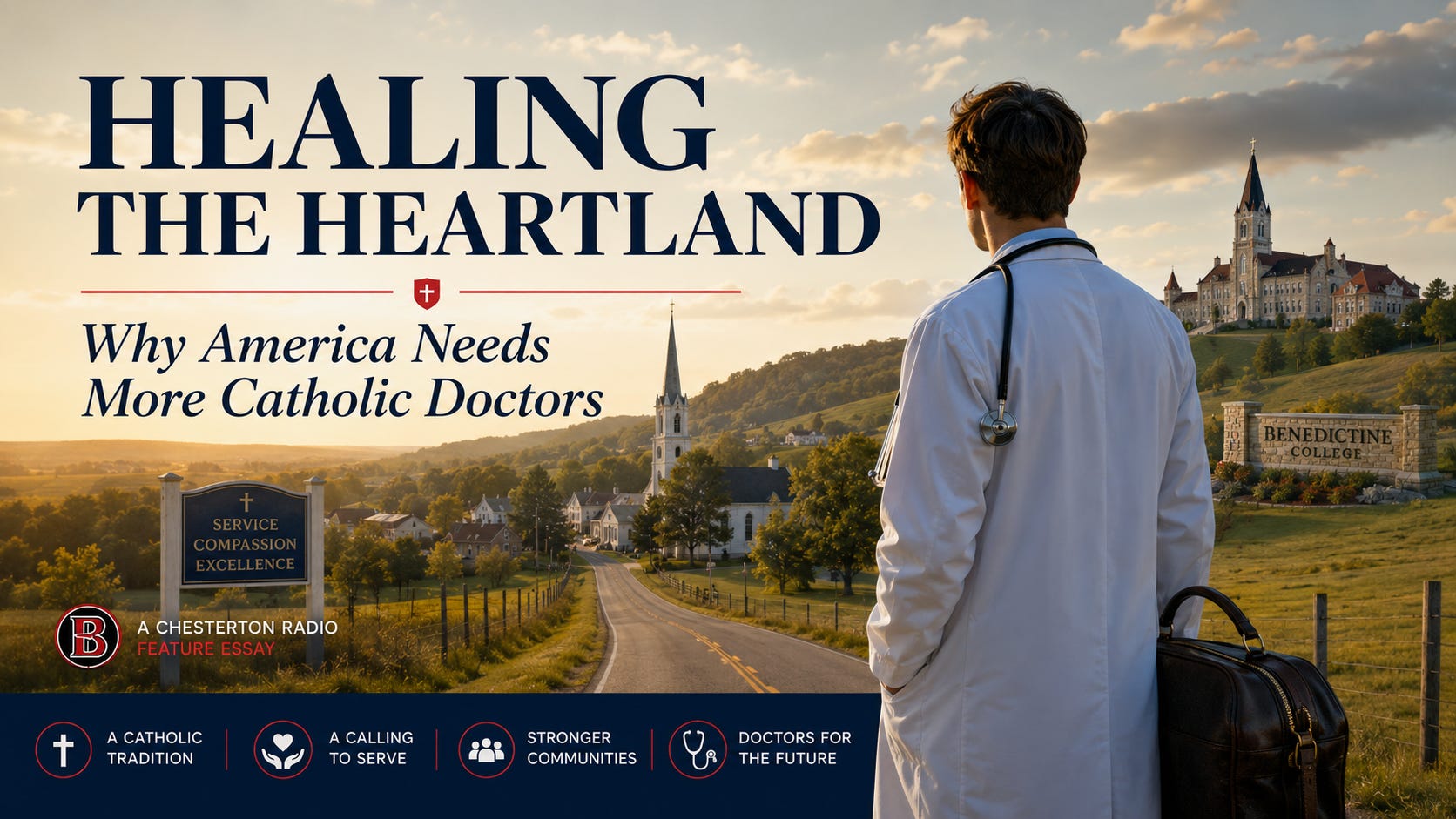
Perhaps that is why the image of Benedictine College overlooking the Missouri River feels so fitting.
For generations, schools have stood upon hills.
Monasteries have stood upon hills.
Churches have stood upon hills.
Not because elevation grants superiority, but because such places serve as visible reminders of hope.
They remind communities that learning matters.
They remind societies that truth matters.
They remind young people that their lives can be directed toward something larger than themselves.
The proposed medical school belongs within that tradition.
It represents a belief in the future.
A belief that communities deserve care.
A belief that medicine remains a vocation.
A belief that young people still desire meaningful work.
A belief that institutions rooted in faith can contribute powerfully to the common good.
And perhaps most importantly, it represents a belief that healing remains possible.
Not only for patients.
Not only for hospitals.
But for communities.
For rural America.
For the heartland itself.
One day, if the vision becomes reality, students will arrive on that hill above the Missouri River carrying the same hopes and uncertainties that generations of students have carried before them.
They will study.
They will struggle.
They will learn.
They will discover what kind of physicians they wish to become.
And then they will leave.
Some will travel to major cities.
Some will pursue specialized fields.
Some will enter research and academic medicine.
But others will return to places that have been waiting for them.
To small towns.
To rural hospitals.
To communities searching for healers.
To families who may never know the story of how those physicians were formed.
They will simply know that help arrived.
And in the end, that is what healing has always been about.
One person answering the needs of another.
One community strengthened.
One life restored.
One act of service at a time.
That is how hearts are healed.
That is how communities endure.
And that is how a school on a hill may one day help heal the heartland.
Postscript: The Work of Healing
At Chesterton Radio, we spend a great deal of time exploring the things that endure.
Sometimes those things are found in old books.
Sometimes they are found in forgotten radio dramas, classical music, great works of literature, or the writings of G.K. Chesterton himself.
Sometimes they are found in remarkable individuals whose lives remind us of what is possible when talent is joined to purpose.
And sometimes they are found in institutions.
This essay is part of our ongoing series exploring the people, ideas, and institutions helping to renew education, culture, faith, and community life in America.
In recent years, we have seen something unexpected happen. While many commentators speak only of decline, a quieter story has been unfolding beneath the headlines. Families are rediscovering classical education. Students are seeking meaning as well as success. Newman Guide colleges are growing. Chesterton Academies are expanding. New institutions are emerging. Old institutions are finding new life.
The story of Benedictine College and its proposed School of Osteopathic Medicine belongs to that larger story.
It is not merely a story about one college in Kansas.
It is a story about the future.
It is a story about whether faith and reason can still work together.
It is a story about whether higher education can still form character as well as careers.
It is a story about whether medicine can remain a vocation in an age that increasingly treats everything as a transaction.
And perhaps most importantly, it is a story about hope.
Hope is often misunderstood.
People imagine hope to be optimism. They imagine it to be wishful thinking or positive sentiment.
Chesterton understood something different.
Hope is not believing that everything will work out easily.
Hope is believing that something is worth doing regardless of difficulty.
The founders of schools understand this.
Teachers understand this.
Parents understand this.
Physicians understand this.
Every person who dedicates years of effort to the service of future generations understands this.
Education is an act of hope.
Medicine is an act of hope.
Building institutions is an act of hope.
The people who undertake such work are making a wager on the future. They are declaring that truth matters, that human dignity matters, and that the next generation is worth investing in.
At Chesterton Radio, those are precisely the stories we seek to tell.
We are not primarily interested in the latest controversy or the outrage of the day. Those things pass quickly. Tomorrow’s headlines eventually become yesterday’s forgotten arguments.
We are interested in the permanent things.
The books that still speak.
The ideas that still matter.
The institutions that continue shaping lives.
The men and women quietly building a better future.
Whether through our feature essays, Deep Dive podcasts, Opening Night book discussions, The Music Room, From the Wireless Archive, Daybreak, or our growing library of original content, our mission remains the same: to explore the enduring truths hidden beneath the noise of modern life.
If you have enjoyed this essay, we invite you to become part of the Chesterton Radio community.
A subscription to Chesterton Radio Substack helps support the research, writing, production, hosting, and development of the essays, podcasts, and programs that make this work possible. Paid subscriptions allow us to continue expanding our coverage of Catholic education, great books, history, culture, old-time radio, classical music, and the people and institutions helping to preserve the best of our civilization.
You can also support the mission by sharing articles with friends, recommending Chesterton Radio to fellow readers, leaving comments, and helping introduce others to the growing Chesterton Radio family.
Every subscriber matters.
Every share matters.
Every recommendation matters.
Together, they help keep the signal alive.
For civilization is not preserved by accident.
It is preserved by teachers who continue teaching.
By parents who continue believing.
By physicians who continue healing.
By students who continue searching for truth.
By institutions willing to invest in generations they may never meet.
And by readers who believe that these stories are worth telling.
Thank you for reading.
We’ll meet you again soon—somewhere between a monastery and a medical school, a great book and a country road, an old radio broadcast and a future yet to be written.
Until then, keep your lamp lit, keep your eyes open to wonder, and never underestimate the power of a single life devoted to service.
— Chesterton Radio
“There are no uninteresting things, only uninterested people.”
— G.K. Chesterton