

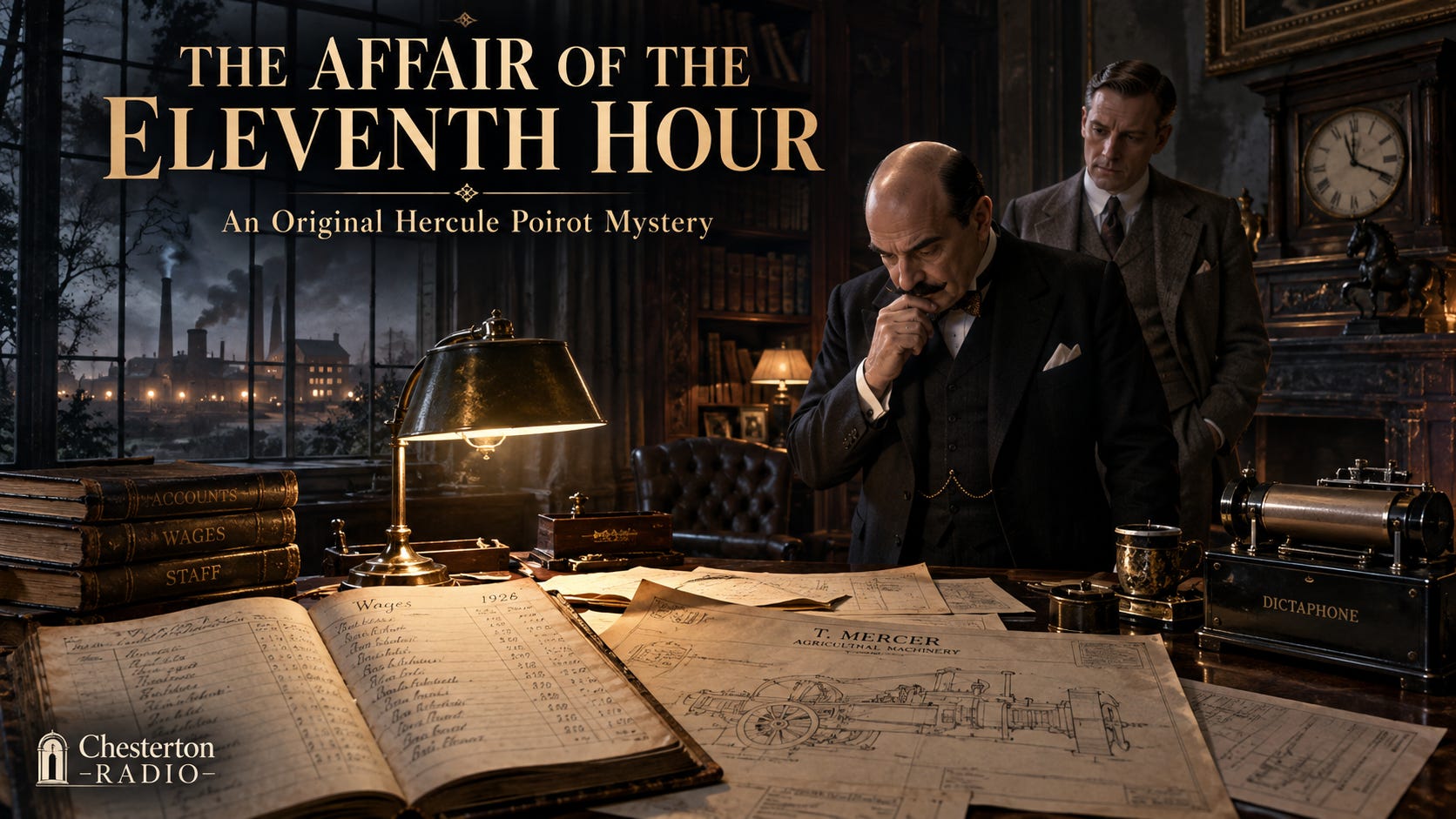
Chesterton Radio presents The New Cases of Hercule Poirot.
Tonight’s mystery begins with two words:
Eleven months.
Sir Matthew Arkwright has spent a lifetime building one of England’s great manufacturing concerns. Now, on the eve of his seventieth birthday, he summons Hercule Poirot to his country house with a curious warning—and the promise that he intends, at last, to put something right.
Before the night is over, an extraordinary inheritance will be announced.
An old injustice will begin to surface.
And Sir Matthew Arkwright will be dead.
From Chesterton Radio, this is a new Hercule Poirot mystery:
The Affair of the Eleventh Hour.
PART ONE
THE ELEVENTH HOUR
There are cases which remain in one’s memory because of their violence, others because of their ingenuity, and still others because of some extraordinary person with whom the events brought one into contact.
The affair at Vineyard House belongs, I think, to another class.
I remember it because of a sentence.
At the time, the sentence appeared to me merely cruel. Later, I thought it arrogant. Only when the whole strange business had ended did I understand that it contained, in a fashion, nearly the entire truth.
Poirot understood that sooner than I did.
But then, as he has occasionally taken pains to remind me, this was not an uncommon occurrence.
It began one October afternoon in 1926 when I called upon my old friend at his rooms and found him engaged in an occupation which seemed to me wholly beneath the dignity of a great detective.
He was polishing a shoe.
“Really, Poirot,” I said, dropping my hat upon a chair, “surely you can afford to have that done for you.”
Poirot looked up reproachfully.
“It has been done for me, Hastings.”
“Then why are you doing it again?”
“Because it has been done badly.”
He held the shoe toward the window and regarded it with dissatisfaction.
“There is here, you perceive, a dullness.”
“I perceive nothing of the sort.”
“Precisely.”
He put the shoe aside.
“You have no eye for the small imperfection.”
“I’ve an eye for things that matter.”
“Ah!” said Poirot. “And who decides which are the things that matter?”
I knew from experience that answering questions of that kind merely encouraged him, so I helped myself to a cigarette.
“You have a visitor coming?”
The little table near the window had been arranged with unusual care. There were three cups, though Poirot himself seldom took tea at that hour, and a silver card tray contained a single visiting card.
I picked it up.
SIR MATTHEW ARKWRIGHT
The name was familiar even to me.
“Arkwright Agricultural Machinery?”
“The same.”
“By Jove. He’s worth a fortune.”
Poirot sighed.
“You see, Hastings? Already you have made the poor man into a column of figures.”
“I only meant that he’s tremendously successful.”
“That is not quite the same thing.”
Before I could answer, the bell rang.
A few moments later Sir Matthew Arkwright entered the room.
My first impression was of solidity.
He was seventy, as I learned later, but looked younger. He was not tall, though his broad shoulders and large head gave an impression of size. His hair was iron grey, brushed straight back from a square forehead. The face beneath it was deeply lined, not with frailty but with use. It was the face of a man accustomed to decisions.
His clothes were excellent without being fashionable. His hands interested me. They were large hands, with thick fingers, and although the nails were perfectly kept, I thought they had once been working hands.
He declined tea.
“I’ve no time for ceremony, Monsieur Poirot.”
“Then we shall have none.”
Sir Matthew glanced at me.
“My friend Captain Hastings,” said Poirot. “He assists me sometimes by seeing everything that is obvious.”
I gave Poirot a look.
Sir Matthew did not smile.
“Can he be trusted?”
“With everything except perhaps the final conclusion.”
“Poirot—”
“Sit down, Hastings.”
Sir Matthew did so first. He removed a folded piece of paper from an inside pocket and placed it on the table.
“I received that yesterday.”
Poirot unfolded it.
I came around behind him.
There were two words typed in the centre of an otherwise blank sheet.
ELEVEN MONTHS
That was all.
“No signature?” I asked.
Sir Matthew shook his head.
“Envelope?”
He produced it.
Poirot examined both without touching them more than necessary.
“It came by post?”
“Yes.”
“Postmark?”
“Local.”
“And you have some idea what it means?”
“No.”
The answer came rather too quickly.
I looked at Poirot.
He was examining the paper.
“You have no idea at all?”
“None.”
Poirot laid the note upon the table.
“Then why bring it to me?”
For the first time Sir Matthew seemed irritated.
“Because I dislike anonymous communications.”
“Many people dislike them. Few consult a private detective.”
“I know your reputation.”
“That is agreeable but irrelevant.”
Sir Matthew’s jaw tightened.
“I have enemies.”
“Ah. That is better.”
“I did not say anyone intends to kill me.”
“No. You said you have enemies.”
“I’ve been in business for nearly fifty years. A man doesn’t build a company the size of Arkwright by making everybody happy.”
“No,” said Poirot. “I imagine not.”
Something in his tone made Sir Matthew look at him sharply.
I intervened.
“Could it be blackmail?”
Sir Matthew turned toward me.
“Blackmail requires something to blackmail a man about.”
“Quite.”
“And you think I have such a thing?”
“I didn’t say that.”
“You thought it.”
I confess I liked him less at that moment.
Poirot, however, appeared entertained.
“You see, Hastings? Sir Matthew has also the little grey cells.”
Sir Matthew ignored the compliment.
“I shall be seventy on Saturday. There is to be a gathering at my house in the country. Vineyard House. A few members of the family, some people from the company.”
“And you wish me to attend?”
“Yes.”
“As a detective?”
“As a guest.”
“And if your other guests ask how we know one another?”
Sir Matthew considered.
“Tell them the truth. I consulted you.”
“About?”
“An anonymous letter.”
“That may provoke curiosity.”
“I have never regarded curiosity as fatal.”
Poirot glanced again at the paper.
“Sometimes, Sir Matthew, it is.”
The old man leaned back.
For the first time since his arrival, some of the force seemed to go out of him.
“There is something I intend to put right,” he said. “I should prefer to live long enough to do it.”
The change in him was so unexpected that I stared.
Poirot did not.
“Do you expect violence?”
Sir Matthew looked toward the window. Outside, London traffic passed beneath a grey autumn sky.
When he spoke again, his voice was quieter.
“I have discovered, Monsieur Poirot, that men become remarkably interested in justice when another man receives something they wanted.”
Poirot’s eyes rested upon him.
“That is an interesting discovery.”
“It is an unpleasant one.”
“Often the interesting discoveries are.”
Sir Matthew stood.
“Saturday, then?”
Poirot inclined his head.
“We shall come.”
After our visitor had departed, I went immediately to the window.
“Well!”
Poirot returned to his shoe.
“Well what, Hastings?”
“Blackmail.”
“No.”
“Threats, then.”
“Perhaps.”
“Some business enemy?”
“Perhaps.”
I turned.
“You don’t believe him about the note.”
“No.”
“You think he knows what ‘eleven months’ means?”
“Yes.”
“Then why lie?”
Poirot applied a minute quantity of polish to the leather.
“That, mon ami, is why we go to Vineyard House.”
The journey two days later did nothing to diminish my curiosity.
I had looked up Sir Matthew Arkwright in the financial pages and discovered enough to confirm my first impression.
He had begun with almost nothing.
The original Arkwright concern had occupied a converted workshop and produced repair parts for agricultural equipment. From there had come plough components, feed mechanisms, harvesting machinery and eventually a range of implements familiar throughout England and increasingly abroad.
“I admire that sort of man,” I told Poirot as our train carried us north through countryside touched with the first brown and gold of autumn.
“You admire success.”
“I admire a man who makes something of himself.”
“That is not always the same thing.”
“There you go again.”
Poirot smiled.
“Hastings, you would have made an excellent inscription upon a monument.”
I declined to ask what he meant.
At the station a dark green Daimler awaited us. The driver introduced himself as Harris and took charge of our luggage.
The country through which we drove was pleasantly rolling and agricultural. Here and there fields had already been turned, dark furrows running away beneath a pale sky. We passed a tractor dragging a cultivator, and a few minutes later another machine stood beside a barn.
I noticed the name cast into its frame.
ARKWRIGHT.
“You see?” I said. “The old fellow has put his name across half England.”
Poirot glanced at the machine.
“Names are interesting things, Hastings.”
“Why?”
“They remain when the men do not.”
There are moments when conversation with Poirot becomes unnecessarily gloomy.
We were perhaps two miles farther on when the road rose and the Arkwright works came into view.
They lay in the valley below us: long brick buildings, saw-toothed roofs, a tall chimney, storage sheds and sidings. A locomotive was shunting wagons near one end. Even at that distance one could hear the faint metallic clamour of industry.
It was nearing the end of the working day.
Men were beginning to stream through the gates.
Some pushed bicycles. Others walked in groups, caps on their heads, lunch tins in hand.
There was something impressive about it.
“All that,” I said, “from one little workshop.”
Poirot looked down at the works.
“From one man?”
“Well—one man’s company.”
“Ah. That is already a different sentence.”
Before I could reply, the car turned between stone pillars.
A discreet sign read:
VINEYARD HOUSE
The house itself stood perhaps half a mile beyond the gates, reached by a curving drive bordered with beech and chestnut.
I had expected something grander.
Vineyard House was large but not ostentatious, a mellow brick building of late Georgian appearance with later additions that had been made, I suspected, according to usefulness rather than architectural purity. There was a broad terrace at the rear, extensive lawns and gardens, and beyond them open countryside.
“It doesn’t look like a millionaire’s palace,” I remarked.
“No,” said Poirot. “It looks like the house of a man who wished to be comfortable.”
Sir Matthew received us himself in the hall.
“Good. You’re here.”
It was characteristic of him that this served equally as greeting and welcome.
A woman of about thirty-two stood beside him with a notebook in her hand.
“This is Miss Wynn. She will show you where you’re to be put.”
Clara Wynn had a composed, intelligent face and dark hair arranged with admirable simplicity. Everything about her suggested efficiency without fuss.
“Captain Hastings. Monsieur Poirot.”
She gave us a small smile.
“Sir Matthew has been threatening to reorganise your journey since breakfast.”
“I don’t threaten,” said Sir Matthew.
“No,” she said. “You generally proceed directly to the offence.”
I liked her at once.
Sir Matthew apparently did too, for he merely grunted.
“How long have you managed him?” I asked as she led us upstairs.
“Twelve years.”
“Twelve!”
“One becomes accustomed to almost anything.”
Poirot, behind us, said mildly:
“Twelve years is a long service.”
Miss Wynn looked back.
“At Arkwright? Hardly. Mr Price would call me a newcomer.”
Our rooms overlooked the west lawn.
When we had changed, we went downstairs and found several of the other guests gathered in the drawing room.
Charles Arkwright came forward first.
He was forty-three, good-looking in a well-fed, polished sort of way, with the easy manner of a man accustomed to dining rooms, boardrooms and golf clubs in roughly equal proportions.
“So you’re the famous Monsieur Poirot.”
Poirot acknowledged the introduction.
“And Captain Hastings. Delighted. Uncle Matthew tells us you’ve come to protect him from an anonymous correspondent.”
“Charles,” said a woman’s voice, “must you?”
She was standing near the fireplace.
Beatrice Arkwright was a handsome woman, though there was something tired about her eyes. She wore black, not the heavy black of recent mourning, but with the unconscious preference of one who had once worn it for a long time and never entirely abandoned the habit.
“My daughter-in-law,” said Sir Matthew.
Beatrice corrected him gently.
“Your former daughter-in-law, Matthew.”
“You married Robert. You’re family.”
Her expression altered slightly at the name.
Robert, I remembered, had been Sir Matthew’s only son and had died several years before.
Another man rose from a chair.
“George Bell.”
He was thin, grey and dry in appearance. If one had asked an artist to draw a solicitor who had spent thirty years preventing wealthy clients from doing foolish things, I imagine the result would have looked very much like George Bell.
“I hope,” he said to Poirot, “that Sir Matthew’s anonymous correspondent proves less troublesome than most of Sir Matthew’s acquaintances.”
“Present company excepted?” asked Charles.
“Naturally.”
The door opened.
A broad-shouldered man entered, carrying the unmistakable atmosphere of outdoors and machinery with him despite an excellent dark suit.
Sir Matthew said, “Price.”
Edmund Price was fifty-eight, with greying hair, a weathered face and strong hands. Unlike Sir Matthew’s, his hands had not ceased to be working hands.
He shook mine firmly.
“Hastings.”
There was no affectation about him.
“Monsieur Poirot.”
“So you are Mr Price,” said Poirot.
“Works manager.”
“For long?”
Price smiled.
“Depends what you call long.”
“Edmund came to us as a boy,” said Sir Matthew.
“Eighteen,” Price corrected. “I wasn’t a boy.”
“Forty years,” said Charles. “And still arguing with the proprietor.”
“Somebody has to.”
I liked Price immediately.
There was something reassuring in his solidity. One felt that if a shaft broke at two in the morning, a boiler refused to behave, or a foreman announced that a week’s production was impossible, Price was the man one wanted walking through the door.
“Forty years in one concern is something to be proud of,” I said.
Price’s expression softened.
“I suppose it is.”
Poirot was looking at him.
“One sees many changes in forty years.”
“Enough.”
“Men?”
“Men. Machines. Methods. Everything.”
Sir Matthew said abruptly:
“Not everything.”
Price met his eyes.
“No,” he said. “Not everything.”
The moment passed.
I thought nothing of it then.
The final member of the party arrived a few minutes later, and his entrance produced a curious alteration in the room.
He was young—twenty-four at most—tall, rather lean, with dark hair that refused to remain as orderly as his evening clothes required.
He stopped just inside the door.
“I’m sorry, Sir Matthew. Miss Wynn said six-thirty, but I thought—”
“You’re not late.”
“No, sir.”
“Then don’t apologise.”
Sir Matthew turned toward us.
“Daniel Mercer. One of our draughtsmen.”
The young man coloured slightly.
It was easy to see why.
Everyone else present belonged naturally in the room. Family, solicitor, senior executive, private secretary.
A junior draughtsman did not.
Charles smiled.
“Mercer has been wondering all week what he’s done to deserve a weekend among his betters.”
Daniel’s face tightened.
“I hadn’t put it quite like that.”
“No? I should have.”
Sir Matthew said sharply:
“Leave the boy alone.”
There was a silence.
I saw Daniel look at him with an expression I could not interpret.
Not gratitude.
If anything, embarrassment.
Poirot asked:
“You have been with Arkwright long, Monsieur Mercer?”
“Eleven months.”
I looked at Poirot.
He did not look at me.
Charles laughed.
“There you are, Mercer. Practically one of the old guard.”
Daniel flushed again.
Sir Matthew’s voice cut across the room.
“That’s enough.”
It was the second time in five minutes that he had protected the young man.
I remembered the anonymous note.
ELEVEN MONTHS.
Suddenly the weekend seemed considerably more interesting.
Before dinner I had an opportunity to speak with Daniel alone.
We had gone out onto the terrace, where the last of the afternoon light lay across the lawn. Somewhere beyond the trees I could hear the distant whistle from the works.
Daniel stood with his hands in his pockets.
“I suppose you’re wondering why I’m here.”
His directness surprised me.
“As a matter of fact—”
“Everyone is.”
“Perhaps Sir Matthew thinks highly of your work.”
“He scarcely knew I existed six months ago.”
“But he knows you now.”
“Yes.”
There was something uneasy in the answer.
“How did that happen?”
“I don’t know.”
“Come now.”
“I’m serious, Captain Hastings. I was called into his office one morning because he’d seen some drawings I’d done for a modification to one of the feed assemblies. He asked my name. I told him. He asked it again.”
“Your name?”
“Mercer.”
“And then?”
“He stared at me.”
“What did he say?”
“Nothing. Not then.”
Daniel picked up a fallen leaf from the stone balustrade and turned it between his fingers.
“After that he began asking questions.”
“What sort?”
“My age. Where I was born. My father’s name. My grandfather’s name.”
I felt a distinct thrill.
“And you didn’t find that odd?”
“Of course I found it odd.”
“Did you ask him why?”
“Yes.”
“And?”
“He told me to mind my drawing board.”
I laughed.
Daniel did not.
“He sent for me again two weeks later. Then again. He moved me onto a development project. Last month he increased my salary.”
“Substantially?”
“Enough for everyone in the drawing office to notice.”
I thought of the note.
Eleven months.
“Have you any connection with Sir Matthew outside the company?”
“None.”
“Your family?”
“Not that I know of.”
“Your father perhaps?”
“He never met Sir Matthew.”
“You are certain?”
Daniel looked at me.
“Why are you asking?”
I realised I had gone too far.
“Professional curiosity.”
“You’re not a detective.”
“No.”
He continued looking at me.
“Not officially,” I added.
That did not improve matters.
Daniel tossed the leaf away.
“If Sir Matthew has brought me here for some reason, I wish he’d tell me what it is. Charles Arkwright thinks I’m after his job. Mrs Arkwright looks at me as though I’ve stolen the silver. Mr Price—”
He stopped.
“Price?”
“Nothing. He’s been decent to me.”
“Good man, Price.”
“The best man in the works.”
The conviction with which he said it confirmed my own impression.
Behind us the terrace doors opened.
Sir Matthew stood there.
“Mercer.”
Daniel straightened.
“Sir?”
“Come with me.”
The young man glanced at me, then followed him inside.
Poirot appeared a moment later.
“You have been investigating, Hastings?”
“Merely talking.”
“Ah. It is when you merely talk that I become nervous.”
“There’s something damned odd about the boy.”
“The young man seems quite normal to me.”
“Not Mercer. Sir Matthew’s interest in him.”
“Yes.”
“Did you hear? Eleven months.”
“I possess ears.”
“That’s what the note means.”
“Possibly.”
“Obviously.”
Poirot sighed.
“There is the word which has destroyed many beautiful theories.”
We went inside by way of the library.
It was a handsome room, darker than the drawing room, with books along two walls and large windows facing the lawn. A substantial desk stood near the fireplace.
Upon one corner of it was a machine I did not immediately recognise.
“Dictating apparatus,” I said.
Clara Wynn, who had entered behind us carrying papers, nodded.
“Sir Matthew has been experimenting with it.”
“Does he distrust secretaries?”
“Only progress.”
Poirot inspected the machine without touching it.
“He dictates his letters?”
“When the mood takes him. Which means he uses the machine for twenty minutes and then sends for me.”
She placed a folder on the desk.
On the opposite wall stood a tall clock in a dark wooden case.
I glanced at it.
“Good Lord. Is that the time?”
“No,” said Clara.
I checked my watch.
The clock was seven minutes slow.
“Has it stopped?”
“It loses seven minutes and then, apparently, decides it has done enough damage.”
“Why not have it repaired?”
“Because it belonged to Sir Matthew’s father.”
I failed to see the connection.
Clara evidently read my expression.
“Sir Matthew maintains that his father never allowed anyone to touch the mechanism and he sees no reason to begin now.”
“Even though it’s wrong?”
“Especially because it’s wrong.”
Poirot smiled.
“A sentimentalist.”
“Please don’t tell him that.”
Sir Matthew entered with Daniel.
The young man’s face was set.
Sir Matthew went directly to the desk.
“Miss Wynn, where are the old company files?”
“Which ones?”
“The early design records.”
“The archive boxes from the old works?”
“Yes.”
“In the small records room. You asked for three of them yesterday.”
“I want the others.”
“Tonight?”
“Yes.”
Clara hesitated.
“There are rather a lot.”
“Then begin with the oldest.”
“Very well.”
She left.
Daniel remained by the door.
“Was there anything else, sir?”
Sir Matthew looked at him.
For one peculiar moment the hard old face changed.
There was almost regret in it.
“No. Not yet.”
Daniel left.
I was more certain than ever that some family secret lay behind the matter.
Poirot said nothing.
Dinner began pleasantly enough.
That, looking back, was perhaps the worst of it.
The dining room at Vineyard House was neither enormous nor oppressive. Sir Matthew sat at the head of a long walnut table which could easily have seated twenty but had been reduced by flowers and silver to a more intimate arrangement.
The food was excellent.
Charles talked entertainingly about a disastrous sales demonstration in France.
Price told a story concerning an apprentice who had once assembled part of a machine backwards and then insisted the drawings were wrong.
Even Sir Matthew laughed.
For half an hour we might have been any prosperous English household celebrating a birthday.
Then the conversation turned to the company.
Perhaps it was inevitable.
“Matthew has never understood,” Beatrice said, “that other people occasionally possess lives outside Arkwright.”
Sir Matthew looked down the table.
“Robert understood his responsibilities.”
The temperature of the room seemed to fall.
Beatrice set down her glass.
“Robert understood what you expected of him.”
“Same thing.”
“No.”
Charles intervened smoothly.
“Uncle Matthew, it’s your birthday. Surely we can postpone the annual family battle until breakfast.”
Sir Matthew ignored him.
“Robert would have run Arkwright.”
Beatrice’s voice was very quiet.
“Robert wanted to leave Arkwright.”
Nobody spoke.
Sir Matthew stared at her.
“He never told me that.”
“No.”
“Then perhaps he didn’t.”
Beatrice went pale.
I thought the remark unnecessarily cruel.
Price was looking at his plate.
Daniel seemed to wish himself anywhere else.
It was George Bell who rescued the conversation.
“Sir Matthew,” he said, “if you intend to make your announcement tonight, I suggest you do it before we reach the port. Your judgement has never improved after port.”
Sir Matthew gave him a hard look.
Then, unexpectedly, he smiled.
“Thirty years you’ve been giving me advice I didn’t ask for, George.”
“Someone must.”
“Very well.”
Clara Wynn, seated farther down the table, stopped moving.
Charles looked from Bell to his uncle.
“Announcement?”
Sir Matthew placed both hands upon the table.
“I had intended to wait until tomorrow. There’s no point.”
Something in his manner silenced us.
“I have made a new will.”
Charles leaned back.
“Good God, is that all? I thought you were going to announce a merger.”
“You may wish I had.”
The smile disappeared from Charles’s face.
Sir Matthew continued.
“Bell has drawn it. Signed and witnessed.”
Bell gave no indication of whether this was true or not, which I took as confirmation.
“There are provisions for Beatrice. For Charles. For certain employees. Miss Wynn is provided for.”
Clara opened her mouth.
Sir Matthew raised a hand.
“Don’t argue. Not tonight.”
She closed it.
“Price, there is a provision for you.”
Price looked surprised.
“I’ve never asked—”
“I know.”
Sir Matthew looked down the table toward Daniel.
The young man had gone very still.
“The controlling interest in Arkwright Agricultural Machinery Limited will pass, upon my death, to Daniel Mercer.”
For several seconds nobody moved.
I have witnessed explosions which seemed less complete.
Daniel was the first to speak.
“What?”
Charles gave a short laugh.
It was not amusement.
“Very funny, Uncle Matthew.”
“I am not joking.”
Beatrice stared at Daniel.
George Bell removed his spectacles and polished them.
Clara Wynn watched Sir Matthew.
Price did nothing at all.
Daniel pushed his chair back.
“No.”
Sir Matthew’s eyebrows rose.
“No?”
“I don’t want it.”
“You don’t know what you’re refusing.”
“I know exactly what you’ve just said.”
“You know nothing.”
“Then explain it.”
“Sit down.”
Daniel remained standing.
“Why me?”
The question hung over the table.
It was the question every person there wanted answered.
Sir Matthew looked at him.
“Because I have decided it.”
“That’s not an answer.”
“It is the only one you’re getting tonight.”
Charles’s composure finally broke.
“Do you realise what you’re doing?”
“Perfectly.”
“You are giving the company to a boy.”
Daniel turned.
“I’m twenty-four.”
Charles ignored him.
“A junior draughtsman!”
“An engineer,” said Sir Matthew.
“He isn’t an engineer.”
Daniel flushed.
“I’ve done the work.”
“Eleven months’ work!”
Charles looked around the table as though appealing to a jury.
“Twenty-eight years. Mercer has been here eleven months.”
There it was again.
Eleven months.
I glanced at Poirot.
He was studying his wineglass.
Charles leaned forward.
“I have spent my entire adult life at Arkwright.”
“And been well paid for it.”
“That’s not the point.”
“Then what is?”
“You know perfectly well.”
Sir Matthew’s face hardened.
“No, Charles. Say it.”
Charles hesitated.
We all knew what he meant.
He had expected the company.
Perhaps Sir Matthew had never promised it.
Perhaps nothing had ever been written.
But there are expectations which, allowed to live long enough, begin to feel remarkably like rights.
Beatrice spoke.
“And Robert?”
Sir Matthew turned toward her.
“What about him?”
“Does he count for nothing?”
“Robert is dead.”
She flinched.
I saw Sir Matthew regret the words almost as soon as they were spoken, but he did not withdraw them.
Beatrice rose.
“My husband gave his life to that company.”
“Beatrice—”
“No. You will listen.”
Her voice shook.
“He gave you his health. His time. His marriage. Every holiday interrupted because the works needed him. Every evening you telephoned. Every Sunday something could not wait until Monday.”
Sir Matthew said nothing.
“And now you give it to him?”
She pointed at Daniel.
Daniel stood helplessly.
“I didn’t ask for it.”
Beatrice looked at him.
“No. That somehow makes it worse.”
“That’s unfair,” I said before I could stop myself.
She turned toward me.
“Is it?”
Poirot touched my sleeve lightly.
I subsided.
Sir Matthew’s voice was suddenly weary.
“Enough.”
“No,” said Charles. “Not enough. Not nearly enough. Why Mercer?”
Sir Matthew’s strength seemed to return.
“It is mine to give.”
I saw Price look up.
Until then he had remained almost entirely silent.
Now he spoke.
“I’ve given you forty years.”
There was no anger in his voice.
That made it more powerful.
Sir Matthew turned toward him.
Price continued.
“Forty years, Matthew.”
The use of the Christian name surprised me.
“I came into the old works at eighteen. I swept filings off the floor before they’d let me near a lathe. I’ve seen three shops built and two pulled down. I kept the place going during the war when we couldn’t get material for love nor money. I trained men who are foremen now. I’ve buried men I worked beside.”
“Edmund—”
“I’ve never asked you for the company.”
“I know.”
“I’ve never asked you for anything that wasn’t earned.”
Sir Matthew’s face became hard again.
“And I have paid you for forty years, Edmund.”
The words fell like a blow.
Price did not move.
Nobody did.
Sir Matthew seemed to realise what he had said.
But pride—or perhaps something more complicated—prevented him from taking it back.
Price’s face had become expressionless.
“And him?”
Sir Matthew looked at Daniel.
When he answered, his voice was lower.
“What Mercer receives has nothing whatever to do with what I owe you.”
I confess that I thought the remark insufferable.
Poirot, however, lifted his head.
Only slightly.
Had I not known him so well I should not have noticed.
Price pushed back his chair.
“Then I think I’ll have some air.”
Sir Matthew said, “Price—”
But the works manager had already gone.
Daniel remained standing.
“I won’t take it.”
Sir Matthew turned on him.
“You will do nothing tonight.”
“It’s my decision.”
“Not yet.”
“You can’t force me to own a company.”
For the first time that evening I saw something almost like humour in Sir Matthew’s face.
“No. But I can force you to wait until you know why.”
Daniel stared at him.
“Then tell me.”
“Tomorrow.”
“Why tomorrow?”
“Because I say so.”
Daniel gave a bitter laugh.
“There it is.”
“What?”
“Everyone here has spent the evening telling me what I haven’t earned. You’re the only man who knows why you’re doing this, and you won’t tell me.”
Sir Matthew’s face changed again.
For a moment I thought he would answer.
Instead he said:
“Tomorrow.”
Daniel sat down.
The dinner was over.
The next hour was one of the most uncomfortable I have ever spent in a drawing room.
Beatrice retired almost immediately.
Charles remained long enough to drink a brandy with unnecessary speed, then went out through the terrace doors.
Price had not returned.
Daniel stood by the fireplace, refusing drinks and conversation with equal determination.
George Bell spoke quietly with Sir Matthew near the door.
I could not hear what passed between them.
Clara Wynn entered with a sheaf of papers.
Sir Matthew looked at them.
“The archive material?”
“Some of it.”
“Bring it to the library.”
“Tonight?”
“Tonight.”
She glanced at Daniel, then back at Sir Matthew.
“Very well.”
The old man turned toward Poirot.
“You see?”
Poirot regarded him calmly.
“I see many things.”
“I warned you.”
“You warned me that people become interested in justice.”
Sir Matthew gave a humourless smile.
“And now?”
“Now I think they are interested in arithmetic.”
Sir Matthew frowned.
I had no idea what Poirot meant.
Apparently neither did Sir Matthew.
At a quarter past eleven by my watch, Clara came out of the library carrying her notebook.
“Is Sir Matthew still working?” I asked.
“He has discovered several boxes of records which apparently cannot survive until morning.”
“Was he all right?”
She looked toward the closed library door.
“He was Sir Matthew.”
This seemed answer enough.
She went upstairs.
Daniel appeared from the billiard room.
“Is he alone?”
“I believe so.”
He looked toward the library.
Then away.
“I’ll speak to him later.”
“You may be better waiting until morning.”
Daniel gave me a tired smile.
“Captain Hastings, if I wait until morning I shall spend the entire night wondering whether I’ve gone mad.”
He went back toward the billiard room.
A little later I encountered George Bell in the passage.
He had a book under one arm.
“Where is everyone?” I asked.
“Attempting not to murder one another, I imagine.”
“Bell!”
“A professional exaggeration.”
As we spoke, a voice came distinctly through the library door.
Sir Matthew’s.
“...with reference to your letter of the fourteenth instant, I regret that the proposed delivery schedule cannot be accepted...”
Bell raised his eyebrows.
“Still at it.”
“At this hour?”
“Matthew has never accepted the proposition that correspondence can wait.”
The voice continued inside.
Bell walked on.
I glanced at my watch.
It was approximately twenty-five to twelve.
I remember the fact distinctly because I thought Sir Matthew’s capacity for work at seventy put me rather to shame.
Poirot was in the drawing room examining a small bronze figure on the mantelpiece.
“Still awake?” I asked.
“Obviously.”
“Sir Matthew is still working.”
“Indeed?”
“Bell and I heard him dictating.”
Poirot replaced the bronze figure.
“And where is Monsieur Mercer?”
“Billiard room, I think.”
“Mr Price?”
“Not back yet, so far as I know.”
“Charles?”
“No idea.”
Poirot nodded.
I was becoming irritated.
“Are you actually investigating something?”
“Always.”
“Then what?”
He smiled.
“At present, Hastings, I investigate a very comfortable chair.”
He sat down.
I gave him up.
Ten minutes later Daniel Mercer entered the drawing room.
He had made up his mind about something.
“I’m going to see him.”
Poirot looked up.
“Sir Matthew?”
“Yes.”
“Why?”
Daniel’s mouth tightened.
“Because I’m not going to bed until he tells me why he has done this.”
He crossed the hall.
I followed, partly from curiosity and partly because I had begun to feel some responsibility for the young man.
Poirot came after me at a more leisurely pace.
Daniel knocked on the library door.
No answer.
He knocked again.
“Sir Matthew?”
Silence.
Daniel looked back at us.
“He may be asleep.”
“At his desk?” I said.
He opened the door.
For a second he simply stood there.
Then I heard him draw breath.
Not a cry.
Something smaller.
Worse, somehow.
I moved past him.
Sir Matthew Arkwright lay beside the desk.
One arm was twisted beneath him. His head rested partly against the carpet. Near his hand lay a heavy bronze presentation piece, a stylised gear wheel mounted upon a base, darkened along one edge.
I knew at once that he was dead.
Daniel whispered:
“My God.”
Poirot passed me.
His whole manner had changed.
The small, fastidious man who had been discussing chairs a few minutes earlier had disappeared.
He bent beside the body but did not touch more than was necessary.
“Do not move anything.”
Daniel stood as though turned to stone.
“I didn’t—”
“I know. Remain where you are.”
My eyes moved across the desk.
The room was in disorder, though not violently so. Papers had been shifted. One drawer stood partly open.
A document lay prominently upon the blotter.
I recognised George Bell’s legal hand upon its covering sheet.
The will.
Beside it lay an old leather-bound ledger, its corners worn pale with age.
It had fallen open.
Across the top of the page were columns.
Names.
Dates.
Weekly amounts.
Wages.
And upon the carpet between the desk and Sir Matthew’s body lay a single white sheet of paper.
There were five words upon it.
Written in heavy block capitals.
THE LAST SHALL BE FIRST
Daniel saw them.
The blood drained from his face.
“I didn’t write that.”
Nobody answered.
“I swear to you—I didn’t write it.”
I looked from the words to the will.
Then to Daniel Mercer.
Eleven months at Arkwright.
A junior draughtsman.
A stranger at a family gathering.
At dinner he had been given control of a great company.
Now, before midnight, the man who had given it to him was dead.
And there beside the body lay words which seemed almost to have been written for Daniel himself.
Poirot remained crouched near Sir Matthew.
He looked at the paper.
Then at the ledger.
Then at the dead man.
Finally he looked at Daniel.
There was no accusation in his face.
That struck me as curious, for to my mind accusation was written everywhere else in the room.
“Poirot,” I said quietly.
He raised one hand.
I fell silent.
He rose and looked once more around the library.
His gaze passed over the desk, the open drawer, the old ledger, the bronze weapon and the sheet upon the carpet.
Then he looked toward the tall clock against the wall.
Its hands moved patiently onward, seven minutes behind the rest of England.
Poirot’s eyes returned to the five words.
“What is it?” I asked.
He did not answer immediately.
At last he said:
“It is very obliging.”
I stared at him.
“What is?”
“The evidence, Hastings.”
Daniel looked between us.
Poirot’s face was grave.
“It tells us already what we are supposed to think.”
And standing there beside Sir Matthew Arkwright’s body, with the new heir white-faced before us and those extraordinary words upon the floor, I confess that I could see no reason whatever to think anything else.
PART TWO
THE WAGES OF THE DAY
There is something peculiarly indecent about the arrival of the police at a country house.
I do not mean that as criticism of the police. On the contrary, the men who came to Vineyard House that night conducted themselves with admirable discretion. But a policeman’s notebook, a photographer’s apparatus and the measured questions of an inspector have a way of stripping tragedy of all its private dignity.
A room which, an hour before, has belonged to a family becomes a scene.
A dead man becomes evidence.
And grief itself acquires a timetable.
Daniel Mercer still stood near the library door.
He had scarcely moved since discovering the body.
“I didn’t kill him,” he said again.
It was the third time he had said it.
Poirot turned toward him.
“Then, monsieur, do not behave as though you had.”
Daniel stared.
“I don’t know how an innocent man is supposed to behave.”
“Neither do the police,” said Poirot. “That is why it is usually unwise to perform for them.”
I thought the advice rather cold, but Daniel seemed to take some comfort from it.
The rest of the household had begun to gather.
Charles came first, summoned by my call from the hall. He entered quickly, took one look at his uncle’s body and stopped.
For a moment all the polish went out of him.
“My God.”
He moved forward.
Poirot intercepted him.
“Please, monsieur. Touch nothing.”
Charles looked at him as though he had forgotten he was there.
“That’s my uncle.”
“I know.”
“Is he—?”
“Yes.”
Charles turned away.
Beatrice appeared behind him.
I shall never forget her face when she saw Sir Matthew.
There had been anger between them at dinner. Real anger. Yet whatever resentment she had carried vanished for that first instant before the fact of death.
She put one hand against the door frame.
“Matthew?”
Charles went to her.
“Don’t come in.”
She looked past him.
Her eyes found the body, then the desk, then Daniel.
That last glance changed her expression.
“You.”
Daniel recoiled as though she had struck him.
“I found him.”
“Of course you did.”
“Beatrice,” Charles said sharply.
She did not appear to hear.
“You couldn’t even wait until morning.”
Daniel’s face flushed.
“That’s enough.”
“You inherit everything—”
“I didn’t ask for it!”
“—and before the night is over Matthew is dead.”
“I said that’s enough!”
His voice rang through the library.
Beatrice drew back.
The anger went out of Daniel almost immediately.
“I’m sorry.”
Poirot said quietly:
“Captain Hastings, perhaps Madame Arkwright would be more comfortable in the drawing room.”
Charles took Beatrice’s arm.
“I’ll go with her.”
As he turned, his eyes rested for an instant upon the paper lying near Sir Matthew.
THE LAST SHALL BE FIRST
Charles read it.
Then he looked at Daniel.
He said nothing.
That silence did Daniel more harm than any accusation could have done.
The local police arrived shortly after midnight.
Inspector James Hardwick proved to be a thickset man of about fifty with a heavy moustache, a deliberate manner and the pleasant habit of listening to an answer before asking the next question.
He knew Poirot by reputation.
“Mr Arkwright telephoned that you were here, Monsieur Poirot.”
“By accident, Inspector.”
Hardwick’s eyes moved toward the body.
“In my experience, sir, accidents involving you generally become inconvenient.”
Poirot smiled.
“I shall endeavour not to inconvenience you.”
“I’d be grateful.”
This understanding established, Hardwick began his work.
The police surgeon arrived soon afterward and made his preliminary examination.
Sir Matthew, he thought, had been killed by a single heavy blow. The bronze presentation piece found near the body was entirely consistent with the injury.
There was no sign of a prolonged struggle.
“Death would have been quick,” he said.
“Time?” asked Hardwick.
The doctor considered.
“Not long. Half an hour, perhaps. I shouldn’t want to be precise until I’ve made a proper examination.”
Hardwick checked his watch.
“Body discovered at eleven forty-five.”
“Approximately.”
“So perhaps eleven-fifteen to eleven-forty?”
“That would be reasonable.”
I saw Poirot’s eyes move toward the clock.
It stood against the wall, ticking solemnly.
Hardwick noticed him looking.
“Something wrong with it?”
“Only the time,” I said.
The inspector looked from the clock to his watch.
“Seven minutes slow.”
“It has been for weeks,” I explained. “Sir Matthew wouldn’t have it adjusted. It belonged to his father.”
Hardwick grunted.
“Families.”
He wrote something in his notebook.
That, I thought, was the end of the matter.
The desk received more attention.
The new will lay where we had first seen it. George Bell identified it without touching it.
“That is the document I prepared.”
“Signed?” asked Hardwick.
“Properly executed.”
“When?”
“Three days ago.”
“And under it?”
The inspector indicated the ledger.
Clara Wynn had now joined us.
She frowned.
“That came from the old records.”
“You recognise it?”
“Yes. One of the wage books from the early works.”
“Why was it here?”
“Sir Matthew asked me to bring him several boxes of old company records.”
“Tonight?”
“Yes.”
“Why?”
“I don’t know.”
Hardwick looked at her.
“You were his secretary.”
“For twelve years.”
“And you don’t know why he wanted his own old wage books?”
“No.”
The inspector made another note.
Poirot said:
“Was Sir Matthew often interested in the past, mademoiselle?”
Clara considered.
“Not usually.”
“But recently?”
“Recently, yes.”
“How recently?”
“A few weeks.”
“And what kind of records?”
“Old correspondence. Engineering files. Personnel records. Early company documents.”
“Concerning anyone in particular?”
There was the slightest pause.
“I don’t know.”
I noticed it.
So did Poirot.
Hardwick pointed toward the paper on the floor.
“And that?”
Clara read the words.
Her expression altered.
“Did Sir Matthew write it?”
“We hoped you might tell us.”
She shook her head.
“Those aren’t his capitals.”
“You’re certain?”
“I’ve seen his handwriting every working day for twelve years.”
Hardwick looked at Daniel.
“And yours, Mr Mercer?”
“No.”
“Perhaps we’ll have a sample later.”
Daniel laughed bitterly.
“You may have a dozen.”
Hardwick regarded him without hostility.
“I expect I shall.”
The first formal questioning took place in the morning room.
It was after one o’clock, but nobody suggested going to bed.
Hardwick began with Daniel.
I was not officially required to be present, but Poirot had somehow arranged matters so that we remained. How he did these things I never quite knew. He possessed an extraordinary ability to make his presence appear both unnecessary and inevitable.
Daniel sat opposite the inspector.
Hardwick opened his notebook.
“Your full name?”
“Daniel James Mercer.”
“Age?”
“Twenty-four.”
“Occupation?”
“Mechanical draughtsman.”
“Employed by Arkwright Agricultural Machinery?”
“Yes.”
“For how long?”
Daniel hesitated.
“Eleven months.”
The words seemed to fill the room.
Hardwick looked up.
I wondered whether anyone had yet told him about the anonymous note.
Poirot said nothing.
“And your relationship with Sir Matthew?”
“My employer.”
“Nothing else?”
“Not that I know of.”
Hardwick’s pencil stopped.
“What does that mean?”
Daniel rubbed his forehead.
“It means precisely what I said.”
“Most men know whether they’re related to their employer.”
“I don’t know why Sir Matthew took an interest in me.”
“An interest?”
Daniel explained much of what he had told me on the terrace: the drawings, Sir Matthew’s reaction to his surname, the questions concerning his family, the increased salary and finally the extraordinary invitation to Vineyard House.
Hardwick listened carefully.
“Did Sir Matthew ever give you money outside your wages?”
“No.”
“Promise you money?”
“No.”
“Did you know before tonight that you were named in his will?”
“No.”
“You expect me to believe that?”
Daniel’s head came up.
“I don’t particularly care what you believe.”
“Mercer,” I said.
He looked at me.
Hardwick closed his notebook for a moment.
“Mr Mercer, you’ve had a bad night. I understand that. But your employer has been murdered and you’ve just inherited control of his company. I have to ask questions you aren’t going to like.”
Daniel breathed out.
“Yes.”
“Did you quarrel with him after dinner?”
“I demanded an explanation.”
“That’s not what I asked.”
“Then yes.”
“What was said?”
“He told me to wait until tomorrow.”
“And you refused?”
“I said I wouldn’t accept the company without knowing why.”
“Did you threaten him?”
“No.”
“Did he threaten to change the will?”
“No.”
“Did you fear he might?”
Daniel stared.
“No.”
“Where were you between eleven and eleven-forty-five?”
“In the billiard room for part of it.”
“Alone?”
“Mostly.”
“Mostly?”
“Captain Hastings saw me there. I came into the drawing room shortly before I went to the library.”
Hardwick looked at me.
I confirmed it.
“But before that?”
“I walked outside.”
“Where?”
“Terrace. Garden. I don’t know.”
“Anyone see you?”
“I don’t know.”
“Then you were alone.”
“For some of the time, yes.”
Hardwick wrote it down.
“Why did you go to the library at eleven-forty-five?”
“To make Sir Matthew tell me the truth.”
“What truth?”
“Why he’d given me the company.”
Hardwick leaned back.
“Mr Mercer, I suggest you already knew.”
Daniel’s chair scraped against the floor.
Poirot spoke for the first time in several minutes.
“Inspector.”
Hardwick looked at him.
“Yes?”
“You asked the young man what he knew. You have now told him what you believe.”
Hardwick’s moustache twitched.
“Fair enough.”
He turned back to Daniel.
“Did you write the words found beside the body?”
“No.”
“Have you ever heard Sir Matthew use them?”
Daniel frowned.
“No.”
“Do they mean anything to you?”
“Only what they mean to anyone.”
“What do they mean?”
Daniel looked tired.
“That the last person becomes the first.”
Hardwick’s gaze sharpened.
“And tonight you became first.”
Daniel stood.
“I think I’ve answered enough.”
Hardwick let him go.
As the door closed behind him, the inspector said:
“Touchy.”
“Young,” I said.
“Rich,” said Hardwick.
“Not yesterday.”
“No. That’s rather the difficulty.”
Charles Arkwright was more composed.
He had changed from evening clothes into a dark lounge suit and looked as though he were attending an unusually unpleasant business meeting.
Hardwick asked the usual questions.
Charles answered readily.
“Twenty-eight years with the company?”
“Yes.”
“You started young.”
“Fifteen.”
“As a director?”
Charles smiled faintly.
“No. My uncle did not believe in nephews beginning as directors. I spent my first summer in stores.”
“And you expected eventually to control the company?”
There was a pause.
“I expected to succeed my uncle.”
“Why?”
“Because everyone expected it.”
“Did Sir Matthew promise?”
“No.”
“In writing?”
“No.”
“Verbally?”
Charles looked irritated.
“Not in those words.”
“Which words?”
“’Charles, I hereby promise to leave you the company.’ No.”
“But you arranged your life on that assumption?”
“I worked for Arkwright for twenty-eight years.”
There it was again.
The number.
I saw Poirot’s head tilt very slightly.
Hardwick said:
“You were angry at dinner.”
“Yes.”
“Angry enough to kill?”
Charles smiled without amusement.
“If I say no, will you be astonished?”
“No.”
“Then no.”
“Where were you after dinner?”
“I went outside.”
“Alone?”
“For a time.”
“Did you see Mr Mercer?”
“No.”
“Mr Price?”
Charles hesitated.
“I saw someone near the far end of the terrace. It may have been Price.”
“What time?”
“I couldn’t say.”
“Before or after eleven?”
“Before, I think.”
“Then?”
“I went to my room.”
“Anyone see you?”
“No.”
Hardwick made a note.
“Did you go near the library?”
“No.”
“Did you hear Sir Matthew dictating?”
“No.”
Charles’s expression changed.
“Was he?”
“Mr Bell heard him at about eleven-thirty-five.”
Charles seemed to calculate.
“Then at least we know he was alive then.”
Hardwick did not answer.
I thought Charles’s conclusion perfectly obvious.
Poirot’s face gave nothing away.
“Mr Arkwright,” he said, “you said at dinner that Monsieur Mercer had been at Arkwright eleven months.”
“Yes.”
“You knew the exact period?”
“Everyone does by now.”
“Why?”
Charles gave him a curious look.
“Because Uncle Matthew made it noticeable.”
“In what way?”
“Mercer was suddenly everywhere. He was moved onto work he wouldn’t normally have seen for another two years. Uncle Matthew summoned him personally. Asked about his designs. Had Wynn pull his employment records.”
“You knew this?”
“We all knew it.”
“And what did you think?”
Charles looked toward the door through which Daniel had gone.
“Do you want the polite answer?”
“The true one.”
“I thought the boy had something on him.”
“Blackmail?”
“I didn’t say that.”
“You thought it.”
Charles smiled.
“Captain Hastings and I appear to have something in common.”
I was startled.
He could not have known of my conversation with Sir Matthew.
Poirot glanced at me with infuriating amusement.
“Perhaps,” Charles continued, “Mercer discovered something in the old man’s past.”
“Such as?”
“If I knew, Monsieur Poirot, I shouldn’t be sitting here.”
“What else might explain it?”
Charles hesitated.
Then he shrugged.
“There is another obvious possibility.”
I leaned forward.
Poirot remained still.
“What possibility?”
Charles looked directly at him.
“That Mercer is family.”
There it was.
The thought which had been forming in my own mind since the previous afternoon.
Poirot merely said:
“Indeed?”
Charles gave a short laugh.
“Don’t look so innocent, Monsieur Poirot. You’ve seen the way Uncle Matthew watches him.”
“Sir Matthew had one son.”
“One legitimate son.”
Hardwick’s pencil stopped.
“Do you have any evidence for that, Mr Arkwright?”
“No.”
“Then I suggest you remember you’re speaking about a dead man.”
Charles’s expression hardened.
“You asked what I thought.”
“And now I know.”
When Charles had gone, I looked at Poirot triumphantly.
“You see?”
“What do I see?”
“Exactly what I told you.”
“You told me blackmail.”
“Or family scandal.”
“Ah. You have enlarged your prophecy after the event. A useful method.”
“You can’t deny it’s possible.”
“I deny nothing.”
Which, with Poirot, usually meant he was denying quite a lot.
Beatrice came next.
Her anger had vanished.
She looked exhausted.
Hardwick was gentler with her.
“Mrs Arkwright, I need to ask about your late husband.”
“Robert.”
“Yes.”
She folded her hands.
“What do you want to know?”
“You said at dinner that he gave his life to the company.”
“He did.”
“In what sense?”
“In every sense that matters.”
“Was he ill?”
“For some time.”
“Because of his work?”
“No doctor ever wrote ‘Arkwright Agricultural Machinery’ on a death certificate, if that’s what you mean.”
Her voice was bitter.
“But you believe the work contributed?”
“I believe Matthew did.”
Hardwick waited.
She looked down.
“Robert was not like his father. Matthew lived for the works. Robert worked because Matthew expected it.”
“Did your husband expect to inherit?”
“Of course.”
“Was he promised the company?”
Beatrice smiled sadly.
“Matthew did not make promises. He created expectations and allowed other people to mistake them for promises.”
It was, I thought, a perceptive description.
“After Robert’s death, did you expect his interest to pass to you?”
“No.”
“To Charles?”
“I assumed so.”
“Then why were you angry about Mr Mercer?”
Her eyes flashed.
“Because Robert gave thirty years of his life to Arkwright.”
“Thirty?”
“From school until he became too ill to continue.”
Again the arithmetic.
Years everywhere.
Years weighed and counted like sovereigns.
Beatrice looked toward Poirot.
“Do you know what Matthew used to say? ‘The works must come first.’ Christmas, birthdays, anniversaries—it did not matter. The works must come first.”
Her voice broke slightly.
“And Robert always went.”
“Because Sir Matthew forced him?”
The question came from Poirot.
Beatrice looked at him.
“Matthew could force people without raising his voice.”
“Yet Monsieur Robert was a grown man.”
She stiffened.
“Yes.”
“He could have left.”
Silence.
For the first time Beatrice seemed frightened rather than angry.
“He didn’t.”
Poirot did not press her.
Hardwick said:
“Did you see Sir Matthew after dinner?”
“No.”
“Did you enter the library?”
“No.”
“Where were you at eleven-thirty?”
“In my room.”
“Alone?”
“Yes.”
She gave a tired smile.
“I suppose that makes me suspicious too.”
“It makes you alone.”
As she rose, Poirot asked one final question.
“Madame, when Sir Matthew announced that Mercer would inherit, did you believe Mercer had earned it?”
She looked at him as though the question were absurd.
“Earned it? In eleven months?”
Poirot nodded.
“Thank you.”
After she had gone, I said:
“That’s a peculiar thing to ask.”
“Is it?”
“Obviously he hadn’t earned it.”
Poirot looked at me.
I knew that look.
“What?”
“Nothing, Hastings.”
“You disagree?”
“I merely wonder why everyone is so certain they understand the nature of the transaction.”
“The transaction? He’s been given a company.”
“Yes.”
“For doing nothing.”
“Has he?”
“You heard Beatrice.”
“Ah. Then if Madame Arkwright says it, the matter is settled.”
I refused to be baited.
George Bell entered carrying the expression of a man who had spent his professional life expecting other people’s catastrophes and had finally been inconvenienced by one occurring after midnight.
Hardwick wasted no time.
“You prepared the will?”
“I did.”
“At Sir Matthew’s instruction?”
“Naturally.”
“When did he first discuss changing it?”
Bell considered.
“Approximately three weeks ago.”
“Was Mr Mercer included then?”
“Yes.”
“To this extent?”
“Sir Matthew’s intentions developed over several conversations.”
“Did you advise against them?”
“I advised Sir Matthew of the consequences.”
“That’s not what I asked.”
Bell’s dry face showed the faintest amusement.
“No, Inspector. It is what I answered.”
Hardwick sighed.
“Solicitors.”
“I have found policemen equally attached to their professions.”
Poirot smiled.
Hardwick continued.
“Did Sir Matthew tell you why he wished to leave control of the company to Mercer?”
“Yes.”
I sat forward.
Hardwick did the same.
“And?”
“I am not prepared to discuss privileged communications beyond what is necessary.”
“Your client is dead.”
“My professional obligations are not.”
Hardwick’s expression hardened.
“This is a murder inquiry.”
“I am aware.”
“A young man stands to inherit a fortune, and you know why.”
“I know Sir Matthew’s stated reasons.”
“Which are?”
“I shall disclose whatever I am legally required to disclose at the appropriate time.”
“Mr Bell—”
Poirot intervened.
“Perhaps another question, Inspector.”
Hardwick looked annoyed but nodded.
Poirot leaned forward.
“Monsieur Bell, did Sir Matthew’s decision surprise you?”
“Considerably.”
“Did you believe him mentally competent?”
“Entirely.”
“Did Monsieur Mercer influence him?”
“Not so far as I am aware.”
“Did Sir Matthew believe he owed Monsieur Mercer something?”
Bell’s eyes moved to Poirot.
It was the smallest reaction.
But it was there.
“I cannot answer that.”
“Cannot?”
“Will not.”
Poirot sat back.
“That is an answer.”
Bell’s lips tightened.
Hardwick returned to the evening.
“When did you last see Sir Matthew alive?”
“Shortly after dinner.”
“Not later?”
“I did not see him later.”
“But you heard him?”
“Yes.”
“Tell me exactly.”
Bell removed his spectacles.
“I was going upstairs. I passed the library at approximately eleven-thirty-five. Sir Matthew was dictating.”
“You’re certain it was him?”
Bell looked almost offended.
“I have known Matthew Arkwright for thirty years.”
Again.
Thirty years.
“You heard the words?”
“Some of them.”
“What?”
Bell thought.
“Something concerning a delivery schedule. I did not listen deliberately.”
“Was anyone else speaking?”
“No.”
“Could you see into the room?”
“The door was closed.”
“So you heard a voice.”
“I heard Matthew.”
“At eleven-thirty-five?”
“Approximately.”
“How do you know the time?”
“I had looked at my watch shortly before.”
Hardwick wrote carefully.
This mattered.
Everyone in the room understood that it mattered.
If Sir Matthew had been alive at eleven-thirty-five, the possible period of the murder narrowed sharply.
Daniel had gone to the library at eleven-forty-five.
Ten minutes.
A dead man.
A young heir.
A conveniently empty corridor.
The case against Daniel seemed to tighten before my eyes.
Poirot merely stroked his moustache.
Clara Wynn proved a different sort of witness.
She was exact.
Hardwick asked when she had last seen Sir Matthew.
“Approximately eleven-fifteen.”
“In the library?”
“Yes.”
“Alive and well?”
“I don’t know that I should call Sir Matthew ‘well’ after dinner, but he was certainly alive.”
“What was he doing?”
“Going through old records.”
“The wage ledger?”
“That and other material.”
“What kind?”
“Early employment records. Engineering correspondence. Old drawings.”
“Why?”
“I don’t know.”
“Did you ask?”
“Several times.”
“And?”
“He told me it was none of my business.”
Hardwick smiled faintly.
“Was that unusual?”
“No.”
“Was Mr Mercer mentioned?”
A pause.
“Yes.”
I noticed Poirot watching her closely.
“In what connection?”
“Sir Matthew had asked me previously to locate Mercer’s personnel file.”
“Daniel Mercer’s?”
“Yes.”
“When?”
“About six weeks ago.”
“Why?”
“He didn’t say.”
“What else?”
“He asked me to make inquiries about Mercer’s family.”
Daniel’s family.
I felt a little leap of excitement.
“What sort of inquiries?”
“Where his father had lived. His father’s occupation. Whether his grandfather was still alive.”
Hardwick looked toward Poirot.
I did too.
Poirot’s expression remained infuriatingly blank.
“Did you obtain the information?”
“Some of it.”
“What did you learn?”
Clara hesitated.
“Very little that seemed relevant.”
“Let me decide what’s relevant.”
She looked at him.
“Daniel’s father died some years ago. He had worked in engineering sales and later for a small machinery concern. Daniel’s mother is living. His grandfather on his father’s side was dead.”
“Name?”
Clara frowned.
“I would have to check the file.”
“Did Sir Matthew react when you told him?”
“Yes.”
“How?”
“I don’t know how to describe it.”
“Try.”
She thought.
“Sir Matthew was a man who disliked being surprised.”
“And he was surprised?”
“Very.”
“Frightened?”
“No.”
“Angry?”
“No.”
“Upset?”
Clara looked toward the library door.
“Perhaps.”
Poirot spoke.
“Did he ask for old company records after learning these things?”
“Yes.”
“When?”
“The same day.”
There was silence.
My theory seemed to me almost embarrassingly obvious.
Some old connection between Sir Matthew and the Mercer family.
A woman, perhaps.
A concealed affair.
A child.
Daniel’s father.
I could already see the shape of it.
Poirot glanced at me.
I attempted to arrange my face into complete neutrality.
I suspect I failed.
Hardwick asked:
“Miss Wynn, did Sir Matthew use the dictating machine tonight?”
“Yes.”
“When?”
“Earlier in the day.”
“You heard him?”
“I helped him with it.”
“Had he used it before?”
“A few times.”
“What was he dictating?”
“Ordinary correspondence.”
“Anything concerning Mercer?”
“Not that I heard.”
Hardwick made a note.
“Did he use it tonight after dinner?”
“I don’t know.”
“Mr Bell heard him dictating at eleven-thirty-five.”
Clara looked mildly surprised.
“Then presumably he did.”
The answer was so natural that none of us thought anything of it.
At least, I did not.
Poirot asked:
“When you left Sir Matthew at eleven-fifteen, was the machine in the library?”
“Yes.”
“Where?”
“On the desk.”
“Was it ready for use?”
Clara gave him a puzzled look.
“I suppose so.”
“Thank you.”
Hardwick continued.
“Did you quarrel with Sir Matthew today?”
Clara’s face changed.
“No.”
“You had a private conversation with him?”
“I have private conversations with Sir Matthew every day.”
“One which upset you?”
She became very still.
“Who told you that?”
“I ask the questions.”
Clara looked at him for several seconds.
Then she said:
“It concerned a personal matter.”
“What matter?”
“Mine.”
“Did it concern money?”
A pause.
“Yes.”
“How much?”
“I don’t think that concerns Sir Matthew’s death.”
Hardwick wrote something down.
“Perhaps not.”
Poirot watched her leave.
“You think she’s hiding something,” I said.
“Of course.”
“What?”
“If I knew, Hastings, she would not be hiding it.”
Edmund Price was the last to be questioned.
He came in shortly before two-thirty.
He had changed nothing about his appearance except that his hair was damp from the night air.
“Sorry,” he said. “I walked farther than I meant to.”
Hardwick looked at him.
“After a quarrel?”
Price’s face tightened.
“If you like.”
“I prefer facts.”
“So do I.”
He sat.
“Where did you go?”
“Down toward the lower field. Then along the road toward the works.”
“Anyone see you?”
“Not that I know of.”
“What time did you return?”
Price considered.
“After midnight.”
“You didn’t enter the library?”
“No.”
“You didn’t see Sir Matthew again?”
“No.”
Hardwick turned a page.
“You were angry.”
Price looked at him steadily.
“I was.”
“You told Sir Matthew you’d given him forty years.”
“I did.”
“What did you mean?”
Price’s expression became weary.
“Exactly what I said.”
“That you believed you deserved the company?”
“No.”
“Then what?”
Price looked down at his hands.
“I don’t know.”
For the first time since I had met him, he seemed older than fifty-eight.
“I suppose I wanted him to say it mattered.”
Hardwick waited.
Price gave a short, embarrassed laugh.
“Sounds damned foolish now.”
“No.”
The answer came from Poirot.
Price looked toward him.
Poirot said:
“Forty years is not foolish.”
Something passed across Price’s face.
Gratitude, perhaps.
“Thank you.”
He continued.
“I’ve worked for Arkwright since I was eighteen. Matthew knew that. I knew he knew it. But sometimes knowing a thing isn’t the same as saying it.”
“And Mercer?” Hardwick asked.
Price’s expression hardened slightly.
“The boy’s got nothing to do with it.”
“You didn’t think that at dinner.”
“I was angry.”
“At him?”
Price considered.
“No. Not really.”
“You asked Sir Matthew, ‘And him?’”
“I know what I said.”
“Why?”
Price looked toward the dark window.
“Because forty years seemed a long time just then.”
I felt sorry for him.
It is easy, after a crime, to make every emotion look like motive. But sitting there in that quiet room, Price did not strike me as murderous.
He struck me as humiliated.
There is a difference.
Hardwick asked:
“Did you know Sir Matthew intended to leave the company to Mercer?”
“No.”
“Did you know he’d changed his will?”
“No.”
“Did you know he had been investigating Mercer’s family?”
“No.”
Price looked genuinely surprised.
“Investigating?”
Hardwick ignored the question.
“Did you know Mercer before he joined the company?”
“No.”
“Know his father?”
“Not that I remember.”
“His grandfather?”
Price frowned.
“Mercer isn’t exactly an unusual name.”
Poirot looked at him.
“No,” he said softly. “It is not.”
Hardwick closed the notebook.
“One last question. Who, in your opinion, should have succeeded Sir Matthew?”
Price gave him a long look.
“Charles.”
“Why?”
“Because he’s spent twenty-eight years preparing for it.”
“And if not Charles?”
Price’s mouth twisted.
“I suppose that’s the question, isn’t it?”
He stood.
At the door he stopped.
“For what it’s worth, Inspector, Mercer didn’t kill Matthew.”
Hardwick looked surprised.
“Why do you say that?”
“Because the boy looked as though someone had dropped a house on him when Matthew made the announcement.”
“People can act.”
“Yes.”
Price opened the door.
“But engineers usually aren’t very good at it.”
He went out.
I turned to Poirot.
“There. You see?”
“What?”
“Price thinks Daniel is innocent.”
“That is generous of him.”
“He’s a decent fellow.”
“Yes.”
There was nothing ironic in Poirot’s voice.
That pleased me.
It was nearly three before Hardwick finally allowed the household to retire.
The body had been removed.
The library was locked.
A constable remained in the hall.
Poirot and I went upstairs.
I was exhausted but far too excited to sleep.
“You see the shape of it now,” I said as soon as Poirot’s bedroom door closed behind us.
“The shape of what?”
“The case.”
Poirot removed his jacket with maddening calm.
“Explain it to me.”
“Sir Matthew has some connection with Daniel’s family.”
“Yes.”
“An intimate connection.”
“Possibly.”
“Why else ask about his father and grandfather?”
“There are many reasons.”
“Not reasons for giving a junior draughtsman an industrial empire.”
Poirot folded his jacket.
“Arkwright Agricultural Machinery is not an empire.”
“You know what I mean.”
“Precision, Hastings.”
“Very well. A large and valuable company.”
“Better.”
I sat in the armchair.
“Suppose Sir Matthew had an affair years ago.”
Poirot looked at me.
“Ah.”
“Daniel’s father was the result.”
“Continue.”
“Sir Matthew discovers that Daniel is his grandson.”
“Why does he discover this only now?”
“Because Daniel joins the company.”
“Convenient.”
“It happens.”
“Certainly.”
“He hears the name Mercer. Something about it troubles him. He makes inquiries. Finds Daniel’s father. Realises the truth.”
“And gives Daniel the company.”
“Exactly.”
Poirot considered.
“It is a theory.”
“It’s more than a theory.”
“No, Hastings. At present it is exactly a theory.”
“What about Bell?”
“What about him?”
“He knows the reason and refuses to say.”
“A solicitor refusing to disclose a client’s affairs is not evidence of illegitimacy.”
“Clara says Sir Matthew investigated Daniel’s family.”
“Yes.”
“Charles independently reached the same conclusion.”
“Charles independently reached a conclusion.”
“The anonymous note says ‘ELEVEN MONTHS.’”
“Yes.”
“Daniel has been at Arkwright eleven months.”
“Yes.”
“Someone knew Sir Matthew intended to favour him.”
“Perhaps.”
“And sent a warning.”
“Perhaps.”
“Then Sir Matthew announces the inheritance and is murdered.”
“Undeniably.”
“And Daniel benefits.”
“Undeniably.”
I sat back triumphantly.
Poirot looked at me with affection.
That is never a good sign.
“What?”
“You have arranged everything very nicely.”
“Thank you.”
“It is almost a pity that we have a murder.”
I frowned.
“What do you mean?”
“The murder is inconvenient.”
“To whom?”
“To your theory.”
“Nonsense. It’s the centre of it.”
“No. Your theory explains why Sir Matthew gives Mercer the company. It does not explain who kills Sir Matthew.”
“Daniel himself, perhaps.”
“Do you believe that?”
I hesitated.
“No.”
“Nor do I.”
“Charles, then.”
“Ah.”
“He expects the company. He’s disinherited. He has no alibi.”
“Neither do several others.”
“Beatrice has a motive.”
“Yes.”
“Price was angry.”
“Yes.”
“Clara is hiding something.”
“Yes.”
“Bell knows more than he says.”
“Yes.”
I threw up my hands.
“Then what do you want?”
Poirot sat opposite me.
“I want, Hastings, to know what happened.”
“That’s what we’re trying to discover.”
“No. You are trying to discover which person fits the story you have already written.”
I ignored this.
“At least the time of death is clear.”
“Is it?”
“Bell heard Sir Matthew at eleven-thirty-five.”
“Bell heard a voice.”
“He knew Sir Matthew thirty years.”
“Yes.”
“Clara saw him at eleven-fifteen.”
“Yes.”
“Daniel found him at eleven-forty-five.”
“Yes.”
“So he was killed in those ten minutes.”
Poirot regarded me.
“Was he?”
“For heaven’s sake, Poirot, a dead man cannot dictate letters.”
“That is generally true.”
“Generally?”
Poirot smiled.
“Go to bed, Hastings.”
I rose reluctantly.
At the door I turned.
“There’s one other thing.”
“Yes?”
“The message.”
Poirot’s smile disappeared.
“Ah.”
“’The last shall be first.’ Daniel was the last man into Arkwright and now he’s first. Whoever wrote it must have meant him.”
“That is certainly what we are invited to believe.”
“Invited?”
Poirot walked to the window.
Outside, Vineyard House lay dark beneath the autumn night.
“Tell me, Hastings. If you wished to hide something, what would you do?”
“Conceal it.”
“And if you wished everyone to look in one direction?”
“I’d give them something to look at.”
He nodded.
“Precisely.”
“You think the message was planted?”
“I think all messages left beside murdered men deserve suspicion.”
“Then who planted it?”
Poirot looked at me.
“My dear Hastings, if I knew that, we could both go home.”
I slept badly.
At breakfast the following morning, Vineyard House had changed.
It was still the same room, the same silver coffee service, the same view over the lawns. Yet the civilized machinery of the household had become uncertain.
Nobody knew whether ordinary rules still applied.
Should one discuss the murder?
Should one discuss anything else?
Charles arrived first and drank coffee standing by the window.
Beatrice did not appear.
Daniel came in looking as though he had not slept.
Price entered a few minutes later.
He crossed directly to Daniel.
“Morning.”
Daniel looked up.
“Morning.”
Price hesitated.
“I meant what I said last night.”
Daniel’s expression hardened.
“Which part?”
Price accepted the rebuke.
“Fair enough.”
He pulled out a chair.
“The part where I said the company wasn’t your fault.”
Daniel looked at him.
“You didn’t say that.”
“No. I should have.”
For a moment neither spoke.
Then Daniel said:
“Thank you.”
It was a small exchange.
I found it rather moving.
Charles, from the window, said:
“How touching.”
Price turned.
“Leave it, Charles.”
“Why? We’re all pretending the elephant isn’t in the breakfast room.”
Daniel stood.
“If you’ve something to say to me—”
“I said most of it last night.”
“Then say the rest.”
“Gladly.”
“Messieurs.”
Poirot had entered unnoticed.
There was something about the quiet way he said the word which stopped both men.
He sat down.
“I recommend the eggs.”
Charles stared at him.
“The eggs?”
“Yes. Murder is exhausting. One should not investigate upon an empty stomach.”
“You seem remarkably cheerful.”
“No. Merely hungry.”
Clara entered carrying a small stack of correspondence.
For one second she stopped, apparently forgetting there was no longer anyone to receive it.
Then she set the letters upon the sideboard.
Habit, interrupted by death.
I saw her look at the empty chair where Sir Matthew would have sat.
She turned away quickly.
George Bell entered behind her.
“Inspector Hardwick will be here at ten.”
Charles said:
“I assume he’ll arrest Mercer.”
Daniel’s chair scraped.
Price swore under his breath.
Bell looked at Charles.
“I assume nothing.”
“The evidence is obvious.”
Poirot buttered toast.
“Ah,” he said.
Charles turned toward him.
“You disagree?”
“I distrust obvious evidence.”
“Why?”
“It so often wishes to be noticed.”
Charles gave a short laugh.
“That sounds impressive, Monsieur Poirot, but a man is dead. Mercer receives the company. Mercer finds the body. A message beside it practically names him.”
Daniel said bitterly:
“Why not save the inspector the trouble and hang me before luncheon?”
“No one said—”
“You’ve been saying it since dinner.”
Charles’s face flushed.
Poirot put down his knife.
“Tell me, Monsieur Arkwright. If Daniel Mercer had not existed, who would have received control of the company?”
Charles hesitated.
“I don’t know.”
“You believed it would be you.”
“Yes.”
“Madame Beatrice believed her husband had earned some claim upon it.”
Charles’s expression changed.
“Robert is dead.”
“Nevertheless, she feels the claim.”
Poirot turned toward Price.
“You had no expectation of ownership?”
Price shook his head.
“No.”
“But you expected recognition.”
Price looked at him.
“Perhaps.”
“Miss Wynn has served twelve years.”
Clara’s brows rose.
“I assure you, Monsieur Poirot, I had no expectation of receiving a tractor factory.”
Poirot smiled.
“And Monsieur Bell has served Sir Matthew approximately thirty.”
“As solicitor,” Bell said dryly. “I find my present profession sufficiently troublesome.”
Poirot looked around the table.
“Twenty-eight years. Forty years. Twelve years. Thirty years.”
Then his gaze rested upon Daniel.
“Eleven months.”
No one spoke.
Poirot picked up his coffee.
“Interesting.”
Charles’s patience snapped.
“What is interesting?”
“The manner in which everyone tells me how long he has been here.”
“Because that’s the whole point!”
“Is it?”
“Of course it is.”
Charles leaned forward.
“I’ve given twenty-eight years. Price forty. Clara twelve. Robert gave practically his whole life. Mercer walks in eleven months ago and gets everything.”
Poirot regarded him thoughtfully.
“Everything?”
“Control of the company.”
“Yes.”
“What else do you call it?”
Poirot sipped his coffee.
“I call it control of the company.”
Charles stared.
I confess I shared his irritation.
Poirot continued:
“You all speak as though Sir Matthew held a competition.”
“In a sense, he did.”
“Did he?”
“Every business is.”
“Ah.”
Poirot set down his cup.
“And what were the rules?”
Nobody answered.
It was George Bell who finally said:
“Matthew never believed in rules which restricted Matthew.”
Poirot smiled faintly.
“That, Monsieur Bell, I can believe.”
Inspector Hardwick arrived promptly at ten.
He brought with him a piece of information which appeared to make Daniel’s position considerably worse.
The preliminary examination suggested that Sir Matthew had died between approximately eleven-twenty and eleven-forty.
Bell’s evidence placed him alive at eleven-thirty-five.
Therefore the probable interval was reduced to ten minutes.
Eleven-thirty-five to eleven-forty-five.
“Mr Mercer,” Hardwick said, “you entered the library at eleven-forty-five.”
“Yes.”
“Can anyone establish exactly where you were at eleven-thirty-five?”
Daniel thought.
“No.”
“You were in the billiard room?”
“For some of the time.”
“Alone?”
“Yes.”
Hardwick nodded.
“I see.”
Charles stood near the fireplace.
Beatrice had joined us now. She said nothing.
Price looked increasingly uncomfortable.
Poirot asked:
“Inspector, may I ask whether the medical estimate is exact?”
“No medical estimate of that sort is exact.”
“Then Monsieur Bell’s evidence is more important.”
“Considerably.”
Bell said:
“I know what I heard.”
Poirot turned to him.
“I do not doubt it.”
“Then Matthew was alive.”
Poirot smiled politely.
“You heard Sir Matthew’s voice.”
Bell frowned.
“I fail to see the distinction.”
“Perhaps there is none.”
The matter seemed settled.
But Poirot was not finished.
He turned to Clara.
“Mademoiselle, you said yesterday that Sir Matthew had been using the dictating machine.”
“Yes.”
“Explain it to me.”
She looked surprised.
“The machine?”
“I am very ignorant of such things.”
This was untrue. Poirot could display astonishing ignorance whenever knowledge would have been less useful.
Clara explained briefly.
Sir Matthew could dictate correspondence into the apparatus, which could later reproduce his words so that they might be typed.
“Did he like it?”
“No.”
“Why not?”
“He disliked hearing his own voice.”
I laughed.
Even Hardwick smiled.
“An unusual modesty,” said Poirot.
“Not modesty. He said the machine made him sound pompous.”
“Did it?”
Clara considered.
“Not more than usual.”
For the first time since the murder, several people smiled.
The relief lasted only a second.
Poirot asked:
“What did he dictate yesterday?”
“Several letters.”
“Do you remember them?”
“Some.”
“One concerning delivery schedules?”
Clara frowned.
“Possibly.”
Bell looked at her.
“That’s what I heard.”
She nodded.
“Then he must have dictated another after dinner.”
“Why another?” Poirot asked.
Clara looked puzzled.
“Because I typed the afternoon letters before dinner.”
Poirot’s eyes sharpened.
“You typed them?”
“Yes.”
“All of them?”
“I believe so.”
“And what happened to the recordings?”
“I don’t know.”
Hardwick interrupted.
“Is this important?”
Poirot looked at the machine through the open library doorway.
“I do not yet know.”
He went to it.
Hardwick followed.
So did I.
The apparatus sat exactly where it had the previous evening.
Poirot bent over it.
He did not touch it.
“Inspector, perhaps your people should examine this carefully.”
Hardwick nodded.
“Naturally.”
I whispered:
“You think Bell heard the machine?”
Poirot looked at me.
“Do I?”
“You just—”
“I asked about it.”
“But if it was a recording—”
Poirot raised one finger.
“Hastings.”
I stopped.
He looked back toward the machine.
“We have facts. Let us not improve them.”
The anonymous note had not yet been discussed with the household.
Poirot chose that moment to change the situation.
He asked Hardwick’s permission, then produced the folded paper from his pocket.
Sir Matthew had left it with him in London.
Charles read it first.
His expression changed.
ELEVEN MONTHS
Daniel went white.
“You’ve seen it before?” Hardwick asked.
“No.”
“Someone sent this to Sir Matthew before the weekend.”
Daniel looked at Poirot.
“When?”
“Several days ago.”
“And he came to you?”
“Yes.”
“Because of me?”
“We do not know.”
“Of course it’s because of me.”
Charles said:
“At least somebody knew.”
“Knew what?” asked Poirot.
“That Mercer was going to inherit.”
“Did you?”
“No.”
“Did Madame Beatrice?”
“No.”
“Mr Price?”
Price shook his head.
“Miss Wynn?”
Clara said:
“No.”
“Mr Bell?”
Everyone looked at the solicitor.
Bell’s face remained expressionless.
“I knew the contents of the will.”
The room erupted.
Charles stepped forward.
“You knew?”
“Yes.”
“For how long?”
“I prepared it.”
“And you said nothing?”
“I am a solicitor.”
“You sat at that table last night and watched him humiliate us.”
Bell’s face hardened.
“My duty was to my client.”
“Your client is dead.”
“Yes.”
The two men stared at each other.
Poirot said quietly:
“Who besides yourself knew the contents?”
Bell looked at him.
“Sir Matthew.”
“No one else?”
“Not from me.”
“Could someone have seen the will?”
“I cannot say.”
“Could someone have known that Sir Matthew was interested in Monsieur Mercer without knowing why?”
Bell glanced toward Clara.
“Obviously.”
The note passed from hand to hand.
Eleven months.
A warning.
A threat.
A clue.
Or perhaps merely two words which all of us were too eager to understand.
Poirot took it back.
“Sir Matthew told me something else in London.”
He looked around the room.
“He said there was something he intended to put right.”
Bell’s face changed.
It was slight, but unmistakable.
Poirot saw it.
“So,” he said softly. “That means something to you.”
Bell recovered himself.
“I cannot discuss it.”
Charles swore.
Beatrice looked at him sharply.
“George, what did Matthew do?”
Bell said nothing.
“What was he putting right?”
“I cannot tell you.”
“Does it concern Daniel?”
Silence.
That silence was answer enough for me.
Daniel stared at Bell.
“Does it concern my family?”
Bell’s eyes met his.
For the first time the solicitor looked genuinely troubled.
“I am sorry.”
“That’s not an answer.”
“It is the only answer I can give.”
Daniel stepped toward him.
“Sir Matthew asked about my father. My grandfather. He gave me his company. Now he’s dead. Everyone in this house thinks I killed him, and you know why he did it.”
Bell’s composure cracked slightly.
“I know some of it.”
“Then tell me.”
“I cannot.”
Daniel laughed.
It was an ugly sound.
“Everyone keeps saying that.”
He walked out.
Nobody tried to stop him.
I found Poirot half an hour later in the library.
The police had completed their initial examination, and Hardwick had allowed him inside.
He stood before the old clock.
I leaned against the desk.
“Bell knows.”
“Yes.”
“About Daniel.”
“About something.”
“You still won’t admit it?”
“Admit what?”
“Daniel is related to Sir Matthew.”
Poirot turned.
“You are becoming attached to this illegitimate relative of yours.”
“It explains everything.”
“No theory which explains everything before the evidence is complete should be trusted.”
“You always say things like that after I’ve had a good idea.”
“It is often necessary.”
I pointed toward the desk.
“The will. The family inquiries. Sir Matthew’s reaction to the name Mercer. Bell’s secrecy. What else could it be?”
Poirot did not answer.
Instead he looked down at the old wage ledger.
It had been returned to approximately the position in which we had found it.
“Why this?” he murmured.
“The ledger?”
“Yes.”
“Sir Matthew was looking through old records.”
“Then why was this one open beside him?”
“Coincidence.”
“Perhaps.”
He examined the page.
Names.
Dates.
Amounts.
Ordinary men reduced to lines of ink.
“Weekly wages,” I said.
“I can see that.”
“Then what interests you?”
Poirot ran one finger above the page without touching it.
“Accounts.”
“Well, obviously.”
“Yes, Hastings. Obviously.”
He straightened.
“How curious that everyone in this house has been giving us accounts.”
I frowned.
“Financial accounts?”
“No.”
He walked to the window.
“Charles gives us twenty-eight years. Price gives us forty. Miss Wynn twelve. Madame Beatrice gives us the years of her husband. And Daniel—”
“Eleven months.”
“Exactly.”
“You think that’s important?”
“I think repetition is always interesting.”
I considered.
“They’re comparing themselves with Daniel.”
“Yes.”
“Naturally.”
“Naturally?”
“Of course. Wouldn’t you?”
Poirot turned toward me.
“Perhaps.”
That annoyed me.
“You mean you wouldn’t resent it?”
“I did not say that.”
“Then what?”
Poirot walked back toward the desk.
“Resentment is a feeling, Hastings. Murder is an act. Between the two there is sometimes a bridge.”
He looked again at the ledger.
“I should like to know who built it.”
“The bridge?”
“Precisely.”
I thought this unnecessarily obscure.
My attention wandered to the clock.
“Still seven minutes slow.”
Poirot looked at it.
“Yes.”
“Why are you interested in that thing?”
“Because it tells the wrong time.”
“We know that.”
“Exactly.”
“Everyone knows it.”
Poirot glanced at me.
“Everyone?”
I opened my mouth.
Then closed it.
Before I could ask what he meant, Hardwick appeared in the doorway.
“Monsieur Poirot.”
“Yes?”
“We’ve found something.”
He held a small envelope.
“It was in Sir Matthew’s desk. Locked drawer.”
Bell, summoned a few minutes later, recognised it immediately.
His reaction was extraordinary.
“I wondered where he’d put that.”
“What is it?” asked Hardwick.
Bell hesitated.
“A packet of papers.”
“Concerning?”
Bell looked toward Daniel, who had returned reluctantly to the library.
Then he looked at Poirot.
“Mr Mercer.”
Daniel went rigid.
I felt the old excitement rise again.
Hardwick said:
“Open it.”
“I cannot.”
“Mr Bell—”
“The packet is sealed under my instructions as solicitor. Sir Matthew intended certain documents to be dealt with formally in the event of his death.”
“Which event has occurred.”
“Yes.”
“Then open it.”
Bell looked troubled.
“Not yet.”
Charles, standing behind us, laughed bitterly.
“Good God, George, must we get a court order to discover our own family scandal?”
Bell turned on him.
“This may have nothing to do with your family.”
The words silenced the room.
I stared.
Nothing to do with the Arkwright family?
Then what?
Daniel stepped forward.
“Does it have to do with mine?”
Bell did not answer.
But he did not need to.
Daniel looked at the sealed packet.
His own name was written across the front.
DANIEL MERCER
Below it, in Sir Matthew’s unmistakable hand, were three words:
TO BE EXPLAINED
For a moment no one spoke.
Then Charles said quietly:
“Well, Mercer. It seems Uncle Matthew knew considerably more about you than you knew about yourself.”
Daniel did not reply.
I looked toward Poirot.
His eyes were not upon Daniel.
They were upon George Bell.
And for the first time since the murder, I saw in them that peculiar brightness which meant that somewhere among the confusion, Hercule Poirot had encountered a fact that interested him very much indeed.
Later, as we left the library, I caught his arm.
“Poirot.”
“Yes, Hastings?”
“You know what this means.”
“Do I?”
“Sir Matthew’s interest in Daniel. The inquiries. The inheritance. That packet. It’s family.”
Poirot regarded me for a moment.
Then he shook his head.
“You make always the same mistake, mon ami.”
“What mistake?”
“You look at the direction in which a secret points.”
“And?”
Poirot glanced back toward the library, where Daniel Mercer stood staring at the sealed packet bearing his name.
“You do not ask how far backward it goes.”
PART THREE
FORTY YEARS
There is a peculiar satisfaction in possessing a theory which explains not merely one fact, but half a dozen.
I have noticed since that this satisfaction is at its greatest immediately before the theory collapses.
On the morning following Sir Matthew Arkwright’s death, however, I had no such doubts.
The sealed packet had confirmed everything.
Or nearly everything.
There remained, admittedly, the small difficulty that George Bell refused to open it.
Inspector Hardwick took a dim view of this.
“Your client instructed you that the papers were to be dealt with after his death.”
“Yes.”
“He’s dead.”
“I had observed the fact.”
“Then what’s the difficulty?”
Bell stood before the library fireplace with his hands behind his back.
“The difficulty, Inspector, is that Sir Matthew left precise instructions concerning the circumstances in which the packet was to be opened.”
“What circumstances?”
“Following certain legal formalities connected with the will.”
Hardwick’s moustache appeared to bristle.
“A man has been murdered.”
“I am aware.”
“You’ve said that before.”
“It remains true.”
Hardwick turned to Poirot.
“Do all solicitors behave like this?”
Poirot considered.
“I have known some who were worse.”
Bell inclined his head.
“Thank you.”
“It was not a compliment.”
“I shall nevertheless treasure it.”
I confess that Bell’s professional obstinacy irritated me almost as much as it did Hardwick. There lay the answer, sealed in an envelope, while we stood around discussing whether etiquette permitted us to read it.
Daniel was less restrained.
“You know what’s in there.”
“I know some of what is in there.”
“Does it concern my father?”
Bell hesitated.
“Yes.”
Daniel’s face changed.
“And my grandfather?”
Another pause.
“Yes.”
There was a little silence.
I looked at Poirot triumphantly.
He did not look back.
Daniel said:
“Did Sir Matthew know my father?”
“I cannot answer that precisely.”
“Good God, Bell!”
Charles had entered behind us.
“Must every sentence be dragged out of you with pliers?”
Bell turned.
“Charles, you would have made a poor solicitor.”
“I thank heaven daily.”
“Insufficiently, I should imagine.”
Charles came farther into the room.
He looked tired, and there was something in his manner I had not noticed before—a tautness beneath the polish.
“Inspector, are we permitted to leave the house?”
“For the moment I’d prefer everyone remain available.”
“I have business at the works.”
“So does Mr Price. He asked the same question.”
“And?”
“I told him I’d let him know.”
Charles swore softly.
“Arkwright employs hundreds of people. Matthew is dead. Rumours will be everywhere by luncheon.”
Price entered as though summoned by his name.
“They’re everywhere already.”
His face was grim.
“The morning shift knows.”
Charles turned.
“How?”
“How does a factory ever know anything? Somebody tells somebody who tells everybody.”
“What are they saying?”
“That Matthew was murdered. That Mercer found him. That Mercer inherits.”
Daniel looked away.
Price saw it.
“They’re not saying you did it.”
“Not yet.”
Price’s expression hardened.
“Men in the works have more sense than that.”
Charles gave a dry laugh.
“An touching vote of confidence.”
Price ignored him.
“Inspector, I need to go down there.”
Hardwick considered.
“I don’t want anyone leaving the district.”
“I’m proposing to go two miles.”
“Very well. But I may want you back.”
“You know where to find me.”
Poirot spoke.
“Perhaps Captain Hastings and I might accompany Monsieur Price.”
Price looked surprised.
“To the works?”
“If you do not object.”
“Why should I?”
Hardwick frowned.
“You investigating the factory now?”
Poirot spread his hands.
“I am merely curious.”
I knew better.
With Poirot, curiosity was generally the most dangerous stage of an investigation.
Before we left, however, Charles supplied us with a diversion.
Hardwick had asked him to remain.
The inspector had received a telephone call from the bank.
I was not present for the beginning of the conversation, but when Poirot and I returned to the morning room, Charles was standing at the window and Hardwick held several sheets of paper.
“You told me last night that Sir Matthew’s death did not create an immediate financial advantage for you.”
Charles turned.
“I don’t remember using those words.”
“You said your position was secure.”
“It is.”
“Is it?”
Charles said nothing.
Hardwick tapped the papers.
“You have substantial debts.”
Beatrice, seated near the fireplace, looked up sharply.
“Charles?”
He flushed.
“It’s none of your business.”
“It became my business when your uncle was murdered.”
“My finances have nothing to do with Matthew’s death.”
“How much do you owe?”
Charles’s jaw tightened.
“I don’t know the exact figure.”
“Try.”
“Perhaps twelve thousand.”
Beatrice stared at him.
In 1926, twelve thousand pounds was no casual embarrassment.
Hardwick said:
“Perhaps?”
“There are investments.”
“Bad ones?”
“Some.”
“Loans?”
“Yes.”
“Secured against what?”
Charles did not answer.
Hardwick did.
“Expectations.”
I saw Poirot become very still.
Charles swung around.
“That’s a damned misleading way of putting it.”
“Is it?”
“Everyone knew I was expected to succeed Matthew.”
“So you borrowed on the strength of an inheritance you did not possess.”
“Not formally.”
“Informally, then.”
Charles laughed bitterly.
“Inspector, businessmen make arrangements every day on the basis of future expectations.”
“And yours disappeared at dinner.”
Charles looked toward Daniel.
Daniel was not in the room.
That seemed to make the glance worse.
Hardwick continued.
“When did Sir Matthew learn of your financial position?”
“He didn’t.”
Hardwick waited.
Charles looked away.
“Or not all of it.”
“Which?”
“He knew I’d borrowed some money.”
“When?”
“Last month.”
“Did you quarrel?”
“Yes.”
“Did he threaten to cut you out of his will?”
“No.”
“Are you certain?”
Charles turned sharply.
“He said I was a fool. He said if I couldn’t manage my own affairs I had no business managing Arkwright. He did not say he was changing his will.”
“But he had already begun doing so.”
“I didn’t know that.”
“Can anyone confirm you didn’t know?”
“No.”
There was silence.
I confess my opinion of Charles altered considerably.
Twenty-eight years of expectation.
Heavy debts.
Then, in a single sentence at dinner, everything gone.
He had motive enough.
Poirot said mildly:
“Monsieur Charles, why did you not tell us this last night?”
“Because it’s humiliating.”
“More humiliating than being suspected of murder?”
Charles looked at him.
“Last night I didn’t believe I was suspected of murder.”
“And now?”
“Now I believe everyone in this house is suspected of murder.”
“That is probably sensible.”
Charles gave him a hard look.
“You enjoy this, don’t you?”
Poirot’s face became grave.
“No, monsieur.”
Something in his voice silenced Charles.
We encountered Clara Wynn in the hall.
She was dressed to go out.
Poirot stopped.
“Mademoiselle.”
She looked almost guilty.
That interested me immediately.
“Where are you going?”
“To the works.”
“So are we.”
“Oh.”
It was not a pleased “oh.”
Poirot smiled.
“Perhaps we may travel together.”
“I have some things to do first.”
“What things?”
For the first time since I had met her, Clara lost her composure.
“Personal things.”
Poirot said nothing.
She added:
“I shall come later.”
We continued toward the door.
Outside, I said:
“She’s hiding something.”
“Yes.”
“You agree?”
“I agreed yesterday.”
“Perhaps she knew about the will.”
“Perhaps.”
“Or about Daniel.”
“Perhaps.”
“Or Sir Matthew was paying her.”
Poirot stopped.
“Why do you say that?”
“Hardwick asked her about money. She wouldn’t answer.”
“True.”
“Maybe she was blackmailing him.”
“Ah. We return to blackmail.”
“It fits.”
“Hastings, you possess the admirable ability to make the same theory fit several entirely different people.”
“At least I have theories.”
“So does Scotland Yard. It is why they require me.”
I ignored that.
“Do you think Clara could have killed him?”
“Yes.”
I was surprised.
“You do?”
“Certainly.”
“You don’t usually answer so directly.”
“You asked whether she could have killed him. Many people could have killed him.”
“Do you think she did?”
“No.”
“Why not?”
Poirot opened the motorcar door.
“That is a different question.”
The Arkwright works were far more impressive at close range.
The road approached between brick walls before opening onto a broad yard. Beyond it stood the main machine shop, assembly buildings, stores and offices. A siding ran behind the works, where wagons loaded with castings waited beneath a travelling crane.
The place was alive with sound.
Belts hummed.
Metal struck metal.
Somewhere a press came down with a heavy repeated thump which I felt through the soles of my shoes.
The air carried the smells of oil, hot iron, coal smoke and cutting fluid.
Price changed the moment we passed through the gate.
At Vineyard House he had been a guest, an employee, a man nursing a humiliation.
Here he was in command.
“Morning, Mr Price.”
“Morning, Tom.”
A foreman intercepted him.
“Number Three line’s down.”
“Why?”
“Drive shaft bearing.”
“Again?”
“Looks like it.”
“Don’t run it until Jenkins has seen the housing. If it’s misaligned we’ll only cook another bearing.”
The foreman nodded and disappeared.
An apprentice hurried up with a drawing.
Price glanced at it.
“Who dimensioned this?”
“Mr Collins.”
“Take it back to him. You can’t make a hole from a dimension that isn’t there.”
The boy fled.
I laughed.
“Reminds me of the Army.”
Price looked at me.
“More dangerous. In the Army they admit they’re trying to kill you.”
He seemed almost cheerful.
We walked through the machine shop.
Men looked up as he passed.
There was respect there.
Not fear.
A fitter stopped him beside a half-assembled mechanism.
Price listened, asked two questions, then crouched beside the machine and pointed to something beneath the frame.
“That’s your trouble.”
The fitter looked.
“How’d you see that?”
“Because I was making the same mistake before you were born.”
The men laughed.
Price moved on.
Poirot watched him.
“You know every machine?”
“No.”
“Every man?”
Price considered.
“Nearly.”
“After forty years.”
“Forty years,” Price repeated.
There was pride in it here.
Not bitterness.
I understood suddenly why the words at dinner had hurt him so badly.
This place was not merely his employment.
His life was built into it.
We entered the drawing office.
Rows of sloping boards stood beneath high windows. Men in shirtsleeves worked over tracings and detail drawings.
Several looked up when Daniel’s empty board came into view.
Price noticed.
“Get on with it,” he said.
Heads went down.
He turned to us.
“Mercer’s place.”
The board held a partly completed assembly drawing.
I stepped closer.
The thing meant little to me—shafts, bearings, plates and a bewildering quantity of dimensions.
Poirot looked at it.
“He is good?”
Price nodded.
“Very.”
“For eleven months?”
Price glanced at him.
“Ability doesn’t arrive by seniority.”
The words struck me.
Poirot said nothing.
Price continued:
“Mercer’s young. He makes mistakes. Sometimes he thinks because something works on paper it’ll work in steel. That’s curable.”
“You promoted him?”
“I recommended him for better work.”
“Before Sir Matthew took an interest?”
“Yes.”
That was significant.
“So Daniel didn’t advance merely because Sir Matthew favoured him?”
“No.”
Price sounded irritated.
“The boy earned his place in this office.”
Poirot’s eyes rested on him.
“But not the company?”
Price’s face closed.
“No.”
The distinction was understandable enough.
We moved on.
At the far end of the office a glass partition enclosed a smaller room containing drawing cabinets and old files.
“Records?” Poirot asked.
“Some. Most of the old material is downstairs.”
“Sir Matthew had been asking for it.”
“So I hear.”
“You did not know?”
“No.”
“Curious.”
“Matthew owned the company. He didn’t ask my permission to look at his own papers.”
“But you were works manager.”
Price looked at him.
“I ran production. Matthew ran Matthew.”
That, I thought, was very well put.
We spent nearly two hours at the works.
Poirot asked questions which appeared to have no connection whatever with murder.
How long had this foreman worked there?
When had that building been added?
Who kept old drawings?
Were obsolete designs destroyed?
Did Sir Matthew visit the drawing office often?
Had Daniel ever worked in the pattern shop?
At last I became impatient.
“What are we looking for?”
Poirot glanced at me.
“The past.”
“That’s rather a large thing to look for.”
“Fortunately, people file it.”
Price laughed.
“Not very well.”
He led us downstairs to an archive room.
Calling it a room was generous.
It was a long, low space lined with cabinets, shelves and boxes. Bundles of drawings lay in racks. Some were thirty or forty years old.
A clerk named Simmons appeared.
“Mr Price?”
“Sir Matthew asked for early design files yesterday.”
“Yes, sir.”
“Which ones?”
Simmons consulted a list.
“These three cabinets. And two boxes from the old works.”
Poirot looked around.
“May we see them?”
Price shrugged.
“Inspector may object.”
“He has permitted us to investigate.”
This was not precisely what Hardwick had said, but Price accepted it.
Simmons brought out the first box.
Old correspondence.
Invoices.
Specifications.
The second contained drawings.
I picked up one tracing.
It depicted some sort of chain-and-feed arrangement.
“I don’t suppose this is the murder weapon.”
Poirot gave me a look.
“Your technical insight is invaluable.”
I put it down.
Simmons opened another bundle.
“These go back before the present works.”
“How far?” asked Poirot.
“Thirty years. More.”
Price picked up a drawing.
“Good Lord.”
“What?” I asked.
“I haven’t seen one of these in years.”
He spread it on a table.
The title block bore the old company name.
The mechanism seemed primitive compared with the machines upstairs.
Price smiled.
“I worked on these.”
“You?”
“Not designing them. Making them.”
He traced a line with one thick finger.
“Feed drive. Always jammed in wet material.”
I looked at the paper.
A small handwritten notation appeared near the lower corner.
T. MERCER
Poirot’s hand stopped.
He did not touch the drawing.
“What is it?” I asked.
“Nothing.”
Price leaned closer.
“Mercer.”
I felt a sudden jolt.
“Daniel?”
“No. This drawing’s older than Daniel.”
“Then who?”
Price frowned.
“Don’t know.”
Simmons peered over his shoulder.
“Could be a draughtsman.”
“Do you remember him?” Poirot asked Price.
Price continued staring at the drawing.
“Mercer...”
He shook his head.
“Thirty years is a long time. Men came and went.”
“Yet you were here.”
“Yes.”
“You have been here forty years.”
Price looked at him.
“I believe we’ve established that.”
Poirot smiled.
“Forgive me.”
I examined the title block more closely.
The drawing bore a date.
“Good Lord. That’s thirty years old.”
“Approximately,” said Poirot.
“Could Daniel’s father have worked here?”
Price shrugged.
“Possible.”
My theory leapt forward.
Sir Matthew.
A Mercer.
Thirty years earlier.
A hidden relationship.
I looked at Poirot.
He was studying not the drawing itself but the initials and date.
“Poirot.”
“Yes?”
“You see it.”
“I see a drawing.”
“Mercer.”
“I can read.”
“Thirty years ago.”
“Time continues to pass, Hastings.”
I lowered my voice.
“This could be Daniel’s father.”
“Could it?”
“Of course.”
“How old is Daniel?”
“Twenty-four.”
“And how old was his father thirty years ago?”
I stopped.
I did not know.
Poirot smiled faintly.
“Arithmetic, Hastings.”
“Well, perhaps he was young.”
“Perhaps.”
Price rolled the drawing carefully.
“Should we show this to Hardwick?”
Poirot answered at once.
“Yes.”
Price nodded.
“I’ll have Simmons put it aside.”
As the clerk carried the drawing away, I saw Poirot watching it.
For all his dismissive remarks, he was interested.
Very interested.
Clara arrived shortly before luncheon.
I happened to be in the outer office when she entered.
She saw me and stopped.
“Captain Hastings.”
“Miss Wynn.”
She held a handbag tightly beneath one arm.
“Is Monsieur Poirot here?”
“With Price.”
“I see.”
There was something nervous in her manner.
“You’ve been somewhere else first.”
She looked at me.
“Have I?”
“You said you had personal business.”
Her expression became cool.
“Then you already know the answer.”
“I’m only trying to help.”
“Are you?”
“Of course.”
She sighed.
“I’m sorry.”
“Look here, Miss Wynn. Sir Matthew is dead. If there’s something you haven’t told the police—”
“There are many things I haven’t told the police.”
That startled me.
“Such as?”
“Such as what I had for breakfast last Tuesday.”
“You know what I mean.”
“Yes.”
She looked toward the closed office door.
Then she said:
“Sir Matthew and I had a disagreement yesterday.”
“About money?”
Her eyes returned to mine.
“Who told you?”
“No one.”
“Inspector Hardwick asked.”
“Ah.”
She seemed to make a decision.
“Sir Matthew offered me money.”
My heart jumped.
“For what?”
“To stay.”
I stared.
“Stay?”
“At Arkwright.”
“You were leaving?”
“I intended to.”
“Why?”
“Twelve years is a long time, Captain Hastings.”
There it was again.
Twelve years.
“What did Sir Matthew say?”
“That I was being foolish.”
“Why did you want to leave?”
She smiled.
“Because I should like to discover whether there is a world beyond Sir Matthew’s correspondence.”
“You quarrelled?”
“He offered to increase my salary.”
“And you refused?”
“Yes.”
“How much?”
“Enough to make refusal difficult.”
“Why hide that?”
She looked at me as though the answer should have been obvious.
“Because a secretary receiving a private financial offer from a wealthy murdered employer is the sort of fact policemen find exciting.”
I had to admit this was true.
“Did you tell Poirot?”
“No.”
“You should.”
“I expect he already knows.”
At that moment the door opened.
Poirot emerged.
“Knows what?”
Clara closed her eyes briefly.
“That is an extremely irritating habit.”
“So I am told.”
She explained.
Poirot listened.
“You wished to leave after twelve years.”
“Yes.”
“And Sir Matthew wished you to remain.”
“Apparently.”
“Why?”
“I am good at my job.”
She said it without vanity.
Poirot nodded.
“I believe you.”
She looked surprised.
“That simple?”
“Competence is not a crime.”
“Not yet.”
“And where did you go this morning?”
Clara hesitated.
Then she opened her handbag and removed a folded letter.
“I went to post this.”
Poirot did not take it.
“What is it?”
“My acceptance of another position.”
“Ah.”
“You see why I didn’t want to discuss it.”
“Yes.”
“I had decided before Sir Matthew died.”
“You can prove that?”
“The offer is dated last week.”
“Then, mademoiselle, I suggest you tell Inspector Hardwick before he discovers it himself.”
She nodded.
As she moved away, Poirot called after her.
“One thing.”
She turned.
“Sir Matthew’s investigation of Daniel Mercer. Did it begin before or after he started examining the old records?”
“Before.”
“How long before?”
“Not long. Perhaps a day.”
Poirot’s eyes sharpened.
“So first Mercer.”
“Yes.”
“Then the old records.”
“Yes.”
“Thank you.”
When she had gone, I said:
“That supports me.”
Poirot sighed.
“Everything supports you.”
“It does.”
“An enviable universe.”
We lunched in Price’s office.
Sandwiches arrived from the works canteen, along with tea strong enough, Poirot complained, to remove paint.
Price was called away twice.
Each time, some difficulty required a decision.
Watching him, I understood why the factory respected him.
He did not merely issue orders.
He knew.
A machine was not simply late; he knew which casting had delayed it. A foreman was not simply troublesome; he knew the man’s wife had been ill. An apprentice was not merely clumsy; Price remembered his father had worked in assembly.
Forty years.
I found myself thinking of the phrase differently.
Poirot seemed to read my mind.
“You admire Monsieur Price.”
“Yes.”
“So do I.”
I looked at him.
“Really?”
“Why should that surprise you?”
“You don’t usually say so.”
Poirot broke a sandwich in half.
“Competence is admirable.”
“He’s given his life to this place.”
Poirot looked through the office window at the shops beyond.
“Yes.”
“And Sir Matthew dismissed it with one sentence.”
“’I have paid you for forty years.’”
“Exactly.”
“A cruel sentence.”
“Very.”
“Then you understand why Price was angry.”
“Perfectly.”
“Good.”
Poirot looked at me.
“Understanding anger does not tell us what a man does with it.”
I frowned.
“You keep returning to that.”
“Because murder is not committed by motive alone.”
Price returned.
“Sorry.”
“Trouble?” I asked.
“Always.”
He sat down.
Poirot said:
“Mr Price, did you ever consider leaving Arkwright?”
Price laughed.
“Often.”
“But you remained.”
“Yes.”
“Why?”
Price considered the question.
“I suppose because every time I thought of going there was something unfinished.”
“A machine?”
“A contract. Expansion. New line. War. Then after the war there was reconstruction.”
He smiled.
“Always something.”
“Your wife did not object?”
The smile disappeared.
“Sometimes.”
Poirot’s voice became gentler.
“She is dead?”
“Six years.”
“I am sorry.”
Price nodded.
“She used to say Arkwright was my first wife.”
He looked through the glass toward the factory.
“Perhaps she was right.”
For a moment none of us spoke.
Then Price shook himself.
“Listen to me. Getting sentimental over sandwiches.”
I liked him more than ever.
Inspector Hardwick arrived at the works in the afternoon.
He was not pleased that we had discovered the old drawing before he did.
“Next time you find something with the suspect’s surname on it, telephone.”
“Daniel is not formally a suspect,” Poirot observed.
Hardwick gave him a look.
“Everybody’s formally something at this point.”
The drawing had been placed flat upon a table.
Hardwick examined it.
“T. Mercer.”
“Yes.”
“Who is he?”
No one knew.
Hardwick looked at Price.
“You’ve been here forty years.”
“So everybody keeps reminding me.”
“Remember him?”
Price shook his head.
“No.”
“Try.”
Price stared at the initials.
“There were a lot of men through the old works.”
“This one produced drawings.”
“Then he may have been in the drawing office.”
“Wouldn’t you know him?”
“I was a shop lad thirty years ago.”
Hardwick turned to Simmons.
“Personnel records?”
“Some survive.”
“Find him.”
Simmons went away.
I looked at Poirot.
His expression told me nothing.
Hardwick noticed the date.
“1896.”
He looked at Daniel’s name written in his notes.
“Family connection?”
“Possibly,” I said.
Poirot coughed.
Hardwick looked at me.
“You know something?”
“Only that Sir Matthew was investigating Daniel’s family.”
“And you think this Mercer is related?”
“It seems obvious.”
Poirot sighed audibly.
Hardwick smiled.
“I take it Monsieur Poirot doesn’t agree.”
“He has an unreasonable prejudice against obvious things.”
“No, Hastings. I have a prejudice against marrying facts before they have been properly introduced.”
Hardwick rolled his eyes.
“God help me.”
Simmons returned twenty minutes later.
He carried an old personnel ledger.
“Found him.”
We gathered around.
The entry was brief.
MERCER, THOMAS
My excitement rose.
Occupation: draughtsman and mechanical designer.
Date engaged: 1894.
Date left: 1898.
Beside the final entry someone had written one word.
DISMISSED
Hardwick read it twice.
“Reason?”
“Nothing here,” said Simmons.
Price frowned.
“Thomas Mercer.”
The name seemed to trouble him.
“You remember now?” Poirot asked.
“No. Almost.”
He shook his head.
“It’s a long time.”
“Thirty years.”
“Yes.”
“Ten years after you joined.”
Price looked at him.
“When I was twenty-eight. There were two hundred men here by then.”
Hardwick pointed at the entry.
“Dismissed by whom?”
Simmons looked uncomfortable.
“The proprietor, I suppose.”
“Sir Matthew?”
“Yes.”
I felt the pieces locking together.
Thomas Mercer.
Dismissed thirty years ago.
Daniel Mercer.
Sir Matthew’s sudden interest in the young man’s family.
The sealed packet.
The inheritance.
There had been a scandal.
I was certain of it.
Perhaps Thomas had discovered Sir Matthew’s relationship with his wife.
Perhaps Daniel’s father had been—
Poirot interrupted my thoughts.
“Hastings.”
“Yes?”
“You are looking romantic.”
“I beg your pardon?”
“It worries me.”
Hardwick closed the ledger.
“I want copies of everything concerning Thomas Mercer.”
Simmons nodded.
“Letters, drawings, personnel records. Everything.”
“Yes, sir.”
Poirot said:
“And patents.”
Price looked at him.
“Patents?”
“Did Arkwright patent its designs?”
“Of course.”
“Then records from the same period may be useful.”
Hardwick frowned.
“Why?”
Poirot smiled.
“Because Thomas Mercer was a mechanical designer.”
“That doesn’t make him an inventor.”
“No.”
Poirot looked at the old drawing.
“But it makes it possible.”
Daniel came to the works late that afternoon.
He had obtained Hardwick’s permission.
I watched him enter the drawing office.
Conversation stopped.
It was instantaneous.
Twenty men who had been working over drawings became suddenly fascinated by their pencils.
Daniel walked to his board.
No one spoke.
Then an older draughtsman rose.
“Dan.”
Daniel looked at him.
The man held out his hand.
Daniel hesitated, then took it.
“Sorry about all this.”
“Thanks, Collins.”
Another man said:
“Police giving you trouble?”
“Enough.”
“Tell ‘em you can’t have done it. Your tolerances are too loose.”
There was laughter.
Daniel laughed too.
The tension broke.
Men returned to work.
I saw Price watching from the doorway.
He smiled.
“Good lads.”
Daniel came over.
“Inspector said you found something.”
Hardwick showed him the personnel entry.
Daniel read the name.
His expression altered.
“Thomas Mercer.”
“You know him?” Hardwick asked.
Daniel looked up.
“My grandfather was Thomas.”
Silence.
There it was.
Not father.
Grandfather.
A small adjustment, I thought.
Nothing fatal to my theory.
“What did he do?” asked Hardwick.
Daniel frowned.
“I don’t know much about him. He died before I was born.”
“Your father never spoke about him?”
“Not often.”
“Was he an engineer?”
“I think so.”
“Did he work for Arkwright?”
Daniel stared at the ledger.
“Not that I knew.”
Poirot said softly:
“Your father never told you?”
“No.”
“Your mother?”
“No.”
Daniel looked at the drawing.
“Is that his?”
“We do not know.”
He bent over it.
I watched his eyes move over the lines.
Unlike me, he understood what he was seeing.
“This is a feed mechanism.”
Price nodded.
“Old one.”
Daniel pointed.
“That’s clever.”
“What?”
“This arrangement here.”
Price leaned over.
Daniel traced the geometry.
“It keeps the material from bridging before the drive picks it up.”
Price frowned.
“That was always the problem with those early machines.”
Daniel looked at the initials again.
T. MERCER
His face had become very pale.
“Why would Sir Matthew have this?”
Nobody answered.
Then Daniel looked at Poirot.
“This is why, isn’t it?”
Poirot’s expression remained calm.
“Why what, monsieur?”
“Why he asked about my grandfather.”
“Perhaps.”
“Why he gave me the company.”
“Perhaps.”
Daniel straightened.
“What did my grandfather do?”
Poirot said gently:
“That is what we must discover.”
On the return journey to Vineyard House, I could contain myself no longer.
“You were wrong.”
Poirot turned from the window.
“About what?”
“The family connection.”
“I do not remember saying there was none.”
“You doubted it.”
“I doubted yours.”
“That’s splitting hairs.”
“An important activity in detection.”
“Thomas Mercer was Daniel’s grandfather.”
“Yes.”
“Sir Matthew knew him.”
“Apparently.”
“Dismissed him.”
“Apparently.”
“Then later Sir Matthew had an affair with Mercer’s wife.”
Poirot closed his eyes.
“Hastings.”
“What?”
“You have now accused Sir Matthew of adultery with a woman whose Christian name you do not know.”
“It would explain Daniel’s father.”
“Daniel’s father requires no explanation. Like most people, he presumably had two parents.”
“You know what I mean.”
“Unfortunately.”
I persisted.
“Suppose Daniel’s father was actually Sir Matthew’s son.”
“Then Sir Matthew gave the company to his grandson.”
“Exactly.”
“And Thomas Mercer?”
“Believed Daniel’s father was his.”
Poirot opened his eyes.
“You have constructed a remarkably elaborate domestic tragedy from one engineering drawing.”
“It fits.”
“Does it?”
“Sir Matthew’s interest in Daniel’s family. His reaction to the name. The inheritance. Bell’s secrecy.”
“Yes.”
“The old records.”
“Yes.”
“Thomas Mercer.”
“Yes.”
“What else can it be?”
Poirot looked out of the window again.
“The difficulty, Hastings, is that you continue to look at the people.”
“What should I look at?”
“The drawing.”
“It’s a machine.”
“Precisely.”
“What’s that supposed to mean?”
Poirot turned back.
“Thomas Mercer was not merely a name in an old family history. He was a mechanical designer.”
“We know that.”
“He worked for Arkwright.”
“Yes.”
“He made drawings.”
“Obviously.”
“He was dismissed.”
“Yes.”
“And thirty years later Sir Matthew Arkwright begins searching old engineering records immediately after hearing the name Mercer again.”
I stared at him.
“You’re suggesting this has something to do with business?”
“I am suggesting nothing.”
“You are.”
“No. I am asking why an industrialist searches industrial records.”
“Because he’s hiding a family scandal in them.”
Poirot regarded me sadly.
“Hastings, sometimes I despair.”
Back at Vineyard House, we found Charles waiting.
He was angry.
Not the controlled anger of the previous night.
Something had frightened him.
He took Poirot aside, though not far enough to prevent me hearing.
“I want to speak to you.”
“Certainly.”
“Privately.”
Poirot glanced at me.
“Hastings is practically furniture.”
I objected to this description, but Charles was too agitated to care.
We went into the morning room.
Charles shut the door.
“Hardwick has been asking questions about my debts.”
“Naturally.”
“He thinks I killed Matthew.”
“Does he?”
“Don’t play games.”
Poirot sat.
“What do you wish from me?”
Charles paced.
“I lied.”
I became attentive.
Poirot merely said:
“Yes.”
Charles stopped.
“You knew?”
“I knew you had not told us everything.”
“Matthew knew more about my debts than I admitted.”
“How much more?”
“Most of it.”
“And?”
Charles looked toward the window.
“He told me a fortnight ago that he would not rescue me.”
“Did you ask him to?”
“Yes.”
“How much?”
“Ten thousand.”
I whistled.
Charles shot me a look.
Poirot said:
“Continue.”
“He refused.”
“Did he say why?”
“He said if he paid my debts I would merely learn that recklessness had no consequences.”
“Did he threaten to disinherit you?”
Charles hesitated.
“Not directly.”
“Indirectly?”
“He said perhaps it was time I stopped assuming the future belonged to me.”
That was more serious.
“You understood this to refer to Arkwright?”
“What else could it mean?”
“Did you know about Mercer?”
“No.”
“Did you suspect?”
“Not until dinner.”
“Why tell us now?”
Charles laughed bitterly.
“Because Hardwick will get it from the bank, and I’d rather you hear it from me.”
Poirot looked at him.
“You are afraid.”
“Of course I’m afraid!”
Charles’s control broke.
“My uncle is murdered on the night he publicly disinherits me. I owe a fortune. I have no alibi. What would you be?”
“Concerned.”
“Thank you.”
“But not necessarily guilty.”
Charles stared.
“Do you believe I killed him?”
Poirot’s face was unreadable.
“I do not yet know who killed Sir Matthew.”
Charles gave a short laugh.
“At least you’re honest.”
After he had gone, I said:
“That’s motive.”
“Yes.”
“Strong motive.”
“Yes.”
“And he lied.”
“Yes.”
“And no alibi.”
“Yes.”
I waited.
Poirot said nothing.
“Well?”
“Well what?”
“You must suspect him.”
“I suspect everybody who lies.”
“Then you suspect Clara too.”
“Yes.”
“Daniel?”
“Yes.”
“Price?”
“Yes.”
“Bell?”
“Yes.”
“Beatrice?”
“Yes.”
“You suspect everyone.”
Poirot smiled.
“It saves time.”
That evening we gathered again in the drawing room.
No one wished to dine formally.
Trays were brought.
People ate little.
The atmosphere was less openly hostile than the previous evening but more dangerous.
We knew things about one another now.
Charles’s debts were no longer private.
Clara’s intention to leave had emerged after she spoke with Hardwick.
Daniel’s grandfather had worked for Arkwright.
Bell possessed secrets he would not disclose.
Beatrice had admitted Robert wanted to leave the company.
Only Price seemed comparatively untouched by investigation.
He sat near the fire, tired after his day at the works.
Daniel occupied the chair opposite him.
Between them lay a silence which was not unfriendly.
At last Daniel said:
“Did you really not remember my grandfather?”
Price shook his head.
“No.”
“You were there.”
“I was.”
“For ten years while he worked there.”
Price sighed.
“Dan, I started in the shops. Your grandfather was apparently in the drawing office. Arkwright wasn’t a little shed even then.”
“I know.”
“I might have passed him a hundred times.”
Daniel looked into the fire.
“Strange.”
“What?”
“That a man can spend years somewhere and disappear completely.”
Price looked at him.
“Most of us do.”
Something in the words struck me.
Daniel did not answer.
Poirot, seated nearby, watched them both.
Price continued:
“The machines remain longer.”
Daniel smiled faintly.
“Not always.”
“No. Not always.”
“That feed mechanism was good.”
“You think so?”
“Very.”
Price nodded.
“Then perhaps something of him remained after all.”
It was a generous thing to say.
I saw Daniel’s expression soften.
Later, when Price had gone upstairs, I remarked upon it to Poirot.
“He’s a good man.”
Poirot was arranging the objects on a small side table.
“You have said so before.”
“Daniel thinks so too.”
“Yes.”
“Everyone at the works respects him.”
“Yes.”
“Forty years.”
Poirot looked at me.
“What?”
“I understand it now.”
“Do you?”
“His anger. Imagine giving your whole working life to a place, then watching a young fellow arrive and receive control after eleven months.”
Poirot adjusted an ashtray by perhaps half an inch.
“Yes.”
“It would be difficult for anyone.”
“Very.”
“Sir Matthew was cruel.”
“Yes.”
I was almost annoyed by his agreement.
“But?”
Poirot looked up.
“But what?”
“You’re waiting to contradict me.”
“No.”
“You always do.”
“Then perhaps you should enjoy the novelty.”
He turned toward the fire.
After a moment he said:
“Forty years is a very long time, Hastings.”
“Exactly.”
“A man can build many things in forty years.”
“Machines. A company.”
“Habits.”
I frowned.
“Habits?”
“Yes.”
“Such as?”
Poirot looked at the fire.
“Keeping accounts.”
Before I could ask what he meant, Clara appeared in the doorway.
She was holding a folder.
“Monsieur Poirot?”
“Yes?”
“Inspector Hardwick asked me to find anything relating to Thomas Mercer.”
“And?”
“I found something.”
We gathered around the table.
She opened the folder.
Inside were three sheets.
The first was an old memorandum.
The second appeared to be correspondence.
The third was a faded copy of an engineering drawing.
Daniel came closer.
Clara pointed to the first sheet.
“It’s dated 1898.”
“Thomas Mercer’s final year,” I said.
“Yes.”
“What’s it about?”
She shook her head.
“I don’t entirely understand it.”
Poirot took the paper.
His eyes moved rapidly over the page.
“What does it say?” Daniel asked.
Poirot did not answer immediately.
Then he handed it to me.
It was brief.
Most of it concerned technical matters which meant little to me.
But one sentence was clear enough.
Mr Mercer continues to assert that the feed-and-drive improvement is his design and that the company has no right to proceed without agreement as to his interest therein.
Below it were initials.
M.A.
Matthew Arkwright.
Daniel read over my shoulder.
Nobody spoke.
He took the memorandum from me.
“His design.”
Clara said quietly:
“There’s more.”
She placed the second letter beside it.
It was from Thomas Mercer.
The handwriting was cramped and faded.
I read only fragments.
...understanding between us...
...my drawings...
...cannot accept that I was merely acting under instruction...
...mechanism was developed by me before...
Daniel looked up.
“What happened?”
Clara shook her head.
“I don’t know.”
Poirot had picked up the third sheet.
The old drawing.
Not the same one we had seen at the works.
This was earlier.
Across the lower corner were the initials:
T. MERCER
And beside them a date.
Poirot studied it.
Then he asked:
“Miss Wynn, do we possess the date of Arkwright’s patent covering this mechanism?”
“I don’t know.”
Price, who had returned quietly to the room, answered from behind us.
“I can find it.”
Everyone turned.
He came to the table.
His face was grave.
“Matthew’s first important feed patent was about then.”
Daniel looked at him.
“Was this mechanism part of it?”
Price bent over the drawing.
For several seconds he said nothing.
Then:
“Looks like it.”
“You’re certain?”
“No. Not from this. But the principle’s there.”
Daniel’s hand tightened around the old letter.
“What does that mean?”
Nobody answered.
Poirot looked at the date once more.
Then at Daniel.
Then at the sealed history which had begun, piece by piece, to emerge from thirty years of dust.
I realised suddenly that my beautiful theory of secret parentage had developed a serious difficulty.
Thomas Mercer had not merely been a convenient husband in an old family scandal.
He had been an engineer.
He had designed something.
He had claimed it as his.
Sir Matthew Arkwright had disputed that claim.
And shortly afterward Thomas Mercer had been dismissed.
Daniel looked at the papers spread across the table.
When he spoke, his voice was low.
“Sir Matthew didn’t give me the company because of who my grandfather was.”
Poirot looked at him.
Daniel touched the drawing.
“He gave it to me because of something he did to him.”
No one moved.
Poirot’s expression remained grave.
“Perhaps, Monsieur Mercer.”
Daniel looked up sharply.
“Perhaps?”
“One must not run ahead of the facts.”
Daniel gave a humourless laugh.
“Everyone else has been doing that since he died.”
Poirot inclined his head.
“Quite so.”
He picked up the drawing again.
His finger rested beside the old date.
I looked at him.
“Poirot?”
“Yes, Hastings?”
“You said we should look at the drawing.”
“I did.”
“You knew.”
“No.”
“But you suspected.”
“I wondered.”
“What?”
Poirot’s eyes remained upon the initials in the corner.
“Why a man who wished to discover the history of Daniel Mercer did not begin with births, marriages and deaths.”
He looked toward the old papers.
“He began with engineering records.”
And at that moment, for the first time, it occurred to me that the secret at Vineyard House might have nothing whatever to do with an illicit love affair.
It might be something far less romantic.
And considerably more dangerous.
PART FOUR
THE WRONG INHERITANCE
It is difficult to surrender a theory gracefully.
One has fed it, defended it, explained away its little weaknesses and presented it proudly to one’s friends. When at last it expires, the temptation is to insist that it is merely resting.
My theory concerning Daniel Mercer survived until ten o’clock the following morning.
I maintain that this was not unreasonable.
The evidence, after all, had been suggestive. Sir Matthew’s extraordinary interest in Daniel’s family; the inquiries concerning his father and grandfather; George Bell’s obstinate secrecy; the sudden inheritance; the sealed packet.
Even Poirot admitted that there was a family connection.
“An historical connection,” he corrected as we breakfasted.
“You’re splitting hairs again.”
“No. I am rescuing facts from your imagination.”
“You can’t deny that Sir Matthew knew Daniel’s grandfather.”
“I have never denied it.”
“And treated him badly.”
“That appears increasingly possible.”
“And then thirty years later Daniel appears.”
“Yes.”
“And Sir Matthew gives him the company.”
“Yes.”
I buttered my toast with some force.
“Then I don’t see why you’re so pleased with yourself.”
Poirot looked wounded.
“I am not pleased with myself.”
“You look pleased.”
“I have an intelligent face. You confuse the two.”
I declined to answer.
Outside the windows a pale autumn sun lay across the lawn. Vineyard House had resumed some of its ordinary appearance, but the illusion was imperfect. A constable still occupied the hall, Inspector Hardwick was expected before eleven, and Sir Matthew’s chair remained empty.
Poirot drank his chocolate.
“The difficulty, Hastings, is not that your theory contains no truth.”
“Thank you.”
“It contains too much decoration.”
“What decoration?”
“The affair. The illegitimate child. The deceived husband. You have furnished the house before discovering whether it exists.”
“Then what do you think happened?”
“I think Thomas Mercer believed Matthew Arkwright had taken something from him.”
“The design.”
“Perhaps.”
“And Sir Matthew later decided Mercer had been right.”
“Perhaps.”
“And gave the company to Daniel as compensation.”
Poirot looked at me.
“You are improving.”
“I’ve been saying essentially that since yesterday.”
“No, Hastings. Yesterday you were conducting Sir Matthew’s imaginary love affair.”
Before I could reply, George Bell entered.
He carried a leather document case.
Poirot looked at it.
“Ah.”
Bell sat opposite us.
“I have spoken to Inspector Hardwick.”
“And?”
“I am prepared to disclose rather more concerning the Mercer matter.”
I put down my cup.
Poirot merely said:
“Indeed.”
Bell looked tired.
“Certain formalities concerning the will were completed this morning. In addition, given the circumstances of Matthew’s death, continued silence would now obstruct rather than protect his intentions.”
“Then we may open the packet?”
“Part of it.”
I groaned.
Bell looked at me.
“Captain Hastings, the law rarely becomes simpler merely because people are impatient.”
“The law might try.”
“It has resisted more formidable men than you.”
Poirot concealed a smile.
Bell opened his case.
“The sealed packet contains several categories of material. Some concern company ownership and will eventually be provided to Mr Mercer. Others concern historical matters Matthew had been investigating.”
“Thomas Mercer,” I said.
“Yes.”
“Daniel’s grandfather?”
“Yes.”
“Not his father?”
Bell gave me a curious look.
“No.”
I glanced at Poirot.
He appeared fascinated by his napkin.
Bell continued.
“Matthew first consulted me concerning Daniel approximately six weeks ago.”
“After Daniel had already been employed for several months?” Poirot asked.
“Yes.”
“What caused the consultation?”
“Matthew asked me to determine whether Daniel James Mercer was the grandson of a Thomas Mercer formerly employed by Arkwright.”
“And was he?”
“Yes.”
“How did Sir Matthew know there might be a connection?”
Bell hesitated.
“He had seen Daniel’s name.”
“Merely the surname?”
“Initially.”
“And that was sufficient?”
“Apparently.”
Poirot leaned back.
“A name remembered for thirty years.”
Bell’s face became grave.
“Matthew remembered many things.”
“Especially debts?”
Bell looked at him sharply.
“I did not say that.”
“No.”
Poirot smiled.
“But you thought it.”
Daniel was summoned.
He came in with Charles, who had apparently intercepted him in the hall.
Charles looked from Bell to the document case.
“So the oracle finally speaks.”
Bell ignored him.
Daniel sat.
“You wanted me?”
Bell placed one sheet before him.
“This is a certified copy of your father’s birth registration.”
Daniel looked bewildered.
“My father’s?”
“Yes.”
I leaned forward.
There are moments in an investigation when one knows with absolute certainty that a theory is about to be vindicated.
This was one of them.
Daniel read the paper.
His brow furrowed.
“What am I looking for?”
Bell said:
“Your father’s parents.”
Daniel read.
“Thomas Mercer. Eleanor Mercer.”
I waited.
Nothing else happened.
Charles looked at Bell.
“So?”
Bell produced another document.
“Their marriage certificate.”
Daniel examined it.
Thomas Mercer and Eleanor Hughes had married two years before the birth of Daniel’s father.
I felt a slight sinking sensation.
Poirot glanced at me.
I refused to meet his eye.
Bell continued.
“I also obtained correspondence from surviving relatives. There is no evidence whatsoever that Sir Matthew Arkwright was Daniel’s father, grandfather or any other variety of concealed relation.”
Charles laughed.
It was the first genuine laugh I had heard from him since the murder.
I found it unnecessary.
Daniel looked at me.
“Was someone suggesting that?”
“No,” I said.
Poirot coughed.
“Not seriously.”
Daniel’s eyes narrowed.
“Hastings?”
“Certain possibilities had to be considered.”
“Apparently.”
Charles was still smiling.
“I wish someone had told me. It’s the first entertaining thing that’s happened in two days.”
“You suggested it yourself,” I reminded him.
“I suggested the possibility. I didn’t construct the family tree.”
Poirot rescued me.
“Enough. We have eliminated one explanation. That is useful.”
Daniel looked at Bell.
“Then why did Sir Matthew care who my grandfather was?”
Bell’s amusement disappeared.
“That is the important question.”
He took out a second group of papers.
“Your grandfather worked for Arkwright from 1894 until 1898.”
“We know that.”
“He did more than work here.”
Bell placed an old copy letter on the table.
“Thomas Mercer claimed that one of Arkwright’s most commercially important early mechanisms was his invention.”
Daniel stared.
“The feed drive?”
“Yes.”
Poirot leaned forward.
“What precisely did he claim?”
Bell consulted the papers.
“That he had developed the essential arrangement independently, before Arkwright incorporated it into the company’s machinery.”
“And Sir Matthew’s position?”
“That Mercer had developed it as an employee in the ordinary course of his work and therefore had no separate proprietary claim.”
“A familiar dispute,” Poirot said.
Bell nodded.
“Very.”
Charles looked impatient.
“This happened thirty years ago.”
“Yes.”
“What has it to do with us?”
Bell turned toward him.
“Quite possibly everything.”
The papers told only part of the story.
Thomas Mercer had been a talented mechanical designer.
That much was clear.
He had entered Arkwright when the company was still relatively young and expanding rapidly. He worked on feed mechanisms for agricultural machinery—devices which, though unromantic to the layman, could make the difference between a machine which operated reliably and one which clogged every few yards.
Mercer developed an arrangement which he claimed as his own.
Arkwright used it.
The company prospered.
The dispute began quietly.
Letters.
Memoranda.
Meetings.
Then accusations.
Mercer insisted that his work predated his employment assignment.
Sir Matthew insisted that improvements produced within Arkwright belonged to Arkwright.
There had apparently been talk of compensation.
Nothing came of it.
Then Mercer was dismissed.
Daniel read the papers without speaking.
At last he said:
“Did my grandfather sue?”
Bell shook his head.
“No.”
“Why not?”
“Litigation is expensive.”
“And Sir Matthew had money.”
“More than your grandfather.”
Daniel looked at the faded letter in his hand.
“What happened to him?”
Bell hesitated.
“He struggled.”
“Meaning?”
“Employment was difficult.”
“Because Sir Matthew made it difficult?”
“We do not know.”
Daniel’s jaw tightened.
“He died poor.”
“Yes.”
There was silence.
Charles stood by the fireplace.
“This is absurd.”
Daniel turned.
“What is?”
“Whatever happened between Matthew and your grandfather, it doesn’t make you owner of Arkwright.”
Daniel’s face hardened.
“I didn’t say it did.”
“No. Uncle Matthew did.”
“And I told him I didn’t want it.”
“How noble.”
Price’s voice came from the doorway.
“Leave the boy alone, Charles.”
Charles turned.
“Why? Because you’re suddenly his champion?”
“Because he’s just learned something about his family that none of us knew yesterday.”
Charles laughed.
“And therefore we mustn’t mention the several-million-pound company dropping into his lap?”
Price’s face darkened.
“Not every conversation has to be about what you didn’t get.”
The words landed heavily.
Charles flushed.
“And I suppose you’re above that?”
Price went still.
For one instant the dinner table seemed to return.
Forty years.
Eleven months.
Poirot stepped between them without moving from his chair.
“Messieurs, the dead man has already provided us with sufficient quarrels.”
Price looked away.
Charles muttered something and left.
Daniel gathered the papers.
“May I keep these?”
Bell shook his head.
“Not yet.”
Daniel gave a bitter smile.
“Of course not.”
He left.
Price watched him go.
“Poor devil.”
Bell began replacing the documents.
Poirot said:
“Monsieur Bell, did Sir Matthew accept Thomas Mercer’s claim?”
Bell paused.
“Toward the end, I believe he had begun to.”
“Toward the end of his life?”
“Yes.”
“Not thirty years ago.”
“No.”
“What changed his mind?”
Bell looked at the papers.
“A drawing.”
Poirot’s eyes sharpened.
“The one we found?”
“Possibly. Matthew was searching for a particular original.”
“What would it establish?”
“That Thomas Mercer’s design existed before the date Arkwright claimed it had been developed.”
“Before the patent?”
“Yes.”
Price, still standing near the door, frowned.
“That would be serious.”
Bell nodded.
“Very.”
I said:
“Could Mercer have owned part of the company?”
Bell shook his head.
“It is not so simple.”
“But Sir Matthew thought he owed him something.”
Bell looked at me.
“Matthew thought he had an account to settle.”
Poirot became very still.
“Those were his words?”
Bell realised his mistake.
“Approximately.”
Poirot leaned forward.
“Tell me exactly.”
Bell sighed.
“He said, ‘There is an old account, George, and I have discovered that it was never properly settled.’”
Nobody spoke.
I remembered Sir Matthew in Poirot’s London rooms.
There is something I intend to put right.
I should prefer to live long enough to do it.
The whole matter seemed suddenly clearer.
Not family.
Debt.
Not inheritance.
Restitution.
At least, so it appeared.
Inspector Hardwick was less impressed.
“All right,” he said when Bell had explained. “Suppose Sir Matthew cheated Mercer’s grandfather thirty years ago.”
Bell stiffened.
“I did not say cheated.”
“Suppose he did something he later regretted. Why does that help us?”
“It explains the will,” I said.
“Maybe.”
“And Daniel’s inheritance.”
“Maybe.”
“And the old records.”
“Yes.”
Hardwick looked at Poirot.
“But it doesn’t explain the murder.”
“No,” said Poirot.
“Mercer still benefits.”
“Yes.”
“Charles still loses.”
“Yes.”
“Price still quarrelled with him.”
“Yes.”
“Mrs Arkwright still resented him.”
“Yes.”
“And Miss Wynn was leaving after a disagreement.”
“Yes.”
Hardwick frowned.
“You are an irritating man.”
“So Hastings tells me.”
“Frequently,” I said.
Hardwick opened his notebook.
“I’ve got something else.”
He looked toward the door.
“Miss Wynn.”
Clara entered.
She was pale.
Hardwick said:
“You told us you intended to leave Sir Matthew’s employment.”
“Yes.”
“You also told us he offered you money to remain.”
“A salary increase.”
“Quite a large one.”
“Yes.”
“Did you refuse?”
“Yes.”
“Why?”
“I wanted another life.”
Hardwick nodded.
“And yet you destroyed a letter last night.”
Clara went white.
I stared.
Poirot did not move.
Hardwick continued:
“A constable found the remains in the grate in your room.”
Clara said nothing.
“What was it?”
“Personal.”
“Everything is personal until it becomes evidence.”
She looked at Poirot.
“Must I?”
Poirot’s voice was gentle.
“If it has no connection with Sir Matthew’s death, the sooner it is known, the sooner it ceases to be dangerous.”
Clara closed her eyes.
“It was from a married man.”
No one spoke.
Hardwick’s expression softened slightly.
“Sir Matthew?”
Her eyes flew open.
“No!”
“Then who?”
She hesitated.
“Robert Arkwright.”
Beatrice was standing in the doorway.
I do not know how long she had been there.
Clara saw her.
All colour left her face.
Beatrice said:
“My husband?”
Clara whispered:
“Yes.”
What followed was painful.
There are revelations which excite the detective instinct and others which make one ashamed of possessing one.
This was the latter.
Robert Arkwright had written to Clara shortly before his death.
There had been no affair.
Clara was adamant upon that point, and Beatrice eventually believed her.
Robert had been desperately unhappy.
He wanted to leave Arkwright.
He had asked Clara, as his father’s secretary, whether she knew of any way to persuade Sir Matthew to accept it without destroying the family.
Clara had answered cautiously.
Robert’s final letter thanked her.
It also contained a sentence Clara feared would look terrible after Sir Matthew’s murder:
Sometimes I think the only way anyone escapes my father is by dying before he can stop them.
Beatrice read it twice.
Then she sat down.
“I knew.”
Clara stared at her.
“What?”
“I knew Robert wanted to leave.”
“But—”
“I persuaded him to stay.”
Her voice was almost inaudible.
“Matthew said Robert would regret throwing away his inheritance. I told Robert he was tired. That he should wait. That we had children to think of.”
She looked at the letter.
“He stayed.”
No one spoke.
Beatrice folded the paper carefully.
“So you see, Inspector, if you’re looking for resentment, I had more than Clara.”
Hardwick said gently:
“Mrs Arkwright—”
“No. Let’s be accurate. Everyone seems very concerned with accuracy now.”
She looked toward Poirot.
“Robert gave Matthew years he did not want to give.”
Poirot said nothing.
Beatrice stood.
“But I helped make him do it.”
She handed the letter back to Clara.
“I don’t blame you.”
Then she left.
Clara began to cry.
Quietly.
Price escorted her from the room.
Hardwick closed his notebook.
“Another secret.”
Poirot nodded.
“Yes.”
“Does it help?”
“Every truth helps.”
“Even when it has nothing to do with the murder?”
“Especially then.”
Hardwick frowned.
“I don’t follow.”
“A lie which conceals no murder can otherwise be mistaken for one which does.”
The inspector considered this.
“Fair enough.”
By afternoon the investigation had accumulated an extraordinary quantity of human unhappiness and remarkably little certainty.
Charles had lied about his debts.
Clara had concealed Robert’s letter.
Beatrice had concealed her guilt over her husband’s decision to remain at Arkwright.
Bell continued to conceal portions of Sir Matthew’s instructions.
Daniel had inherited a company because of a thirty-year-old wrong he knew nothing about.
Price alone seemed to have no hidden history.
Poirot, naturally, distrusted this simplicity.
Or so I assumed.
We returned to the library.
The dictating machine had been examined by the police and returned to its place.
Poirot stood before it.
“You are still interested in that thing,” I said.
“Very.”
“Because Bell heard it?”
“Perhaps.”
“You think Sir Matthew made a recording after Clara left.”
“That is possible.”
“Then Bell’s evidence stands.”
“Perhaps.”
I sighed.
“Poirot, is there any question to which you know the answer?”
“Many.”
“Would you care to share one?”
“No.”
I sat at the desk.
The old clock ticked behind me.
“At least we know why Sir Matthew gave Daniel the company.”
“Do we?”
“Restitution.”
“That is a word.”
“A fairly precise one.”
“Is it?”
“Sir Matthew wronged Thomas Mercer. He discovered the proof. He gave the company to Mercer’s grandson.”
Poirot turned.
“Why the company?”
“Because that’s what he had.”
“He also had money.”
“Perhaps money wasn’t enough.”
“Why?”
I hesitated.
“Because the wrong concerned the company.”
Poirot smiled slightly.
“Better.”
“Then you agree.”
“I agree that Sir Matthew believed the remedy should concern Arkwright.”
“Same thing.”
“No.”
“It is close enough.”
“Close enough is an expression which has sent many innocent men to prison.”
I groaned.
He turned back to the machine.
“What exactly are you looking for?”
“Something Miss Wynn said.”
“When?”
“Yesterday.”
“She said a great many things.”
“Yes.”
He touched nothing.
“She told us Sir Matthew dictated letters during the afternoon.”
“Yes.”
“She typed them.”
“Yes.”
“Before dinner.”
“Yes.”
“Then Bell heard Sir Matthew dictating at eleven-thirty-five.”
“Yes.”
I waited.
Poirot looked at me.
“Does nothing trouble you?”
“No.”
“Excellent.”
“Why excellent?”
“It means the thing which troubles me may be worth troubling about.”
Before I could answer, Clara appeared.
Her eyes were red, but she had recovered her composure.
“Monsieur Poirot, you wanted me?”
“Yes, mademoiselle. Forgive me.”
He indicated the machine.
“I should like you to help me.”
“Of course.”
“You said Sir Matthew dictated several letters yesterday afternoon.”
“Yes.”
“Do you remember them?”
“Most.”
“Please tell me.”
She frowned.
“There was one to a steel supplier. One to the Birmingham distributor. One concerning a delayed casting order. One about a proposed delivery schedule—”
She stopped.
Poirot did not move.
I felt something cold run down my back.
“What did you say?” I asked.
Clara looked at me.
“A proposed delivery schedule.”
Poirot’s voice was very quiet.
“What was the wording?”
“I can’t remember exactly.”
“Try.”
She closed her eyes.
“Something like—’With reference to your letter of the fourteenth instant, I regret that the proposed delivery schedule cannot be accepted...’”
I stood up.
Those were the words.
The words Bell and I had heard through the library door.
Clara opened her eyes.
“What?”
I stared at Poirot.
“That’s it.”
Clara looked from me to him.
“What is?”
“Last night. Bell and I heard Sir Matthew say exactly that.”
Her face changed.
“No.”
“At eleven-thirty-five.”
“No.”
“You just repeated it.”
“But—”
She looked at the machine.
Then back at Poirot.
“But I typed that yesterday afternoon.”
Silence.
Absolute silence.
Even the ticking of the old clock seemed suddenly loud.
Poirot said:
“You are certain?”
“Yes.”
“Absolutely?”
“I typed it myself.”
“When?”
“About four.”
“What happened to the recording?”
“I don’t know.”
“Did Sir Matthew dictate that same letter twice?”
“Why would he?”
“That is what I am asking.”
“He wouldn’t.”
Bell had entered behind her.
He had heard enough.
“What are you saying?”
I turned.
“The words you heard last night were dictated in the afternoon.”
Bell stared.
“Impossible.”
Clara shook her head.
“No. I remember the letter.”
Bell looked toward the machine.
“But I heard Matthew.”
“So did I,” I said.
“At eleven-thirty-five.”
“Yes.”
Bell’s face became uncertain.
Poirot asked:
“Did you hear anything besides the voice?”
“No.”
“Movement?”
“No.”
“Another person?”
“No.”
“Did Sir Matthew answer anyone?”
“No.”
“You did not enter?”
“No.”
“You merely passed the closed door.”
“Yes.”
Poirot nodded.
“Then you did not know Sir Matthew was alive.”
Bell stared at him.
“I heard him.”
“You heard his voice.”
The distinction which had seemed pedantic the previous day no longer seemed pedantic at all.
I looked at the machine.
“My God.”
Clara whispered:
“Someone played the recording.”
Nobody answered.
Inspector Hardwick arrived within twenty minutes.
He made Clara repeat everything.
Then me.
Then Bell.
Then again, because policemen possess a healthy distrust of revelations which arrive neatly packaged.
Finally he stood in the library staring at the dictating apparatus.
“If this is right, our time of death is wrong.”
Poirot corrected him.
“Our assumption about the time of death is wrong.”
“The doctor said eleven-twenty to eleven-forty.”
“Approximately.”
“And Clara saw Sir Matthew alive at eleven-fifteen.”
“Yes.”
“Mercer found him at eleven-forty-five.”
“Yes.”
“Then the killing could have occurred any time after eleven-fifteen.”
“Yes.”
Hardwick rubbed his chin.
“Who knew the machine had recordings on it?”
Clara answered.
“Anyone who knew Sir Matthew had been dictating.”
“Which means?”
“Staff. Perhaps others.”
“Could it play accidentally?”
She hesitated.
“I suppose.”
Poirot looked at her.
“How?”
“Someone could touch the control.”
“Would it begin immediately?”
“Yes.”
“Would it continue?”
“Until stopped or the recording ended.”
Hardwick said:
“So the killer deliberately played Sir Matthew’s voice to make us think he was alive.”
Poirot raised a finger.
“No.”
Hardwick stared.
“No?”
“We do not yet know that.”
“What else?”
“Perhaps someone entered the library for another purpose and started the machine.”
“After killing him?”
“Perhaps.”
“Before?”
“Perhaps.”
Hardwick’s irritation returned.
“Monsieur Poirot, you could make a sermon out of the word perhaps.”
“It is one of the most useful words in detection.”
I barely heard them.
My thoughts were racing.
The entire case had shifted.
At eleven-thirty-five Sir Matthew might already have been dead.
Daniel’s ten-minute opportunity was gone.
Charles’s movements mattered differently.
Beatrice’s.
Clara’s.
Price’s.
Bell’s.
Anyone who had been unaccounted for after eleven-fifteen.
I looked toward the clock.
Its hands continued their patient falsehood.
Seven minutes behind.
Poirot followed my gaze.
For the first time, I understood why he had been interested in it.
Or thought I did.
“Someone used the recording to create an alibi.”
Poirot looked at me.
“Perhaps.”
“Then whoever knew Bell was in the corridor—”
“Did anyone know?”
I stopped.
“Well, no.”
“An alibi which depends upon a witness passing accidentally is a poor alibi.”
“Then the killer meant anyone to hear it.”
“Perhaps.”
Hardwick said:
“Or the recording wasn’t deliberate at all.”
Poirot smiled.
“Exactly.”
Clara frowned.
“But if it was accidental—”
“Then something else becomes important.”
“What?”
Poirot looked at the desk.
“Why was someone here after Sir Matthew was dead?”
No one answered.
Hardwick reconstructed the movements again.
Clara had left Sir Matthew alive at approximately eleven-fifteen.
Beatrice had gone upstairs.
Charles claimed to have gone outside and later to his room.
Daniel had walked in the grounds, then spent time alone in the billiard room.
Bell had moved between the drawing room and his room before passing the library at approximately eleven-thirty-five.
Price had gone out after dinner and said he remained outside until after midnight.
There was no longer a ten-minute murder window.
There was half an hour.
Perhaps more.
“That helps Mercer,” I said.
Daniel, sitting opposite Hardwick, looked up.
“It doesn’t clear me.”
“No.”
“But it helps.”
Hardwick nodded reluctantly.
“You had more opportunity before than anyone else. Now you merely have as much as several people.”
Daniel gave a humourless smile.
“Comforting.”
Poirot asked:
“When did you return from the grounds?”
Daniel thought.
“I don’t know exactly.”
“Before eleven-thirty?”
“Probably.”
“You passed the library?”
“No.”
“Did you hear anything?”
“No.”
Hardwick turned to Charles.
“And you?”
Charles shrugged.
“I told you. I was outside, then upstairs.”
“What time upstairs?”
“About eleven-twenty.”
“Anyone see you?”
“No.”
“Did you pass the library?”
“Not that I remember.”
Beatrice had no additional information.
Clara none.
Bell none.
Price was not in the room.
Hardwick noticed.
“Where’s Price?”
“At the works,” Charles said.
“This late?”
“Production doesn’t stop because Matthew is dead.”
Hardwick closed his notebook.
“I want to speak to him again.”
Poirot said nothing.
But I noticed his eyes go to the clock.
After the others left, I remained with him.
“Now we have it.”
“Have what?”
“The real problem.”
“Which is?”
“Who played the recording.”
“Do we?”
“Obviously.”
Poirot winced.
“Forgive me.”
“What?”
“The word.”
I ignored him.
“The killer murders Sir Matthew earlier than we thought, then returns and plays the recording.”
“Why return?”
“To establish the false time.”
“How does he know someone will hear?”
“He leaves the door open?”
“It was closed.”
“He waits until someone approaches.”
“Then Bell might hear movement.”
“Perhaps the killer heard Bell coming and started it.”
“Possible.”
I thought.
“Or the machine was timed somehow.”
“Was it?”
“I don’t know.”
“Neither do I.”
I began pacing.
“Who knew how to use it?”
“Clara.”
“Obviously.”
“Sir Matthew.”
“Yes.”
“Perhaps Daniel. He’s an engineer.”
Poirot looked pained.
“Being an engineer does not confer mystical knowledge of every machine ever constructed.”
“Price, then.”
“Why Price?”
“He knows machinery.”
“Ah. Then Captain Hastings, who served in the Army, presumably knows how to operate every artillery piece in Europe?”
“That’s different.”
“Naturally.”
I sat down.
“Charles might know.”
“Yes.”
“Bell?”
“Possibly.”
“Beatrice?”
“Possibly.”
“This isn’t helping.”
“No.”
Poirot walked to the desk.
“The machine is important, Hastings. But not in the way you think.”
“Then how?”
“It destroys a certainty.”
“The time.”
“Yes.”
“And therefore the alibis.”
“Yes.”
“So it is important exactly as I think.”
Poirot smiled.
“Temporarily.”
I was about to reply when he bent over the old wage ledger.
Again.
“You keep returning to that ledger.”
“Yes.”
“Why?”
“Because Sir Matthew was reading it when he died.”
“Or the killer put it there.”
“Perhaps.”
“Like the message.”
“Perhaps.”
“What are you looking for?”
Poirot turned a few pages.
Names.
Wages.
Dates.
Forty-year-old arithmetic.
“How much a man received,” he said.
“Yes.”
“For his work.”
“That’s what wages are.”
“Exactly.”
I sighed.
“You’re doing it again.”
“What?”
“Making an ordinary object sound mysterious.”
Poirot closed the book.
“The object is ordinary.”
“Then?”
“The idea is not.”
“What idea?”
He looked at me.
“Payment.”
That evening Daniel asked to speak with Poirot privately.
Poirot allowed me to remain, which I took as proof that he considered my presence indispensable.
Daniel sat near the fire.
“I’ve been thinking about my grandfather.”
“Naturally.”
“If Sir Matthew took his design—”
“We do not yet know precisely what happened.”
“I know.”
Daniel stared at his hands.
“But suppose he did.”
“Yes?”
“Then what Sir Matthew gave me wasn’t an inheritance.”
Poirot said nothing.
“It was repayment.”
“Perhaps.”
Daniel laughed bitterly.
“You like that word.”
“It is safer than certainty.”
“Then suppose it was repayment. I still don’t want it.”
“Why?”
Daniel looked surprised.
“Because I didn’t earn it.”
Poirot’s eyes sharpened.
“Ah.”
Daniel continued:
“My grandfather may have earned something. If Arkwright owed him money, pay the estate. Pay my grandmother’s estate. Whatever the law says. But why should I own the company?”
“An interesting question.”
“Everyone hates me because Sir Matthew gave me something I didn’t earn.”
“Do they?”
“Charles does.”
“Charles hates what he lost.”
“Same thing.”
“No.”
Daniel frowned.
Poirot continued:
“Madame Beatrice grieves for what her husband gave. Monsieur Price remembers forty years. Monsieur Charles remembers twenty-eight. You remember eleven months.”
Daniel stared.
“What are you saying?”
“Only that each person measures the same event with a different ruler.”
Daniel looked toward the fire.
“Sir Matthew said he would explain.”
“Yes.”
“Now he can’t.”
“No.”
“And Bell won’t.”
“Not yet.”
Daniel stood.
“Then find out.”
Poirot looked up.
“That is why I am here.”
At the door Daniel stopped.
“There’s one thing I keep thinking.”
“What?”
“If Sir Matthew was trying to put something right, why wait thirty years?”
Poirot’s face became grave.
“That, Monsieur Mercer, is an excellent question.”
Daniel left.
I said:
“Perhaps he only recently found the drawing.”
“Yes.”
“Then he only recently knew he was wrong.”
“Perhaps.”
“Or perhaps he always knew.”
Poirot looked at me.
“That is also possible.”
“And guilt caught up with him.”
“Perhaps.”
“You really are impossible.”
“Yet you continue to travel with me.”
Later that night Hardwick telephoned from the works.
Price had not been there when he arrived.
He had left earlier.
No one knew precisely when.
Poirot listened without comment.
When he replaced the receiver, I asked:
“Trouble?”
“Perhaps.”
I glared at him.
He smiled.
“Monsieur Price left the works shortly after six.”
“Where did he go?”
“No one knows.”
“Back here?”
“Apparently not.”
“Hardwick wants him?”
“Yes.”
“Do you think he’s run away?”
“No.”
“How can you know?”
“Because his coat is upstairs.”
“People can leave without coats.”
“In November?”
I admitted the point.
We found Price twenty minutes later.
He came through the front door carrying a long cardboard tube.
Hardwick, who had returned behind him in a police motorcar, was furious.
“Where the devil have you been?”
Price looked surprised.
“Old Jenkins’s cottage.”
“Who is Jenkins?”
“Used to be a pattern-maker.”
“Why?”
Price held up the tube.
“Because I remembered something.”
Poirot came forward.
“What?”
Price looked at Daniel.
“Thomas Mercer.”
Everyone gathered in the library.
Price placed the tube on the desk.
“I couldn’t remember him yesterday. Not properly. Then something Simmons said bothered me.”
“What?” asked Poirot.
“The drawings.”
Price removed a rolled sheet.
“Jenkins was at Arkwright before I was. He kept old patterns and sketches after he retired. Half of it should probably have been thrown away twenty years ago.”
He unrolled the paper.
An engineering drawing.
Older than the others.
Worn.
Creased.
But legible.
At the bottom:
T. MERCER
And a date.
Poirot leaned closer.
Bell did the same.
Charles stood behind them.
Daniel did not move.
Price said:
“Jenkins remembered Mercer. Said he was clever. Said there was a row over this.”
Poirot pointed to the date.
“Before the Arkwright patent.”
“Yes.”
“How long?”
Bell calculated.
“Several months.”
Price nodded.
“And Jenkins says this isn’t a copy made later. He remembers Mercer bringing it into the pattern shop.”
Daniel whispered:
“So it was his.”
Poirot raised a hand.
“It strongly supports his claim.”
Daniel looked at him.
“Still ‘perhaps’?”
Poirot’s expression softened.
“Less perhaps than before.”
Bell examined the drawing.
“If this is authentic, Matthew would have understood its significance immediately.”
“Why?” I asked.
Bell looked at me.
“Because it means Thomas Mercer possessed the essential design before the company claimed it as Arkwright development.”
Charles stared.
“Are you saying Uncle Matthew stole it?”
Bell’s expression tightened.
“I am saying the historical position requires careful examination.”
Price gave a humourless laugh.
“Solicitor to the end.”
Bell ignored him.
Daniel touched the edge of the paper.
“Sir Matthew knew.”
Poirot looked at him.
“Recently, yes.”
“No. I mean then.”
Nobody spoke.
Daniel pointed to the old correspondence.
“He dismissed my grandfather.”
Bell said:
“That proves a dispute, not theft.”
“It proves Sir Matthew knew there was a dispute.”
“Yes.”
“And thirty years later he gives me Arkwright.”
Daniel looked around the room.
“What am I supposed to think?”
No one answered.
Poirot’s gaze went from the drawing to the wage ledger.
Then to the white paper still preserved among the police evidence.
THE LAST SHALL BE FIRST
His face became very thoughtful.
After midnight, I found Poirot alone in the library.
The house was silent.
The old clock showed five minutes past twelve.
My watch showed twelve minutes past.
Poirot stood beneath it.
“Seven minutes,” I said.
“Yes.”
“You really think it matters.”
“Yes.”
“Because the killer may have mistaken the time.”
Poirot looked at me sharply.
I felt pleased with myself.
“Ah,” he said.
“I thought of that.”
“So you did.”
“Everyone knows the clock is slow.”
Poirot’s eyebrows rose.
“Again this everyone.”
“Clara knows. Sir Matthew knew. We know.”
“Yes.”
“The family presumably knows.”
“Perhaps.”
“Price has been here for years.”
“Yes.”
“So he must know.”
Poirot looked at the clock.
“Must he?”
I frowned.
“Surely.”
“People know many things, Hastings. But knowledge which is familiar is not always knowledge which is present.”
“What does that mean?”
“It means a man may know a clock is slow and still look at it.”
“That’s hardly a clue.”
“No.”
Poirot smiled faintly.
“Not yet.”
I looked at the desk.
The drawing lay there in its protective covering.
“At least we know the inheritance was restitution.”
Poirot did not answer.
“Don’t we?”
He walked to the window.
“Sir Matthew believed he owed something.”
“To Thomas Mercer.”
“Yes.”
“And Thomas is dead.”
“Yes.”
“So he gave it to Daniel.”
“Yes.”
“Then that’s settled.”
Poirot turned.
“No, Hastings.”
“What isn’t?”
“The question which matters.”
“Which question?”
He looked toward the dark outline of the Arkwright works in the valley.
“Sir Matthew had wronged a dead man.”
“Yes.”
“He wished to make restitution to that man’s grandson.”
“Yes.”
“Everyone in this house asks whether Daniel deserved what he received.”
“Naturally.”
Poirot shook his head.
“No.”
He spoke very softly.
“Not naturally.”
I stared at him.
“What else should they ask?”
Poirot looked back at the drawing.
“What Sir Matthew owed.”
The following morning Inspector Hardwick arrived with the police surgeon’s fuller report.
The revised medical evidence was compatible with death considerably earlier than Bell’s apparent eleven-thirty-five sighting.
There was nothing now to prevent Sir Matthew having been killed shortly after Clara left him.
“Approximately eleven-fifteen onward,” Hardwick said.
Poirot nodded.
“And the voice?”
“Could have been the recording.”
“Yes.”
Hardwick looked dissatisfied.
“I don’t like it.”
“Why?”
“Because it gives everybody opportunity.”
“Reality is inconsiderate.”
Hardwick ignored this.
“I’ve gone through their movements again.”
He opened his notebook.
“Mrs Arkwright upstairs. No witness.”
“Yes.”
“Charles outside, then upstairs. No witness.”
“Yes.”
“Mercer grounds and billiard room. Partly unconfirmed.”
“Yes.”
“Bell moving about the house.”
“Yes.”
“Miss Wynn in her room.”
“Yes.”
“Price outside.”
“Yes.”
Hardwick looked up.
“Price says he was walking until after midnight.”
“Yes.”
“No one saw him.”
“Apparently.”
“He had just quarrelled with the victim.”
“Yes.”
“Rather publicly.”
“Yes.”
“And he’d spent forty years expecting—”
Poirot interrupted.
“Expecting what?”
Hardwick stopped.
“The company.”
“Did he?”
Hardwick frowned.
“He was angry he didn’t get it.”
“That is not the same thing.”
“You think he wasn’t?”
“I think Monsieur Price said he had never expected ownership.”
“People say many things after murder.”
“True.”
Hardwick closed his notebook.
“You like him.”
Poirot’s expression changed.
“That is irrelevant.”
“It is to most people.”
“Then most people should not investigate murders.”
Hardwick looked at him for a moment.
“Fair enough.”
He turned to go.
At the door he stopped.
“One thing.”
“Yes?”
“Price gave me a more precise time for when he came back toward the house.”
Poirot became still.
“What time?”
“About eleven-twenty.”
“How does he know?”
Hardwick consulted the notebook.
“He says he remembers looking through the library window as he crossed the terrace.”
I felt Poirot beside me change.
It was almost imperceptible.
“What did he see?”
“Nothing useful. Curtains partly drawn.”
“The time, Inspector.”
Hardwick looked down.
“Price said, ‘It was twenty past eleven. I remember looking at the library clock.’”
Silence.
Poirot did not move.
I looked at the clock.
Seven minutes slow.
If it had displayed eleven-twenty—
My mind began to work.
Hardwick continued:
“Does that help?”
Poirot’s face had become expressionless.
“Perhaps.”
I nearly shouted.
Hardwick gave him a long look and departed.
The moment the door closed, I turned.
“Poirot.”
“Yes?”
“He said twenty past.”
“Yes.”
“The clock is seven minutes slow.”
“Yes.”
“So if Price saw twenty past on that clock—”
“The actual time was approximately twenty-seven minutes past eleven.”
I stared.
“And he says he was merely crossing the terrace.”
“Yes.”
“Near the library.”
“Yes.”
“During the real murder period.”
“Yes.”
My excitement rose.
“Then Price lied.”
Poirot shook his head.
“Not necessarily.”
“But—”
“He told us exactly what he saw.”
“The wrong time.”
“The clock showed twenty past eleven.”
“Which was really eleven-twenty-seven.”
“Yes.”
I stopped.
Poirot’s face was grave.
“Then what’s important?”
He walked to the clock.
For several seconds he listened to it tick.
“Price has worked at Arkwright for forty years,” he said.
“I know.”
“He has visited Vineyard House many times.”
“Yes.”
“He knows Sir Matthew.”
“Obviously.”
“He may even know this clock is slow.”
“Then why—”
Poirot turned.
“Because, Hastings, when a man tells the truth from memory, he remembers what he saw.”
I frowned.
“And when he invents a time?”
Poirot’s eyes sharpened.
“He remembers what time he needs.”
A chill ran through me.
“Are you saying Price—”
“No.”
“But you think—”
“I think,” Poirot said, “that for the first time Monsieur Edmund Price has given us something which does not fit comfortably with the rest.”
I thought of Price in the factory.
His easy authority.
The men who trusted him.
His kindness to Daniel.
His forty years of service.
“I don’t believe it.”
Poirot looked at me sadly.
“That, mon ami, is why sympathy is not evidence.”
On the desk between us lay Thomas Mercer’s old drawing.
Beside it lay the wage ledger.
Thirty years.
Forty years.
Eleven months.
All through the case men had spoken of time as though it were currency.
How long they had worked.
How much they had given.
What they had earned.
What another man had received.
And for the first time I wondered whether Poirot had been listening not merely to their words—
but to the arithmetic behind them.
PART FIVE
WHAT WAS OWED
The difficulty with a debt is that two people may agree perfectly upon the amount and disagree entirely upon what it means.
One man sees a figure.
Another sees twenty years of his life.
A third sees an injustice.
A fourth sees only money which someone else has received.
At Vineyard House, we had been speaking of debts since the moment Sir Matthew Arkwright entered Poirot’s rooms.
We simply had not known it.
By the fifth day of the investigation, the house had acquired the exhausted air of a place in which too many truths had been told.
Breakfast had become almost silent.
Charles read letters which I suspected he did not absorb.
Beatrice sat by the window.
Clara worked because work was the only habit left to her.
Daniel came and went between the house and the works.
Price had returned to his duties.
George Bell spent long periods behind closed doors.
And Poirot watched them all.
I knew the signs.
He had ceased asking many questions.
That was always dangerous.
When Poirot was confused, he questioned everyone.
When he began to understand, he became quiet.
On that particular morning he spent nearly ten minutes arranging his breakfast.
Finally I could stand it no longer.
“You know.”
He looked up.
“I know what?”
“Who killed Sir Matthew.”
He added a small quantity of sugar to his chocolate.
“You have asked me this before.”
“And you’ve avoided answering.”
“Perhaps because I enjoy your suspense.”
“Poirot.”
He smiled.
“I know a great deal more than I did two days ago.”
“About Price?”
The spoon stopped.
Only for an instant.
But I saw it.
“Ah,” he said.
“You do.”
“I said nothing.”
“You didn’t need to.”
Poirot resumed stirring.
“I have always admired your ability, Hastings, to obtain certainty from silence.”
“He lied about the time.”
“No.”
“You said—”
“I said his statement interested me.”
“He looked at a clock seven minutes slow and called it twenty past eleven.”
“Because that is what the clock showed.”
“Then why is it suspicious?”
Poirot put down his spoon.
“Suppose I ask you the time.”
I looked at my watch.
“Eight twenty-three.”
“Good. Now suppose tomorrow I ask what time this conversation occurred.”
“About eight twenty-five.”
“Why not eight twenty-three?”
“Because I wouldn’t remember exactly.”
“Precisely.”
He leaned back.
“Human beings remember events. They reconstruct time.”
“And Price?”
“He gave Inspector Hardwick an exact remembered time tied to an object.”
“The clock.”
“Yes.”
“Which was wrong.”
“Yes.”
“So he lied.”
“Again, no.”
I groaned.
Poirot smiled.
“You want very much to arrive before the train.”
“Then explain.”
“Not yet.”
“Why?”
“Because there is still something I must know.”
“What?”
He looked toward the door.
“How much Sir Matthew owed.”
The answer arrived with George Bell.
The solicitor entered shortly after nine carrying the same leather case.
This time, when he placed it upon the table, there was a finality in the gesture.
“The necessary formalities are complete.”
I sat up.
“You can open the packet?”
“Yes.”
Poirot looked at him.
“All of it?”
Bell gave me the faintest glance.
“Captain Hastings has made me sensitive to qualifications. Yes. All of it.”
Daniel was summoned.
So were Hardwick, Charles, Beatrice, Clara and Price.
We gathered in the library.
It was the first time we had all been there together since the murder.
I found the experience uncomfortable.
Sir Matthew’s desk remained in its place.
The bronze award which had killed him was gone, retained by the police.
But I could still see it.
I suspect we all could.
Bell placed the packet on the desk.
DANIEL MERCER
TO BE EXPLAINED
He broke the seal.
Inside were copies of the will, correspondence, several old engineering records and a handwritten memorandum from Sir Matthew.
Bell unfolded it.
“Matthew instructed me to read this to Mr Mercer if he died before giving the explanation himself.”
Daniel said nothing.
Bell began.
The memorandum was not a confession in the dramatic sense.
Sir Matthew Arkwright had apparently been incapable of melodrama even when confessing a thirty-year-old wrong.
He stated facts.
In 1896 Thomas Mercer had developed a feed-and-drive mechanism while employed by Arkwright.
The company had incorporated the principle into a new line of machinery.
A patent application followed.
Mercer objected.
Sir Matthew had insisted that the work belonged to the company.
Mercer maintained that the essential concept had been developed independently before he had been assigned the Arkwright project.
The dispute deteriorated.
Mercer was dismissed.
Sir Matthew’s memorandum continued:
“I believed at the time that Mercer had no proof sufficient to sustain his claim. I permitted myself to regard this as equivalent to his having no claim.”
Bell stopped.
Poirot murmured:
“Ah.”
Hardwick looked at him.
“What?”
“Nothing. Continue.”
Bell read on.
Years later, questions had apparently arisen in Sir Matthew’s mind concerning the old patent history.
Nothing had been done.
Thomas Mercer was dead.
The company had grown.
The mechanism itself had long since been superseded, but the machines in which it had first appeared had helped establish Arkwright’s reputation and finance its expansion.
Then Daniel Mercer had joined the company.
Sir Matthew saw the surname.
Later he saw one of Daniel’s drawings.
The combination disturbed him.
He began asking questions.
Clara found the personnel records.
Bell traced the family.
And eventually the surviving original drawing was discovered—or rather, evidence of its existence.
The drawing Price had obtained from Jenkins completed the proof.
Bell continued:
“Matthew wrote this before that final drawing was recovered, but he had already become convinced that Thomas Mercer’s claim was substantially correct.”
Daniel stared at the desk.
Bell read the next passage.
“I cannot calculate what would have followed had I dealt honourably with Mercer at the time. A royalty may have been agreed. An interest in the business may have been granted. He may have remained and contributed further work. None of these things can now be known.”
Bell paused.
Then:
“What can be known is that I used the uncertainty to my own advantage. I had greater means, greater authority and greater appetite for the fight. Mercer had a drawing and a claim. I had the company. I won.”
No one moved.
I thought of the Sir Matthew I had met in London.
The large hands.
The blunt voice.
The certainty.
I could imagine the younger man very well.
Bell continued.
“The fact that a wrong cannot now be calculated does not mean that no wrong occurred.”
Daniel raised his head.
Price was staring at the floor.
Charles’s expression had changed from impatience to something like disbelief.
Bell turned the page.
“I considered money. It was insufficient.”
Poirot glanced at me.
I remembered our conversation.
Why the company?
Bell read:
“Mercer’s work did not merely produce a sum of money. It contributed to the enterprise itself. I therefore intend to return to his family not merely money extracted from Arkwright, but a place in Arkwright.”
Daniel closed his eyes.
There it was.
The answer.
Bell continued:
“Daniel Mercer has shown sufficient ability that I do not believe this act will destroy the company. If he had proved a fool, I should have found another remedy. He has not.”
Despite everything, Daniel almost smiled.
Sir Matthew’s compliments had remained Sir Matthew’s compliments.
Bell reached the final paragraph.
“I do not pretend that this makes the account equal. Men who speak easily of putting things right usually mean putting them where they would prefer to see them. Thomas Mercer cannot be restored to his work, his reputation or his life. I can only cease profiting from the wrong as though it never existed.”
Bell lowered the paper.
Silence filled the library.
Daniel finally said:
“So that’s it.”
Bell nodded.
“Yes.”
“He wasn’t my grandfather.”
“He was.”
“You know what I mean.”
“Yes.”
Daniel looked at the old drawing.
“He wasn’t giving me something because of who I was.”
Poirot spoke.
“He was returning something because of what had been done.”
Daniel looked at him.
“To a man who’s dead.”
“Yes.”
“And I’m supposed to know what to do with that?”
“No.”
Daniel laughed softly.
“That’s reassuring.”
Poirot’s voice was gentle.
“Sir Matthew could choose what to give. He could not choose what you must feel about receiving it.”
Charles had listened in silence.
Now he stood.
“So that’s the explanation.”
Bell folded the memorandum.
“Yes.”
Charles looked at Daniel.
“I suppose congratulations are in order.”
Beatrice said sharply:
“Charles.”
“What?”
“Don’t.”
He turned on her.
“Why not? Apparently the entire history of our family has just been rewritten because a draughtsman made a drawing before I was born.”
Daniel stood.
“I still haven’t asked for anything.”
Charles laughed.
“No. You keep saying that as though it makes a difference.”
“It makes a difference to me.”
“How fortunate.”
Price stepped forward.
“Charles.”
“No.”
Charles looked around the room.
“I’ve had enough of everyone treating Mercer like the victim.”
Daniel’s face hardened.
“My grandfather died poor.”
“And mine built the company.”
“Using my grandfather’s work.”
“One mechanism!”
“Enough.”
The word came from Poirot.
Not loudly.
Yet everyone stopped.
Poirot looked at Charles.
“You are angry.”
“Very perceptive.”
“Because you believe something has been taken from you.”
“It has.”
“Was it yours?”
Charles stared.
“I spent twenty-eight years—”
Poirot raised one hand.
“Yes. Twenty-eight years. We know.”
Charles flushed.
Poirot continued:
“Did Sir Matthew owe you the company?”
“He intended—”
“Did he owe it?”
Charles said nothing.
Poirot turned to Beatrice.
“Did he owe it to Robert?”
Her eyes filled.
“I don’t know.”
“To Monsieur Price?”
Price looked away.
“To Miss Wynn?”
Clara shook her head.
“To Daniel?”
Poirot paused.
“That is the interesting one.”
Charles gave a short laugh.
“You’ve just heard the same document we have.”
“Yes.”
“Then apparently he did.”
Poirot shook his head.
“No.”
Daniel frowned.
“No?”
“Sir Matthew did not owe Daniel Mercer because Daniel had worked eleven months.”
“Obviously.”
“He did not owe him because Daniel was more virtuous than Charles.”
Charles’s mouth tightened.
“Nor because he was more loyal than Monsieur Price.”
Price looked up.
“Nor because he had suffered more than Madame Beatrice.”
Poirot looked around the room.
“Sir Matthew’s debt and Daniel’s merit were two different questions.”
No one spoke.
I remembered the dinner.
Price’s voice.
And him?
Sir Matthew’s answer:
What Mercer receives has nothing whatever to do with what I owe you.
At the time I had thought the remark brutal.
Now I heard something else in it.
Poirot saw my expression.
“Yes, Hastings.”
“He told us.”
“Almost.”
Price looked at him.
“Told you what?”
Poirot turned.
“That he was keeping separate accounts.”
Price’s face was unreadable.
Hardwick brought the discussion back to murder.
“Very interesting,” he said, “but Sir Matthew didn’t die of bookkeeping.”
“No,” said Poirot.
“Then what does this change?”
“The motive.”
“Whose?”
“That is what we must consider.”
Hardwick looked around the room.
“Mercer’s motive weakens.”
“Does it?”
“He didn’t know the reason for the inheritance.”
“Precisely.”
“He could still kill for the company.”
“Yes.”
“But the note—”
Hardwick looked toward the police envelope containing the words:
THE LAST SHALL BE FIRST
“—now looks different.”
Poirot nodded.
“Very different.”
“How?”
Poirot turned to Daniel.
“Monsieur Mercer, before Sir Matthew’s announcement, had you ever heard anyone describe you as ‘the last’?”
“No.”
“Had Sir Matthew?”
“Not to me.”
“Did you know the phrase had any connection to him?”
“No.”
Poirot looked at Clara.
“Mademoiselle?”
She frowned.
“Sir Matthew had used something similar.”
“When?”
“Once or twice.”
“In what context?”
She thought.
“Usually sarcastically.”
“Explain.”
“Someone complained about promotion order, I think. Sir Matthew said something like, ‘Yes, yes, the last shall be first and the first shall complain about it.’”
Poirot’s eyes brightened.
“Ah.”
Hardwick said:
“So the killer may have heard him say it.”
“Yes.”
“Meaning someone close to him.”
“Perhaps.”
Charles muttered:
“That narrows it to half the county.”
Poirot ignored him.
He asked Clara:
“Was Sir Matthew religious?”
“Not particularly.”
“Biblical?”
“He knew phrases. Everyone does.”
“Did he use this one often?”
“No.”
“Would Daniel know it was associated with him?”
“No.”
Poirot turned to Hardwick.
“Then the message was not written for Daniel.”
Hardwick frowned.
“It points straight at him.”
“Exactly.”
“Isn’t that the same thing?”
“No.”
Poirot’s eyes moved around the room.
“It was written for us.”
Later, when we were alone, I challenged him.
“That’s a fine distinction.”
“It is a vital one.”
“The message points to Daniel.”
“Yes.”
“So it was meant to incriminate him.”
“Yes.”
“Then it was written for Daniel.”
“No. It was written for the people who would investigate Daniel.”
I waved this aside.
“Same result.”
Poirot sighed.
“Hastings, imagine you find beside a murdered banker a paper saying, ‘THE CASHIER DID IT.’”
“I would suspect the cashier.”
“Precisely.”
“Then—”
“And I would suspect the person who wrote the paper.”
I stopped.
“Ah.”
“At last.”
“So the message is too obvious.”
“Not merely obvious. Convenient.”
“You said that when we found the body.”
“Yes.”
“Then you suspected from the beginning?”
“I suspected the evidence wished to tell a story.”
“About Daniel.”
“Yes.”
“The newest man becomes owner. The last becomes first.”
“Exactly.”
“And the wage ledger?”
Poirot looked at me.
“That is more interesting.”
“Why?”
“Because the message and the ledger express the same idea.”
I frowned.
“Do they?”
“Work. Payment. Order. Who has earned what. Who receives what.”
He tapped the table.
“Sir Matthew dies beside a book recording what men were paid for their labour.”
“Coincidence?”
“Perhaps.”
I glared.
Poirot smiled.
“But I think not.”
“Then the killer chose it.”
“Or noticed it.”
“What’s the difference?”
“Intent.”
I thought about that.
“The killer sees the ledger and writes the message?”
“Perhaps.”
“Because he’s thinking about wages.”
Poirot said nothing.
“Price.”
Still nothing.
“He said forty years.”
Poirot walked to the window.
“So did everyone, in one form or another.”
“But Price more than anyone.”
“Yes.”
“You think his motive was the inheritance.”
Poirot turned.
“No.”
That surprised me.
“What else?”
“Comparison.”
“Isn’t that the same thing?”
“No.”
“Explain.”
Poirot looked toward the works.
“Monsieur Price did not spend forty years expecting to own Arkwright.”
“Then why kill Sir Matthew?”
“I did not say he did.”
“Poirot!”
He smiled faintly.
“Patience.”
That afternoon we went again to the works.
Poirot asked specifically for Price.
We found him on the assembly floor beside a machine with its guards removed.
He was arguing with a foreman.
“If the shaft moves, the guard moves with it. I don’t care what the drawing says.”
“The drawing gives clearance.”
“The drawing isn’t standing beside a rotating shaft.”
He noticed us.
“Back again?”
Poirot smiled.
“One final tour, perhaps.”
Price looked at him.
“That sounds ominous.”
“Does it?”
“Everything you say sounds ominous now.”
He told the foreman to continue and led us toward his office.
The men greeted him as before.
Watching him, I found my suspicions difficult to reconcile with the man before me.
Price belonged here.
He was useful.
Trusted.
Competent.
It seemed absurd that such a man should murder Sir Matthew because a young draughtsman inherited shares.
Poirot asked:
“You have heard Monsieur Bell’s explanation?”
“Yes.”
“What do you think?”
Price sat behind his desk.
“I think Matthew should have settled with Mercer thirty years ago.”
“Even if it cost him?”
“Especially then.”
“You believe Thomas Mercer was wronged?”
“If that drawing is genuine, yes.”
“And Daniel?”
Price sighed.
“The boy didn’t do anything.”
“Yet he receives the company.”
“Yes.”
“Does that trouble you?”
Price looked at him.
“Are we back to this?”
“Please.”
Price rubbed his face.
“Yes. It troubles me.”
“Why?”
“Because it’s a damned strange way to settle a debt.”
“Strange?”
“Give the family money. Give Mercer shares. Give him whatever a court might have awarded.”
“But not control.”
“No.”
“Why?”
Price looked through the glass toward the drawing office.
“Because running Arkwright isn’t compensation.”
“What is it?”
“A job.”
Poirot smiled slightly.
“An interesting answer.”
“It’s true.”
“You do not believe ownership and work are the same thing.”
“Of course not.”
“Yet at dinner you compared your forty years with Daniel’s eleven months.”
Price’s expression hardened.
“I was angry.”
“Because you had worked longer.”
“Yes.”
“And received less.”
Price stood.
“I’ve answered this.”
Poirot remained seated.
“Have you?”
Price’s face reddened.
“I gave Matthew forty years.”
“Yes.”
“I never asked him for the company.”
“Yes.”
“But when he gave it to a boy who’d been there eleven months, I wanted to know what those forty years meant.”
Poirot nodded.
“Exactly.”
Price stared.
“Exactly what?”
Poirot stood.
“Thank you, monsieur.”
Price looked bewildered.
“For what?”
“For saying it again.”
As we crossed the yard, I caught Poirot’s arm.
“That was practically a confession.”
“No.”
“He said the same thing.”
“Yes.”
“Forty years against eleven months.”
“Yes.”
“And you thanked him.”
“Yes.”
“Why?”
Poirot stopped.
Around us the works continued.
Machines turned.
Men shouted.
A crane moved overhead.
The industrial world Sir Matthew had built—and Thomas Mercer had helped build—carried on without either of them.
Poirot said:
“Because Monsieur Price has never once spoken of Daniel’s inheritance without measuring it against his own service.”
“Charles does the same.”
“Charles measures what he expected to inherit.”
“And Price?”
“He measures what he believes he earned.”
I thought.
“That’s different.”
“Very.”
“Enough for murder?”
Poirot’s face became grave.
“That is the question.”
Poirot spent the next hour asking questions about the night of the murder.
Not of Price.
Of everyone else.
He spoke to the night watchman.
The gate clerk.
Two men on late maintenance.
A gardener who had been locking an outbuilding.
None had seen Price during the period he claimed to have been walking.
But neither had they seen Charles or Daniel.
Then Poirot asked an apparently trivial question.
“From the terrace of Vineyard House, can one see the library clock?”
The gardener laughed.
“Through the French window? If the curtains aren’t shut.”
“At night?”
“If the lamps are on.”
“Could one read it?”
“From close to the window, yes.”
“From the lawn?”
“Not likely.”
“From the terrace?”
“Yes.”
Poirot nodded.
“And the clock is slow?”
The gardener grinned.
“Always.”
“How slow?”
“Seven minutes.”
“You know this?”
“Everyone in the house does.”
I looked at Poirot.
He looked back.
There was no triumph in his face.
Only concentration.
Hardwick met us at Vineyard House.
“I’ve checked Price’s statement.”
“And?”
“He now says he may have returned toward the terrace closer to half past.”
“Interesting.”
“He says he isn’t certain.”
“More interesting.”
Hardwick frowned.
“Why?”
“Because uncertainty is natural.”
“You think his original certainty wasn’t?”
“I think it deserves attention.”
Hardwick opened his notebook.
“His exact words yesterday were: ‘It was twenty past eleven. I remember looking at the library clock.’”
“Yes.”
“But the clock showed twenty past at twenty-seven minutes past.”
“Yes.”
“So?”
Poirot sat.
“Suppose Monsieur Price wished to place himself outside at eleven-twenty.”
Hardwick nodded slowly.
“He says he looked through the window and saw the clock.”
“Yes.”
“But if he had actually looked at it, he’d have seen eleven-twenty.”
“Correct.”
“Which means actual time eleven-twenty-seven.”
“Yes.”
Hardwick frowned harder.
“That’s not enough.”
“No.”
“Could be a simple mistake.”
“Certainly.”
“You’ve got more.”
Poirot smiled.
“Yes.”
“What?”
“Not yet.”
Hardwick swore.
I sympathised.
The missing piece came from Clara.
She entered the library shortly before dinner.
“I’ve remembered something.”
Poirot looked up.
“Yes?”
“The dictating machine.”
“What about it?”
“The recording couldn’t have been started from the doorway.”
I stared.
“Why not?”
“The control was awkward. Sir Matthew complained about it.”
“Where was it?”
“On the side facing his chair.”
Poirot rose.
“Show me.”
We went to the machine.
Clara indicated the lever.
“To start playback, you’d have to come around the desk.”
Hardwick said:
“So whoever started it was inside the room.”
“Yes.”
“Could they do it accidentally?”
Clara hesitated.
“Possibly.”
“How?”
“If they were moving papers or reaching across.”
Poirot said:
“Or searching the desk.”
Clara looked at him.
“Yes.”
Hardwick’s eyes narrowed.
“So someone comes into the library after Sir Matthew is dead.”
“Yes.”
“Searches the desk.”
“Perhaps.”
“Accidentally starts the recording.”
“Perhaps.”
“And leaves.”
“Yes.”
“Bell passes and hears the voice.”
“Yes.”
Hardwick exhaled.
“Then the false time may never have been planned.”
Poirot smiled.
“Exactly.”
I stared at him.
“But the killer benefited from it.”
“Enormously.”
“Then—”
“He may have realised afterward what had happened.”
Hardwick said:
“And used Bell’s evidence.”
Poirot nodded.
“That is much more likely than arranging an alibi which depended upon Monsieur Bell wandering past the door at precisely the correct moment.”
It was so obvious once he said it that I wondered why I had not seen it.
“Then whoever searched the desk after the murder is probably the killer.”
“Probably.”
“What was he looking for?”
Poirot looked at the opened packet.
“The reason.”
I understood.
“The killer didn’t know why Daniel inherited.”
“No.”
“So after killing Sir Matthew, he searched for an explanation.”
“Yes.”
“The will.”
“Perhaps.”
“The Mercer papers.”
“Perhaps.”
“And started the machine.”
“Yes.”
Hardwick said:
“Then the murderer killed before he understood the inheritance.”
Poirot turned toward him.
“Precisely.”
There was silence.
I thought of the implications.
Daniel knew nothing.
Charles knew nothing.
Beatrice knew nothing.
Clara knew only that Sir Matthew was investigating Daniel.
Price knew nothing.
Bell alone knew.
Poirot said:
“The murderer did not kill Sir Matthew because Thomas Mercer had been wronged.”
Hardwick nodded.
“He didn’t know.”
“No.”
“Then he killed because of the announcement itself.”
“Yes.”
“The company going to Daniel.”
“Yes.”
I said:
“Charles.”
Poirot looked at me.
“Or Price.”
I fell silent.
After dinner Poirot asked us to walk with him.
Hardwick came.
We crossed the terrace.
The night was cold and clear.
Through the library window the old clock was visible.
Poirot stopped.
“What time does it show, Hastings?”
I peered through the glass.
“Nine eighteen.”
I checked my watch.
“Nine twenty-five.”
“Good.”
He turned to Hardwick.
“Imagine it is the night of the murder.”
“All right.”
“You are outside.”
“Yes.”
“You wish later to say you were here at eleven-twenty.”
Hardwick looked at the clock.
“I’d say I saw eleven-thirteen.”
I stared.
Poirot smiled.
“Exactly.”
Hardwick’s face changed.
“If I knew the clock was seven minutes slow.”
“Yes.”
“And if I were inventing the story carefully.”
“Yes.”
“But Price said the clock showed eleven-twenty.”
“Yes.”
“Which places him here at eleven-twenty-seven.”
“Yes.”
Hardwick looked toward the library.
“Near the room.”
“Yes.”
“During the murder period.”
“Yes.”
Hardwick was silent.
Then:
“That still doesn’t prove he went inside.”
“No.”
“But it means his alibi does the opposite of what he intended.”
“Yes.”
I said:
“Why would he make such a stupid mistake?”
Poirot turned toward me.
“Because it is not the mistake of a stupid man.”
“What then?”
“A hurried man.”
He looked at the clock.
“Price knew the clock was slow. Ask him tomorrow and he will tell you so. But when he constructed his account, he remembered the face of the clock as he had seen it.”
“At eleven-twenty-seven.”
“Yes.”
“He remembered twenty past.”
“Yes.”
“And forgot, for one moment, that twenty past on Sir Matthew’s clock was not twenty past in the world.”
Hardwick rubbed his chin.
“That’s good.”
“It is human.”
Back inside, I remained troubled.
“Poirot.”
“Yes?”
“If Price killed Sir Matthew at about eleven-twenty-seven—”
“I did not say that.”
“Close enough.”
He winced.
“Sorry. But if he did, when did he start the recording?”
“Later.”
“Why return?”
“To search.”
“For the will?”
“Perhaps.”
“Then he leaves, Bell hears the recording at eleven-thirty-five.”
“Yes.”
“And Price later learns Bell heard Sir Matthew.”
“Yes.”
“So suddenly he has an apparent alibi.”
“Not an alibi.”
“Why not?”
“Because no one knew where Price was.”
“Then what?”
“A later time of death.”
I understood.
“If Sir Matthew was alive at eleven-thirty-five, Price could claim he was outside by then.”
“Precisely.”
“And Daniel enters at eleven-forty-five.”
“Yes.”
“Making Daniel look perfect.”
“Yes.”
I thought of the paper.
THE LAST SHALL BE FIRST
“Price wrote the message.”
Poirot did not answer.
“Didn’t he?”
Poirot looked toward the library.
“I believe the message was written by a man who could not stop thinking in comparisons.”
“Forty years and eleven months.”
“Yes.”
“Then why wait until tomorrow?”
“Because belief is not enough.”
“What else do you need?”
Poirot’s face became very grave.
“I need to give Monsieur Price the opportunity to tell us the truth.”
“You think he will?”
“No.”
“Then?”
“Then I shall tell it for him.”
The following morning Poirot asked Hardwick to gather everyone in the library at eleven.
“Why eleven?” I asked.
He smiled.
“Would you prefer eleven-thirty-five?”
I ignored him.
At ten-forty-five I found Price alone on the terrace.
He was looking toward the works.
“Morning,” I said.
“Morning.”
He seemed tired.
“Poirot wants everyone in the library.”
“So I hear.”
“Do you know why?”
Price gave me a strange look.
“I imagine we’re finally going to be told which one of us did it.”
The words made me uncomfortable.
“You’ve nothing to worry about if you’re innocent.”
He smiled faintly.
“That’s a very English thing to say, Hastings.”
“Is it?”
“Yes.”
He looked back toward the works.
“Forty years.”
I said nothing.
“Do you know what forty years looks like?”
“The factory?”
He nodded.
“Some of it.”
His voice was quiet.
“I remember when the north shop was a field. I remember the first electric motors. I remember Matthew refusing them because steam had worked perfectly well for his father.”
He smiled.
“Then six months later he claimed he’d always wanted electrification.”
I laughed.
“Sounds like him.”
“It was.”
Price’s smile faded.
“He could be a hard bastard.”
“Yes.”
“But he built something.”
“So did you.”
Price looked at me.
“Yes.”
There was no arrogance in it.
Only fact.
“I did.”
He turned toward the library.
“And now I suppose we’d better hear what Monsieur Poirot has to say.”
As he passed me, I felt again the resistance I had felt before.
I did not want Price to be guilty.
Charles would have been easier.
Charles with his debts, his expectations and his lies.
Even Daniel would have made a more conventional story.
But Price?
The man the factory trusted?
The man who had defended Daniel?
The man who had gone himself to recover Thomas Mercer’s drawing?
I entered the library with a heavy heart.
Everyone was there.
Charles by the fireplace.
Beatrice near the window.
Clara beside the desk.
Bell in an armchair.
Daniel standing near the old wage ledger.
Hardwick at the door.
Price took a chair.
Poirot stood beside Sir Matthew’s desk.
Behind him the library clock ticked seven minutes behind the rest of England.
Poirot waited until it had struck eleven.
Seven minutes late.
Then he looked around the room.
“We have spoken a great deal,” he said, “about what Sir Matthew Arkwright gave.”
No one moved.
“The company to Monsieur Mercer. Money to others. Employment. Wages. Opportunity.”
His eyes rested briefly on the ledger.
“But this case was never truly about what Sir Matthew gave.”
He looked at Daniel.
“It was about what he owed.”
Then at Charles.
“And what others believed they were owed.”
Then at Price.
Edmund Price did not move.
Poirot continued:
“Those are not the same thing.”
The old clock ticked.
Once.
Twice.
Three times.
And I knew, with that peculiar certainty one sometimes feels before a storm breaks, that Hercule Poirot had finished investigating.
He was about to reckon the accounts.
PART SIX
RECKONING
I have often wondered whether a murderer knows the exact moment when he is lost.
Is it when the overlooked footprint is discovered?
When the missing letter appears?
When a witness remembers one sentence too many?
Or is it earlier—at the instant when the murderer himself says something which cannot afterward be unsaid?
If Edmund Price knew, he gave no sign.
He sat with his hands upon his knees and looked at Poirot as steadily as any man in the room.
Poirot stood beside Sir Matthew’s desk.
The old wage ledger lay before him.
“From the beginning,” he said, “this case has been presented to us as a problem of inheritance.
“It is not.
“It is a problem of accounting.”
Charles shifted impatiently.
“Is there a difference?”
“There is every difference, monsieur.”
Poirot touched the ledger.
“An inheritance asks: what does one man choose to give another?
“An account asks: what is owed?”
He looked around the room.
“Sir Matthew understood the difference too late.
“His murderer never understood it at all.”
No one moved.
Poirot turned to Daniel.
“Let us begin with you, Monsieur Mercer, because everyone else did.”
Daniel gave a faint, humourless smile.
“That seems fair.”
“Fair.”
Poirot repeated the word.
“Yes. We have heard it many times without always using it.
“You came to Arkwright eleven months before Sir Matthew’s death. You were young. You were comparatively junior. You had no money, no influence and no expectation of inheritance.
“Then Sir Matthew noticed your name.”
Daniel nodded.
“Mercer.”
“Yes.
“At first it disturbed a memory. Then he saw your engineering work and became more curious. He asked questions about your family. Miss Wynn obtained information. Monsieur Bell established that you were the grandson of Thomas Mercer.
“And Sir Matthew began searching the past.”
Poirot lifted the old drawing.
“Thomas Mercer had claimed that an important Arkwright mechanism was his design.
“Thirty years ago Sir Matthew defeated that claim.
“Not necessarily by forging documents or stealing a drawing in the night. Reality is often less theatrical and more unpleasant.
“Sir Matthew had the company.
“He had money.
“He had position.
“He had the stronger hand.
“Thomas Mercer had a claim which was difficult to prove.
“Sir Matthew used that uncertainty to his own advantage.”
Bell nodded gravely.
Poirot continued:
“The surviving drawing finally established what Sir Matthew had begun to suspect. Thomas Mercer’s claim had substance. His design predated the Arkwright patent history.”
Daniel looked down.
“Sir Matthew could not restore your grandfather’s career. He could not restore his reputation during his lifetime. He could not know what Thomas Mercer might have earned, invented or become had events taken another course.
“So he chose an imperfect remedy.”
“The company,” said Daniel.
“Control of it, yes.”
Charles stirred.
Poirot turned to him.
“You disliked that decision.”
“I think we’ve established that.”
“You had spent twenty-eight years at Arkwright.”
“Yes.”
“You expected to succeed your uncle.”
“Yes.”
“You had even arranged your financial affairs upon that expectation.”
Charles flushed.
“Yes.”
“You therefore had a motive.”
Hardwick watched him.
Poirot continued:
“But your motive was not the murderer’s motive.”
Charles stared.
“How do you know?”
“Because you knew what you had lost.”
Poirot turned toward Price.
“The murderer was thinking about something else.”
Price did not move.
Poirot walked slowly around the desk.
“Madame Beatrice also had a grievance.
“Her husband Robert gave many years to Arkwright. She believed Sir Matthew’s demands had cost him happiness and perhaps shortened his life.
“Miss Wynn had served twelve years and intended to leave.
“Monsieur Bell had served Sir Matthew professionally for approximately thirty.
“And Monsieur Price—”
Poirot stopped.
“—had served him for forty.”
Price looked up.
“Yes.”
“Forty years.”
Poirot said it without emphasis.
That somehow made the words heavier.
“You came to Arkwright at eighteen.”
“Yes.”
“You grew with the company.”
“Yes.”
“You helped build the works.”
“I did my job.”
“More than that.”
Price’s expression changed slightly.
Poirot continued:
“You knew the machines. The men. The buildings. The mistakes. The improvements. You remembered what had stood where before the north shop was built. You remembered steam giving way to electric motors. You trained men who became foremen. You buried colleagues. You gave Arkwright the greater part of your adult life.”
Price said quietly:
“Yes.”
“You loved it.”
Price looked toward the window.
After a moment:
“Yes.”
“And that is why, Hastings, Monsieur Price is not a small man.”
I was startled.
Poirot looked at me.
“It is important.”
He turned back to Price.
“A small motive does not require a small person.
“Sometimes it requires a good quality turned inward until it becomes poisonous.”
Price’s jaw tightened.
Poirot continued.
“At dinner Sir Matthew announced that Daniel Mercer would receive control of Arkwright.
“Monsieur Charles said:
“’Twenty-eight years. Mercer has been here eleven months.’
“Sir Matthew answered:
“’It is mine to give.’
“Then you spoke, Monsieur Price.
“’I’ve given you forty years.’”
Price stared at him.
Poirot’s voice softened.
“You did not say, ‘I wanted the company.’
“You did not say, ‘You promised it to me.’
“You said:
“’I’ve given you forty years.’”
No one spoke.
“Sir Matthew answered:
“’And I have paid you for forty years, Edmund.’
“That wounded you.”
Price’s face had gone pale.
“Yes.”
“And then you asked the most important question in this case.”
Poirot paused.
“’And him?’”
The library seemed very still.
“You did not know Thomas Mercer had been wronged.
“You did not know Sir Matthew was making restitution.
“You saw only the arithmetic.
“Forty years.
“Eleven months.
“You had given forty years.
“Daniel had given eleven months.
“Therefore what Daniel received seemed to you an insult to what you had given.”
Price said:
“It was an insult.”
“No.”
The word came quietly.
Price looked at Poirot.
Poirot continued:
“That was your mistake.”
Price stood.
Hardwick moved slightly toward him.
Poirot raised a hand.
“Please.”
Price remained standing.
“You think I killed Matthew because my feelings were hurt?”
“No.”
“That’s exactly what you’re saying.”
“I am saying that your feelings revealed the manner in which you thought.”
Price laughed once.
“Psychology.”
“Arithmetic.”
Poirot pointed to the ledger.
“You kept an account.”
“I ran a factory.”
“Not that account.”
Price’s expression hardened.
Poirot continued:
“You counted years.
“Forty years of service.
“Forty years of loyalty.
“Forty years of sacrifices.
“And because you knew precisely what you had given, you came to believe that you also knew what you should receive.”
Price’s hands closed.
“Is that unreasonable?”
“It is human.”
Poirot paused.
“The danger came when you decided that because you knew your own account, you also knew Daniel Mercer’s.”
Price said nothing.
Poirot turned toward the others.
“That is the psychological key.
“Charles also resented Daniel. But Charles thought: He has received what I expected.
“Beatrice thought: He has received what Robert sacrificed for.
“But Price thought something subtly different.
“I have worked forty years. He has worked eleven months. Therefore I know what he deserves.“
Price’s voice was low.
“He deserved nothing.”
Poirot looked at him.
There was sorrow rather than triumph in his face.
“Precisely.”
Hardwick stepped forward.
“That’s motive. I need murder.”
Poirot nodded.
“Of course.”
He looked toward the old clock.
“Then we come to time.”
My heart began beating faster.
“The murder appeared at first to be extremely simple.
“Miss Wynn saw Sir Matthew alive at approximately eleven-fifteen.
“Monsieur Bell and Captain Hastings heard him dictating at approximately eleven-thirty-five.
“Daniel discovered the body at approximately eleven-forty-five.
“Therefore Sir Matthew appeared to have been murdered in a ten-minute interval.”
Hardwick nodded.
“Which was very bad for Mercer.”
“Extremely.”
Poirot turned toward Daniel.
“You entered the library intending to demand an explanation. You found the man who had just made you his heir lying dead beside a weapon, his new will and a message which seemed almost to describe you:
“’THE LAST SHALL BE FIRST.’”
Daniel said:
“Someone wanted me blamed.”
“Eventually, yes.”
“Eventually?”
Poirot smiled faintly.
“We must distinguish what was planned from what was improvised.”
He went to the dictating machine.
“Monsieur Bell heard Sir Matthew’s voice.
“He was entirely truthful.
“Captain Hastings heard it too.
“He was also truthful.”
I inclined my head.
“Thank you.”
Poirot ignored me.
“But Sir Matthew was already dead.”
Price’s face did not change.
Poirot continued:
“The words they heard had been dictated during the afternoon.
“Miss Wynn knew this because she had typed the letter.”
Clara nodded.
Poirot quoted:
“’With reference to your letter of the fourteenth instant, I regret that the proposed delivery schedule cannot be accepted...’”
Bell said:
“Exactly.”
“Thus the apparent eleven-thirty-five evidence vanished.”
Hardwick said:
“The machine.”
“Yes.”
“The killer started it.”
Poirot looked at him.
“Not deliberately.”
Price moved.
Only slightly.
But I saw it.
So did Poirot.
“This is important,” Poirot continued.
“Had the murderer deliberately intended to create a false time of death, his plan would have been absurd.
“How could he know Monsieur Bell would pass the closed library door while the recording played?
“He could not.
“How could he know Captain Hastings would be nearby?
“He could not.
“The recording was not part of the original murder plan.”
Hardwick nodded slowly.
“It was accidental.”
“Yes.”
“How?”
Poirot walked behind Sir Matthew’s desk.
“After the murder, someone searched here.”
He indicated the drawers.
“Remember the scene.
“One drawer was open.
“The will lay upon the desk.
“Old records were disturbed.
“The dictating machine stood beside Sir Matthew’s chair.”
Clara had demonstrated the control.
Poirot placed his hand near it without touching.
“The person searching the desk accidentally started the playback.
“Perhaps a sleeve caught the control.
“Perhaps a hand reached across it.
“It does not matter.
“Sir Matthew’s recorded voice began speaking.
“Imagine the murderer’s reaction.”
I could.
In that room.
Beside the body.
The dead man suddenly speaking.
Poirot continued:
“He left quickly.
“Then Monsieur Bell passed the door.
“He heard Sir Matthew.
“Later his testimony became known.
“And the murderer realised that chance had given him something extremely useful.
“A dead man had acquired another twenty minutes of life.”
Price said:
“You can’t prove who started it.”
“No.”
“Anyone could have searched the desk.”
“Yes.”
“Then this proves nothing.”
“Alone, no.”
Price sat again.
Poirot looked toward the clock.
“But we have not finished.”
“The old clock in this room runs seven minutes slow.”
Poirot’s voice was almost conversational.
“Everyone who lives in Vineyard House knows this.
“Sir Matthew refused to have it corrected because it belonged to his father.
“On the night of the murder, Monsieur Price says he returned toward the terrace.
“Later he gave Inspector Hardwick a precise recollection:
“’It was twenty past eleven. I remember looking at the library clock.’”
Hardwick opened his notebook.
“Exact words.”
Price shrugged.
“I told you what I saw.”
“Yes.”
Poirot smiled.
“Exactly.”
Price’s eyes narrowed.
Poirot went to the window.
“If the clock showed eleven-twenty, what time was it actually, Hastings?”
“Eleven-twenty-seven.”
“Precisely.”
He turned.
“Monsieur Price attempted to give us a recollection which placed him outside at twenty past eleven.
“But he did not say, ‘It was twenty-seven minutes past, though the clock showed twenty.’
“He said it was twenty past because he remembered the clock face.”
Price said:
“So?”
“So the memory was genuine.”
Price stared.
Poirot continued:
“You really did look at this clock when it showed eleven-twenty.”
“Then my statement was true.”
“More true than you intended.”
Price’s face changed.
“The clock placed you near the library at approximately eleven-twenty-seven.”
“So I crossed the terrace.”
“Perhaps.”
“You’ve said yourself the clock could be seen from outside.”
“Yes.”
“Then where is your proof?”
Poirot’s voice remained calm.
“Not proof by itself.
“But it destroys the story you wished to tell.”
“What story?”
“That after leaving dinner you walked away from the house and did not return until after midnight.”
Price’s face hardened.
“I may have been mistaken.”
“Indeed.”
“You expect a man to remember every minute of a night like that?”
“No.”
Poirot smiled sadly.
“That is exactly why your original precision was interesting.”
Price looked toward Hardwick.
“Is this enough for you?”
Hardwick said nothing.
Poirot answered.
“No.”
Price gave a short laugh.
“At least you’re honest.”
“We need the sequence.”
Poirot returned to the desk.
“After dinner you went outside.
“You were furious.
“Not with Daniel, initially.
“With Sir Matthew.
“You walked.
“Perhaps you tried to master yourself.
“Then you returned.
“You saw the library light.
“You entered.”
Price shook his head.
“No.”
Poirot continued as though he had not spoken.
“Sir Matthew was alone.
“The old records were before him.
“You resumed the quarrel.”
“No.”
“You asked again about Daniel.”
“No.”
“You asked what forty years meant.”
Price stood.
“I said no.”
Hardwick moved forward.
Poirot’s voice became softer.
“And Sir Matthew answered you.”
Price’s breathing had changed.
“What did he say?” asked Hardwick.
Poirot looked at Price.
“I do not know the exact words.”
For the first time Price seemed almost relieved.
Poirot continued:
“But I know Sir Matthew.
“We all know him a little now.
“He would not soothe.
“He would not apologise merely to end a quarrel.
“He would tell Price again that wages had been paid for work performed.
“That the company was his.
“That Daniel’s inheritance was his affair.
“Perhaps he repeated the sentence from dinner:
“’What Mercer receives has nothing whatever to do with what I owe you.’”
Price’s hands trembled.
Poirot saw it.
“You had given forty years.
“He reduced them, in your ears, to wages.”
“Stop.”
It was almost a whisper.
Poirot did not.
“The bronze award stood on the desk.
“A symbol of Arkwright.
“Industry.
“Achievement.
“Sir Matthew’s achievement.”
Price looked at him.
“I said stop.”
“You picked it up.”
“No.”
“You struck him once.”
“No!”
The word rang through the library.
No one moved.
Price’s chest rose and fell.
Poirot waited.
When he spoke again, his voice was gentle.
“Once.”
Price looked away.
“You did not come intending to kill him.”
Silence.
“You did not bring a weapon.”
Silence.
“You struck in anger.”
Price closed his eyes.
Hardwick said:
“Mr Price?”
Price opened them.
“No.”
But the word had lost its strength.
Poirot continued.
“Then you saw what you had done.
“Sir Matthew was dead.
“You had to think.
“You knew the announcement at dinner had produced many enemies.
“Charles.
“Beatrice.
“Daniel himself, perhaps.
“But Daniel was the obvious one.”
Daniel stared at Price.
Price would not look at him.
“The young man had just inherited everything.
“He had publicly quarrelled with Sir Matthew.
“His eleven months had been discussed before everyone.
“Then you saw the old wage ledger.”
Poirot touched it.
“Men’s names.
“Work.
“Payment.
“Years reduced to entries.
“It expressed exactly what was in your mind.”
Price said nothing.
“You wrote:
“’THE LAST SHALL BE FIRST.’”
Clara drew in her breath.
Poirot continued:
“You had heard Sir Matthew use the phrase sarcastically before.
“You knew how perfectly it would point toward Daniel.
“The last arrival at Arkwright had suddenly become first.”
Daniel’s face had gone white.
Price looked at him at last.
“I didn’t—”
Poirot raised his hand.
“Then you searched the desk.”
“For what?” Hardwick asked.
“The explanation.”
Poirot looked at Price.
“That is one of the most important facts in the case.
“Price did not know about Thomas Mercer.
“He did not know why Sir Matthew had given Daniel the company.
“That ignorance was his motive.
“After the murder he wanted to know.”
Price said bitterly:
“Wouldn’t anyone?”
“Perhaps.
“But only one man searched the desk beside the body.”
Poirot indicated the dictating machine.
“And during that search you started the recording.
“Sir Matthew spoke.
“You fled.
“Later you learned that Bell had heard the voice.
“And suddenly the murder seemed to have occurred later.
“Closer to Daniel’s discovery.
“You did not create that false chronology.
“But once it existed, you encouraged it.”
Hardwick said:
“How?”
Poirot turned.
“By placing himself outside at eleven-twenty.”
Price laughed.
“That’s before Bell heard Matthew.”
“Exactly.
“If Sir Matthew was alive at eleven-thirty-five, then where Price had been at eleven-twenty did not matter.
“His statement seemed harmless.
“Only when the recorded voice was exposed did it become dangerous.”
I understood.
“The alibi existed only because everyone believed Sir Matthew was alive later.”
“Yes.”
“And when that collapsed—”
“Price’s own remembered clock face placed him near the library during the true murder period.”
Price said:
“Circumstance.”
Poirot nodded.
“Yes.”
“Nothing more.”
“Not quite.”
Poirot looked toward Bell.
“Monsieur Bell, the wage ledger.”
Bell frowned.
“What about it?”
“Was Thomas Mercer listed?”
Bell looked surprised.
“I believe so.”
Poirot opened the book.
He had marked a page.
There it was.
MERCER, THOMAS
Weekly wage.
Dates.
A man’s working life in ink.
Poirot turned the book toward us.
“Sir Matthew had this open because he was investigating Thomas Mercer.
“Price saw it after the murder.
“But Price misunderstood its significance.”
Price’s face tightened.
“He saw a wage book.
“To Sir Matthew it concerned an old debt.
“To Price it represented something else.”
Poirot looked at him.
“Payment for labour.”
No one spoke.
“That is why the staged message was not random.
“It came from the murderer’s own grievance.
“The last shall be first.
“Forty years.
“Eleven months.
“Work.
“Wages.
“Reward.
“The scene was arranged by a man who could think of Daniel only in comparison with himself.”
Hardwick said:
“Still psychological.”
“Yes.”
“Anything physical?”
Poirot nodded.
“The bronze award.”
Hardwick’s eyes sharpened.
“What about it?”
“Price knew it well.”
“So did others.”
“Yes. But ask where it normally stood.”
Clara answered.
“On the right-hand corner of the desk.”
Poirot nodded.
“And when we found it?”
I remembered.
“Near Sir Matthew’s left hand.”
“Yes.”
Hardwick frowned.
“Meaning?”
“Very little by itself.”
Poirot turned to Price.
“But Monsieur Price told one of the constables on the first morning that Sir Matthew must have reached for it.”
Hardwick flipped through his notebook.
“Yes.”
Price said:
“I saw it on the floor.”
“Indeed.”
Poirot continued:
“But at that time the police had not announced it was the weapon.”
Price stared.
“You could see the blood.”
“Not from the doorway where you stood.”
Hardwick became very still.
Price said nothing.
Poirot’s voice softened.
“You knew the bronze had been in Sir Matthew’s hand only in the story you had begun constructing.
“But Sir Matthew had not reached for it.
“You had.”
The room was silent.
Price looked at Hardwick.
Then at the door.
Hardwick took one step toward it.
“Don’t.”
Price laughed.
A strange, tired laugh.
“I’m not going anywhere.”
He sat.
For the first time he looked like an old man.
Nobody spoke for several seconds.
Then Price said:
“Forty years.”
It was almost to himself.
Poirot watched him.
Price looked up.
“I gave him forty years.”
Poirot nodded.
“Yes.”
“Do you understand that?”
“Yes.”
“No, you don’t.”
Price’s voice rose.
“None of you do.”
He pointed toward the window.
“I built that place with him.
“When the castings came wrong, I fixed them.
“When men didn’t turn up, I found men.
“When machines failed, I stayed.
“During the war we worked until we couldn’t see straight.
“When Matthew wanted expansion, I made it happen.
“When his son wanted to leave, who kept the works going?
“When Charles was learning how to wear a director’s suit, who was on the floor?”
Charles looked away.
Price continued:
“Forty years.”
His eyes went to Daniel.
“And then that boy.”
Daniel said nothing.
“Eleven months.”
Price laughed bitterly.
“Eleven bloody months.”
Poirot said:
“Yes.”
“He didn’t even want it!”
“No.”
“That made it worse.”
Daniel flinched.
Price looked at him.
“I know.”
His voice broke.
“I know it wasn’t your fault.”
Daniel whispered:
“Then why?”
Price looked away.
“Because every time I looked at you I saw what forty years were worth.”
Poirot spoke quietly.
“No, Monsieur Price.”
Price looked at him.
“You saw what Daniel received.
“That is not the same thing.”
Price’s face twisted.
“Easy to say.”
“It is essential to say.”
Poirot stepped closer.
“You knew what you had given.
“That was true.
“You knew the sacrifices.
“The years.
“The work.
“The things your wife asked of you and did not receive.
“You knew the whole account of Edmund Price.”
Price stared at him.
Poirot’s voice became very gentle.
“But from that truth you made one terrible step.
“You believed that because you knew what you had given, you also knew what Daniel Mercer deserved.”
Price said nothing.
“You made yourself the accountant of his life also.”
The words seemed to strike him.
Poirot continued:
“Sir Matthew’s debt to Thomas Mercer had nothing to do with your wages.
“Daniel’s inheritance did not erase your forty years.
“It did not say they were worthless.
“It did not even measure them.
“But you measured yourself against him.”
Price whispered:
“He hadn’t earned it.”
Poirot shook his head.
“That was never the question.”
Price’s eyes filled.
Poirot said:
“You murdered a man because you were certain you knew what another man deserved.”
No one moved.
Price covered his face with both hands.
Hardwick waited.
At last Price lowered them.
“I didn’t mean to kill him.”
Hardwick said quietly:
“Tell me.”
Price stared at the floor.
“I went back.”
His voice was barely audible.
“I’d walked down toward the field. I kept hearing him.
“’I have paid you for forty years.’
“As if that settled everything.”
He swallowed.
“I saw the library light.
“I went in.”
No one interrupted.
“I asked him what Mercer had done.
“He said it wasn’t my concern.
“I said I’d made Arkwright what it was.
“He said I’d been paid to help make it.”
Price’s face twisted.
“I asked him whether forty years meant less than eleven months.
“He said I was asking a fool’s question.”
Poirot closed his eyes briefly.
Sir Matthew to the end.
Price continued.
“He said what he gave Mercer had nothing to do with me.”
His voice hardened.
“Nothing to do with me.”
He looked at Poirot.
“I don’t remember picking up the bronze.”
“But you did.”
“Yes.”
“Once?”
“Once.”
Price’s shoulders sagged.
“He went down.”
Silence.
“I knew at once.”
Hardwick said:
“And the note?”
Price nodded.
“I saw the ledger.”
He laughed without humour.
“Wages.”
Poirot said nothing.
“I thought of Mercer.
“Eleven months.
“The last man in.”
“And you wrote the message.”
“Yes.”
“The desk?”
“I wanted to know.”
Price looked at Daniel.
“I wanted to know what you’d done.”
Daniel’s expression was stricken.
“I hadn’t done anything.”
“I know.”
Price looked away.
“I know now.”
“The recording?” Hardwick asked.
Price frowned.
“I was pulling open the drawer. Reached across. Then Matthew’s voice started.”
For the first time a trace of horror returned to his face.
“God.”
He shuddered.
“I nearly—”
He stopped.
“I got out.”
“And Bell heard it.”
“I didn’t know until later.”
“When you heard he had?”
Price nodded.
“I thought...”
“What?”
“I thought perhaps I’d been given a chance.”
Hardwick said:
“So you lied about being outside.”
“Yes.”
“The clock?”
Price looked toward it.
“I remembered seeing twenty past.”
Poirot said:
“But forgot it was slow.”
Price gave a tired smile.
“For once.”
Poirot nodded.
“For once.”
Hardwick stepped forward.
“Edmund Price, I am going to have to ask you to come with me.”
Price stood.
He looked toward Daniel.
“I’m sorry.”
Daniel’s jaw tightened.
For several seconds he could not answer.
Then:
“So am I.”
Price nodded.
Hardwick led him toward the door.
At the threshold Price stopped.
He looked once toward the window.
Beyond it, invisible from where we stood but present in all our minds, lay the Arkwright works.
Then he left.
The house felt extraordinarily empty afterward.
Charles poured himself a drink.
Beatrice went upstairs.
Clara returned automatically to the correspondence before remembering again that there was no Sir Matthew to answer it.
Bell closed his document case.
Daniel remained by the window.
I went to Poirot.
“The bronze.”
He looked at me.
“What about it?”
“Did Price really say Sir Matthew reached for it before the police identified it as the weapon?”
Poirot’s moustache twitched.
“More or less.”
“Poirot.”
“The constable’s recollection was not quite so precise.”
I stared.
“You bluffed.”
“I encouraged Monsieur Price to consider the totality of the evidence.”
“You bluffed.”
“Only a little.”
I laughed.
After the strain of the morning it felt remarkably good.
Then I looked toward the door through which Price had gone.
“It’s a pity.”
“Yes.”
“I liked him.”
“So did I.”
“More than Charles.”
“That is not difficult.”
I smiled.
Then sobered.
“Price really did give forty years.”
“Yes.”
“And Sir Matthew was cruel.”
“Yes.”
“And Price had reason to feel hurt.”
“Yes.”
“But—”
Poirot looked at me.
“But none of those things killed Sir Matthew.”
“No.”
“Price did.”
“Yes.”
I thought of the dinner.
“He wasn’t wrong about his forty years.”
“No.”
“Only about what they entitled him to.”
Poirot smiled sadly.
“Exactly, Hastings.”
Daniel did not immediately accept control of Arkwright.
That surprised Charles.
It did not surprise Poirot.
For several weeks Daniel insisted that Bell and the company’s advisers examine every possible arrangement.
Thomas Mercer’s descendants were traced.
Financial provision was made for surviving family.
The old patent history was reviewed.
Thomas Mercer’s contribution was formally entered into the company archive.
His name, absent for nearly thirty years, returned to the engineering record.
Daniel eventually accepted a position in the company.
Not as Sir Matthew’s replacement.
Not immediately.
He was too young, and he knew it.
That, Poirot remarked, was one of the strongest arguments that he might someday be capable of the responsibility.
Charles remained with Arkwright.
His debts required uncomfortable arrangements.
He and Daniel never became friends, so far as I know.
But they learned to work together.
Beatrice left Vineyard House.
Clara accepted the position she had intended to take before the murder.
George Bell continued being George Bell, which I suspect no murder could have prevented.
As for the works, they continued.
Factories possess a curious indifference to human drama.
Orders must be filled.
Bearings fail.
Drawings require correction.
Men arrive in the morning and leave in the evening.
The machines go on.
Some months later Poirot and I happened to pass near the Arkwright works.
Daniel invited us to visit.
We stood for a while on the gallery above the main shop.
Below us men moved between machines.
A crane carried a casting across the building.
The old and the new works joined one another in brick, steel and accumulated alteration.
On the wall outside the drawing office hung a framed reproduction of Thomas Mercer’s drawing.
Beneath it was a simple brass plate.
THOMAS MERCER
MECHANICAL DESIGNER
ARKWRIGHT WORKS, 1894–1898
Nothing more.
I thought it sufficient.
Daniel joined us.
“Bell wanted a longer inscription.”
Poirot smiled.
“And you?”
“I thought Grandfather had had enough words written about him by other people.”
Poirot nodded approvingly.
Daniel looked down at the works.
“I’m still not sure Sir Matthew did the right thing.”
Poirot said:
“Perhaps there was no perfect right thing left to do.”
Daniel glanced at him.
“That’s not very satisfying.”
“No.”
Poirot smiled.
“Truth is frequently inconsiderate in that respect.”
Daniel laughed.
He was called away by a draughtsman with a question.
We watched him go.
“Do you think he’ll make a success of it?” I asked.
Poirot shrugged.
“I am a detective, Hastings, not a prophet.”
“He seems capable.”
“Yes.”
“And he has something Price didn’t.”
Poirot looked at me.
“What?”
“Perspective.”
Poirot considered.
“Perhaps.”
We walked toward the stairs.
Below us a whistle sounded.
Men began putting away tools.
The day’s work was ending.
I thought again of Edmund Price.
Forty years.
It seemed terribly long.
“Poirot.”
“Yes, mon ami?”
“Price wasn’t entirely wrong, was he?”
Poirot stopped.
I continued.
“A man ought to receive something for forty years.”
“He did.”
“Wages?”
Poirot smiled.
“Ah. There speaks the Englishman with his ledger.”
I objected.
“That’s not what I meant.”
“I know.”
We descended the stairs.
Outside, the evening light lay across the roofs of the works.
Men streamed through the gates on bicycles and on foot, laughing, talking, carrying lunch tins.
Some had worked there thirty years.
Some ten.
Some perhaps only a week.
I said:
“Then how do you judge it?”
“Judge what?”
“What a man deserves.”
Poirot walked a few steps before answering.
“I do not.”
I looked at him.
“Never?”
“There is only one account for which each of us possesses all the figures.”
He tapped his chest lightly.
“Our own, mon ami.”
The factory whistle sounded again behind us.
And this time, I understood him.
ou’ve been listening to The Affair of the Eleventh Hour, from The New Cases of Hercule Poirot, presented by Chesterton Radio.
At the heart of tonight’s mystery was a very old human question:
Why should another man receive what I believe I have earned?
The story was inspired by the laborers in the vineyard in the Gospel according to Saint Matthew, chapter twenty—the men who came early, the men who came late, and the resentment that begins when one man stops considering what he has been given and begins measuring it against what another has received.
Edmund Price knew the account of his own forty years.
His tragedy was believing that this gave him the right to reckon another man’s account as well.
As Poirot tells Hastings:
“There is only one account for which each of us possesses all the figures. Our own, mon ami.”
Thank you for listening to Chesterton Radio.
Until next time, the door remains open.
You’ve been listening to The Affair of the Eleventh Hour, from The New Cases of Hercule Poirot, presented by Chesterton Radio.
At the heart of tonight’s mystery was a very old human question:
Why should another man receive what I believe I have earned?
The story was inspired by the laborers in the vineyard in the Gospel according to Saint Matthew, chapter twenty—the men who came early, the men who came late, and the resentment that begins when one man stops considering what he has been given and begins measuring it against what another has received.
Edmund Price knew the account of his own forty years.
His tragedy was believing that this gave him the right to reckon another man’s account as well.
As Poirot tells Hastings:
“There is only one account for which each of us possesses all the figures. Our own, mon ami.”
And the story doesn’t end here.
The Open Door from Chesterton Radio is live twenty-four hours a day, with classic radio drama, literature, music, conversation, and new Chesterton Radio originals like the story you’ve just heard.
If you enjoy what we’re creating, please consider supporting Chesterton Radio. We’re building an independent, listener-supported home for great stories and ideas—and your support helps us keep the stream running and create more original programs like The New Cases of Hercule Poirot.
You can listen to The Open Door Live Stream and find ways to support Chesterton Radio at ChestertonRadio.com.
Thank you for listening.
And until next time—
the door remains open.