

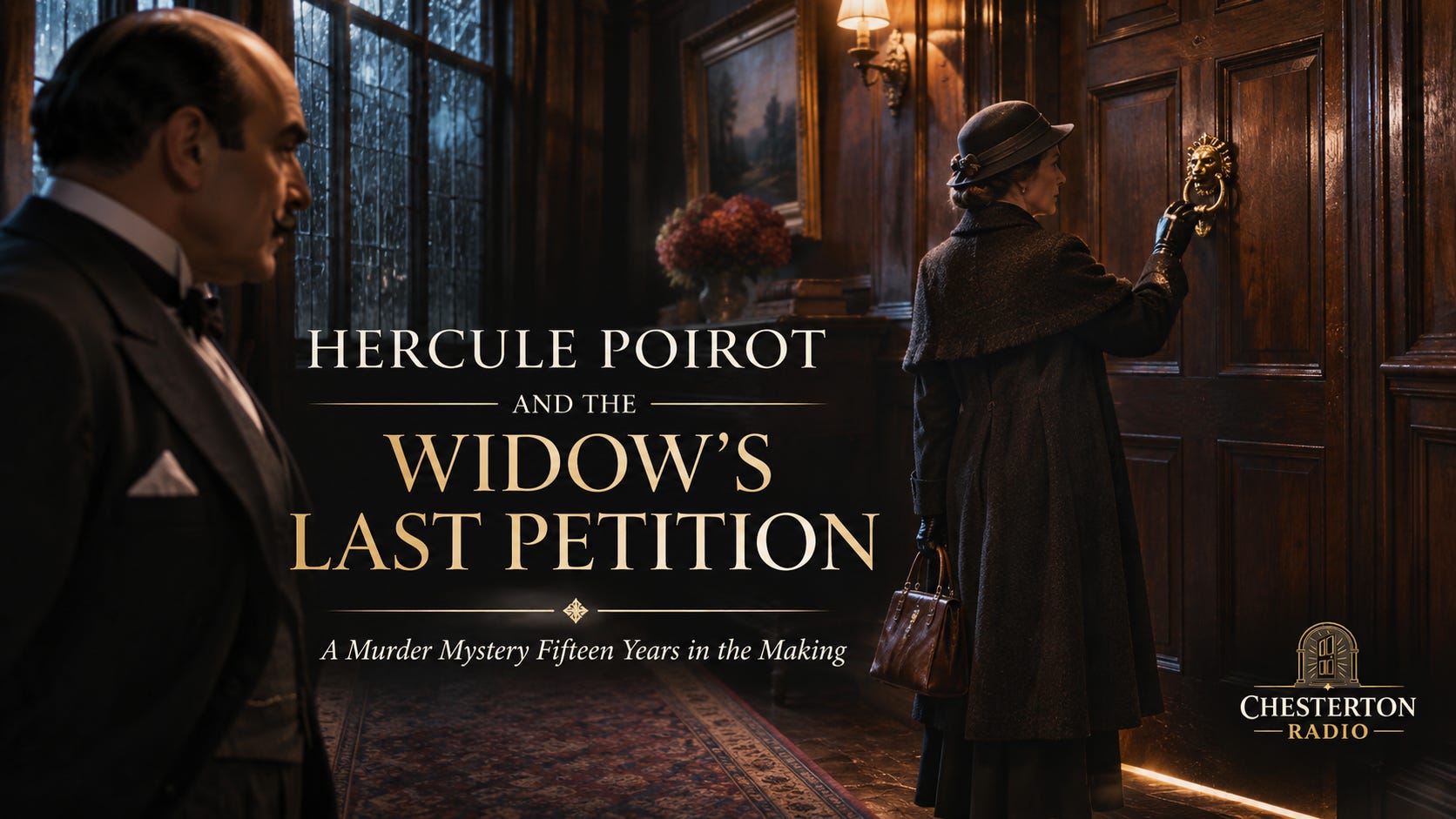
Part One — The Twelfth Knock
As narrated by Captain Arthur Hastings
There are certain men whose entire lives have been devoted to the maintenance of their own dignity, and I have often observed that such men are singularly ill-equipped to survive the discovery that they have made a mistake.
My friend Hercule Poirot had expressed this opinion to me on more than one occasion, though generally in rather less charitable terms. I was reminded of it one wet November morning in 1927, when a retired judge came to our rooms in London and asked Poirot to help him undo something that had happened fifteen years before.
At the time, neither of us imagined that the gentleman had less than two days to live.
It was a Saturday, and the rain had been falling steadily since breakfast. Poirot was engaged in arranging a small collection of correspondence according to a system which I had never entirely understood. The letters were already arranged by date, but this apparently did not satisfy him.
“One must distinguish, Hastings, between the order in which things happen and the order in which they become important.”
“A distinction which must make filing rather difficult.”
“On the contrary. It makes filing interesting.”
I had been about to suggest that he might find some more profitable occupation when our visitor was announced.
Sir Reginald Ashcombe was a tall, spare man of sixty-seven, with iron-grey hair, a carefully trimmed moustache, and the manner of one accustomed to having his remarks received as conclusions rather than invitations to discussion. His dark overcoat was immaculate despite the weather. He carried a polished walking stick, which he placed beside his chair with considerable precision.
He declined tea.
Poirot, who regarded the refusal of refreshments as a minor but revealing indication of character, seated himself opposite our guest.
“You have come to consult me, Sir Reginald?”
“I have.”
“Concerning a crime?”
The judge hesitated.
“Concerning a conviction.”
“Ah. That is not necessarily the same thing.”
A slight colour appeared in Ashcombe’s cheeks.
“I am aware of the distinction, Monsieur Poirot.”
“Naturally. You are a man of the law.”
“I was a man of the law. I have retired.”
“One does not retire from one’s conscience, however.”
I thought this unnecessarily pointed, particularly before we knew the nature of our visitor’s business. But Ashcombe merely looked at Poirot for a long moment.
“That,” he said at last, “is precisely the difficulty.”
He removed a leather document case from beneath his arm and laid it across his knees.
“Fifteen years ago, I presided over a murder trial. The accused was convicted, sentenced, and subsequently executed. I have lately received information which suggests that certain evidence presented to the court may have been misleading.”
“Deliberately misleading?”
“I cannot yet say.”
“Then what can you say?”
Ashcombe’s fingers tightened upon the case.
“That I should like you to examine the matter before I take any further action.”
Poirot leaned back.
“Why me?”
“Your reputation is considerable.”
“That is agreeable, but it is not an answer. You have solicitors. You have friends in the judiciary. There are official procedures.”
“Official procedures,” said Ashcombe coldly, “can be exceedingly slow.”
“Indeed. Sometimes fifteen years.”
For an instant I thought the judge would rise and leave us. Instead, he turned toward the window, where the rain had begun to beat against the glass.
“The case concerned a man named Henry Vale,” he said.
The name meant nothing to me. Poirot, however, remained quite still.
“Henry Vale,” he repeated. “The railway clerk?”
“You remember the case?”
“Only a little. A businessman was murdered. Money disappeared. The clerk was convicted.”
“Frederick Lancing was the victim. A substantial sum was missing from his office. Vale had been seen upon the premises, and the evidence against him was considered overwhelming.”
“By the jury?”
“By everyone concerned.”
“Except, perhaps, Monsieur Vale.”
The judge ignored this.
“There were witnesses. There were documents. Medical testimony established the probable time of death. The accused offered no satisfactory explanation for his movements.”
“And his wife?”
Ashcombe looked sharply at Poirot.
“What of her?”
“Did she not maintain his innocence?”
“Naturally. Wives frequently do.”
It was the first remark our visitor had made which struck me as positively disagreeable.
Poirot said nothing.
After a moment, Ashcombe continued.
“Mrs. Vale has never accepted the verdict. She has petitioned various authorities for years. More recently, she has taken to appearing at my house.”
“How frequently?”
“Every Saturday for the past eleven weeks.”
“Eleven!”
“Precisely. It has become intolerable. She arrives, demands an interview, and refuses to depart until someone explains that I am not available.”
“Yet you are available now.”
“I have invited her to see me this evening.”
Poirot’s eyebrows rose.
“Then something has changed.”
“Yes.”
“What?”
The judge opened his case, withdrew a narrow envelope, examined it, and then replaced it without showing us the contents.
“I would prefer to discuss the documents at Ashcombe Hall. Certain original papers are kept there.”
“Very well. But why invite the widow?”
“Because she has a right to hear what I have discovered.”
The words seemed to cost him an effort.
I found myself revising my opinion of Sir Reginald. Whatever his faults, it required courage for a man of his standing to reconsider a decision of such consequence.
Poirot appeared less impressed.
“And what, Sir Reginald, do you fear will happen when she hears it?”
The judge rose.
“I have not said that I fear anything.”
“No. You have not.”
“Then perhaps we understand one another.”
“I think,” said Poirot gently, “that we are beginning to.”
Our visitor gave us the particulars of the afternoon train and arranged for a motorcar to meet us at the station.
At the door, he paused.
“There is one thing I ought to make clear. I do not intend to submit myself to a public spectacle. Whatever the truth may be, it must be handled with dignity.”
Poirot bowed.
“Of course, monsieur.”
When the door had closed, I remarked that the judge seemed a rather difficult old gentleman.
“Not difficult, Hastings. Frightened.”
“He certainly did not appear frightened.”
“That is because he has spent sixty-seven years learning how not to appear so.”
“You think someone has threatened him?”
“Perhaps.”
“Mrs. Vale?”
Poirot regarded me thoughtfully.
“Tell me, Hastings. If a woman wishes to murder a man, is it customary for her to announce her arrival at his house on eleven consecutive Saturdays?”
“She might be trying to intimidate him.”
“Certainly. But then why should she continue after he has agreed to receive her?”
“Perhaps she does not trust him.”
“Ah.”
Poirot smiled.
“That, mon ami, is a possibility worth remembering.”
Ashcombe Hall stood some three miles beyond a small market town whose name I have no particular reason to preserve. The countryside was bleak under the November sky, the hedgerows black with rain and the fields already stripped of their autumn colour.
The house itself was a substantial building of red brick and pale stone, erected during the reign of Queen Anne and enlarged by succeeding generations whose architectural ambitions had not always been accompanied by corresponding good taste.
A broad gravel drive approached the entrance beneath ancient chestnut trees. To the east, a terrace overlooked formal gardens. Beyond these lay a stretch of woodland, where the bare branches moved restlessly in the wind.
“An admirable setting for a murder,” I remarked as we approached.
Poirot gave me a reproachful look.
“Hastings! We have been invited to prevent a misfortune, not to admire the scenery in anticipation of one.”
“I was speaking figuratively.”
“Then let us hope the figure remains merely a figure.”
The front door was opened by a woman of approximately sixty, dressed in the severe black of a senior housekeeper.
“Mrs. Pritchard,” she announced, with an economy of words which suggested that she considered introductions an unnecessary expenditure.
She conducted us into a large entrance hall, where a fire burned beneath a stone mantelpiece.
Sir Reginald had not yet returned from the station at which he had attended to some business, but Lady Ashcombe received us almost immediately.
Lady Margaret was a handsome woman of forty-nine, with dark hair touched by grey and an expression which suggested both intelligence and considerable fatigue. Her welcome was courteous, though I thought her manner somewhat strained.
“My husband has been expecting you. I hope the journey was not unpleasant.”
“Not at all,” I assured her.
“The roads are dreadful in this weather. Charles insists upon driving far too quickly, but I suppose young men always do.”
She smiled faintly.
“My nephew is staying with us. There are several other guests. I fear you have arrived at a rather unsettled time.”
“Because of the old case?” asked Poirot.
Lady Ashcombe’s smile disappeared.
“So he has told you.”
“Only a little.”
“Then you know as much as I do.”
She looked toward the great staircase.
“Reginald has become very preoccupied. He spends hours in his study. He has had Miss Finch searching through papers which ought to have been disposed of years ago. And there is that unfortunate woman.”
“Mrs. Vale?”
“Yes.”
Lady Ashcombe lowered her voice.
“I do not wish to speak unkindly of her. She has suffered terribly. But there must be some limit to what one person may demand of another.”
“Perhaps,” said Poirot, “that depends upon what is being demanded.”
Before she could reply, a young man entered from the direction of the drawing room.
He was tall, fair, and exceedingly well dressed, with an easy manner which I recognised as belonging to the sort of fellow who has never found it necessary to consider the price of anything until the bill arrives.
“Hallo, Aunt Margaret. Has Uncle Reginald returned?”
“Not yet. Charles, these are Monsieur Poirot and Captain Hastings.”
Charles Ashcombe shook our hands enthusiastically.
“Delighted. Heard a tremendous amount about you, Monsieur Poirot. My uncle seems to think you can sort out this wretched business.”
“One hopes so.”
“Personally, I think the whole thing ought to be left alone. Nothing to be gained by digging up ancient scandals.”
“Not even the truth?” asked Poirot.
Charles laughed.
“The truth is an expensive luxury, Monsieur Poirot. Particularly in families.”
His aunt gave him a warning glance.
“Charles.”
“Sorry. Shouldn’t have said that.”
But he did not appear especially sorry.
We were shown to our rooms and later descended for tea.
The drawing room contained a gathering of people whose relationships to one another were not immediately apparent.
Dr. Julian Mercer was a compact, heavily built gentleman with silver spectacles and the professional air of a man accustomed to being consulted in emergencies. He spoke quietly, with a habit of pausing before making any definite statement.
Miss Beatrice Finch, the judge’s secretary, was a slender woman in a dark blue dress. Her hair was drawn severely back, and she carried a notebook even during tea.
The Reverend Thomas Bell was a pleasant-looking clergyman with a weathered face and a voice which suggested that he had spent much of his life addressing people who were either deaf or reluctant to listen.
The last gentleman introduced to us was Arthur Pembroke.
He was a distinguished-looking man of sixty-one, broad-shouldered, clean-shaven, and possessed of an agreeable manner. His grey hair was carefully brushed, and his clothes, though conservative, were plainly expensive.
He had been standing beside a small writing table, closing a dark leather document portfolio. I noticed that the portfolio was secured by a green wax seal, an unusual arrangement which struck me as rather old-fashioned.
“One acquires habits,” he explained when he saw my glance. “My clerks are forever mislaying correspondence. I have taken to sealing the important packets myself.”
“With wax?” I asked.
“With wax, Captain Hastings. A most satisfactory invention. It leaves one in no doubt whether a packet has been opened.”
Poirot, who had been examining a small porcelain figure upon the mantelpiece, turned at this.
“Provided, monsieur, that one recognises the seal.”
Pembroke smiled.
“Quite so.”
He placed the portfolio upon a side table and accepted his tea.
“I understand you are here on account of poor Reginald’s latest obsession.”
“His latest?” asked Poirot.
“Oh, he has always had enthusiasms. Legal reform. Historical documents. The proper interpretation of obscure judgments. But this business of the Vale case is quite different. He has been brooding over it for weeks.”
“You knew the people concerned?”
“Some of them. Frederick Lancing was my business partner.”
There was a brief silence.
“Indeed?” said Poirot.
“Yes. A dreadful affair. I was away from the office when it happened, fortunately. The fellow who killed him was one of our clerks. Quite respectable in appearance. One never knows.”
“And you were satisfied with the conviction?”
“My dear Monsieur Poirot, the man was tried before a distinguished judge and convicted by a jury. What more could one reasonably require?”
Poirot stirred his tea.
“Nothing, perhaps. If the evidence was correct.”
Pembroke gave a little shrug.
“That is rather the point of a trial, is it not?”
Dr. Mercer, who had been listening with evident discomfort, set down his cup.
“There were difficulties with the medical evidence,” he said.
Pembroke looked at him.
“Surely not, Julian.”
“I did not say that the evidence was wrong. Merely that medical estimates are sometimes treated as more exact than they can properly be.”
“After fifteen years,” observed Charles, “I imagine everyone’s recollection is likely to be rather imperfect.”
“Quite,” said Pembroke.
Poirot asked no further questions.
But I noticed that he had ceased stirring his tea.
It was shortly after five when the first disturbance occurred.
We were in the drawing room when raised voices became audible from the entrance hall.
A woman’s voice was speaking with considerable determination.
“I was told he would see me today.”
Mrs. Pritchard answered in tones of firm disapproval.
“Sir Reginald is not receiving visitors at present.”
“Then I shall wait.”
“You cannot remain here indefinitely.”
“I have been waiting fifteen years, Mrs. Pritchard. Another hour will hardly make a difference.”
Lady Ashcombe rose.
“Oh dear.”
She went into the hall, followed by Charles and, after a moment’s hesitation, the rest of us.
The woman standing near the entrance was of medium height, plainly dressed in a dark coat which had seen better days. Her hat was slightly crooked, and the cuffs of her gloves were damp.
She carried a worn leather handbag and a folded umbrella.
There was nothing remarkable about her appearance except her eyes.
They were grey, steady, and entirely without embarrassment.
“Mrs. Vale,” said Lady Ashcombe. “You were asked to come at nine.”
“I know what I was asked, my lady.”
“Then why are you here now?”
“Because I received a message this morning suggesting that Sir Reginald might reconsider.”
Miss Finch, who had followed us into the hall, looked startled.
“I sent no such message.”
“I did not say you had.”
“Who sent it?” asked Charles.
“A gentleman who did not give his name.”
This produced an uncomfortable silence.
Lady Ashcombe drew herself up.
“My husband will keep his appointment.”
“I hope so.”
“He has given you his word.”
Mrs. Vale looked at her.
“Your ladyship will forgive me if I attach rather less importance to that than you do.”
I confess that I thought the remark impertinent.
Poirot, however, was watching the widow with unusual attention.
At that moment Sir Reginald entered through a door at the far end of the hall.
He stopped when he saw her.
“Mrs. Vale.”
“Sir Reginald.”
“I asked you to come at nine.”
“And I have come.”
“At five.”
“I was afraid you might change your mind.”
The judge’s face darkened.
“I have given you my assurance.”
“You gave my husband your assurance that he would receive a fair trial.”
There was a sharp intake of breath from Lady Ashcombe.
“Really, Mrs. Vale—”
But the widow continued.
“He trusted the court. He trusted the witnesses. He trusted the judge. And when they took him away, he told me not to worry, because the truth would come out.”
Her voice had risen, though she did not appear to notice.
“Well, it has been fifteen years, Sir Reginald. Fifteen years, and the truth has not come out.”
The judge stood motionless.
“I have told you that I intend to discuss the matter.”
“Discuss it? I have had discussions. I have written letters. I have filled in forms and waited outside offices until the clerks went home. I have been told to be patient by people who have never had anything taken from them.”
Her hands trembled.
“I will not leave this house without an answer.”
Charles moved forward.
“Now see here—”
Poirot raised one hand.
The gesture was so slight that I doubt anyone but myself noticed it, yet Charles stopped.
Sir Reginald spoke quietly.
“You shall have your answer, Mrs. Vale. At nine o’clock.”
For the first time, something uncertain passed across the woman’s face.
She looked at him for several seconds.
Then she nodded.
“Very well.”
Lady Ashcombe directed Mrs. Pritchard to make a room available where the widow might wait.
As she was led away, Mrs. Vale turned once more toward the judge.
“I hope you understand, Sir Reginald, that I shall keep coming until this is finished.”
He inclined his head.
“I understand.”
The remainder of the afternoon passed under a cloud.
At dinner, the company assembled in a dining room whose polished table seemed almost large enough to accommodate a delegation from Parliament.
The judge sat at one end, Lady Ashcombe at the other. Poirot was placed beside Miss Finch, while I found myself between Charles and Dr. Mercer.
Arthur Pembroke sat opposite me.
The conversation began with the weather, progressed through the condition of the roads, and eventually reached the subject of a recent parliamentary debate, which Charles described with more confidence than knowledge.
Sir Reginald contributed little.
He ate sparingly and drank no wine.
At one point Lady Ashcombe asked whether he was feeling unwell.
“Perfectly well, Margaret.”
“You have scarcely touched your dinner.”
“I am not hungry.”
Dr. Mercer leaned forward.
“You must not overtax yourself, Reginald. I have warned you about unnecessary agitation.”
“Yes, Julian. You have warned me about a great many things.”
The doctor subsided.
Presently Sir Reginald laid down his knife and fork.
“There is something I should like to say.”
The conversation ceased.
“I have been reviewing certain matters connected with a case over which I presided some years ago.”
Lady Ashcombe looked distressed.
“Reginald, must we discuss this now?”
“Yes.”
He glanced around the table.
“I have reached the conclusion that a grave injustice may have occurred. I intend to take steps to correct it.”
There was a silence.
Charles was the first to speak.
“Good Lord, Uncle. Surely you don’t mean to make some sort of public announcement?”
“I mean to do what is necessary.”
“But the newspapers—”
“The newspapers are not my principal concern.”
Arthur Pembroke folded his napkin with deliberate care.
“Have you obtained new evidence, Reginald?”
“Yes.”
“Documentary evidence?”
“Among other things.”
“What documents?”
The judge looked at him.
“I shall discuss that with Monsieur Poirot.”
Pembroke gave an agreeable smile.
“Naturally. I was merely curious.”
Dr. Mercer cleared his throat.
“If the matter concerns the Lancing case, I should like an opportunity to review my own testimony.”
“You shall have it, Julian.”
“Because there are certain qualifications which may not have been adequately understood at the time.”
“That,” said the judge, “is precisely what I have come to suspect.”
Miss Finch was staring down at her plate.
Lady Ashcombe appeared close to tears.
The Reverend Bell, who had remained silent throughout, spoke at last.
“I am glad, Reginald.”
The judge looked toward him.
“I hope you will still be glad when you understand what it may cost.”
The clergyman answered quietly.
“I think the cost has been paid by someone else for a very long time.”
No one replied.
After dinner the gentlemen withdrew to the drawing room, where coffee was served.
It was then approximately half past eight.
Sir Reginald excused himself almost immediately.
“I have some papers to examine before my appointment.”
He turned to Poirot.
“Will you come to my study after I have spoken with Mrs. Vale? There are matters I wish to place in your hands.”
“Certainly, monsieur.”
The judge nodded and left us.
I remember that Arthur Pembroke watched him go.
It was not an especially remarkable glance. Indeed, I might never have recalled it had subsequent events not lent significance to almost every small movement made that evening.
Charles poured himself a brandy.
“Well, that’s torn it.”
Lady Ashcombe looked at him sharply.
“Charles, please.”
“I’m sorry, Aunt Margaret, but Uncle Reginald seems determined to ruin himself.”
“He is determined to do what he believes right,” said the Reverend Bell.
“An admirable sentiment,” replied Charles, “provided one can afford it.”
Dr. Mercer rose.
“I think I shall take a turn about the hall.”
He departed, looking decidedly unhappy.
Arthur Pembroke remained seated for a few moments, then consulted his watch.
“I must retrieve a letter from my portfolio. There is a matter I ought to settle before the evening is over.”
He excused himself.
Poirot was engaged in conversation with Miss Finch, and I found myself listening to Charles describe the unfortunate condition of his finances with a candour which I suspected owed something to the brandy.
“My uncle has always been generous,” he said, “but lately he has developed the most extraordinary ideas about responsibility. One would think I had committed a crime merely by losing a little money.”
“How much money?” I asked.
Charles gave an embarrassed laugh.
“Enough to make the subject disagreeable.”
At that moment Mrs. Pritchard appeared to replenish the coffee.
She paused near a small cabinet in the passage, glanced down at something upon its polished surface, and gave a faint click of disapproval.
Then she continued about her duties.
It was a trivial incident.
I mention it only because Poirot later insisted that nothing which occurred in that house was quite so trivial as it appeared.
At five minutes to nine, Arthur Pembroke returned to the drawing room.
He seemed in excellent spirits.
“Reginald is still occupied with his papers, I understand.”
“Yes,” said Lady Ashcombe.
“Then we must hope the interview goes satisfactorily.”
He seated himself near the fire.
The Reverend Bell was speaking to Poirot about a parish restoration fund, and I was examining a volume of sporting prints when the clock in the hall began to strike nine.
Almost immediately we heard the sound of the brass knocker upon the study door.
Three distinct blows.
They were not particularly loud, but the old house carried sound in a curious fashion, and the drawing room fell silent.
“Mrs. Vale,” murmured Lady Ashcombe.
There was a pause.
Then another sound reached us, duller and less distinct.
It seemed to come from somewhere beyond the study.
A door closing, perhaps.
Charles looked up.
“Well, he’s seeing her at last.”
But a moment later the knocker sounded again.
This time more urgently.
Lady Ashcombe rose.
“Why does he not answer?”
No one replied.
The knocking continued.
We went into the hall.
Mrs. Vale stood outside the study, her face pale but composed.
“He will not answer me.”
“Perhaps he is occupied,” said Charles.
“I heard someone moving.”
“Then give him a moment.”
“I have given him fifteen years.”
She struck the knocker once more.
The sound echoed through the corridor.
Still there was no reply.
Dr. Mercer, who had rejoined us, approached the door.
“Reginald? Are you quite well?”
Silence.
He tried the handle.
The door opened a few inches, then met an obstruction.
“Something is against it.”
Charles stepped forward.
“Let me.”
Between them they forced the door sufficiently wide for us to enter.
The room was illuminated by a green-shaded lamp upon the desk. The fire had burned low, and the French windows reflected the lamplight against the blackness outside.
Sir Reginald Ashcombe lay upon the carpet beside his writing table.
His head was turned at an unnatural angle.
A small bronze figure of Justice lay near his outstretched hand, its delicate scales broken.
Beside the fireplace, a mantel clock had fallen to the floor. Its glass was shattered, and its hands stood motionless.
Dr. Mercer knelt beside the judge.
For several seconds he said nothing.
Then he rose slowly.
“I am afraid there is nothing to be done.”
Lady Ashcombe gave a cry and caught at the doorframe.
Charles moved to support her.
Mrs. Vale stood quite still.
She looked down at the dead man, and I saw an expression pass over her face which I could not then interpret.
It was not triumph.
It was not grief.
It was something nearer to disbelief.
Poirot had entered behind us.
He surveyed the room without speaking.
His eyes moved from the body to the bronze statue, from the shattered clock to the desk, and finally to the open space beside the writing table.
“Captain Hastings,” he said quietly, “would you be so good as to ask everyone to remain where they are?”
I obeyed.
Poirot approached the desk.
A rectangular patch upon its polished surface was noticeably lighter than the surrounding wood, as though some object had recently been removed.
He examined it for a moment.
Then he turned to the widow.
“Madame, when you knocked upon the door, you heard a sound?”
“Yes.”
“What kind of sound?”
“Someone moving. A door, perhaps. I thought Sir Reginald was coming to let me in.”
“But he did not.”
“No.”
“And you knocked again?”
“Yes.”
Poirot inclined his head.
“Thank you.”
He looked once more toward the body.
I had seen that expression upon his face before: the peculiar stillness which came over him when some small and apparently unimportant detail had disturbed the orderly arrangement of his thoughts.
“What is it, Poirot?” I whispered.
He did not answer immediately.
Instead, he glanced at the empty place upon the desk.
“Something is missing, Hastings.”
“The judge’s life, certainly.”
“Yes, mon ami.”
His voice was grave.
“But I fear that is not the only thing.”
Outside, the rain began again, striking softly against the darkened windows.
And in the corridor behind us, Mrs. Eleanor Vale—the woman who had spent fifteen years demanding that Sir Reginald Ashcombe answer her—stood before a door which, at last, would never open to her again.
End of Part One — The Twelfth Knock
Hercule Poirot and the Widow’s Last Petition
A Chesterton Radio Original Mystery
Part Two — The Heart of Stone
As narrated by Captain Arthur Hastings
There is something peculiarly dreadful about the sudden death of a man who has assembled his friends and acquaintances for the express purpose of making an important announcement. The ordinary courtesies of a country-house visit are transformed in an instant into a series of awkward silences, suspicious glances, and questions which nobody wishes to answer.
At Ashcombe Hall, the transformation was particularly complete.
Only a quarter of an hour earlier, Sir Reginald Ashcombe had been a formidable gentleman whose principal concern appeared to be the preservation of his dignity. Now he lay upon the carpet of his study, and the very people who had been anxious to hear what he intended to say seemed equally anxious to forget that he had intended to say anything at all.
Poirot, however, was not disposed to forget.
“Nobody must touch anything,” he said.
Dr. Mercer, who was still kneeling beside the body, looked up with an expression of professional irritation.
“My dear Monsieur Poirot, I am a physician.”
“That is precisely why I have permitted you to examine him, doctor. But we must now consider the police.”
“Surely you do not suggest—”
“I suggest nothing. I observe that Sir Reginald is dead, that there has been violence, and that the circumstances require investigation.”
Charles Ashcombe, who had been supporting his aunt, turned toward us.
“Good God, man! You mean murder?”
Poirot glanced at the bronze figure lying upon the carpet.
“It would be premature to give the matter another name.”
Lady Ashcombe made a faint sound and sank into a chair which I hastily brought forward.
The Reverend Bell went to her side.
“Margaret, perhaps you should leave the room.”
“No.”
Her answer surprised us all.
She sat very upright, her hands clasped tightly together.
“I shall remain until I understand what has happened to my husband.”
I could not help admiring her composure.
Poirot bowed slightly.
“As you wish, madame. But I must ask that no one approach the desk or disturb the objects upon the floor.”
He turned to me.
“Hastings, will you telephone the police? Ask for the local superintendent or inspector. Explain that there has been a suspicious death and that the room is being preserved.”
I went into the hall, where Mrs. Pritchard directed me to the telephone.
The housekeeper had recovered her customary self-possession with remarkable speed. Indeed, she appeared to regard the murder as an additional household difficulty which, though inconvenient, would eventually yield to proper management.
“The police station is at Market Wetherby,” she informed me. “You will find the number beside the instrument.”
“Thank you.”
“And Captain Hastings?”
“Yes?”
“I should be obliged if you would ask them not to bring mud into the house.”
When I returned, Poirot was standing beside the fireplace.
He had not touched the fallen clock, but was examining it from several angles.
Dr. Mercer had withdrawn to a chair near the door, where he sat with his hands upon his knees. Arthur Pembroke stood beside the bookcase, his expression grave and attentive.
Mrs. Vale remained in the corridor.
It was an extraordinary circumstance that the woman who had come to demand justice from Sir Reginald should now be the only person present who seemed to have no desire to enter his study.
Poirot beckoned to me.
“Observe, Hastings.”
He indicated the clock.
It was a handsome little mantel clock in a dark wooden case, with brass ornamentation and a white enamel dial. Its glass had shattered, and the hands stood at thirteen minutes to nine.
“Eight forty-seven,” I said.
“Yes.”
“Then we know when the murder occurred.”
“Do we?”
“The clock was knocked down during the struggle.”
“That is possible.”
“Surely it is more than possible.”
Poirot looked at me with mild reproach.
“You have already constructed the struggle, established the time of death, and identified the clock as a witness. It is admirable how quickly you work.”
“I merely meant—”
“Yes, yes. But a clock which has stopped tells us when the clock stopped. It does not necessarily tell us when a man died.”
He pointed toward the fragments of glass.
“Nevertheless, we shall remember it.”
The bronze statue lay several feet from the body. It represented Justice as a blindfolded woman holding a pair of scales. One of the delicate chains had snapped, and a small brass pan rested beneath the desk.
The figure was perhaps nine inches high and sufficiently heavy to serve as a dangerous weapon.
“An unfortunate choice of ornament,” I remarked.
“Why unfortunate?”
“Considering the circumstances.”
Poirot regarded the statue thoughtfully.
“Ah, you are thinking of the symbolism.”
“Naturally.”
“Then you are thinking as a writer of sensational fiction, Hastings. A murderer may select a weapon because it is convenient, not because it is poetic.”
He crouched carefully beside the desk.
A dark mark was visible upon the corner of the carpet. I looked away.
“Was the judge struck from behind?” I asked.
“That is for the doctor and the police to determine.”
“But the statue—”
“May have been used. Yes.”
Poirot rose and turned to Mercer.
“Doctor, can you tell us anything concerning the time of death?”
Mercer adjusted his spectacles.
“Very little with certainty.”
“An admirable beginning.”
The physician appeared uncertain whether this was intended as a compliment.
“The injury is severe. Death may have followed rapidly. I should not care to offer a precise time without a proper examination.”
“Would you say he was alive at nine o’clock?”
“I cannot say.”
“Yet Mrs. Vale heard someone moving.”
“That is what she reports.”
Poirot watched him.
“You do not appear anxious to accept her interpretation.”
“Nor should you, Monsieur Poirot. A sound heard through a closed door is hardly medical evidence.”
“Quite so.”
There was something in the doctor’s manner which disturbed me. He seemed determined to avoid any definite statement, yet I remembered how confidently he had spoken of medical evidence during tea.
Poirot evidently remembered it also.
“You testified at the trial of Henry Vale, did you not?”
Mercer’s face tightened.
“Yes.”
“And on that occasion you were able to estimate the time of death?”
“I gave an opinion.”
“With confidence?”
“With such confidence as the circumstances justified.”
“Naturally.”
Poirot said no more.
The local police arrived shortly before ten.
Inspector Edward Harcourt was a substantial man of about fifty, with a broad face, a close-cropped moustache, and the air of someone who had spent many years discovering that human beings rarely behaved as sensibly as the law expected them to.
He was accompanied by a young constable and a police surgeon who immediately took charge of the medical examination.
Harcourt greeted Poirot with polite reserve.
“I understand you were a guest in the house, sir.”
“That is correct.”
“And that Sir Reginald had consulted you professionally?”
“Yes.”
“Concerning what?”
“A matter connected with an old criminal conviction.”
The inspector made a note.
“Then perhaps you had better remain available.”
“I should be delighted.”
Harcourt looked around the study.
“Who discovered the body?”
“All of us, more or less,” I replied.
“Someone must have opened the door.”
“Dr. Mercer tried the handle,” said Charles. “I helped him push it open.”
“Was it locked?”
“No. Something was obstructing it.”
“The body?”
“Yes.”
The inspector examined the position of the door.
“Then there was no difficulty entering except the body lying behind it?”
“Precisely,” said Poirot.
Harcourt glanced toward the French windows.
“Fastened?”
“From within,” I answered.
The inspector inspected the catches.
“Quite.”
He then turned to the smaller door near the bookcases.
“And this?”
Mrs. Pritchard, who had been summoned to assist, replied immediately.
“The records room, Inspector.”
“Where does it lead?”
“To the passage behind the library.”
“Is it usually kept locked?”
“Yes, sir.”
“Who has the key?”
“There is a key cabinet in the passage. The household keys are kept there.”
Harcourt made another note.
“Has anyone used that door this evening?”
“Not to my knowledge.”
Poirot looked toward the narrow door but made no comment.
The inspector asked Mrs. Pritchard to show him the cabinet.
I accompanied them.
It was a modest oak cupboard fixed to the wall of a side passage, containing a number of labelled hooks and keys.
Mrs. Pritchard opened it.
“There, sir.”
Harcourt examined the contents.
“All present?”
“As far as I can see.”
“Do you keep a record of who takes them?”
“No, sir. We are not a hotel.”
The inspector appeared accustomed to such replies.
Poirot, who had followed us, bent slightly to examine the lower tray.
“May I?” he asked.
“Certainly,” said Harcourt.
Poirot took out his pocket magnifying glass.
I saw a minute dark-green fragment lying near the corner of the tray.
It appeared to be sealing wax.
“An interesting colour,” Poirot murmured.
Mrs. Pritchard looked offended.
“I assure you the cabinet is dusted regularly.”
“I do not doubt it for an instant, madame.”
He replaced the magnifying glass.
“Was the cabinet opened this evening?”
“Not by me.”
“Did you see anyone near it?”
Mrs. Pritchard considered.
“Mr. Pembroke was in the passage after dinner. I remember seeing his leather portfolio on the little table nearby.”
“Did he open the cabinet?”
“I couldn’t say. I was carrying the coffee things.”
“Thank you.”
Harcourt regarded Poirot with renewed interest.
“Is that important?”
“Perhaps. Or perhaps it is merely a small piece of sealing wax in a very well-kept cupboard.”
I thought this a singularly unhelpful observation.
The first person questioned was Mrs. Eleanor Vale.
Inspector Harcourt conducted the interview in a small morning room, with Poirot and myself present at his invitation.
The widow sat opposite us, her damp gloves folded neatly upon her lap.
She had recovered from the shock of discovering the body, though her face remained pale.
“Mrs. Vale,” began the inspector, “I understand you had a disagreement with Sir Reginald this afternoon.”
“I spoke to him.”
“Rather forcefully, according to several witnesses.”
“I have been speaking to him for fifteen years. It is difficult to remain polite indefinitely.”
“Did you threaten him?”
“No.”
“You said you would not leave the house without an answer.”
“That is correct.”
“Some might consider that a threat.”
“Then some people have a very poor understanding of English.”
I confess that I found her manner increasingly trying.
Harcourt, however, remained patient.
“Why did you come to Ashcombe Hall today?”
“Because Sir Reginald invited me.”
“At nine o’clock?”
“Yes.”
“Yet you arrived at five.”
“I received a telephone message suggesting that he might cancel the appointment.”
“Who telephoned?”
“A man.”
“Did he give his name?”
“No.”
“What did he say?”
“That Sir Reginald had been advised against making any statement and that I should not be surprised if the interview were postponed.”
“Did you recognise the voice?”
“No.”
“Was it someone from the household?”
“I cannot say.”
Poirot leaned forward.
“Madame, did the caller say that the judge had changed his mind, or merely that he might change it?”
“The latter.”
“And you came immediately?”
“Yes.”
“Why?”
She looked at him as though the answer were obvious.
“Because I have learned that when people intend to refuse you, they prefer to do it by letter.”
Poirot nodded.
“And when you arrived?”
“I was told to wait.”
“Did you see Sir Reginald again before nine?”
“No.”
“Did you enter his study?”
“No.”
“Did you know where it was?”
“Of course. I have been shown that door often enough.”
The inspector looked up.
“What do you mean?”
“On my previous visits I was told that Sir Reginald was occupied in his study. Sometimes I could hear him speaking to other people. Once I heard him laughing.”
Her voice changed.
“I was told he was too busy to see me. But he was not too busy to laugh.”
There was an uncomfortable silence.
Harcourt returned to his notes.
“At nine o’clock you approached the study?”
“Yes.”
“Did you knock?”
“Three times.”
“Why three?”
“Because that is how one knocks upon a door.”
The inspector sighed.
“And then?”
“I heard something.”
“What?”
“A movement. A door closing, perhaps.”
“From inside the study?”
“I thought so.”
“Did anyone answer?”
“No.”
“Then you knocked again?”
“Yes.”
“And when the others arrived?”
“They opened the door.”
“Did you touch anything?”
“No.”
“Did you approach the body?”
“No.”
Harcourt closed his notebook.
“Mrs. Vale, I must ask you a difficult question. Did you hate Sir Reginald Ashcombe?”
She considered this with surprising seriousness.
“I have hated what he did.”
“That is not quite an answer.”
“No,” she said. “It is the only honest answer I can give.”
Poirot spoke quietly.
“And now that he is dead?”
For the first time her composure failed.
She looked down at her gloves.
“Now I shall never know what he intended to tell me.”
After she had gone, I expressed my opinion rather strongly.
“She is a most extraordinary woman.”
“Indeed,” said Poirot.
“She practically admits that she hated the judge.”
“She admits that she hated what he did.”
“A distinction without much difference.”
“On the contrary, Hastings. It is a distinction of considerable importance.”
“She had motive, opportunity, and a public quarrel with the victim.”
“Yes.”
“And she was standing outside the door when the body was discovered.”
“Yes.”
“Then surely—”
Poirot raised a finger.
“One little difficulty.”
“What?”
“If she had murdered him, why should she remain outside the door knocking until the entire household arrived?”
“To establish her innocence.”
“Perhaps. But she would then have arranged to be discovered in the most conspicuous possible position, immediately after threatening him before witnesses. It is not impossible, but it is hardly subtle.”
“She does not strike me as a subtle woman.”
“Ah. Yet she has managed to keep an entire household uncomfortable for eleven consecutive Saturdays without once giving them a legitimate reason to have her arrested.”
I had no immediate reply.
Poirot smiled.
“Do not underestimate persistence, mon ami. It is sometimes a form of intelligence.”
The inspector next questioned Charles Ashcombe.
Charles was visibly nervous, though he attempted to disguise it beneath an air of injured good humour.
“My uncle and I were on excellent terms.”
“Despite your disagreement at dinner?” asked Harcourt.
“That was nothing. Families disagree.”
“You were concerned about his intended announcement.”
“Naturally. The family name would suffer.”
“And your financial position?”
Charles looked startled.
“What has that to do with it?”
“I understand Sir Reginald assisted you financially.”
“From time to time.”
“Was he proposing to alter his will?”
Charles hesitated.
“He had mentioned the possibility.”
“To your disadvantage?”
“Possibly.”
“Then you had a reason to be dissatisfied with him.”
“Good Lord, Inspector! One doesn’t murder one’s uncle because he threatens to cut down one’s allowance.”
Harcourt merely looked at him.
Charles flushed.
“At least, I don’t.”
“Where were you between half past eight and nine?”
“In the drawing room.”
“Throughout?”
“I believe so.”
Poirot intervened.
“You spoke to Captain Hastings about your finances.”
“Yes.”
“And before that?”
“I poured myself a brandy. I spoke to Aunt Margaret. I believe I looked at the newspapers.”
“Did you leave the room?”
“Not that I remember.”
“Did you see Mr. Pembroke leave?”
“Yes. He went to fetch some correspondence.”
“And return?”
“Certainly. Before nine.”
“At what time?”
Charles frowned.
“I couldn’t say precisely. Five minutes to, perhaps.”
Poirot nodded.
“Thank you.”
The inspector dismissed him.
I thought Charles had acquitted himself poorly, but Poirot appeared more interested in the question of who had left the drawing room than in the nephew’s debts.
Miss Beatrice Finch was a different proposition.
She answered every question with exactness, rarely using more words than necessary.
She had been Sir Reginald’s secretary for nearly twelve years.
She managed his correspondence, maintained his appointments, and assisted with the preparation of legal and historical papers.
“Did you know he intended to reopen the Vale case?” asked Harcourt.
“Yes.”
“Did you approve?”
“My opinion was not requested.”
“Did you believe the conviction was wrong?”
“I believed Sir Reginald had become dissatisfied with certain evidence.”
“What evidence?”
“I was not shown the originals.”
“Did you prepare copies?”
“Some typed extracts, yes.”
“From what documents?”
“Old trial papers, correspondence, and railway records.”
The inspector looked up.
“Railway records?”
“Yes.”
Poirot leaned forward.
“Did Sir Reginald explain their significance?”
“No.”
“Did he ask you to prepare a statement?”
“Several drafts.”
“What became of them?”
“He destroyed two. The third was incomplete.”
“Where is it?”
“In his study, I presume.”
“Did he keep documents in a dispatch case?”
“Yes. A brown leather case with brass fittings.”
“Where was it kept?”
“Usually upon the desk.”
Poirot glanced at me.
I remembered the pale rectangle upon the polished wood.
“Was it there this afternoon?” he asked.
“Yes.”
“And now?”
Miss Finch looked toward the inspector.
“I do not know.”
Poirot said quietly, “It is no longer there.”
For the first time, the secretary’s composure deserted her.
“Then someone has taken it.”
“That would seem probable.”
She clasped her hands.
“But Sir Reginald intended to give those papers to you.”
“Yes.”
“Then whoever took them must have known what they contained.”
Poirot regarded her thoughtfully.
“Or feared what they might contain.”
It was approaching midnight when the inspector permitted us to return to the study.
The police surgeon had completed his preliminary examination and arranged for the removal of the body.
He was a cautious man, and I found his observations less satisfying than I had hoped.
The fatal injury was consistent with a heavy blow from a blunt object.
Death had probably followed rapidly.
He could not establish an exact time.
“Could the judge have been dead before nine?” asked Poirot.
“Certainly.”
“Before eight fifty?”
“Quite possibly.”
“At eight forty-seven?”
The surgeon gave him a look of mild exasperation.
“I should not care to distinguish between eight forty-seven and eight fifty-two on the evidence available.”
Poirot bowed.
“An excellent answer.”
When the surgeon had gone, I remarked that the medical profession seemed determined to tell us nothing useful.
“On the contrary,” said Poirot. “He has told us something of the greatest importance.”
“What?”
“That we must not allow the clock to become a witness more authoritative than the evidence permits.”
He approached the fireplace.
The broken clock remained where it had fallen.
“Observe the position, Hastings. It has fallen from the mantel. The glass is shattered. The hands are bent.”
“During the struggle.”
“Possibly.”
“And the statue?”
“Perhaps the same disturbance caused both.”
He indicated a tiny fragment of glass lying partly beneath the bronze figure.
“That interests me.”
“Why?”
“Because it suggests that the statue and the clock were involved in the same violent event.”
“Then the clock does establish the time.”
“It supports a time. It does not establish it.”
I was beginning to find the distinction tiresome.
Poirot evidently noticed.
“Patience, Hastings. We must distinguish between what we know, what we believe, and what we merely find convenient.”
He turned toward the desk.
The rectangular mark where the dispatch case had stood was clearly visible.
“Someone removed the case.”
“Obviously.”
“Yet the drawer beneath it is locked.”
He examined the drawer without attempting to open it.
“Curious.”
“What is?”
“The murderer took the object which could be seen and left the compartment which could not.”
“Perhaps he did not know about the drawer.”
“Precisely.”
Poirot looked pleased.
I could not understand why.
The following morning brought no improvement in the weather.
Rain lay upon the terrace, and the lawns beyond the windows had become a dull expanse of grey-green.
Breakfast was served in an atmosphere of profound discomfort.
Lady Ashcombe did not appear.
Charles sat staring at his plate.
Dr. Mercer read the newspaper without turning a page.
Arthur Pembroke was the only member of the company who seemed capable of ordinary conversation.
“A dreadful business,” he said as Poirot and I entered. “I scarcely slept.”
“Nor did I,” replied Charles.
“One hopes the police will soon establish what happened.”
Poirot accepted a cup of coffee.
“That is also my hope, monsieur.”
Pembroke folded his newspaper.
“Have they discovered anything?”
“Several interesting details.”
“Such as?”
“A clock. A missing case. A door which was not locked.”
Pembroke smiled faintly.
“Hardly the ingredients of a solution.”
“No. But perhaps the ingredients of a question.”
“What question?”
Poirot spread a little marmalade upon his toast.
“Why should a murderer take papers from a dead man?”
Pembroke considered.
“To conceal something, presumably.”
“Yes. But what?”
“Surely that depends upon what the papers contained.”
“Exactly.”
Poirot looked at him.
“And that is what I find so interesting.”
Pembroke’s expression did not change.
“Then you have discovered their contents?”
“Not yet.”
“Ah.”
He returned to his newspaper.
I noticed that Poirot did not look at him again.
Later that morning we spoke with the Reverend Bell.
The clergyman received us in the library, where he had been sitting beside the window with an unopened book upon his knee.
He looked older than he had the previous evening.
“Poor Reginald,” he said. “He was so close.”
“Close to what?” asked Poirot.
“To doing what he should have done years ago.”
“You believed the conviction was unjust?”
“I believed there were questions which had never been answered.”
“Did you know Henry Vale?”
“Only slightly. He was a quiet man. Worked hard. Attended church when his duties permitted. I cannot claim to have known his heart.”
“And Mrs. Vale?”
“I have known her for many years.”
“Has she spoken to you of revenge?”
The clergyman looked genuinely surprised.
“Revenge? No.”
“Of hatred?”
“Certainly. She has spoken of hatred. She would hardly be human if she had not felt it.”
“Yet you do not believe she killed Sir Reginald.”
“No.”
“Why?”
Bell considered.
“Because she wanted him alive.”
It was such a simple answer that I almost laughed.
But Poirot did not.
“Explain.”
“She wanted him to speak. She wanted him to admit that her husband had been wronged. His death gives her nothing.”
“Unless she believed he would never speak.”
“She had waited fifteen years, Monsieur Poirot. She could have waited another evening.”
Poirot nodded.
“Did Sir Reginald discuss the case with you?”
“Yes.”
“Did he tell you what he had discovered?”
“Not precisely. He said that an old piece of evidence had been misunderstood. He spoke of a railway document.”
“A railway document?”
“Yes. Something concerning the time at which a consignment had been collected.”
“Did he mention a name?”
“Only one. Samuel Wren.”
Poirot became very still.
“Who is Samuel Wren?”
“A former railway clerk, I believe. Reginald said the man had written to him some years ago.”
“And what did the letter contain?”
“I do not know.”
Bell looked down at his hands.
“He told me that he had been afraid to act upon it.”
“Afraid?”
“Of admitting that he might have been wrong.”
The clergyman’s voice was quiet.
“He had spent his life being certain. It is difficult for such a man to discover that certainty may have been his greatest weakness.”
Poirot regarded him for a long moment.
“And what changed his mind?”
Bell looked toward the window.
“He was ill last spring. Very ill. For a time we thought he would die.”
“Did he speak of the Vale case then?”
“Yes.”
“What did he say?”
The clergyman hesitated.
“That he had been hearing a knocking.”
I felt a sudden chill.
“At his door?” I asked.
Bell shook his head.
“No, Captain Hastings. He meant that he could no longer put the matter out of his mind.”
Poirot said nothing.
“After he recovered,” Bell continued, “Mrs. Vale began coming every Saturday. I think her visits made it impossible for him to forget what he had already begun to understand.”
“Then she did not create his conscience,” said Poirot.
“No.”
“She merely prevented him from silencing it.”
Bell looked at him.
“That is very well put.”
When we left the library, I found myself unusually thoughtful.
“Poor old fellow,” I said. “It must have been dreadful to discover that he had condemned an innocent man.”
Poirot stopped in the corridor.
“Had he discovered that?”
“Surely that is what the clergyman implied.”
“He discovered that the evidence might have been wrong.”
“Is there much difference?”
“An enormous difference. One may suspect an injustice without knowing who committed it.”
“And you think the judge knew?”
“I think he knew enough to be afraid.”
We passed the study door.
A constable stood outside.
Poirot paused and looked at the brass knocker.
“Tell me, Hastings. What is the purpose of a door?”
“To keep people out, I suppose.”
“Sometimes.”
“And to allow them in.”
“Precisely.”
He touched the polished brass lightly.
“But a door may also permit one person to remain comfortable while another waits.”
“That is rather philosophical.”
“Perhaps. Yet the murderer has made excellent use of this particular door.”
“How?”
Poirot looked toward the far end of the passage.
“By allowing everyone to believe that the most important person was the one standing outside it.”
It was shortly before luncheon when Inspector Harcourt returned.
He found us in the morning room, where Poirot had been examining a rough plan of the ground floor prepared by Miss Finch.
The inspector looked tired.
“We have spoken to everyone who was in the house last night.”
“And?” asked Poirot.
“Nobody admits seeing anyone enter the study after Sir Reginald retired.”
“That is not quite the same as nobody entering.”
“No.”
“Have you established Mr. Pembroke’s movements?”
“He left the drawing room for a short time to collect a letter. Returned before nine. Several witnesses confirm it.”
“And Dr. Mercer?”
“He was in the hall for part of the evening.”
“Charles Ashcombe?”
“In the drawing room.”
“Mrs. Vale?”
“In the small sitting room until shortly before nine.”
The inspector sat down.
“Frankly, Monsieur Poirot, the widow remains the most obvious suspect.”
“Because she had a motive?”
“Because she had a motive, threatened the deceased, and was found at his door.”
“Yet she was also the person who summoned the household.”
“That may have been deliberate.”
“Certainly.”
Harcourt studied him.
“You do not believe she did it.”
“I have not said so.”
“But you doubt it.”
“I doubt the simplicity of the explanation.”
The inspector sighed.
“Then perhaps you can offer something better.”
Poirot rose and went to the window.
For some moments he watched the rain.
“Tell me, Inspector. Have you found the missing dispatch case?”
“No.”
“Have you searched the grounds?”
“Yes.”
“The rooms?”
“With the occupants’ consent, where appropriate.”
“And the motorcars?”
“Not yet.”
Poirot turned.
“Then I should be interested to know whether the case has left the house.”
Harcourt looked at him sharply.
“Why?”
“Because a murderer who removes documents must eventually decide what to do with them.”
“Burn them, perhaps.”
“Perhaps.”
“Or conceal them.”
“Yes.”
The inspector rose.
“I shall make inquiries.”
At the door he paused.
“There is something else. We have found a number of letters from Mrs. Vale among Sir Reginald’s papers.”
“Indeed?”
“Some are quite unpleasant.”
“How so?”
“She accuses him of cowardice. Of protecting his reputation at the expense of her husband’s life.”
Poirot nodded.
“That is understandable.”
“One letter says she will continue until he is forced to answer.”
“Yes.”
“And another says that if he will not give her justice, she will find another way.”
I looked at Poirot.
Surely this was significant.
But he merely asked, “When was that letter written?”
“Three years ago.”
“Ah.”
The inspector frowned.
“Does the date matter?”
“Very much.”
“Why?”
“Because three years ago Sir Reginald was refusing to hear her. Yesterday he had invited her to speak.”
Harcourt considered this.
“Perhaps she did not believe him.”
“Perhaps.”
Poirot returned to the window.
“But if we are to understand this murder, Inspector, we must first discover what Sir Reginald intended to say.”
That afternoon Miss Finch brought Poirot a small bundle of papers.
They were copies of correspondence and notes prepared during the judge’s private examination of the old case.
Among them was a memorandum referring to a dispatch entry made on the evening Frederick Lancing died.
The memorandum contained two times.
Six ten.
Seven ten.
I read them over Poirot’s shoulder.
“What does it mean?”
“I do not yet know.”
“One hour’s difference.”
“Yes.”
“Hardly a great deal.”
Poirot looked at me.
“In a railway timetable, Hastings, one hour may be the difference between catching a train and missing it.”
“Naturally.”
“In a murder trial, it may be the difference between guilt and innocence.”
He placed the memorandum upon the table.
Miss Finch stood waiting.
“Was there anything else?” he asked her.
“Only that Sir Reginald had become very particular about the originals.”
“What originals?”
“A letter from a railway clerk and a copy of a waybill. He would not permit me to handle them.”
“Where did he keep them?”
“I do not know.”
“Did anyone else know of their existence?”
“Possibly Mr. Pembroke. Sir Reginald discussed some of the old business records with him.”
Poirot nodded.
“And the dispatch case?”
“Sir Reginald intended to bring it to you last night.”
“After speaking with Mrs. Vale?”
“Yes.”
She hesitated.
“He said there were things which could no longer be left in private hands.”
Poirot looked at her.
“Did he say why?”
Miss Finch’s eyes filled with tears.
“He said he had waited too long already.”
When she had gone, I remained standing beside the table.
“Then it seems clear enough,” I said. “The judge discovered evidence that Henry Vale was innocent. Someone stole it to prevent the truth coming out.”
“Yes.”
“And killed him.”
“Possibly.”
“Why possibly?”
“Because we do not yet know whether the papers were taken before or after his death.”
“Does that matter?”
“It may.”
I sat down.
“Poirot, you are making this unnecessarily complicated.”
He smiled.
“That is a criticism frequently directed at me.”
“The widow had every reason to hate the judge. Charles had financial difficulties. Dr. Mercer feared professional disgrace. Pembroke was connected with the original business. Any of them might have wanted the papers.”
“Quite so.”
“Then what are we waiting for?”
Poirot picked up the memorandum.
“For the question which none of them wishes to answer.”
“What question?”
He held the paper toward the light.
“Not whether Henry Vale was guilty.”
“Then what?”
“Why a man who had spent fifteen years defending a conviction suddenly became determined to destroy his own reputation.”
“Because he discovered he had been wrong.”
“Perhaps.”
Poirot placed the memorandum carefully upon the table.
“But consider, Hastings. If Sir Reginald merely discovered that the evidence was unreliable, he might have referred the matter quietly to the proper authorities. He might have asked for further investigation. He might have preserved his dignity while acknowledging uncertainty.”
“Yes.”
“Yet he summoned me. He invited the widow. He announced his intentions before his family and friends. He behaved like a man who had reached a conclusion from which he could no longer retreat.”
“And you think he had?”
“I think he had discovered something more terrible than a mistake.”
Poirot turned toward the window.
Beyond the glass, the gardens lay silent beneath the rain.
“Something which made silence impossible.”
I waited.
But he said no more.
For the first time since Sir Reginald’s death, I began to understand that the murder at Ashcombe Hall was not merely the consequence of an old injustice.
It was the consequence of an old injustice which someone had believed would remain buried forever.
And somewhere among the people who had gathered at the judge’s dinner table was a person for whom the truth was not simply inconvenient.
It was dangerous.
End of Part Two — The Heart of Stone
Hercule Poirot and the Widow’s Last Petition
A Chesterton Radio Original Mystery ·
Part Three — The Unanswered Door
As narrated by Captain Arthur Hastings
It has often been my experience that a murder committed in a respectable household produces two quite distinct kinds of anxiety. There is, naturally, the fear that a murderer may still be among those present. But there is also a more immediate concern that the servants may talk, that the newspapers may obtain particulars, and that the neighbours may begin to draw conclusions.
At Ashcombe Hall, the second anxiety was becoming almost as troublesome as the first.
By Monday morning, the death of Sir Reginald Ashcombe had become the principal subject of conversation throughout the district. A reporter from a London newspaper had arrived at the gates before breakfast, and Lady Ashcombe had instructed Mrs. Pritchard to admit no one without her express permission.
Charles Ashcombe, meanwhile, had developed an extraordinary interest in the family solicitors.
Dr. Mercer was anxious to return to London.
Arthur Pembroke had announced that business required his presence in town.
And Mrs. Eleanor Vale, whose presence had been regarded as intolerable while the judge was alive, was now being urged to remain available to the police.
Poirot alone appeared entirely content with the situation.
He had breakfasted upon two boiled eggs, a small quantity of toast, and coffee which he declared to be surprisingly acceptable for an English country house. He then spent twenty minutes examining the arrangement of several books upon a library shelf.
I watched him with growing impatience.
“Really, Poirot, I cannot see how you can concern yourself with books when we have two murders to consider.”
He turned.
“Two murders, Hastings?”
“The murder of Sir Reginald and the murder of Henry Vale’s employer.”
“Ah. Then you have already decided that the two crimes are connected.”
“Surely that is obvious.”
“Many things are obvious, mon ami, until one examines them.”
“Then you do not believe they are connected?”
“I believe the connection is most important. But I should prefer to establish it rather than merely admire it.”
He returned a volume to its place.
“Come. We shall speak to Dr. Mercer.”
The physician received us in a small sitting room overlooking the terrace.
He had evidently slept badly. His complexion was grey, and there were dark shadows beneath his eyes.
“I have told the inspector everything I know,” he began.
“Then you will have no difficulty telling me,” replied Poirot.
Mercer sighed.
“I suppose not.”
Poirot seated himself opposite him.
“Doctor, fifteen years ago you gave evidence concerning the death of Frederick Lancing.”
“Yes.”
“You estimated the time at which he had died.”
“I did.”
“And that estimate was important to the prosecution.”
“It was.”
“Why?”
Mercer removed his spectacles and polished them with a handkerchief.
“Because it placed the death within the period during which Henry Vale was believed to have been at the office.”
“Believed?”
The doctor hesitated.
“The documentary evidence indicated that Vale had collected a consignment shortly after seven.”
“And your medical evidence supported that conclusion?”
“Yes.”
“Or was it the other way round?”
Mercer looked sharply at him.
“I do not understand.”
“Did your examination establish the time, or did the time suggested by the witnesses influence your examination?”
The doctor replaced his spectacles.
“That is an unfair question.”
“Perhaps. But it is a necessary one.”
For several moments Mercer said nothing.
Then he leaned forward.
“I was a younger man in 1912, Monsieur Poirot. I had not long established my practice. The police were convinced that they had their murderer. The prosecution was confident. The judge was a distinguished man.”
“And you wished to be helpful.”
“I wished to be accurate.”
“Of course.”
Mercer looked away.
“The body was discovered some time after death. There were indications which permitted an estimate. But the interval was not nearly so precise as the court was led to believe.”
“Who led the court to believe it?”
The doctor swallowed.
“I did.”
I felt a certain satisfaction at this admission.
“Then your evidence was false,” I said.
“No, Captain Hastings. That is precisely what I am trying to explain. It was not false. It was insufficiently qualified.”
Poirot nodded.
“A distinction of great importance.”
Mercer looked at him gratefully.
“I said that death was consistent with the period suggested by the prosecution. Under questioning, that became something rather nearer to certainty.”
“And you did not correct the impression?”
“No.”
“Why?”
The physician gave a bitter little laugh.
“Because I had already allowed myself to sound certain. It is difficult to retreat from certainty before a crowded courtroom.”
Poirot regarded him without expression.
“Sir Reginald Ashcombe understood this?”
“Not at the time.”
“But recently?”
“Yes. He asked me to review my testimony. He had obtained some new information about a railway dispatch.”
“What did he say?”
“That the time recorded in the office ledger might have been altered.”
“Did he tell you who had altered it?”
“No.”
“Did he suspect anyone?”
Mercer hesitated.
“He asked whether I had ever considered the possibility that someone other than Henry Vale had killed Lancing.”
“And had you?”
“Not seriously.”
“Why not?”
“Because Vale had been convicted.”
Poirot looked at him for a long moment.
“Ah, doctor. You see the difficulty.”
Mercer bowed his head.
“Yes,” he said quietly. “I see it now.”
When we left him, I was in no mood to be charitable.
“A pretty business,” I said. “A man gives evidence which helps send another man to the gallows, and fifteen years later he admits that he was not certain.”
Poirot walked slowly along the corridor.
“Would you prefer that he continued to pretend certainty?”
“Certainly not.”
“Then we must allow a man the possibility of correcting an error.”
“An error which cost a life.”
“Yes.”
Poirot stopped.
“That is why the correction matters.”
I was silent.
He continued.
“But observe something else. Dr. Mercer is concerned with his own testimony. He fears that he was careless, that his reputation will suffer, that he will be judged harshly.”
“Quite naturally.”
“Yet he has not once asked whether the missing dispatch case contains evidence against him.”
“Why should he?”
“Precisely.”
He resumed walking.
“Now let us discover why another gentleman has shown such an interest in the contents of that case.”
Inspector Harcourt had arranged for copies of the principal documents from the 1912 trial to be brought to Ashcombe Hall.
We found him in the morning room with a considerable quantity of paper spread across the table.
“I thought you might wish to see these,” he said.
Poirot looked delighted.
“You are most obliging, Inspector.”
“I have also sent inquiries concerning Samuel Wren, the railway clerk.”
“Excellent.”
Harcourt indicated a bound volume.
“This is a copy of the relevant portion of the trial record.”
I examined the pages.
The case against Henry Vale had been straightforward enough.
Frederick Lancing, a wealthy industrialist, had been discovered dead in his office. A substantial sum of money was missing. A bloodstained account book had been found near the body. Vale, a railway accounts clerk who occasionally collected documents and consignments from the firm, had been seen upon the premises that evening.
The prosecution maintained that he had discovered an opportunity to steal eight hundred pounds and had killed Lancing when confronted.
The office dispatch ledger placed him at the building at ten minutes past seven.
Dr. Mercer’s evidence had been treated as consistent with that hour.
Vale had denied the crime.
His wife had testified that he was with her during part of the period in question, but her evidence had failed to persuade the jury.
He had been convicted and executed.
I closed the volume.
“A dreadful case.”
“Yes,” said Poirot. “And remarkably convenient.”
“For whom?”
“For the prosecution. The money is missing. The accused is present. The medical evidence agrees with the documents. Everything fits.”
“Surely that is what one hopes for in a criminal trial.”
“Certainly. But when everything fits too perfectly, one must sometimes ask who has arranged the pieces.”
Harcourt handed him another paper.
“This is a typed extract from the office dispatch ledger.”
Poirot examined it.
“Seven ten.”
“Yes.”
“And the original?”
“Still among the surviving records of Lancing’s firm. We have requested access.”
“Who now controls those records?”
The inspector consulted his notes.
“The business was reorganised after Lancing’s death. Arthur Pembroke retained an interest for some years before disposing of it.”
“Ah.”
I looked at Poirot.
“You think Pembroke altered the ledger?”
“I think someone may have altered it.”
“But why?”
“To make an innocent visit appear suspicious.”
Harcourt frowned.
“That would require the genuine time to have been different.”
“Precisely.”
“And you believe it was?”
Poirot tapped the memorandum which Miss Finch had supplied.
“Sir Reginald had written two times upon this paper. Six ten and seven ten.”
The inspector leaned forward.
“An hour’s difference.”
“Yes.”
“Where did he obtain the earlier time?”
“That, Inspector, is what Samuel Wren may be able to tell us.”
Mrs. Vale was waiting in the morning room when we returned after luncheon.
She had asked to speak privately with Poirot.
I was surprised to find that she had changed her clothes. The dark travelling coat had been replaced by a plain brown dress, neatly made but evidently much worn.
Poirot greeted her courteously.
“You wished to see me, madame?”
“Yes.”
She took an envelope from her handbag.
“I should have shown this to the police yesterday.”
“What is it?”
“Sir Reginald’s letter.”
Poirot accepted it.
The paper was heavy and cream-coloured. The handwriting was firm, though several words had been corrected.
The letter was brief.
Sir Reginald requested that Mrs. Vale attend Ashcombe Hall at nine o’clock on Saturday evening. He stated that he had completed an examination of certain matters connected with her husband’s conviction and had reached conclusions which he believed she was entitled to hear.
He added that he intended to take the necessary steps to place the matter before the proper authorities.
Poirot read it twice.
“Why did you not show this to Inspector Harcourt?”
“I told him I had been invited.”
“Yes. But the letter is more definite than your account.”
She looked at him steadily.
“I did not wish to surrender it.”
“Why?”
“Because it is the first letter Sir Reginald ever wrote to me which did not tell me to go away.”
There was something in the simplicity of the answer which moved me.
Poirot returned the letter.
“You may keep it, madame. But the inspector should be permitted to examine it.”
She nodded.
“I understand.”
He hesitated.
“May I ask you something?”
“Certainly.”
“You continued writing to Sir Reginald even after receiving this invitation.”
“Yes.”
“Why?”
“Because I had received promises before.”
“From him?”
“From solicitors. Members of Parliament. Officials who said they would look into the matter. They were always very kind at first.”
“And afterwards?”
“They stopped answering.”
Poirot nodded.
“You feared that Sir Reginald would do the same.”
“Yes.”
She looked down at the letter.
“I wrote to him on Thursday. I asked him not to change his mind.”
“Did he reply?”
“No.”
“Did you believe he intended to help you?”
For the first time she appeared uncertain.
“I wanted to.”
There was a pause.
Then she added, “I had begun to think he might.”
“Why?”
“Because his last letter was different.”
“In what way?”
“He did not say that he regretted my distress. He did not tell me that the matter had been properly considered. He said he had reached conclusions.”
Poirot smiled faintly.
“You noticed the distinction.”
“I have had fifteen years to learn the meaning of official letters, Monsieur Poirot.”
She rose.
“May I ask you something in return?”
“Of course.”
“Do you think my husband was innocent?”
Poirot considered his answer.
“I think there are serious reasons to question the evidence upon which he was convicted.”
“That is what the judge would have said.”
“Perhaps.”
She looked disappointed.
Poirot continued.
“But I am not the judge, madame. And I do not intend to stop with that observation.”
For a moment her expression softened.
Then she gave a small, almost embarrassed nod and left us.
I remained standing beside the fireplace.
“She is a difficult woman,” I said.
“Undoubtedly.”
“And not particularly grateful.”
“Why should she be grateful?”
“Well, you are trying to help her.”
Poirot looked at me.
“She has spent fifteen years being asked to be grateful for promises. Perhaps we should first give her something for which gratitude is appropriate.”
I felt the rebuke.
“Still,” I said, “she might have been more forthcoming.”
“She has been forthcoming about everything except her feelings. Those, Hastings, are her own property.”
He placed the letter beside the trial papers.
“Observe what this establishes.”
“That the judge invited her.”
“More than that. He intended to act.”
“Yes.”
“And she knew it.”
I considered this.
“Then her motive for killing him was weaker than we supposed.”
“Exactly.”
“But perhaps she became angry when he refused to answer.”
“Yet she did not enter the room.”
“She might have entered earlier.”
“Then she would have had to leave, return at nine, and summon witnesses to discover the body.”
“It is possible.”
“Everything is possible, Hastings. The question is what is reasonable.”
It was during the afternoon that Poirot developed an unexpected interest in the architecture of Ashcombe Hall.
He asked Mrs. Pritchard to show us the records room.
The housekeeper looked surprised.
“There is nothing of interest there, sir.”
“Then we shall not detain you long.”
She led us along the passage behind the library.
At its far end stood an ordinary painted door.
“This is the outer entrance,” she explained.
She unlocked it with a key obtained from the household cabinet.
The room beyond was narrow and rather cold. Shelves lined two walls, holding old account books, boxes of correspondence, and several bundles of legal papers tied with faded ribbon.
A small window overlooked a service yard.
At the opposite end stood another door.
“That opens into Sir Reginald’s study,” said Mrs. Pritchard.
“Was it used frequently?”
“Not in recent years. His lordship preferred to keep his papers separate from the household.”
“Yet it is an ordinary door.”
“Certainly.”
“Not a secret passage?”
Mrs. Pritchard looked offended.
“This is a respectable house, Monsieur Poirot.”
“Of course.”
He examined the door and its lock.
“Who would know of this room?”
“The family. Miss Finch. The servants. Mr. Pembroke has known the house for years.”
“Indeed?”
“He and Sir Reginald were friends long before Lady Margaret came here.”
Poirot nodded.
“Would a visitor be able to pass through the records room without being seen?”
Mrs. Pritchard considered.
“If no one happened to be in the passage, I suppose so.”
“And where does the passage lead?”
“To the hall, behind the library.”
Poirot looked at me.
“An alternative route.”
I nodded.
He then crouched beside the lower edge of the outer door.
There was a brass plate fixed across the bottom, evidently to protect the wood from damage.
Poirot examined it closely.
“What is it?” I asked.
“A small irregularity.”
He indicated a minute dark-green fragment caught beneath one corner of the plate.
It resembled the sealing wax we had seen in the key cabinet.
“Another piece,” I said.
“Perhaps.”
“From the same source?”
“That remains to be established.”
Mrs. Pritchard leaned forward.
“Is something wrong with the door?”
“No, madame. The door is behaving admirably.”
She looked unconvinced.
Poirot rose.
“Tell me, Mrs. Pritchard. Was this door opened last Saturday evening?”
“Not that I recall.”
“Are you certain?”
She frowned.
“I cannot be expected to remember every door opened in the house.”
“Certainly not. But perhaps you remember a draught.”
The housekeeper looked at him sharply.
“A draught?”
“Yes.”
For a moment she said nothing.
Then her expression changed.
“Oh.”
Poirot waited.
“I did come here at about nine,” she said.
“Indeed?”
“The door had not been properly closed earlier. The passage was cold. I came to see whether the window in the records room had been left open.”
“And was it?”
“No. But the outer door was standing slightly ajar.”
“What did you do?”
“I pulled it shut.”
“Firmly?”
“Yes. The latch sometimes sticks.”
Poirot nodded.
“And then?”
“I went back toward the hall.”
“Did you hear Mrs. Vale knocking?”
“Yes. I heard the knocker just before I closed the door. Then again afterwards.”
I stared at her.
“Good heavens!”
Mrs. Pritchard looked alarmed.
“Have I done something wrong?”
“No, madame,” said Poirot. “On the contrary, you have been most helpful.”
“But I told the inspector I had not used the records room.”
“You had not entered it.”
“No.”
“You merely closed its outer door.”
“Yes.”
“And you did not consider that important.”
“Why should I?”
Poirot smiled.
“Because, madame, you may have answered a question which has troubled us since Saturday night.”
We returned to the study corridor.
Poirot asked me to stand beside the brass knocker.
Mrs. Pritchard remained at the records-room entrance.
The inspector, who had joined us, watched with considerable interest.
“What are you proposing?” he asked.
“A small experiment.”
Poirot entered the study through the service door.
He then closed it behind him.
A moment later his voice reached us.
“Hastings, knock three times.”
I obeyed.
The sound echoed along the corridor.
There was a pause.
Then, from somewhere beyond the study, came a dull closing sound.
It was not loud.
It was not particularly distinctive.
But it was unmistakably similar to the noise we had heard on Saturday night.
Poirot reappeared.
“Well?”
“It sounded like a door closing,” I said.
“From where?”
“From beyond the study.”
“Exactly.”
Harcourt looked thoughtful.
“Mrs. Vale believed the sound came from inside.”
“Yes.”
“But it may have been the records-room door.”
“Precisely.”
The inspector turned toward Mrs. Pritchard.
“You closed that door at nine?”
“As near as I can remember.”
“And heard the widow knocking?”
“Yes.”
Harcourt made a note.
Poirot looked at me.
“Now, Hastings, what did Mrs. Vale actually tell us?”
“That she heard someone moving.”
“No. She said she heard a movement. A door, perhaps. She thought Sir Reginald was coming to let her in.”
“And he was not.”
“Apparently not.”
“Then the sound proves nothing about whether he was alive.”
“Exactly.”
I looked toward the study.
The whole matter seemed suddenly altered.
For two days we had accepted that the knocking and the movement behind the door belonged to the same event.
Now it appeared that they might have been entirely separate.
The widow had knocked.
Mrs. Pritchard had closed a door.
And Sir Reginald had already been dead.
Inspector Harcourt was not entirely satisfied.
“Even if the judge died before nine, we must establish who had access to the room.”
“Certainly,” said Poirot.
“The service door was locked.”
“Usually.”
“And the key was in the cabinet.”
“When we examined it.”
Harcourt considered.
“You believe someone borrowed it.”
“I believe that possibility deserves attention.”
“Who?”
Poirot did not answer immediately.
Instead, he asked Mrs. Pritchard to repeat what she had observed after dinner.
The housekeeper remembered seeing Arthur Pembroke in the passage.
He had been standing near the little table beside the key cabinet.
His dark leather portfolio had been lying upon the table.
She had noticed it because the green sealing wax on the closure was unusually conspicuous.
“Did you see him open the cabinet?” asked Harcourt.
“No.”
“Did you see him take a key?”
“No.”
“Did you see him return one?”
“No.”
Poirot nodded.
“Then we must not pretend that you did.”
Mrs. Pritchard looked relieved.
“But you are certain he was there?”
“Yes.”
“And that the portfolio was there?”
“Yes.”
Poirot turned to Harcourt.
“An opportunity, Inspector. Not proof.”
Harcourt looked toward the cabinet.
“And the wax?”
“Two small fragments. Their resemblance is interesting. But sealing wax is not a fingerprint.”
“Then we shall have them examined.”
“An excellent precaution.”
That evening, I found Poirot alone in the library.
He had arranged the documents from the old trial in neat piles upon the table.
Beside them lay a rough plan of the ground floor and a list of the guests’ movements on Saturday evening.
I examined the list.
Sir Reginald had entered the study at approximately half past eight.
Pembroke had left the drawing room some minutes later.
Dr. Mercer had also been absent for part of the evening.
Charles had remained with the others.
Pembroke had returned shortly before nine.
The widow had approached the study at nine.
Mrs. Pritchard had closed the records-room door at about the same time.
The body had been discovered a few minutes later.
“It is beginning to make sense,” I said.
“Is it?”
“Someone entered the study before nine, killed the judge, and escaped through the records room.”
“Possibly.”
“Then returned the key.”
“Possibly.”
“And joined the others before the widow knocked.”
Poirot looked up.
“You have improved considerably since yesterday, Hastings.”
I accepted the compliment.
“Then the murderer must be Pembroke or Mercer.”
“Why?”
“Both were absent from the drawing room.”
“Quite so.”
“Mercer had reason to fear the reopening of the case.”
“Yes.”
“And Pembroke had been connected with the original business.”
“Yes.”
“Which do you suspect?”
Poirot regarded me thoughtfully.
“Tell me, Hastings. What did Dr. Mercer ask about the old case?”
“He wanted to review his testimony.”
“And what did Charles Ashcombe ask?”
“Whether there would be a public announcement.”
“And Lady Ashcombe?”
“She was concerned about her husband’s reputation.”
“And Mr. Pembroke?”
I thought back.
“He asked whether the judge had obtained new evidence.”
“More precisely?”
I remembered the dinner table.
“Documentary evidence.”
“And then?”
“What documents?”
Poirot nodded.
“Exactly.”
I considered this.
“He was interested in the papers.”
“Very interested.”
“Because they might concern his old business.”
“Perhaps.”
Poirot gathered the documents into a single pile.
“Each person at Ashcombe Hall feared something different. The widow feared that the judge would remain silent. The family feared that he would speak. The doctor feared that his old evidence would be questioned.”
“And Pembroke?”
Poirot looked at me.
“Pembroke feared what the judge had found.”
There was a long silence.
Then I said, “You think he knows what is in the missing case.”
“I think he wishes very much to know.”
Shortly afterwards Inspector Harcourt entered.
He carried a telegram.
“We have located Samuel Wren,” he announced.
Poirot rose.
“Excellent.”
“He is living with his daughter in Nottinghamshire. He confirms that he wrote to Sir Reginald some years ago.”
“And the railway document?”
“He says he retained a carbon copy of the original waybill.”
“What time does it show?”
The inspector looked at the telegram.
“Six ten.”
I felt a sudden excitement.
“Then the ledger was altered!”
“Not necessarily,” said Poirot. “But the discrepancy is real.”
Harcourt continued.
“Wren also remembers that Arthur Pembroke made inquiries about the dispatch ledger shortly after Lancing’s death.”
Poirot’s expression did not change.
“Did Wren explain why?”
“No. He says Pembroke asked whether the original entry could be corrected if a clerical mistake had been made.”
“Ah.”
The inspector looked at him.
“You expected this?”
“I hoped for something of the kind.”
Harcourt placed the telegram upon the table.
“The original waybill carbon was sent to Sir Reginald with Wren’s letter. Wren no longer possesses it.”
“Then it may still be in this house.”
“Unless it was in the missing dispatch case.”
Poirot shook his head.
“Miss Finch prepared typed working copies for that case. Sir Reginald was particularly careful with the originals.”
“Then where did he keep them?”
Poirot looked toward the study.
“I believe we should examine the desk more carefully.”
The inspector obtained Lady Ashcombe’s permission, and we returned to the study.
The room had been restored to a degree of order, though the absence of its owner seemed more pronounced than ever.
The bronze figure had been removed by the police.
The clock had also been taken for examination.
The desk remained.
Poirot stood before it for some time.
Then he asked Miss Finch to join us.
“Did Sir Reginald possess a key to this lower compartment?”
“Yes.”
“Where did he keep it?”
“On his personal key ring.”
The inspector produced the ring, which had been retained among the judge’s effects.
Miss Finch identified a small brass key.
It fitted the lock.
Inside the compartment were several envelopes, a narrow packet tied with string, and a folded letter.
Poirot did not touch them until Harcourt had examined their position.
The inspector then lifted out the packet.
It contained a carbon copy of a railway waybill.
The time recorded upon it was six ten.
Beneath it lay a letter signed by Samuel Wren.
Harcourt read the relevant passage aloud.
Wren explained that the retained carbon had been filed separately from the firm’s office dispatch ledger. He had discovered it while sorting old railway papers. He remembered the original collection and had become troubled when he learned that the trial record gave a different time.
He also recalled Arthur Pembroke’s inquiries concerning the ledger after Lancing’s death.
The inspector lowered the letter.
“Good Lord.”
Poirot examined the waybill.
“An independent record.”
“Yes.”
“And one which the prosecution did not produce.”
Harcourt looked grim.
“We shall need the original office ledger.”
“Certainly.”
“And an expert examination of the alteration.”
“Of course.”
I looked at the carbon copy.
“Then Henry Vale was at the office at six ten, not seven ten.”
“That is what this document indicates,” said Poirot.
“And the prosecution’s chronology was wrong.”
“It was at least seriously compromised.”
“Then he was innocent.”
Poirot looked at me gently.
“We have discovered that a central piece of evidence against him was unreliable. That is a very great thing. But we must still establish how the false entry came to be made, and by whom.”
He turned toward the inspector.
“Nevertheless, I think we can now understand why Sir Reginald wished to speak.”
Harcourt nodded.
“He had evidence that the conviction might have been unsafe.”
“Yes.”
“And someone killed him to prevent its disclosure.”
Poirot considered.
“Someone certainly wished to prevent something.”
“Is that not the same thing?”
“Not necessarily.”
He looked at the empty space upon the desk where the dispatch case had stood.
“The murderer took the case.”
“Yes.”
“But left the originals.”
“Yes.”
“Then the murderer did not know precisely where Sir Reginald kept the most important documents.”
Harcourt frowned.
“He took what he could find.”
“Exactly.”
Poirot’s eyes brightened.
“And that tells us something about the murderer.”
“What?”
“He was sufficiently familiar with the judge’s affairs to know that the documents were dangerous, but insufficiently familiar with his private arrangements to know where the originals were concealed.”
I thought of Miss Finch.
“She knew the desk.”
“Yes.”
“And Lady Ashcombe?”
“Perhaps.”
“But Pembroke—”
Poirot raised a hand.
“Not yet, Hastings.”
We left the study shortly before dinner.
In the corridor, Arthur Pembroke was speaking to Charles Ashcombe.
He turned as we approached.
“Any progress, Monsieur Poirot?”
“A little.”
“Have the police recovered the missing papers?”
“Not all of them.”
Pembroke’s expression sharpened.
“Not all?”
“No.”
“Then some have been found?”
Poirot regarded him pleasantly.
“Why do you ask, monsieur?”
Pembroke gave a small laugh.
“Because we are all naturally anxious to see this business resolved.”
“Of course.”
“Were they important?”
“Very.”
Pembroke’s smile faded slightly.
“Important to the murder?”
“Perhaps.”
“And to the old case?”
Poirot bowed.
“That is a question which I hope we shall soon be able to answer.”
Pembroke looked at him for a moment.
Then he turned away.
I watched him go.
“He is nervous,” I whispered.
“Yes.”
“Then you suspect him.”
Poirot adjusted one cuff.
“I suspect that he is beginning to understand that the investigation has moved in a direction he did not anticipate.”
“Will you tell the inspector?”
“I have already told him what we know.”
“And what do we know?”
Poirot looked down the corridor toward the study.
“That the widow knocked at nine. That a door was closed at nine. That Sir Reginald may have died before either event. That someone removed a case containing copies of documents which might expose a crime committed fifteen years ago.”
“And?”
He paused.
“And that one gentleman has shown a most persistent interest in discovering exactly how much evidence has survived.”
I waited for him to continue.
But Poirot merely took out his watch.
“It is nearly time for dinner, Hastings.”
“Surely you are not thinking of dinner!”
“Why not? The cook has been put to considerable trouble, and I see no reason to add to her difficulties.”
He began walking toward the dining room.
I followed him, thoroughly dissatisfied.
For two days we had been attempting to determine what happened behind the study door at nine o’clock.
Now we knew that the most important event might have occurred before nine, and that the sound which had deceived us all was no more than an ordinary door closing in an ordinary passage.
The mystery had not disappeared.
It had merely moved backward in time.
And with it had moved the shadow of another murder, committed fifteen years earlier, whose consequences had at last reached the respectable rooms of Ashcombe Hall.
End of Part Three — The Unanswered Door
Hercule Poirot and the Widow’s Last Petition
A Chesterton Radio Original Mystery ·
Part Four — The Last Petition
As narrated by Captain Arthur Hastings
There are occasions upon which the solution of a mystery brings a certain exhilaration. The discovery of an ingenious deception, the exposure of a criminal who has believed himself beyond suspicion, the sudden illumination of facts which have hitherto appeared contradictory—all these may produce a satisfaction which, I confess, I have sometimes found difficult to conceal.
The conclusion of the affair at Ashcombe Hall was not such an occasion.
Two men had been murdered, though fifteen years separated their deaths. A third had been executed for a crime he had not committed. And the woman who had spent those fifteen years attempting to obtain a hearing was now obliged to watch strangers examine the most painful circumstances of her life.
I remember thinking, on that last evening, that whatever Poirot might discover, there could be no entirely satisfactory ending.
Poirot himself appeared to have reached a similar conclusion.
He stood at the library window, looking out upon the wet November gardens.
“Justice, Hastings,” he remarked, “is a curious thing. Men speak of it as though it were a possession which can be handed from one person to another. But sometimes, when it arrives, there is very little left for it to restore.”
I looked up from the newspaper.
“You are thinking of Mrs. Vale?”
“Among others.”
“Then you believe her husband was innocent?”
“I believe that the case upon which he was condemned has been destroyed.”
“Surely that amounts to the same thing.”
“Not quite. But it is an excellent beginning.”
He turned from the window.
“And now, mon ami, I think we may proceed to the end.”
Inspector Harcourt arrived shortly after six.
He had spent much of the afternoon in communication with the police at Market Wetherby and with officials who had been examining the surviving records of Frederick Lancing’s business.
He carried a substantial envelope.
“The original office dispatch ledger has been located,” he announced.
Poirot inclined his head.
“Excellent.”
“It was among the records transferred when the company was reorganised. We have had it brought here for examination.”
“And the entry?”
“Seven ten, as reported at the trial.”
“Does it appear to have been altered?”
Harcourt opened the envelope and produced several photographs, together with a written memorandum.
“The original has been examined under magnification. There are indications that the figure seven was written over an earlier figure. The ink is not quite uniform.”
Poirot examined the photographs.
“Ah. Yes.”
He placed one beside the railway carbon which Samuel Wren had preserved.
The difference was plain enough.
In the office ledger, the collection of a sealed payroll packet valued at eight hundred pounds appeared at ten minutes past seven.
In the independent railway record, the same consignment, bearing the same identifying particulars and Henry Vale’s signature, appeared at ten minutes past six.
“An hour,” I said.
“Precisely,” replied Poirot.
“And an hour was enough to hang a man.”
Harcourt looked grave.
“It was certainly enough to influence the case against him.”
Poirot turned to the inspector.
“Have you examined the other entries made upon that page?”
“Yes.”
“And the handwriting?”
“The altered numeral is not conclusive by itself. But the firm’s surviving records show that Arthur Pembroke frequently made corrections to the dispatch accounts.”
“Indeed.”
“The handwriting in certain corrections resembles the writing in the disputed entry. We shall obtain a fuller examination.”
Poirot nodded.
“One must be careful. Handwriting is not magic, Inspector. But when it is considered with the separate railway record, Mr. Wren’s recollection, and the circumstances of the original murder, it becomes most interesting.”
Harcourt took out another paper.
“We have also made inquiries concerning Pembroke’s financial affairs in 1912.”
I leaned forward.
“Have you discovered the missing eight hundred pounds?”
“Not the actual money, Captain Hastings. But there are records of transactions which appear to have been concealed from Lancing.”
Poirot looked attentive.
“Tell us.”
“Pembroke had invested heavily in a private enterprise. The venture was failing. Money from the business was transferred into an account under his control. The records suggest that Lancing had begun questioning those transactions shortly before his death.”
“And the amount?”
“Several sums were involved. One of them was eight hundred pounds.”
I looked at Poirot triumphantly.
“There! That settles it.”
Poirot smiled faintly.
“It settles a great deal, Hastings. But we must not confuse a compelling explanation with a completed proof.”
He took up the railway carbon.
“Nevertheless, the picture is becoming clear.”
At Poirot’s request, Inspector Harcourt arranged for the principal members of the household to assemble in the drawing room after dinner.
The gathering was a melancholy one.
Lady Ashcombe sat beside the fireplace, dressed in black, her hands folded upon her lap. Charles stood behind her chair, looking unusually subdued.
Dr. Mercer occupied a seat near the window. Miss Finch sat upright beside a small table, with a notebook which she had brought from force of habit but had not opened.
The Reverend Bell stood near the bookshelves.
Mrs. Pritchard remained by the door.
Arthur Pembroke arrived last.
He entered with his customary assurance, though I thought that his expression altered slightly when he saw Inspector Harcourt.
“Is this necessary?” he asked.
“I believe so,” replied Poirot.
Pembroke looked around the room.
“Surely we have endured enough unpleasantness.”
“Unfortunately, monsieur, unpleasantness does not disappear merely because we are tired of it.”
Pembroke gave a short laugh.
“Very well. Let us have your explanation.”
Poirot glanced toward the door.
“There is one person missing.”
Lady Ashcombe looked distressed.
“Surely you do not intend to bring Mrs. Vale into this room.”
“Yes, madame.”
“But after everything—”
“Especially after everything.”
A moment later Mrs. Eleanor Vale entered.
She had evidently been uncertain whether she ought to come. She paused just inside the doorway, looking from one face to another.
Poirot rose.
“Madame, will you take this chair?”
He indicated a seat near the fire.
She hesitated.
“That is Lady Ashcombe’s chair.”
“No. Lady Ashcombe is seated there. This chair is for you.”
Something in his manner prevented further objection.
Mrs. Vale sat down.
Poirot remained standing.
“Ladies and gentlemen, I have asked you to assemble because the investigation into Sir Reginald Ashcombe’s death has reached a point at which certain conclusions may be stated.”
Charles shifted uneasily.
“Have you found the murderer?”
“I believe so.”
There was a sudden silence.
Poirot continued.
“But to understand the murder of Sir Reginald, we must first return to the death of Frederick Lancing in 1912.”
“Fifteen years ago,” he began, “a businessman was discovered dead in his office. Money was missing. A railway clerk had been seen upon the premises. There was documentary evidence placing him there at a time which appeared consistent with the medical estimate of death.
“The case was presented as straightforward.
“The clerk, Henry Vale, was convicted and executed.”
Mrs. Vale sat very still.
Poirot glanced toward her.
“Madame, I shall speak plainly. There is no kindness in concealing from you what has been discovered.”
She nodded.
“Please continue.”
“The prosecution relied upon a dispatch-ledger entry recording a collection at seven ten in the evening. That entry was false.”
Dr. Mercer leaned forward.
“False?”
“Yes, doctor. The genuine collection occurred at six ten.”
Poirot placed the two records upon the table.
“Here is the office ledger, or rather a photograph of the relevant entry. Here is the independent railway waybill carbon retained by Samuel Wren. The consignment particulars correspond. The signature corresponds. But the times differ.”
Harcourt added, “The original ledger shows signs of alteration.”
Poirot nodded.
“Someone changed six ten to seven ten.”
“Who?” asked Charles.
“That is the question.”
He turned toward Dr. Mercer.
“At the trial, doctor, your evidence concerning the probable time of death was treated as supporting the later hour.”
Mercer looked miserable.
“Yes.”
“But you have since admitted that your estimate was not sufficiently precise to establish that hour.”
“Yes.”
“And that the confidence expressed in court exceeded what the medical observations justified.”
The physician bowed his head.
“That is correct.”
Poirot spoke without harshness.
“You were not necessarily dishonest. You were insufficiently cautious. The distinction matters, though it does not undo the consequence.”
Mercer said nothing.
Poirot continued.
“Thus the prosecution possessed two apparently independent pieces of evidence: the office ledger and the medical opinion. But one was altered, and the other was less precise than the court believed.”
“And Henry’s evidence?” asked Mrs. Vale.
Poirot turned to her.
“Your husband maintained that his visit was an ordinary collection made earlier in the evening. You supported his account of his subsequent movements.”
“Yes.”
“Your evidence was discounted.”
“Because I was his wife.”
“That was certainly one reason given for doubting it.”
Mrs. Vale looked down.
Poirot continued.
“The alteration of the ledger made your husband’s legitimate visit appear to coincide with the period during which the prosecution alleged that the murder occurred.”
“Then he was telling the truth.”
“About the collection, yes.”
Her hands tightened upon one another.
For a moment I thought she would speak again.
But she remained silent.
Poirot walked slowly toward the fireplace.
“Now let us consider Frederick Lancing himself.
“He had discovered irregularities in his business accounts. Money had been diverted into a private investment scheme. The man responsible for those transactions was his partner, Arthur Pembroke.”
Every eye turned toward Pembroke.
He did not move.
“That,” he said after a moment, “is a serious accusation.”
“Yes.”
“And one which you will find difficult to prove.”
“Perhaps. But we shall examine it.”
Poirot continued.
“Mr. Pembroke was in financial difficulty. His partner had begun to investigate. Exposure would have meant disgrace and possibly prosecution.
“An argument occurred. Frederick Lancing was killed.”
Pembroke gave an impatient movement.
“You are constructing a fantasy.”
“No, monsieur. I am reconstructing a crime.”
“You have no witness.”
“Not to the killing itself.”
“Then you have nothing.”
Poirot regarded him thoughtfully.
“Not nothing. We have the financial records. We have the altered ledger. We have the independent railway carbon. And we have the recollection of Samuel Wren.”
Pembroke’s expression changed.
“Wren?”
“Yes. The railway clerk who retained the original carbon.”
“I scarcely remember the man.”
“He remembers you.”
Pembroke shrugged.
“After fifteen years? I should hesitate to rely upon such recollections.”
“Quite right. We must test them against the documents.”
Poirot paused.
“Mr. Wren recalls that you made inquiries concerning the dispatch ledger shortly after Lancing’s death. You wished to know whether an entry could be corrected if a clerical error had been made.”
“A perfectly ordinary question.”
“Perhaps. But an unusual one for a gentleman who had no reason to concern himself with the precise hour of a railway collection.”
Pembroke folded his arms.
“I was responsible for the business after my partner’s death.”
“Indeed. And that gave you access to the ledger.”
“It gave me access to every record in the office.”
“Precisely.”
Poirot’s voice remained quiet.
“You altered the time of Henry Vale’s collection because the earlier hour did not serve your purpose. The later hour placed an innocent man in circumstances which appeared to implicate him.”
“Absurd.”
“You also concealed the financial transactions which had caused your quarrel with Lancing.”
Pembroke looked toward the inspector.
“Am I obliged to listen to this?”
Harcourt answered evenly.
“You are not obliged to answer Monsieur Poirot’s questions, sir. But I should advise you to listen carefully.”
Poirot returned to the centre of the room.
“We must now consider Sir Reginald Ashcombe.
“At the trial, he accepted the evidence presented to him. He did not knowingly condemn an innocent man.”
Mrs. Vale looked up sharply.
Poirot continued before she could speak.
“That distinction is important. The judge was mistaken, but at that time he did not know the evidence had been manipulated.
“Years later, however, Samuel Wren wrote to him. He enclosed the railway carbon and explained the discrepancy.”
Lady Ashcombe looked astonished.
“Years later?”
“Yes, madame.”
“But Reginald never told me.”
“No.”
Poirot paused.
“He examined the matter privately. He discovered enough to understand that the conviction was almost certainly unsafe.”
“And he did nothing?” asked the Reverend Bell.
“For a long time, yes.”
The clergyman lowered his eyes.
Poirot continued.
“Sir Reginald feared the consequences of admitting his mistake. He had presided over a celebrated trial. His judgment had been praised. His reputation rested, in part, upon the certainty with which he had conducted his professional life.
“To acknowledge that an innocent man might have been executed following proceedings over which he presided was a terrible prospect.”
Lady Ashcombe spoke quietly.
“He was a proud man.”
“Yes.”
“But he was not cruel.”
“No, madame. I do not believe he was.”
Poirot looked toward Mrs. Vale.
“Yet pride may produce consequences as cruel as deliberate malice.”
She met his gaze without speaking.
“Sir Reginald preserved Wren’s letter and the railway carbon. He kept them in a locked compartment of his desk. He prepared copies and continued to investigate.
“Then, after a serious illness, he began to reconsider his silence.”
The Reverend Bell nodded slowly.
“He spoke to me about responsibility.”
“Yes.”
“He asked whether a man could repair an injustice after so many years.”
“What did you tell him?”
“That he could at least cease contributing to it.”
Poirot inclined his head.
“A sensible answer.”
He turned to Mrs. Vale.
“And you continued to come.”
“Yes.”
“Eleven Saturdays.”
“Yes.”
“Though he refused to see you.”
“Yes.”
“And on the twelfth he invited you.”
Her voice was barely audible.
“Yes.”
“Because he had finally decided to act.”
For several moments nobody spoke.
Then Poirot said, “And that decision brought about his death.”
Pembroke gave a short, contemptuous laugh.
“You are suggesting that someone murdered him because he intended to reopen an old case?”
“Exactly.”
“But why should anyone care?”
Poirot looked directly at him.
“Because the old case contained the evidence of another murder.”
Pembroke’s expression hardened.
“You are becoming tiresome, Monsieur Poirot.”
“I fear I have been called worse.”
Poirot turned toward Inspector Harcourt.
“May we now consider Saturday evening?”
The inspector nodded.
Poirot took a sheet of paper from the table.
“Sir Reginald retired to his study at approximately half past eight. He intended to examine certain documents before receiving Mrs. Vale at nine.
“Several members of the household had reason to be uneasy.
“Lady Ashcombe feared scandal. Charles feared financial consequences. Dr. Mercer feared that his old testimony would be questioned. Miss Finch knew that her employer had been corresponding with Mrs. Vale. The Reverend Bell wished him to acknowledge the truth.
“And Mr. Pembroke feared something rather different.”
Pembroke said nothing.
“He feared the documents.”
Poirot looked around the room.
“At dinner, when Sir Reginald announced his intention to correct a grave injustice, most of you asked what he intended to do.
“Mr. Pembroke asked what evidence he possessed.”
I remembered the conversation distinctly.
Documentary evidence? What documents?
Poirot continued.
“It was a revealing distinction. The others were concerned with the consequences of an announcement. Mr. Pembroke was concerned with the material upon which that announcement would be based.”
“Natural curiosity,” said Pembroke.
“Perhaps. But your curiosity was unusually persistent.”
Poirot moved toward the door.
“At approximately twenty minutes to nine, you left the drawing room. You said you wished to retrieve a letter from your portfolio.”
“I did.”
“Mrs. Pritchard saw you near the household key cabinet.”
“I may have passed it.”
“Your portfolio was upon the nearby table.”
“Yes.”
“And the cabinet contained the key to the records room.”
Pembroke looked impatient.
“What of it?”
“Someone removed that key and later returned it.”
“You cannot prove that.”
“Not from the cabinet alone.”
Poirot turned toward Mrs. Pritchard.
“Madame, will you tell us what you observed?”
The housekeeper stood a little straighter.
“I saw Mr. Pembroke in the passage. His leather portfolio was on the table. I did not see him take a key.”
“Thank you.”
Poirot looked at Pembroke.
“You see? We shall be quite precise.”
He continued.
“At approximately eight forty-two, someone entered Sir Reginald’s study. The judge was expecting a private conversation concerning the old case, and a longstanding friend would have had little difficulty obtaining admission.”
Pembroke’s eyes narrowed.
“You have no evidence that I entered the study.”
“Not a witness who saw you cross the threshold, no.”
“Then this is speculation.”
“It is a reconstruction which we shall test against the evidence.”
Poirot took up a photograph of the study.
“Sir Reginald was seated near his desk. The bronze figure of Justice stood within reach. A quarrel occurred.
“The judge had discovered that the office ledger was altered. He possessed the independent railway carbon. He intended to disclose what he knew.
“The person confronting him understood that such a disclosure might expose not merely an old fraud but the murder of Frederick Lancing.”
Pembroke gave a slight movement.
Poirot continued.
“The quarrel became violent. The bronze figure was seized and used as a weapon. Sir Reginald fell.
“During the disturbance, the mantel clock was knocked from its place.”
He indicated the photograph.
“The clock stopped at eight forty-seven.”
I leaned forward.
“Then that was the time of death.”
Poirot shook his head.
“No, Hastings. That was the time indicated by the fallen clock. The hands were bent by the impact, and a fragment of its glass was found beneath the bronze figure. These details support the conclusion that the clock fell during the violent disturbance.
“But we cannot ask the clock to certify the precise instant at which Sir Reginald died.”
Harcourt nodded.
“The medical findings are consistent with death before nine.”
“Exactly.”
Poirot continued.
“The murderer then took the dispatch case from the desk.”
“Why?” asked Lady Ashcombe.
“Because he believed it contained the original evidence.”
“And did it?”
“No. It contained typed working copies. The originals remained in the locked compartment of the desk.”
Pembroke looked away.
Poirot watched him.
“The murderer made a serious mistake. He took the papers he could see, not the papers which mattered most.”
Poirot walked toward the fireplace.
“Now we come to the most curious feature of the affair.
“Mrs. Vale knocked upon the study door at nine o’clock. She heard a movement beyond it. She believed Sir Reginald was alive and coming to admit her.
“But he did not answer.”
Mrs. Vale nodded.
“That is what happened.”
“Exactly, madame. You have never altered your account.”
“No.”
“And you were telling the truth.”
Poirot turned toward the others.
“The error was not in what she heard. It was in what she believed the sound meant.”
He paused.
“The noise came from the records-room corridor door.”
Mrs. Pritchard looked down.
“I closed it.”
“Yes.”
“I had gone to check a draught. The door was not properly shut.”
“And the sound carried through the adjoining rooms.”
Poirot turned toward Harcourt.
“We demonstrated this yesterday.”
The inspector nodded.
“The sound was very similar.”
“Thus the widow’s knocking establishes only that she arrived at nine. The sound establishes only that another door was closed at approximately the same time.
“Neither establishes that Sir Reginald was alive.”
Charles looked bewildered.
“Then the murderer had already gone?”
“Yes.”
“How?”
“Through the records room.”
Poirot indicated the plan of the house.
“The study possessed a second door, normally locked, opening into an ordinary adjoining room. From that room another door led to the passage behind the library.
“The murderer used the key taken from the household cabinet. He left the study shortly after the fatal struggle, passed through the records room, and returned the key before rejoining the guests.”
“And the study door?” asked Charles.
“It was not locked. When the body was discovered, it opened a few inches before meeting an obstruction. That obstruction was Sir Reginald himself.”
Poirot looked toward me.
“There was never a locked-room mystery, Hastings. There was merely a room with two doors, one of which had been overlooked.”
I felt rather foolish.
“Then the widow was never in the room.”
“Not before the body was discovered.”
“And the murderer was safely back among us at nine.”
“Yes.”
Poirot turned toward Pembroke.
“You returned to the drawing room at approximately five minutes to nine.”
Pembroke’s face was pale.
“So did others.”
“Certainly. But the relevant period was not nine o’clock. It was the interval before you returned.”
Inspector Harcourt opened a small evidence envelope.
Inside lay two minute fragments of dark-green sealing wax.
Poirot indicated them.
“One fragment was discovered in the tray of the key cabinet. The other was caught beneath the lower brass plate of the records-room door.”
Pembroke stared at them.
“What are you suggesting?”
“That someone carrying a portfolio sealed with dark-green wax passed through those places.”
“Half the country uses sealing wax.”
“Not quite half, perhaps. But your objection is reasonable. The colour alone proves very little.”
Poirot looked toward the side table, where Pembroke’s dark leather portfolio had been placed.
“May we examine your portfolio, monsieur?”
Pembroke did not move.
“Why?”
“Because the seal has been damaged.”
“It is an old seal.”
“Indeed. But the damage appears fresh.”
Harcourt stepped forward.
“Mr. Pembroke, I should like to examine it.”
Pembroke hesitated.
Then, with an impatient gesture, he handed it over.
The inspector inspected the closure.
A small piece was missing from one edge of the green wax.
Poirot spoke quietly.
“The fragments found in the cabinet and beneath the records-room door resemble the material of this seal. Their size and appearance are consistent with the damage.”
Pembroke gave a strained laugh.
“Consistent! You cannot seriously propose to accuse me of murder on the strength of two crumbs of wax.”
“No,” said Poirot. “I should never propose such a thing.”
He looked at Harcourt.
“The wax is one piece of the reconstruction. The opportunity is another. The documents are a third. The motive is a fourth.”
“And none of them proves anything,” said Pembroke.
Poirot regarded him steadily.
“Then perhaps we should consider the missing dispatch case.”
For the first time, Pembroke appeared genuinely alarmed.
“What about it?”
Poirot did not answer immediately.
Instead, he turned to Inspector Harcourt.
“Inspector?”
Harcourt stepped forward.
“Mr. Pembroke, the police have obtained authority to search your motorcar.”
Pembroke rose abruptly.
“My motorcar?”
“Yes.”
“On what grounds?”
“On grounds which I shall explain to you privately if necessary.”
“This is outrageous.”
“Perhaps. But the search has been conducted.”
Pembroke looked from the inspector to Poirot.
“And?”
Harcourt took a key from his pocket.
“In the locked luggage compartment we found a dispatch case bearing Sir Reginald Ashcombe’s initials.”
The room became utterly silent.
“The case contains typed copies of documents relating to the Vale trial.”
Pembroke stood motionless.
Poirot spoke gently.
“You took the wrong papers, monsieur.”
For several seconds Pembroke said nothing.
Then he gave a short, unnatural laugh.
“This is absurd. Reginald gave me that case.”
“Did he?” asked Poirot.
“Yes. He asked me to examine certain financial records.”
“When?”
“On Saturday evening.”
“Before or after dinner?”
“After.”
“At what time?”
“I cannot remember precisely.”
“Approximately eight forty-five?”
Pembroke hesitated.
“Possibly.”
Poirot nodded.
“Then you admit that you entered the study during the period in which the fatal struggle occurred.”
Pembroke’s face changed.
“I did not say that.”
“You said Sir Reginald gave you the case after dinner.”
“He may have given it to me earlier.”
“Then why did you not mention it when the case was reported missing?”
“I had forgotten.”
“You forgot that a murdered man had entrusted you with documents which everyone was searching for?”
Pembroke’s mouth tightened.
Poirot continued.
“You concealed the case in your locked motorcar compartment. You made no attempt to return it. You asked repeatedly whether the missing papers had been recovered. And when we discovered the original railway carbon, you became anxious to learn precisely what it contained.”
Pembroke looked toward the inspector.
“I have nothing further to say.”
Harcourt nodded.
“That is your right.”
Poirot remained very still.
“Then I shall say one more thing.”
He approached Pembroke.
“In 1912, you murdered Frederick Lancing because he had discovered your financial dishonesty.
“You altered the dispatch ledger so that Henry Vale would appear to have been present at the wrong time. You allowed an innocent man to be convicted and executed.
“For fifteen years you lived with the knowledge of what you had done.
“Then Sir Reginald Ashcombe discovered the discrepancy. He preserved the evidence, but he delayed.
“And because he delayed, you remained safe.”
Pembroke stared at him.
Poirot continued.
“On Saturday, the judge announced that he intended to correct the injustice. At last he was going to speak.
“That was what you could not permit.”
“You cannot know what passed between us,” Pembroke said.
“No. I cannot know every word. But I know what you feared.”
Pembroke’s expression hardened.
“You know nothing of what I feared.”
Poirot looked at him sadly.
“I know that you feared the truth more than you feared committing another murder.”
Inspector Harcourt stepped forward.
“Mr. Pembroke, I must ask you to accompany me.”
Pembroke looked around the room.
No one spoke.
His gaze passed over Lady Ashcombe, Charles, Dr. Mercer, and finally Mrs. Vale.
She was watching him with an expression I shall never forget.
There was no triumph in it.
There was scarcely even anger.
It was as though she had been listening to the description of a stranger’s life and had only just understood that the stranger was her husband.
Pembroke looked away first.
“You have no right to judge me,” he said.
Mrs. Vale answered quietly.
“I have not judged you.”
He turned toward her.
“No?”
“No.”
She paused.
“I have been waiting for someone to listen.”
For a moment Pembroke seemed about to reply.
Then he lowered his eyes.
Harcourt indicated the door.
“Come along, sir.”
Pembroke went with him.
The drawing room remained silent after they had gone.
Lady Ashcombe sat with her face hidden in her hands.
Charles moved toward the window.
Dr. Mercer looked older than I had ever seen him.
The Reverend Bell stood beside Mrs. Vale’s chair.
At last she spoke.
“Is it finished?”
Poirot turned toward her.
“The investigation into Sir Reginald’s death is substantially complete, madame. There will be further proceedings.”
“And Henry?”
Poirot approached her.
“The evidence which led to your husband’s conviction has been shown to be gravely defective. The original chronology was false. The financial evidence points toward another man. The authorities will have to examine the matter formally.”
She looked at him.
“Will they say he was innocent?”
“I believe the evidence now provides powerful grounds for correcting the record. But I cannot promise the precise form or timing of the official decision.”
She nodded slowly.
“I understand.”
Then she asked, “Will they tell people?”
Poirot hesitated.
“I think they must.”
“Because everyone knew when he was hanged.”
No one answered.
She continued.
“It was in all the newspapers. They printed his name and his photograph. They printed what the judge said. They printed what the jury said.”
Her voice remained steady.
“They did not print very much of what I said.”
Poirot bowed his head.
“No, madame.”
“I should like them to print it now.”
“I shall do what I can to see that the evidence receives proper attention.”
She looked down at her hands.
“Thank you.”
It was the first time I had heard her offer those words without reservation.
Later that evening I found Poirot in Sir Reginald’s study.
The room had been opened for the purpose of examining certain papers, and he stood beside the desk where the judge had spent so many hours considering the consequences of his own mistake.
I entered quietly.
“Well, Poirot,” I said, “you have solved it.”
“Yes.”
“And exposed a murderer who escaped justice fifteen years ago.”
“Yes.”
“Then why do you look so dissatisfied?”
He turned toward me.
“Because three men are dead, Hastings.”
I had no answer.
He looked toward the empty space upon the desk.
“Frederick Lancing was murdered because he discovered dishonesty. Henry Vale was executed because the evidence against him was manipulated. Sir Reginald Ashcombe was murdered because he finally resolved to correct the error.”
“And Pembroke?”
“Pembroke believed that every difficulty could be removed by silencing the person who threatened him.”
Poirot shook his head.
“It is a very poor philosophy. Unfortunately, it is not an uncommon one.”
I walked toward the fireplace.
“Sir Reginald was a strange man.”
“In what way?”
“He knew the conviction might have been wrong, yet he did nothing for years. Then, when he finally decided to act, he was killed.”
Poirot nodded.
“He was a man who had spent his life believing that authority and correctness were almost the same thing.”
“And they are not?”
“No.”
He looked at me.
“Authority may pronounce a judgment. It cannot make an error true.”
I considered this.
“Still, he intended to put matters right.”
“Yes.”
“And that ought to count for something.”
“It does.”
Poirot spoke gently.
“We must not deny a man credit for changing his mind merely because he should have changed it sooner.”
He looked once more at the desk.
“Sir Reginald was not a monster. He was proud, and frightened, and very late in discovering the limits of his own certainty.”
“Yet he did discover them.”
“Yes.”
“And Mrs. Vale helped him.”
Poirot smiled faintly.
“More than she knew.”
The following morning was cold and clear.
For the first time since our arrival, the rain had stopped.
The gardens lay beneath a pale November sky, and the wet gravel of the drive shone in the early light.
Our motorcar was waiting before the entrance.
Lady Ashcombe had already said farewell. Charles had returned to his room, and Dr. Mercer was preparing to leave for London.
Mrs. Vale stood near the front door.
She had her old handbag in one hand and her folded umbrella in the other.
Poirot approached her.
“You are returning home, madame?”
“Yes.”
“Have you sufficient money for the journey?”
She looked almost offended.
“I have managed to come here eleven Saturdays without assistance, Monsieur Poirot.”
“Twelve,” he corrected gently.
She gave a small smile.
“Twelve.”
He bowed.
“Then I wish you a safe journey.”
She hesitated.
“Monsieur Poirot?”
“Yes?”
“Do you think Sir Reginald meant to tell me everything?”
Poirot considered.
“I believe he intended to tell you enough to begin correcting the injustice.”
She nodded.
“That is something.”
“Yes.”
She looked toward the house.
“I was very angry with him.”
“I know.”
“I still am, a little.”
“That is understandable.”
She seemed relieved.
“I should not like you to think I am a particularly good woman.”
Poirot smiled.
“I have never found goodness to depend upon being agreeable at all times.”
For a moment she looked at him with something approaching amusement.
Then she held out her hand.
He took it.
“Goodbye, Mrs. Vale.”
“Goodbye, Monsieur Poirot.”
She turned and walked down the steps.
I watched her go.
There was nothing remarkable about her appearance. She was a plainly dressed woman of forty-four, carrying a worn handbag and an umbrella which had seen better days.
Yet I thought of the many offices in which she had waited, the letters she had written, the doors which had been closed against her, and the years during which she had continued to insist upon a truth which almost everyone else had found it convenient to forget.
I felt suddenly ashamed of the impatience with which I had regarded her persistence.
We entered the motorcar.
As we drove away, Ashcombe Hall receded behind the bare trees.
For some time neither of us spoke.
At last I said, “Poor Mrs. Vale.”
Poirot looked toward me.
“Why poor?”
“Because she has received the answer she sought for fifteen years, but it cannot restore her husband.”
“No.”
“And I wonder whether she can possibly consider herself satisfied.”
Poirot shook his head.
“You confuse satisfaction with justice, Hastings.”
“Do I?”
“Yes. Satisfaction is a feeling. Justice is not obliged to produce it.”
We passed the entrance gates.
I looked back toward the house.
“It is extraordinary,” I said, “how long that woman continued knocking when she had so little reason to expect an answer.”
Poirot considered this.
“Perhaps, Hastings, she understood something that the judge had forgotten.”
“What was that?”
“That a closed door is not necessarily an empty room.”
I was silent.
The motorcar continued toward London.
End of Part Four — The Last Petition
End of Hercule Poirot and the Widow’s Last Petition