

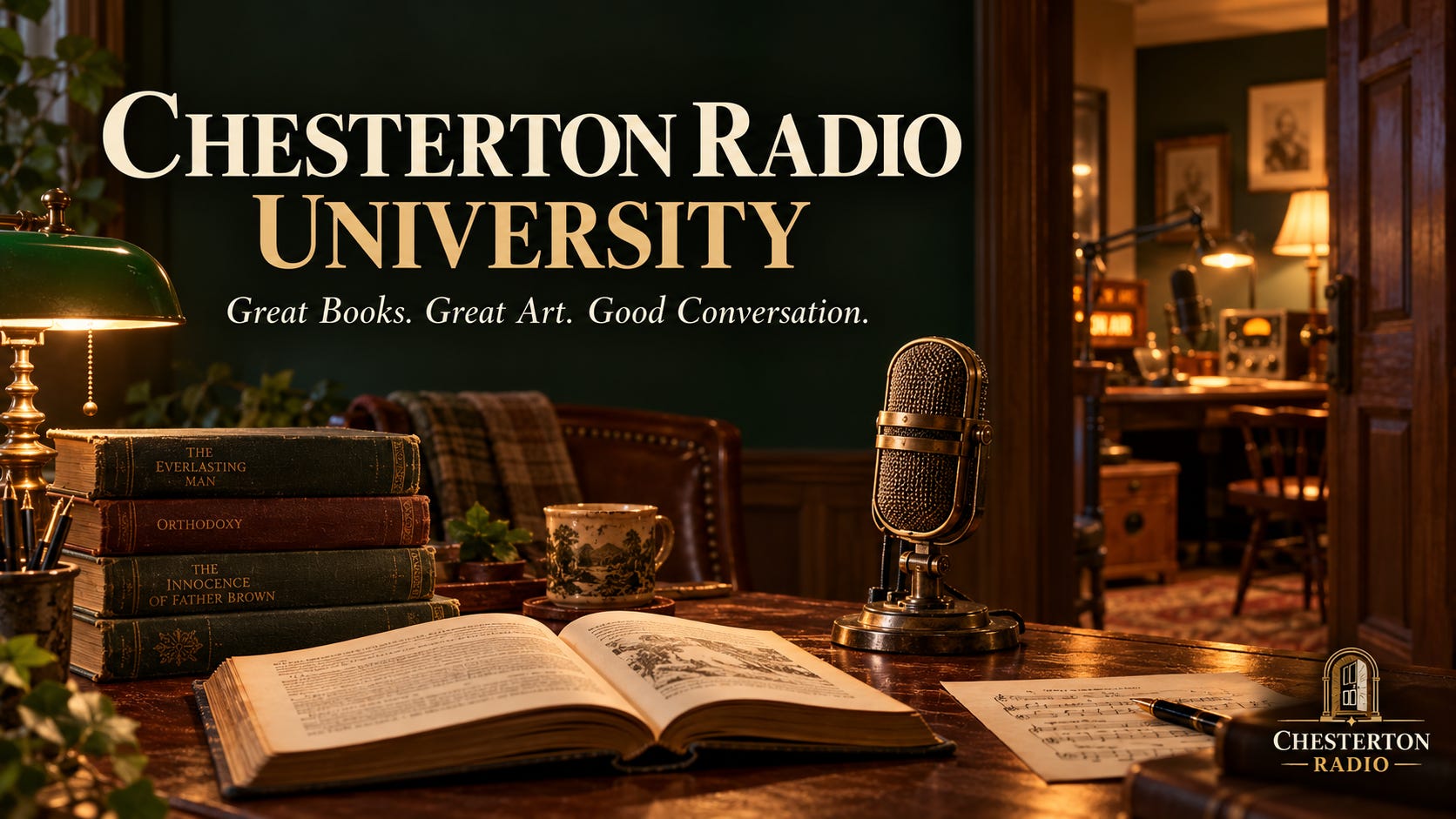
A good book deserves more than a place on a list. A great play deserves more than a plot summary. And a piece of music can become an entirely different experience when someone helps us hear what we have been missing.
That is the idea behind Chesterton Radio University, a new educational series from Chesterton Radio.
We will encounter important works of literature and the arts, spend time with their ideas, and bring them into conversation with the remarkable performances preserved in classic radio.
You can begin wherever your curiosity takes you. Bring a book, a pair of headphones, and a willingness to look again.
A university at the little station
Chesterton Radio has long been a place for stories, plays, music, prayer, and conversation. Chesterton Radio University gives that listening a more deliberate course.
Our subjects will include literature, drama, music, visual art, and architecture, with history, philosophy, and theology helping us understand the works we encounter.
The approach is classical and Catholic. We will consider questions of truth, goodness, beauty, conscience, freedom, faith, and human dignity through particular works and the choices they place before us.
What does a character owe his family? When does ambition become destructive? Why does a painting direct our attention to one small gesture? What changes when a composer returns to a familiar theme?
These are questions we can explore together.
The name “University” expresses the breadth of that undertaking. CRU is an independent educational series from Chesterton Radio, with no academic credit or formal affiliation with a school. It is open to adults, students, teachers, and homeschool families—and to anyone who has ever finished a story and wanted someone to talk with about it.
How a unit will work
Each unit will begin with a work: a book or selected chapters, a play, a musical composition, a painting, or a building.
We will provide links to the original material where suitable sources are available, explain what the unit covers, and offer a companion discussion. Questions and optional activities will help you take the encounter further.
Sometimes that might mean reading a scene aloud. Sometimes it might mean listening twice to a passage of music, sketching a detail in a painting, or returning to a paragraph that seemed puzzling the first time.
You can listen to the discussion on its own. But we hope it will send you back to the work with sharper attention and fresh questions.
Longer books will have room to unfold across several units. There is no need to hurry through them merely to check off another title.
Where classic radio comes in
Related Radio Listening will be a recurring part of Chesterton Radio University.
Radio artists have brought literature, history, and moral questions to life through voices, silence, music, and sound. Their performances give us another way to approach a subject—and something concrete to compare with the original.
Programs such as NBC University Theater, Biography in Sound, and Living Fiction will be among our starting points for finding related listening. We will also look to series such as Columbia Workshop, CBS Radio Workshop, The Theatre Guild on the Air, and Lux Radio Theatre, along with classical music broadcasts.
The connection will guide the choice. A particular broadcast might help us encounter a literary work, understand an author’s life, explore a historical setting, or hear a moral question tested through drama.
A novel might have a radio adaptation that compresses several hundred pages into an hour. What survives that compression? Which character becomes more sympathetic? What disappears?
A unit on conscience might include a drama in which someone must make a difficult choice. A music unit might point to a historical performance or a broadcast about the composer. A biographical program might help us consider the circumstances in which an author or artist worked.
When a worthwhile connection is available, we will provide the listening link, context, and a question to carry into the program. We will distinguish adaptations from thematic or biographical companions and explain important departures from the original. The broadcast will supplement our encounter with the complete work.
The recording will normally remain on its source site. Our contribution will be the discussion and guidance that help you listen more closely.
We begin with St. Francis
Our opening unit is “St. Francis and the World Made New.”
We will explore G. K. Chesterton’s St. Francis of Assisi, concentrating on “The Problem of St. Francis” and “Le Jongleur de Dieu.”
The question at its heart is simple:
How can a man who gives up so much become so joyful?
Alongside Chesterton’s book, we will consider Catholic context, a painted portrait of Francis, and related listening from Lives of Great Men and Ave Maria Hour.
This first unit introduces the pattern we hope to follow: encounter the work, explore its ideas, and consider how artists in another medium have presented them.
Come along
Chesterton Radio University will grow one carefully prepared unit at a time. You can follow the developing course or join us for a single work that interests you.
If you are teaching, use what serves your students. If you are reading at home, bring your questions. If you have been meaning to return to the books and music you once loved, this may be a good place to begin.
Visit ChestertonRadio.com for our articles and discussions, and listen around the clock through the Open Door live stream.
If you would like to help this work grow, please consider becoming a paid subscriber or visiting the Chesterton Radio Mercantile. Your support helps keep The Little Station on Commercial Street on the air.
Welcome to Chesterton Radio University.
Paul Korzenecki
Chesterton Radio