

Read Along
This series is designed to be read alongside the original text of Orthodoxy, available free through Project Gutenberg.
Read Orthodoxy by G.K. Chesterton on Project Gutenberg
There are books that argue.
There are books that explain.
And then there are books that seem somehow to laugh.
Not because they are unserious, but because they have stumbled upon a joy too large to remain solemn for very long.
G.K. Chesterton’s Orthodoxy belongs to that rare category.
More than a century after its publication in 1908, it still arrives in the modern world sounding strangely unlike anything around it. Most modern writing proceeds from anxiety, outrage, ideology, or exhaustion. Chesterton begins somewhere else entirely.
He begins with astonishment.
This is perhaps the first thing a new reader notices. Orthodoxy does not open like a theological treatise. It does not begin with abstract proofs, ecclesiastical systems, or doctrinal machinery. Instead, Chesterton opens with an almost boyish delight in existence itself. The tone is exploratory, paradoxical, playful, and deeply alive.
And this may be why the book still feels so revolutionary.
Modern civilization has become extraordinarily skilled at explaining why things are meaningless. We possess entire industries devoted to disillusionment. Cynicism now passes for sophistication. Permanent criticism passes for intelligence. The modern intellectual instinct is often not to behold the world, but to “see through” it.
Chesterton saw the danger in this long before most people recognized it.
For when a man insists upon seeing through everything, he eventually discovers there is nothing left worth seeing.
Orthodoxy begins as a rebellion against that emptiness.
The Strange Confidence of Modern Cynicism
One of the oddest features of modern life is the confidence with which people announce despair.
The modern world often treats pessimism as evidence of depth. The gloomy man at the dinner table is assumed to be more intelligent than the grateful one. The cynic is considered realistic. The person capable of enthusiasm is regarded with suspicion, as though joy itself were a kind of naïveté.
Chesterton reverses this instinct almost immediately.
He writes as though gratitude requires courage.
This is one of the reasons he still feels startlingly modern despite writing from another century. Chesterton recognized that civilizations can become spiritually exhausted long before they collapse materially. People may possess comfort, technology, entertainment, and abundance while simultaneously losing the ability to experience wonder.
Indeed, one suspects he would find modern digital culture both hilarious and tragic.
We live amid miracles previous centuries could scarcely imagine:
instant global communication
limitless libraries in our pockets
medical advances
recorded music
flight
electric light
endless access to art and knowledge
And yet modern people often speak as though existence itself were fundamentally disappointing.
We have information without enchantment.
Connection without companionship.
Consumption without gratitude.
Chesterton’s response to this condition is not simplistic optimism. He is not blind to suffering, cruelty, poverty, or evil. Rather, he insists that the first duty of an intelligent man is to recover his capacity for astonishment.
To look again at the world as though one had just arrived inside it.
This is why Orthodoxy feels less like an argument at first than an awakening.
Chesterton’s Great Reversal
Perhaps the most remarkable thing about the opening of Orthodoxy is the order in which Chesterton proceeds.
Most intellectuals begin by defending their system.
Chesterton begins by defending existence.
This is an extraordinarily important distinction.
He does not first argue for Christianity as a rigid set of propositions. Instead, he begins with fairy tales, patriotism, adventure, limitation, gratitude, and delight in ordinary life. Christianity enters the story later, almost as the answer to a mystery he has already encountered while wandering through reality itself.
Chesterton did not begin with theology and arrive at wonder.
He began with wonder and arrived at theology.
That reversal changes the entire emotional atmosphere of the book.
For many modern people, religion appears primarily as restriction. A narrowing of possibility. A collection of prohibitions placed upon human freedom. But Chesterton approaches the question from the opposite direction entirely. He argues that modern civilization has not become too constrained, but spiritually starved precisely because it has forgotten how to receive life as a gift.
This is why Orthodoxy feels strangely liberating even when discussing boundaries and limitations.
Chesterton understands something modern culture often forgets:
The world becomes unbearable when human beings lose gratitude for being in it at all.
The Modern Hatred of Limits
Again and again throughout the introduction, Chesterton hints at an idea that would become even more relevant in the centuries after his death.
Modern people resent limitation itself.
We increasingly believe freedom means endless self-creation. Identity becomes something manufactured rather than discovered. Boundaries are interpreted not as structure, but oppression. To accept any given reality — human nature, morality, mortality, obligation, tradition — is often regarded as weakness.
Chesterton rebels against this assumption.
For him, limits are not the enemies of meaning. They are what make meaning possible.
A river is powerful precisely because it has banks.
A game becomes joyful precisely because it has rules.
A story becomes beautiful because it possesses shape.
Even love depends upon limitation. To love one thing deeply is necessarily to choose it above countless alternatives.
The modern fantasy of infinite possibility sounds liberating at first, but often produces paralysis instead. Endless options become exhausting. Human beings drift. Desire expands endlessly without satisfaction because it no longer knows what it is for.
Chesterton saw the beginnings of this spiritual restlessness long before the arrival of consumer algorithms, social media identities, and digital self-construction. One suspects he would recognize immediately the peculiar sadness of a civilization drowning in choices while starving for purpose.
For Chesterton, gratitude begins when life is received rather than endlessly redesigned.
The world is not meaningful because we invented it.
The world is meaningful because it was given.
Fairy Tales and the Recovery of Wonder
One of Chesterton’s greatest gifts was his ability to defend profound truths through images so simple they almost appear childlike.
Fairy tales occupy an important place in the imagination of Orthodoxy. Chesterton insists that fairy tales do not deceive children about reality. Children already know darkness exists. They already know fear exists. They know giants, loneliness, danger, and dragons long before adults explain such things philosophically.
What fairy tales teach is something else entirely.
They teach that dragons can be defeated.
Chesterton understood that enchantment is not escapism. It is one of the ways human beings learn courage.
Modern culture often prides itself on disenchantment. We explain mysteries until they no longer appear mysterious. We reduce beauty to chemistry, morality to biology, love to instinct, imagination to neurological processes. We become extremely efficient at dismantling meaning while remaining strangely unable to construct it again afterward.
Chesterton believed the world itself was far more magical than modern intellectual systems allowed.
Not magical in the sense of fantasy detached from reality, but magical in the sense that existence itself is astonishing.
Sunrise is astonishing.
Laughter is astonishing.
Consciousness is astonishing.
The fact that anything exists at all is astonishing.
The child sees this naturally.
The adult gradually forgets it.
And perhaps that is why old stories, old radio dramas, old myths, and old fairy tales continue to matter. They remind human beings how to look at reality without boredom.
Chesterton was not trying to make the world childish.
He was trying to make adults capable of wonder again.
Patriotism, Gratitude, and Loving Imperfect Things
One of the most misunderstood aspects of Chesterton’s thought is his defense of patriotism.
Modern readers often hear the word and immediately imagine aggression, tribalism, or nationalism in its ugliest forms. But Chesterton means something gentler and far more humane.
He means affection.
For Chesterton, patriotism resembles love of family more than conquest. One loves home not because it is flawless, but because it is one’s own. Indeed, love becomes meaningful precisely because the object loved is imperfect.
This insight extends far beyond politics.
Modern culture often assumes criticism proves intelligence. The person who tears things down appears sophisticated. Affection is regarded as sentimental. Loyalty appears naïve. Gratitude seems intellectually weak.
Chesterton reverses the entire arrangement.
To love a thing deeply while seeing its flaws requires far more courage than detached contempt.
This is true of nations.
It is true of churches.
It is true of traditions.
And it is true of civilization itself.
Chesterton loved the world not because he believed it perfect, but because he regarded existence itself as fundamentally miraculous.
The cynic asks:
“How dare the world fail to satisfy me?”
Chesterton asks:
“How extraordinary that there should be a world at all.”
The Romance of Being Alive
At the center of the introduction lies perhaps the most important idea in all of Orthodoxy:
Existence is not an entitlement.
It is a gift.
Chesterton writes as though life itself were an adventure into which humanity has unexpectedly awakened. The world is not dull unless we become dull toward it. The ordinary is not truly ordinary at all. Meals, friendship, sunlight, storytelling, rain, laughter, music, firelight, conversation — these are not background details beneath “real life.”
They are the substance of it.
Modern civilization often trains people to seek intensity while losing the capacity for appreciation. We chase novelty because we no longer know how to behold familiar things. We consume experiences endlessly while remaining internally restless.
Chesterton offers another possibility.
Wonder is not produced by acquiring more.
Wonder begins when one learns to see again.
This is why Orthodoxy still feels strangely healing in an exhausted age. Chesterton refuses to participate in the fashionable boredom of modern intellectual life. He insists that existence itself remains charged with drama, mystery, danger, beauty, and meaning.
Not because suffering is absent.
But because reality itself is alive.
Why This Introduction Feels So Modern
Perhaps the strangest thing about reading Chesterton today is realizing how accurately he anticipated the emotional atmosphere of modern civilization.
He foresaw the danger of endless skepticism detached from joy.
He foresaw intellectual systems that explain everything while leaving human beings spiritually starving.
He foresaw a culture increasingly unable to distinguish freedom from rootlessness.
And he foresaw the peculiar exhaustion that emerges when human beings lose the ability to experience gratitude.
Modern people are surrounded by comforts previous centuries could scarcely imagine, yet many live with profound anxiety, loneliness, and metaphysical fatigue. The soul becomes overwhelmed by stimulation while deprived of meaning.
Chesterton’s answer is not simplistic optimism.
It is something far deeper and more demanding:
Wonder.
Gratitude.
Humility before existence itself.
The recognition that reality is not merely a mechanism to manipulate, but a mystery to inhabit.
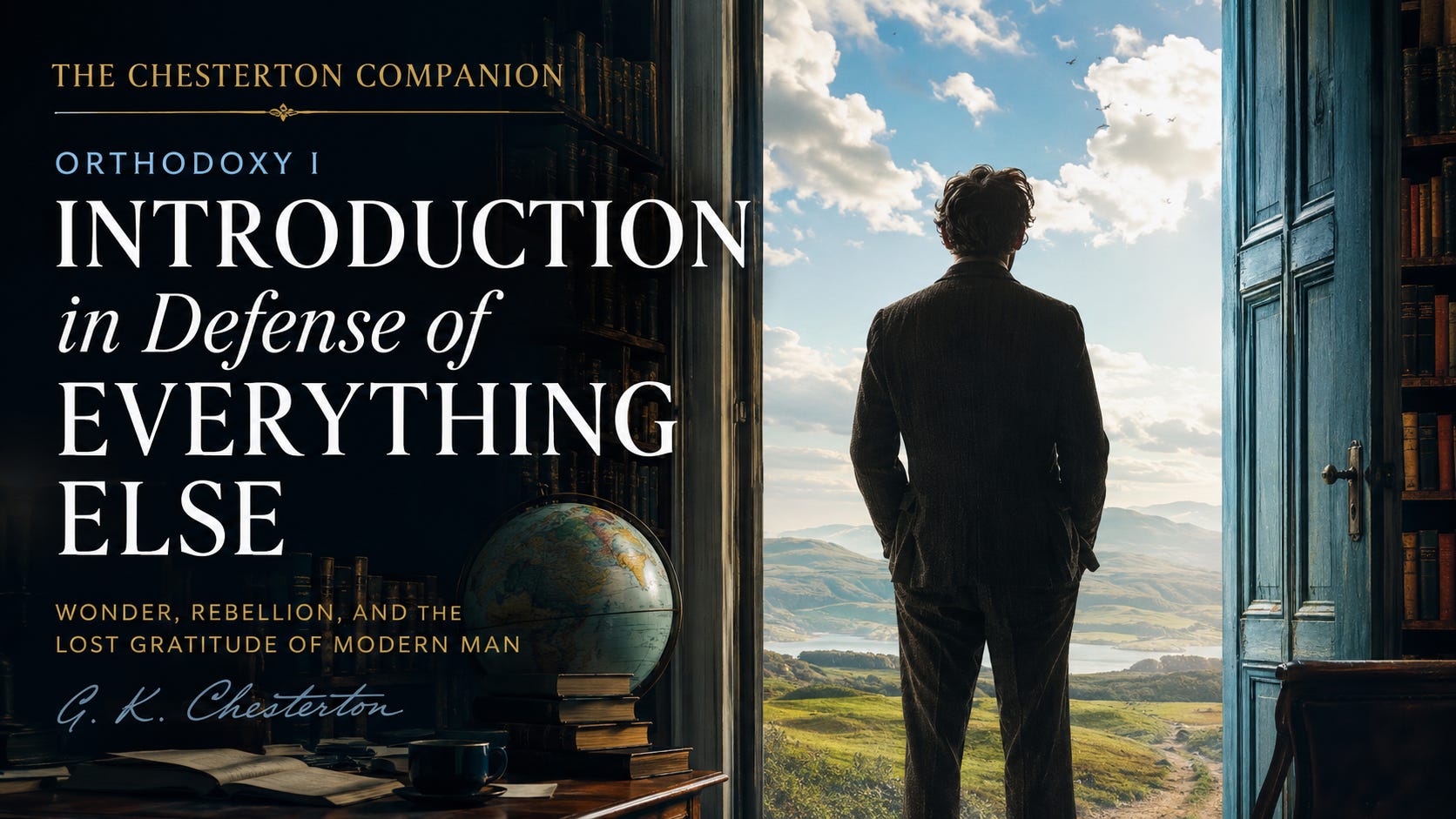
The Doorway Into Orthodoxy
The introduction to Orthodoxy is not merely a preface.
It is a doorway.
Chesterton establishes from the beginning that this journey will proceed differently from ordinary intellectual argument. He invites the reader not merely to think differently, but to see differently.
Before theology comes delight.
Before doctrine comes astonishment.
Before certainty comes gratitude.
And perhaps that is why Orthodoxy continues to endure while so many modern arguments fade almost immediately into irrelevance.
Chesterton does not merely present conclusions.
He reawakens perception.
He reminds the reader that existence itself is stranger, more beautiful, and more exhilarating than modern civilization usually permits people to believe.
The first act of rebellion, he suggests, may not be outrage at the world.
It may be gratitude for it.
Continue the Conversation
The Chesterton Companion is an ongoing series exploring the works, ideas, paradoxes, and enduring relevance of G.K. Chesterton one essay at a time.
Together we will journey through:
Orthodoxy
Heretics
The Everlasting Man
Father Brown
essays, poems, debates, and forgotten writings
and the wider world of imagination, faith, literature, and civilization surrounding Chesterton himself
These essays are not intended merely as summaries or academic analysis.
They are attempts to recover a way of seeing.
A way of reading slowly.
Of thinking deeply.
Of rediscovering wonder in an exhausted age.
Alongside The Chesterton Companion, Chesterton Radio also features:
From the Wireless Archive
classic radio drama
literary reflections
sacred music
Morning Prayer
original fiction
and The Open Door, our continuous live stream of timeless broadcasts and cultural programming
If these essays resonate with you, consider subscribing and supporting the work. Independent cultural projects devoted to beauty, memory, faith, and imagination survive only because readers choose to keep them alive.
And perhaps that is the real purpose of Chesterton Radio.
Not escape from the modern world.
But the recovery of forgotten riches within it.
The Open Door 24/7 Live Stream is always on