

“The detective story differs from every other story in this: that it deals with the detection of a crime, and therefore with the detection of a fact.”
— G. K. Chesterton
We live in an age that investigates everything except the truth.
We analyze motives before hearing testimony. We render verdicts before gathering facts. We pronounce guilt or innocence with the speed of electricity and the patience of a thunderstorm. And yet, for all our information, we seem less certain of what is real.
It is precisely for this reason that the old detective drama still matters.
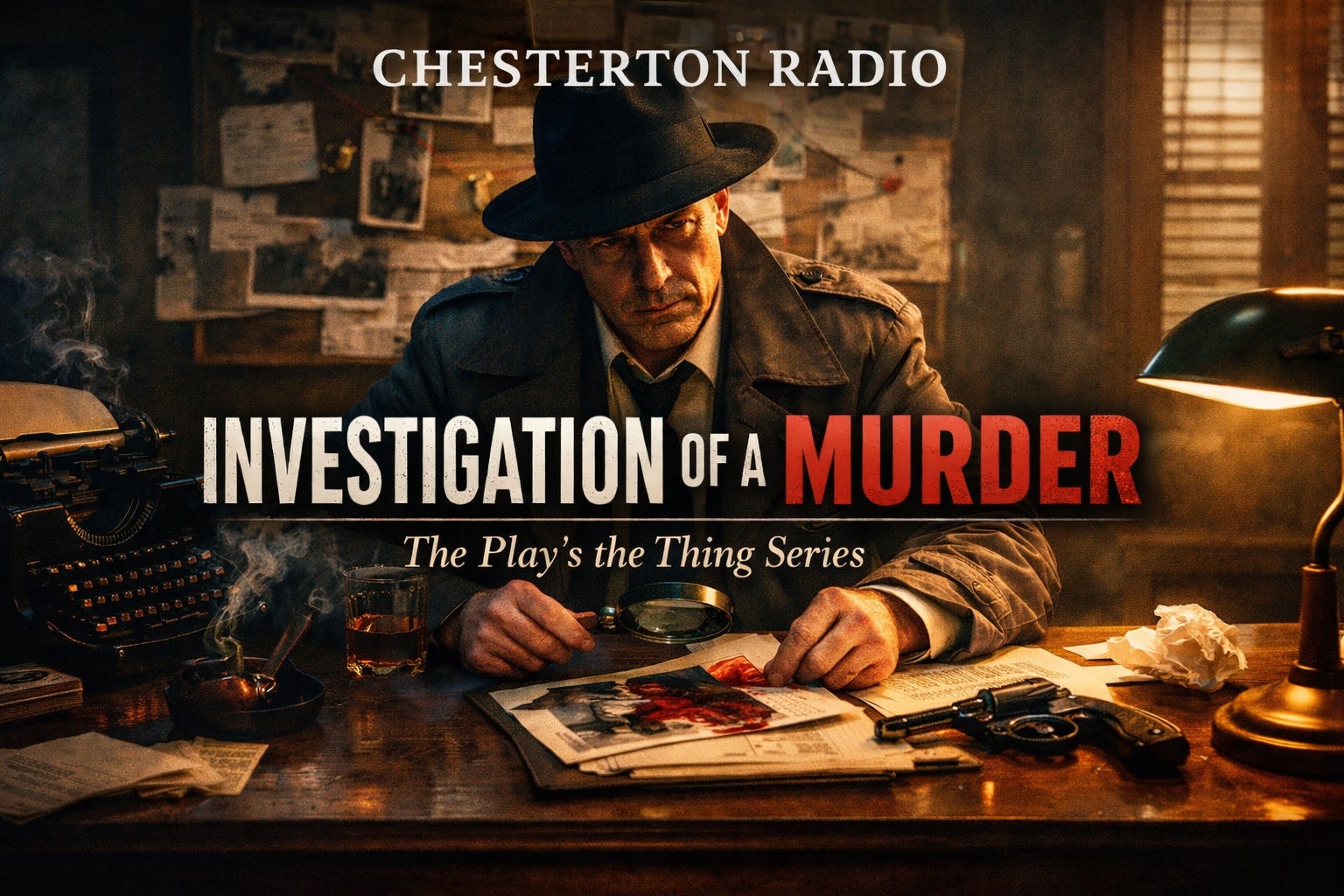
This week’s Sunday feature in The Play’s the Thing brings us Investigation of a Murder — a radio drama that unfolds not with spectacle but with discipline. It is not a thriller in the modern sense. It does not rush. It does not shout. It does not instruct the audience how to feel.
Instead, it does something rarer.
It investigates.
🎧 Listen here:
The Story Without the Spoiler
Investigation of a Murder begins, as all good detective stories must, with disruption. A life has ended unnaturally. Order has been broken. Something has gone terribly wrong — not only in the physical sense, but in the moral architecture of the world.
The drama unfolds through interviews, statements, careful questioning, and the slow assembly of contradictory fragments. Each voice carries its own perspective. Each detail adds weight. Suspicion hovers, but certainty remains withheld.
There are no dramatic car chases. No orchestral crescendos announcing revelation. The power lies in restraint. The investigation proceeds as real investigations do — through listening.
The listener becomes a participant. We weigh testimony. We notice hesitation. We hear what is said — and what is not said. We begin to feel the delicate tension between suspicion and proof.
And slowly — methodically — clarity begins to emerge.
But the true drama is not simply in discovering who committed the crime.
It is in watching how truth is approached.
Radio as Moral Training
There is something uniquely fitting about detective drama on the wireless.
In film, the eye dominates. We are shown what to think. Visual cues guide our emotional responses. But in radio, we must attend. We must imagine. We must listen.
Listening is not passive.
It is disciplined attention.
When we hear a character speak, we must infer tone, posture, intention. We must hold multiple possibilities in mind. We must resist premature certainty.
In this way, radio drama trains something our culture has nearly forgotten: intellectual patience.
To listen well is to suspend judgment.
To investigate well is to refuse haste.
And this is why Investigation of a Murder feels almost countercultural. It invites us into a world where truth is not declared — it is discovered.
Investigation as Moral Discipline
A murder is not merely a crime. It is a rupture.
It tears through relationships. It disturbs order. It creates a vacuum where meaning once stood. In the presence of such rupture, the human impulse is either rage or despair.
The detective offers a third path.
Investigation is the moral discipline by which a wounded world attempts to restore order.
Notice what this requires.
First, humility. The investigator begins not with answers but with questions. He assumes he does not yet know.
Second, restraint. Suspicion is not conviction. Possibility is not proof.
Third, confidence. There must be an underlying belief that truth exists — that facts are real, that evidence matters, that reality is coherent.
Without that belief, investigation collapses into performance.
The genius of detective fiction — and of plays like Investigation of a Murder — is that they assume a moral universe. They assume that the truth can be found. That lies contradict themselves. That facts, patiently assembled, will align.
Chesterton understood this deeply. His Father Brown did not solve crimes because he was clever. He solved them because he believed in the reality of sin — and therefore in the reality of truth.
To investigate properly is to assume that reality is structured.
And that is a profoundly metaphysical claim.
Against the Age of Instant Verdicts
We are not patient people.
The modern world moves at algorithmic speed. News breaks in fragments. Context arrives later — if it arrives at all. Accusation spreads faster than inquiry.
We have grown accustomed to verdicts without process.
The result is not justice but exhaustion.
When everything is declared certain, nothing feels trustworthy.
This is why the slow unfolding of a drama like Investigation of a Murder feels almost therapeutic. It restores proportion. It insists on sequence. It reminds us that conclusions must be earned.
The investigator in the play does not rush toward guilt. He gathers. He listens. He weighs.
He understands something we have nearly forgotten: that justice without patience is merely power.
The old detective story stands as a quiet act of rebellion against modern haste.
It whispers that truth is not a trending topic.
It is a discovery.
The Restoration of Order
At the heart of every murder mystery lies a theological assumption, whether acknowledged or not.
Murder is wrong.
Not merely inconvenient. Not merely illegal. Wrong.
It violates an order that ought to exist.
And investigation is the attempt to restore that order — not by vengeance, but by clarity.
This is why detective fiction satisfies us. We long for coherence. We long for a world in which chaos can be named, understood, and answered.
If truth does not exist, detective fiction collapses. There can be no solution if there is no reality to uncover.
The enduring popularity of such stories reveals something hopeful about humanity. However confused we may become, we still crave a universe in which facts matter.
We still want to believe that the truth can be found.
Investigation of a Murder honors that longing. It does not reduce the crime to spectacle. It treats it as serious. Weighty. Disruptive.
And it treats the search for truth as equally serious.
That alone is refreshing.
Listening as an Act of Charity
There is another dimension to investigation that deserves attention.
To question someone carefully — to listen fully — is an act of respect.
The investigator does not merely interrogate; he attends. He allows space for contradiction. He permits complexity.
This is not softness. It is discipline.
In a world eager to flatten human beings into caricatures, careful listening restores depth.
Radio drama heightens this effect. Stripped of visual distraction, voice becomes central. Tone carries weight. Silence speaks.
We are forced to encounter persons rather than headlines.
And in doing so, we practice something deeply needed: the refusal to reduce others to assumptions.
In this way, detective drama becomes moral training.
It teaches us that understanding precedes judgment.
The Final Question
The real mystery in Investigation of a Murder is not simply who committed the crime.
It is whether we still believe truth can be discovered.
A society that loses confidence in truth does not become free. It becomes loud.
Without investigation, accusation reigns. Without patience, justice collapses. Without discipline, order dissolves into noise.
The quiet investigator — the careful listener — becomes almost heroic in such an age.
He stands against chaos not with force, but with attention.
He believes that reality is structured.
He believes that truth exists.
And he proceeds accordingly.
Why We Preserve These Plays
Chesterton Radio exists to keep alive this kind of moral imagination.
We are not preserving these dramas for nostalgia’s sake. We preserve them because they form something in us. They train patience. They defend reason. They restore proportion.
After YouTube demonetized the channel, this work now depends entirely on listener support. There are no corporate sponsors behind these archives. No algorithmic incentives.
Only listeners who believe that stories matter.
If this Sunday reflection has reminded you of the dignity of truth — if these plays have given you an hour of careful attention in a distracted world — would you consider supporting Chesterton Radio?
Your support keeps the wireless warm.
It allows us to continue publishing essays, preserving classic drama, and producing new stories that defend reason, imagination, and moral clarity.
Truth does not trend.
But it endures.
And so, we investigate.