

There was a peculiar feeling in movie theaters in April 2019.
It was not simply excitement about a new film. Audiences had been excited about movies before. Nor was it merely anticipation about finding out who would defeat the villain, who would survive, or how the cliffhanger of Infinity War would be resolved.
Something else had accumulated.
For eleven years, beginning with Iron Man in 2008, millions of people had been watching a story grow almost accidentally into a kind of shared mythology. Characters who had once occupied separate movies had met, argued, fought, reconciled, disappeared and returned. Jokes had acquired histories. Objects had acquired histories. Friendships had acquired histories.
By the time Avengers: Endgame arrived on April 26, 2019, Marvel described it as the culmination of twenty-two films. But numbers do not quite explain what had happened.
Marvel had acquired something much harder to manufacture:
memory.
Not merely the characters’ memory.
Ours.
A phrase from an earlier film could suddenly carry the weight of years. A familiar face appearing through a glowing portal required no introduction. A hammer moving from the ground into an unexpected hand could make a theater erupt because everyone understood what it meant.
And yet the strangest thing about Endgame is that, after exploiting that accumulated memory on a scale few popular films had ever attempted, it ultimately refuses to end with spectacle.
It gives us armies, gods, aliens, spaceships, sorcerers, time travel, resurrection and a battle for the universe.
And then it leaves all of them behind.
The final image is a man and a woman in a quiet room.
There is music playing.
They are dancing.
And suddenly we understand what all the fighting may have been for.
After the End of the World
Most superhero movies begin with a threat.
Endgame begins with the consequences.
Thanos has already won.
That makes all the difference.
The opening with Clint Barton and his family is almost cruel in its simplicity. There is no battlefield. No villain appears. Clint is enjoying an ordinary afternoon with his wife and children. He turns around, and they are gone.
The catastrophe is cosmic, but the movie introduces it domestically.
That distinction will matter later.
The surviving Avengers eventually find Thanos, discover that he has destroyed the Infinity Stones, and kill him. Thor cuts off his head.
In almost any conventional superhero story, killing the villain would constitute the climax.
Here it accomplishes nothing.
The people who disappeared remain gone.
Victory has arrived too late to be victory.
Then the movie does something audacious.
It waits five years.
Not five days. Not five weeks. Five years.
The world has had to continue.
That decision changes Endgame from a story about reversing a disaster into something more interesting: a story about people who have learned, or failed to learn, how to live after one.
Steve Rogers leads a support group.
Natasha Romanoff keeps the remnants of the Avengers functioning.
Clint has turned grief into vengeance.
Thor has collapsed.
Tony Stark has done something no previous version of Tony Stark seemed capable of doing.
He has stopped.
He has a home. He has Pepper. He has a daughter.
He has dinner.
That last detail may be more important than it sounds.
For years Tony was the man incapable of leaving tomorrow alone. Every danger implied another invention. Every invention exposed another danger. His intelligence was a machine that could never quite turn itself off.
Then Thanos wins, and Tony discovers ordinary life.
Morgan Stark wants juice. She wears her father’s helmet. She says things that only a small child could say and completely disarms a man who once believed charm was a substitute for intimacy.
Tony has found something more valuable than saving the world.
He has found a world worth saving.
Steve Rogers has the opposite problem.
Steve spends his time telling other people that they must move forward.
He cannot.
He is still, emotionally, the young man who went into the ice in 1945.
The world has moved on around him. Steve has adjusted to smartphones, aliens, gods and interplanetary warfare remarkably well. But adaptation is not the same thing as belonging.
Somewhere inside Captain America remains Steve Rogers, the skinny kid from Brooklyn who promised Peggy Carter a dance.
And missed it.
That old promise sits almost silently beneath Endgame.
The movie will take three hours to return to it.
The People Who Survived
The five-year jump allows Endgame to ask a question superhero movies often avoid:
What happens to heroes when heroism doesn’t work?
Thor provides the most uncomfortable answer.
The God of Thunder believes he should have stopped Thanos. Worse, he nearly did. He chose to strike Thanos in a way that allowed him a final moment to use the Infinity Stones.
“Should have gone for the head” becomes more than a taunt.
It becomes a sentence Thor imposes upon himself.
Five years later he is hiding in New Asgard, drinking, playing games and avoiding the person he once was. The film sometimes plays his weight for laughs, and those jokes have aged less gracefully than the deeper idea beneath them.
Thor is not funny because he has become fat.
Thor is tragic because he has become ashamed.
He does not merely believe he failed.
He believes his failure revealed what he truly is.
That is why his encounter with Frigga during the Time Heist matters so much. Thor has gone into the past expecting to retrieve a stone and instead encounters his mother on the last day of her life. She recognizes almost immediately that something is wrong with her son.
Thor gets something the mission did not promise him.
Mercy.
He does not get to save his mother. The past is not repaired.
Instead, he receives permission to stop defining himself entirely by his worst moment.
Tony receives something similar when he encounters Howard Stark.
Their relationship had been burdened by things unsaid and misunderstood. Tony cannot rewrite his childhood. He cannot become a different son or give himself a different father.
But he can see Howard differently.
The Time Heist therefore becomes something richer than a device for collecting six glowing objects.
The Avengers walk backward through their own history.
And because they have changed, the past changes—not in the literal sense the film spends considerable energy explaining, but in meaning.
We know this experience.
We cannot travel backward through time. But we do travel backward through memory.
We return to the house where we grew up and discover that it is smaller than we remember. We find an old photograph and suddenly understand the expression on our father’s face. We hear a song we haven’t heard in thirty years and become, impossibly, two ages at once.
That is what Endgame understands at its best.
The past cannot always be fixed.
Sometimes it can be forgiven.
Sometimes it can be understood.
And sometimes, perhaps, there is one promise still waiting there.
Whatever It Takes
Natasha Romanoff may understand the stakes better than anyone.
For much of her life, Natasha did not have what most people would call a family. The Avengers became one.
That makes her behavior during the five missing years revealing. Tony retreats into domestic life. Thor retreats into despair. Clint disappears into violence.
Natasha stays at the table.
She keeps answering calls.
She keeps the lights on.
So when Natasha and Clint arrive on Vormir and discover that obtaining the Soul Stone requires the sacrifice of someone they love, the scene becomes a grim inversion of the usual superhero fight.
Neither is trying to kill the other.
Each is trying to die first.
It is one of Endgame’s strangest battles because both combatants have the same objective: save the other person.
Clint believes Natasha deserves to live.
Natasha believes Clint needs to return to his family.
Both, in different ways, have been trying to pay debts for much of their lives.
Natasha wins.
That sentence feels deliberately wrong.
There is no victory on Vormir.
The film itself never quite gives Natasha’s death the space it gives Tony’s later sacrifice. There is no equivalent funeral bringing together the entire Marvel world. Her absence can feel swallowed by the enormous machinery of the final act.
But perhaps there is something fitting in the quieter nature of her sacrifice.
Natasha, who began as the spy nobody entirely knew, dies for the people who became her family.
The woman with the red in her ledger gives away everything she has left.
“Whatever it takes” stops being a slogan.
Someone has to pay it.
Walking Through Memory
The Time Heist could easily have become unbearable fan service.
At times, it comes close.
But the best callbacks work because Endgame understands a crucial distinction.
Recognition is not enough.
Something must have changed.
When the Avengers return to the Battle of New York, we are not simply being invited to point at the screen and say, “I remember that.”
We are watching people enter their own history with knowledge their younger selves did not possess.
The audience possesses that knowledge too.
That creates a curious intimacy between movie and viewer. We have been there before. We know where the corridors lead. We know who Loki is. We know what will happen to these people.
For once, the heroes do too.
This is why Endgame could do things that would have seemed absurd in 2008. It could allow a brief phrase, prop or musical cue to carry narrative weight that another movie would need minutes of exposition to establish.
Eleven years had created dramatic compound interest.
Nothing demonstrates this better than the final battle.
Captain America has been battered almost beyond recognition. His shield is broken. Thanos has an army behind him large enough to make resistance appear ridiculous.
Steve tightens the strap on what remains of his shield.
Of course he does.
This is the man who, long before he had a super-soldier’s body, said he could do this all day.
Then his radio crackles.
A familiar voice says:
“On your left.”
Three words.
That is all.
But anyone who remembers Steve’s first meeting with Sam Wilson in The Winter Soldier knows what those words contain.
Then the portals open.
The dead—or rather, the vanished—come walking through.
Black Panther.
Doctor Strange.
Spider-Man.
The Guardians.
Sam.
Bucky.
Wakandans.
Sorcerers.
Friends.
The sequence is spectacular, certainly. But CGI alone does not explain why it works. Hollywood had shown audiences armies before. It had shown bigger explosions.
What Marvel had accumulated was recognition.
Every portal was opening onto another story.
And then Steve finally says the words that had been waiting for him:
“Avengers… assemble.”
The sentence is almost comically simple.
Its power exists entirely in what came before it.
Worthy
Before the portals, however, Endgame delivers perhaps its most perfectly engineered audience payoff.
Thor’s hammer moves.
Not toward Thor.
Toward Steve Rogers.
Captain America catches Mjolnir.
The moment had been planted years earlier in Age of Ultron, when the Avengers took turns attempting to lift the hammer and Steve managed to make it move—just slightly.
Thor noticed.
So did we.
Endgame cashes that tiny check four years later.
But the scene works for a reason deeper than continuity.
Mjolnir is not simply a weapon. Within these stories, it is a judgment.
The hammer answers the question of worthiness.
Steve does not become worthy when Mjolnir flies into his hand.
The hammer confirms something about him that the audience already believes.
And perhaps the best part is Thor.
“I knew it.”
No resentment.
No bruised divine ego.
Delight.
One hero sees another revealed.
It is fan service, unquestionably.
But “fan service” need not be an insult when a story has earned the right to serve its audience.
There is a difference between reminding people of something they once loved and allowing something planted years earlier finally to flower.
Endgame frequently understands that difference.
And then, after giving Captain America the hammer, after opening every portal and assembling virtually everyone, the film arrives at the man with whom the entire experiment began.
Tony Stark.
I Am Iron Man
The Marvel Cinematic Universe began, in practical terms, with a man standing at a press conference.
Tony Stark had been given the usual superhero instructions. Maintain the cover story. Preserve the secret identity.
Instead he announced:
“I am Iron Man.”
It was pure Tony.
Ego.
Theater.
Self-invention.
Eleven years later, Thanos believes he has won again.
“I am inevitable.”
Tony looks at him.
The Infinity Stones are no longer in Thanos’s gauntlet.
They are in Tony’s hand.
“And I… am Iron Man.”
The words are the same.
The man is not.
That is character development reduced to four words.
The Tony Stark of 2008 announces himself because he wants the world to know who he is.
The Tony Stark of 2019 says it just before giving himself away.
That distinction is everything.
Tony’s sacrifice would be far less interesting if Endgame had portrayed him as a lonely man with nothing left to lose.
Instead, it does the opposite.
Tony has Pepper.
He has Morgan.
He has the quiet house.
He has tomorrow.
He sacrifices himself after discovering how badly he wants to live.
That is what makes sacrifice sacrifice.
The snap kills Thanos and his army.
Tony dies.
The funeral that follows gathers faces from across the history of the MCU, and for a moment Endgame becomes almost a class photograph taken at graduation. Here are the people we met along the way. Here are the stories that somehow became one story.
It would be the obvious place to end.
The founding hero is dead.
The villain is defeated.
The universe has been restored.
The funeral provides closure.
Roll credits.
But Endgame has one more story to finish.
And it may be the more important one.
Two Men, Two Futures
Tony Stark and Steve Rogers spent much of their shared history as opposites.
Tony was the futurist.
Steve was literally a man from the past.
Tony distrusted limits. Steve believed in principles.
Tony built increasingly elaborate technology to control what might happen next. Steve carried a shield.
Their conflict in Civil War was political and personal, but beneath it lay two radically different temperaments.
By Endgame, the great irony is that they have reversed positions.
Tony has finally learned to inhabit the present.
Steve has not escaped the past.
Tony has a family and home he refuses to risk casually. Steve has spent his life in service to everyone except himself.
And so their endings mirror one another.
Tony gives up the future he finally learned to love.
Steve returns to the past and accepts the life he never allowed himself to have.
One gives his life for home.
The other finally goes home.
That is why Endgame cannot properly end with Tony’s funeral.
Steve Rogers still has one mission.
He must return the Infinity Stones.
Bruce Banner activates the machine.
Bucky and Sam wait.
Steve disappears.
He is supposed to return almost immediately.
He doesn’t.
Then Bucky notices someone sitting on a bench.
An old man.
Steve.
He has lived.
There is something almost mischievous about the revelation. After spending a lifetime doing what everyone needed Captain America to do, Steve Rogers has apparently made one enormous decision for Steve Rogers.
He gives Sam the shield.
The symbol can continue.
But Steve does not need to.
And then Endgame does something astonishing.
It goes backward one final time.
Not for another battle.
Not for another Infinity Stone.
Not even for another superhero.
For a dance.
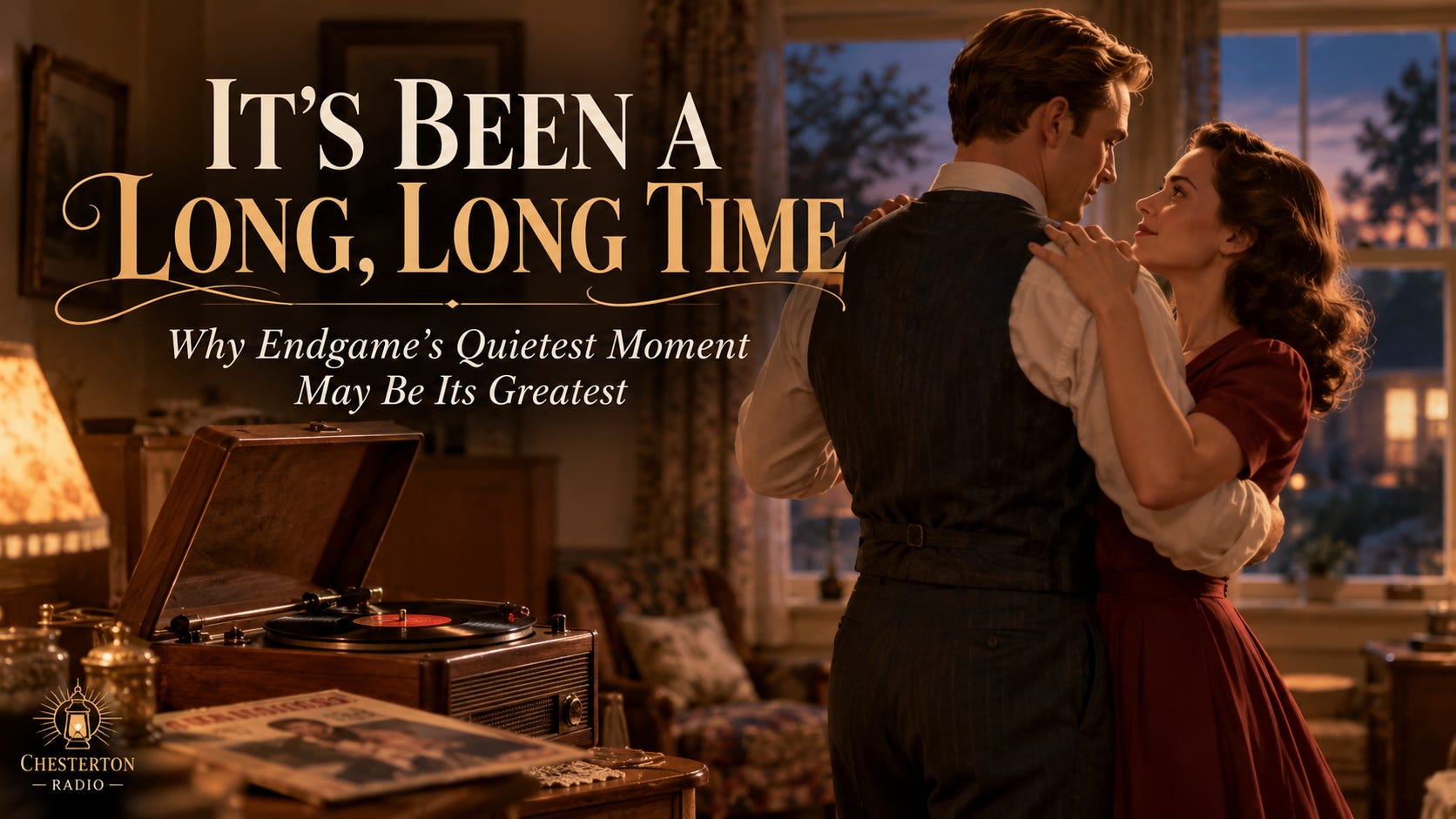
It’s Been a Long, Long Time
The house is quiet.
Peggy Carter is there.
Steve is there.
And on the record player is Harry James and His Orchestra with Kitty Kallen singing “It’s Been a Long, Long Time”—the 1945 song by Jule Styne and Sammy Cahn. Marvel’s own official listing confirms the Harry James recording as the song used in the film.
The choice is exquisite.
The song belongs to the emotional world of 1945: separation ending, lovers reuniting, soldiers returning from war.
And suddenly the entire ending becomes clear.
Captain America has finally come home from the war.
Not merely the war against Thanos.
The war.
Steve Rogers never really came home from World War II.
He went into the ice.
He awoke decades later.
The world had continued without him.
The woman he loved had grown old.
His friends were gone.
His neighborhood was changed.
Even the Brooklyn Dodgers had left Brooklyn.
And almost immediately, Steve went back to work.
Loki.
Hydra.
Ultron.
The Avengers’ civil war.
Thanos.
There was always another emergency.
Always another person who needed Captain America.
Always another reason Steve Rogers would have to wait.
This is one of the oldest traps of duty: the belief that because a thing is good, one must do it forever.
Steve’s virtue had always been sacrifice.
Eventually even sacrifice must have a destination.
So after helping save half the life in the universe, Captain America receives no throne.
No monument.
No new command.
No cosmic reward.
He gets the dance.
And the scale of Endgame suddenly collapses.
Minutes earlier, armies filled the screen.
Now there are two people.
There were spaceships.
Now there is a living room.
There were Infinity Stones capable of reshaping existence.
Now there is a record.
There was a battle for the universe.
Now Steve Rogers has his arm around Peggy Carter.
The biggest movie ends with the smallest thing.
And that may be precisely why it works.
The Extraordinary and the Ordinary
There is something Chestertonian here, though there is no need to turn Avengers: Endgame into an allegory it was never intended to be.
Chesterton was fascinated by the difficulty of seeing ordinary things as extraordinary.
We become accustomed to existence.
We become accustomed to home, dinner, children, friendship, marriage, trees, streets and mornings. Familiarity can make astonishing things seem inevitable.
Chesterton repeatedly tried to reverse the telescope.
Suppose they were not inevitable.
Suppose the ordinary things were gifts.
Suppose they could be lost.
Suddenly they become marvelous.
Endgame, perhaps unintentionally, spends three hours performing a similar trick.
It makes the universe enormous and then asks what the universe is for.
Tony Stark provides one answer.
Here is a man who could build almost anything. He possessed wealth, fame, intelligence, houses, cars, laboratories and technology beyond the dreams of most governments.
What does he discover he cannot bear to lose?
Morgan.
Pepper.
Home.
Putting his daughter to bed.
Steve provides the other answer.
Captain America has saved cities, countries, planets and finally the universe.
What does he want?
A dance.
This does not diminish heroism.
It explains heroism.
Why save the world?
Because somebody lives there.
Because children are eating dinner there.
Because someone is waiting for someone else to come home.
Because there are promises worth keeping.
Because somewhere a record is playing and two people ought to be dancing.
The extraordinary exists to defend the ordinary.
That may be Endgame’s most enduring idea.
The Avengers do not ultimately save “the universe” as a philosophical abstraction.
They save particular lives.
Clint’s wife.
Clint’s children.
Peter Parker.
Sam Wilson.
T’Challa.
Families.
Friends.
People who had empty chairs at their tables for five years.
The enormous abstraction matters because it contains the small particular.
And this is where Tony and Steve finally meet.
Tony sacrifices ordinary life because he has learned its value.
Steve chooses ordinary life because he has finally fulfilled his sacrifice.
Tony dies so others can go home.
Steve goes home.
Two endings.
One truth.
The End of an Age
Seen from a distance, Endgame increasingly feels like a dividing line.
Marvel continued, of course. The universe grew larger. More characters arrived. More worlds appeared. Timelines multiplied. The multiverse itself became part of the machinery.
But size is not the same thing as weight.
That distinction helps explain why Endgame remains difficult to reproduce.
Its greatest asset was not Thanos.
It was not the Infinity Stones.
It was not its visual effects budget.
It was accumulation.
Marvel had spent eleven years allowing these characters to acquire history.
That history could be uneven. The films varied enormously in tone and quality. Some character arcs were stronger than others. Endgame itself is hardly flawless.
Its time-travel mechanics invite arguments almost immediately. Natasha’s sacrifice receives less ceremonial mourning than Tony’s. Thor’s grief is sometimes undercut by jokes that belong to a shallower movie. The final battle occasionally resembles the largest action-figure box in history being emptied onto the floor.
And Endgame asks an enormous amount from anyone who did not spend the previous decade watching Marvel movies.
But those limitations illuminate the accomplishment.
The movie works best when it trusts history rather than spectacle.
“On your left.”
A hammer moving.
“I am Iron Man.”
A cheeseburger.
A dance.
These things matter because they point backward.
Marvel had accidentally discovered one of the oldest truths about storytelling:
Meaning requires memory.
You cannot manufacture twelve years of friendship in twelve minutes.
You cannot substitute another dimension for a relationship.
You cannot make something important merely by making it bigger.
A universe can expand while its stories become weightless.
And a single living room can contain an entire world if the story has earned the right to take us there.
That is why the final minute of Endgame remains so surprising.
After three hours of demonstrating everything a modern blockbuster can put on a screen, the movie ends by removing almost all of it.
Home
A quiet house.
A record playing.
Peggy Carter.
Steve Rogers.
They dance.
There is no speech explaining what Steve has learned.
There doesn’t need to be.
There is no villain waiting outside.
No army.
No shield.
No hammer.
No portal.
No command to assemble.
The original 2019 film simply allows Steve Rogers to be there.
That matters because Steve has spent almost his entire adult life somewhere else—somewhere duty required him to be.
Now, finally, there is nowhere else he needs to go.
The song continues.
“It’s Been a Long, Long Time.”
Of all the songs Marvel could have chosen, it chose a record from 1945—a song from the world Steve lost, carrying the sound of separation ending and people coming home.
And perhaps that is why the scene can catch a viewer so unexpectedly.
We have been trained by the movie to look for something enormous.
Instead it gives us something precious.
Captain America spent his life saving the world.
At the end, Endgame finally lets Steve Rogers live in it.
Perhaps the most moving image in his story is not Captain America standing alone against an army.
It is not the shield.
It is not Mjolnir.
It is not even the moment the Avengers assemble behind him.
It is Steve Rogers keeping an old promise.
After all the battles, all the sacrifice, all the years that were taken from him, the soldier finally comes home.
Peggy is waiting.
Steve takes her in his arms.
And somewhere in a quiet room, after a very long war, the record keeps playing.
P.S. From the Chesterton Radio World
If you enjoyed this kind of journey—where an old song, a popular film, a radio drama or a forgotten story becomes a doorway into something larger—welcome to the wider world of Chesterton Radio.
Here we explore classic radio drama, literature, music, history, Reading Chesterton, cultural deep dives, original productions and the continuing adventure of finding extraordinary things hiding inside ordinary ones.
You can also listen to the Chesterton Radio stream around the clock and explore the growing collection of programs and essays.
If this work is worth having in the world, please consider subscribing and supporting Chesterton Radio. Independent projects survive because listeners and readers decide they are worth keeping alive.
Thank you for reading—and for being part of the Chesterton Radio world.
Help Keep Chesterton Radio Going
Chesterton Radio is built around a simple idea: some things are worth keeping alive.
The old stories. The great radio dramas. Forgotten music. Chesterton. And conversations like this one—where a superhero movie can unexpectedly lead us back to sacrifice, homecoming, an old song, and two people dancing in a quiet room.
If you value what we’re building, please consider becoming a paid subscriber. Your support helps keep Chesterton Radio independent and makes possible the essays, deep dives, original productions, Reading Chesterton, and the 24/7 Chesterton Radio stream.
And if a paid subscription isn’t right for you, a free subscription, a share, or simply telling a friend about Chesterton Radio helps more than you might imagine.
Thank you for reading, listening, and keeping the light on with us.