

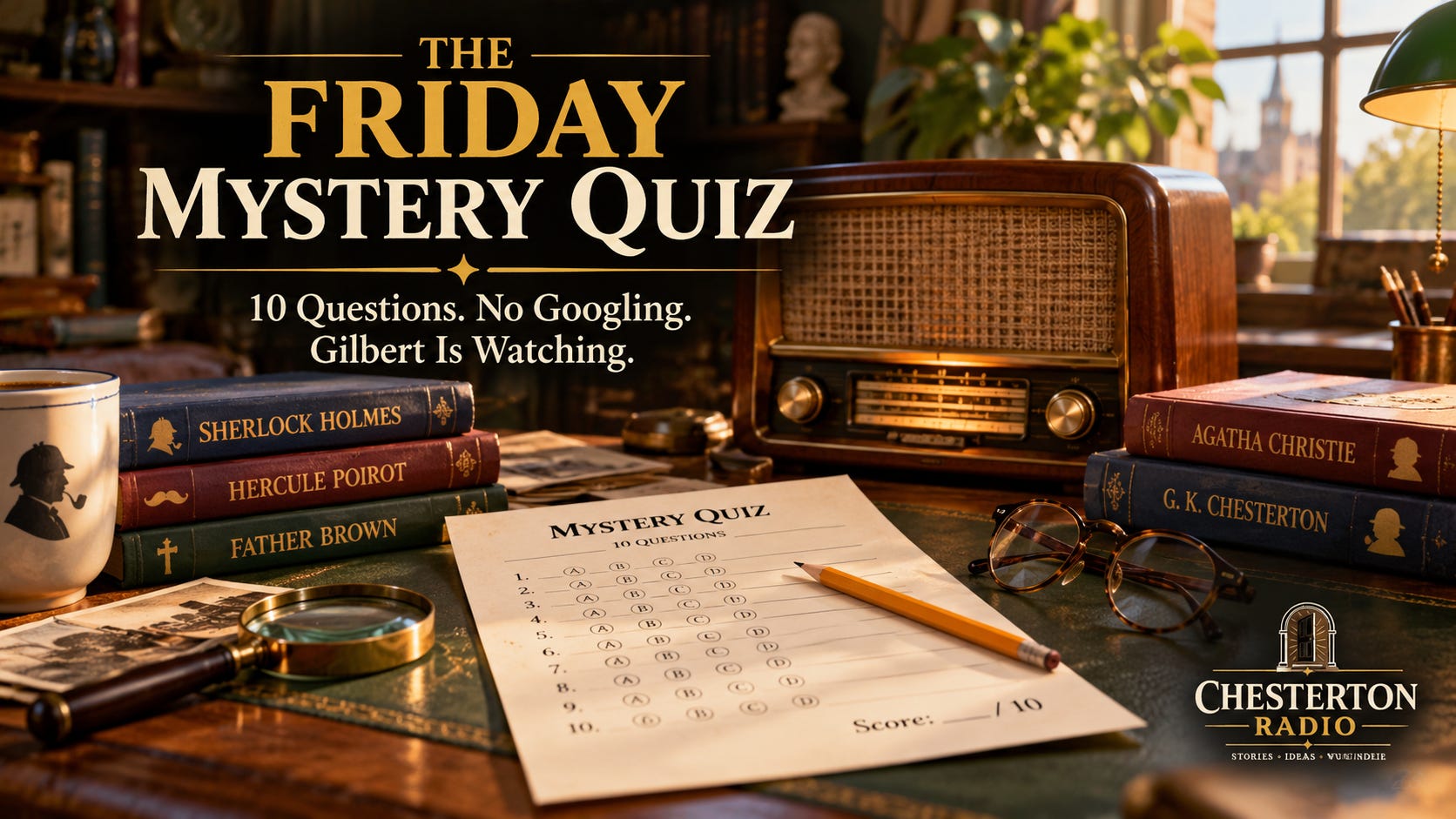
It is Friday afternoon. The serious business of the world has had quite enough of our attention for one week.
So put down whatever you’re supposed to be doing, move the coffee within reach, and join us for ten questions from the slightly disreputable shelves of the Chesterton Radio library: detectives, priests, Belgians, Victorians, radio actors, murderers, playwrights, and at least one man with a magnificent moustache.
There are only three rules:
1. No Googling.
2. No consulting the bookshelf.
3. No asking the person sitting next to you who has read every Agatha Christie novel twice.
Write down your answers. Honor system.
There are no prizes, although a perfect score may qualify you for an unpaid position somewhere in the Chesterton Radio archives.
Ready?
1. We shall begin gently.
Hercule Poirot is many things: detective, perfectionist, defender of order, and implacable enemy of crooked picture frames.
But what is his nationality?
A. French
B. Belgian
C. Swiss
D. English, although he has spent years convincing everyone otherwise
2. Elementary?
In which book did Sherlock Holmes first appear?
A. The Sign of Four
B. The Hound of the Baskervilles
C. A Study in Scarlet
D. The Adventures of Sherlock Holmes
3. A priest walks into a murder mystery...
Which fictional detective is a short Roman Catholic priest whose apparently innocent manner frequently causes criminals to underestimate him?
A. Lord Peter Wimsey
B. Father Brown
C. Inspector Maigret
D. Brother Cadfael
So far, so good.
You may be getting confident.
This is generally when something terrible happens in a detective story.
4. Before Poirot became Poirot...
Agatha Christie’s first published novel introduced Hercule Poirot to the world. Which was it?
A. Murder on the Orient Express
B. The Murder of Roger Ackroyd
C. The Mysterious Affair at Styles
D. Death on the Nile
5. Meanwhile, at the theatre...
Oscar Wilde wrote one of the great comic plays in the English language, involving mistaken identities, cucumber sandwiches, a handbag, and a gentleman who has invented an imaginary invalid friend named Bunbury.
Which play is it?
A. An Ideal Husband
B. The Importance of Being Earnest
C. Lady Windermere’s Fan
D. The Mousetrap
6. Turn down the lights.
For much of its run, which actor served as the principal host of CBS Radio Mystery Theater, introducing listeners to its nightly tales of mystery and suspense?
A. Orson Welles
B. E. G. Marshall
C. Vincent Price
D. Alfred Hitchcock
7. One for the Chestertonians.
What is the title of the first Father Brown story, in which Chesterton introduced his unassuming priest-detective?
A. The Hammer of God
B. The Wrong Shape
C. The Blue Cross
D. The Invisible Man
The room has grown quieter.
Someone has locked the door.
We didn’t do it.
Proceed.
8. A little Golden Age geography.
Although Hercule Poirot became one of the most famous detectives in English fiction, what profession had he practiced before becoming a private detective?
A. Belgian police officer
B. French army intelligence officer
C. Professor of mathematics
D. Chocolatier
We admit that D would explain certain things.
9. Now we separate the listeners from the people who keep notes.
Before Agatha Christie became famous for ingenious murders, her wartime work gave her practical knowledge that proved extremely useful when devising fictional ones.
Where did she acquire much of her knowledge of poisons?
A. Working in a hospital dispensary
B. Studying chemistry at Oxford
C. Working for Scotland Yard
D. Assisting a London coroner
10. THE KEEPER-OF-THE-ARCHIVE QUESTION
Chesterton did not invent Father Brown merely as an eccentric clerical detective. He based an important part of the character on a real priest he knew.
Who was that priest?
A. Ronald Knox
B. John Henry Newman
C. Father John O’Connor
D. Fulton J. Sheen
Choose carefully.
Somewhere, a transcription disc has stopped turning.
PENCILS DOWN.
No changing Question 9 because something suddenly occurred to you.
No saying, “Well, technically I was going to choose B.”
And absolutely no opening another browser tab and returning five minutes later with an astonishing new command of Belgian police history.
Commit to your answers.
Ready?
Scroll on.
THE ANSWERS
1. B — Belgian
Poirot is Belgian, not French—a distinction he has occasionally had cause to make clear. Christie conceived him as a former Belgian police officer, inspired in part by Belgian refugees living in England during the First World War. His foreignness also allowed Christie to create a detective who could observe English society from slightly outside it.
2. C — A Study in Scarlet
Sherlock Holmes and Dr. Watson first entered the world in Arthur Conan Doyle’s A Study in Scarlet. Later stories would make 221B Baker Street one of the most famous addresses in fiction, but this is where the extraordinary partnership began.
If you answered The Hound of the Baskervilles, we understand. It simply feels like the beginning of everything.
3. B — Father Brown
Chesterton’s Father Brown possesses no laboratory, magnifying glass, elegant moustache, or private income of any apparent size. His great instrument is his knowledge of human nature—especially fallen human nature. He understands criminals because he understands something much more interesting: people.
4. C — The Mysterious Affair at Styles
Christie’s first published novel introduced Poirot in 1920. Captain Hastings encounters the retired Belgian detective in England, where Poirot is living among refugees displaced by the First World War. Christie could hardly have known that the little Belgian was beginning one of detective fiction’s longest careers.
5. B — The Importance of Being Earnest
Cucumber sandwiches. Bunburying. Lady Bracknell. And, of course, the handbag.
Wilde called it A Trivial Comedy for Serious People, which is nearly sufficient reason by itself to keep it permanently somewhere near the Chesterton Radio bookshelf.
6. B — E. G. Marshall
That wonderfully grave voice belongs to E. G. Marshall, the host most closely associated with CBS Radio Mystery Theater. The series brought radio drama back to American network broadcasting in the 1970s, long after television was supposed to have finished off the form.
Fortunately, radio drama has proved rather difficult to kill.
7. C — The Blue Cross
The Blue Cross introduced Father Brown—and also the master criminal Flambeau, whose relationship with the little priest would take a rather unexpected turn.
It establishes something essential about Father Brown immediately: the people around him see an ordinary, absent-minded priest. Brown sees what they do not.
8. A — Belgian police officer
Before becoming the world’s most fastidious private detective, Poirot had served in the Belgian police. By the time we encounter him in The Mysterious Affair at Styles, he is a refugee in England and already known to Hastings from his police career.
And no, he was never a chocolatier.
Although we would listen to that series.
9. A — Working in a hospital dispensary
During the First World War, Christie worked in a hospital dispensary, where she gained practical knowledge of medicines and poisons. When she began plotting The Mysterious Affair at Styles, poisoning was therefore a rather natural choice.
A useful reminder to mystery writers: apparently no honest employment is ever entirely wasted.
10. C — Father John O’Connor
The real-life Catholic priest Father John O’Connor was an important inspiration behind Father Brown. Chesterton was fascinated by the contrast between O’Connor’s apparently innocent manner and his profound knowledge of human sin acquired through priestly experience.
That paradox helped produce one of detective fiction’s most unusual heroes: a man capable of understanding the criminal precisely because he refuses to regard the criminal as a different species of human being.
If you knew that one immediately, report to the archive.
We have work for you.
HOW DID YOU DO?
0–2 — THE LOST LISTENER
You appear to have wandered into Chesterton Radio while looking for something else.
Excellent.
That’s how some of the best adventures begin. Pull up a chair.
3–5 — THE CASUAL LISTENER
You know your way around the wireless, but there are still several suspicious corridors in the library you haven’t investigated.
We envy you. There are doors left to open.
6–7 — THE ARMCHAIR DETECTIVE
Respectable.
Very respectable.
Poirot would probably permit you into the drawing room, although he has noticed what you’ve done to that cushion.
8–9 — THE RADIO SLEUTH
You are extremely well read, alarmingly attentive, or spending entirely too much time at Chesterton Radio.
We approve of all three explanations.
10 — KEEPER OF THE ARCHIVE
Perfect.
We have only one question:
Where were you on the night the missing transcription disc disappeared?
Please remain where you are. Father Brown would like a word.
YOUR TURN
Post your score below. Honor system.
And tell us:
Which question got you?
Then send this quiz to one person you think can beat your score.
Not ten people. Not everybody in your address book.
One.
Preferably someone insufferably confident.
BONUS QUESTION — AND THIS ONE HAS NO CORRECT ANSWER
It is 8:55 on Friday night.
For reasons nobody has adequately explained, you have been handed the key to the little station on Commercial Street.
The red ON AIR light comes on in five minutes.
You may put only one of these on at 9:00:
A. Father Brown
B. Sherlock Holmes
C. Hercule Poirot
D. CBS Radio Mystery Theater
You get one choice.
What’s going on the air—and why?
That answer doesn’t count toward your score.
It may, however, tell us more about you than the other ten questions combined.
Put your choice in the comments.
We’ll be arguing about it all weekend.
If this is your sort of Friday afternoon, you may have found your little radio station.
Chesterton Radio is a place for mysteries, great stories, radio drama, books worth remembering, original fiction, curious essays, and the occasional piece of civilized foolishness.
Paid subscriptions help us keep the lights on and The Open Door open—our continuous Chesterton Radio live stream, playing day and night.
Thanks for spending part of your Friday with us.
Now go find someone who claims he can get all ten.