

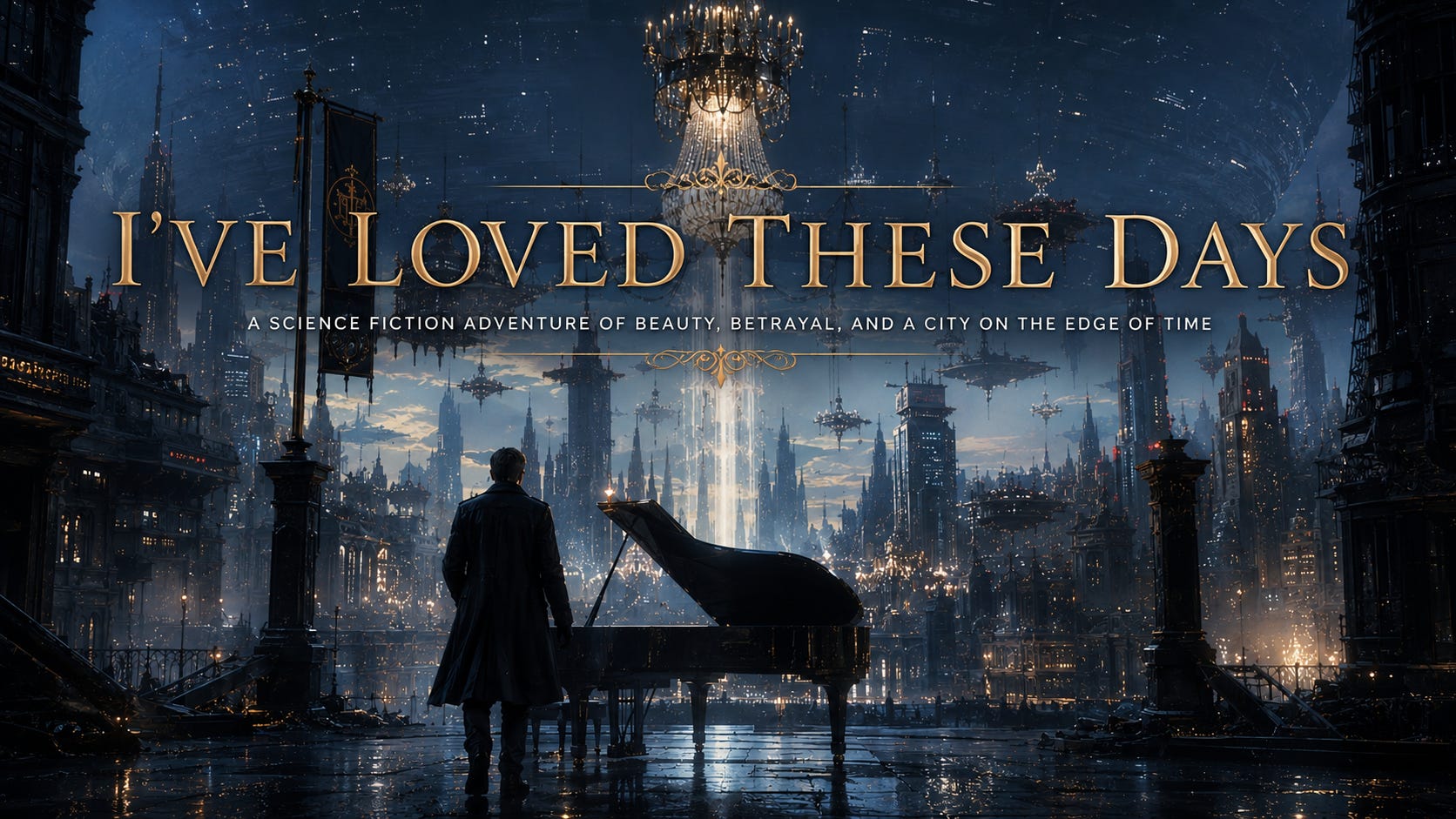
The first thing that fell from the sky was a piano.
Not a meteor. Not a ship. Not a weapon.
A black grand piano.
It descended through the violet clouds above the City of Meridian without flame or sound, turning slowly as if lowered by invisible strings. Thousands watched from the terrace cafés and floating promenades as it drifted between the silver towers and finally came to rest in the middle of the Avenue of Saints, directly beneath the oldest chandelier in the world.
Then it began to play.
No hands touched the keys.
Yet music rolled through the avenue—slow, melancholy, impossibly beautiful.
People stopped drinking.
Stopped laughing.
Stopped pretending.
And for the first time in many years, the citizens of Meridian remembered they were dying.
Meridian floated two miles above a poisoned earth.
The city had once been the triumph of mankind—the last sanctuary after the Collapse Wars boiled the oceans and turned continents into deserts of glass. The founders had built Meridian as a refuge of refinement. Art survived there. Music survived. Silk survived. Crystal, wine, velvet, sculpture, philosophy, opera, and impossible cuisine survived.
Reality did not.
Reality remained below the clouds.
The rich descendants of the First Families drifted through endless galas while hidden engines deep beneath the city slowly failed. The old reactors coughed and dimmed. Entire districts lost power at night. Elevation thrusters flickered. Gardens browned beneath synthetic suns.
But the parties continued.
Always the parties.
The people of Meridian had perfected the science of elegant denial.
No one embodied the city better than Lucien Vale.
He was famous for three things: his fortune, his impossible midnight feasts, and his refusal to discuss where either came from.
Tall and silver-eyed, Lucien lived in the Observatory Quarter where the ceilings were painted with constellations no longer visible from Earth. His mansion overlooked the entire city. Crystal chandeliers floated in magnetic fields above marble dining halls. Ancient jazz records spun beside fountains of imported wine. Artificial fireplaces glowed blue against black stone.
Every week he hosted another celebration.
Every week the city came.
Senators. industrial magnates. artists. neural architects. memory designers. gene sculptors. women wearing dresses woven from liquid light. men in velvet jackets stitched with gold circuitry.
They arrived laughing.
They departed hollow.
Lucien knew this.
He simply did not care enough to stop.
Or rather—he had once cared too much, and exhaustion had hardened into elegance.
On the night the piano fell from the sky, Lucien stood alone on his balcony listening to the music rise from the avenue below.
It was an old song.
Ancient.
Pre-Collapse.
He recognized fragments from forgotten recordings his mother once played when he was a child.
There was longing in it.
And regret.
And a strange tenderness toward doomed things.
Behind him, the ballroom still roared with music and intoxication. Hundreds danced beneath the chandeliers. Glasses clinked. Silk whispered across polished floors.
But the melody from the street passed through the walls like a ghost.
Lucien turned.
For the first time in years, the party sounded ugly.
Three hours later, a woman arrived at his door.
She wore no jewels.
That alone made her dangerous.
Her coat was ash-gray, practical, military. Rain from the lower atmosphere shimmered on her shoulders. She carried no visible weapon.
The servants refused to admit her.
Lucien overruled them immediately.
People without ornaments interested him.
She introduced herself as Mara Vey.
“Inspector?” Lucien asked.
“Formerly.”
“Which usually means dangerous.”
“It usually means inconvenient.”
He poured two glasses of amber liquor. She did not touch hers.
“That piano,” she said, “was meant for you.”
Lucien smiled faintly. “That’s dramatic.”
“You should hear the rest.”
She placed a thin crystal rod onto the table. It flickered alive, projecting a rotating symbol above the surface.
A circle.
Surrounded by chandeliers.
Lucien’s expression changed.
Very slightly.
But enough.
“You recognize it,” Mara said.
“I haven’t seen that crest in twenty years.”
“The Society of Lamps.”
“Dead.”
“No,” Mara replied. “Hidden.”
The room grew still.
Outside, the city glowed in artificial twilight while thunder moved below the cloud layer like distant artillery.
Lucien sat slowly.
The Society of Lamps had once been Meridian’s most exclusive inner circle. Not merely wealthy—powerful beyond law. Industrial dynasties. Reactor guilds. Atmospheric engineers. Cultural ministers.
Men and women who secretly governed the city while pretending civilization still functioned.
Lucien’s father had belonged to them.
Then the murders began.
One by one, members vanished.
No bodies.
No explanations.
Just music.
Always music.
Eventually the Society dissolved itself. The surviving members sealed their records. The city moved on.
Or pretended to.
Mara studied him carefully.
“Three days ago,” she said, “another member disappeared.”
Lucien’s hand froze around his glass.
“Who?”
“Cassian Reeve.”
Lucien stared.
Cassian had once been his closest friend.
The two of them had inherited entire worlds together. They drank together, gambled together, wasted years together beneath floating chandeliers and artificial stars.
Then Cassian vanished from public life a decade earlier.
No explanation.
No farewell.
Nothing.
“And now?” Lucien asked quietly.
“Now his penthouse is empty. The walls are stripped bare. And the only thing left behind was a recording.”
Mara touched the crystal rod again.
Music filled the room.
Piano.
The same melody from the avenue.
Then a voice.
Cassian’s voice.
Tired.
Older.
“If you’re hearing this,” he said, “then the city is almost out of time.”
Static crackled.
“They lied to us, Lucien. About everything. The engines. The descent systems. The lower world. Meridian isn’t surviving. It’s drifting.”
A pause.
“They built paradise on top of a grave.”
The recording ended.
Lucien realized he was gripping the table hard enough to whiten his knuckles.
“What do you want from me?” he asked.
Mara finally lifted the untouched glass.
“Access,” she said. “Your family archives. Your father’s records. And possibly your conscience.”
Lucien laughed once.
Not because it was funny.
They descended beneath Meridian the following night.
Most citizens never saw the Underworks.
The hidden mechanical world beneath the elegant city.
The place where the illusion survived.
The deeper they traveled, the uglier Meridian became.
Marble gave way to rusted steel.
Perfume gave way to oil.
Music gave way to machinery.
Entire districts of exhausted workers lived in dim maintenance corridors beneath the luxury sectors above. Children slept beside reactor pipes. Old technicians coughed black dust into stained handkerchiefs.
Lucien looked at them with the uncomfortable recognition of a man discovering the cost of his own comfort.
Mara noticed.
“You didn’t know?”
“I knew,” he said quietly.
“Then what’s the difference?”
“I never looked long enough.”
That answer seemed to satisfy her more than denial would have.
They continued downward.
Finally they reached the Archive Vaults.
Lucien used his genetic seal to open the ancient doors.
Dust spiraled upward as forgotten systems awakened.
Thousands of crystal memory rods lined the chamber.
His father’s voice echoed in his mind.
The city survives because people believe it survives.
At the center of the chamber stood a chandelier.
Immense.
Golden.
Unlit.
Mara approached it slowly.
“This is older than Meridian.”
Lucien nodded.
“The founders brought it from Earth.”
“Why?”
“No idea.”
Then he saw the inscription beneath it.
For the first time.
Not decorative script.
Coordinates.
Mara saw them too.
They exchanged a look.
And suddenly the mystery became something far larger than murder.
The coordinates led below the cloud layer.
Below the poison storms.
Below the dead world itself.
There were legends of subterranean colonies—humanity surviving beneath the ruined earth while Meridian floated above like a drunken aristocrat refusing to acknowledge reality.
Most dismissed the stories.
But Cassian had not.
Nor, apparently, had Lucien’s father.
Three nights later, Lucien and Mara boarded an illegal descent craft from the abandoned freight docks.
The vessel trembled violently as it pierced the toxic cloud layers beneath the city.
Lightning engulfed them.
For several terrifying minutes the world vanished into blackness.
Then they emerged beneath the storms.
Lucien stared in disbelief.
Earth was not dead.
Not entirely.
Massive oceans shimmered beneath the clouds. Forests glowed with bioluminescent life. Ancient cities lay in ruins beside thriving hidden settlements.
Humanity had survived.
Meridian had simply abandoned it.
Mara whispered, “My God.”
But Lucien barely heard her.
Because directly below them, built into the side of a mountain, stood another city.
And every tower glittered with chandeliers.
The hidden city was called Eidon.
It had been founded by engineers, scientists, and refugees who rejected Meridian generations earlier. While the floating city drifted in endless indulgence, Eidon rebuilt the earth.
Quietly.
Patiently.
Without spectacle.
Its leader was an old man named Adrastus.
And he had been waiting for Lucien.
“You look exactly like your father,” Adrastus said.
“That isn’t a compliment.”
“No,” the old man agreed. “It rarely was.”
They met in a vast underground hall lit by warm golden lamps.
Not artificial.
Real flame.
Lucien found them strangely beautiful.
Adrastus explained the truth.
Meridian had been doomed for decades.
The propulsion systems were failing beyond repair. The city’s ruling circles knew this. They concealed it to preserve order—and privilege.
Soon the city would fall.
Millions would die.
Unless Meridian descended intentionally while evacuation corridors still existed.
“But your elites won’t allow panic,” Adrastus said. “They would rather host one final banquet at the end of the world.”
Lucien thought of the endless parties.
The satin sheets.
The chandeliers.
The numbness.
And suddenly he hated all of it.
Not because it was beautiful.
But because it was cowardly.
“Cassian discovered this?” he asked.
Adrastus nodded.
“He tried to warn them.”
“What happened?”
Silence.
Then:
“They killed him.”
The words landed like iron.
Lucien closed his eyes.
For years he and Cassian had drifted through luxury pretending sophistication was wisdom.
Meanwhile his friend had awakened first.
And died alone for it.
Mara stepped forward. “Can Meridian be saved?”
Adrastus looked at Lucien.
“Only if someone inside the illusion breaks it.”
They returned to Meridian during the Festival of Lanterns.
The greatest celebration of the year.
Perfect timing.
The city blazed with light. Floating orchestras drifted through the avenues. Wine fountains spilled across silver basins. Thousands danced beneath suspended chandeliers.
And above it all, hidden in the upper districts, the ruling families prepared their escape ships.
Lucien now knew everything.
Which meant he could no longer survive as the man he had been.
He entered the Grand Conservatory shortly before midnight.
Every major figure in Meridian stood assembled there beneath the legendary chandelier from Earth.
Music swelled.
Laughter echoed.
The world glittered.
Lucien walked directly onto the central stage.
The orchestra faltered.
People turned.
Some smiled drunkenly.
Others frowned.
Lucien activated the hall projectors.
The ceiling vanished.
In its place appeared reactor schematics. Structural failures. Hidden evacuation plans. Recordings. Murder files.
Cassian’s face filled the chamber.
“You built paradise for yourselves,” the dead man said, “while the city rotted beneath us.”
Panic erupted instantly.
Senators shouted.
Security forces surged forward.
But Lucien continued speaking.
Not loudly.
He did not need to.
“I spent half my life pretending elegance was civilization,” he said. “Pretending refinement could save us from truth.”
The room fell gradually silent.
“We drank while the engines failed. We danced while children starved below the city. We buried ourselves beneath silk and crystal because we were afraid to admit the world still existed.”
He looked upward at the chandeliers.
Beautiful.
Fragile.
Meaningless.
“And yet,” he said softly, “I have loved these days.”
That surprised them.
It surprised even him.
Because it was true.
He had loved the music.
The wine.
The impossible beauty.
The laughter.
The tenderness hidden inside ruined souls.
The tragedy was not that beauty existed.
The tragedy was that they had used beauty to escape responsibility.
“We do not have to become monsters to survive,” Lucien said. “But we must wake up.”
Then the lights went out.
Completely.
The chandeliers died overhead.
Darkness swallowed Meridian.
And somewhere deep below the city, the ancient engines finally failed.
For one terrible moment, the floating city began to fall.
People screamed.
Glass shattered.
Alarms roared through every district.
Then—slowly—the descent stabilizers engaged.
Not Meridian’s.
Eidon’s.
From beneath the clouds, hidden guidance towers awakened across the earth below. Massive gravitic beacons reached upward and caught the dying city like invisible hands.
Meridian descended through the storms.
Slowly.
Painfully.
Like a god learning mortality.
Dawn touched the earth for the first time in generations as the city landed.
Not perfectly.
Not gracefully.
But alive.
Millions emerged cautiously from the broken avenues and terraces.
They stood beneath real sunlight.
Real wind.
Real trees.
Many wept.
Others simply stared.
Lucien walked alone through the silent streets as workers dismantled shattered chandeliers overhead.
Mara eventually found him beside the motionless piano that had begun everything.
“You could help govern now,” she said.
“No.”
“Why not?”
He smiled faintly.
“Because men like me are very good at parties.”
“And bad at endings?”
“No,” Lucien said quietly. “Bad at beginnings.”
The wind moved softly through the ruined avenue.
Somewhere nearby, children laughed.
Real laughter.
Untouched by desperation.
Untouched by denial.
Lucien listened to it for a long time.
Then he placed his hand gently on the old piano.
And at last, with sorrow and gratitude intertwined like music, he whispered:
“I loved those days.”