

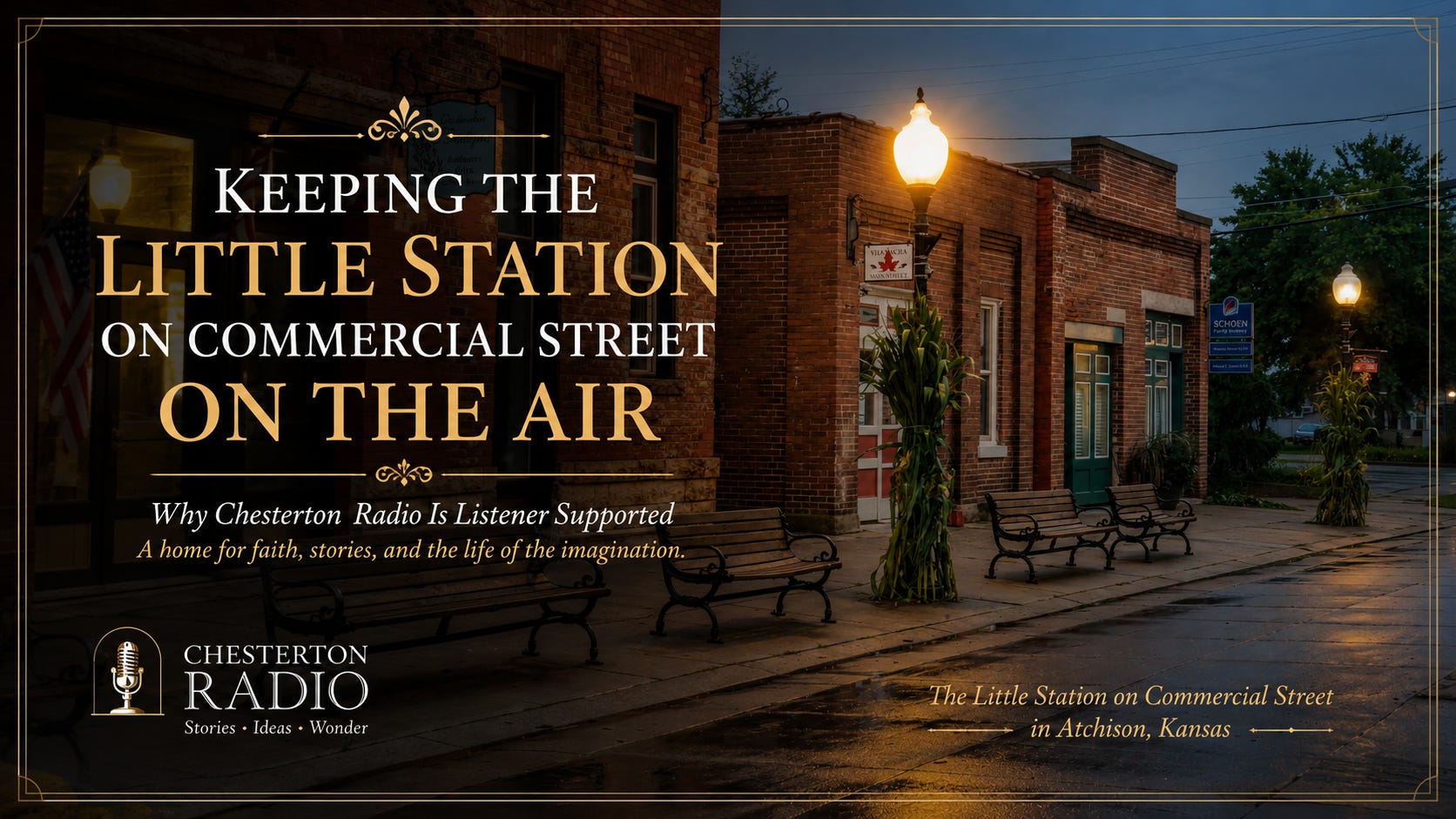
The lights come on before sunrise.
Not with a dramatic flourish, but quietly, one switch at a time.
A small lamp glows over an old wooden desk. The coffee begins to brew. A microphone wakes with the familiar click of a switch. Somewhere in the background, a vintage radio hums softly as its tubes warm. Outside, Commercial Street in Atchison, Kansas, is still mostly asleep. The storefronts are dark. The sidewalks are empty except for the occasional early walker and the first delivery truck of the morning.
Inside The Little Station on Commercial Street, another day is about to begin.
Someone opens a worn Douay-Rheims Bible.
Morning Prayer is only a few moments away.
Now, before anyone writes to point out that no such radio station appears on an FCC license, let me confess something.
The station exists.
And it doesn’t.
There is no brick building with a Chesterton Radio sign hanging above the sidewalk. There is no engineer in a booth adjusting a glowing rack of vacuum-tube transmitters. The station is, in one sense, imaginary.
But everything it represents is real.
The prayer is real.
The stories are real.
The conversations are real.
The listeners are certainly real.
Every day, people from around the world gather for a few minutes of Scripture before beginning their work. Some listen while driving to the office. Others while making breakfast. Some are retired. Some are students. Some are alone in hospital rooms. Others are walking their dogs through quiet neighborhoods before sunrise.
Together they form a congregation that may never meet in person, yet somehow knows one another.
That little station on Commercial Street has become a place.
And perhaps that is one of the oldest definitions of home.
More Than a YouTube Channel
If you first discovered Chesterton Radio through YouTube, you probably assumed it was simply another channel posting old radio shows.
To be honest, that’s how it began.
I have loved old-time radio for decades. Those crackling broadcasts from another era possess something that modern entertainment often lacks: confidence that a good story, well told, is enough.
A voice.
A script.
A little music.
The listener supplies the rest.
There is something deeply human about that.
Long before “immersive media” became a fashionable phrase, radio had already mastered it.
But something unexpected happened.
People didn’t merely listen.
They stayed.
They wrote comments.
They shared memories of hearing Jack Benny with their parents.
They remembered Gunsmoke on family vacations.
They introduced grandchildren to Suspense.
Some discovered Father Brown for the first time.
Others confessed they had fallen asleep every night for years listening to old radio because it made the world feel gentler.
Slowly, almost without noticing it, the channel stopped feeling like an archive.
It began feeling like a gathering place.
That changed everything.
Why Chesterton?
People occasionally ask why the station bears Chesterton’s name when so much of our programming consists of classic radio.
The answer is surprisingly simple.
Chesterton believed that ordinary things were extraordinary.
He believed gratitude was more revolutionary than cynicism.
He believed imagination was not an escape from reality but one of the ways we discover it.
He loved paradox because life itself is filled with them.
Those ideas happen to describe the best of old radio as well.
Classic radio rarely depended on spectacle.
It depended on craftsmanship.
A writer who respected language.
Actors who respected the audience.
Sound engineers who understood that a single creaking door could create an entire castle inside the listener’s imagination.
Chesterton would have appreciated that.
Not because it was nostalgic.
Because it treated ordinary people as intelligent.
The Little Station
If you were somehow able to walk through the front door of our imaginary station, you would find that it has many rooms.
One room is filled with prayer.
Each morning begins with Scripture, the Psalms, the prayers of the Church, and a brief reflection rooted in the liturgical calendar.
Morning Prayer isn’t designed to entertain.
It is designed to orient.
Before politics.
Before stock markets.
Before algorithms.
Before headlines.
Prayer reminds us who we are.
Another room contains our Morning Prayer Deep Dive.
There the day’s Gospel receives the luxury modern life rarely grants anything—an hour of thoughtful conversation.
We wander through Scripture, Chesterton, Benedictine spirituality, literature, philosophy, history, and the peculiar joys of ordinary life.
Somewhere down the hall, Father Brown is quietly solving another mystery—not through forensic science, but through understanding the human heart.
Nearby, original stories are being written because preserving tradition also means contributing to it.
Another studio echoes with Saturday Night Theatre, where great plays continue to live for new audiences.
Around the corner you’ll hear CBS Radio Mystery Theater, Suspense, Escape, Lux Radio Theatre, Gunsmoke, Jack Benny, One Man’s Family, and dozens of other voices that refuse to grow old because human nature has not changed very much.
Elsewhere, listeners gather for long-form Deep Dives into literature, philosophy, engineering, history, radio, and culture.
Outside the studios, conversations continue on Substack.
On YouTube.
On Apple Podcasts.
On Spotify.
On the livestream.
What once looked like separate projects gradually reveal themselves as parts of one place.
One station.
One community.
Why We Restore Old Voices
There is a temptation to believe that progress always means replacement.
Chesterton suspected otherwise.
Sometimes progress means remembering.
Every restored radio broadcast represents hours of work.
Finding recordings.
Cleaning audio.
Correcting metadata.
Researching cast members.
Writing descriptions.
Designing artwork.
Publishing.
Archiving.
Answering comments.
Maintaining websites.
The listener hears sixty minutes.
Hundreds of quiet decisions made those sixty minutes possible.
Beauty usually arrives that way.
Not dramatically.
Patiently.
Why We Create New Things
Preservation alone isn’t enough.
Museums preserve.
Living cultures create.
That is why Chesterton Radio now includes original Father Brown mysteries, essays, Morning Prayer, Deep Dives, and entirely new programming inspired by timeless ideas.
We are not trying to recreate 1947.
We are trying to carry forward what was best about it.
Every generation receives an inheritance.
Every generation also adds a room onto the house.
That is tradition.
Why Listener Supported?
People sometimes ask why we don’t simply fill every program with advertisements.
There is nothing wrong with commerce.
Commercial Street itself reminds us that honest trade builds healthy communities.
But there are places where commerce should remain a guest rather than becoming the host.
Morning Prayer should not sound like a rush-hour radio show.
Imagine finishing the Gospel only to hear someone enthusiastically selling discount mattresses.
The contrast would be absurd.
Atmosphere matters.
Silence matters.
Reverence matters.
The same is true of Father Brown, literary discussions, and reflective conversations.
These programs invite listeners to slow down.
That atmosphere deserves protection.
Listener support allows us to preserve it.
A New Kind of Sponsorship
That said, we also believe there is another path.
Not advertising.
Partnership.
We are beginning to invite a small number of Founding Sponsors to help underwrite specific programs.
Not by interrupting them.
By making them possible.
Imagine a Catholic university helping support Morning Prayer.
A family-owned manufacturer sponsoring a season of Father Brown.
A skilled trades company underwriting educational programming because they believe craftsmanship deserves to be celebrated.
A retreat center helping keep the daily Deep Dive available to everyone.
A family sponsoring a week of broadcasts in memory of a husband, wife, parent, or grandparent who loved old radio.
These aren’t advertisements.
They’re acts of stewardship.
They say something beautiful:
“We believe this should exist.”
Builders
When medieval craftsmen carved hidden figures high inside cathedral roofs, they knew few people would ever see them.
They carved anyway.
Because excellence was offered first to God.
Chesterton Radio needs that same spirit.
Editors.
Writers.
Researchers.
Audio restorers.
Storytellers.
Sponsors.
Subscribers.
Listeners who simply tell a friend.
Each becomes a builder.
Institutions are rarely built by one visionary.
They’re built by thousands of people who quietly decide that something is worth preserving.
Ten Years From Now
Close your eyes for a moment and imagine visiting Chesterton Radio in 2036.
Morning Prayer has become part of daily life for thousands.
The Deep Dive library contains years of reflections through the liturgical calendar.
Children are listening to original radio adventures.
New Father Brown novels sit beside the classics—not replacing them, but honoring them.
Students discover literature through audio.
Engineers discuss craftsmanship.
Historians preserve forgotten broadcasts.
Listeners gather in Atchison for annual Chesterton Radio weekends.
Young apprentices learn the nearly forgotten art of audio restoration.
Authors record essays.
Actors perform new dramas.
Classic radio remains alive not because people remembered it fondly, but because someone continued telling the stories.
Perhaps there is even a real little studio on Commercial Street by then.
Perhaps visitors stop by for coffee.
Perhaps they sit before the microphones and smile.
“I’ve always wondered what this place looked like.”
The Open Door
There is a phrase we often use at Chesterton Radio.
The Open Door is always on.
It’s an odd expression.
Doors are usually open or closed.
Radios are on or off.
But perhaps that’s exactly the point.
Chesterton Radio has always tried to be both.
A door.
And a broadcast.
A place where anyone—regardless of age, background, denomination, or country—can step inside for a while and find good company.
Sometimes that company comes in the form of Jack Benny.
Sometimes Father Brown.
Sometimes a Psalm.
Sometimes an old Gunsmoke episode.
Sometimes a conversation about why wonder is still possible in an age that mistakes novelty for wisdom.
The Invitation
If you’ve been listening for years, thank you.
If you discovered us yesterday, welcome.
If you’ve shared a program with a friend, you’ve already become part of this story.
If you’ve left a thoughtful comment, you’ve helped shape the community.
If you’ve prayed Morning Prayer with us before work, you’ve reminded us why it matters.
And if you’ve ever thought, “I hope this little station is still here ten years from now,” then perhaps you’re already thinking like a builder.
There are many ways to help.
Listen.
Share.
Become a paid Substack subscriber.
Support the station through Buy Me a Coffee.
Become a monthly supporter.
Sponsor a week of Morning Prayer.
Sponsor a Deep Dive.
Help underwrite Father Brown, Saturday Night Theatre, or one of our special collections.
If you’re part of a Catholic business, university, publisher, retreat center, engineering firm, skilled trades company, healthcare organization, financial practice, or family foundation, we’d be delighted to explore a sponsorship partnership that reflects your mission while preserving the thoughtful spirit of Chesterton Radio.
If you’d like to begin that conversation, simply write to:
📧 paul@chestertonradio.com
No marketing department.
No layers of bureaucracy.
Just the fellow tending the little station.
Until Tomorrow Morning
The day is ending now.
The last program signs off.
The microphones fall silent.
The coffee pot is empty.
The lights are switched off one by one.
The front door on Commercial Street is locked for the evening.
Outside, the street grows quiet again.
Tomorrow, before sunrise, someone will unlock that door.
The coffee will brew.
The Bible will open.
Morning Prayer will begin.
And somewhere, perhaps in a kitchen, a workshop, a monastery, a pickup truck, a hospital room, or a quiet porch, another listener will tune in.
With God’s help—and with a community of builders who believe that stories, prayer, and wonder still matter—the lights of The Little Station on Commercial Street will come on again.
And, as always,
The Open Door is always on.