

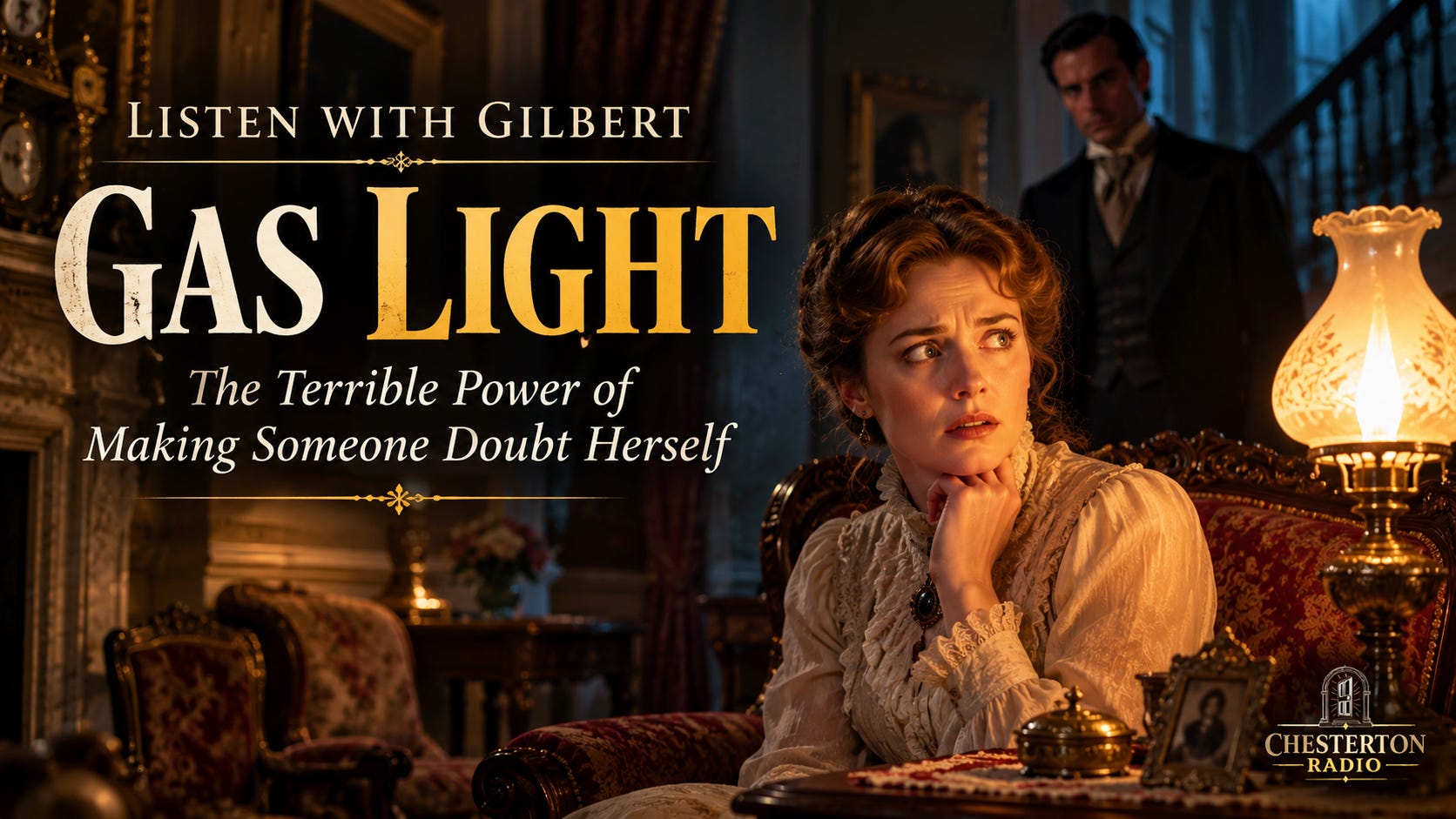
LISTEN WITH GILBERT The Chesterton Radio Listening Guide
Chesterton Radio has four interpretations of Gas Light, including three dramatic adaptations and a Jack Benny comedy treatment. Together, they make an unusually interesting listening collection: the same disturbing premise moves from stage to Hollywood, from psychological suspense to popular comedy.
The central question is larger than the mystery itself. What happens when the person you trust most becomes the person who teaches you to distrust your own senses?
LISTEN TO THE BROADCASTS
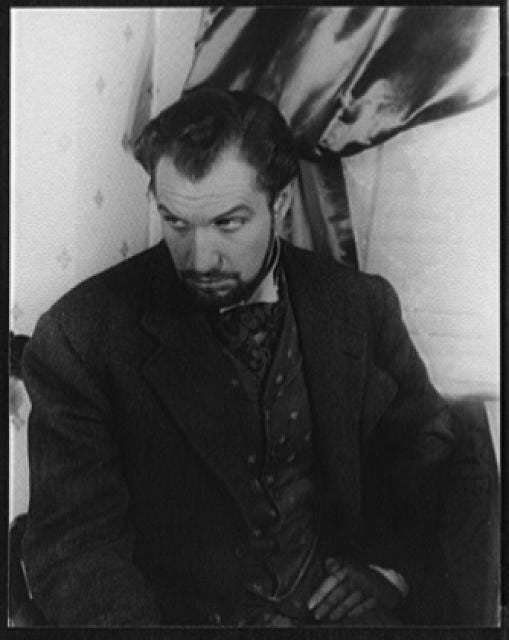
1. Angel Street — Best Plays
June 22, 1952 · NBC
Vincent Price and Judith Evelyn return to the roles they originated on Broadway.
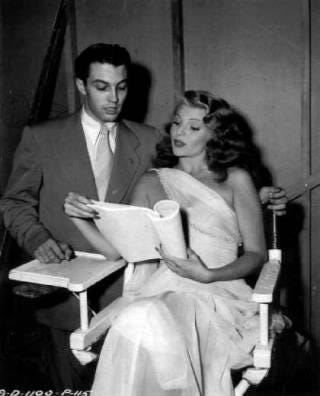
2. Gaslight — Screen Guild Theater
February 3, 1947 · CBS
Charles Boyer and Susan Hayward in a condensed dramatic adaptation.
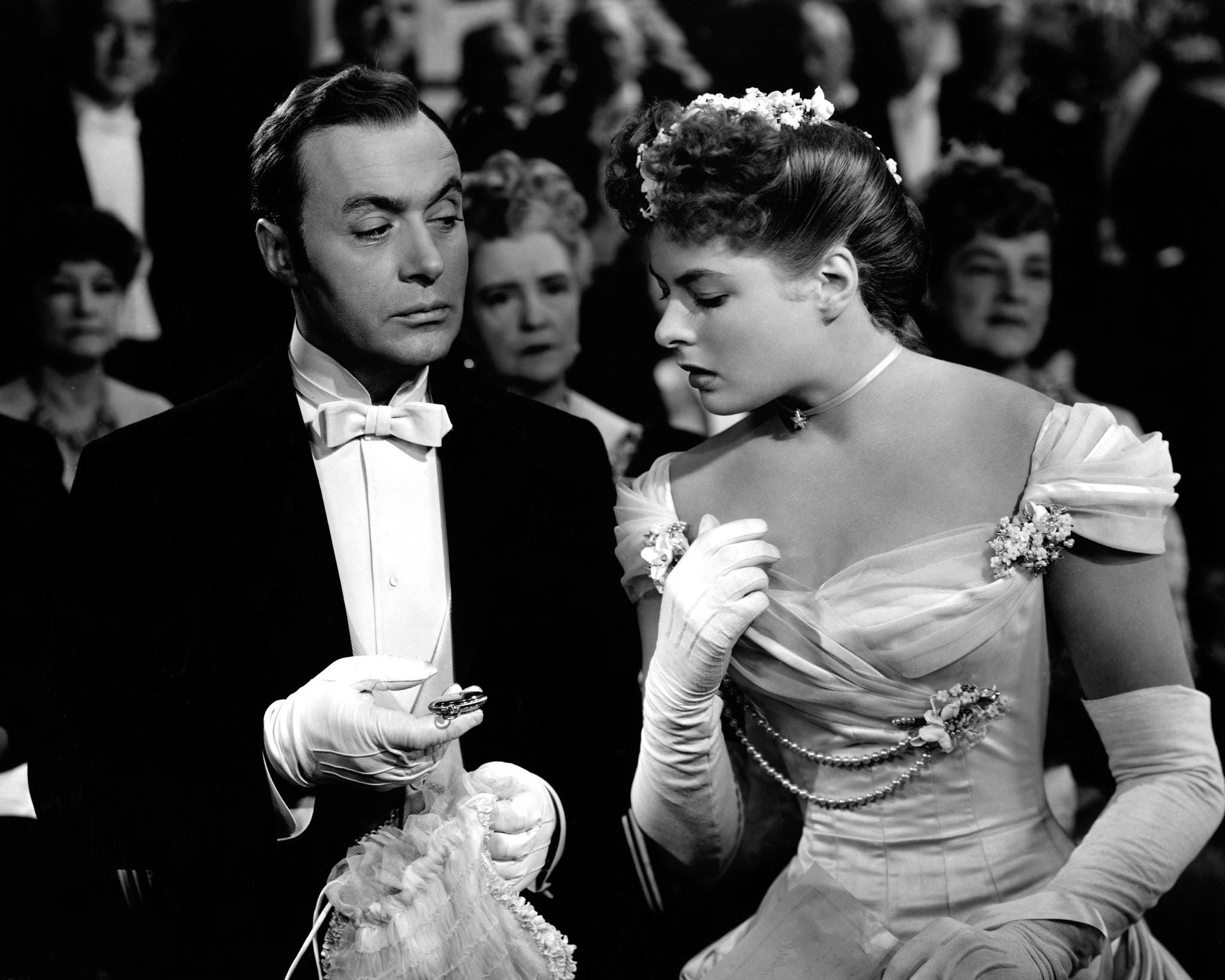
3. Gaslight — Lux Radio Theatre
April 29, 1946 · CBS
Charles Boyer and Ingrid Bergman recreate their celebrated film roles.
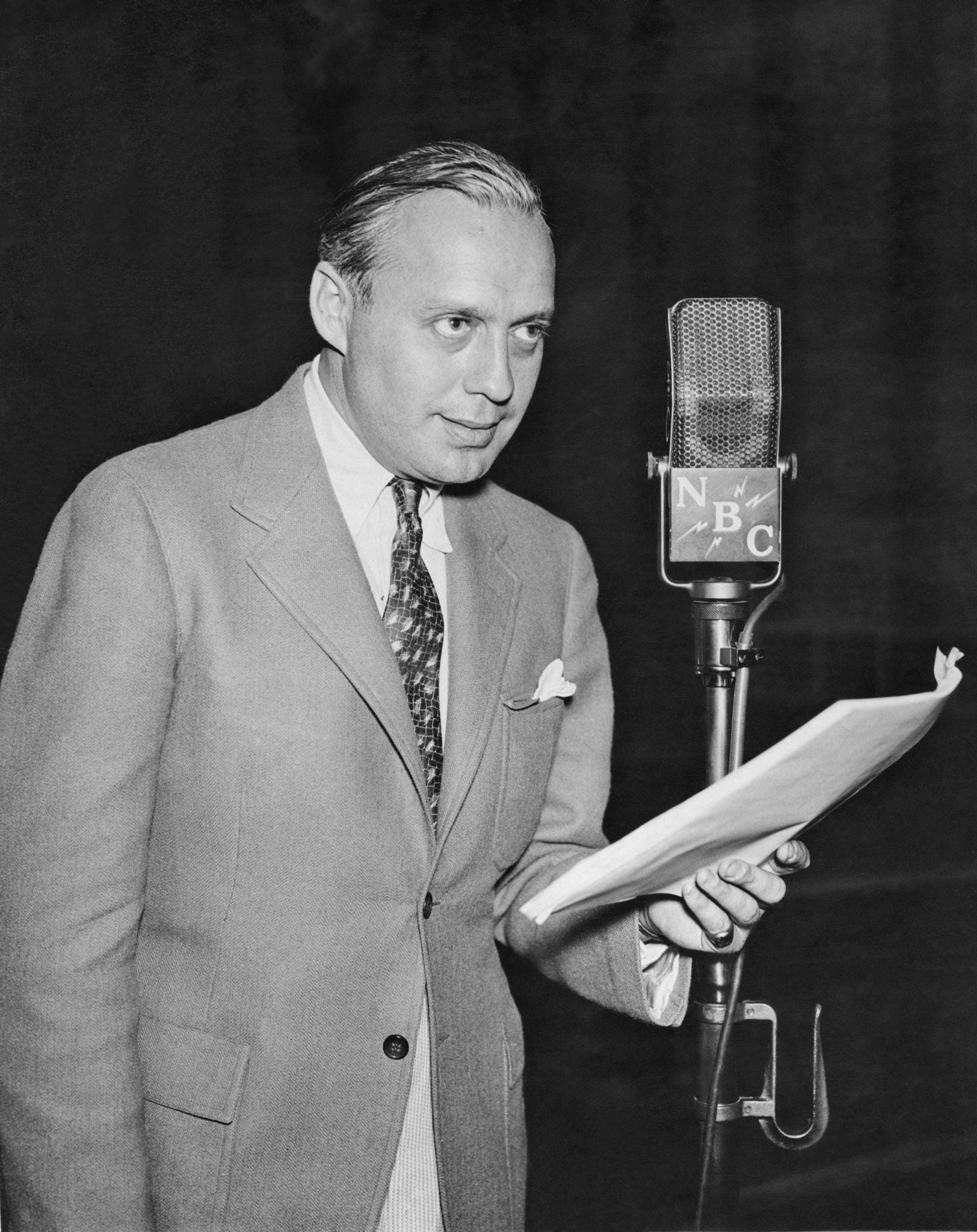
4. Gaslight — The Jack Benny Program
Comedy parody
Jack Benny turns the familiar thriller into a comedy of deception and absurdity.
THE STORY AND ITS HUMAN QUESTION
A Victorian drawing room. A respectable husband. A nervous wife. A gas lamp that grows dim for no apparent reason.
Nothing here should be especially frightening. The furniture is comfortable, the household orderly, and the husband apparently concerned for his wife’s welfare.
Yet something is terribly wrong.
Patrick Hamilton’s Gas Light, first performed in London in December 1938, takes the familiar surroundings of domestic life and makes them instruments of terror. The play reached Broadway as Angel Street in 1941, with Vincent Price, Judith Evelyn, and Leo G. Carroll among its principal performers.
The original play concerns Jack and Bella Manningham. In the later Hollywood adaptation, they become Gregory Anton and Paula Alquist. The names and circumstances change, but the essential predicament remains.
A husband repeatedly tells his wife that she has forgotten things, misplaced possessions, imagined sounds, and misunderstood events. He presents his accusations as reluctant observations. He is not angry, he suggests, but worried.
And because he is her husband, his words carry an authority that those of a stranger would not.
Gradually, she begins to surrender her confidence in what she sees and remembers.
The gas lamps are particularly important. Their inexplicable dimming is not merely an atmospheric trick. It is physical evidence that contradicts the husband’s account of the household.
She sees something happening. He insists it is not happening.
The suspense therefore comes from a question more disturbing than the usual mystery of who committed a crime: can a person continue to believe the evidence of her own senses when everyone around her seems to say otherwise?
The audience recognizes the danger before the heroine fully understands it. We are left listening to an intelligent woman being persuaded that her intelligence is itself unreliable.
PERFORMANCE AND WRITING
Vincent Price: The villain in the drawing room
The Best Plays production of Angel Street is particularly valuable because Vincent Price and Judith Evelyn had originated their respective roles in the Broadway production.
Price was not yet primarily associated with the horror films that would eventually make his voice so recognizable to later generations. His theatrical background, cultivated diction, and ability to suggest menace beneath impeccable manners made him a natural choice for Manningham.
The villain requires more than an ominous voice. He must be convincing as a respectable husband, a man whose behavior might initially pass for concern.
That is the great theatrical trick of Angel Street.
If Manningham appears monstrous from the beginning, the audience may wonder why Bella believes him. If he appears entirely benevolent, the psychological cruelty loses its edge.
Price’s stage association with the character gives this radio production a special place in the collection. We are hearing an actor return to a role he helped establish for American audiences.
Judith Evelyn’s participation matters just as much. The story depends on Bella remaining a human being rather than becoming merely a frightened victim. Her uncertainty must be understandable, her suffering credible, and her eventual recovery of confidence dramatically meaningful.
The 1952 production also demonstrates why Hamilton’s play proved so durable. It does not require spectacular action. Its central struggle can be expressed through conversation, silence, and the changing authority of one voice over another.
Charles Boyer and Ingrid Bergman: Hollywood comes to radio
The 1946 Lux Radio Theatre production reunites Charles Boyer and Ingrid Bergman in the roles they played in MGM’s 1944 film.
Boyer’s Gregory Anton is a different sort of villain from the stage Manningham. His sophistication and romantic manner are essential to the deception. The audience must understand why Paula could once have loved him.
The disturbing quality of the character comes from the distance between his outward composure and his intentions.
Bergman’s Paula is equally important. Her performance in the film earned her the Academy Award for Best Actress, and the radio adaptation allows us to encounter the character without the visual elements that helped make the screen performance famous.
On radio, emotional uncertainty must be conveyed through the voice.
A hesitation, a question repeated, or an attempt to sound certain can communicate the strain of someone who no longer trusts her own judgment.
The hour-long Lux format provides room for the relationship to develop and for the listener to understand the emotional cost of the deception.
The production also preserves the character of Hollywood radio at its most ambitious: major film stars recreating an important motion picture for an audience gathered around the family receiver.
The adaptation is not simply a recording of the film’s dialogue. It is another dramatic form, with its own rhythm and demands.
Charles Boyer and Susan Hayward: The shorter telling
The Screen Guild Theater version, broadcast February 3, 1947, pairs Boyer with Susan Hayward.
Here the story must operate within approximately half an hour.
The shorter format necessarily places greater weight on the central conflict. There is less opportunity for extended atmosphere, secondary characterization, or the gradual accumulation of unease.
But compression also exposes the strength of Hamilton’s underlying premise.
The essential machinery of the drama remains understandable: a husband manufactures uncertainty, a wife struggles to make sense of her experience, and the truth threatens to overturn the apparent order of the household.
Hayward’s presence gives listeners an opportunity to hear a different actress inhabit Paula while Boyer remains the familiar Gregory.
The contrast is especially interesting when the two Hollywood adaptations are heard close together.
The husband is the same performer. The wife is not. The length and dramatic pacing also change.
The result invites us to consider how much of a character belongs to the writing, and how much emerges from the individual actor.
Jack Benny: When terror becomes comedy
Then comes Jack Benny.
The fourth Chesterton Radio recording takes the premise of Gaslight and turns it toward comedy.
This is not as strange a transformation as it first appears.
Benny’s familiar radio character is vain, miserly, self-important, and frequently convinced that he is the cleverest person in the room. The audience, of course, usually knows better.
That relationship between the character’s confidence and the listener’s superior knowledge is also central to Hamilton’s thriller.
In Gaslight, the audience sees through the husband’s manipulation and fears for the wife.
In a Benny parody, the same dramatic advantage can become the foundation of a joke. The villain’s elaborate cleverness is exposed as ridiculous.
The audience is no longer helplessly watching cruelty unfold. It is invited to laugh at the pretensions of the man attempting it.
The result is a useful reminder that comedy and suspense often depend on the same arrangement of information: one person knows something that another does not.
The emotional destination is different, but the machinery is surprisingly similar.
THE RADIO EXPERIENCE
Gas Light is particularly well suited to radio because its central subject is uncertainty about perception.
The stage and film versions use the visible dimming of the lamps. The radio listener cannot see the room, but can hear a character describe what she sees and hear another character deny it.
That changes the relationship between audience and heroine.
We must imagine the physical evidence while listening to the conflicting accounts of it. We are asked to judge voices, just as she is.
Footsteps, doors, household noises, and changes in musical atmosphere can become unusually significant. In a mystery built around apparently inexplicable events, an ordinary sound may be evidence.
The domestic setting also makes the story an effective radio experience.
A large adventure may need elaborate narration to establish its geography. Gas Light needs a room, a staircase, and the suggestion of another part of the house that the heroine cannot enter or understand.
The listener supplies the rest.
The three dramatic adaptations demonstrate different approaches to this challenge. The Best Plays production carries the theatrical origins of the story. Lux presents the Hollywood adaptation in an hour-long broadcast. Screen Guild condenses the material into a shorter presentation.
The Jack Benny recording then reminds us of something else about radio: its performers could move from drama to parody, allowing the audience to recognize a famous story through familiar voices and comic conventions.
The same listener who shuddered at Gaslight could later laugh at it.
THE CHESTERTONIAN READING
The evidence of ordinary things
There is a particularly Chestertonian paradox at the heart of Gas Light.
The supposedly irrational person is the one paying attention to reality.
The apparently rational person is the one determined to deny it.
Bella notices the light. She remembers events. She hears sounds. Her difficulty is not that she has abandoned reason, but that someone she trusts has persuaded her to abandon confidence in her own reasoning.
Her husband, meanwhile, maintains the outward appearance of sanity and authority while constructing an elaborate false account of the world.
He does not simply tell lies. He attempts to establish himself as the person entitled to decide what is true.
This is what makes the story more than an ingenious mystery.
It concerns the moral importance of ordinary perception.
Chesterton repeatedly returned in his writing to the importance of common sense, the reality of the ordinary world, and the danger of systems of thought that become detached from experience.
Through that lens, the gas lamp becomes an unexpectedly powerful object.
It is not grand. It is not mysterious in itself. It is a household appliance.
Yet it bears witness.
When the flame diminishes, something has happened. Whatever explanation the husband offers must account for that fact.
His authority cannot make the physical event disappear.
The terrible achievement of his manipulation is to convince his wife that his account of reality matters more than reality itself.
The recovery of her confidence is therefore not merely psychological. It is moral.
She must learn that she has the right to notice what is happening in her own home.
The difference between authority and truth
There is another distinction worth making.
Hamilton does not present all authority as inherently corrupt.
The detective’s intervention is important because he helps the heroine recover her ability to examine evidence. He offers an alternative account of events, but the deeper restoration comes when the facts begin to make sense.
This is the difference between an authority that demands submission and one that helps another person understand.
The husband uses his superior position to diminish his wife.
The detective uses his knowledge to restore her confidence.
One relationship makes her smaller. The other allows her to become herself again.
The contrast gives the story an ethical dimension that extends beyond its Victorian setting.
We all depend on other people for knowledge. Nobody can personally verify every fact, remember every event, or understand every circumstance without assistance.
Trust is therefore necessary.
But trust becomes dangerous when it requires a person to deny the evidence of ordinary experience.
The heroine’s predicament is not that she trusted someone. It is that her trust was deliberately exploited.
That distinction matters.
A world in which nobody trusts anyone would be almost as intolerable as the household Hamilton depicts. The answer to corrupted trust is not universal suspicion, but the restoration of truthful relationships.
The comedy of false authority
Jack Benny’s parody supplies an unexpected companion to this interpretation.
Comedy has a remarkable ability to puncture false authority.
A frightening villain may seem powerful because everyone around him treats him seriously. A comic villain loses much of that power when the audience recognizes the absurdity of his pretensions.
Benny’s established comic persona is particularly suited to this reversal. He is forever attempting to preserve his dignity while events expose his vanity.
In the dramatic versions, the husband’s control of appearances is terrifying.
In comedy, that same desire to control appearances becomes ridiculous.
This does not diminish the seriousness of Hamilton’s original subject. It demonstrates another way that art can reveal the truth about human behavior.
Sometimes evil is frightening because it is powerful.
Sometimes it is ridiculous because it imagines itself more powerful than it is.
The gas lamp remains stubbornly real in either case.
WHAT STILL SPEAKS—AND WHAT FEELS OF ITS TIME
The word gaslighting has become so familiar that it is easy to forget the work from which it emerged.
Today it is used to describe deliberate psychological manipulation that causes another person to question their perception or judgment. The expression derives from Hamilton’s play and its screen adaptations.
But the original story is more precise than many casual uses of the term.
The husband does not merely disagree with his wife. He systematically creates false evidence, denies real events, isolates her, and exploits her trust for his own purposes.
That specificity gives the drama its force.
The Victorian assumptions surrounding marriage, household authority, and women’s independence belong to the period in which the story is set. The Hollywood adaptations also reflect the conventions of mid-century melodrama.
The heroine’s rescue through the intervention of a male detective may feel especially characteristic of its time.
Yet the essential subject remains recognizable.
The fear of not being believed, particularly by someone whose affection ought to provide security, requires no Victorian drawing room to be understood.
Nor does the experience of being told that an obvious fact is merely a product of one’s imagination.
The radio versions also offer a reminder of the strengths and limitations of adaptation.
A half-hour broadcast cannot preserve every element of a full-length play. The hour-long Hollywood version inevitably emphasizes different aspects of the story from the stage production.
And comedy changes the audience’s relationship to the material altogether.
Rather than treating these differences as defects, the collection invites us to appreciate how a strong dramatic idea can survive substantial changes in form.
VERDICT
For listeners encountering the story for the first time, the Lux Radio Theatre production offers a substantial introduction through the performances of Charles Boyer and Ingrid Bergman.
Those interested in the theatrical origins should make time for Angel Street, particularly because of Vincent Price and Judith Evelyn’s connection to the Broadway production.
The Screen Guild Theater version offers a shorter treatment and the opportunity to hear Susan Hayward opposite Boyer.
And the Jack Benny recording provides a welcome change of pace after the suspense.
Heard together, these four broadcasts reveal something more interesting than a succession of remakes.
They show how one dramatic idea can survive changes of cast, medium, length, and even genre.
At the center remains a woman, a household, and a lamp whose flame refuses to behave as her husband insists it must.
The most important discovery in Gas Light is not simply that the husband has been lying.
It is that the wife was right to trust what she saw.
BROADCAST NOTES
Production
Original broadcast
Principal performers
Best Plays: Angel Street
June 22, 1952
Vincent Price, Judith Evelyn
Lux Radio Theatre: Gaslight
April 29, 1946
Charles Boyer, Ingrid Bergman
Screen Guild Theater: Gaslight
February 3, 1947
Charles Boyer, Susan Hayward
Jack Benny: Gaslight
Date of linked radio recording not independently verified
Jack Benny
The dramatic adaptations derive from Patrick Hamilton’s 1938 stage play and, in the case of the Hollywood radio versions, the 1944 MGM film.
Editorial note: Jack Benny also performed a Gaslight parody on television with Barbara Stanwyck on January 27, 1952. That television broadcast should not be confused with the date of the Chesterton Radio audio recording.
KEEP LISTENING WITH GILBERT
Chesterton Radio preserves and shares classic radio drama, comedy, literature, and original commentary for a new generation of listeners.
If you enjoy Listen with Gilbert, consider becoming a paid subscriber. Your support helps us continue producing these original essays and keeping the great voices of radio accessible.
And tell us in the comments: Which interpretation of Gas Light stays with you—the theatrical menace of Vincent Price, the Hollywood performances of Boyer and Bergman, or Jack Benny’s comic treatment?
Sometimes the most revealing way to revisit a frightening story is to hear someone make us laugh at it.
Angel Street - Vincent Price - Gas Light - Patrick Hamilton - Best Plays of New York Theater
Gaslight - Charles Boyer - Susan Hayward - Screen Guild Theater
Gaslight - Charles Boyer - Ingrid Bergman - Lux Radio Theater
Gaslight - Jack Benny Show - Radio’s Best Comedy