

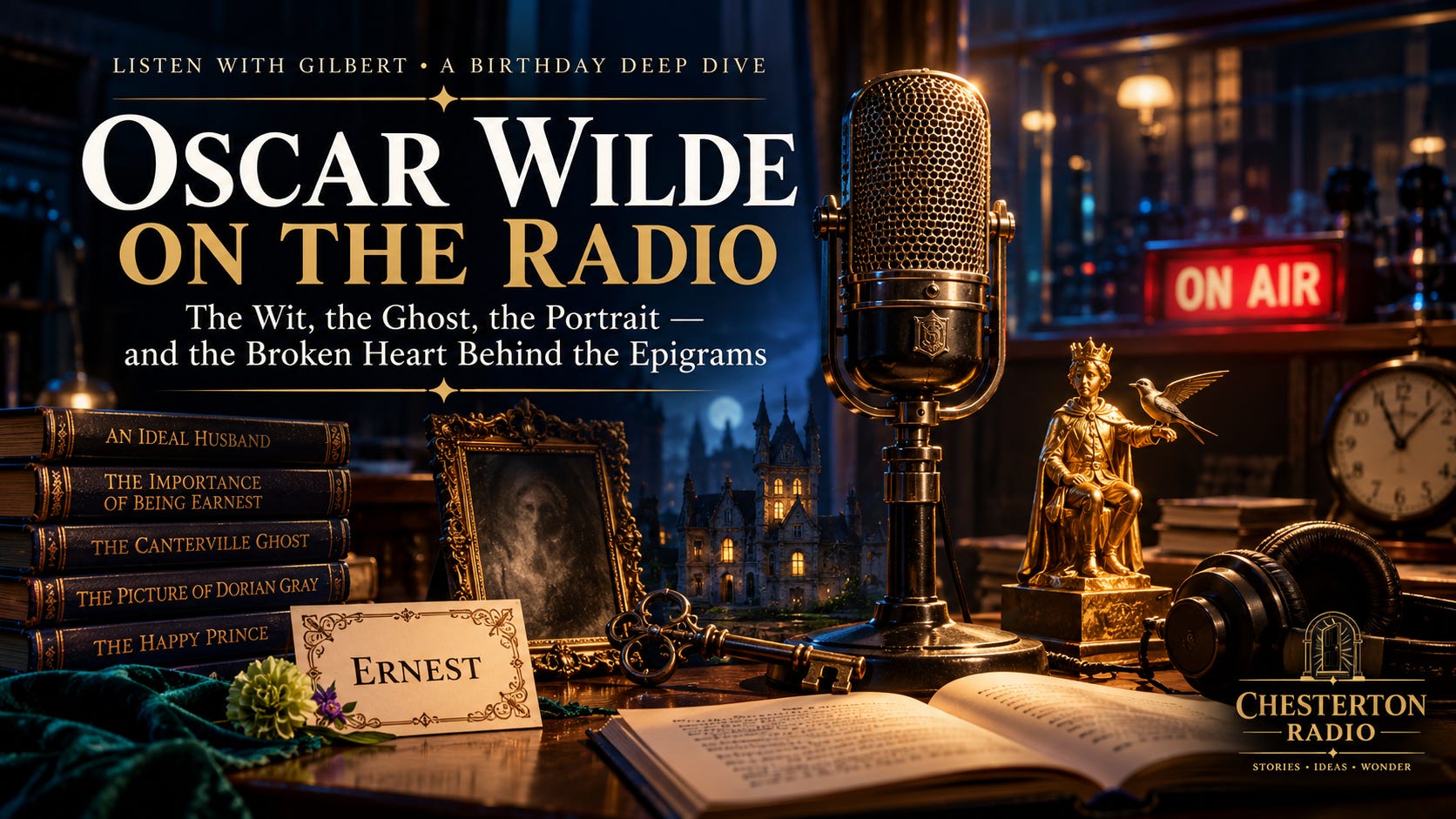
A birthday celebration of Oscar Wilde, born October 16, 1854
There are writers whom radio diminishes.
Oscar Wilde is not one of them.
Take away the scenery, the costumes, the drawing rooms and the theatrical entrances, and something remarkable happens: the words remain.
Perhaps more than remain. They take command.
On radio, Wilde’s paradoxes crack like pistol shots. His conversations become music. The ridiculous seriousness of The Importance of Being Earnest becomes even more ridiculous—and even more serious. The moral machinery inside An Ideal Husband becomes harder to ignore. The Picture of Dorian Gray, deprived of its famous visual premise, becomes a drama of voices, temptation and conscience.
And then there is The Happy Prince.
There the Wilde of the green carnation and the devastating epigram seems almost to disappear, and another Wilde steps forward: the teller of fairy tales about suffering, sacrifice, poverty, mercy and love.
So on Wilde’s birthday, rather than simply remembering the man, let us listen to him.
🎧 I. An Ideal Husband — Saturday Night Theatre
Listen: An Ideal Husband — Oscar Wilde — Saturday Night Theatre
Wilde’s 1895 play begins with one of the great social nightmares: what if the respectable man has something in his past that cannot withstand the light?
Sir Robert Chiltern appears to possess everything Victorian society admires—position, reputation, marriage and moral standing.
But his success rests upon an old act of corruption.
Mrs. Cheveley knows it.
And she intends to use it.
The machinery sounds like melodrama. Wilde makes it something considerably more interesting: a comedy about the dangerous human appetite for perfect people.
That makes An Ideal Husband unusually compatible with radio. The drama does not ultimately depend upon spectacle. It depends upon accusation, evasion, confession and conversation.
And beneath the jokes sits a profoundly serious question:
Can we love another person after discovering that the person is not the ideal we constructed?
Wilde’s answer is considerably more merciful than his reputation for cynicism might lead one to expect.
The BBC repeatedly returned to An Ideal Husband for radio, beginning very early in broadcasting history; numerous radio versions followed across the decades. Wikipedia
🎭 II. The Importance of Being Earnest — Saturday Night Theatre
Listen: The Importance of Being Earnest — Oscar Wilde — Saturday Night Theatre
If An Ideal Husband asks what happens when respectable society discovers a man’s secret, The Importance of Being Earnest asks a more mischievous question:
What if respectable society itself is absurd?
Jack becomes Ernest.
Algernon invents Bunbury.
Gwendolen is determined to marry a man named Ernest.
Cecily has practically conducted an entire romance before her suitor realizes he is participating in it.
And Lady Bracknell presides over the madness with the absolute confidence of someone who believes that she alone is sane.
Radio is almost an ideal medium for Earnest because Wilde built so much of the play from rhythm.
Listen to the pauses.
Listen to the reversals.
Listen to how frequently one character states something perfectly sensible only for another to answer with something logically outrageous—and somehow more memorable.
The BBC recognized the play’s suitability for broadcasting almost from radio’s beginning: an adaptation aired as early as 1925, followed by numerous later productions. Wikipedia
Strip away the Victorian furniture and Earnest still works.
Because the principal special effect is Oscar Wilde’s sentence.
👻 III. The Canterville Ghost — Lux Radio Theatre
Listen: The Canterville Ghost — Margaret O’Brien — Lux Radio Theatre
Now Wilde crosses the Atlantic—or at least his characters do.
An American family acquires an English house.
Unfortunately, the house comes with a ghost.
Unfortunately for the ghost, the Americans aren’t properly impressed.
That reversal is the joke.
Sir Simon has spent centuries cultivating the terrifying traditions of the English haunted house. The Otis family responds to the supernatural with the practical confidence of people who assume every problem can probably be solved with a commercial product.
The ghost is eventually reduced from terrifying the household to being tormented by it.
But Wilde doesn’t leave the story there.
Underneath the Anglo-American comedy is another of his recurring ideas: the apparently ridiculous figure may actually be the suffering figure.
The ghost needs something the practical world cannot provide.
He needs mercy.
And so comedy gradually gives way to tenderness.
That transition—from satire into compassion—is one of the signatures of Wilde’s best work.
🖼️ IV. The Picture of Dorian Gray — Living Fiction
Listen: The Picture of Dorian Gray — Living Fiction
This may present the greatest challenge of the group.
After all, Wilde’s story revolves around a picture.
Radio cannot show us the portrait.
That apparent weakness becomes an advantage.
We must imagine it.
Dorian remains young while the hidden portrait records what he has become. In a visual adaptation, someone eventually has to decide what corruption looks like.
Radio leaves that terrible picture inside the listener’s head.
And there is another reason Dorian Gray belongs in this birthday collection.
The popular caricature of Wilde can make him sound as though he believed that beauty and pleasure were sufficient answers to life.
His novel is considerably more complicated.
Dorian tries something close to that experiment.
It destroys him.
Beauty without goodness cannot save him. Pleasure cannot silence conscience. Concealment cannot abolish reality.
The portrait remembers.
👑 V. The Happy Prince — The Railroad Hour
Listen: The Happy Prince — The Railroad Hour with Gordon MacRae
And now we encounter another Wilde.
High above the city stands the statue of the Happy Prince, covered in gold and decorated with precious stones.
From that height he can finally see what he could not see while living comfortably inside his palace:
suffering.
A swallow becomes his messenger.
One jewel goes.
Then another.
Then the gold.
Piece by piece the beautiful statue becomes outwardly worthless precisely because the Prince has finally discovered what beauty is for.
This is not the Wilde of drawing-room scandal.
It is the Wilde who understands sacrifice.
And perhaps that is why The Happy Prince has endured so powerfully in spoken-word and radio adaptations. Its images are simple enough for a child; its moral implications are not.
📻 VI. The Happy Prince — Orson Welles
Listen: The Happy Prince — Orson Welles Theatre
And here Wilde meets one of radio’s supreme craftsmen.
Orson Welles understood something essential about literary radio: adaptation does not mean merely reading a book into a microphone.
Radio creates space through voices, silence, music, perspective and sound.
Welles had been experimenting aggressively with those possibilities since the Mercury Theatre broadcasts of 1938, using classic literature as raw material for a distinctly radio form of storytelling. Radio Archives
That makes Wilde and Welles an intriguing pairing.
Both were theatrical.
Both understood performance.
Both understood the power of a voice.
And both possessed the dangerous ability to make an audience listen simply because they wanted to hear what the man would say next.
🎙️ VII. The Happy Prince — Lady Esther Presents Mercury Theatre
Listen: The Happy Prince — Lady Esther Presents Mercury Theatre — Orson Welles
This is the fascinating companion piece.
The broadcast aired December 22, 1941, as part of Welles’s Lady Esther program. Contemporary radio documentation dates the episode to that night. Radio Index
And its surrounding program makes the selection particularly interesting for Chesterton Radio.
The broadcast opened with a reading from the Gospel of Luke, moved into Wilde’s The Happy Prince, and included a recitation of G. K. Chesterton. Wellesnet | The Orson Welles Resource
Think about that combination:
Luke. Wilde. Chesterton.
They are not identical voices. Far from it.
But placed together, they illuminate something easily overlooked about Wilde.
Gilbert Listens to Oscar
Chesterton never treated Wilde merely as a dispenser of clever quotations.
That would have been too easy.
The deeper Wilde is full of contradictions: beauty and corruption, laughter and grief, vanity and generosity, pleasure and suffering.
And perhaps nowhere is that clearer than in The Happy Prince.
The world sees a magnificent statue and calls it beautiful.
Then the Prince gives everything away.
The jewels disappear.
The gold disappears.
The swallow dies.
The statue becomes shabby.
The city authorities look at it and conclude that it is no longer useful.
He has become ugly in the eyes of the world precisely because he has become beautiful in the moral sense.
That is almost startlingly Chestertonian.
The apparent loser wins.
The useless thing possesses the greatest value.
The beautiful object must surrender its beauty before anyone discovers what beauty actually means.
And suddenly the Wilde of the drawing room does not seem so far removed from the Wilde who would later write from prison.
The Wilde We Hear
Listening to these seven productions together produces a Wilde considerably larger than the familiar caricature.
There is the satirist in The Importance of Being Earnest.
There is the moral psychologist in An Ideal Husband.
There is the comic storyteller in The Canterville Ghost.
There is the anatomist of temptation in The Picture of Dorian Gray.
And there is the teller of stories about sacrificial love in The Happy Prince.
Perhaps that is why radio has served Wilde so well for a century.
Radio removes almost everything except the things Wilde understood best:
a voice,
a listener,
a story,
and words.
On October 16, 1854, Oscar Fingal O’Flahertie Wills Wilde was born in Dublin.
One hundred and seventy-two years later, the voice is still traveling.
The radio is on.
Come through the Open Door and listen.
An Ideal Husband - Oscar Wilde - Saturday Night Theatre
The Canterville Ghost - Margaret O’Brien - Oscar Wilde - Lux Radio Theater
The Importance of Being Earnest | Oscar Wilde | Saturday Night Theatre
The Picture of Dorian Gray - Living Fiction - Oscar Wilde
The Happy Prince - Railroad Hour - Gordon MacRae - Oscar Wilde
The Happy Prince - Orson Welles Theater - Christmas 1941
The Happy Prince | Lady Esther Presents Mercury Theatre | Orson Welles