

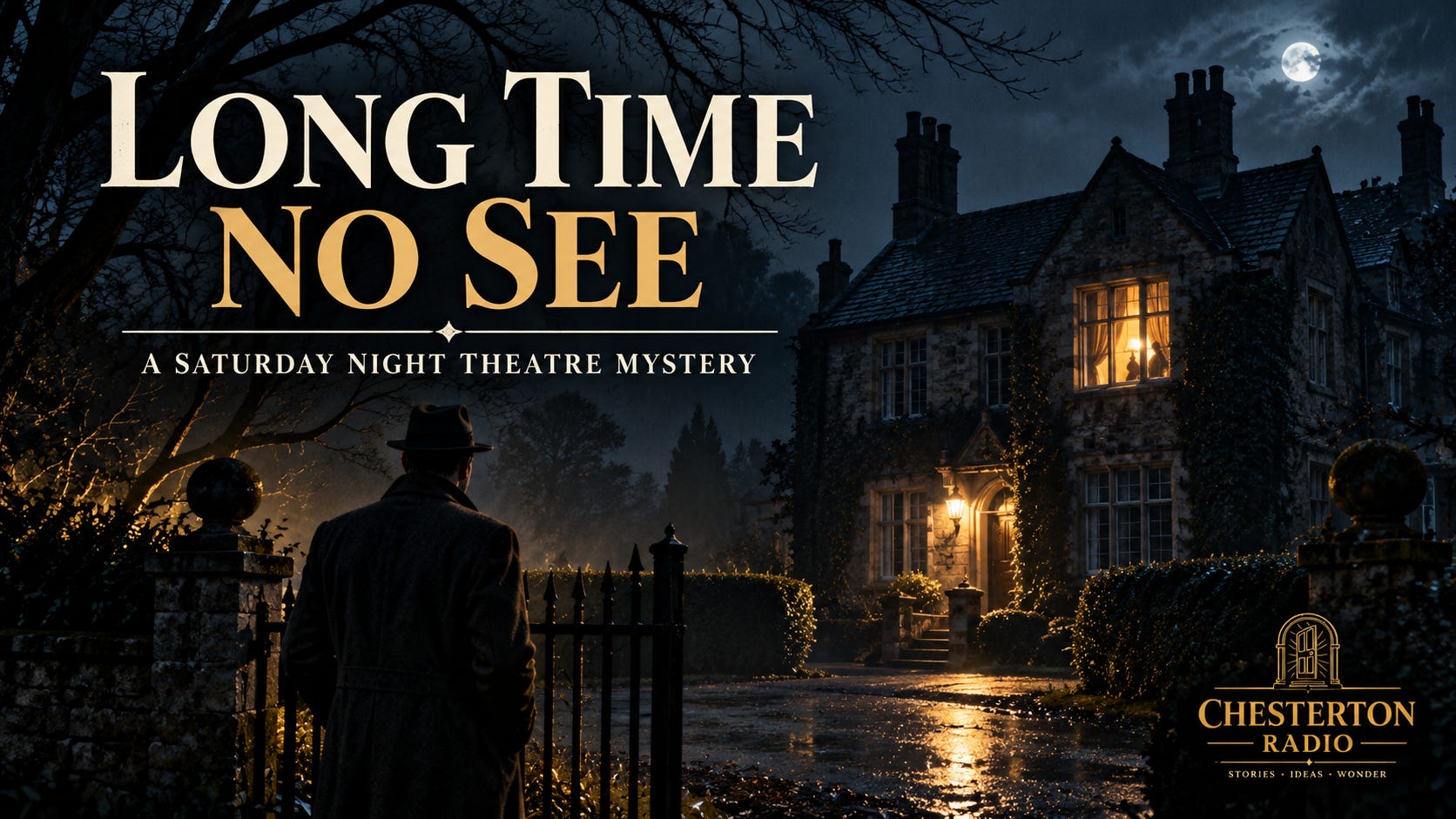
More than forty years later, listeners are still trying to solve it.
The Man Who Wasn’t Supposed to Be There
A writer is murdered in his own house.
That is mystery enough. But Inspector Burgess has a more interesting problem before he has even begun asking questions.
Alan Bell was not supposed to be home.
His wife, Harriet, had gone to Paris. Everyone had reason to believe Bell had gone with her. Instead, he remained behind, and sometime during her absence someone came to the house and killed him.
There is no obvious sign that the visitor forced his way inside. Several people may have had reason to see Bell. Several had reasons to dislike him. But very few people should have known that he was there at all.
And then there is the phrase.
Bell apparently greeted his visitor with the words:
“Long time no see.”
It sounds harmless. Almost cheerful.
But Harriet tells Inspector Burgess something that changes its meaning. Her husband had a particular habit of using that breezy greeting when confronted with someone he did not especially want to see.
The title of Joan Sadler’s play has just become a clue.
That is the beginning of Long Time No See, broadcast on BBC Radio 4’s Saturday Night Theatre at 8:30 on the evening of 15 May 1982. The surviving listing credits Sadler as writer and Margaret Etall as director, with Michael McStay as Inspector Burgess. Sutton Elms
It is an old radio murder mystery from a writer whose name is now difficult to find outside broadcasting archives.
And people keep listening to it.
The Chesterton Radio presentation has attracted roughly half a million views on YouTube. That may be the more intriguing mystery surrounding Long Time No See. Why, in 2026, are so many people voluntarily giving nearly an hour and a half to a BBC radio play first heard more than forty years ago?
Perhaps the answer begins with what Joan Sadler asks us to do.
She asks us to listen.
A Mystery Made Almost Entirely of Attention
There is nothing flashy about Inspector Burgess.
Michael McStay does not play him as a theatrical genius announcing deductions to a room full of astonished suspects. Burgess has none of Poirot’s magnificent vanity, none of Sherlock Holmes’s impatience with ordinary minds.
He asks questions.
He listens to answers.
Then he asks another question.
That understatement is one of the pleasures of the play. Burgess is interesting because he does not insist on being interesting. He gives the other characters room to talk, and Sadler understands that in a radio mystery, talking is not what happens between the action.
Talking is the action.
The confirmed cast gives him plenty of people to listen to. Jean Trend plays Harriet Bell; Steve Hodson is Alan Bell; Ronald Herdman and Sheila Reid play Ernest and Dora Pollak; Philip Voss is Colonel Charles Fergusson; Michael Miller and Lisa Daniely are Commander Henry and Hilda Morgan; Hugh Dickson and Elaine Mitchell play Donald and Elaine Stoner. Miranda Forbes appears as Beaty Fuller, and Alex Jennings as a police sergeant. Amazon Music
Sadler gradually moves Burgess among them.
Each conversation alters the case a little.
Someone knew Bell.
Someone disliked him.
Someone has not told Burgess everything.
And because we cannot see anyone, we listen differently.
A hesitation matters. So does a casual answer. A detail that would disappear into the scenery on television has nowhere to hide on radio. The listener begins performing a second investigation alongside Burgess: not merely what did this person say? but why did Sadler have this person say it now?
The title itself teaches us how to listen.
“Long time no see” is ordinary language. Sadler makes it evidence.
The Theatre We Built Ourselves
One of radio drama’s peculiar tricks is that it can leave you with memories of things you never saw.
Listen to enough Saturday Night Theatre and you may remember the houses.
The rooms.
The roads.
The faces.
None of them existed before a camera. Some never existed anywhere except in a studio and, finally, in the listener’s imagination.
That is not a deficiency radio must overcome. It is the medium’s great bargain with its audience.
A film director chooses the room for you. The camera determines where you stand in it. Casting supplies the face. Lighting tells you where to look.
Radio provides voices, words, sound and silence. The rest of the production takes place somewhere behind your eyes.
Long Time No See benefits enormously from that arrangement because its mystery depends less on spectacle than on relationships. We construct Bell’s world from what other people say about him. The dead man becomes increasingly present as the investigation proceeds.
And the portrait is not especially flattering.
People have histories with Alan Bell. Resentments emerge. Old relationships acquire new significance. Apparently straightforward accounts develop inconvenient edges.
We begin with the question Who killed him?
Sadler gradually introduces another:
Who was he, really?
That is a better mystery.
Inspector Burgess Had Been Here Before
There is another reason Michael McStay’s performance feels settled.
This was not his first appearance as Inspector Burgess.
Three years earlier, on 15 September 1979, BBC Radio 4 broadcast another Joan Sadler mystery, Death on a Fourth Wednesday, also as Saturday Night Theatre. Margaret Etall directed that production too, and Michael McStay again played Inspector Burgess. Sutton Elms
That small piece of broadcasting history changes our understanding of Long Time No See.
This was not simply a writer inventing a detective for one Saturday evening. Sadler had returned to a character and to the actor who had played him before.
There was, however modestly, a Burgess series.
It is precisely the sort of thing that disappears easily from cultural memory. Hercule Poirot survives because the novels remain continuously in print, the character has been adapted repeatedly, and each generation receives another Poirot.
Inspector Burgess survives more precariously.
He survives because recordings survive.
That leads us to Joan Sadler herself.
The Curious Disappearance of Joan Sadler
The play is easy to hear.
Its author is considerably harder to find.
Reliable biographical information about Joan Sadler is surprisingly thin. The surviving radio record establishes her work more readily than it establishes her life.
We know, for example, that Death on a Fourth Wednesday was broadcast in 1979, directed by Margaret Etall with McStay as Burgess. A recording-recovery catalogue also documents that production. Sutton Elms
Then in 1982 came Long Time No See, again pairing Sadler, Etall and McStay. Sutton Elms
Beyond such programme records, the trail becomes much thinner.
That scarcity is worth noticing rather than filling with speculation.
Radio depended on working writers whose names once appeared routinely in the listings. They wrote plays, met deadlines, worked with producers, actors and directors, and supplied the BBC with an enormous quantity of original drama. Their work could enter millions of homes on the evening of transmission.
Then Saturday ended.
Another programme appeared the following week.
Decades later, a famous novelist remains famous. A working radio dramatist can become little more than a name attached to a recording.
Except that the recording can begin circulating again.
Suddenly Joan Sadler has an audience she could not possibly have anticipated: people listening on phones, laptops, smart televisions and headphones in countries far removed from the original BBC Radio 4 signal.
The writer has nearly disappeared.
The story has not.
When Saturday Night Meant Something Particular
The original broadcast time matters.
8:30 p.m.
Saturday.
Not “whenever you get around to it.”
The BBC schedule for 15 May 1982 shows the rhythm of the day: news, Any Questions?, Desert Island Discs, Stop the Week, other familiar Radio 4 programmes—and at 8:30, Saturday-Night Theatre: Long Time No See. Weather followed at 9:58. tvrdb.com
The play occupied the evening.
That idea now seems almost exotic.
We have gained something wonderful in on-demand media. A listener in Kansas can hear a British radio play from 1982 at noon on a Tuesday. Someone can discover Joan Sadler forty-four years after the original broadcast. An audience no longer needs to live within reach of the transmitter or arrange Saturday evening around the schedule.
But appointment listening had a quality of its own.
The schedule made a small declaration:
This is tonight’s play.
You could listen or not. But there was no catalogue of ten thousand competing choices sitting beneath it. If you chose the play, you entered that particular story and remained there.
Long Time No See was built for that kind of attention.
Curiously, its modern success suggests that the appetite for such attention never entirely disappeared.
People will still listen to a long drama.
They will still follow a patient investigation.
They will still remember characters introduced only by voice.
They will still wait for the solution.
The medium did not lose all its power when the appointment disappeared.
The Art of Giving Everyone a Reason
Sadler’s construction is traditional in the best sense.
The victim has not moved through life without leaving damage behind him.
As Burgess investigates, plausible lines of suspicion multiply. Ernest Pollak, the gardener, has a troubled history and a connection to a possible weapon. Donald Stoner has an old relationship with Bell and reasons for resentment. Colonel Fergusson and Commander Morgan occupy another part of Bell’s social world, and their own circumstances begin to complicate the investigation.
Sadler does not need to turn them into grotesques.
What matters is that each possibility is plausible long enough to command our attention.
This is one of the satisfactions of the traditional whodunit. The writer and listener enter into a quiet agreement. The writer will distribute information. The listener will attempt to decide which information matters.
A weak mystery simply hides the answer.
A good one makes us look directly at useful information while thinking about something else.
Long Time No See repeatedly plays that game.
And its most elegant example is sitting in the title.
We hear the phrase.
We understand the phrase.
Only gradually do we understand what it means.
Why Burgess Works
There is an additional pleasure in watching—or rather hearing—a competent person do his job.
Burgess does not require a tortured personal history to make the investigation interesting. We do not need scenes from his marriage, a feud with his superior, or a private demon that mirrors the crime.
Sadler gives him a case.
McStay gives him patience.
That is enough.
Burgess’s restraint also gives the suspects room to become the dramatic center of the play. He is the fixed point against which their accounts can be measured.
And because he is not constantly telling us how clever he is, the listener is allowed a little dignity too.
We can notice things.
We can change our minds.
We can suspect the wrong person.
We can hear Burgess ask a question and suddenly understand why he has asked it.
For a mystery listener, there are few pleasures better than realizing the detective has just noticed something you noticed too.
Unless, of course, he noticed it twenty minutes ago.
⚠️ SPOILER WARNING
If you have not heard Long Time No See, this is where I would stop.
The mystery is much more enjoyable when Burgess and the listener reach the truth together. Hear the complete production first, decide whom you suspect, and then return.
What follows discusses the murderer, motive and solution.
The Five Words That Matter
The killer is Colonel Charles Fergusson.
Once that is known, the title becomes more satisfying, not less.
“Long time no see” was never merely a memorable phrase chosen to give the play a slightly mysterious name. It belongs to the machinery of the mystery.
Alan Bell knew the person at his door.
But recognition alone does not solve the case. Many people knew Bell.
Harriet’s explanation of the phrase narrows its emotional meaning. Bell’s greeting indicates not simply familiarity but an unwelcome familiarity. The murderer belongs to a particular category: someone known to Bell, yet not happily received.
That is an elegant radio clue because it consists entirely of language.
There is no cigarette ash that must be photographed in close-up. No footprint that the audience can barely see. No object planted conspicuously on a mantelpiece.
We hear the clue.
The difficulty is understanding what we have heard.
The investigation eventually connects Fergusson to the crime through the movements surrounding the murder and through the history Burgess uncovers. The solution also reaches backward into Bell’s past. His death cannot be understood solely by reconstructing one evening; Burgess must discover the older events and relationships that made that evening possible.
That gives the mystery a satisfying shape.
The past is not background.
It is motive.
The Value of the Wrong Suspect
On a first listening, Ernest Pollak draws attention for obvious reasons.
There is history surrounding him, a pruning knife enters the investigation, and his behavior gives Burgess reasons to continue asking questions.
Yet Ernest’s importance to the drama extends beyond his usefulness as a red herring.
Once the solution is known, his story becomes more painful.
The murderer benefits from suspicion moving elsewhere. Ernest’s own fear and history make that easier. Information that appears to point toward guilt can instead reveal vulnerability.
This is where a second listening becomes particularly rewarding.
The first time through, we classify information:
clue, motive, alibi, suspect.
The second time, we already know the answer, so our attention moves from what happened? to how did Sadler persuade me to think otherwise?
Fergusson sounds different.
Ernest sounds different.
Burgess’s questions sound different.
Even Bell’s casual greeting sounds different.
Nothing in the recording has changed.
The listener has.
That is one of the surest signs that a mystery has been constructed with care.
Does Sadler Play Fair?
Broadly, yes.
The pleasure of the solution is not that Burgess suddenly announces some decisive fact that could never have occurred to us.
Sadler gives the listener meaningful information: Bell was unexpectedly at home; his killer appears to have been someone he knew; several people have concealed or complicated their movements; Bell’s past matters; and his peculiar use of “long time no see” changes the significance of his final encounter.
The solution requires Burgess to investigate information beyond what the listener can independently verify, as police mysteries generally do. But the identity of the murderer grows out of the relationships and clues the drama has been developing rather than being imported from nowhere at the finish.
More importantly, the ending makes earlier scenes more intelligible.
That may be a better test of a mystery than whether an unusually clever listener can name the murderer at minute forty-seven.
After the revelation, do the earlier pieces fit more tightly?
Here, they do.
The ending sends us backward through the play.
And that is why Long Time No See is worth hearing twice.
The Strange Second Life of an Old Radio Play
None of this explains the half-million listeners completely.
Plenty of competent mysteries have disappeared.
Why does this one keep finding people?
Perhaps part of the answer is precisely that Long Time No See does not announce itself as an important work.
It is a Saturday-night murder mystery.
It has a good premise.
It has a detective worth spending time with.
It gives several people credible reasons to lie.
It provides clues.
It resolves the case.
Then it ends.
There is something refreshing about craftsmanship that does not continually call attention to itself.
And there is another factor.
Old radio no longer arrives as old radio once did.
A listener finding Long Time No See online is not necessarily approaching it as an exercise in nostalgia. Many were not listening to BBC Radio 4 in 1982. Some were not alive.
To them, this is not a memory.
It is a new mystery.
That distinction matters.
We sometimes speak about preserving old broadcasts as though their highest purpose were archival: save them because they are historical artifacts.
Certainly they are.
But a drama can be preserved perfectly and never truly live again.
The more interesting moment occurs when somebody presses play.
Then the archive stops being an archive.
Alan Bell is alive again, at least for a little while.
Harriet leaves for Paris.
Burgess begins asking questions.
Someone arrives at the house.
And a listener who knows nothing about 1982 wants to know who did it.
Rediscovering Saturday Night Theatre One Play at a Time
Long Time No See is not an isolated case.
When Chesterton Radio recently looked at The 30 Most-Listened-To Saturday Night Theatre Plays, the numbers revealed a substantial audience for these productions. Plays that disappeared from the weekly schedule decades ago are accumulating tens or hundreds of thousands of listens in their digital afterlife.
That response suggests a different way of thinking about the archive.
A list of recordings is useful.
But every recording contains another story around the story.
Who wrote it?
Who performed it?
Where did it sit in the broadcasting culture of its time?
Why does one play disappear while another attracts hundreds of thousands of new listeners?
What does a production sound like when heard forty years later?
And, most importantly, is it still good?
Those are questions worth pursuing one play at a time.
There are hundreds of Saturday Night Theatre productions waiting for that treatment. Famous writers sit beside names almost completely forgotten. Adaptations share the shelf with original mysteries. Actors who later became familiar faces appear as nothing more than voices.
Each recording opens another door.
Joan Sadler’s work makes a particularly good place to begin because the contrast is so striking.
Her biography is elusive.
Her play is not.
Michael McStay’s Inspector Burgess can still walk into the case whenever we press the button.
That is an extraordinary kind of survival.
The Return of Appointment Listening
There is one final irony in all this.
The technology that destroyed the necessity of appointment listening may now be making a voluntary form of it possible again.
Nobody has to hear Long Time No See at 8:30 on Saturday evening.
You can stop it.
Skip ahead.
Listen at twice the speed.
Answer an email halfway through.
But you can also choose not to.
You can put the phone down.
Turn off the other screen.
Give the play its eighty-odd minutes.
And for that time, recreate something of the original bargain between broadcaster and listener:
Here is tonight’s play.
Listen.
That may be part of what people are rediscovering in old radio drama. Not merely old voices or old production styles, but a different relationship with a story.
The play asks for attention.
In return, it gives the imagination something to do.
That exchange still works.
If you’d like us to keep rediscovering Saturday Night Theatre one play at a time, consider becoming a paid subscriber. Your support makes these long-form articles, Companion programs, and new Chesterton Radio productions possible.
Long Time No See
Return, finally, to the house.
Alan Bell is home when he is not supposed to be.
Someone knows.
The visitor arrives.
Bell recognizes the person standing at the door and reaches for the sort of breezy phrase people use when they want an encounter to seem easier than it is.
Long time no see.
Five ordinary words.
Joan Sadler turns them into a clue, a title, and the hinge of a murder mystery.
On 15 May 1982, listeners heard those words as part of their Saturday evening. The play ended before ten. The weather followed at 9:58, then the news at ten, and Radio 4 moved on with its schedule. tvrdb.com
That should have been the natural life of a radio play: ninety minutes in the air, perhaps a repeat, and eventually a place in the archive.
Instead, four decades later, people are still arriving at the house.
They come through YouTube instead of the wireless. They listen in places the original broadcast never reached. Many know nothing about Joan Sadler when they press play.
It does not matter.
A writer is dead.
He was not supposed to be home.
Someone came to see him.
Inspector Burgess begins asking questions.
And somewhere, another listener leans a little closer.
Long time no see.