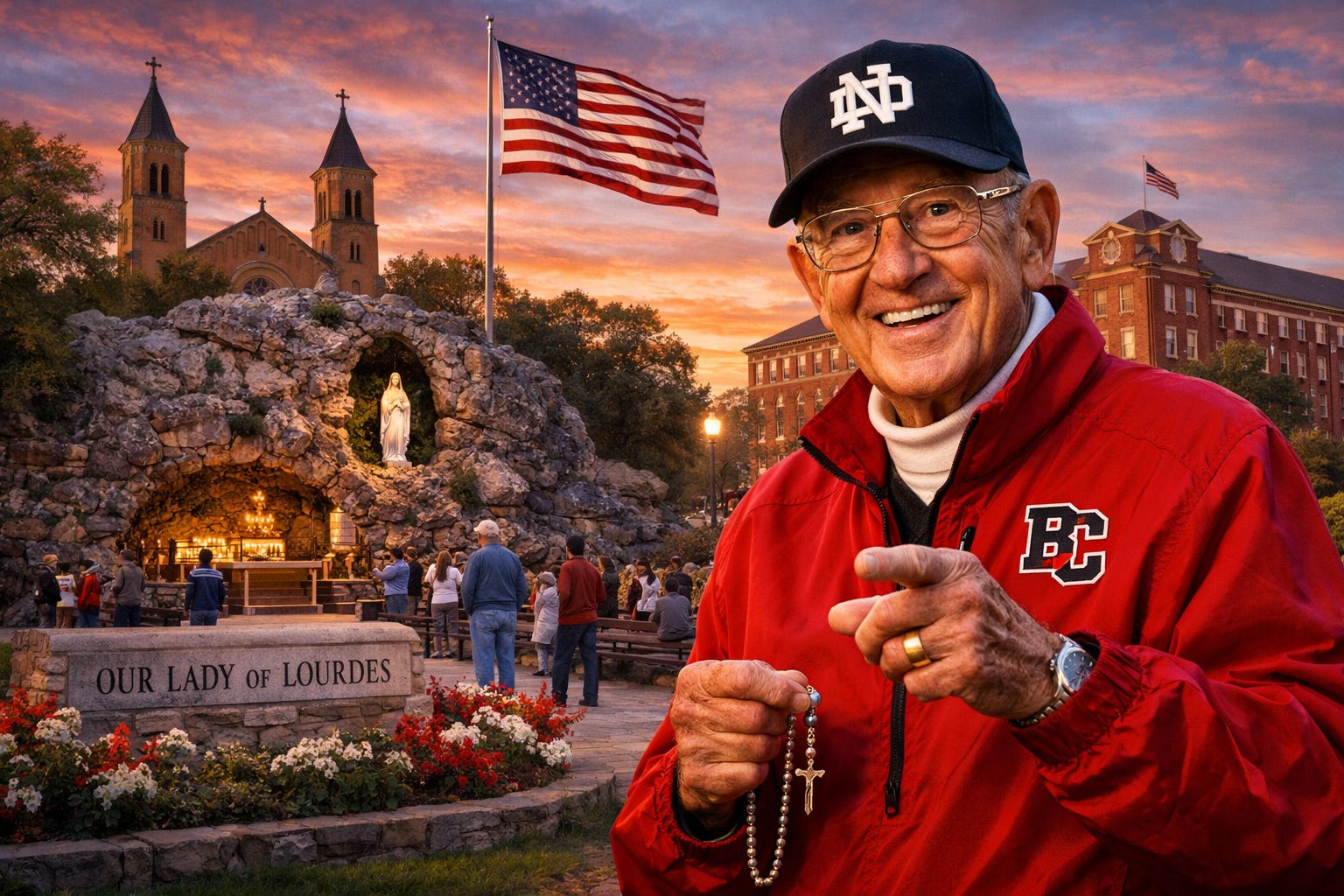
There are public figures who drift with the cultural tide, and there are those who plant their feet and accept the weather that follows. Lou Holtz has always seemed to belong to the second category.
Best known nationally as a championship football coach — especially for his years at the University of Notre Dame — Holtz built a reputation on discipline, faith, and unapologetic moral clarity. Those traits won him admiration on the field and, later, controversy off of it.
When Politics and Alma Mater Collided
In 2016, Holtz stepped into the political spotlight when he publicly supported Donald Trump during the presidential campaign. After a high-profile speech that aligned him with Trump’s candidacy, Notre Dame moved quickly to clarify that Holtz’s political views were his own and did not represent the university.
The moment was striking not because universities and alumni never disagree — they often do — but because Holtz was not just any alumnus or former employee. He was a defining figure in modern Notre Dame football history. Yet in a climate where political lines had grown sharper, even legendary status offered no insulation from institutional distancing.
Holtz, for his part, did not retreat. Agree with him or not, he demonstrated a pattern that has marked much of his life: he says what he believes, then lives with the consequences.
A Different Welcome in Atchison

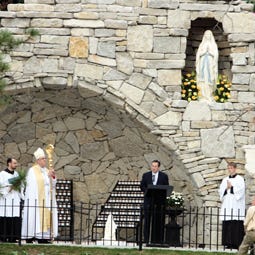
While some doors narrowed elsewhere, others opened wide — notably at Benedictine College in Atchison, Kansas.
Benedictine has hosted Holtz multiple times as a speaker, where his talks typically center on faith, character, leadership, and the responsibilities of public life. On a campus that emphasizes Catholic identity and moral formation alongside academics, his message has found a receptive audience.
Holtz’s connection to Benedictine is not merely that of a visiting celebrity. He has been closely associated with the college’s efforts to strengthen visible expressions of faith on campus — most notably the Our Lady of Lourdes Grotto at Benedictine College. He has been widely credited as a strong supporter and advocate for the project, helping champion a space designed for prayer, reflection, and Marian devotion.
The grotto itself, modeled after the shrine at Lourdes in France, has become one of the spiritual hearts of the campus — a place where students light candles, pray rosaries, and pause between classes to remember that education, in Benedictine’s vision, is not only about the mind but also about the soul.
More Than a Coaching Legacy
Holtz’s life story is often told through wins and losses, locker rooms and pep talks. But his later years have revealed another dimension: a willingness to speak publicly about faith and civic responsibility, even when that stance complicates his legacy in certain circles.
At Benedictine College, that willingness is seen less as a liability and more as a witness — the example of a public figure who treats belief not as a private hobby but as a guiding principle.
Whether one cheers or groans at his political choices, Holtz’s relationship with Benedictine highlights something increasingly rare: institutions and individuals choosing one another not for perfect agreement on every issue, but for shared convictions about faith, character, and the moral formation of young people.
In an age that often rewards careful neutrality, Lou Holtz remains unmistakably himself — and in Atchison, Kansas, that has made him not an exile, but a welcome voice.