

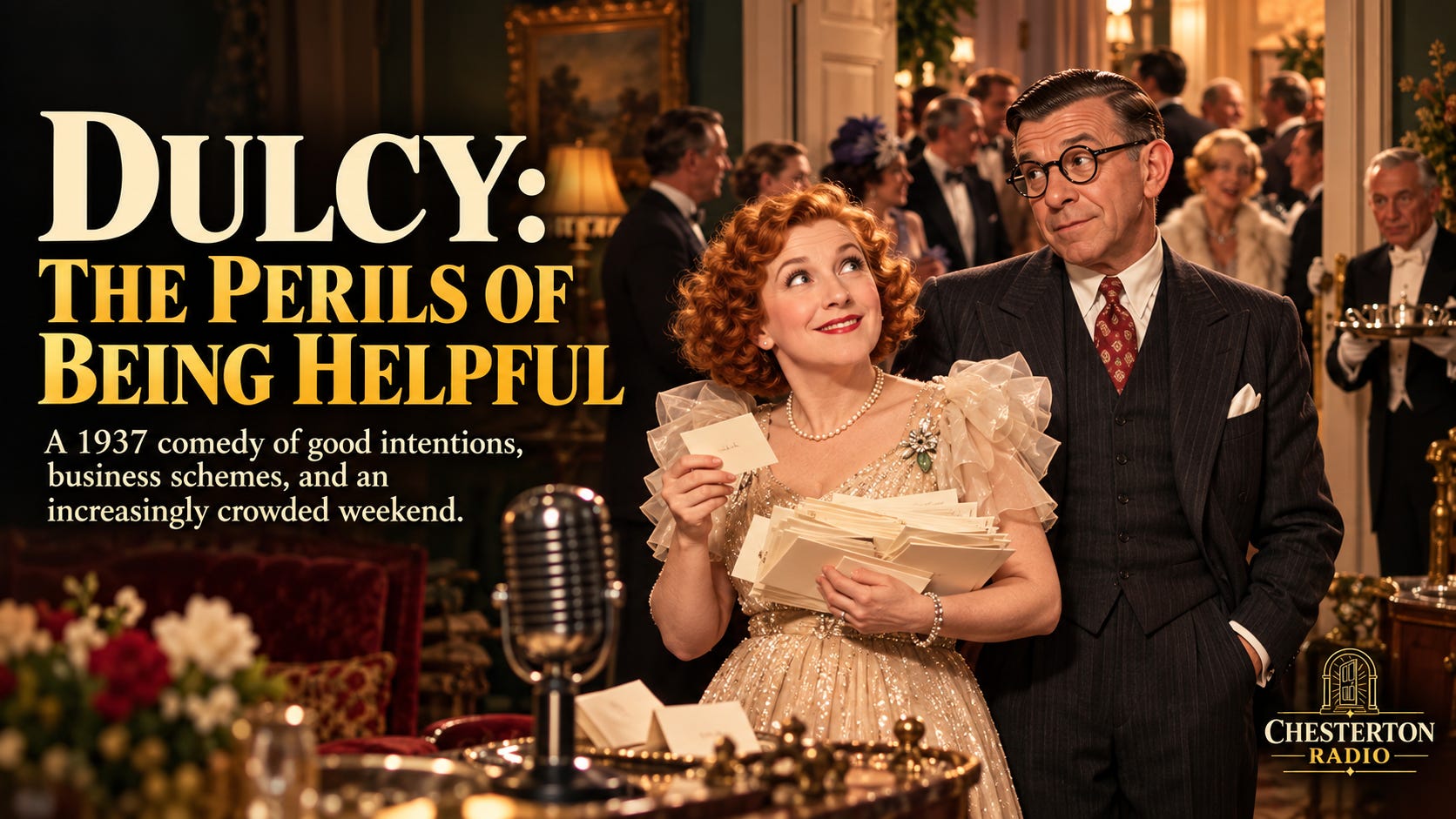
The Chesterton Radio Listening Guide: a 1937 comedy of good intentions, business schemes, and an increasingly crowded weekend.
Radio reviews in the spirit of G.K. Chesterton—warm, witty reflections on classic broadcasts and the human nature behind them.
LISTEN TO THE BROADCAST
Lux Radio Theatre — “Dulcy,” March 29, 1937, starring George Burns and Gracie Allen:
A party is an arrangement that believes it has invited people. Dulcy’s party discovers it has invited consequences.
Dulcinea “Dulcy” Smith means to help her husband, Gordon, improve his business prospects. A weekend gathering with an important associate seems just the thing. Then the guest list grows, a business merger becomes entangled with romance, a young couple plans to elope, and Dulcy hires a butler with a rather unusual past.
She is trying to bring everything together. The trouble is that everything has its own idea of where it belongs.
That is the cheerful paradox at the heart of this Lux Radio Theatre comedy: Dulcy’s intentions are better than her methods. She is not scheming for herself. She simply believes that a little more hospitality, a little matchmaking, and a little encouragement can improve any situation. The situations, being situations, decline to cooperate.
GRACIE ALLEN AND GEORGE BURNS
The Burns and Allen partnership is made for this kind of comedy. Gracie’s Dulcy pursues each new idea with such sincere confidence that the audience can see the disaster approaching before she can. George’s Gordon supplies the steadier voice, though his composure has to withstand a weekend in which every effort to protect the business deal seems to invite a new complication.
The humor is not merely that Dulcy misunderstands people. It is that she understands them generously, then acts on that understanding without checking the details. Her faith in people is admirable; her faith in her own plans is what makes it funny.
That distinction keeps the play affectionate. Dulcy can be exasperating, but she is never mean. The comedy lets us laugh at the confusion without making kindness itself the joke. In her world, good intentions may not prevent trouble, but they do make the trouble worth forgiving.
A VERY FULL WEEKEND
Kaufman and Connelly’s stage comedy gives the radio adaptation plenty to keep in motion: business negotiations, social maneuvering, a possible elopement, a suspiciously reassuring butler, and the arrival of a wealthy guest whose identity adds still another turn. At times the plot is so busy that it resembles the party Dulcy has planned: everyone has been invited, and no one is quite sure what happens next.
That crowded quality is also part of the pleasure. Farce depends on complications multiplying faster than anyone can tidy them away. The listener’s job is to keep the people and their plans straight while Dulcy cheerfully makes that job harder.
The broadcast has its own period charm beyond the play. Cecil B. DeMille introduces the production, and the intermission brings in Hollywood columnist Hedda Hopper and celebrated hostess Elsa Maxwell, who offers advice on giving a party. Maxwell is an especially apt guest. Even outside the story, the program finds another way to ask whether a successful party depends on careful planning—or on accepting that people will do what people do.
WHY THIS BROADCAST IS WORTH HEARING
This is a fine example of radio comedy built around character rather than noise. The words carry the action: who has been invited, what Dulcy has promised, and which secret is no longer secret. Burns and Allen give the confusion a familiar human center, while the Lux presentation turns the play into a full evening with a host, guests, and a proper send-off.
There is a modest wisdom inside the nonsense. Dulcy’s methods are unreliable, but her impulse is sound: she wants people to be happier and more successful. The joke is that she tries to arrange happiness as if it were a guest list. Still, the story is kinder than its heroine’s judgment. By the end, her meddling has made a muddle of the weekend, but her concern for the people around her has not been misplaced.
VERDICT
“Dulcy” is a lively, good-hearted comedy for listeners who enjoy Gracie Allen’s wonderfully confident logic and George Burns’s patient reactions. Its plot is crowded, its heroine is incorrigible, and its central problem is as old as company visiting: the host wants everyone to have a good time, and everyone keeps being a person.
Give Dulcy an evening and she will make a party of it. She may even improve the business deal. But first, she will have to make it worse.
FROM THE ARCHIVE
Series: Lux Radio Theatre
Broadcast: March 29, 1937
Stars: George Burns and Gracie Allen
Host: Cecil B. DeMille
Intermission guests: Hedda Hopper and Elsa Maxwell
Playwrights: George S. Kaufman and Marc Connelly
Radio adaptor: George Wells
The RadioGold catalog lists a complete KNX Los Angeles aircheck, running 60:40.
Catalog record: https://radiogoldin.library.umkc.edu/ProgramMoreinfo/40119