

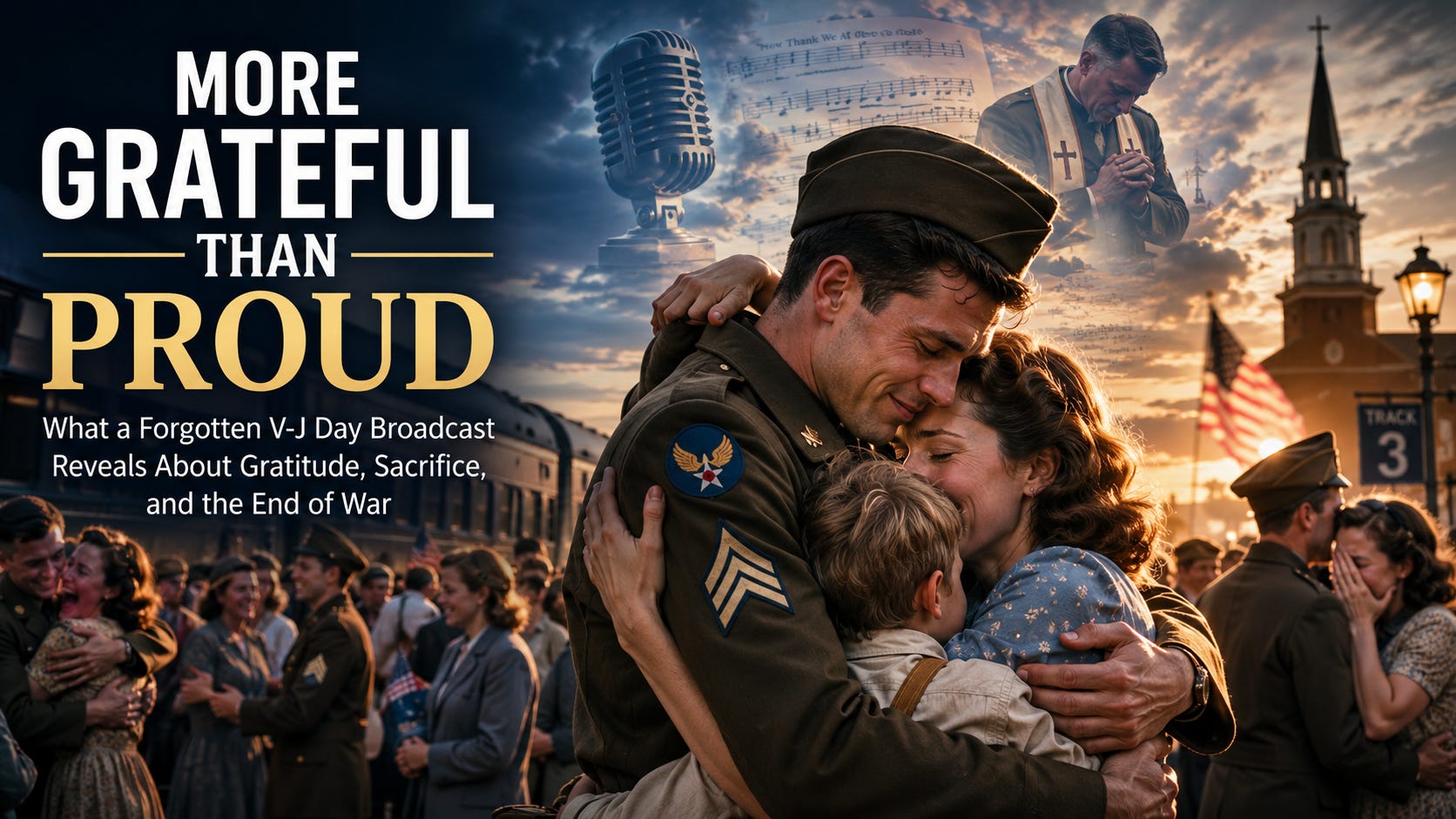
On September 2, 1945, the war was over.
For nearly four years, the world had been consumed by violence on a scale previously unimaginable. Cities had been reduced to rubble. Entire nations had been occupied. Tens of millions of people had been killed. Families had been scattered across continents. Young men who had once worried about school examinations, baseball games, first jobs, and courtships had found themselves crossing oceans, storming beaches, sleeping in foxholes, and confronting death on a daily basis.
Then, almost suddenly, it ended.
The surrender documents had been signed aboard the USS Missouri in Tokyo Bay. The guns that had thundered across Europe and the Pacific fell silent. The long casualty lists ceased. The telegrams dreaded by parents and spouses stopped arriving. For the first time in years, people could begin to imagine a future that was not defined by war.
One might expect that a nation emerging from such a struggle would celebrate with unrestrained triumph.
One might expect boasting.
One might expect self-congratulation.
One might expect victory speeches filled with declarations of national greatness and military superiority.
Instead, something rather different occurred.
That evening, the Armed Forces Radio Service assembled one of the most remarkable broadcasts in radio history. It featured President Harry Truman. It featured Bing Crosby, Bob Hope, Frank Sinatra, Orson Welles, military chaplains, combat veterans, musicians, and entertainers whose voices had accompanied millions of Americans through the difficult years of the war. The program reached servicemen and women around the globe while also being carried by major networks throughout the United States. It was designed to commemorate total victory.
Yet listening to it today, one is struck not by celebration but by humility.
Again and again, the participants return to themes that feel almost foreign to modern ears.
Gratitude.
Prayer.
Sacrifice.
Home.
Peace.
Responsibility.
The obligations owed to the dead.
The responsibilities owed to future generations.
The broadcast begins not with fanfare but with an invocation. Brigadier General Luther D. Miller, Chief of Chaplains of the United States Army, addresses God directly. He offers thanks for victory but immediately turns his attention to the wounded, the grieving, the oppressed, and those who have suffered through years of conflict. Victory is acknowledged, but triumph is tempered by compassion. Even in the moment of success, the focus remains on those who paid the price.
It is a striking contrast to many modern commemorations.
Today we often divide public memory into two categories. On one side stands triumphalism—the tendency to celebrate victory while minimizing its costs. On the other stands cynicism—the tendency to dismiss heroism altogether and reduce great historical struggles to exercises in power and politics.
The V-J Day broadcast belongs to neither category.
It occupies a third position that has become increasingly rare.
It is grateful.
Not proud.
That distinction may seem subtle.
It is not.
Pride directs attention toward the self.
Gratitude directs attention outward.
Pride asks what we have achieved.
Gratitude asks what we have received.
Pride congratulates.
Gratitude remembers.
Pride celebrates victory.
Gratitude remembers sacrifice.
The difference between the two attitudes runs throughout the entire program.
Perhaps nowhere is it expressed more powerfully than in a passage attributed to Ernie Pyle and read during the broadcast by Bob Hope. Pyle had become the most beloved war correspondent of the conflict because he understood that the war was not primarily a story about generals, politicians, or grand strategy. It was a story about ordinary men. He wrote about infantrymen sleeping in mud, mechanics repairing equipment under fire, and exhausted soldiers carrying burdens that most civilians could scarcely imagine.
His words on the day of victory remain extraordinary.
Reflecting on the end of the war, he observed that victory had come through courage, sacrifice, allies, resources, and countless circumstances beyond the control of any single nation. Then came the line that serves as the moral center of the entire broadcast:
“I hope that in victory we are more grateful than we are proud.”
It is difficult to imagine a more appropriate sentence for the moment.
Or for our own time.
Because gratitude requires memory.
And memory requires honesty.
To be grateful for victory, one must first remember what victory cost.
One must remember the dead.
One must remember the wounded.
One must remember the families who waited.
One must remember the years of uncertainty, fear, and separation.
The participants in the V-J Day broadcast remembered all of it.
Indeed, one of the most moving aspects of the program is how often the speakers return to the subject of home.
Again and again, listeners are reminded that families are being reunited. Husbands and wives are seeing one another after years apart. Parents are embracing sons they feared they might never see again. Brothers are returning home. Entire households are being restored after long periods of absence and anxiety.
This focus on home is no accident.
For all the military victories, strategic decisions, and historic ceremonies that marked the end of the war, the ultimate goal had never been conquest.
The goal was peace.
The goal was home.
The goal was ordinary life.
That truth is often forgotten when history is reduced to battles and treaties.
The men fighting in Europe and the Pacific were not dreaming of military glory.
Most were dreaming of home.
Of front porches.
Of kitchens.
Of wives.
Of children.
Of parents.
Of ordinary mornings.
Of quiet evenings.
Of the simple privilege of living without fear.
The V-J Day broadcast understands this instinctively.
Its emotional center is not victory.
Its emotional center is reunion.
And perhaps that is why the program still resonates eighty years later.
It understands something profound about human nature.
The deepest aspirations of most people are not imperial.
They are domestic.
The things people are ultimately willing to fight for are often remarkably simple.
Family.
Home.
Peace.
The chance to build a life.
The chance to return to those they love.
As the broadcast unfolds, this theme becomes increasingly clear. Beneath the music, the speeches, and the celebration lies a deeper conviction. The war has ended. The task ahead is not merely reconstruction.
It is gratitude.
And gratitude, the program insists, carries responsibilities of its own.
The Responsibilities of Victory
Modern people often think of victory as an ending.
The V-J Day broadcast understood victory as a beginning.
This may be the most surprising aspect of the entire program. Nearly every participant seems aware that the conclusion of the war does not remove responsibility. In some ways, it increases it. The years of sacrifice, suffering, and struggle have purchased an opportunity, but they have not guaranteed an outcome. The guns may be silent, but the future remains unwritten. Again and again, the speakers return to a single question.
What will be done with the peace that has been won?
This concern reaches its fullest expression in President Harry Truman’s address to the armed forces. Speaking directly to servicemen and women around the globe, Truman acknowledges the magnitude of the achievement before him. The war has produced total victory over the nation’s enemies. It is a moment for rejoicing. Yet almost immediately he shifts attention away from the battlefield and toward the future. The destructive force of war has been removed, he says, but now comes the grave task of preserving the peace.
The phrase is worth lingering over.
Preserving the peace.
Not enjoying the peace.
Not celebrating the peace.
Preserving it.
The wording implies that peace is not self-sustaining. It must be maintained. Protected. Cultivated. It requires effort, vigilance, cooperation, and wisdom. In Truman’s view, the defeat of Germany and Japan had solved one problem while revealing another. How could civilization prevent itself from repeating the catastrophe it had just endured?
Listening today, one cannot help noticing how frequently the speakers use the language of civilization itself. Truman warns that civilization cannot survive another total war. The statement is not rhetorical. It reflects a genuine fear shared by millions who had witnessed two world wars within a single generation. For them, the possibility of civilizational collapse was not an abstract academic concept. It was a recent memory. Entire cities had vanished beneath bombing campaigns. Nations that had seemed permanent only a few years earlier had disappeared. Families, churches, schools, businesses, and communities had been destroyed almost overnight. The stability that previous generations had taken for granted suddenly appeared fragile.
This perspective gives the broadcast an urgency that is easy to miss today.
We know how the story turned out.
They did not.
The participants were standing at a crossroads between history and uncertainty. They knew what had been lost. They did not yet know what would come next.
There is a humility in that uncertainty that feels refreshing in an age obsessed with prediction. Modern society often speaks as though the future can be engineered through sufficient expertise. We create models, forecasts, and projections. We imagine that knowledge alone grants control.
The men and women of 1945 had recently witnessed the collapse of some of the most sophisticated societies on earth.
They knew better.
They understood that civilization rests upon foundations more fragile than most people realize.
Perhaps this explains why the broadcast repeatedly returns to moral rather than technological themes. There is remarkably little discussion of weapons, military strategy, or industrial capacity. Those things certainly mattered. Yet the speakers seem convinced that the deeper challenge lies elsewhere.
The challenge is human.
Can people learn from suffering?
Can nations exercise restraint?
Can former enemies become peaceful neighbors?
Can gratitude overcome pride?
Can freedom survive without responsibility?
These questions hover over the entire program.
They also explain why the broadcast feels so different from many contemporary discussions of war and peace. Today, public discourse often swings between extremes. Some voices romanticize conflict. Others treat patriotism with suspicion. Some emphasize military strength. Others focus exclusively on political failures.
The V-J Day special does neither.
It recognizes the necessity of victory while refusing to glorify war itself.
That distinction may be one of its most important lessons.
The participants are proud of what has been accomplished. How could they not be? The defeat of Nazi Germany and Imperial Japan represented an extraordinary achievement purchased at enormous cost. Yet no one seems eager to linger on conquest. Instead, the focus remains fixed on the responsibilities that follow.
This attitude reaches perhaps its clearest expression in the repeated references to those who did not live to see the day of victory.
Again and again, the broadcast asks listeners to remember the dead. Not merely as casualties. Not merely as statistics. As human beings whose sacrifices created the possibility of peace. The prayers offered during the program return repeatedly to this theme. The dead are not forgotten. The wounded are not forgotten. The grieving are not forgotten. The triumph of the moment does not erase the sorrows that made it possible.
There is something profoundly healthy about this balance.
A civilization that remembers only victory becomes arrogant.
A civilization that remembers only suffering becomes bitter.
The V-J Day broadcast seeks a middle path.
It remembers both.
It remembers sacrifice and achievement.
Loss and gratitude.
Sorrow and hope.
The result is a form of patriotism that feels unusually mature.
Patriotism, in this understanding, is not the belief that one’s nation is flawless. Nor is it the belief that one’s nation is uniquely virtuous. It is gratitude for an inheritance coupled with a determination to be worthy of it. It recognizes blessings while acknowledging obligations. It understands that freedom is not merely something to enjoy but something to preserve for those who come after.
This perspective appears throughout the broadcast, but nowhere more movingly than in the repeated references to future generations. Truman speaks of soldiers returning home and hoping that their children will never again have to endure the horrors of global war. The concern is not merely for the present. It is for the future. The victory being celebrated is meaningful precisely because it creates the possibility of a different life for those who follow.
That idea resonates deeply because it touches something universal.
The greatest acts of sacrifice are often performed for people who are not yet born.
Parents understand this instinctively. So do grandparents. So do those who plant trees whose shade they will never enjoy.
The generation that fought the Second World War believed they were doing something similar. They were enduring hardship so that others might inherit peace. They were carrying burdens so that future generations might be spared.
Whether they succeeded completely is another question.
No generation ever does.
But the aspiration itself remains noble.
And it is precisely that aspiration that gives the V-J Day broadcast its enduring power.
The participants are not celebrating the end of responsibility.
They are celebrating the beginning of a new responsibility.
The responsibility to build a peace worthy of the sacrifices that purchased it.
And that responsibility, they understood, would begin not in capitals or conference rooms but in the ordinary places where civilizations are ultimately sustained.
In homes.
In families.
In communities.
In the quiet work of rebuilding a world that war had nearly destroyed.
A Prayer for Peace
Perhaps the most surprising aspect of the V-J Day broadcast is not what it celebrates.
It is how it celebrates.
A modern listener approaching the program for the first time might reasonably expect speeches about military victory, national strength, industrial achievement, or geopolitical success. Such themes certainly appear from time to time. Yet they never dominate. Running beneath everything else is a deeper current that gives the broadcast its distinctive character.
The program is saturated with prayer.
Not ceremonial prayer.
Not perfunctory prayer.
Not the kind of obligatory invocation sometimes included at public events before everyone quickly moves on to the main attraction.
Prayer stands at the center of the broadcast.
The very first voice heard after the introduction belongs not to a politician, a general, or an entertainer, but to Brigadier General Luther D. Miller, Chief of Chaplains of the United States Army. His invocation immediately establishes the tone for everything that follows. He thanks God for victory, but almost in the same breath turns toward those who continue to suffer. The wounded are remembered. The grieving are remembered. The oppressed are remembered. The anxious are remembered. Even in the moment of triumph, attention is directed toward human need rather than national glory.
It is a remarkable way to begin a victory celebration.
The prayer assumes something that many modern observers might find unusual. It assumes that gratitude is incomplete unless it is directed somewhere. Gratitude requires a recipient. One can be pleased with an outcome. One can be satisfied by success. But gratitude implies that a gift has been received.
The chaplain’s prayer reflects precisely this understanding.
Victory is not treated as something America simply achieved through its own efforts. It is treated as a blessing received with humility and thanksgiving. The distinction is subtle, yet it transforms the emotional character of the entire broadcast.
Throughout the program, listeners are reminded again and again that victory did not belong exclusively to any single nation or group. Ernie Pyle’s words, read by Bob Hope, emphasize that the war was won through the courage of countless individuals, the contributions of allies, the resources of entire societies, and circumstances beyond the control of any one people. The appropriate response, Pyle insists, is gratitude rather than pride.
That sentiment echoes through the prayers that follow.
Later in the broadcast, Orson Welles reads a prayer written by a young enlisted sailor. The prayer is extraordinary not merely because of its eloquence but because of its perspective. Rather than focusing on national victory, it remembers the dead. It remembers the wounded. It remembers the countless men and women from many nations who suffered and died so that peace might become possible. The prayer speaks not only of Americans but of “citizens of earth,” united by a common love of dignity and freedom. It asks for wisdom to use the gift of peace wisely because that gift was purchased at such terrible cost.
The language feels almost liturgical.
And perhaps that is exactly what it was intended to be.
Listening to the broadcast today, one gradually realizes that it functions less like a variety show and more like a national service of thanksgiving. The music, speeches, prayers, and reflections all work together to create a shared act of remembrance. Millions of listeners scattered across continents were invited not merely to celebrate but to reflect.
This is particularly striking because the participants understood the temptation that accompanies victory.
Victory can create arrogance.
Success can create forgetfulness.
Triumph can encourage a nation to focus on its own achievements while neglecting the sacrifices that made those achievements possible.
The broadcast consistently resists this temptation.
Again and again, speakers redirect attention away from power and toward responsibility. They speak not about domination but about peace. Not about superiority but about stewardship. Not about what has been gained but about what must now be protected.
There is a maturity in this perspective that feels increasingly rare.
Modern culture often treats gratitude as a private emotion. We think of it as a personal virtue, something individuals practice in their own lives. The V-J Day broadcast suggests something larger. It presents gratitude as a civic virtue.
A grateful nation remembers.
A grateful nation honors sacrifice.
A grateful nation recognizes that freedom has costs.
A grateful nation understands that blessings carry obligations.
This understanding helps explain why the broadcast devotes so much attention to memory. The dead are not forgotten because gratitude requires remembrance. The wounded are not forgotten because gratitude requires honesty. The years of fear and uncertainty are not forgotten because gratitude requires perspective. Without memory, thanksgiving becomes sentimentality. Without remembrance, celebration becomes self-congratulation.
The participants seem determined to avoid both.
They know that the world standing on the threshold of peace is not the same world that existed before the war. Too much has happened. Too many lives have been altered forever. Too many sacrifices have been made. The appropriate response, therefore, is neither exuberance nor despair.
It is reverence.
One senses throughout the broadcast that the participants are standing in the presence of something larger than themselves. The war has ended, but they understand that they are living through one of those rare moments when history changes direction. They are conscious of the generations that preceded them. They are conscious of the sacrifices made by their contemporaries. And they are conscious of the generations that will inherit the world they are about to build.
That awareness naturally leads to prayer.
Not because prayer provides easy answers.
Not because prayer eliminates uncertainty.
But because prayer acknowledges dependence. It reminds people that they are not the sole authors of their own history. It places victory within a larger moral framework and asks whether those who have survived will prove worthy of the opportunities now before them.
Chesterton would have appreciated this instinct.
He often argued that gratitude is among the most important of human virtues because it preserves a sense of wonder and humility. The grateful person understands that life itself is a gift. The grateful society understands that its freedoms, institutions, and blessings were inherited rather than invented. Gratitude creates stewardship because it teaches people to care for things they did not create.
That lesson permeates the V-J Day broadcast from beginning to end.
The participants are not merely thankful that the war is over.
They are thankful for the possibility of peace.
And they understand that peace, like freedom, is not self-sustaining.
It must be protected.
It must be nurtured.
It must be handed forward.
The final benediction of the program captures this spirit perfectly. After the speeches have concluded, after the music has faded, after the celebrations have quieted, the audience is once again invited into prayer. The blessing is simple. The language is ancient. The request is profound.
Peace.
Not victory.
Not power.
Not glory.
Peace.
And perhaps that fact alone explains why this forgotten broadcast still speaks so powerfully across the decades.
It reminds us that the highest aspiration of those who endure war is not to win it.
It is to create a world in which it no longer needs to be fought.
The World They Wanted to Build
There is a temptation when studying the past to focus exclusively on what previous generations achieved.
We admire their accomplishments.
We marvel at their endurance.
We study their victories.
We commemorate their sacrifices.
All of these things are important.
Yet there is another question that is often more revealing.
What kind of world did they hope to leave behind?
The V-J Day broadcast is valuable precisely because it provides an unusually clear answer.
The participants had every reason to celebrate military success. The largest war in human history had ended in victory. The dictators who had plunged the world into catastrophe had been defeated. The concentration camps had been liberated. The threat posed by militaristic aggression had been broken. Few generations have ever possessed a stronger claim to triumph.
And yet triumph is not what dominates the program.
Instead, the speakers consistently look beyond victory toward something else.
Normal life.
Again and again, the broadcast returns to images that are almost startling in their simplicity. Families reunited after years of separation. Husbands returning to wives. Sons returning to parents. Brothers embracing one another. People gathering around tables, walking familiar streets, and reclaiming the ordinary routines that war had interrupted.
The future they envisioned was not grand.
It was human.
This may be one of the most important lessons the broadcast has to offer modern audiences.
Contemporary culture often imagines progress in terms of scale. We speak about transformative technologies, massive institutions, global systems, and sweeping historical movements. We are fascinated by the large and the dramatic. We assume that significance resides in things that are visible, measurable, and impressive.
The generation that fought the Second World War certainly understood the power of large institutions. They had just participated in the largest military mobilization the world had ever seen. They understood industry, logistics, technology, and national organization better than perhaps any generation before them.
Yet when they imagined peace, their minds returned not to vast systems but to small places.
Homes.
Families.
Communities.
Churches.
Schools.
Neighborhoods.
The ordinary settings where human life actually unfolds.
This perspective appears throughout the broadcast. The speakers repeatedly express hope that servicemen and women will soon return to civilian life. They speak of children. They speak of future generations. They speak of rebuilding rather than conquering. Even President Truman, addressing millions around the world, frames victory largely in terms of what it will make possible for future families and communities.
What emerges is a vision of civilization that feels remarkably consistent with many of the themes explored elsewhere in the Chesterton Radio universe.
Civilization, according to this view, is not primarily a collection of governments, corporations, or military forces.
Those things matter.
But they are not the heart of the matter.
Civilization is ultimately composed of relationships.
It consists of parents teaching children.
Neighbors helping neighbors.
Friends sharing burdens.
Churches gathering for worship.
Teachers passing wisdom to students.
Citizens accepting responsibility for one another.
In other words, civilization is built from countless ordinary acts of loyalty and care.
The war generation understood this because they had witnessed what happened when those bonds were broken.
The destruction of the war was not merely physical. Entire social worlds had been shattered. Families had been separated. Communities had disappeared. Traditions had been interrupted. Millions of people found themselves displaced from the places and relationships that had given their lives meaning.
When the war ended, they did not simply want peace.
They wanted restoration.
They wanted the return of ordinary life.
They wanted the chance to rebuild what had been lost.
This longing explains why the broadcast feels so deeply connected to the themes of So Long As The American Home Exists.
Carleton E. Morse argued that the family was the foundation of civilization. The V-J Day broadcast reveals what happens when a civilization fights to defend that foundation. Again and again, the participants describe home not merely as a location but as a source of meaning. Home represents belonging. Home represents continuity. Home represents the possibility of a life larger than conflict.
The connection is impossible to miss.
The war was fought on battlefields.
The peace was intended for homes.
The sacrifices were made so that ordinary life could continue.
The goal was never permanent mobilization.
The goal was the restoration of normality.
This understanding may help explain why the broadcast feels surprisingly relevant in the twenty-first century.
Many modern people experience a different kind of disruption. The challenges are not the same as those faced in 1945, yet they often produce similar feelings of instability. Technological change accelerates. Institutions struggle to maintain trust. Communities fragment. Loneliness becomes increasingly common. People move frequently, change jobs repeatedly, and find themselves disconnected from traditions that once provided continuity.
In such circumstances, the longing for home reappears.
Not merely as nostalgia.
As a human need.
People seek places where they belong.
Places where they are known.
Places where they are connected to something larger than themselves.
The war generation understood that need because they had spent years separated from those places. Their celebration of peace was ultimately a celebration of return.
Return to family.
Return to community.
Return to ordinary life.
Return to the responsibilities and joys that make civilization possible.
Perhaps this is why the V-J Day broadcast still resonates eight decades later.
It reminds us that the purpose of great sacrifices is often remarkably humble. Nations do not endure hardship simply to achieve abstract victories. They endure hardship so that people can live ordinary lives in freedom and peace.
The generation that gathered around radios on September 2, 1945, understood this instinctively.
They had seen what happened when civilization collapsed into violence.
They had witnessed the consequences of pride, hatred, and aggression.
And having seen those things, they knew exactly what they wanted.
Not glory.
Not conquest.
Not domination.
A world where families could gather around dinner tables.
A world where children could grow up without fear.
A world where communities could flourish.
A world where peace could become ordinary.
In the end, that was the future they hoped to build.
And perhaps the greatest tribute we can offer them is not merely to remember their victory.
It is to remember what they believed that victory was for.
More Grateful Than Proud
Near the center of the V-J Day broadcast lies a sentence so simple that it would be easy to overlook.
Yet it may be the most important sentence in the entire program.
Reflecting on the end of the war, Ernie Pyle’s words were read to millions of listeners across the world:
“I hope that in victory we are more grateful than we are proud.”
The line lasts only a moment.
The idea behind it can sustain a civilization.
Pyle understood something that history repeatedly demonstrates. Victory creates a choice. Nations can emerge from triumph believing they have been vindicated by their own greatness, or they can emerge with a deeper appreciation for the gifts, sacrifices, and blessings that made victory possible.
The first path leads toward arrogance.
The second leads toward gratitude.
The difference matters because pride and gratitude produce very different kinds of societies.
Pride encourages entitlement.
Gratitude encourages stewardship.
Pride focuses on what we deserve.
Gratitude focuses on what we have received.
Pride assumes permanence.
Gratitude understands fragility.
The generation that gathered around radios on September 2, 1945, had little difficulty understanding this distinction. They had lived through too much uncertainty to assume that prosperity, peace, and freedom were inevitable. They knew how quickly the ordinary routines of life could disappear. They had watched nations collapse, economies shatter, and families endure years of separation. They understood that many of the blessings they had once taken for granted were not guaranteed.
That realization naturally produced gratitude.
One of the most striking aspects of the V-J Day broadcast is the absence of self-congratulation. There is pride in accomplishment, certainly. There is satisfaction in victory. But there is remarkably little boasting. The speakers consistently direct attention away from themselves and toward others. They remember the dead. They honor the wounded. They acknowledge allies. They give thanks for deliverance. They pray for wisdom. They ask for peace.
Listening today, one cannot help wondering whether modern society has become somewhat uncomfortable with gratitude.
We are very comfortable discussing rights.
We are less comfortable discussing obligations.
We are very comfortable celebrating achievement.
We are less comfortable acknowledging dependence.
We speak often about what we have built.
We speak less often about what we have inherited.
Yet every human life begins with inheritance.
None of us created the language we speak.
None of us created the families that raised us.
None of us created the civilization into which we were born.
None of us created the traditions, institutions, or freedoms that shape our lives.
Every generation receives gifts from those who came before.
The question is whether it recognizes those gifts.
That question sits quietly beneath the entire V-J Day broadcast.
The participants understood that they were inheritors. They had inherited a nation built by previous generations. They had inherited freedoms purchased by sacrifices they did not personally make. They had inherited institutions strong enough to survive a global war. Their gratitude reflected an awareness that they stood within a larger story rather than at its center.
Chesterton frequently returned to this idea. He often described tradition as a form of democracy extending across time, allowing the dead a voice alongside the living. Gratitude naturally follows from such a perspective. When people recognize themselves as heirs rather than self-creators, they become more inclined to preserve what is good, repair what is broken, and pass along what is valuable.
The V-J Day broadcast embodies precisely this spirit.
Again and again, speakers express concern not merely for their own generation but for those who will come after them. President Truman speaks of children who should never have to experience another world war. The prayers ask for wisdom to use peace responsibly. The reflections on sacrifice consistently point toward the future.
This future-oriented gratitude may be the most important lesson the broadcast offers.
True gratitude is never passive.
It does not merely appreciate the past.
It accepts responsibility for the future.
To be grateful for freedom means preserving it.
To be grateful for peace means protecting it.
To be grateful for family means strengthening it.
To be grateful for community means participating in it.
To be grateful for civilization means contributing to its renewal.
The generation that fought the Second World War understood this instinctively because they had experienced what happens when civilization is neglected. They knew that peace requires effort. They knew that freedom requires vigilance. They knew that institutions require maintenance. They knew that the inheritance they received could be lost.
Their response was not despair.
It was gratitude.
And gratitude gave them the energy to rebuild.
That may be why this forgotten radio broadcast feels unexpectedly relevant today. We live in a time when many people sense that something important is fraying. Trust is harder to maintain. Communities feel weaker. Families face new pressures. Public life often seems dominated by anger, suspicion, and division. It is tempting in such moments to focus entirely on what is broken.
The V-J Day broadcast offers a different perspective.
It reminds us to begin with what is worth preserving.
The participants were not blind to suffering. They had seen more suffering than most of us can imagine. Yet they refused to let tragedy become their only lens. They chose gratitude instead. Not a shallow optimism. Not a denial of reality. A deliberate recognition that blessings remained, that sacrifices had meaning, and that the future was still worth building.
That choice may be the deepest reason the broadcast continues to resonate eighty years later.
It speaks from a generation that understood loss but refused cynicism.
A generation that experienced victory without arrogance.
A generation that knew the difference between celebration and thanksgiving.
And a generation that, at one of the most triumphant moments in its history, paused long enough to offer a simple prayer.
Not that it would become more powerful.
Not that it would become more prosperous.
But that it would become worthy of the peace it had received.
Perhaps that is the real message of the broadcast.
Not merely that the war ended.
Not merely that victory was achieved.
But that gratitude, properly understood, is the beginning of responsibility.
And that civilizations endure not because they are proud of what they have accomplished, but because they remain grateful for what they have been given.
Postscript: A Forgotten Broadcast for a Grateful Nation
The V-J Day special discussed in this article survives today not merely as a historical artifact but as a reminder of a particular way of seeing the world.
It came from a generation that had endured depression, war, separation, uncertainty, and loss. Yet when victory finally arrived, they did not gather around their radios to congratulate themselves. They gathered to give thanks.
They prayed.
They remembered.
They mourned.
They hoped.
And above all, they expressed gratitude.
Listening to the broadcast today, one is struck not by how different these men and women were from us, but by how familiar their deepest concerns remain. They worried about peace. They worried about the future. They worried about the kind of world their children would inherit. They wondered whether the sacrifices of the war would prove worthwhile. They hoped that civilization had learned something from its suffering.
Those are not questions confined to 1945.
They are questions every generation must answer for itself.
At Chesterton Radio, we often explore old broadcasts because they allow forgotten voices to speak again. Sometimes those voices entertain us. Sometimes they surprise us. Occasionally they challenge us. This remarkable V-J Day program does all three.
Most of all, it reminds us that gratitude is not merely a feeling.
It is a way of seeing.
A grateful person recognizes gifts.
A grateful family remembers sacrifices.
A grateful nation understands that freedom, peace, and civilization are precious precisely because they are not guaranteed.
Perhaps that is why the simple hope expressed during the broadcast still feels so relevant today:
May we be more grateful than proud.
If you have the opportunity, I encourage you to listen to the complete V-J Day special. Listen to the prayers. Listen to the music. Listen to the voices of a generation standing at the threshold between war and peace. Listen to what they feared, what they hoped, and what they believed was worth preserving.
You may discover that their greatest victory was not the defeat of an enemy.
It was the determination to build a better world after the fighting was done.
— Chesterton Radio
Keeping the signal alive through stories, conversations, and forgotten voices from the past that still have something important to say today.