

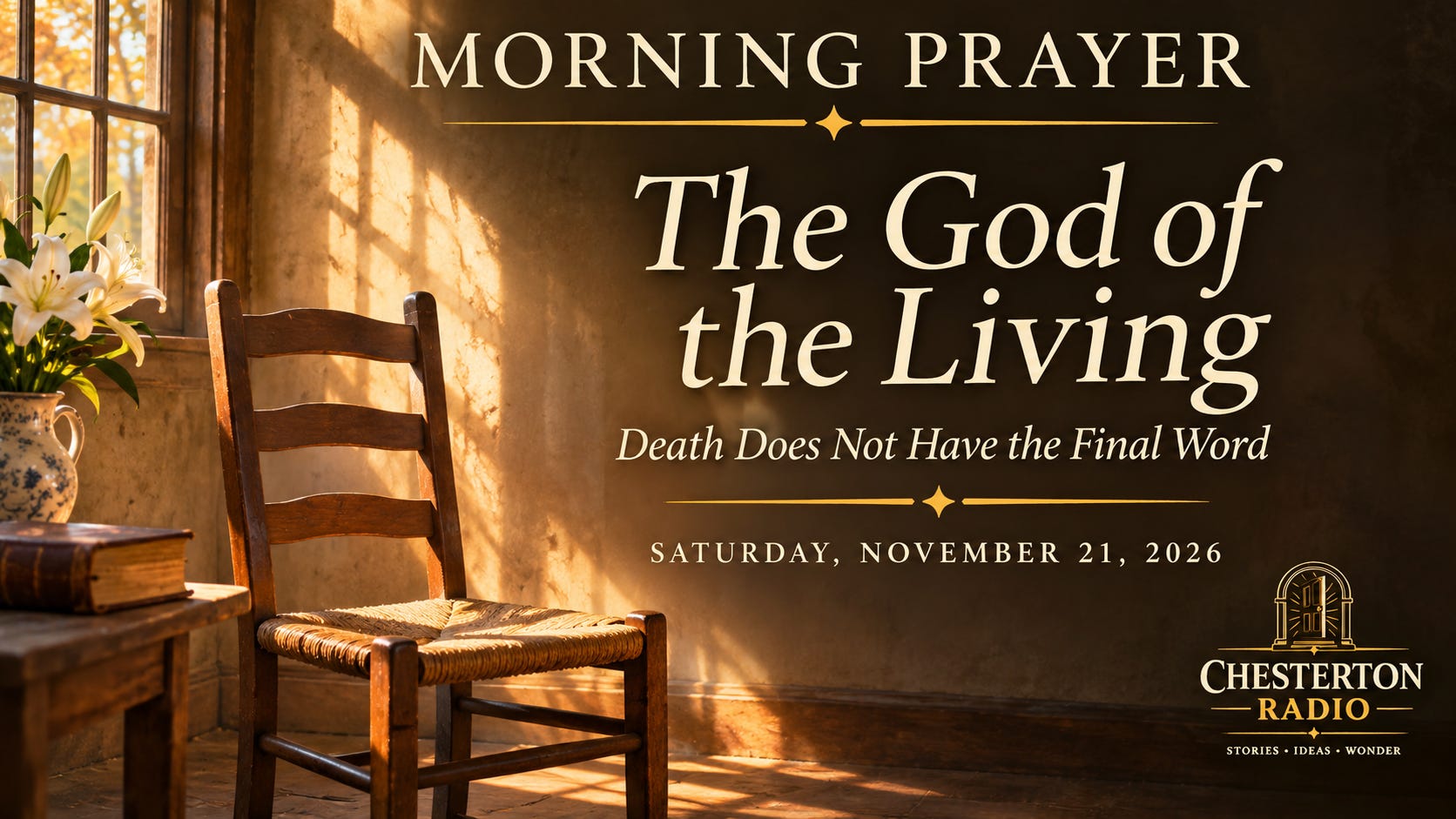
Morning Prayer: The God of the Living
The world sees an ending. Christ sees a life that death cannot hold.
CHESTERTON RADIO MORNING PRAYER
Saturday, November 21, 2026
Memorial of the Presentation of the Blessed Virgin Mary
Thirty-Third Week in Ordinary Time · Psalter Week I · Liturgical Year A, Weekday Cycle II
Opening
There is a peculiar tenderness about an empty chair.
We notice it especially as the year draws toward its close, when families begin thinking about Thanksgiving tables and the people who once occupied familiar places. A chair may remain in the same corner, a photograph may hang on the same wall, and yet a voice that once filled the room is no longer heard.
The world calls this absence. And it is a real absence. Christianity does not ask us to pretend otherwise.
Yet this morning Christ speaks words that change the meaning of every grave and every farewell: God is not the God of the dead, but of the living.
Today the Church also remembers the Presentation of the Blessed Virgin Mary, a celebration rooted in the ancient Christian tradition of Mary’s dedication to God. Her life would become an extraordinary witness to a promise greater than death itself.
As another morning begins, let us bring our memories, our hopes, and our unfinished lives before the God who makes all things new.
Opening Verse
Lord, open my lips.
And my mouth shall declare thy praise.
Invitatory
Antiphon: Come, let us adore Christ, the Son of Mary, the Lord of the living.
Psalm 94 (95) — A Call to Worship
Come let us praise the Lord with joy: let us joyfully sing to God our saviour.
Let us come before his presence with thanksgiving; and make a joyful noise to him with psalms.
For the Lord is a great God, and a great King above all gods.
For in his hand are all the ends of the earth: and the heights of the mountains are his.
For the sea is his, and he made it: and his hands formed the dry land.
Come let us adore and fall down: and weep before the Lord that made us.
For he is the Lord our God: and we are the people of his pasture and the sheep of his hand.
Today if you shall hear his voice, harden not your hearts:
As in the provocation, according to the day of temptation in the wilderness: where your fathers tempted me, they proved me, and saw my works.
Forty years long was I offended with that generation, and I said: These always err in heart.
And these men have not known my ways: so I swore in my wrath that they shall not enter into my rest.
Glory be to the Father, and to the Son, and to the Holy Ghost.
As it was in the beginning, is now, and ever shall be, world without end. Amen.
Antiphon: Come, let us adore Christ, the Son of Mary, the Lord of the living.
Psalmody
Psalm 118 (119):145–152 — Prayer Before the Dawn
Antiphon 1: Before the morning light, I call upon thee, O Lord; in thy word is my hope.
I cried with my whole heart, hear me, O Lord: I will seek thy justifications.
I cried unto thee, save me: that I may keep thy commandments.
I prevented the dawning of the day, and cried: because in thy words I very much hoped.
My eyes to thee have prevented the morning: that I might meditate on thy words.
Hear thou my voice, O Lord, according to thy mercy: and quicken me according to thy judgment.
They that persecute me have drawn nigh to iniquity; but they are gone far off from thy law.
Thou art near, O Lord: and all thy ways are truth.
I have known from the beginning concerning thy testimonies: that thou hast founded them for ever.
Glory be to the Father, and to the Son, and to the Holy Ghost.
As it was in the beginning, is now, and ever shall be, world without end. Amen.
Antiphon 1: Before the morning light, I call upon thee, O Lord; in thy word is my hope.
Canticle — Exodus 15:1–4a, 8–13, 17–18
The Song of Moses — Victory at the Red Sea
Antiphon 2: The Lord is my strength and my salvation; he leadeth his people into life.
Then Moses and the children of Israel sung this canticle to the Lord: and said: Let us sing to the Lord: for he is gloriously magnified, the horse and the rider he hath thrown into the sea.
The Lord is my strength and my praise, and he is become salvation to me: he is my God and I will glorify him: the God of my father, and I will exalt him.
The Lord is as a man of war, Almighty is his name.
4a. Pharao’s chariots and his army he hath cast into the sea.
And with the blast of thy anger the waters were gathered together: the flowing water stood, the depths were gathered together in the midst of the sea.
The enemy said: I will pursue and overtake, I will divide the spoils, my soul shall have its fill: I will draw my sword, my hand shall slay them.
Thy wind blew and the sea covered them: they sunk as lead in the mighty waters.
Who is like to thee, among the strong, O Lord? who is like to thee, glorious in holiness, terrible and praiseworthy, doing wonders?
Thou stretchedst forth thy hand, and the earth swallowed them.
In thy mercy thou hast been a leader to the people which thou hast redeemed: and in thy strength thou hast carried them to thy holy habitation.
Thou shalt bring them in, and plant them in the mountain of thy inheritance, in thy most firm habitation which thou hast made, O Lord; thy sanctuary, O Lord, which thy hands have established.
The Lord shall reign for ever and ever.
Glory be to the Father, and to the Son, and to the Holy Ghost.
As it was in the beginning, is now, and ever shall be, world without end. Amen.
Antiphon 2: The Lord is my strength and my salvation; he leadeth his people into life.
Psalm 116 (117) — All Nations Called to Praise
Antiphon 3: Praise the Lord, all ye nations; his mercy endureth for ever.
O praise the Lord, all ye nations: praise him, all ye people.
For his mercy is confirmed upon us: and the truth of the Lord remaineth forever.
Glory be to the Father, and to the Son, and to the Holy Ghost.
As it was in the beginning, is now, and ever shall be, world without end. Amen.
Antiphon 3: Praise the Lord, all ye nations; his mercy endureth for ever.
Short Reading
Isaiah 61:10
I will greatly rejoice in the Lord, and my soul shall be joyful in my God: for he hath clothed me with the garments of salvation: and with the robe of justice he hath covered me, as a bridegroom decked with a crown, and as a bride adorned with her jewels.
Short Responsory
V. The Lord hath clothed his people with salvation.
R. The Lord hath clothed his people with salvation.
V. His mercy endureth from generation to generation.
R. He hath clothed his people with salvation.
V. Glory be to the Father, and to the Son, and to the Holy Ghost.
R. The Lord hath clothed his people with salvation.
Gospel of the Day
Luke 20:27–40 — The Resurrection of the Dead
And there came to him some of the Sadducees, who deny that there is any resurrection: and they asked him,
Saying: Master, Moses wrote unto us: If any man’s brother die, having a wife, and he leave no children, that his brother should take her to wife and raise up seed unto his brother.
There were therefore seven brethren: and the first took a wife and died without children.
And the next took her to wife: and he also died childless.
And the third took her. And in like manner, all the seven: and they left no children and died.
Last of all the woman died also.
In the resurrection therefore, whose wife of them shall she be? For all the seven had her to wife.
And Jesus said to them: The children of this world marry and are given in marriage:
But they that shall be accounted worthy of that world and of the resurrection from the dead shall neither be married nor take wives.
Neither can they die any more for they are equal to the angels and are the children of God, being the children of the resurrection.
Now that the dead rise again, Moses also shewed at the bush, when he called the Lord: The God of Abraham and the God of Isaac and the God of Jacob.
For he is not the God of the dead, but of the living: for all live to him.
And some of the scribes answering, said to him: Master, thou hast said well.
And after that they durst not ask him any more questions.
Benedictus
The Canticle of Zachary — Luke 1:68–79
Antiphon: Blessed art thou, O Mary, who didst believe the word of the Lord; blessed is the life he hath promised to his faithful.
Blessed be the Lord God of Israel; because he hath visited and wrought the redemption of his people:
And hath raised up an horn of salvation to us, in the house of David his servant:
As he spoke by the mouth of his holy prophets, who are from the beginning:
Salvation from our enemies, and from the hand of all that hate us:
To perform mercy to our fathers, and to remember his holy testament,
The oath, which he swore to Abraham our father, that he would grant to us,
That being delivered from the hand of our enemies, we may serve him without fear,
In holiness and justice before him, all our days.
And thou, child, shalt be called the prophet of the Highest: for thou shalt go before the face of the Lord to prepare his ways:
To give knowledge of salvation to his people, unto the remission of their sins:
Through the bowels of the mercy of our God, in which the Orient from on high hath visited us:
To enlighten them that sit in darkness, and in the shadow of death: to direct our feet into the way of peace.
Glory be to the Father, and to the Son, and to the Holy Ghost.
As it was in the beginning, is now, and ever shall be, world without end. Amen.
Antiphon: Blessed art thou, O Mary, who didst believe the word of the Lord; blessed is the life he hath promised to his faithful.
Intercessions
Let us pray to Jesus Christ, the Son of Mary, who conquered death and called us to everlasting life.
Response: Lord Jesus, strengthen our hope in thee.
For the Holy Father, our bishops, priests, deacons, and all who serve the Church: that they may preach the resurrection with conviction and lead God’s people in holiness and hope, we pray.
Lord Jesus, strengthen our hope in thee.
For all who honor the Blessed Virgin Mary today: that her example of faith, obedience, and generous service may inspire us to welcome God’s will in every circumstance, we pray.
Lord Jesus, strengthen our hope in thee.
For the leaders of nations and communities: that they may protect human dignity, defend the vulnerable, and seek peace where violence and fear have taken root, we pray.
Lord Jesus, strengthen our hope in thee.
For those who grieve the death of a husband, wife, child, parent, sibling, or friend: that they may receive the consolation of the Holy Ghost and the assurance of Christ’s promise of eternal life, we pray.
Lord Jesus, strengthen our hope in thee.
For those who are seriously ill, those nearing death, and those who care for them: that they may experience tenderness, courage, and the peace of God’s presence, we pray.
Lord Jesus, strengthen our hope in thee.
For our work and daily responsibilities, for those seeking employment, and for families facing uncertainty: that we may act faithfully today without surrendering our hope for tomorrow, we pray.
Lord Jesus, strengthen our hope in thee.
For our families as Thanksgiving approaches: that gratitude may overcome resentment, forgiveness may heal old wounds, and love may reach even those who cannot gather around our tables, we pray.
Lord Jesus, strengthen our hope in thee.
For all the faithful departed, especially those whom we remember in this month of November: that the Lord may forgive their sins and welcome them into the light of his eternal presence, we pray.
Lord Jesus, strengthen our hope in thee.
For ourselves: that, following Mary’s example, we may surrender our fears and entrust our lives to the God whose promises cannot fail, we pray.
Lord Jesus, strengthen our hope in thee.
Our Father
Our Father, who art in heaven, hallowed be thy name.
Thy kingdom come.
Thy will be done on earth as it is in heaven.
Give us this day our daily bread.
And forgive us our trespasses, as we forgive those who trespass against us.
And lead us not into temptation, but deliver us from evil.
Amen.
Concluding Prayer
Almighty and eternal God, whose mercy hath opened the gates of everlasting life, we thank thee for the faithful witness of the Blessed Virgin Mary.
Grant us a portion of her trust, her courage, and her willingness to serve thee without reservation.
Strengthen our faith in the resurrection of the dead. Comfort those who mourn, sustain those who suffer, and teach us to live each day in the light of eternity.
May we follow thy Son through the uncertainties of this world until we rejoice with Mary and all thy saints in the kingdom that shall have no end.
Through the same Jesus Christ, thy Son, our Lord, who liveth and reigneth with thee in the unity of the Holy Ghost, God, world without end.
Amen.
Blessing
May the Lord bless us, protect us from all evil, and bring us to everlasting life.
Amen.
The Paradox of the Day
Death is the one certainty the world cannot escape—and the one certainty Christ refuses to let have the final word.
Chesterton for the Morning
G. K. Chesterton wrote:
“Christianity has died many times and risen again; for it had a God who knew the way out of the grave.”
— The Everlasting Man (1925), Part II, Chapter VI, “The Five Deaths of the Faith.”
A Chestertonian Meditation
The God of the Living
There are very few things in life more stubborn than an old family photograph.
It may have faded. Its corners may be bent, its surface scratched, and the people in it dressed in clothes that would now attract unwanted attention at almost any respectable gathering. The car parked behind them may have been crushed for scrap forty years ago. The house may have been demolished. The photographer may be long forgotten.
Yet there they stand.
A father in his shirtsleeves. A mother squinting into the sunshine. Children who believed the summer afternoon would last forever.
The photograph is a most peculiar object. It preserves a moment but cannot prolong it. It allows us to see a face but not hear the voice. It can tell us what someone looked like but nothing of what became of their soul.
And when the person has died, the photograph seems to ask an enormous question.
Where are they now?
It is not merely a question about memory. It is a question about reality.
The Sadducees who approached Christ in today’s Gospel thought they had discovered an excellent way to make belief in the resurrection appear ridiculous.
They produced a complicated hypothetical family history involving seven brothers, one woman, and a remarkable succession of deaths. It was the sort of argument that probably seemed particularly clever when discussed among educated men with sufficient leisure to enjoy it.
Their question was simple enough: if all seven brothers had been married to the same woman, whose wife would she be in the resurrection?
They assumed that eternal life, if it existed, would have to operate under exactly the same arrangements as earthly life.
And having constructed a situation in which those arrangements became absurd, they believed they had disposed of the resurrection itself.
This is a familiar human achievement.
We first construct a very small picture of the universe. Then we congratulate ourselves when God cannot fit inside it.
Christ refuses to accept their premise.
The life of the resurrection is not merely an extension of our present arrangements. It is a transformed existence, no longer subject to death. Earthly marriage, with its particular vocation and circumstances, does not continue in precisely the same form.
Yet love is not thereby declared meaningless.
Rather, everything truly good is brought toward its fulfillment in God.
Then Jesus makes an even more astonishing argument.
He reminds his questioners that God identified himself to Moses as the God of Abraham, Isaac, and Jacob.
Not merely the God who once knew these men.
Not the God who keeps their names in a celestial filing cabinet.
The God of Abraham, Isaac, and Jacob.
God is not the God of the dead, but of the living.
This is a claim more radical than it may initially appear.
The Sadducees thought death was the end of the argument. Christ insists that death does not exhaust the relationship between God and the person he has called.
The Creator does not misplace his creatures.
Nor does divine love become powerless because a human heartbeat has stopped.
Chesterton understood that Christianity had made a particularly outrageous claim about the universe: that death, which appears to govern everything, has itself encountered a greater authority.
In The Everlasting Man, he observed that Christianity had repeatedly appeared to perish throughout history, only to rise again. His explanation was characteristically startling. The faith had a God who knew the way out of the grave.
Chesterton was speaking about the surprising revivals of Christian civilization. But his observation rests upon something far more important than the survival of an institution.
It rests upon the Resurrection of Jesus Christ.
Christianity does not teach merely that hope is pleasant, that memory is comforting, or that human beings continue to influence the world after death.
These things may all have their place. A good parent’s influence can endure through generations. A kind act may set in motion consequences that no one can calculate.
But such continuities are not the resurrection.
The Christian claim is much larger.
Christ truly rose from the dead. And because he lives, death is not the final destiny of those who belong to him.
We profess the resurrection of the body and life everlasting. We await not a vague survival of memories, but the fulfillment of God’s saving purpose for the whole human person.
That is a formidable promise.
It is also a promise that changes the meaning of ordinary life.
Consider the humble work of preparing a home.
A person sweeps the floor, washes the dishes, repairs a broken hinge, or sets another place at the table. These actions are rarely spectacular. No brass band assembles when someone finally cleans out a kitchen cupboard.
Yet these simple activities express a remarkable belief: that life is worth preparing for.
We arrange a room because someone will live in it.
We prepare a meal because someone will come.
We mend a chair because someone will sit down.
We make room for the future.
The Presentation of the Blessed Virgin Mary offers a fitting image of this preparation.
The celebration recalls an ancient Christian tradition, not an event narrated in the canonical Gospels, according to which Mary was dedicated to God in the Temple while still a child.
Whatever questions historians may raise about the details of that tradition, the Church’s spiritual emphasis is clear.
Mary’s entire life was directed toward God.
Long before Bethlehem, before the shepherds and the Magi, before the wedding at Cana and the sorrow of Calvary, there was a hidden life of trust and preparation.
The extraordinary entered the world through the ordinary.
A young woman welcomed the word of God.
A child was born.
A family made a home.
And the history of the universe changed.
Mary’s greatness does not consist in her having escaped the ordinary responsibilities of human life. It consists in her having received God’s extraordinary calling through a life of faithfulness.
The same woman who consented to the Annunciation would one day stand beneath the Cross.
She knew the depth of human sorrow.
She did not possess an exemption from suffering because she belonged to God.
But she belonged to the God who would conquer death.
This matters because Christian hope is often misunderstood as an instruction to stop grieving.
Someone suffers a terrible loss, and well-meaning people become anxious to improve the atmosphere. They offer cheerful observations, reassuring formulas, and sometimes the unfortunate suggestion that a sufficiently strong faith ought to produce immediate happiness.
But Christ himself wept at the tomb of Lazarus.
Grief is not a failure of belief.
Love makes absence painful.
A husband can believe firmly in the resurrection and still miss his wife’s voice at breakfast. A mother can trust in God’s mercy and still reach instinctively for the child she has lost.
Christian hope does not abolish these sorrows with a convenient explanation.
It places them before a God who has entered human suffering and overcome death.
And it gives us reason to continue loving.
That is perhaps the most practical consequence of today’s Gospel.
If human beings are destined for eternity, then our encounters with them matter more, not less.
The person who irritates us in the grocery store is not merely an inconvenience standing between us and the checkout counter.
The elderly neighbor is not simply a reminder of decline.
The child asking another question at the end of a tiring day is not merely another interruption.
Each is a person made for communion with God.
Every life carries an eternal significance that our hurried judgments are ill-equipped to measure.
This does not make every ordinary inconvenience sacred or every difficult person easy to love. It does mean that patience, mercy, and faithfulness possess a significance out of all proportion to their outward appearance.
We are not simply passing time until death brings everything to an end.
We are learning how to love in a world created for eternal life.
On this Saturday morning, perhaps the most useful thing we can do is reconsider something we have been treating as finished.
A relationship that needs forgiveness.
A neglected duty that can still be performed.
A prayer we have abandoned because its answer seems delayed.
A disappointment that has convinced us nothing good can follow.
Not every earthly loss can be reversed. Some doors remain closed in this life. Some wounds leave permanent marks. Faith does not require us to invent happy endings where there are none.
But it forbids us to mistake our limited view for the whole of God’s providence.
We do not know everything that may yet be redeemed.
We do not see all that God is doing.
And we have not reached the final chapter.
The photograph on the mantelpiece remains silent.
The empty chair is still empty.
The November morning may be cold, and the world may appear no different from yesterday.
Yet the Christian rises to pray because the universe is not ultimately governed by the grave.
It is governed by the living God.
And perhaps, as the first light reaches the window, we may begin to understand why the Church has always regarded morning prayer as such a profoundly hopeful act.
We awaken because another day has been given to us.
We pray because the One who gives it is listening.
And we hope because, beyond the last evening of our earthly lives, there is a dawn that death cannot darken.
Closing
Lord Jesus Christ, thou art the resurrection and the life. Give us the faith of Mary, the courage to face our sorrows, and the hope to trust thy promises.
May we cherish the people thou hast placed in our lives, remember the faithful departed with love, and serve thee faithfully until the day when all things are made new.
Our Lady, Mother of Hope, pray for us.
Chesterton Radio